Lesson Plans
The Long Valley
40
60
90
Day 1-The Long Valley, The Red Pony, "The Gift"
Outcomes for Today
Prepare
Background
Gather background knowledge about a place, time, event, person, or thing.
Who is John Steinbeck?
John Steinbeck (1901-1968) was a Nobel Prize winning author who was probably California’s most famous author. Many of his stories, including all of those in The Long Valley, are centered on life in the Salinas/Monterey area of California, where Steinbeck was born and raised. Steinbeck wrote about the lives of Californians from all walks of life. He is perhaps most famous for his novel, The Grapes of Wrath, which follows a poor migrant family during the Great Depression. Students may also be familiar with The Pearl and Of Mice and Men, two of Steinbeck’s other works that are read as part of the CBL program.
Word Wall
Here are five vocabulary words to teach and add to the Word Wall.
Introduce 5 important, useful words from today’s reading.
|
contemplative (145) |
stern (146) |
disciplinarian (146) |
jovial (146) |
crossroads (148) |
Read
Review
Review the timeline from the beginning every day.
Read
Read the selection, usually in a Shared Reading Read React Predict Cycle of 2-3 pages.
Read p. 145-155 The Red Pony “The Gift”
|
Setting |
Characters |
Pages |
|
The Tiflin Ranch Bunkhouse |
Billy Buck |
145 |
|
The Tiflin farmhouse |
Mrs. Tiflin, Billy |
145 |
|
Tiflin Kitchen |
Mrs. Tiflin, Jody |
145-6 |
|
Tiflin dining room |
Mrs. Tiflin, Mr. Tiflin, Jody, Billy |
146-7 |
|
The ridge behind the farmhouse |
Jody, Doubletree Mutt, Smasher |
147-148 |
|
The Tiflin house |
Mrs. Tiflin, Jody |
|
|
On the way to and from school |
Jody |
148-149 |
|
The Tiflin kitchen |
Jody, Mrs. Tiflin |
149 |
|
The barn and farm |
Jody |
149 |
|
The farm |
Jody, Billy, Mr. Tiflin, Mrs. Ruth Tiflin |
149-150 |
|
The next morning, the dining room |
Jody, Mrs. Tiflin, Billy, Mr. Carl Tiflin |
150-151 |
|
The barn, after breakfast |
Mr. Tiflin, Billy, Jody, the red pony |
151-153 |
|
The barn, after school |
Jody, boys from school, the red pony |
153-154 |
|
Jody, the red pony |
154 |
|
|
Jody, the red pony, Mrs. Tiflin |
154-155 |
Respond
Timeline
Agree on the facts in today’s reading, and list the 3-5 most important on the Timeline.
Discuss the reading and add 3-5 events to the timeline.
- Discuss the story to fix the facts: who, what, when, where, and why.
- Decide on the 3-5 most important events and add these to the timeline.
Students might mention:
- The Setting: A ranch near Salinas, sometime in the early 20th Century.
- A 10-year-old boy, Jody Tiflin, lives with his parents and a ranch hand named Billy Buck.
- Billy and Jody’s father go to Salinas to sell some old cows to the Butcher.
- Jody wanders the farm with his dogs before he goes to school.
- Jody gets home from school at four and does his chores.
- Jody has a rifle, but he will not have ammunition for it until he is twelve.
- Whenever Jody’s father gives him a gift, he has some kind of discipline to go with it.
- Jody’s father tells him he’ll need him in the morning, and Jody knows there’s something to be excited about.
- In the morning, Jody’s father takes him to the barn and gives him a red pony colt and a leather saddle.
- In order to keep the pony, Jody has to take care of him and do his chores.
- Jody names the pony Gabilan.
- Jody brings his friends home to see the pony; they are all jealous.
- Jody forgets to do his chores, but when his mother goes to scold him, she is proud of how he is taking care of the pony.
Map
Add to ongoing class activities like a KWL chart or map: where did the characters go?
Map
Begin a class map of the settings of The Long Valley.
- Today, locate Salinas and the Gabilan Mountains.
Explore
Activity
Explore the reading more deeply with a visual or oral language activity.
2g6 Beginning-Middle-End Chart
Start a Beginning-Middle-End chart on “The Gift.” Have students fill in what happens at the beginning of The Red Pony.
2g6 Beginning-Middle-End Chart

Discussion
Ask discussion questions of all 9 types.
Key Questions
- Why does Steinbeck spend so much time describing the place where this story happens with sensory details?
- What are some of the sensory details Steinbeck uses?
- Do you know any ten-year-olds who are capable of caring for a horse?
- What kind of man is Jody’s father?
- Who is Jody’s true father-figure?
- Why is Jody’s mother proud of him?
- How do you think the setting of The Red Pony might mirror some of the author’s own childhood?
- What three adjectives would you use to describe Jody?
Analyze
Analyze the key paragraph.
Key Paragraph, p. 148
“…Behind him, in the tall sagebrush, the birds were scampering on the ground, making a great noise among the dry leaves; the squirrels piped shrilly on the side-hills. Jody looked along at the farm buildings. He felt an uncertainty in the air, a feeling of change and of loss and of the gain of new and unfamiliar things. Over the hillside two big black buzzards sailed low to the ground and their shadows slipped smoothly and quickly ahead of them. Some animal had died in the vicinity. Jody knew it. It might be a cow or it might be the remains of a rabbit. The buzzards overlooked nothing. Jody hated them as all decent things hate them, but they could not be hurt because they made away with carrion” (p. 148).
Extend
Write
Have each student write a short product based on today’s prompt to connect to the unit theme.
Steinbeck uses plants and animals to provide sensory details that show how alive the land is. He writes continually about this area of California that he was so attached to.
Think about a place that is important to you, or just a place you really, really like. Close your eyes and imagine how it feels, looks, smells, tastes, and sounds. Write a paragraph describing your place in vivid detail. Try to make sure you have all the parts of a good paragraph, and use as many good location words as you can.
Close
Close by extending today’s lesson to life and the world.
Community Connection
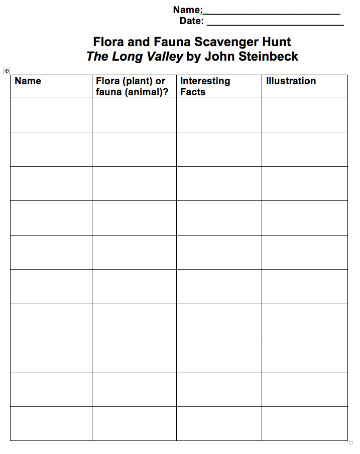
The common thread of nature links all of the stories in Steinbeck’s The Long Valley. As you read the novel, have students list all of the animals and plants mentioned in the novel. As the novel progresses, they can research interesting facts about these animals and plants, and create an illustrated dictionary of California flora and fauna. A sample worksheet is included at the end of the Day 1 lesson to help guide the process.
Day 2- The Long Valley, The Red Pony, "The Gift"
Outcomes for Today
Prepare
Background
Gather background knowledge about a place, time, event, person, or thing.
What are the Gabilan Mountains?
Jody gives his red pony the name “Gabilan” after the mountain range that borders his family’s home. The Gabilan Mountain Range is located in San Benito and Monterey Counties, running northeast/southeast along California’s Central Coast. The mountains have alternately been referred to as “Gabilan” and “Gavilan.” Gavilan is Spanish for hawk, which is the likely origin of the name. In 1845, in an event known as the Gavilan Peak Incident, a conflict erupted between American Captain Fremont and Mexican General Castro over the Americans’ right to be in Mexican California. Fremont initially retreated toward Oregon, but, of course, Fremont soon returned and California became a US State in 1850. Today, Gavilan Peak is known as Fremont Peak in his honor.
Word Wall
Here are five vocabulary words to teach and add to the Word Wall.
|
inflection (157) |
lax (157) |
coaxed (157) |
cinch (158) |
bridle (159) |
Read
Review
Review the timeline from the beginning every day.
Read
Read the selection, usually in a Shared Reading Read React Predict Cycle of 2-3 pages.
Read p. 155-164 The Red Pony “The Gift”
|
Setting |
Characters |
Pages |
|
Mornings in the barn |
Jody, Gabilan |
155-156 |
|
Jody, Gabilan, Billy |
156 |
|
|
The corral |
Jody, Gabilan |
156-157 |
|
Early fall, training the pony |
Jody, Gabilan, Billy |
157-158 |
|
The farmhouse |
Jody Gabilan, Billy, Mr. Tiflin |
158 |
|
The farm |
Jody, Gabilan, Billy |
158-159 |
|
The farm, three weeks before Thanksgiving |
Jody, Gabilan, Carl Tiflin |
159-160 |
|
A cool morning, just before Thanksgiving |
Jody, Gabilan, Billy |
161-162 |
|
School |
Jody |
162 |
|
The corral after school, in the rain |
Jody, Gabilan |
162-163 |
|
Later that night at dinner |
Jody, Billy, Carl Tiflin, Mrs. Tiflin |
163 |
|
The Barn |
Jody, Billy, Gabilan |
163-164 |
Respond
Timeline
Agree on the facts in today’s reading and list the 3-5 most important on the timeline.
Students might mention:
- Every day, Jody is out of bed before dawn to take care of his pony.
- Billy, who has an impressive history as a horseman, helps Jody learn about horses.
- Gabilan is a spirited, strong horse, and Jody gets to know him better every day.
- In the fall, Billy and Jody start to train the horse to walk on a lead and halter.
- Mr. Tiflin gives Jody permission to get the horse used to the saddle, and says that Jody may ride the pony at Thanksgiving.
- Jody is nervous about riding the pony for the first time.
- One rainy day, the pony is left outside while Jody is at school.
- Jody works to dry the pony, but Billy thinks Gabilan is still looking a little too quiet, and might be sick.
Map
Add to ongoing class activities like a KWL chart or map: where did the characters go?
KWL
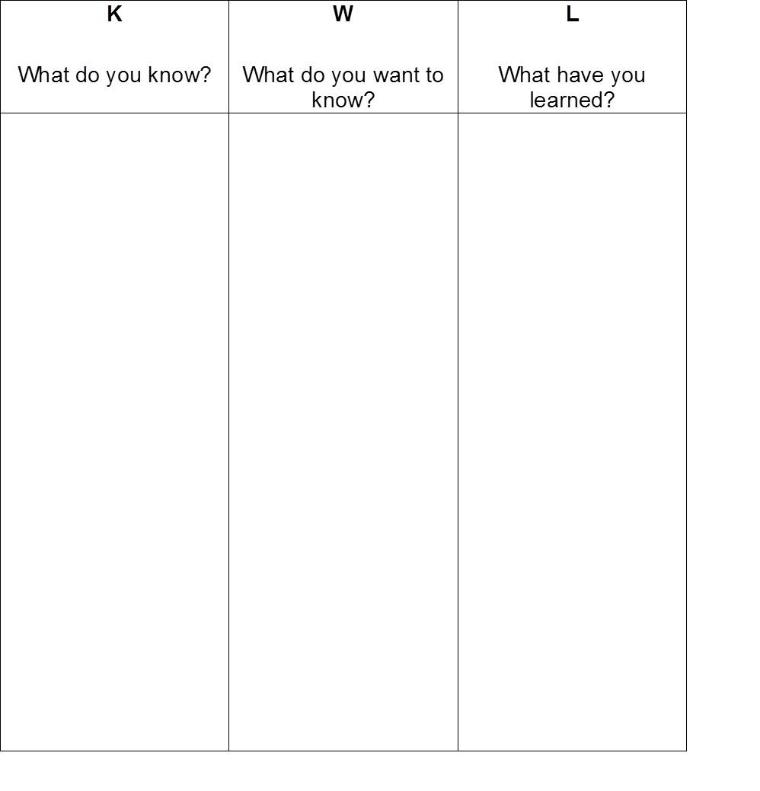
What do students already know about the Salinas/Monterey area? Begin to fill the “Know” section of a KWL Chart about Salinas and Monterey.
KWL Chart
Explore
Activity
Explore the reading more deeply with a visual or oral language activity.
2g6 Beginning Middle End Chart
Continue the Beginning Middle End chart on “The Gift.” Have students fill in what is happening in the middle of The Red Pony.
2g6 Beginning-Middle-End Chart
Story Sketch
Steinbeck uses incredibly rich imagery and description in his writing. He uses words to paint a picture for the reader. Today, use Steinbeck’s written description to create a sketch of a particular event, setting, or character from today’s reading.
- Choose a sentence or passage that you find especially descriptive.
- Write that sentence or passage across the bottom of the paper.
- Use the rest of the paper to create a picture that matches and enhances the words.
- Be sure to utilize the colors that Steinbeck describes.
Discussion
Ask discussion questions of all 9 types (see Day 1).
Key Questions
- What is Jody learning from the experience of raising his horse?
- Why was Jody afraid for the time when he would be able to ride his pony?
- How has Billy Buck earned his infallibility in Jody’s eyes?
- How does Steinbeck foreshadow what will happen next in the story?
- What do Jody’s daydreams about Gabilan being injured mean?
- Why are boys so afraid to disappoint their male role models?
- What is your favorite example of descriptive imagery from today’s reading?
- What does the name “Gabilan” tell the readers about the pony’s qualities?
- Would you want to be Carl Tiflin’s son? Why or why not?
Analyze
Analyze the key paragraph.
Key Paragraph, p. 159
“And Jody trembled when he thought of the time when he would first sit in the saddle. The pony would probably throw him off. There was no disgrace in that. The disgrace would come if he did not get right up and mount again. Sometimes he dreamed that he lay in the dirt and cried and couldn’t make himself mount again. The shame of the dream lasted until the middle of the day” (p. 159).
Extend
Write
Have each student write a short product based on today’s prompt to connect to the unit theme.
Jody is afraid to ride his pony, because he isn’t sure how he will react to adversity. He really wants to ride, but doesn’t want to embarrass himself. Write a paragraph about a time when, like Jody, you were afraid to do something you were looking forward to because of what might happen. How did you feel about the situation? Be sure to use a very clear topic sentence.
Close
Close by extending today’s lesson to life and the world.
Community Connection
The common thread of nature links all of the stories in Steinbeck’s The Long Valley. As you read the novel, have students list all of the animals and plants mentioned in the novel. As the novel progresses, they can research interesting facts about these animals and plants, and create an illustrated dictionary of California flora and fauna.
Day 3- The Long Valley, The Red Pony, "The Gift"
Outcomes for Today
Prepare
Background
Gather background knowledge about a place, time, event, person, or thing.
What is strangles?
Jody’s pony, Gabilan, has strangles. Strangles is the name of a contagious bacterial infection that attacks horses’ lymph nodes and upper respiratory tract. During modern times, it is not usually fatal, and can be treated with antibiotics. However, it was a common cause of death for young horses in Steinbeck’s time.
Word Wall
Here are five vocabulary words to teach and add to the Word Wall.
|
precedes (164) |
constricted (165) |
listlessly (165) |
whetted (168) |
incensed (169) |
Read
Review
Review the timeline from the beginning every day.
Read
Read the selection, usually in a Shared Reading Read React Predict Cycle of 2-3 pages.
Read p. 164-174, The Red Pony, “The Gift”
|
Setting |
Characters |
Pages |
|
The Tiflin House |
Jody, Mrs. Tiflin |
164 |
|
The barn |
Jody, Gabilan, Billy Buck |
164-165 |
|
The Tiflin House |
Jody, Mrs. Tiflin |
165 |
|
School |
Jody |
165 |
|
The barn |
Jody, Gabilan, Billy |
165-167 |
|
The Tiflin House |
Jody, Carl Tiflin |
167 |
|
The Barn |
Jody, Gabilan, Billy |
167-168 |
|
The Tiflin House |
Jody, Mrs. Tiflin, Billy |
168 |
|
The barn |
Jody, Gabilan, Billy |
168-169 |
|
Jody, Gabilan, Doubletree Mutt |
169 |
|
|
Jody, Gabilan |
168 |
|
|
Outside the barn, at night |
Jody, Gabilan |
168 |
|
The barn |
Jody, Gabilan, Billy |
168-171 |
|
The Tiflin house |
Jody, Mrs. Tiflin |
171 |
|
The barn |
Jody, Billy, Carl Tiflin, Gabilan |
171 |
|
Jody, Billy, Gabilan |
171 |
|
|
Outside on the farm |
Jody, Doubletree Mutt |
171-172 |
|
The barn |
Jody, Billy, Gabilan |
172-173 |
|
Outside on the ridge |
Jody, Gabilan, buzzards |
173-174 |
|
Jody, Gabilan, buzzards, Carl Tiflin, Billy Buck |
174 |
Respond
Timeline
Agree on the facts in today’s reading and list the 3-5 most important on the timeline.
Students might mention:
- The next morning, Jody wakes up and is worried about his pony.
- Jody runs to the barn, and finds that Gabilan is sick.
- Billy tells Jody not to worry, and that he should go to school.
- When Jody gets home, Gabilan is even sicker, and has a large lump under his jaw.
- Billy doesn’t want to tell Jody, but finally answers that Gabilan has strangles.
- Jody and Billy treat Gabilan with hot steam to open up his closed nasal passages.
- Jody forgets to do his chores, but isn’t scolded.
- Jody’s father tries to tell stories that night to cheer Jody up, but it doesn’t work.
- Carl Tiflin’s feelings are hurt by Jody’s preoccupation with his pony.
- The next day, Gabilan is much worse.
- They drain the pus out of Gabilan’s lump, but it doesn’t seem to make him better.
- Jody falls asleep in the barn.
- In the middle of the night, Gabilan walks out of the barn, but Jody catches him and moves him back in.
- The next morning, Billy makes an incision in Gabilan’s throat to help him breathe better.
- Carl Tiflin tries to get Jody to leave the barn, but he refuses.
- At the end of the day, Jody realizes that Gabilan is going to die.
- The next morning, Jody finds that the pony has left the barn.
- When Jody finds Gabilan, the pony is dead and is already being eaten by buzzards.
- Jody catches one of the buzzards and violently beats it to death.
- Billy pulls him off the buzzard, and Carl questions Jody as to why he beat the buzzard, which didn’t kill Gabilan.
- Billy defends Jody to Carl Tiflin.
Map
Add to ongoing class activities like a KWL chart or map: where did the characters go?
KWL
What do students already know about the Salinas/Monterey area? Continue to fill the “Know” section of a KWL Chart about Salinas and Monterey. What do students know about a ranch in California at this time, based on “The Gift?”
Explore
Activity
Explore the reading more deeply with a visual or oral language activity.
Open Mind Portrait
Twice in today’s reading, we see Jody’s dad get his feelings hurt. Draw an open mind portrait for Jody’s dad that shows what he is thinking and feeling at one of these times.
2g6 Beginning Middle End Chart
Complete the Beginning Middle End chart on “The Gift.” Have students fill in what is happening in the middle of The Red Pony.
Discussion
Ask discussion questions of all 9 types (see Day 1).
Key Questions
- What are the steps in Gabilan’s treatment?
- Does Jody believe Billy Buck’s assertion that Gabilan is going to get better?
- What does Jody learn about life from this experience with his pony?
- When do most children first experience death?
- If you were Jody’s father, how would you have handled the situation?
- What are some other famous novels or movies where a beloved animal dies?
- How does Steinbeck use the setting to increase the drama of the story?
- What do you think will happen next in Jody’s saga?
Analyze
Analyze the key paragraph.
Key Passage, p. 174
“Carl Tiflin wiped the blood from the boy’s face with a red bandana. Jody was limp and quiet now. His father moved the buzzard with his toe. ‘Jody,’ he explained, ‘the buzzard didn’t kill the pony. Don’t you know that?’
‘I know it,’ Jody said wearily.
It was Billy Buck who was angry. He had lifted Jody in his arms, and had turned to carry him home. But he turned back to Carl Tiflin. ‘’Course he knows it,’ Billy said furiously, ‘Jesus Christ man, can’t you see how he’d feel about it?’” (p. 174).
Extend
Write
Have each student write a short product based on today’s prompt to connect to the unit theme.
Jody knows that the buzzard didn’t kill his pony, but his anger leads to violence against the innocent bird. Think about a time when you were very, very angry. Write a paragraph that describes when and why you were angry, and how you reacted. Make sure you have a strong topic sentence. Arrange the sentences in chronological order.
Close
Close by extending today’s lesson to life and the world.
Community Connection
The common thread of nature links all of the stories in Steinbeck’s The Long Valley. As you read the novel, have students list all of the animals and plants mentioned in the novel. As the novel progresses, they can research interesting facts about these animals and plants, and create an illustrated dictionary of California flora and fauna.
Day 4- The Long Valley, The Red Pony, "The Great Mountains"
Outcomes for Today
Prepare
Background
Gather background knowledge about a place, time, event, person, or thing.
Why does Steinbeck name the old man Gitano?
In Spanish, gitano means gypsy. That, combined with his unexpected appearance on the ranch, implies that the man has lived his life as a wanderer without roots or a permanent home. The only place Gitano has ever called home is the ranch where he was born many years before.
Word Wall
Here are five vocabulary words to teach and add to the Word Wall.
|
strenuously (175) |
ferocious (177) |
gnarled (179) |
paisano (179) |
parallel (183) |
Read
Review
Review the timeline from the beginning every day.
Read
Read the selection, usually in a Shared Reading Read React Predict Cycle of 2-3 pages.
Read p. 174-189, The Red Pony, “The Great Mountains”
|
Setting |
Characters |
Pages |
|
The farmhouse yard |
Jody, Carl Tiflin, Mrs. Tiflin, Billy Buck, Gitano |
174-181 |
|
Gitano’s room |
Jody, Gitano |
181-183 |
|
The barn |
Jody, Gitano, Carl Tiflin, Billy Buck, Easter |
183-189 |
Respond
Timeline
Agree on the facts in today’s reading and list the 3-5 most important on the timeline.
Students might mention:
- On a summer afternoon, Jody has nothing to do.
- He intentionally sets a rattrap where his dog will get his nose snapped.
- Then, Jody kills a little bird with a sling and mutilates its body.
- He wonders what is in the western mountains, but his father and Billy Buck say there is nothing but mountains all the way to the ocean.
- An old man walks up and tells Jody “I am Gitano, and I have come back.”
- Gitano wants to stay on the ranch because he is old and has nowhere to go.
- Carl Tiflin tells Gitano he can’t afford to support another person, but he can stay the night.
- Jody introduces Gitano to old Easter, a thirty-year-old horse who was Carl Tiflin’s first horse.
- That night, Gitano shows Jody an old saber that belonged to his father.
- The next morning, both Gitano and Easter are gone.
- Later, a neighbor rides over and tells Carl that he saw an old man riding Easter away toward the mountains.
- Carl decides not to go after Gitano, because he’s saved him the trouble of burying Easter when he dies.
- Jody is sad and lonely when he looks at the mountains.
Map
Add to ongoing class activities like a KWL chart or map: where did the characters go?
Map
Add to your class map of the settings of The Long Valley.
- Label the Great Mountains on your map. They aren’t formally named, so figure out where they would be in relation to the Salinas Valley from Steinbeck’s description.
KWL Chart
Add to your class KWL chart about Steinbeck’s California. What cultural differences are there within the population at this time? How do people treat the old? Who cared for old people in Monterey County?
Explore
Activity
Explore the reading more deeply with a visual or oral language activity.
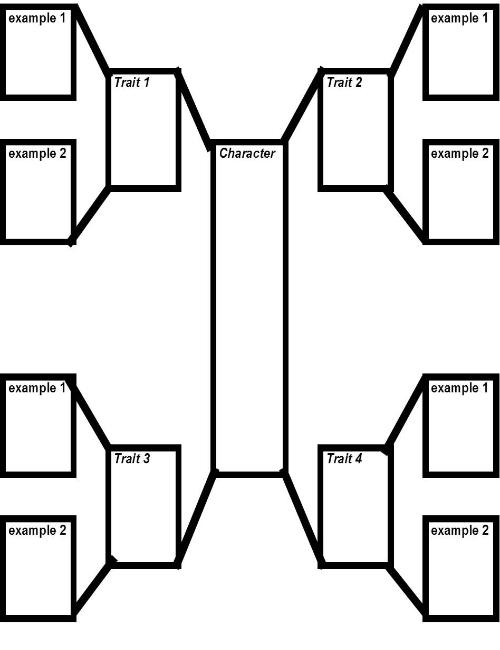
4g6 Character Profile Chart
Complete a Character Profile Chart for Carl Tiflin. Try to think of at least two positive character traits, and two negative character traits to include in your analysis. What kind of person is Carl Tiflin?
4g6 Character Profile Chart
Discussion
Ask discussion questions of all 9 types (see Day 1).
Key Questions
- How does Steinbeck use the character of Carl Tiflin to point out important themes in the story?
- How are Gitano and old Easter similar?
- This is the second time Jody has killed a bird to appease his anger; how does this time contrast with the time he killed the vulture?
- What has Cody learned about life from his interaction with Gitano?
- How do Steinbeck’s characters treat the old? Is this different from how the old are treated in your culture?
- In the last paragraph “The Great Mountains,” on page 189, what emotion is Steinbeck trying to convey to the reader?
- What do you think is going to happen next in The Red Pony?
Analyze
Analyze the key paragraph.
Key Paragraph, p. 175-6
“The bird looked much smaller dead than it had alive. Jody felt a little mean pain in his stomach, so he took out his pocket-knife and cut off the bird’s head. Then he disemboweled it, and took off its wings; and finally he threw all the pieces onto the brush. He didn’t care about the bird, or its life, but he knew what older people would say if they had seen him kill it; he was ashamed because of their potential opinion. He decided to forget the whole thing as quickly as he could, and never to mention it” (p. 175-176).
Extend
Write
Have each student write a short product based on today’s prompt to connect to the unit theme.
Jody kills twice—once in anger, once in boredom. Although the act was the same, the two events were very different.
Think of something that you did or that happened to you twice, for example, getting a bad grade on a report card, breaking up with a boy/girl friend, or getting angry with someone in your family.
Write a paragraph comparing and contrasting two events in your life that were similar. Use a topic sentence, organized body sentences, and a good closing sentence.
Close
Close by extending today’s lesson to life and the world.
Community Connection
The common thread of nature links all of the stories in Steinbeck’s The Long Valley. As you read the novel, have students list all of the animals and plants mentioned in the novel. As the novel progresses, they can research interesting facts about these animals and plants, and create an illustrated dictionary of California flora and fauna.
Day 5-The Long Valley, The Red Pony, "The Promise"
Outcomes for Today
Prepare
Background
Gather background knowledge about a place, time, event, person, or thing.
What’s the difference between a gelding and a stallion?
A stallion is an adult male horse. A gelding is a male horse that has been castrated (had its testicles removed,) usually when it is about one year old. Horses are gelded to prevent them from breeding, to improve their temperament, and make it easier to work with them. In the story, Billy tells Jody that if his horse is born a stallion, he will have to be gelded.
Word Wall
Here are five vocabulary words to teach and add to the Word Wall.
|
languorous (190) |
conscientiously (192) |
nonchalance (192) |
fatuous (196) |
infallible (199) |
Read
Review
Review the timeline from the beginning every day.
Read
Read the selection, usually in a Shared Reading Read React Predict Cycle of 2-3 pages.
Read p. 189-199, The Red Pony, “The Promise”
|
Setting |
Characters |
Pages |
|
Walking home from school |
Jody |
189-191 |
|
The farmhouse kitchen |
Jody, Mrs. Tiflin |
191 |
|
The Barn |
Jody, Carl Tiflin, Billy Buck, Nellie |
192-193 |
|
The Tiflin ranch |
Jody, Billy Buck |
193-194 |
|
Jody, Carl Tiflin, Jody, Nellie |
194 |
|
|
On the way to the ridge ranch |
Jody, Nellie |
194-195 |
|
The ridge ranch |
Jody, Nellie, Jess Taylor, Sundog |
195-196 |
|
The Tiflin ranch |
Jody, Nellie, Carl |
196 |
|
Jody, Nellie, Billy Buck |
196-199 |
Respond
Timeline
Agree on the facts in today’s reading and list the 3-5 most important on the timeline.
Students might mention:
- In the spring, Jody comes home from school one day with a lunch pail full of toads, lizards, snakes, grasshoppers, and newts.
- When Jody gets home, his mother tells him that his father wants to see him in the barn.
- Carl asks Jody if he’s willing to work hard to get another horse.
- Carl will put up the money to get a mare pregnant if Jody works for it all summer and takes good care of the mare.
- Jody will get the mare’s colt as his own.
- They take the mare to be bred, which is a fascinating and frightening experience for Jody.
- Jody works hard all summer on the farm to earn the colt.
- At first, there is no change in Nellie, and Jody is worried that she isn’t pregnant.
- Billy tells Jody that if it’s a male, they’ll have to geld the colt.
- Jody asks about what the birth will be like.
- Billy says that if the birth goes wrong, you might have to kill the colt to save the mare.
- Billy tells Jody that it will probably be fine, though, and promises to do everything he can to make sure the colt comes out all right.
Map
Add to ongoing class activities like a KWL chart or map: where did the characters go?
KWL
What do students want to know about the Salinas/Monterey area? Begin to fill the “Want to Know” section of a KWL Chart about Salinas and Monterey. What questions do students have about Steinbeck’s California at this time?
Explore
Activity
Explore the reading more deeply with a visual or oral language activity.
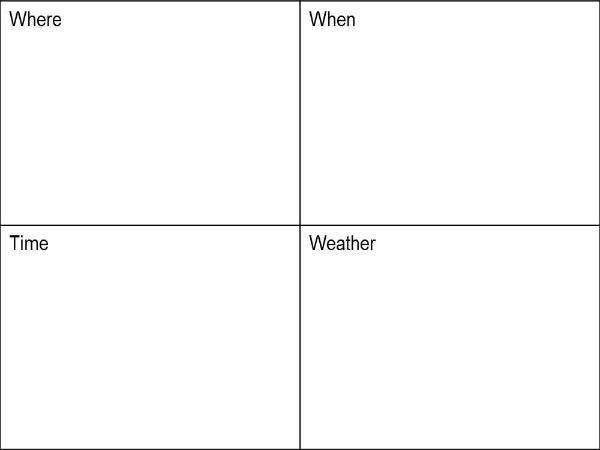
1g6 Setting Chart
By now, students should be very familiar with the setting of The Red Pony. Have them complete a setting chart for the Tiflin ranch.
1g6 Setting Chart
Discussion
Ask discussion questions of all 9 types (see Day 1).
Key Questions
- How does Billy Buck talk Carl Tiflin into letting Jody have another horse?
- How is Carl teaching Jody responsibility?
- What are the ways that Jody shows that responsibility requires action?
- What worries Jody in today’s reading selection?
- What clues does Steinbeck give the reader as to what might happen before the end of “The Promise?”
- What promise does the title of this section refer to?
- Has anyone ever made you a promise they couldn’t keep?
- Do you think Jody will get his colt?
Analyze
Analyze the key paragraph.
Key Paragraph, p. 193
“He went to his work with unprecedented seriousness. This night he did not dump the can of grain to the chickens so that they had to leap over each other and struggle to get it. No, he spread the wheat so far and so carefully that the hens couldn’t find some of it at all. And in the house, after listening to his mother’s despair over boys who filled their lunch pails with slimy, suffocated reptiles, and bugs, he promised never to do it again. Indeed, Jody felt that all such foolishness was lost in the past. He was far too grown up ever to put horny-toads in his lunch pail any more. He carried in so much wood and built such a high structure with it that his mother walked in fear of an avalanche of oak. When he was done, when he had gathered eggs that had remained hidden for weeks, Jody walked down again past the cypress tree, past the bunkhouse toward the pasture. A fat warty toad that looked out at him from under the watering trough had no emotional effect on him at all” (p. 193.)
Extend
Write
Have each student write a short product based on today’s prompt to connect to the unit theme.
Jody is feeling more grown up. He decides to take responsibility around the farm, and changes his behavior. Think about a time when you felt particularly grown up. Did you, like Jody, suddenly become responsible and do the things you were supposed to do?
Write a narrative paragraph about a time when you began to feel more grown up, how you acted, and what you did. Try to make it a strong narrative paragraph that includes who, what, where, when and why.
Close
Close by extending today’s lesson to life and the world.
Community Connection
The common thread of nature links all of the stories in Steinbeck’s The Long Valley. As you read the novel, have students list all of the animals and plants mentioned in the novel. As the novel progresses, they can research interesting facts about these animals and plants, and create an illustrated dictionary of California flora and fauna.
Day 6-The Long Valley, The Red Pony, "The Promise"
Outcomes for Today
Prepare
Background
Gather background knowledge about a place, time, event, person, or thing.
What is a breech birth?
A breech birth is when the baby is turned in the mother’s womb and comes out feet first instead of head first. In the case of a horse, this would mean the back legs would come out before the front legs. This makes the birth more difficult, because the colt’s hips are the widest part of its body. Although this kind of birth is more difficult, mares can often deliver this way with minimal assistance. Nellie’s disastrous breech delivery would be unusual, though not unheard of.
Word Wall
Here are five vocabulary words to teach and add to the Word Wall.
|
scalded (200) |
counteract (200) |
conjunction (200) |
eliminated (200) |
preliminary (203) |
Read
Review
Review the timeline from the beginning every day.
Read
Read the selection, usually in a Shared Reading Read React Predict Cycle of 2-3 pages.
Read p. 199-208, The Red Pony, “The Promise”
|
Setting |
Characters |
Pages |
|
The Tiflin farm |
Jody |
199-201 |
|
The Tiflin kitchen, September |
Jody, Mrs. Tiflin |
201-202 |
|
The Tiflin barn, September |
Jody, Nellie, Billy Buck |
202-203 |
|
The Tiflin barn, winter |
Jody, Billy, Nellie, Carl |
203-204 |
|
The Tiflin farm, February |
Jody, Mrs. Tiflin, Billy, Nellie, Carl Tiflin |
204-206 |
|
The Tiflin barn, February |
Jody, Billy Buck, Nellie, the colt |
206-208 |
Respond
Timeline
Agree on the facts in today’s reading and list the 3-5 most important on the timeline.
Students might mention:
- Jody dreams about his future with the colt, but is worried at the same time.
- In the fall, Mrs. Tiflin shows Jody how to make a special warm mash to keep Nellie in good shape.
- Billy promises Jody that he will call him when Nellie is about to give birth.
- As winter falls, Jody grows more anxious; the colt is due in January.
- January passes into February, and the colt is still not born.
- One night, Jody wakes up feeling very upset, so he goes to visit Nellie in the barn.
- Billy and his father reassure him that Billy will be able to deliver the colt safely.
- That night, Nellie goes into labor.
- The colt is breech, and Billy can’t turn it around so it can be born.
- Billy kills Nellie, and then cuts her open to get the colt out.
- Billy kept his promise to Jody, but feels guilty for killing Nellie.
Map
Add to ongoing class activities like a KWL chart or map: where did the characters go?
KWL
What do students want to know about the Salinas/Monterey area? Begin to fill the “Want to Know” section of a KWL Chart about Salinas and Monterey. What questions do students have about Steinbeck’s California at this time?
Explore
Activity
Explore the reading more deeply with a visual or oral language activity.
Open Mind Portrait
Billy believes that because of his promise to get Jody a foal, he has no choice but to kill Nellie. Is this true? Create an open mind portrait for Billy Buck when he realizes he can only save one or the other. How does he make his choice?
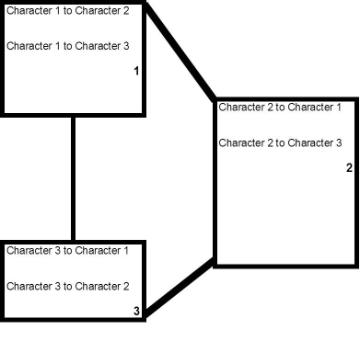
5g6 Character Interaction Chart
Create a character interaction chart for Jody, Billy Buck, and Carl Tiflin. How does each relate to the other? How are their relationships different? Does Jody interact differently with Billy than he does with his father?
5g6 Character Interaction Chart
Discussion
Ask discussion questions of all 9 types (see Day 1).
Key Questions
- What is the mood of the story at the beginning of today’s reading on page 199?
- How are Jody’s daydreams different from the reality of his situation?
- How is Jody’s relationship with Billy Buck different from his relationship with his father?
- Why is Jody so worried as Nellie’s time approaches?
- Are there really any times when we have no choices?
- In Billy’s situation, what would you have done?
- Was Billy’s choice the most responsible choice he could have made?
- Why does Jody find it hard to be happy about the colt?
Analyze
Analyze the key paragraph.
Key Paragraph, p. 208
“Billy’s face and arms and chest were dripping red. His body shivered and his teeth chattered. His voice was gone; he spoke in a throaty whisper. ‘There’s your colt. I promised. And there it is. I had to do it—had to.’ He stopped and looked over his shoulder into the box stall. ‘Go get hot water and a sponge,’ he whispered. ‘Wash him and dry him the way his mother would. You’ll have to feed him by hand. But there’s your colt, the way I promised’” (p. 208).
Extend
Write
Have each student write a short product based on today’s prompt to connect to the unit theme.
Billy does something he knows is wrong in order to follow through on his promise to Jody. He felt like killing the mother horse was his only option.
Write a paragraph describing a time when you thought you had no choice, or didn’t like any of the choices you had. Describe the situation and what you were thinking. You might want to start by drawing an open mind portrait for yourself at that time. When you write your paragraph, make sure you have a clear topic sentence, an organized body, and a strong closing sentence. Include as many personal and sensory details (“showing” writing) as possible to make your writing exciting.
Close
Close by extending today’s lesson to life and the world.
Community Connection
The common thread of nature links all of the stories in Steinbeck’s The Long Valley. As you read the novel, have students list all of the animals and plants mentioned in the novel. As the novel progresses, they can research interesting facts about these animals and plants, and create an illustrated dictionary of California flora and fauna.
Day 7-The Long Valley, The Red Pony, "The Leader of the People"
Outcomes for Today
Prepare
Background
Gather background knowledge about a place, time, event, person, or thing.
What was the Westward Movement?
Even before the United States won its independence from Great Britain, people started traveling west and exploring the rest of the continent. Pioneers traveled west to find better land, better jobs, more opportunity, or sometimes just to get away from the growing civilization of the east. Especially after the discovery of gold at Sutter’s Mill in Northern California in 1848, thousands of people began to travel across continent to gain a better life on the west coast.
Some traveled from the East Coast by ship around South America. Others chose to come over land, and typically traveled in wagon trains. They would travel in groups for protection, with a guide to bring them across safely. Jody’s grandfather appears to have been such a guide, leading a group of settlers all the way to the Central California coast.
Word Wall
Here are five vocabulary words to teach and add to the Word Wall.
|
ominously (210) |
relented (211) |
judiciously (212) |
rancor (213) |
humoring (216) |
Read
Review
Review the timeline from the beginning every day.
Read
Read the selection, usually in a Shared Reading Read React Predict Cycle of 2-3 pages.
Read p. 209-216, The Red Pony, “The Leader of the People” (stopping after “’…I rode him sometimes, and he didn’t mind.’”)
|
Setting |
Characters |
Pages |
|
The Tiflin farm, a Saturday in March |
Jody, Billy Buck |
209-210 |
|
Jody |
210-211 |
|
|
The Tiflin Kitchen |
Jody, Mrs. Tiflin |
211 |
|
Jody, Mrs. Tiflin, Carl Tiflin |
211-213 |
|
|
Jody, Mrs. Tiflin |
213-214 |
|
|
The Tiflin farm |
Jody |
214 |
|
Jody, Grandfather |
214-216 |
Respond
Timeline
Agree on the facts in today’s reading and list the 3-5 most important on the timeline.
Students might mention:
- One Saturday afternoon, Jody is hanging out on the farm.
- Jody wants to call the dogs and hunt the mice in the haystack, but Billy Buck says he should wait to get permission from Carl Tiflin.
- Jody uses profanity in front of Billy to try to act more grown up.
- Jody watches for his father to come home, and sees he has a letter.
- The letter is for Jody’s mother, and tells her that her father, Jody’s grandfather, is coming for a visit.
- Carl is unhappy that his father-in-law is coming, because all he does is talk about Indians and crossing the plains.
- Tiflin tells her husband that he should be patient with her father, because crossing the plains was the most important part of his life.
- Jody is excited about his grandfather’s visit, because he loves hearing about Indians.
- Jody eagerly watches for his grandfather’s arrival, and greets him at the road.
- Jody and Grandfather talk about the mouse hunt and other things happening around the farm.
Map
Add to ongoing class activities like a KWL chart or map: where did the characters go?
Map
Add to your class map of the settings of The Long Valley.
- Today, trace some of the routes by which settlers would have arrived in California from the East.
Explore
Activity
Explore the reading more deeply with a visual or oral language activity.
6g6 Venn Diagram
Have students complete a Venn Diagram chart comparing Jody to his father, Carl Tiflin. How are the two the same? How are they different? The two differ not only in age and experience, but also in temperament and worldview. Why? How is it that a child can be so different from the parent who raises him?
6g6 Venn Diagram

Discussion
Ask discussion questions of all 9 types (see Day 1).
Key Questions
- Why does Jody want to kill the mice in the haystack?
- What role does story telling play in building and maintaining a culture?
- Why do we tell stories to children?
- Why do you suppose Carl Tiflin doesn’t want to hear Grandfather’s stories over and over while Jody does?
- How is Grandfather similar to Gitano, the old man from “The Great Mountains?”
- How does Steinbeck portray elderly people differently in different stories?
- Are older people portrayed differently in other novels you have read? (For example: The Giver, The Maze, Harry Potter, The Circuit, The Contender, A Christmas Carol, Night, etc.)
- How do you treat the elderly people in your family?
Analyze
Analyze the key paragraph.
Key Paragraph, p. 216
“‘No, not much—but then later, when the troops were hunting Indians and shooting children and burning teepees, it wasn’t much different from your mouse hunt’” (p. 216).
Extend
Write
Have each student write a short product based on today’s prompt to connect to the unit theme.
Jody’s father isn’t thrilled about his father-in-law’s visit, because he only talks about one thing – Indians. Think of a family member, friend, or teacher who likes to tell stories, maybe even the same ones over and over.
Write a narrative paragraph showing what it is like to listen to a person in your life tell a story. Write the paragraph from the point of view of a listener. How do you feel when you are listening to the story? Try to put your narrative paragraph in chronological order. Make sure you have a clear topic sentence, an organized body, and a good closing sentence.
Close
Close by extending today’s lesson to life and the world.
Community Connection
The common thread of nature links all of the stories in Steinbeck’s The Long Valley. As you read the novel, have students list all of the animals and plants mentioned in the novel. As the novel progresses, they can research interesting facts about these animals and plants, and create an illustrated dictionary of California flora and fauna.
Day 8-The Long Valley, The Red Pony, "The Leader of the People"
Outcomes for Today
Prepare
Background
Gather background knowledge about a place, time, event, person, or thing.
Why was it a bad idea for pioneers to eat their oxen?
Oxen were the large draft cattle which pulled settlers’ wagons across the Great Plains, the Rocky Mountains, into California and Oregon. The wagons contained all of the settlers’ worldly possessions, as well as food and supplies for the journey. Along much of the trail, food was scarce, and without the ammunition, water, and the dry food stores the wagons carried, settlers would not have made it all the way to California. If they killed their oxen in the mountains, they would not have had sufficient means to carry water across the desert, especially if the party was made up of families with lots of women and children. Grandfather tells the family that he had to stop people from killing their oxen for food, because they would have been in danger later on the journey.
Word Wall
Here are five vocabulary words to teach and add to the Word Wall.
|
reverence (217) |
staunchness (221) |
apprehension (222) |
retract (223) |
disconsolately (224) |
Read
Review
Review the timeline from the beginning every day.
Read
Read the selection, usually in a Shared Reading Read React Predict Cycle of 2-3 pages.
Read p. 216-226, The Red Pony, “The Leader of the People” (beginning with “A door slammed at the house…”)
|
Setting |
Characters |
Pages |
|
The Tiflin porch |
Jody, Grandfather, Carl Tiflin, Mrs. Tiflin, Billy Buck |
216-217 |
|
Jody, Grandfather, Mrs. Tiflin, Carl Tiflin |
217 |
|
|
The Tiflin farmhouse, during and after dinner |
Jody, Grandfather, Mrs. Tiflin, Carl Tiflin, Billy Buck |
217-220 |
|
Jody, Grandfather, Mrs. Tiflin, Carl Tiflin |
220-220 |
|
|
Jody’s room |
Jody |
220-221 |
|
The Tiflin farmhouse, the next morning |
Jody, Mrs. Tiflin
|
221 |
|
The Tiflin farm |
Jody, Doubletree Mutt, Smasher |
221-222 |
|
Jody, Billy Buck |
222 |
|
|
The dining room |
Jody, Mrs. Tiflin, Carl Tiflin, Billy Buck |
222-223 |
|
Jody, Mrs. Tiflin, Carl Tiflin, Billy Buck, Grandfather |
223 |
|
|
Jody, Mrs. Tiflin, Grandfather |
223-224 |
|
|
The Tiflin Farm |
Jody, Grandfather |
224-225 |
|
The Tiflin kitchen |
Jody, Grandfather, Mrs. Tiflin |
225-226 |
Respond
Timeline
Agree on the facts in today’s reading and list the 3-5 most important on the timeline.
Students might mention
- Jody’s parents and Billy Buck welcome Grandfather.
- Grandfather says he plans to stay about two weeks, but isn’t sure.
- Grandfather tells a story about how he kept settlers from slaughtering their oxen for food when they were heading west.
- Carl Tiflin makes his wife angry by interrupting Grandfather’s story.
- Carl continues to be rude, and the adults don’t listen while Grandfather tells his stories after dinner.
- The next morning, Jody is excited to spend the day with his grandfather and to kill the mice in the haystack.
- At breakfast, Grandfather is late, and while they are waiting Carl Tiflin complains about having to listen to the same stories over and over.
- Grandfather overhears the complaint and says he’ll try to not tell stories to people who don’t want to hear them.
- Grandfather doesn’t want to help Jody kill mice, so Jody sits on the porch with him.
- Grandfather tells Jody how the important thing in his life was “westering.” In his case, it was the journey, not the destination, that mattered.
- At the end, Jody feels very sad.
- He makes lemonade for his Grandfather, but not for himself.
Map
Add to ongoing class activities like a KWL chart or map: where did the characters go?
KWL
What do students want to know about the Salinas/Monterey area? Continue to fill the “Want to Know” section of a KWL Chart about Salinas and Monterey. What questions do students have about Steinbeck’s California at this time? Today, start to fill in the “Learned” section as well. What have students learned about the settlers of Salinas/Monterey from the story “The Leader of the People?”
Explore
Activity
Explore the reading more deeply with a visual or oral language activity.
Postcard
As Jody, write a postcard to Grandfather after he goes home. On one side, draw a scene from the Tiflin farm. On the other, write to Grandfather and tell him about your feelings about your home in the Salinas Valley.
4g6 Character Profile Chart
Complete a Character Profile Chart for Jody. What are his best characteristics? Be sure to give detailed examples of each character trait. If you choose responsibility as a characteristic, the examples should illustrate Responsibility Requires Action.
4g6 Character Profile Chart
Discussion
Ask discussion questions of all 9 types (see Day 1).
Key Questions
- Why did Steinbeck end The Red Pony with the story about Grandfather?
- If people like Grandfather had not led wagon trains across the country, how would California have developed?
- What is the primary conflict in “The Man of the People?” In The Red Pony as a whole?
- Why do older people like to tell stories of their youth?
- How are Carl and Jody Tiflin different in their treatment of Grandfather?
- Do you think Jody would treat his grandfather differently if he were an older teenager?
- At the end of the novella The Red Pony, how does Mrs. Tiflin feel about her son?
- What will happen as Jody develops into a man?
Analyze
Analyze the key paragraph.
Key Paragraph, p. 224
“‘It wasn’t Indians that were important, nor adventures, nor even getting out here. It was a whole bunch of people made into one big crawling beast. And I was the head. It was westering and westering. Every man wanted something for himself, but the big beast that was all of them wanted only westering. I was the leader, but if I hadn’t been there, someone else would have been the head. The thing had to have a head’” (p. 224).
Extend
Write
Have each student write a short product based on today’s prompt to connect to the unit theme.
Jody’s grandfather is talking about being a leader. He says it wasn’t necessarily important who was the leader, but that the group had to have a person to lead and control it as it crossed the country.
Think about a time when you were in a leadership position. How did it make you feel? Write a strong narrative paragraph with a topic sentence that tells your story about being a leader. Be sure to describe the group you were leading, as well as how you felt as their leader. Use at least one concluding word in your closing sentence.
Close
Close by extending today’s lesson to life and the world.
Community Connection
The common thread of nature links all of the stories in Steinbeck’s The Long Valley. As you read the novel, have students list all of the animals and plants mentioned in the novel. As the novel progresses, they can research interesting facts about these animals and plants, and create an illustrated dictionary of California flora and fauna.
Day 9-The Long Valley, "The White Quail"
Outcomes for Today
Prepare
Background
Gather background knowledge about a place, time, event, person, or thing.
What is Florida Water?
Florida Water was a product unique to the Americas, popular during Steinbeck’s youth. It was an eau-de-cologne-type item that was scented with lavender and oranges. The name reminds one of the mythical qualities the conquistadors believed that the water in the Fountain of Youth would have possessed. People used it like they use body splash today. It was also believed to have soothing qualities, which is why Harry would have patted Florida Water on Mary’s head when she felt upset.
Word Wall
Here are five vocabulary words to teach and add to the Word Wall.
|
fuchsias (14) |
perfunctorily (15) |
coping (19) |
accustomed (20) |
decisive (21) |
Read
Review
Review the timeline from the beginning every day.
Read
Read the selection, usually in a Shared Reading Read React Predict Cycle of 2-3 pages.
Read p. 14-22, “The White Quail”
|
Setting |
Characters |
Pages |
|
Mary’s imagination, before she is married |
Mary |
14 |
|
Harry’s proposal to Mary |
Mary, Harry Teller |
15 |
|
The Teller home and garden |
Mary Teller |
16 |
|
The window seat in the Teller home |
Mary and Harry Teller |
16-17 |
|
Teller home and garden |
Mary and Harry Teller, guests |
17 |
|
The garden |
Mary and Harry Teller |
17 |
|
The garden at night |
18 |
|
|
The Teller living room |
|
18-19 |
|
The garden at night |
Mary |
19-20 |
|
The living room at night |
Mary and Harry |
20-21 |
|
Mary’s bedroom |
Mary |
21-22 |
Respond
Timeline
Agree on the facts in today’s reading and list the 3-5 most important on the timeline.
Students might mention:
- Mary has imagined a very special garden since she was a young girl.
- Mary married Harry Teller because he seems to fit her garden idea.
- Harry loves Mary, and agrees that she can have her garden.
- The two get married, and Mary builds her garden exactly as she wants it.
- Harry is both in love with Mary and intimidated by her.
- Mary goes out one night to retrieve a garden tool she left out, and imagines what she would look like if she were still inside.
- She discusses Harry’s business—she feels he takes advantage of people by charging interest on loans.
- That night, when Harry tries Mary’s bedroom door, it is locked.
- Mary remembers how nice Harry was when he wanted a dog, but Mary vetoed it because the dog might destroy her garden.
Map
Add to ongoing class activities like a KWL chart or map: where did the characters go?
Map
For “The White Quail,” consider making a class map to represent Mary’s garden.
Explore
Activity
Explore the reading more deeply with a visual or oral language activity.
Postcard
Write a postcard as though you were Mary writing to her sister. On one side, draw the garden. On the other, tell your sister about the newly finished garden.
Discussion
Ask discussion questions of all 9 types (see Day 1).
Key Questions
- What was Mary’s goal in life?
- Why did Mary marry Harry?
- How did Mary feel after her garden was completed?
- Would you rather be Mary or Harry?
- What is a good reason to get married?
- What words and phrases does the author use to illustrate Harry’s feelings towards Mary?
- Is a vivid imagination a blessing or a curse?
- If Mary were a “modern woman,” allowed to have a job outside her home, do you think she would be a happier person?
Analyze
Analyze the key paragraph.
Key Paragraph, p. 18
“‘That’s the enemy,’ Mary said one time. ‘That’s the world that wants to get in, all rough and tangled and unkempt. But it can’t get in because the fuchsias won’t let it. That’s what the fuchsias are there for, and they know it. The birds can get in. They live out in the wild, but they come to my garden for peace and for water.’ She laughed softly. ‘There’s something profound in all that, Harry. I don’t know quite what it is. The quail are beginning to come down now. At least a dozen were at the pool this evening’” (p. 18).
Extend
Write
Have each student write a short product based on today’s prompt to connect to the unit theme.
Mary’s garden is her refuge. She has built an elaborate fantasy world around her garden. It has become her entire life.
Think about a place you go for “refuge.” Write a paragraph describing a place that you go for refuge, and explain what it means to you to have such a place. This place might be a room, park, store, or almost any place in your life that makes you feel good. Remember to use sensory details. Arrange your sentences in order of importance.
Close
Close by extending today’s lesson to life and the world.
Community Connection
The common thread of nature links all of the stories in Steinbeck’s The Long Valley. As you read the novel, have students list all of the animals and plants mentioned in the novel. As the novel progresses, they can research interesting facts about these animals and plants, and create an illustrated dictionary of California flora and fauna.
Day 10-The Long Valley, "The White Quail"
Outcomes for Today
Prepare
Background
Gather background knowledge about a place, time, event, person, or thing.
What is a quail?
The California Quail is a bird indigenous to wilder parts of California. They are sometimes seen in quiet parks and gardens. The body of the quail is a little smaller than a soccer ball. The male is a rich chocolate brown with a “topknot” on its head that sticks up. The female is a paler brown. Both have a white pattern on their breast. They spend most of their time on the ground, under the cover of bushes, and only fly for short periods of time when in danger. The California Quail is the state bird of California, and is a popular game bird for hunters. The quail that Mary wants to have in her garden are not unusual, but will require a serene, quiet place for them to come regularly. The bird in the story is an albino, or colorless, quail, which would be very unique.
Word Wall
Here are five vocabulary words to teach and add to the Word Wall.
|
sacred (22) |
discouraged (23) |
ecstasy (23) |
paralysis (24) |
albino (25) |
Read
Review
Review the timeline from the beginning every day.
Read
Read the selection, usually in a Shared Reading Read React Predict Cycle of 2-3 pages.
Read p. 22-27, “The White Quail”
|
Setting |
Characters |
Pages |
|
The garden |
Mary |
22-23 |
|
Mary, the white quail |
23-24 |
|
|
Mary, the white quail, the cat |
24 |
|
|
Mary and Harry Teller |
24 |
|
|
Mary’s bedroom |
Mary and Harry Teller |
25-26 |
|
The garden at dawn |
Harry, the white quail |
26 |
|
Teller home |
Harry, Mary |
27 |
|
The living room |
Harry |
2 7 |
Respond
Timeline
Agree on the facts in today’s reading and list the 3-5 most important on the timeline.
Students might mention:
- Every evening, Mary stays in the garden and enjoys sacred time to herself.
- She imagines that the plants and animals talk, make up parties, and enjoy her garden as much as she does.
- One evening, Mary sees a beautiful white quail.
- Mary imagines that the white quail is just like her.
- A cat almost kills the white quail.
- Mary demands that Harry poison the cat, but he refuses.
- Harry offers to shoot the cat with an air gun instead, to scare it off.
- The next morning, Harry gets up to scare off the cat, but ends up shooting and killing the white quail.
- Harry tells himself that he meant to just scare off the quail.
- Harry realizes that he killed the quail because his life with Mary is so lonely.
Map
Add to ongoing class activities like a KWL chart or map: where did the characters go?
Map
You can finish your map of Mary’s garden today.
KWL
What do students want to know about the Salinas/Monterey area? Continue to fill the “Want to Know” section of a KWL Chart about Salinas and Monterey. What questions do students have about Steinbeck’s California at this time? Today, fill in the “Learned” section as well. What have students learned about the people of this area, especially about the lives of women, from the story “The White Quail?”
Explore
Activity
Explore the reading more deeply with a visual or oral language activity.
Open Mind Portrait
Complete side-by-side open mind portraits of Mary and Harry. What is important to each of them? What do they think about the other person? Why does each need the other person?
Story Sketch
Draw a picture of the white quail Mary sees in her garden.
Discussion
Ask discussion questions of all 9 types (see Day 1).
Key Questions
- What does Mary associate with the white quail?
- What information does the author reveal about Mary’s past that gives the reader insight into her character?
- Why does Harry refuse to poison the cat?
- Who do you think was right: Mary or Harry?
- Is it wrong to poison animals, even if they’re going to kill other animals?
- Do you think Harry accidentally killed the quail?
- Why is Harry lonely?
- What does this story reveal about Steinbeck’s attitude toward women?
Analyze
Analyze the key paragraph.
Key Paragraph, p. 26
“Harry walked slowly over to her and picked her up. ‘I didn’t mean to kill it,’ he said to himself. ‘I just wanted to scare it away’” (p. 26).
Extend
Write
Have each student write a short product based on today’s prompt to connect to the unit theme.
Although he does not consciously plan to kill the bird, Harry shoots the white quail. His life with Mary is desperately lonely—she lavishes all of her feeling, affection, and love on her garden, leaving her devoted husband starved for affection. Unconsciously, Harry kills Mary’s alter-ego, the white quail, as a way to avenge his hurt feelings and empty home life.
Think about a time you wanted to make someone feel bad, get revenge, or get even with someone for something. Write a paragraph or two telling what happened and how you felt about it. What did the offending party do? Why did you feel the need for revenge? Did the revenge make you feel any better? Would you make the same choice today? Remember to include a beginning, middle, and end to your story.
Close
Close by extending today’s lesson to life and the world.
Community Connection
The common thread of nature links all of the stories in Steinbeck’s The Long Valley. As you read the novel, have students list all of the animals and plants mentioned in the novel. As the novel progresses, they can research interesting facts about these animals and plants, and create an illustrated dictionary of California flora and fauna.
Day 11-The Long Valley, "The Chrysanthemums"
Outcomes for Today
Prepare
Background
Gather background knowledge about a place, time, event, person, or thing.
What is a tinker?
A tinker was a traveling workman who would travel from home to home, fixing pots and pans and other metal items. Prior to widespread automobile ownership and good roads, people on farms had limited access to towns where those kinds of services were available. Therefore, some workers would travel in wagons so that they could increase their business.
Word Wall
Here are five vocabulary words to teach and add to the Word Wall.
|
chrysanthemum (1) |
transplant (3) |
mongrel (4) |
sedately (4) |
definitive (4) |
Read
Review
Review the timeline from the beginning every day.
Read
Read the selection, usually in a Shared Reading Read React Predict Cycle of 2-3 pages.
Read p. 1-13, “The Chrysanthemums”
|
Setting |
Characters |
Pages |
|
The Allen ranch, the Salinas Valley, winter, Elisa Allen’s flower garden |
Elisa Allen Henry Allen Two men in suits |
1-2 |
|
Elisa and Henry Allen |
2-3 |
|
|
Elisa Allen |
3-4 |
|
|
Elisa, the tinker |
4-10 |
|
|
The Allen ranch, inside the house |
Elisa |
10-11 |
|
Elisa and Henry |
11-12 |
|
|
In the car, on the way to town |
Elisa and Henry |
12-13 |
Respond
Timeline
Agree on the facts in today’s reading and list the 3-5 most important on the timeline.
Students might mention:
- Elisa Allen is working in the garden while her husband, Henry, is talking to two men in the car.
- Henry tells Elisa that he sold his cattle and suggests they go out on the town to celebrate.
- Henry leaves to go find and round up the cattle.
- While he is gone, Elisa starts to transplant her chrysanthemums.
- A man in a decrepit wagon pulls up.
- He is a tinker, and asks if she has any knives or scissors to sharpen, or pots to repair.
- Elisa tells him she has no business for him.
- The tinker asks her about her flowers, and asks if he can take some to one of his customers.
- Elisa softens up, gets him a chrysanthemum, and tells him how to take care of it.
- Elisa finds a pot for him to repair before he leaves.
- Elisa suddenly feels strong and capable.
- Henry notices the difference in her when he comes home.
- They head into town, and Elisa sees that the tinker threw out her flower onto the road.
- She no longer feels strong and powerful, and she cries.
Map
Add to ongoing class activities like a KWL chart or map: where did the characters go?
Map
Locate a spot on your map of California where you think Elisa and Henry’s farm might be.
KWL
What do students want to know about the Salinas/Monterey area? Continue to fill the “Want to Know” section of a KWL Chart about Salinas and Monterey. What questions do students have about Steinbeck’s California at this time? Today, start to fill in the “Learned” section as well. What have students learned about California flora and fauna, as well as California women, from the story “The Chrysanthemums?”
Explore
Activity
Explore the reading more deeply with a visual or oral language activity.
Your Hobby, Task, or Chore
Elisa’s favorite hobby is raising beautiful chrysanthemums. She gives the tinker very detailed instructions on how to care for a flower and raise it to be as wonderful as hers. Draw a picture of your favorite hobby, task, or chore. It should be something that involves some skill, and that has steps involved in completing it correctly. Below the picture, or on the back, make a list of the steps you take to complete your task. For example, if you are a cyclist, give details about how you would repair part of your bicycle, or the steps involved in getting ready for a long ride. You could also outline the steps in a chore you complete regularly at home, like mowing the lawn or cleaning your kitchen.
Story Sketch
Draw a picture of one of Elisa’s Chrysanthemums.
Discussion
Ask discussion questions of all 9 types (see Day 1).
Key Questions
- Why was Elisa so passionate about chrysanthemums?
- What are you passionate about?
- Do you think Elisa would like to be “transplanted?”
- What change comes over Elisa after she gives the plant to the tinker?
- Why did the old man really ask Elisa for the chrysanthemum?
- Is Elisa satisfied with her life?
- Why might Elisa think about going to the fights when she wouldn’t have before?
- Why is she crying at the end of the story?
Analyze
Analyze the key paragraph.
Key Paragraph, p. 3
“There was a little square sandy bed kept for rooting the chrysanthemums. With her trowel she turned the soil over and over, and smoothed it and patted it firm. Then she dug ten parallel trenches to receive the sets. Back at the chrysanthemum bed she pulled out the little crisp shoots, trimmed off the leaves of each one with her scissors and laid it on a small orderly pile” (p. 3).
Extend
Write
Have each student write a short product based on today’s prompt to connect to the unit theme.
Eliza works in a diligent and orderly fashion to plant her chrysanthemums. She has a routine to ensure that the little plants are properly planted and cared for.
Think of a task or chore that you do on a regular basis and make a list of the steps that are necessary to complete that task. Take the list and turn it into a paragraph explaining to a peer how you complete that task. Remember to keep all the steps of the action in order.
Close
Close by extending today’s lesson to life and the world.
Community Connection
The common thread of nature links all of the stories in Steinbeck’s The Long Valley. As you read the novel, have students list all of the animals and plants mentioned in the novel. As the novel progresses, they can research interesting facts about these animals and plants, and create an illustrated dictionary of California flora and fauna.
Day 12-The Long Valley, "Flight"
Outcomes for Today
Prepare
Background
Gather background knowledge about a place, time, event, person, or thing.
What does “thee” mean?
The word “thee” is out of common use in every day English, but was a common word several hundred years ago. In fact, even in Steinbeck’s time, it would have been an unusual word to use regularly. Spanish speakers can think of it as a translation of “tu”— it is the word “you” in the familiar, and would be used with family, friends, and those younger or inferior to you. For example, in older translations of the Bible, God uses the word “thee” when speaking to human beings. Mama Torres uses the word “thee” with her children, and the reader can assume she is either old-fashioned, or that Steinbeck is “translating” “tu” because Mama Torres actually speaks to her children in Spanish.
Word Wall
Here are five vocabulary words to teach and add to the Word Wall.
|
aphids (28) |
ancient (28) |
thatch (28) |
chiseled (28) |
abalones (31) |
Read
Review
Review the timeline from the beginning every day.
Read
Read the selection, usually in a Shared Reading Read React Predict Cycle of 2-3 pages.
Read p. 28-36, “Flight”
|
Setting |
Characters |
Pages |
|
15 miles south of Monterey, the Torres home |
Mama Torres, Emilio, Rosy, Pepé |
28-31 |
|
Mama Torres, Emilio, Rosy |
31-32 |
|
|
Torres home, late at night |
Mama Torres, Pepé |
32-33 |
|
Mama Torres, Pepé, Rosy, Emilio |
33-35 |
|
|
Torres home, Dawn |
Mama Torres, Emilio, Rosy |
35-36 |
Respond
Timeline
Agree on the facts in today’s reading and list the 3-5 most important on the timeline.
Students might mention:
- Mama Torres and her three children live on a poor farm outside of Monterey.
- The younger children are twelve and fourteen; Pepé is nineteen.
- Pepé is a lazy boy, but Mama Torres adores her son.
- Pepé is good with a knife, which is all he has left of his father.
- Mama sends Pepé to town on some errands; he will spend the night with a friend of Mama’s.
- The children and Mama have dinner and go to bed.
- In the middle of the night, Pepé arrives home.
- He tells Mama that he killed a man in a silly argument.
- Mama prepares Pepé to run into the mountains.
- She gives him some food, and a gun with only ten cartridges.
- He rides out, and Mama mourns for him as though he is dead.
- Emilio asks his sister, Rosy, if Pepé is dead; Rosy explains “Not yet” (36).
Map
Add to ongoing class activities like a KWL chart or map: where did the characters go?
Map
Mark a possible place on your map of California where Mama Torres and her children might live. Remember, it should be near the ocean, far from the county seat, and close to the mountains.
Explore
Activity
Explore the reading more deeply with a visual or oral language activity.
Venn Diagram
Create a Venn Diagram comparing Pepé before he went to town and Pepé after he returns home. How has he changed in the span of just a few hours?
Discussion
Ask discussion questions of all 9 types (see Day 1).
Key Questions
- How would you describe Pepé’s character at the beginning of the story?
- How does the author foreshadow the murder and Pepé’s fate?
- What do you think defines a man?
- Does Pepé accept responsibility for what he did?
- Does Mama believe her son is responsible for his actions?
- How would a responsible person respond to the situation Pepé was in?
- Why does Mama say Pepé is a man now?
- Did Pepé mean to kill the man? Does that make a difference?
- What does Rosy mean when she says “‘Not yet?’” (p. 36)?
Analyze
Analyze the key paragraph.
Key Passage, p. 35
“Pepé turned back to Mama. He seemed to look for a little softness, a little weakness in her. His eyes were searching, but Mama’s face remained fierce. ‘Go now,’ she said. ‘Do not wait to be caught like a chicken.’
Pepé pulled himself into the saddle. ‘I am a man,’ he said” (p. 35).
Extend
Write
Have each student write a short product based on today’s prompt to connect to the unit theme.
Pepé acted on impulse, and was irresponsible. As a result, he now chooses to leave his home and his family, rather than face justice.
Write a paragraph describing a time you acted irresponsibly, and had to pay the consequences later. Did you regret your irresponsible action? What did you learn? Revise and edit your paragraph to improve your storytelling.
Close
Close by extending today’s lesson to life and the world.
Community Connection
The common thread of nature links all of the stories in Steinbeck’s The Long Valley. As you read the novel, have students list all of the animals and plants mentioned in the novel. As the novel progresses, they can research interesting facts about these animals and plants, and create an illustrated dictionary of California flora and fauna.
Day 13-The Long Valley, "Flight"
Outcomes for Today
Prepare
Background
Gather background knowledge about a place, time, event, person, or thing.
What is blood poisoning?
Blood poisoning is not a medical term, but is a commonly used phrase referring to bacterial infection in the blood as a result of an untreated wound. It is accompanied by a number of symptoms, including a fever, pain, vomiting, chills, and an increased heart rate. It can lead to sepsis, for which a patient is usually hospitalized. Pepé receives a wound that slowly turns black, indicating that the wound is badly infected.
Word Wall
Here are five vocabulary words to teach and add to the Word Wall.
|
sentinel (37) |
foliage (37) |
ascended (38) |
monotonous (38) |
sliver (43) |
Read
Review
Review the timeline from the beginning every day.
Read
Read the selection, usually in a Shared Reading Read React Predict Cycle of 2-3 pages.
Read p. 36-48, “Flight”
|
Setting |
Characters |
Pages |
|
In the hills |
Pepé, his horse |
36-37 |
|
Pepé, his horse, a fat horseman |
37 |
|
|
Pepé, his horse |
37-40 |
|
|
Pepé, his horse, a wildcat |
40-41 |
|
|
Pepé, his horse |
41-42 |
|
|
Pepé, his pursuers |
42-43 |
|
|
Pepé |
43-46 |
|
|
Pepé, a mountain lion |
46 |
|
|
Pepé, his pursuers and their dog |
46 |
|
|
Pepé |
46-48 |
|
|
Pepé, his pursuers and their dog |
48 |
Respond
Timeline
Agree on the facts in today’s reading and list the 3-5 most important on the timeline.
Students might mention:
- Pepé enters the hills on his horse, and things seem to go all right at first.
- Another horseman rides by, but doesn’t bother Pepé.
- Pepé takes a break at a watering hole and sees a wildcat.
- In the middle of the night, his horse wakes him, and he starts to travel in the dark.
- In the morning, Pepé’s horse is suddenly shot by someone trying to catch him.
- Pepé continues on foot, but is injured by a piece of granite that hits him in a gun battle with his invisible pursuer.
- Pepé continues, but is exhausted, and his injured hand starts to swell and bother him.
- Pepé sees another lion that night, but it is carried away by the dog that someone is using to track Pepé.
- He continues to move, but his wound has become infected and he’s in severe pain.
- His pursuers corner him.
- Knowing he can’t continue with no water and the increasing pain, Pepé stands up straight and is shot by his pursuers.
Map
Add to ongoing class activities like a KWL chart or map: where did the characters go?
KWL
What have students learned about the Salinas/Monterey area? What do they now know about the life of a man on the run in California at this time? Add to the “Learned” section of your KWL chart.
Explore
Activity
Explore the reading more deeply with a visual or oral language activity.
Open Mind Portrait
Steinbeck uses vivid descriptions to show us how Pepé is feeling rather than just telling us. Look through today’s reading selection for strong descriptive phrases. Use these to create an OMP with at least five descriptive thoughts that Pepé is having as he travels through the mountains.
Discussion
Ask discussion questions of all 9 types (see Day 1).
Key Questions
- What does Pepé do after leaving home that makes him a man?
- Is Pepé ready to be a man?
- What role does the setting play in “Flight?”
- How does Steinbeck create such a vivid picture of Pepé’s struggle?
- Is this a realistic portrayal of someone on the run from the law?
- What do you think will happen to Pepé’s mother, brother, and sister?
- What responsible choices could Pepé have made to avoid his death?
- How is this story different from other Steinbeck books you have read so far?
Analyze
Analyze the key paragraph.
Key Paragraph, p. 44
“Pepé was pushing the rifle with his left hand now. Little drops of sweat ran to the ends of his coarse black hair and rolled down his cheeks. His lips and tongue were growing thick and heavy. His lips writhed to draw saliva into his mouth. His little dark eyes were uneasy and suspicious. Once when a grey lizard paused in front of him on the parched ground and turned its head sideways he crushed it flat with a stone” (p. 44).
Extend
Write
Have each student write a short product based on today’s prompt to connect to the unit theme.
In the end of “Flight,” Pepé faces death head on. Steinbeck ends the story in a tragic way, but it is an ending that the reader expects. How did Steinbeck “set up” the reader so that Pepé’s death wasn’t a complete surprise? What clues did the author leave in the story that told us the main character was going to die in the end?
Write an analytical paragraph that explains how Steinbeck foreshadowed Pepé’s death throughout the story. List at least three clues that Steinbeck left for the reader. Use one strong quote from the story that was a literary device intended to develop the story.
Close
Close by extending today’s lesson to life and the world.
Community Connection
The common thread of nature links all of the stories in Steinbeck’s The Long Valley. As you read the novel, have students list all of the animals and plants mentioned in the novel. As the novel progresses, they can research interesting facts about these animals and plants, and create an illustrated dictionary of California flora and fauna.
Day 14-The Long Valley, "The Snake"
Outcomes for Today
Prepare
Background
Gather background knowledge about a place, time, event, person, or thing.
Who is the “real” Dr. Phillips?
Dr. Phillips is based on Ed Ricketts, a friend of Steinbeck’s who ran a small research lab near the ocean on Cannery Row, in Monterey. He collected specimens for other students of science to study. According to Steinbeck, “The Snake” was based on a real incident that Steinbeck witnessed in Ricketts’ lab one night. Ricketts became the basis for several characters in varying Steinbeck books and novels, including The Log from the Sea of Cortez, Sweet Thursday, and Cannery Row.
Word Wall
Here are five vocabulary words to teach and add to the Word Wall.
|
cannery (49) |
dissection (49) |
forceps (50) |
subjective (56) |
objective (56) |
Read
Review
Review the timeline from the beginning every day.
Read
Read the selection, usually in a Shared Reading Read React Predict Cycle of 2-3 pages.
Read p. 49-60, “The Snake”
|
Setting |
Characters |
Pages |
|
Cannery row, Monterey, Dr. Phillips laboratory |
Dr. Phillips, the snakes, his animals |
49-51 |
|
Dr. Phillips, a tall woman, the animals |
51-53 |
|
|
Dr. Phillips, a tall woman, the animals, a male rattlesnake |
53-59 |
|
|
Dr. Phillips, the male rattlesnake |
59-60 |
Respond
Timeline
Agree on the facts in today’s reading and list the 3-5 most important on the timeline.
Students might mention:
- Dr. Phillips leaves the tide pool and goes home to his laboratory in Monterey.
- When he gets home, he looks at the rattlesnakes in their glass cages, builds a fire, and prepares his meal.
- He takes starfish out of the collection bag, feeds his rats, and gasses a cat.
- He begins working with the starfish, when a woman knocks on the door.
- The woman asks if she can come in, and says she’ll be quiet while Dr. Phillips works.
- Dr. Phillips is extracting sperm and ova from the starfish, and creating a series of slides for biological study.
- Then, he takes the dead cat out and embalms it for a biology class.
- When he is done working for a while, the woman asks him if he has a male rattlesnake.
- She admires the snake, and asks if he will sell it to her.
- He says he could sell it, but is worried that she’ll be bitten.
- She pays for the snake, and says she just wants to leave him there, knowing that he is hers.
- Dr. Phillips sells her a rat, and she feeds it to the snake.
- Dr. Phillips feels, somehow, that she is evil, but he doesn’t know why.
- Dr. Phillips thinks that the woman is very like a snake as she watches the rattlesnake eat its prey.
- After the woman leaves, Dr. Phillips is confused about his own reaction.
- He vows to leave the woman alone with the snake if she comes again, but she never does.
Map
Add to ongoing class activities like a KWL chart or map: where did the characters go?
Map
Locate Monterey and the approximate location of Cannery Row on your class map of California.
KWL
Fill in more of the “Learned” section of your class KWL chart. Perhaps you might list what they’ve learned about industry and occupations that were available in Monterey at the time.
Explore
Activity
Explore the reading more deeply with a visual or oral language activity.
Story Sketch
In pictures, recreate the scene of the strange woman watching the snake kill and eat its prey. What does she look like while watching the snake?
6g6 Venn Diagram
Choose a woman from another Steinbeck story. You might choose Mrs. Tiflin from The Red Pony, Mama from “Flight,” Mary from “The White Quail,” or any others you can think of. Complete a Venn Diagram comparing one of those women to the character of the strange woman in “The Snake.”
6g6 Venn Diagram
Discussion
Ask discussion questions of all 9 types (see Day 1).
Key Questions
- Why does the woman’s behavior both fascinate and disgust Dr. Phillips?
- Do you think Dr. Phillips wants her to return? Why or why not?
- What is the relationship between the woman and the snake?
- Do you believe it is ethical to kill animals for science?
- Why does Dr. Phillips have a problem with feeding the snake for entertainment, when he would have to feed the snake eventually anyway?
- Is Dr. Phillips a responsible person? What evidence would you use to defend your answer?
- Steinbeck claimed that he witnessed this exact scene in Ed Ricketts’ laboratory; why do you think he made a short story out of it?
- How are the women in Steinbeck’s stories similar? How are they different?
Analyze
Analyze the key paragraph.
Key Paragraph, p. 55
“He shrugged his shoulders. ‘I see. You want to watch how rattlesnakes eat. All right. I’ll show you. The rat will cost twenty-five cents. It’s better than a bullfight if you look at it one way, and it’s simply a snake eating his dinner if you look at it another.’ His tone had become acid. He hated people who make sport of natural processes. He was not a sportsman but a biologist. He could kill a thousand animals for knowledge, but not an insect for pleasure. He’d been over this in his mind before” (p. 55).
Extend
Write
Have each student write a short product based on today’s prompt to connect to the unit theme.
Steinbeck often uses animal imagery to describe people. In this case, the snake is compared to Dr. Phillips’ female guest. Think of someone you know who reminds you of an animal of some kind. Write a paragraph in which you describe this person in terms of the animal imagery. Revise your paragraph using the * and Ö method.
Close
Close by extending today’s lesson to life and the world.
Community Connection
The common thread of nature links all of the stories in Steinbeck’s The Long Valley. As you read the novel, have students list all of the animals and plants mentioned in the novel. As the novel progresses, they can research interesting facts about these animals and plants, and create an illustrated dictionary of California flora and fauna.
Day 15-The Long Valley, "Breakfast", "Saint Katy the Virgin"
Outcomes for Today
Prepare
Background
Gather background knowledge about a place, time, event, person, or thing.
What is a monastery?
A monastery is a place where people, either male or female, have decided to leave the common world and devote themselves to their religion. Generally, these people are known as monks or nuns, depending on their gender, and they live, pray, and work in the monastery. Different monasteries have different missions. Usually, the role of a Catholic monastery in France in the 14th Century would have been to minister to local people, manage the lands owned by the monastery, and promote adherence to Catholic rules and principles. In “Saint Katy the Virgin,” the monastery plays a large role as both the home of the monks who converted Katy, and the home of Saint Katy as she lived out her religious life.
Word Wall
Here are five vocabulary words to teach and add to the Word Wall.
|
averted (62) |
element (64) |
heretic (140) |
impervious (140) |
repentance (141) |
Read
Review
Review the timeline from the beginning every day.
Read
Read the selection, usually in a Shared Reading Read React Predict Cycle of 2-3 pages.
Read p. 61-64, “Breakfast”
|
Setting |
Characters |
Pages |
|
In a camp, early in the morning |
Narrator, a young woman, a baby, an older man, a younger man |
61-64 |
Read p. 135-144, “Saint Katy the Virgin”
|
Setting |
Characters |
Pages |
|
Roark’s farm |
Roark, Katy |
135-137 |
|
Roark, Katy, Brother Paul and Brother Colin |
137-138 |
|
|
Outside Roark’s gate |
Katy, Brother Paul, Brother Colin |
138-142 |
|
The monastery |
Katy, Brother Paul, Brother Colin, the monks, Father Benedict |
142-143 |
|
The barber’s |
Katy, the barber, the brothers |
143-144 |
|
The chapel at the monastery |
Pilgrims, the relics of Saint Katy the Virgin |
144 |
Respond
Timeline
Agree on the facts in today’s reading and list the 3-5 most important on the timeline.
In “Breakfast”, students might mention:
- The narrator is relating a memory that fills him with pleasure.
- He approaches a camp, consisting of a tent and a camp stove.
- A young mother is beside a stove, cooking while nursing her baby under her dress.
- Two men, who appear to be related, come out of the tent and say good morning to the narrator.
- The older man invites the narrator to join them for breakfast.
- They enjoy biscuits, bacon, gravy, and coffee.
- The family tells them that they have been picking cotton for twelve days, have eaten well, and have gotten new clothes.
- They offer to try to get the narrator a job, but he thanks them and declines.
- The narrator reflects that he doesn’t know why it is such a good memory, but that the experience was somehow very beautiful.
In “Saint Katy the Virgin”, students might mention:
- Roark is a bad man who owns a bad pig.
- Katy, the pig, eats everything, including her brothers and sisters, chickens, ducks, small children, and her own piglets.
- After Katy eats the piglets, Roark finally decides to butcher her.
- Just before he kills her, two monks walk up to ask Roark for his share of the church donation.
- To the brothers’ surprise, Roark offers him a pig.
- The brothers try to take her, but she takes a bite out of one of them before they get very far.
- They try to exorcise the pig, but it doesn’t work.
- Brother Paul somehow manages to convert Katy, and she repents her evil past.
- When they return to the monastery, the head monk tells them they can’t butcher a Christian pig.
- Katy lives a life of good deeds, and many come to see her to be cured, helped, etc.
- It is decided that she is a virgin by intent.
- After she dies, they put her bones in a gold box, and pilgrims come to touch the box to be healed.
Map
Add to ongoing class activities like a KWL chart or map: where did the characters go?
Map
Add a possible location of “The Breakfast” to your map of California.
KWL
What have students learned about the Salinas/Monterey area? What was life like for migrating farm workers? Why would a story about a pig in 14th Century France be included in a collection of stories about California? Add to the “Learned” section of your KWL chart.
Explore
Activity
Explore the reading more deeply with a visual or oral language activity.
Postcard
Write a postcard from the narrator of “The Breakfast” to a close friend telling about sharing breakfast with the migrant workers. On the other side, draw the breakfast scene.
Comic Strip
Create a comic strip showing the transformation of Katy in “Saint Katy the Virgin.”
Discussion
Ask discussion questions of all 9 types (see Day 1).
Key Questions, “Breakfast”
- What descriptive details does Steinbeck use to describe the setting?
- Did the narrator’s pleasure depend on the breakfast, or the setting in which it took place?
- Why are the characters living in a tent?
- Why was it so significant that the migrant workers shared their meal with the narrator?
- Although the men are described as “neither friendly nor unfriendly” (62), they treat the narrator with courtesy—why?
- Would you have shared your meal with a stranger?
- What lesson is Steinbeck trying to convey to the readers?
Key Questions, “Saint Katy the Virgin”
- What were the funniest parts of this story?
- Have you ever owned or known an animal like Katy, that appeared to be “evil?”
- Can animals be Christian?
- Do you agree with Father Benedict when he tells the priest that he was a fool to think he could convert a pig and then butcher it?
- How important are intentions in determining whether we are considered “wicked” or “saintly”?
- Can a person (or a pig, for that matter), change “overnight”?
- What is the moral of Steinbeck’s story?
Analyze
Analyze the key paragraph.
Key Passage, p. 64: “Breakfast”
“That’s all. I know, of course, some of the reasons why it was pleasant. But there was some element of great beauty there that makes the rush of warmth when I think of it” (p. 64).
Key Passage, p. 141: “Saint Katy the Virgin”
“As for Katy, she came forward stamping and champing, ready to snatch it and tread it under her feet. The face of Katy was a tiger’s face. Just as she reached the cross, the sharp shadow of it fell on her face, and the cross itself was reflected in her yellow eyes. Katy stopped—paralyzed. The air, the tree, the earth shuddered in an expectant silence, while goodness fought with sin.
Then, slowly, two great tears squeezed out of the eyes of Katy, and before you could think, she was stretched prostrate on the ground, making the sign of the cross with her right hoof and mooing in anguish at the realization of her crimes.
Brother Paul dangled the cross a full minute before he hoisted himself back on the limb.
All this time Roark had been watching from his gate. From that day on, he was no longer a bad man; his whole life was changed in a moment. Indeed, he told the story over and over to anyone who would listen. Roark said he had never seen anything so grand and inspiring in his life” (p. 141).
Extend
Write
Have each student write a short product based on today’s prompt to connect to the unit theme.
Writing Prompt for “Breakfast”
Steinbeck conveys a lot of information about the workers and the narrator in this short description of the simple act of sharing a meal.
Think about a meal you shared with others. Write a paragraph describing the meal. Try to convey any significance of things other than just the sharing of food that were occurring. Be sure to mention the who, what, where, when, and why of this meal.
Writing Prompt for “Saint Katy the Virgin”
In this humorous story, Steinbeck tells about a truly evil character (Katy the pig) that repents her evil ways and becomes saint-like overnight.
Think about a time when you wanted to change something in your life or yourself. Were you able to change “overnight”? Write a paragraph that tells the story of your attempted change. What was significant about the experience? Was the change easy or difficult? Was this a responsible choice?
Close
Close by extending today’s lesson to life and the world.
Community Connection
The common thread of nature links all of the stories in Steinbeck’s The Long Valley. As you read the novel, have students list all of the animals and plants mentioned in the novel. As the novel progresses, they can research interesting facts about these animals and plants, and create an illustrated dictionary of California flora and fauna.
Day 16-The Long Valley, "The Raid"
Outcomes for Today
Prepare
Background
Gather background knowledge about a place, time, event, person, or thing.
To what group do Nick and Root belong?
Although Steinbeck never says outright, the evidence hints that Nick and Root are probably members of the Communist Party. In the 1930s, the American Communist Party began to grow and attract more attention from both admirers and detractors. This was the era of Stalin, whose apparent successes in the U.S.S.R. was causing many workers to think that communism was the future. Steinbeck himself chronicled a visit to the Soviet Union in 1948 in his book, The Russian Journals, and was favorably impressed with Soviet people and collective farms at the time. The world did not yet know of Stalin’s atrocities and the horror that was life for millions of Russian workers and peasants. In the U.S., people like Nick and Root were drawn to the basic philosophy of Communism and linked it to the ideals of unions: that working people should be paid well, and should have the right to strike if their demands were not met. All over the country, pro-Communist groups organized labor strikes such as the railroad workers’ movement Nick and Root are trying to get started in this nameless California town.
Word Wall
Here are five vocabulary words to teach and add to the Word Wall.
|
dismally (65) |
mournfully (66) |
scabrous (68) |
resumed (72) |
deportment (74) |
Read
Review
Review the timeline from the beginning every day.
Read
Read the selection, usually in a Shared Reading Read React Predict Cycle of 2-3 pages.
- 65-76, “The Raid”
|
Setting |
Characters |
Pages |
|
A small town in the Central Valley of CA |
Root, Dick |
65-68 |
|
The meeting building |
Root, Dick |
68-71 |
|
A man in overalls |
71-72 |
|
|
Root, Dick |
72-74 |
|
|
Root, Dick, a crowd of men who are there to raid the meeting |
74-75 |
|
|
The jail, a hospital cell |
Root, Dick |
75-76 |
Respond
Timeline
Agree on the facts in today’s reading and list the 3-5 most important on the timeline.
Students might mention:
- Two men, Root and Dick, are walking together in a small California town.
- Root is very nervous about what they are going to do; Dick is a veteran.
- Root is going to make a speech.
- Root’s father works for the railroad; he threw Root out when he found out what he was doing.
- If there’s any trouble at their meeting, the men have orders to stay and take whatever beating or punishment comes.
- They arrive at the meeting building and start to set up.
- The men wait, but no one shows up for their meeting.
- Half an hour after the meeting was supposed to start, someone finally shows up.
- The stranger warns them that a raiding party is coming.
- Root and Dick tell him they will stay and face what’s coming.
- Root is worried that no one will help them after the beating.
- After an hour and a half of waiting, the raiding party shows. Someone screams, “Kill the red rats!” (75) and the beating commences.
- Root wakes up in jail pretty beat up.
- The two men are going to get six months in jail for inciting a riot.
- Root quotes the Bible: “’Forgive them because they don’t know what they’re doing’” (76).
- Dick reminds him that, “’Religion is the opium of the people’” (76).
Map
Add to ongoing class activities like a KWL chart or map: where did the characters go?
KWL
What have students learned about the Salinas/Monterey area? What do they now know about the life men who wanted to unionize at this time? Add to the “Learned” section of your KWL chart.
Explore
Activity
Explore the reading more deeply with a visual or oral language activity.
Open Mind Portrait
Draw an open mind portrait for Root as he is waiting for the union busters to show up. What is he thinking? Feeling? Planning?
Discussion
Ask discussion questions of all 9 types (see Day 1).
Key Questions
- What kind of meeting are Root and Dick hosting?
- Who is the man on the red and black poster?
- Did this sort of thing happen on a regular basis?
- Why does the committee demand that the organizers stay and “take it?”
- Was taking the beating the responsible thing for the men to do?
- Did they accomplish anything?
- Root doesn’t fear the beating itself—what is he really worried about?
- Why does Root quote Jesus Christ at the end of the story?
- Do you agree that “religion is the opium of the people”?
Analyze
Analyze the key paragraph.
Key Paragraph, p. 72
“‘Take hold, kid! You take hold! And listen to me; if some one busts you, it isn’t him that’s doing it, it’s the System. And it isn’t you he’s busting. He’s taking a crack at the Principle. Can you remember that?’” (p. 72).
Extend
Write
Have each student write a short product based on today’s prompt to connect to the unit theme.
Root is frightened about what is about to happen. He knows it will be difficult and dangerous, and is afraid despite his desire to prove himself.
Write a paragraph telling the story of a time when you were afraid of something and overcame it. Make sure you organize your thoughts and have a clear beginning, middle, and end of the story. In your conclusion, tell what you learned from this experience.
Close
Close by extending today’s lesson to life and the world.
Community Connection
The common thread of nature links all of the stories in Steinbeck’s The Long Valley. As you read the novel, have students list all of the animals and plants mentioned in the novel. As the novel progresses, they can research interesting facts about these animals and plants, and create an illustrated dictionary of California flora and fauna.
This week, choose one item from your list to share with the class. Make a poster, PowerPoint, or handout that includes the item’s common and scientific name, a large color illustration, and at least ten interesting facts about your plant or animal’s habits, lifespan, habitat, and current level of endangerment. Share your findings with your teacher and your peers.
Day 17-The Long Valley, "The Harness"
Outcomes for Today
Prepare
Background
Gather background knowledge about a place, time, event, person, or thing.
Who are the Masons?
Masonry is a fraternity—a men’s club or organization—with a long history. It originated in Europe during the Middle Ages and developed as a formal organization in England in the 18th Century. Soon, Masonic lodges appeared in the British Colonies in America, and many of the Founding Fathers were Masons, including George Washington, John Hancock, and Benjamin Franklin.
Masonry in California dates to the Gold Rush, and California has one of the largest groups of Masons in the world. The philosophies of the organization in its modern form are tolerance, personal growth, family, philanthropy, ethics, and freedom. In California, it is open to men over the age of 18 who believe in the existence of a Supreme Being. Other Masons students might recognize are: Sugar Ray Robinson, Napoleon, Louie Armstrong, Cy Young, and Davy Crockett.
Steinbeck mentions the Randall’s Masonic connections as a gauge of their social importance. Mrs. Randall’s father was the head Mason in the state of California, which would have given her family high standing in the community. Peter Randall himself is involved in the Masonic lodge, which would indicate he was an active participant in the community and respected by local men.
Word Wall
Here are five vocabulary words to teach and add to the Word Wall.
|
emulate (77) |
sullen (77) |
probity (77) |
hysteria (80) |
harness (82) |
Read
Review
Review the timeline from the beginning every day.
Read
Read the selection, usually in a Shared Reading Read React Predict Cycle of 2-3 pages.
Read p. 77-92, “The Harness”
|
Setting |
Characters |
Pages |
|
The Randall farm in Monterey County |
Peter Randall, Emma Randall, |
77-79 |
|
Monterey County |
Dr. Marn, Mrs. Chappell |
79-80 |
|
The Randall house, during Emma’s illness |
Peter Randall, Dr. Marn, Miss Jack (a nurse,) neighbors |
80 |
|
The Randall house, the night of Emma’s death |
Peter, Mrs. Chappell, Ed Chappell, the doctor, the undertaker, Miss Jack |
80-81 |
|
Peter, Ed Chappell |
81-86 |
|
|
The Randall farm, after Emma’s funeral |
Peter Randall |
86 |
|
Monterey County |
Farmers, Peter Randall, Clark DeWitt, Ed Chappell, Mrs. Chappell |
|
Respond
Timeline
Agree on the facts in today’s reading and list the 3-5 most important on the timeline.
Students might mention:
- Peter Randall is well respected in the community.
- Once a year, he leaves his wife alone on the farm when he goes away for a business trip.
- Every year, Emma is ill for a month or two when he returns.
- The Randall ranch is beautiful and successful, and the other men in the valley try to imitate everything Peter does.
- Emma keeps a lovely home, which is admired by all.
- One fall, Emma becomes sick, and word spreads that she is going to die.
- After an illness that lasted two months, Emma dies.
- Peter becomes hysterical when she dies, and the doctor asks a neighbor, Ed Chappell, to stay with him overnight.
- Peter wakes up, and begins to talk to Ed.
- Ed finds out that Emma kept Peter from being himself: she made him wear an elastic belt to hold his stomach in, and a harness so he would stand up straight.
- Peter drinks whiskey, which shocks Ed, and tells him that once a year he would go to fancy houses in San Francisco for a week.
- Peter talks about all the things he’s wanted to do, but couldn’t because Emma was there.
- He says he’s going to plant all of his land in sweet peas just to have color and smell, have brandy on the shelf all the time, track dirt in the house, and hire a fat, buxom housekeeper.
- After the funeral, Peter is secretive about what he is going to plant, which is unusual for him.
- Peter plants sweet peas, which is a very risky crop.
- The sweet peas are gorgeous, and people come from all over to look at them.
- After the crops come in, Ed runs into Peter in San Francisco.
- They have a drink, and Peter admits that he was worried sick about his crop all year, as if Emma was still there to nag him.
- Peter decides to use some of the money from his crop to put electric lights in the house, because Emma always wanted them.
Map
Add to ongoing class activities like a KWL chart or map: where did the characters go?
Map
Find a location in the upper Salinas Valley for the Randall ranch, and mark it on your map. Also, locate San Francisco, where Peter visits every year.
Explore
Activity
Explore the reading more deeply with a visual or oral language activity.
5c12 Cube the Structure of the Text
Create a cube of today’s story. Be sure to focus on the conflict and the theme of “The Harness.” Is the conflict Peter deals with internal or external? What does he learn by the end of the story?
5c12 Cube the Structure of the Text
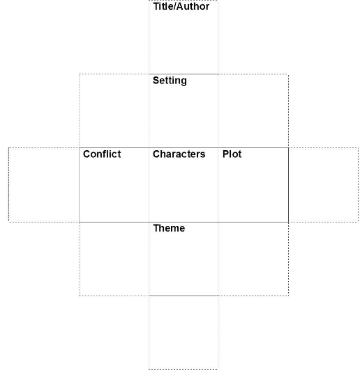
Discussion
Ask discussion questions of all 9 types (see Day 1).
Key Questions
- Is it crazier to be different, or to hide your true self from the world?
- What is the primary conflict in Peter Randall’s life?
- Why did Steinbeck call the story “The Harness”?
- What does the harness symbolize?
- What kind of relationship did Peter and Emma have?
- What sensory details does Steinbeck share to make the reader see the beauty of the sweet peas planted in Peter’s ranch?
- Is Peter Randall a responsible person? What evidence do you have to support your answer?
- How do you think Peter Randall will behave in the future?
- Will he become more or less responsible as the years go on?
Analyze
Analyze the key paragraph.
Key Paragraph, p. 82
“Peter went on as though he was talking to himself. ‘Even if she could see me, and I didn’t do what she wanted, she ought to feel good because I did it when she was here. It ought to please her that she made a good man of me. If I wasn’t a good man when she wasn’t here, that’d prove she did it all, wouldn’t it? I was a good man, wasn’t I, Ed?’” (p. 82).
Extend
Write
Have each student write a short product based on today’s prompt to connect to the unit theme.
For the entirety of his marriage, Peter lived up to his wife’s standards. He worked hard to meet her expectations of what a man should be, even though it wasn’t what he wanted out of life.
Most people try to please another person at some point in life, whether it is for respect, love, money, or happiness. Write a story about a time you tried to please someone by doing, wearing, or saying things that they wanted you to, but that you didn’t really want to do. Was it satisfactory for anyone? Make sure you have a thesis sentence that states your purpose clearly (a thesis statement is like a topic sentence). Revise the story so that it has energy and enthusiasm.
Close
Close by extending today’s lesson to life and the world.
Community Connection
The common thread of nature links all of the stories in Steinbeck’s The Long Valley. As you read the novel, have students list all of the animals and plants mentioned in the novel. As the novel progresses, they can research interesting facts about these animals and plants, and create an illustrated dictionary of California flora and fauna.
This week, choose one item from your list to share with the class. Make a poster, PowerPoint, or hand out that includes the item’s common and scientific name, a large color illustration, and at least ten interesting facts about your plant’s or animal’s habits, lifespan, habitat, and current level of endangerment. Share your findings with your teacher and your peers.
Day 18-The Long Valley, "The Vigilante"
Outcomes for Today
Prepare
Background
Gather background knowledge about a place, time, event, person, or thing.
What is lynching?
Lynching is the illegal hanging of a person by a mob or group. It was often done when a person was accused of a crime and members of the community took justice into their own hands. It is illegal because a lynching typically would happen before a person was tried or convicted of a crime, but the law often looked the other way. In the United States, lynchings of African Americans were especially common, especially if the perceived crime or insult was to a white person. Many innocent people were murdered as the result of lynchings, and this represents a very dark period in our national history.
Word Wall
Here are five vocabulary words to teach and add to the Word Wall.
|
melancholy (95) |
fiend (96) |
haggled (97) |
vehemence (98) |
petulant (99) |
Read
Review
Review the timeline from the beginning every day.
Read
Read the selection, usually in a Shared Reading Read React Predict Cycle of 2-3 pages.
Read p. 93-100, “The Vigilante”
|
Setting |
Characters |
Pages |
|
A park in town |
Mike, the mob, the victim |
93-94 |
|
The town’s street |
Mike |
94 |
|
The bar |
Mike, the bartender |
94-98 |
|
The town street, walking home |
Mike, Welch (the bartender) |
98-99 |
|
Mike’s house |
Mike, his wife |
99-100 |
Respond
Timeline
Agree on the facts in today’s reading and list the 3-5 most important on the timeline.
Students might mention:
- Mike just participated in a lynching in the park.
- As he is leaving, he notices that someone is trying to burn the body of the hanged man.
- Mike is upset that they’re trying to burn the body, because it “don’t do no good” (93).
- After he leaves the mob, Mike feels empty.
- He remembers how the mob broke down the door of the jail.
- Mike goes into an empty bar, and asks the bartender for a beer.
- The bartender was also at the lynching, and came back to his place because he thought people would want beer.
- They talk about the lynching and agree that the man they hung was guilty.
- The sheriff didn’t do much to prevent the lynching, probably because an election is coming up.
- Mike got a piece of the victim’s pants as a souvenir, which the bartender buys from him.
- The bartender closes up and the two men walk home.
- They wonder about what kind of man the hanged man was.
- When Mike gets home, his wife accuses him of being out with another woman.
- He doesn’t explain where he’s really been, but realizes that he feels like he’s been out with another woman.
Map
Add to ongoing class activities like a KWL chart or map: where did the characters go?
KWL
Add to the “Learned” section of your KWL chart. We often think of lynchings as something that only happens in the Deep South. What have you learned about race relations in California from the story “The Vigilante?”
Explore
Activity
Explore the reading more deeply with a visual or oral language activity.
5g6 Character Interaction Chart
Fill out a character interaction chart for Mike, Welch, the bartender, and the lynched man. How do they interact? What is the difference between how the two white men view the black man? We don’t know the dead man’s thoughts, but imagine what he would have thought of Mike and Welch as they came into the jail to get him.
5g6 Character Interaction Chart
Discussion
Ask discussion questions of all 9 types (see Day 1).
Key Questions
- How do the men in the mob justify their actions?
- Is it right to punish someone who hasn’t had a trial?
- What do you think the hanged man is accused of?
- At the end of the story, does Mike think he did the right thing?
- How do you think you would have felt if you were a witness to this event?
- Does Steinbeck think that vigilantism is an act of justice?
- Did the mob behave responsibly?
- What responsibility does the sheriff have for the black man’s death?
- Why do you think there were few—if any—consequences for the members of lynch mobs during this time period?
Analyze
Analyze the key paragraph.
Key Paragraph, p. 95
“Mike drank again and then looked through his beer and watched the beads of bubbles rising from the grains of salt in the bottom of the glass. ‘Everything,’ he said. ‘I was one of the first in the jail, and I helped pull on the rope. There’s times when citizens got to take the law in their own hands. Sneaky lawyer comes along and gets some fiend out of it’” (p. 95).
Extend
Write
Have each student write a short product based on today’s prompt to connect to the unit theme.
Steinbeck clearly communicates to the reader the mob’s justification of its actions. They use the cost of a trial as reason to hang a man who has not been convicted of any crime. Because the black man is dead when the story starts, the reader never gets to hear his point of view. What do you think he was thinking and feeling as the lynch mob broke into the jail?
In two or three paragraphs, rewrite the story of the lynching from the victim’s point of view. Be descriptive. What were the sights and sounds he experienced in the last moments of his life? What did he think about the men coming after him? Be sure to include some dialogue in your story.
Close
Close by extending today’s lesson to life and the world.
Community Connection
The common thread of nature links all of the stories in Steinbeck’s The Long Valley. As you read the novel, have students list all of the animals and plants mentioned in the novel. As the novel progresses, they can research interesting facts about these animals and plants, and create an illustrated dictionary of California flora and fauna.
This week, choose one item from your list to share with the class. Make a poster, PowerPoint, or hand out that includes the item’s common and scientific name, a large color illustration, and at least ten interesting facts about your plant’s or animal’s habits, lifespan, habitat, and current level of endangerment. Share your findings with your teacher and peers.
Day 19-The Long Valley, "Johnny Bear"
Outcomes for Today
Prepare
Background
Gather background knowledge about a place, time, event, person, or thing.
What is a sharecropper?
A sharecropper is a farmer who farms on someone else’s land. In return, the farmer pays the owner of the land with a percentage of the crop that is raised. Often, this was the only route available to disenfranchised minorities who weren’t able to raise the money or meet the legal requirements to purchase land for themselves. Typically, sharecropping was profitable only for the landlord while the farmer would remain poor for their lifetime.
Word Wall
Here are five vocabulary words to teach and add to the Word Wall.
|
covet (101) |
elaborately (105) |
feeble (112) |
transpired (117) |
opposition (119) |
Read
Review
Review the timeline from the beginning every day.
Read
Read the selection, usually in a Shared Reading Read React Predict Cycle of 2-3 pages.
Read p. 101-120, “Johnny Bear”
|
Setting |
Characters |
Pages |
|
|
|
The village of Loma |
The narrator
|
101 |
|
|
|
The Buffalo Bar |
The narrator, Fat Carl, Timothy Ratz |
102-103 |
|
|
|
Outside of Loma |
The narrator, Mae Romero |
103 |
|
|
|
The Buffalo Bar |
The narrator, Alex Hartnell, Johnny Bear, Fat Carl, Timothy Ratz |
103-108 |
|
|
|
Loma, outside |
The narrator, Alex Hartnell |
108-109 |
|
|
|
Loma, Mrs. Ratz’ boarding house |
The narrator |
109-110 |
||
|
The swamp |
The narrator, his crew |
110 |
||
|
Loma, on the road to Alex’s farm |
The narrator, Alex |
110-111 |
||
|
The narrator, Alex, Emalin and Amy Hawkins |
111 |
|||
|
The narrator, Alex |
111-112 |
|||
|
Alex’s house |
The narrator, Alex, Alex’s sister |
112 |
||
|
On the road back to Loma |
The narrator, Alex |
112 |
||
|
The narrator, Alex, Doctor Holmes |
112 |
|||
|
The Buffalo Bar |
The narrator, Alex, Fat Carl, the dredger crew, Timothy Ratz, Johnny Bear |
112-114 |
||
|
Loma, Mrs. Ratz’ boarding house |
The narrator |
115 |
||
|
The swamp |
The narrator, the crew, a deck hand, a lever man, the cook, the new cook |
115 |
||
|
Outside the Hawkins home |
The narrator, a Chinese field hand |
115-116 |
||
|
Alex’s farm |
The narrator, Alex |
116-117 |
||
|
Buffalo Bar |
The narrator, Fat Carl, Timothy Ratz, Johnny Bear |
117-119 |
||
|
The narrator, Johnny Bear, Fat Carl |
119-120 |
|||
|
Alex’s car |
The narrator, Alex |
120 |
||
Respond
Timeline
Agree on the facts in today’s reading and list the 3-5 most important on the timeline.
Students might mention:
- The narrator is living in Loma, California, while he works for a company putting a ditch through to regain swampland.
- Loma is a small town where there’s nothing to do except go to the Buffalo Bar.
- Fat Carl owns the bar, and only serves whiskey.
- The narrator starts to hang out with a local girl, Mae Romero, and takes walks with her at night.
- After he takes Mae home, he goes into the bar.
- One day, the narrator is sitting with Alex Hartnell, a farmer, when Johnny Bear walks in.
- Johnny Bear is mentally disabled. He comes in and asks for whiskey.
- To the surprise of the narrator, someone buys him a drink, and Johnny Bear performs.
- Johnny Bear perfectly imitates the narrator and Mae’s evening out, and the narrator is horrified.
- Alex explained that Johnny Bear follows people and imitates anyone or anything.
- Later that night, Johnny Bear imitates two sisters in town, Emalin and Amy Hawkins, who were having a very private conversation.
- Alex explains that the Hawkins’ sisters are like local aristocracy, and that they own a farm with Chinese sharecroppers.
- The narrator meets the Hawkins and admires them.
- Later, Alex and the narrator run into the doctor who is on his way to see Miss Amy, who is sick.
- Johnny Bear comes into the bar that night and imitates a conversation between Emalin and the doctor, revealing that Miss Amy tried to commit suicide.
- The narrator has a run of bad luck at his work, so he doesn’t go into town for a while.
- When he sees Alex again, he finds out that the Hawkins sisters are not doing well.
- Two days later, everyone finds out that Miss Amy committed suicide by hanging herself.
- Johnny Bear comes in asking for whisky, and repeats a conversation between Emalin and the doctor, this time revealing that Miss Amy was pregnant.
- The men won’t buy any more whiskey for Johnny Bear, but Johnny starts speaking in Chinese.
- In the middle of Johnny’s performance, Alex hits Johnny to make him stop.
- Later, Alex asks the narrator if anyone noticed that one of the Chinese voices was Miss Amy’s.
Map
Add to ongoing class activities like a KWL chart or map: where did the characters go?
Map
Add a possible location for Loma onto your California map. Does the town exist in California today?
KWL
Add to the “Learned” section of your class KWL Chart. How are race relations in this story different from the ones expressed in “The Vigilante?”
Explore
Activity
Explore the reading more deeply with a visual or oral language activity.
3g6 Plot Profile Chart
Complete a Plot Profile Chart for “Johnny Bear.” Have students list ten events from the story in chronological order. Then, have them rate the events for excitement from one to ten, and graph them on the worksheet. What does this tell you about how Steinbeck crafted the plot of “Johnny Bear?”
3g6 Plot Profile Chart
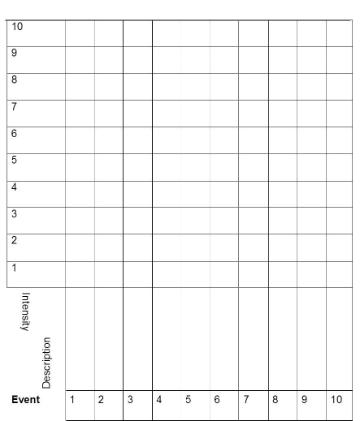
Discussion
Ask discussion questions of all 9 types (see Day 1).
Key Questions
- Why does Steinbeck tell the story in the first person?
- Why is gossip, even when true, usually ugly?
- If you ran into Johnny Bear, would you want to hear one of his performances?
- Does anyone in this story behave in a responsible manner?
- Looking back, what hints did Steinbeck leave that might have “clued in” the reader as to what was really going on with Miss Amy?
- Why is Alex worried that someone recognized Miss Amy’s voice in the end?
- Were you surprised by the end of the story?
- What would have been the consequences of Miss Amy’s unplanned pregnancy in 1930’s rural California?
- How would Miss Amy’s situation have been different if she were alive today?
Analyze
Analyze the key paragraph.
Key Paragraph, p. 106
“Alex rolled a cigarette a lighted it. ‘He isn’t, but he loves whiskey. He knows if he listens in windows and comes here and repeats what he hears, someone will give him whiskey. He tries to palm off Mrs. Ratz’ conversation in the store, or Jerry Noland arguing with his mother, but he can’t get whiskey for that’” (p. 106).
Extend
Write
Have each student write a short product based on today’s prompt to connect to the unit theme.
The men in Loma can’t get enough of the gossip that Johnny Bear’s talent provides. They buy him whiskey night after night, just so they can be entertained. They rarely think about who could be hurt as a result.
Think about time when someone was hurt by gossip, either you or someone you know. Write a paragraph about the danger and hurtful power that gossip can have in a community. Use one example from the story, and one example from your life to make your point. Is gossiping a responsible act? What action can individuals take to counteract the effects of gossip? Be sure to include a strong thesis statement about gossip’s consequences.
Close
Close by extending today’s lesson to life and the world.
Community Connection
The common thread of nature links all of the stories in Steinbeck’s The Long Valley. As you read the novel, have students list all of the animals and plants mentioned in the novel. As the novel progresses, they can research interesting facts about these animals and plants, and create an illustrated dictionary of California flora and fauna.
This week, choose one item from your list to share with the class. Make a poster, PowerPoint, or handout that includes the item’s common and scientific name, a large illustration, and at least ten interesting facts about your plant’s or animal’s habits, lifespan, habitat, and level of endangerment. Share your findings with your teacher and peers.
Day 20-The Long Valley, "The Murder"
Outcomes for Today
Prepare
Background
Gather background knowledge about a place, time, event, person, or thing.
What is a Jugo-Slav?
Yugoslavia was a country in southeastern Europe. It was created after World War I as part of the Versailles Treaty from areas previously controlled by the Austrian-Hungarian Empire. It was bordered by Greece, Italy, Albania, Austria, Hungary, Romania, and Bulgaria. It was home to a variety of competing ethnic groups, and was often referred to collectively as the powder keg of Europe. Its history in the late 20th Century would turn tragic, as it was the location of mass genocide in the 1990s.
Word Wall
Here are five vocabulary words to teach and add to the Word Wall.
|
vulgarity (124) |
rig (125) |
cantered (127) |
glistened (130) |
resonance (133) |
Read
Review
Review the timeline from the beginning every day.
Read
Read the selection, usually in a Shared Reading Read React Predict Cycle of 2-3 pages.
Read p. 121-134, “The Murder”
|
Setting |
Characters |
Pages |
|
Canon del Castillo valley, the Moore ranch |
Jim Moore |
121-122 |
|
Jim Moore’s wedding |
Jim Moore, Jelka Šepić, Mr. Šepić |
122 |
|
The Moore ranch |
Jim Moore, Jelka Moore |
122-127 |
|
The Moore Ranch, on the way to town |
Jim Moore |
127 |
|
Jim Moore, his neighbor George |
127-128 |
|
|
The Moore Ranch |
Jim Moore |
128-130 |
|
|
Jim Moore, Jelka Moore, her male cousin |
130 |
|
The Moore Ranch, outside the house |
Jim Moore |
130 |
|
The Moore Ranch |
Jim Moore, Jelka Moore, her cousin |
130-131 |
|
The Moore Ranch, daybreak |
Jim Moore, the deputy sheriff, the coroner |
131-132 |
|
The Moore Ranch |
Jim Moore, Jelka Moore |
132-134 |
Respond
Timeline
Agree on the facts in today’s reading and list the 3-5 most important on the timeline.
Students might mention:
- The story is set in Monterey County, in a valley in the Santa Lucia range called The Cañon del Castillo.
- There is an abandoned house on Jim Moore’s ranch; he lives in a new house elsewhere on the ranch with his pretty wife.
- In his early thirties, Jim Moore married a Jugo-Slav girl named Jelka Šepić.
- At his wedding, Jelka’s father advises Jim to beat Jelka, just as her mother and grandmother were beaten, or she won’t like him.
- Jim soon discovers that Jelka is a pretty, devoted, and capable wife, but they never have a real connection.
- After a year of marriage, Jim starts going to hang out in Monterey on Saturday nights with the girls in the brothel again.
- Jelka never minds, and never wants to go to town with him.
- On his way into town late on Saturday night, Jim runs into a neighbor who tells him that someone has poached one of his calves.
- Jim goes to investigate, then heads home because it’s now too late to go to town, and he’s worried about his wife’s safety.
- Once he gets home, he immediately hears a strange horse in the barn.
- Jim quietly enters the house, looking for an intruder, and sees Jelka in bed with her cousin.
- Jim leaves the house, but soon recovers, enters the house, and shoots Jelka’s cousin as he lies next to her in bed.
- Jim walks out of the house and rides away.
- In the morning, Jim returns with the deputy sheriff and the coroner.
- They take care of the body, tell Jim that charges will likely be dismissed, and ask him to go easy on his wife.
- Jim finds Jelka hiding in the barn, and beats her with a bullwhip.
- Afterward, Jelka makes him breakfast, and Jim tells her they’re going to build a new house.
- Jim promises not to whip Jelka any more—for this.
Map
Add to ongoing class activities like a KWL chart or map: where did the characters go?
Map
Find a possible location for Jim and Jelka’s ranch on your map of California.
KWL
Complete your KWL chart on Steinbeck’s California. What do we know now about the lives of the people on which Steinbeck based most of his work? What does all of this reveal about the author’s attitude toward his home state?
Explore
Activity
Explore the reading more deeply with a visual or oral language activity.
6g6 Venn Diagram
Use a Venn Diagram to compare Jim and Jelka. What do they have in common? How are they different? Should they have gotten married?
6g6 Venn Diagram
Discussion
Ask discussion questions of all 9 types (see Day 1).
Key Questions
- From the first page of the story, how did Steinbeck hint at the tragedy that might take place?
- What expectations did men have of their wives in the 1930s?
- Why do you think Jelka married Jim?
- What was the biggest problem in Jim and Jelka’s marriage?
- Is what Jelka was doing with her cousin any different than what Jim was doing at the Three Stars?
- Do Jim and Jelka behave responsibly?
- If Jim existed today, what would have been the consequences of his behavior?
- Once again, what does this story reveal about Steinbeck’s attitude toward women?
Analyze
Analyze the key paragraph.
Key Paragraph, p. 133
“‘You hurt me,’ she said. ‘You hurt me bad.’
He nodded gravely. ‘Bad as I could without killing you’” (p. 133).
Extend
Write
Have each student write a short product based on today’s prompt to connect to the unit theme.
In “The Murder,” neither Jim nor Jelka is a particularly moral person. Both make mistakes and suffer in a marriage that is lacking on both sides. Steinbeck carefully crafts his characters so that both have strong positive and negative qualities.
Use the Venn Diagram you completed today to write a paragraph comparing and contrasting Jim and Jelka. How are they the same, and how are they different? Both show responsibility at some times, but not at others. Focus on character traits when discussing these two individuals and their marriage.
Close
Close by extending today’s lesson to life and the world.
Community Connection
The common thread of nature links all of the stories in Steinbeck’s The Long Valley. As you read the novel, have students list all of the animals and plants mentioned in the novel. As the novel progresses, they can research interesting facts about these animals and plants, and create an illustrated dictionary of California flora and fauna.
This week, choose one item from your list to share with the class. Make a poster, PowerPoint, or hand out that includes the item’s common and scientific name, a large color illustration, and at least ten interesting facts about your plant’s or animal’s habits, lifespan, habitat, and current level of endangerment. Share your findings with your teacher and your peers.
Final Writing Product
John Steinbeck’s collection of short stories, The Long Valley, immortalizes numerous fascinating characters. They range from the overwhelmingly moral to the depraved, and both inspire and disgust the reader. Steinbeck brings his characters to life by making them real people, even when their actions and decisions are guided by the basest human instincts.
Though many of Steinbeck’s characters are similar, no two are exactly alike. For your final writing product on The Long Valley, you will choose two similar characters from two different stories, and compare them to one another. Write an essay comparing and contrasting these two characters, focusing especially how each illustrates the concept of Responsibility Requires Action. Use the checklist below to help you plan and execute your essay.
o Choose two similar characters. You might choose two farmers, two women, two fathers, two growers, two single men, two married men, two animal lovers, etc. Write their names, and the titles of their stories, below.
_________________________ ________________________
Character 1 Story 1
_________________________ ________________________
Character 2 Story 2
o Complete a Venn Diagram comparing and contrasting these two characters.
Write a strong thesis statement, including at least one similarity and one
difference you will be concentrating on in your essay.
o List a quote from each story that illustrates one of the characters’ similarities.
“___________________________________________________________.
Quote from Story 1 page #
“___________________________________________________________.
Quote from Story 2 page #
o List a quote from each story that illustrates one of the characters’ differences.
“___________________________________________________________.
Quote from Story 1 page #
“___________________________________________________________.
Quote from Story 2 page #
o Write two body paragraphs. One body paragraph should be about similarities, one on differences.
o Write a stellar introductory paragraph. Include your thesis statement, the author’s name, the book’s name, the characters’ names, and the stories’ names.
o Finally, write your closing paragraph. This should restate your thesis, and summarize your body paragraphs. End with a general statement about Steinbeck’s view on your chosen characters. For example, after comparing two female characters, you might conclude that Steinbeck thought _______ about women.
o Trade your rough draft with a peer and begin the editing process.
o Type or neatly write your final essay.