Lesson Plan
White Fang
40
60
90
Day 1
Outcomes for Today
Outcomes for Today
W2. Write informative/explanatory texts to examine a topic and convey ideas, concepts, and information through the selection, organization, and analysis of relevant content.
a.) Introduce a topic clearly, previewing what is to follow; organize ideas, concepts, and information, using strategies such as definition, classification, comparison/contrast, and cause/effect; include formatting (e.g., headings), graphics (e.g., charts, tables), and multimedia when useful to aiding comprehension.
b.) Develop the topic with relevant facts, definitions, concrete details, quotations, or other information and examples.
c.) Use appropriate transitions to create cohesion and clarify the relationships among ideas and concepts.
d.) Use precise language and domain-specific vocabulary to inform about or explain the topic.
e.) Establish and maintain a formal style.
f.) Provide a concluding statement or section that follows from and supports the information or explanation presented.
W4. Produce clear and coherent writing in which the development, organization, and style are appropriate to task, purpose, and audience. (Grade-specific expectations for writing types are defined in standards 1-3.)
W7. Conduct short research projects to answer a question, drawing on several sources and generating additional related, focused questions for further research and investigation. W10. Write routinely over extended time frames (time for research, reflection, and revision) and shorter time frames (a single sitting or a day or two) for a range of discipline-specific tasks, purposes, and audiences.
Prepare
Background
Gather background knowledge about a place, time, event, person, or thing.
What is the weather, climate, and geography of the Yukon Territory?
Yukon, formerly Yukon Territory, territory of northwestern Canada, an area of rugged mountains and high plateaus. It is bounded by the Northwest Territories to the east, by British Columbia to the south, and by the U.S. state of Alaska to the west, and it extends northward above the Arctic Circle to the Beaufort Sea. The capital is Whitehorse.
The mineral wealth of Yukon has been known since the famous Klondike gold rush of the later 1890s, but the combination of an Arctic climate and remoteness from markets has limited the economic exploitation of such resources and the development of modern settlement. Instead, the territory remains among the few frontiers on the North American continent, a sparsely populated and largely unspoiled wilderness. Area 186,272 square miles (482,443 square km). Pop. (2011) 33,897.
Source, pictures, and maps: https://www.britannica.com/place/Yukon-territory
Word Wall
Here are five vocabulary words to teach and add to the Word Wall.
|
persisted (109) |
comrade (109) |
betray (111) |
carcasses (111) |
moccasins (112) |
Read
Review
Review the timeline from the beginning every day.
Read
Read the selection, usually in a Shared Reading Read React Predict Cycle of 2-3 pages.
Read 107-114
|
Setting |
Characters |
Pages |
|
Northland Wild also referred to as the Northland in the Yukon Territory, Canada |
Henry, Bill, and sled-dogs |
107-114 |
Respond
Timeline
Agree on the facts in today’s reading, and list the 3-5 most important on the Timeline.
Students might mention:
- Bill and Henry are mushing to Fort McGurry with the body of Lord Alfred in a box. Alfred froze to death.
- Bill sees that there is another dog with their group of dogs, but he only has cartridges left in his rife so he doesn't want to shoot at wolves unless it’s a sure shot.
- The next morning the men discover Fatty was eaten by the wolves.
Map
Add to ongoing class activities like a KWL chart or map: where did the characters go?
Map
Create a map of the west coast, from the Yukon Territory to Santa Clara, and mark places along the path mentioned in the novel.
Today locate: Yukon Territory, Canada
Conflict Chart:
Create a class conflict chart (see example below)
|
1st person or thing involved in the conflict |
2nd person or thing involved in the conflict |
example and page from the book |
illustration |
|
|
Animal Fatty the sled-dog |
Animal unknown animal |
113 Fatty is eaten by an animal. |
|
You should be looking for conflicts that involve (but are not limited to J)
Man vs. man
Man vs. nature
Animal vs. man
Animal vs. nature
As the characters change or are involved in a conflict add them to the chart.
Explore
Activity
Explore the reading more deeply with a visual or oral language activity.
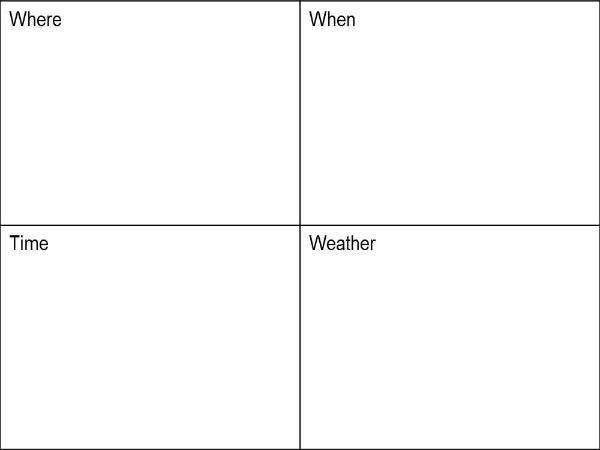
1g6 Setting Chart
- Describe the place where the story takes place in the where box on the chart. This includes the location, geography, scenery and other details about the place.
- Describe the time period in which the story is taking place in the when box on the chart. Is this a contemporary story, or does it take place in the past or the future? Give details about this past or future time if this is the case.
- Describe the time of day or day of the week the story begins in the time box on the chart. This box is important if the story of the part you are analyzing takes place in a short period of time.
- Describe the weather in the weather box of the chart. Is it sunny, stormy, snowing, all of the above, none of the above? Sometimes the weather matters, sometimes not. Sometimes it is critical.
Discussion
Ask discussion questions of all 9 types.
Key Questions
- In your own words, describe the journey of Henry and Bill. Where are they going? How are they getting there?
- What is the purpose of their journey?
- Who is Lord Alfred? How did he die? What lessons did Henry and Bill learn from him?
- Provide three quotes that prove that the North is cold.
- Explain how Henry and Bill depend on their dogs? How do their dogs depend on Henry and Bill?
- How are these dogs different than pets?
- What type of sounds do Henry and Bill hear?
- Formulate a theory of how Henry and Bill will be affected by the wild?
- How do you think Henry and Bill protect themselves in the wild?
- Predict what will happen next in the journey.
Analyze
Analyze the key paragraph.
Key Paragraph, pg. 113
“’Say, Henry,’ he asked suddenly,
‘how many dogs did you say we had?’
‘Six.’
‘Wrong,’ Bill proclaimed triumphantly.
‘Seven again?’ Henry queried.
‘No, five; one’s gone.’
‘The hell!’ Henry cried in wrath, leaving the cooking to come and count the dogs.
‘You’re right, Bill,’ he concluded. ‘Fatty’s gone’” (p. 113).
Extend
Write
Have each student write a short product based on today’s prompt to connect to the unit theme.
Henry is convinced that they are only traveling with six dogs. Bill tries to convince Henry that he fed fish to seven dogs. The next day, the men only count five dogs and the dog Fatty is missing.
In an informative paragraph, explain why Bill is convinced there were seven dogs. Why did Henry not believe him? What do Bill and Henry think happened to Fatty? What do you think happened to Fatty?
Close
Close by extending today’s lesson to life and the world.
Day 2
Outcomes for Today
Outcomes for Today
W2. Write informative/explanatory texts to examine a topic and convey ideas, concepts, and information through the selection, organization, and analysis of relevant content.
a.) Introduce a topic clearly, previewing what is to follow; organize ideas, concepts, and information, using strategies such as definition, classification, comparison/contrast, and cause/effect; include formatting (e.g., headings), graphics (e.g., charts, tables), and multimedia when useful to aiding comprehension.
b.) Develop the topic with relevant facts, definitions, concrete details, quotations, or other information and examples.
c.) Use appropriate transitions to create cohesion and clarify the relationships among ideas and concepts.
d.) Use precise language and domain-specific vocabulary to inform about or explain the topic.
e.) Establish and maintain a formal style.
f.) Provide a concluding statement or section that follows from and supports the information or explanation presented.
W4. Produce clear and coherent writing in which the development, organization, and style are appropriate to task, purpose, and audience. (Grade-specific expectations for writing types are defined in standards 1-3.)
W7. Conduct short research projects to answer a question, drawing on several sources and generating additional related, focused questions for further research and investigation. W10. Write routinely over extended time frames (time for research, reflection, and revision) and shorter time frames (a single sitting or a day or two) for a range of discipline-specific tasks, purposes, and audiences.
Prepare
Background
Gather background knowledge about a place, time, event, person, or thing.
What is a famine?
Famine, severe and prolonged hunger in a substantial proportion of the population of a region or country, resulting in widespread and acute malnutrition and death by starvation and disease. Famines usually last for a limited time, ranging from a few months to a few years. They cannot continue indefinitely, if for no other reason than that the affected population would eventually be decimated.
Source: https://www.britannica.com/science/famine
Word Wall
Here are five vocabulary words to teach and add to the Word Wall.
| sympathized (115) | triumphant (115 | harnessed (116) | vague (116) | eagerness (116 |
Read
Review
Review the timeline from the beginning every day.
Read
Read the selection, usually in a Shared Reading Read React Predict Cycle of 2-3 pages.
Read 114-123
|
Setting |
Characters |
Pages |
|
Northland Wild also referred to as the Northland in the Yukon Territory, Canada |
Henry, Bill, sled-dogs, and the she-wolf. |
114-123 |
Respond
Timeline
Agree on the facts in today’s reading, and list the 3-5 most important on the Timeline.
Students might mention:
- A wolf that looks like a dog tries to steal salmon from Bill.
- Bill and Henry tie their dogs using leather for the night and in the morning Spanker (one of the dogs) was able to escape.
- She-wolf comes to the camp again in the evening. Bill goes to shoot it but it leaps away.
- The wolves are in a famine and are starving.
Map
Add to ongoing class activities like a KWL chart or map: where did the characters go?
Map
Create a map of the west coast, from the Yukon Territory to Santa Clara, and mark places along the path mentioned in the novel.
Conflict Chart
Create a class conflict chart (see example below)
|
1st person or thing involved in the conflict |
2nd person or thing involved in the conflict |
example and page from the book |
illustration |
|
|
Animal Fatty the sled-dog |
Animal unknown animal |
page 113 Fatty is eaten by an animal. |
|
|
|
Nature The famine |
Vs |
Animal The wolves |
page120-121 The wolves are starving from the famine. |
|
You should be looking for conflicts that involve (but are not limited to J)
Man vs. man
Man vs. nature
Animal vs. man
Animal vs. nature
As the characters change or are involved in a conflict add them to the chart.
Explore
Activity
Explore the reading more deeply with a visual or oral language activity.
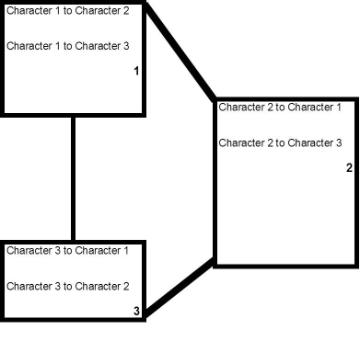
5g6 Character Interaction Chart
- Fill the name of three characters (ex: Bill, Henry, and the Wolves) in each one of the 3 boxes.
- Each character box has another character box on each side. On the side of the first character box near the second character box, write down what the first character thinks about the second character, and how the first character interacts or gets along with, the second character.
- Then do the same thing for how the second character thinks about and interacts with the first, in the second characters box.
- Continue doing this until you have filled out each box: the second for the third, the third for the second, the third for the first and the first for the third.
Discussion
Ask discussion questions of all 9 types.
Key Questions
- Explain what happened to Fatty.
- Describe the series of events that lead to Spankers disappearance.
- Henry and Bill are the leaders of their dogs. How do they protect their dogs?
- Do you think Henry and Bill are examples of leadership requires engagement? Why or why not?
- Select a quote from today's reading that proves that the wolves will even try to eat Bill and Henry.
- What advice would you give Henry and Bill to ensure their safety and the safety of their dogs?
- Who is the wolf dog or the she-wolf? Describe what the wolf dog looks like.
- Explain why the she-wolf is showing up around the campsite.
- Describe how Billy tried to kill the wolf dog. Explain why he wasn't successful.
- Predict what will happen next in the journey.
Analyze
Analyze the key paragraph.
Key Paragraph, pg. 120-121
“But Bill ignored him.
‘I seen some of them. They’re pretty thin. They ain’t had a bite in weeks I reckon, outside of Fatty an’ Frog an’ Spanker; an’ there’s so many of ’em that that didn’t go far. They’re remarkable thin. Their ribs is like wash-boards, an’ their stomachs is right up against their backbones. They’re pretty desperate, I can tell you. They’ll be goin’ mad, yet, an’ then watch out’” (p. 120-121).
Extend
Write
Have each student write a short product based on today’s prompt to connect to the unit theme.
The wolves are suffering from a famine. Pretend you are a news reporter and write an article about the famine. In an informative paragraph, explain how the famine is affecting the animals, including the wolves. Pretend you are able to interview Henry and Bill. Provide a quote from today’s reading from Henry or Bill to include in your article. Be sure to introduce Henry and Bill to your audience by explaining what they are doing, how they are traveling, where are they going, what is their purpose, etc.
Close
Close by extending today’s lesson to life and the world.
Day 3
Outcomes for Today
Outcomes for Today
W2. Write informative/explanatory texts to examine a topic and convey ideas, concepts, and information through the selection, organization, and analysis of relevant content.
a.) Introduce a topic clearly, previewing what is to follow; organize ideas, concepts, and information, using strategies such as definition, classification, comparison/contrast, and cause/effect; include formatting (e.g., headings), graphics (e.g., charts, tables), and multimedia when useful to aiding comprehension.
b.) Develop the topic with relevant facts, definitions, concrete details, quotations, or other information and examples.
c.) Use appropriate transitions to create cohesion and clarify the relationships among ideas and concepts.
d.) Use precise language and domain-specific vocabulary to inform about or explain the topic.
e.) Establish and maintain a formal style.
f.) Provide a concluding statement or section that follows from and supports the information or explanation presented.
W4. Produce clear and coherent writing in which the development, organization, and style are appropriate to task, purpose, and audience. (Grade-specific expectations for writing types are defined in standards 1-3.)
W7. Conduct short research projects to answer a question, drawing on several sources and generating additional related, focused questions for further research and investigation. W10. Write routinely over extended time frames (time for research, reflection, and revision) and shorter time frames (a single sitting or a day or two) for a range of discipline-specific tasks, purposes, and audiences.
Prepare
Background
Gather background knowledge about a place, time, event, person, or thing.
Are wolves dangerous to humans?
Two recent reports on wolf-human interactions conclude that attacks by healthy wild wolves do occur but are rare and unusual events despite growing numbers of wolves worldwide. Both reports also state that there has not been a person killed by wolves in North America during the 20th century. The Fear of Wolves: A Review of Wolf Attacks on Humans, edited by John Linnell, documents worldwide wolf attacks during the past 400 years. The authors reviewed records of wolf-human encounters from a variety of sources and concluded that historically attacks on humans were very rare, and attacks in the 20th century were even rarer. The report also documents four factors that are associated with wolf attacks. These are rabies (a majority of attacks involved rabid wolves), habituation (many attacks involved wolves that had lost their fear of humans), provocation (wolves were provoked into attack when humans cornered or trapped them or entered their den), and highly modified environments (many attacks occurred in areas where humans have greatly altered the environment). The report also notes that a decrease in the incidence of rabies worldwide has led to a decrease in the number of rabid wolf attacks.
Source: http://wolf.org/wp-content/uploads/2013/05/Are-Wolves-Dangerous-to-Humans.pdf
Word Wall
Here are five vocabulary words to teach and add to the Word Wall.
|
companionship (124) |
ammunition (126) |
desperately (127) |
haggard (127) |
appreciation (127) |
Read
Review
Review the timeline from the beginning every day.
Read
Read the selection, usually in a Shared Reading Read React Predict Cycle of 2-3 pages.
Read 114-124
|
Setting |
Characters |
Pages |
|
Northland Wild or Northland in the Yukon Territory, Canada |
Henry, Bill, sled-dogs, One Ear, and the wolves. |
114-124 |
Respond
Timeline
Agree on the facts in today’s reading, and list the 3-5 most important on the Timeline.
Students might mention:
- Bill tries to save One Ear from the wolves.
- Henry hears shots being fired and then silence. The wolves have killed Bill.
- Henry gathers lots of firewood and makes a large fire to protect himself from the wolves.
- The wolves get too close to Henry and he throws flaming wood at them.
- The next morning Henry tries to create more distance between himself and the wolves. He lightens the sled by leaving the coffin behind.
- The wolves are starving and follow him closely.
- Henry has trouble sleeping and finds it difficult to scare the wolves away.
- He becomes fascinated with his own body thinking of how the wolves will feast upon him.
- He surrounds himself with fire and the wolves circle around him. The fire goes low and he tells the wolves that they could get him. He falls asleep.
- The next morning Henry is still alive and a group of men had chased the wolves away.
Map
Add to ongoing class activities like a KWL chart or map: where did the characters go?
Map
Create a map of the west coast, from the Yukon Territory to Santa Clara, and mark places along the path mentioned in the novel.
Conflict Chart
Create a class conflict chart (see example below)
|
1st person or thing involved in the conflict |
2nd person or thing involved in the conflict |
example and page from the book |
illustration |
|
|
Animal Fatty the sled-dog |
Animal unknown animal |
page 113 Fatty is eaten by an animal. |
|
|
|
Nature The famine |
Animal The wolves |
page120-121 The wolves are starving from the famine. |
|
|
|
Animal The wolves |
Man Bill |
page 126 The wolves attack Bill. |
|
You should be looking for conflicts that involve (but are not limited to)
Man vs. man
Man vs. nature
Animal vs. man
Animal vs. nature
As the characters change or are involved in a conflict add them to the chart.
Explore
Activity
Explore the reading more deeply with a visual or oral language activity.
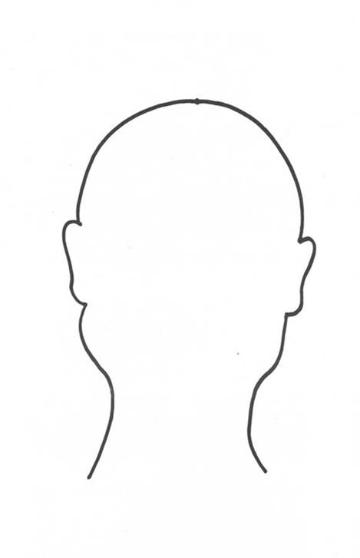
Open Mind Portrait
What problems is Henry faced with? Mention the roadblocks to the character solving his own problems. Explain what Henry is thinking when his conflicts reach a peak. What does he think when a resolution arrives?
Materials:
- large piece of stiff paper for each character, like 11x17 oak tag
- paper for bubbles with scissors and glue sticks
- markers, crayons, pens, pencils, or paint
- construction or tissue paper, scissors and glue sticks if desired
Discussion
Ask discussion questions of all 9 types.
Key Questions
- What does the literary term “allegory” mean?
- Based on what you learned about Darwinism, what is the difference between Social Darwinism and Scientific Darwinism?
- Provide an example of Social Darwinism.
- Provide an example of Scientific Darwinism.
- Which form do you think people are more pressured by?
- Why do you think the author is choosing to focus on a character that reverts back to its true calling?
- Do you think people at some point want to revert back to their beginnings? Why or why not?
- What is the act of civilization?
- Once civilized what circumstances can lead to you becoming uncivilized? If that occurs will your conscious mind revert you back?
- Predict the outcome of White Fang.
Analyze
Analyze the key paragraph.
Key Paragraph, pg. 132-133
“Dawn came, and daylight. The fire was burning low. The fuel had run out, and there was need to get more. The man attempted to step out of his circle of flame, but the wolves surged to meet him. Burning brands made them spring aside, but they no longer sprang back. In vain he strove to drive them back. As he gave up and stumbled inside his circle, a wolf leaped for him, missed, and landed with all four feet in the coals. It cried out with terror, at the same time snarling, and scrambled back to cool its paws in the snow. The man sat down on his blankets in a crouching position. His body leaned forward from the hips. His shoulders, relaxed and drooping, and his head on his knees advertised that he had given up the struggle. Now and again he raised his head to note the dying down of the fire. The circle of flame and coals was breaking into segments with openings in between. These openings grew in size, the segments diminished.
‘I guess you can come an’ get me any time,’ he mumbled.
‘Anyway, I’m goin’ to sleep’” (p. 132-133).
Extend
Write
Have each student write a short product based on today’s prompt to connect to the unit theme.
The wolves have eaten Bill and Henry cannot fend them off much longer. Henry eventually realizes that he might not survive the night. Pretend you are Henry. Write an informative journal entry that explains what has happened to Bill. In a second informative paragraph, describe your current situation of trying to fend off the wolves.
Close
Close by extending today’s lesson to life and the world.
Day 4
Outcomes for Today
Outcomes for Today
W2. Write informative/explanatory texts to examine a topic and convey ideas, concepts, and information through the selection, organization, and analysis of relevant content.
a.) Introduce a topic clearly, previewing what is to follow; organize ideas, concepts, and information, using strategies such as definition, classification, comparison/contrast, and cause/effect; include formatting (e.g., headings), graphics (e.g., charts, tables), and multimedia when useful to aiding comprehension.
b.) Develop the topic with relevant facts, definitions, concrete details, quotations, or other information and examples.
c.) Use appropriate transitions to create cohesion and clarify the relationships among ideas and concepts.
d.) Use precise language and domain-specific vocabulary to inform about or explain the topic.
e.) Establish and maintain a formal style.
f.) Provide a concluding statement or section that follows from and supports the information or explanation presented.
W4. Produce clear and coherent writing in which the development, organization, and style are appropriate to task, purpose, and audience. (Grade-specific expectations for writing types are defined in standards 1-3.)
W7. Conduct short research projects to answer a question, drawing on several sources and generating additional related, focused questions for further research and investigation. W10. Write routinely over extended time frames (time for research, reflection, and revision) and shorter time frames (a single sitting or a day or two) for a range of discipline-specific tasks, purposes, and audiences.
Prepare
Background
Gather background knowledge about a place, time, event, person, or thing.
Why do wolves travel in packs?
Wolves live in family groups called packs. A pack is usually made up of a male parent, a female parent and their pups from the last few years. Usually, four to six pups are born together in a litter. The pups in a litter are called litter mates. Their first home is usually a den, which can be a small cave or a hole dug in the ground. It must be big enough to shelter the mother and pups from weather and protect the pups from other animals that may want to hurt them. Packs sometimes use the same den for several years, or they may find a new den each year.
Source: http://www.wolf.org/wolf-info/wild-kids/wolf-families/
Word Wall
Here are five vocabulary words to teach and add to the Word Wall.
|
confronted (135) |
rivalry (135) |
resented (140) |
tentatively (141) |
snarling (142) |
Read
Review
Review the timeline from the beginning every day.
Read
Read the selection, usually in a Shared Reading Read React Predict Cycle of 2-3 pages.
Read 134-143
|
Setting |
Characters |
Pages |
|
Northland Wild or Northland in the Yukon Territory, Canada |
The she-wolf and the wolf pack |
134-139 |
|
Mackenzie River |
The she-wolf and One Eye |
140-143 |
Respond
Timeline
Agree on the facts in today’s reading, and list the 3-5 most important on the Timeline.
Students might mention
- The wolves run together in a pack to get through the famine. They kill and feast on a moose to end the famine.
- The wolves split up leaving only three wolves to travel to the Mackenzie River. The three males fight with each other. The older wolf is the only survivor.
- The she-wolf and One Eye run together.
Map
Add to ongoing class activities like a KWL chart or map: where did the characters go?
Map
Create a map of the west coast, from the Yukon Territory to Santa Clara, and mark places along the path mentioned in the novel.
Today locate: Mackenzie River
Conflict Chart
Create a class conflict chart (see example below)
|
1st person or thing involved in the conflict |
2nd person or thing involved in the conflict |
example and page from the book |
illustration |
|
|
Animal Fatty the sled-dog |
Animal unknown animal |
page 113 Fatty is eaten by an animal. |
|
|
|
Nature The famine |
Animal The wolves |
page120-121 The wolves are starving from the famine. |
|
|
|
Animal The wolves |
Man Bill |
page 126 The wolves attack Bill. |
|
You should be looking for conflicts that involve (but are not limited to)
Man vs. man
Man vs. nature
Animal vs. man
Animal vs. nature
As the characters change or are involved in a conflict add them to the chart.
Theme Chart
The introduction discusses the themes of the novel. Create a “T” for the class. On one side list the themes. As you read about them give examples of each from the novel.
Explore
Activity
Explore the reading more deeply with a visual or oral language activity.
5g6 Character Interaction Chart
- Choose 3 characters you have profiled and wish to analyze. Fill the name of each character in one of the 3 boxes.
- Each character box has another character box on each side. On the side of the first character box near the second character box, write down what the first character thinks about the second character, and how the first character interacts or gets along with, the second character.
- Then do the same thing for how the second character thinks about and interacts with the first, in the second characters box.
- Continue doing this until you have filled out each box: the second for the third, the third for the second, the third for the first and the first for the third.
Discussion
Ask discussion questions of all 9 types.
Key Questions
- In your own words describe the confrontation between the group of men and the wolf pack.
- Explain why the wolves are running together in a pack.
- During times of famine, how do the wolves demonstrate leadership requires engagement? How do they promote the common good? Provide an example.
- Describe the series of events that lead to the end of the famine.
- Describe a time when you worked with a group to accomplish a common goal.
- Why did the wolf pack split up?
- Describe the battle among the three wolves.
- What do you think was the purpose of their fight?
- Who is One Eye? Select a quote from today’s reading that reveals his character.
- Predict what you think will happen next.
Analyze
Analyze the key paragraph.
Key Paragraph, pg. 134
“Running at the forefront of the pack was a large grey wolf—one of its several leaders. It was he who directed the pack’s course on the heels of the she-wolf. It was he who snarled warningly at the younger members of the pack or slashed at them with his fangs when they ambitiously tried to pass him. And it was he who increased the pace when he sighted the she-wolf, now trotting slowly across the snow” (p. 134).
Extend
Write
Have each student write a short product based on today’s prompt to connect to the unit theme.
Old One Eye is the leader of his wolf pack during the famine. He follows the she-wolf to safety when the pack is confronted by a group of men. Reread today’s key passage to review One Eye’s responsibilities as the leader of the wolf pack. In an informative paragraph, describe One Eye’s responsibilities as the leader. Explain how One Eye uses his time and talent to better his community.
Close
Close by extending today’s lesson to life and the world.
Day 5
Outcomes for Today
Outcomes for Today
W2. Write informative/explanatory texts to examine a topic and convey ideas, concepts, and information through the selection, organization, and analysis of relevant content.
a.) Introduce a topic clearly, previewing what is to follow; organize ideas, concepts, and information, using strategies such as definition, classification, comparison/contrast, and cause/effect; include formatting (e.g., headings), graphics (e.g., charts, tables), and multimedia when useful to aiding comprehension.
b.) Develop the topic with relevant facts, definitions, concrete details, quotations, or other information and examples.
c.) Use appropriate transitions to create cohesion and clarify the relationships among ideas and concepts.
d.) Use precise language and domain-specific vocabulary to inform about or explain the topic.
e.) Establish and maintain a formal style.
f.) Provide a concluding statement or section that follows from and supports the information or explanation presented.
W4. Produce clear and coherent writing in which the development, organization, and style are appropriate to task, purpose, and audience. (Grade-specific expectations for writing types are defined in standards 1-3.)
W7. Conduct short research projects to answer a question, drawing on several sources and generating additional related, focused questions for further research and investigation. W10. Write routinely over extended time frames (time for research, reflection, and revision) and shorter time frames (a single sitting or a day or two) for a range of discipline-specific tasks, purposes, and audiences.
Prepare
Background
Gather background knowledge about a place, time, event, person, or thing.
Do wolf fathers eat their own young?
All the wolves in a pack help take care of the pups. When the pups are very small, other pack members bring food to the mother so she does not have to leave the den. When the pups are a little larger, pack members take turns bringing them food, playing with them and even baby-sitting. Once the pups are about eight weeks old, the adults leave the den and take the pups to a rendezvous site. In this open area, the wolves gather to sleep, play, eat and just hang out. Until the pups are old enough to go with the adults, they stay at the rendezvous site. Often, one of the adult wolves stays with the pups to watch over them.
Source: http://www.wolf.org/wolf-info/wild-kids/wolf-families/
Word Wall
Here are five vocabulary words to teach and add to the Word Wall.
|
lured (143) |
loath (143) |
hesitated (143) |
desire (151) |
devour (151) |
Read
Review
Review the timeline from the beginning every day.
Read
Read the selection, usually in a Shared Reading Read React Predict Cycle of 2-3 pages.
Read 143-151
|
Setting |
Characters |
Pages |
|
The lair near the Mackenzie River |
The she-wolf, One Eye, and a litter of pups |
143-151 |
Respond
Timeline
Agree on the facts in today’s reading, and list the 3-5 most important on the Timeline.
Students might mention
- The she-wolf has an instinct to search for something.
- Someone from the Indian camp shoots at she-wolf and One Eye.
- The she-wolf finds her litter of pups and One Eye brings the pups a porcupine.
Map
Add to ongoing class activities like a KWL chart or map: where did the characters go?
Map
Create a map of the west coast, from the Yukon Territory to Santa Clara, and mark places along the path mentioned in the novel.
Conflict Chart:
Create a class conflict chart (see example below)
|
1st person or thing involved in the conflict |
2nd person or thing involved in the conflict |
example and page from the book |
illustration |
|
|
Animal Fatty the sled-dog |
Animal unknown animal |
page 113 Fatty is eaten by an animal. |
|
|
|
Nature The famine |
Animal The wolves |
page120-121 The wolves are starving from the famine. |
|
|
|
Animal The wolves |
Man Bill |
page 126 The wolves attack Bill. |
|
You should be looking for conflicts that involve (but are not limited to)
Man vs. man
Man vs. nature
Animal vs. man
Animal vs. nature
As the characters change or are involved in a conflict add them to the chart.
Theme Chart
The introduction discusses the themes of the novel. Create a “T” for the class. On one side list the themes. As you read about them give examples of each from the novel.
Explore
Activity
Explore the reading more deeply with a visual or oral language activity.
Open Mind Portrait
You will add thought bubbles to her OMP every couple days. You could use different colors for the beginning, middle and end of the story. Remember in the beginning you are introduced to the setting, the characters and the problems they have. In the middle, you learn about the roadblocks to the characters solving their problems, and conflicts occur. In the end of the story those conflicts reach a peak and then resolve with a resolution of the character’s problems.
Discussion
Ask discussion questions of all 9 types.
Key Questions
- Compare and contrast she-wolf and One Eye’s behavior. How did their behavior change?
- What was the she-wolf looking for?
- Formulate a theory for why the Indian camp shoots at the she-wolf and One Eye.
- Where does the she-wolf find the pups?
- Why do you think One Eye didn’t eat the pups?
- Select two quotes from today’s reading that proves One Eye and Kiche are the parents of the pups.
- How does One Eye demonstrate leadership requires engagement in today’s reading? Provide one example.
- How is One Eye similar to one of your parents or guardians?
- In your own words, describe how One Eye hunts a porcupine.
- Predict what you think will happen with the new pubs.
Analyze
Analyze the key paragraph.
Key Paragraph, pg. 151
“When he dragged the result of his day’s hunt into the cave, the she-wolf inspected it, turned her muzzle to him, and lightly licked him on the neck. But the next instant she was warning him away from the cubs with a snarl that was less harsh than usual and that was more apologetic than menacing. Her instinctive fear of the father of her progeny was toning down. He was behaving as a wolf-father should, and manifesting no unholy desire to devour the young lives she had brought into the world” (p. 151).
Extend
Write
Have each student write a short product based on today’s prompt to connect to the unit theme.
The She-wolf and One Eye are following their instincts to protect and take care of their litter. In an explanatory paragraph, describe how the She-wolf and One Eye have followed their instincts. Provide three examples. In a second informative paragraph, explain how the She-wolf and One Eye demonstrate leadership requires engagement as they care for their litter.
Close
Close by extending today’s lesson to life and the world.
Day 6
Outcomes for Today
Outcomes for Today
W2. Write informative/explanatory texts to examine a topic and convey ideas, concepts, and information through the selection, organization, and analysis of relevant content.
a.) Introduce a topic clearly, previewing what is to follow; organize ideas, concepts, and information, using strategies such as definition, classification, comparison/contrast, and cause/effect; include formatting (e.g., headings), graphics (e.g., charts, tables), and multimedia when useful to aiding comprehension.
b.) Develop the topic with relevant facts, definitions, concrete details, quotations, or other information and examples.
c.) Use appropriate transitions to create cohesion and clarify the relationships among ideas and concepts.
d.) Use precise language and domain-specific vocabulary to inform about or explain the topic.
e.) Establish and maintain a formal style.
f.) Provide a concluding statement or section that follows from and supports the information or explanation presented.
W4. Produce clear and coherent writing in which the development, organization, and style are appropriate to task, purpose, and audience. (Grade-specific expectations for writing types are defined in standards 1-3.)
W7. Conduct short research projects to answer a question, drawing on several sources and generating additional related, focused questions for further research and investigation. W10. Write routinely over extended time frames (time for research, reflection, and revision) and shorter time frames (a single sitting or a day or two) for a range of discipline-specific tasks, purposes, and audiences.
Prepare
Background
Gather background knowledge about a place, time, event, person, or thing.
What is a lynx?
Lynx (genus Lynx), any of four species of short-tailed cats (family Felidae) found in the forests of Europe, Asia, and North America. The Canada lynx (Lynx canadensis) and the bobcat (L. rufus) live in North America. The Eurasian lynx (L. lynx) and the Iberian lynx (L. pardinus) are their European counterparts. The Iberian lynx is the most endangered feline; as of 2013 possibly fewer than 300 individuals remained in the mountainous scrubland of southern Spain.
Source: https://www.britannica.com/animal/lynx-mammal
Word Wall
Here are five vocabulary words to teach and add to the Word Wall.
|
customary (154) |
sufficient (154) |
disappear (154) |
lair (155) |
fiercely (156) |
Read
Review
Review the timeline from the beginning every day.
Read
Read the selection, usually in a Shared Reading Read React Predict Cycle of 2-3 pages.
Read 151-156
|
Setting |
Characters |
Pages |
|
The lair near the Mackenzie River |
The she-wolf, One Eye, litter of cubs, little grey cub, a deadly lynx |
151-156 |
Respond
Timeline
Agree on the facts in today’s reading, and list the 3-5 most important on the Timeline.
Students might mention:
- A little grey cub grows stronger than the other cubs.
- The cub watches his father leave the cave and walk into the wall of light. He tries to walk through another wall of the cave and bumps his nose. The cub wonders why his father can walk through caves but he cannot.
- There is a famine. The cub’s brother and sister die. He is the only one left.
- One Eye is killed while trying to fight a lynx.
Map
Add to ongoing class activities like a KWL chart or map: where did the characters go?
Map
Create a map of the west coast, from the Yukon Territory to Santa Clara, and mark places along the path mentioned in the novel.
Conflict Chart:
Create a class conflict chart (see example below)
|
1st person or thing involved in the conflict |
2nd person or thing involved in the conflict |
example and page from the book |
illustration |
|
|
Animal Fatty the sled-dog |
Animal unknown animal |
page 113 Fatty is eaten by an animal. |
|
|
|
Nature The famine |
Animal The wolves |
page120-121 The wolves are starving from the famine. |
|
|
|
Animal The wolves |
Man Bill |
page 126 The wolves attack Bill. |
|
You should be looking for conflicts that involve (but are not limited to)
Man vs. man
Man vs. nature
Animal vs. man
Animal vs. nature
As the characters change or are involved in a conflict add them to the chart.
Theme Chart
The introduction discusses the themes of the novel. Create a “T” for the class. On one side list the themes. As you read about them give examples of each from the novel.
Explore
Activity
Explore the reading more deeply with a visual or oral language activity.
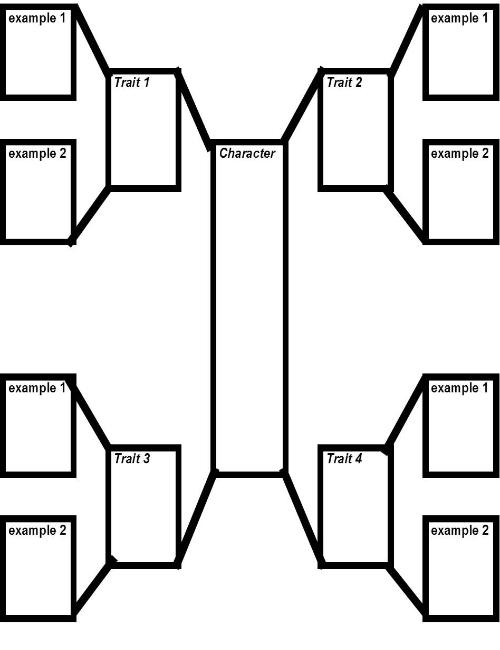
4g6 Character Profile Chart
- Write the name of the character in the box in the middle of the chart.
- Think of 4 characteristics, or traits, that the character has. Describe each with a key word or phrase and write it down one of the 4 boxes that surround the name.
- For each trait, find 2 concrete examples of it in the story. Write each in one of the 2 boxes attached to each trait box. Continue this until you have 2 examples for each of the 4 traits.
Discussion
Ask discussion questions of all 9 types.
Key Questions
- In your own words, describe the little grey cub.
- How is the grey cub similar and different to its siblings?
- Explain how the One Eye can walk through the wall of light.
- How did the cub react when he was not able to walk through the walls like his father?
- For the first time, the cub tried to walk through the wall of light but failed. Describe a time when you tried something for the first and did not succeed.
- Select facts from today’s reading that prove the cub is a curious creature.
- Describe the series of events that led to One Eye’s death.
- What lessons about death does the cub learn about in today’s reading?
- How is the she-wolf similar to the lynx?
- Predict what you think will happen next.
Analyze
Analyze the key paragraph.
Key Paragraph, pg. 155
“Then there came a time when the grey cub no longer saw his father appearing and disappearing in the wall nor lying down asleep in the entrance. This had happened at the end of a second and less severe famine. The she-wolf knew why One Eye never came back, but there was no way by which she could tell what she had seen to the grey cub. Hunting herself for meat, up the left fork of the stream where lived the lynx, she had followed a day-old trail of One Eye. And she had found him, or what remained of him, at the end of the trail. There were many signs of the battle that had been fought, and of the lynx’s withdrawal to her lair after having won the victory. Before she went away, the she-wolf had found this lair, but the signs told her that the lynx was inside, and she had not dared to venture in” (p. 155).
Extend
Write
Have each student write a short product based on today’s prompt to connect to the unit theme.
In today’s reading Jack London explains that the lynx has killed One Eye. The She-wolf saw his remains near the lynx’s lair so she understands what has happened, but is not able to communicate this to her little grey wolf. Pretend wolves can read and write. As the she-wolf, write an explanatory letter to the little grey wolf that describes the series of events that lead to One Eye’s death. What happened first, second, and third? In second informative paragraph, explain why it is important to hunt in pairs or in groups for safety.
Close
Close by extending today’s lesson to life and the world.
Day 7
Outcomes for Today
Outcomes for Today
W2. Write informative/explanatory texts to examine a topic and convey ideas, concepts, and information through the selection, organization, and analysis of relevant content.
a.) Introduce a topic clearly, previewing what is to follow; organize ideas, concepts, and information, using strategies such as definition, classification, comparison/contrast, and cause/effect; include formatting (e.g., headings), graphics (e.g., charts, tables), and multimedia when useful to aiding comprehension.
b.) Develop the topic with relevant facts, definitions, concrete details, quotations, or other information and examples.
c.) Use appropriate transitions to create cohesion and clarify the relationships among ideas and concepts.
d.) Use precise language and domain-specific vocabulary to inform about or explain the topic.
e.) Establish and maintain a formal style.
f.) Provide a concluding statement or section that follows from and supports the information or explanation presented.
W4. Produce clear and coherent writing in which the development, organization, and style are appropriate to task, purpose, and audience. (Grade-specific expectations for writing types are defined in standards 1-3.)
W7. Conduct short research projects to answer a question, drawing on several sources and generating additional related, focused questions for further research and investigation. W10. Write routinely over extended time frames (time for research, reflection, and revision) and shorter time frames (a single sitting or a day or two) for a range of discipline-specific tasks, purposes, and audiences.
Prepare
Background
Gather background knowledge about a place, time, event, person, or thing.
What is a ptarmigan?
Ptarmigan, any of three or four species of partridge like grouse of cold regions, belonging to the genus Lagopus of the grouse family, Tetraonidae. They undergo seasonal changes of plumage, from white against winter snowfields to grey or brown, with barring, in spring and summer against tundra vegetation. Ptarmigan differ from other members of the grouse family in having the toes covered with stiff feathers above and below.
Source: https://www.britannica.com/animal/ptarmigan
Word Wall
Here are five vocabulary words to teach and add to the Word Wall.
|
nudge (157) |
obedience (157) |
petrified (157) |
intimidating (165) |
whimpering (165) |
Read
Review
Review the timeline from the beginning every day.
Read
Read the selection, usually in a Shared Reading Read React Predict Cycle of 2-3 pages.
Read 156-166
|
Setting |
Characters |
Pages |
|
The lair near the Mackenzie River |
The she-wolf, little grey cub, ptarmigan chick, hawk, and weasel. |
156-166 |
Respond
Timeline
Agree on the facts in today’s reading, and list the 3-5 most important on the Timeline.
Students might mention:
- The mother wolf leaves the cave to find food. The cub is obedient and does not approach the entrance. He fears the unknown.
- When the cub gets older he becomes more interested in exploring. Though scared he leaves the cave.
- He kills a ptarmigan chick. The chick’s mother attacks the cub. A hawk swoops down and almost picks the cub up.
- The cub falls in a stream. When he gets out he is attacked by a weasel and is rescued by his mother. The mother kills the weasel and they both eat it.
Map
Add to ongoing class activities like a KWL chart or map: where did the characters go?
Map
Create a map of the west coast, from the Yukon Territory to Santa Clara, and mark places along the path mentioned in the novel.
Conflict Chart
Create a class conflict chart (see example below)
|
1st person or thing involved in the conflict |
2nd person or thing involved in the conflict |
example and page from the book |
illustration |
|
|
Animal Fatty the sled-dog |
Animal unknown animal |
page 113 Fatty is eaten by an animal. |
|
|
|
Nature The famine |
Animal The wolves |
page120-121 The wolves are starving from the famine. |
|
|
|
Animal The wolves |
Man Bill |
page 126 The wolves attack Bill. |
|
You should be looking for conflicts that involve (but are not limited to)
Man vs. man
Man vs. nature
Animal vs. man
Animal vs. nature
As the characters change or are involved in a conflict add them to the chart.
Theme Chart
The introduction discusses the themes of the novel. Create a “T” for the class. On one side list the themes. As you read about them give examples of each from the novel.
Explore
Activity
Explore the reading more deeply with a visual or oral language activity.
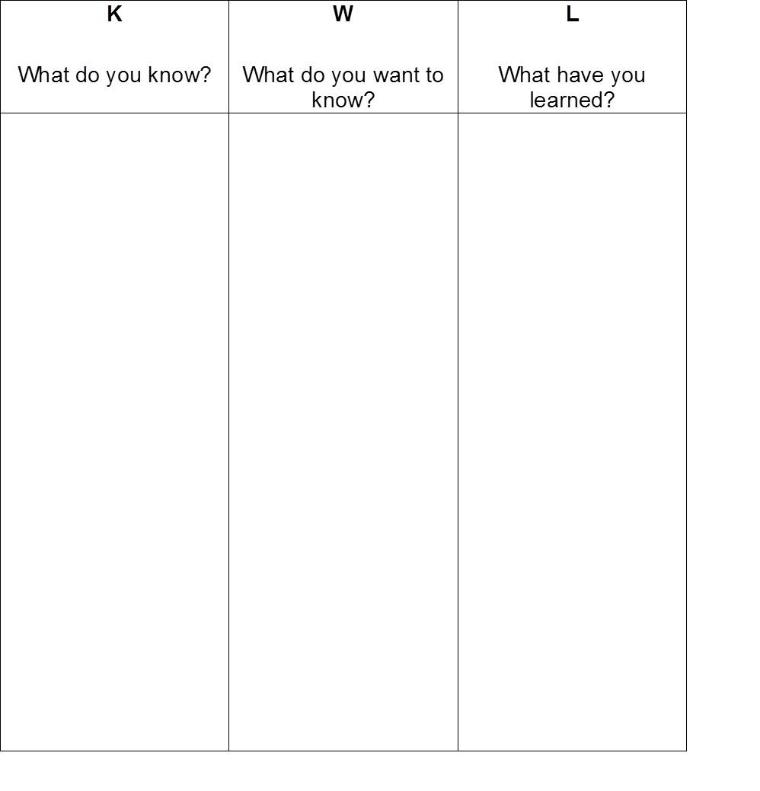
KWL Chart
What You Know, Want to Know, and Learn about wolves
Step One: Read the chapter or segment you wish to analyze
Step Two: Fill out the K [know] column: what do you know?
Step Three: Fill out the W [want] column: what do you want to know?
Step Four: Fill out the L [learned] column: what have you learned?
Discussion
Ask discussion questions of all 9 types.
Key Questions
- In your own words, describe what happens to the cub leaves the lair.
- Why do you think the cub is fearful when he leaves the lair?
- Describe a time when you were afraid of the unknown.
- Formulate a theory to explain why the cub became so intent on exploring outside his lair.
- How is the she-wolf similar to the ptarmigan chick’s mother?
- Describe the series of events that led to the weasel attack.
- Predict the outcome if the she-wolf did not arrive when the cub was attacked by a weasel.
- Select a quote from today’s reading that proves the she-wolf is a strong provider and defender of her cub.
- Do you think the cub is an example of leadership requires engagement? Do you think his actions promote the common good? Why or why not?
- Predict what you think will happen next.
Analyze
Analyze the key paragraph.
Key Paragraph, p. 166
“The grey cub would have died, and there would have been no story to write about him, had not the she-wolf come bounding through the bushes. The weasel let go the cub and flashed at the she-wolf’s throat, missing, but getting a hold on the jaw instead. The she wolf flirted her head like the snap of a whip, breaking the weasel’s hold and flinging it high in the air. And, still in the air, the she-wolf’s jaws closed on the lean, yellow body, and the weasel knew death between the crunching teeth. The cub experienced another access of affection on the part of his mother. Her joy at finding him seemed even greater than his joy at being found. She nuzzled him and caressed him and licked the cuts made in him by the weasel’s teeth. Then, between them, mother and cub, they ate the blood-drinker, and after that went back to the cave and slept” (p. 166).
Extend
Write
Have each student write a short product based on today’s prompt to connect to the unit theme.
The She-wolf places herself in danger in order to protect her little grey wolf. How is the She-wolf an example of leadership requires engagement? Think about someone who would put themselves in danger to protect you. In an explanatory paragraph, describe this person. Why would they do this for you? In a second explanatory paragraph, describe a person you would put yourself in danger for to protect. Who is this person? Why do you care about them so much?
Close
Close by extending today’s lesson to life and the world.
Day 8
Outcomes for Today
Outcomes for Today
W2. Write informative/explanatory texts to examine a topic and convey ideas, concepts, and information through the selection, organization, and analysis of relevant content.
a.) Introduce a topic clearly, previewing what is to follow; organize ideas, concepts, and information, using strategies such as definition, classification, comparison/contrast, and cause/effect; include formatting (e.g., headings), graphics (e.g., charts, tables), and multimedia when useful to aiding comprehension.
b.) Develop the topic with relevant facts, definitions, concrete details, quotations, or other information and examples.
c.) Use appropriate transitions to create cohesion and clarify the relationships among ideas and concepts.
d.) Use precise language and domain-specific vocabulary to inform about or explain the topic.
e.) Establish and maintain a formal style.
f.) Provide a concluding statement or section that follows from and supports the information or explanation presented.
W4. Produce clear and coherent writing in which the development, organization, and style are appropriate to task, purpose, and audience. (Grade-specific expectations for writing types are defined in standards 1-3.)
W7. Conduct short research projects to answer a question, drawing on several sources and generating additional related, focused questions for further research and investigation. W10. Write routinely over extended time frames (time for research, reflection, and revision) and shorter time frames (a single sitting or a day or two) for a range of discipline-specific tasks, purposes, and audiences.
Prepare
Background
Gather background knowledge about a place, time, event, person, or thing.
How do wolves communicate?
A wolf pack maintains order through its hierarchy. This order is constantly reinforced by displays of dominance and submission in a complex mix of vocal and physical communications that wolves employ to express and maintain their status. Mistakenly, people too often interpret this language as being vicious and evil, but it is simply the way wolves communicate.
A wolf's posture when encountering other wolves says a lot about its status in the pack. Subordinates crouch and often lick at the dominant wolf's muzzle like a puppy, while alphas are readily identifiable by their stiff-legged gaits and high tails.Wolves have an extensive repertoire of sounds. Whines and whimpers indicate friendly interaction but also show frustration or anxiety. Growls and snarls are threatening or defensive. Barking is rare, usually an alarm signal. Howls seem to be about togetherness, whether the wolves are gathering for a hunt, mourning a lost pack mate, or announcing territorial or mating intentions.
Smell is probably the most acute of a wolf's senses. Male and female urine differ in chemical composition, so scent marking—urinating on trees—can advertise availability. A paired couple may leave double scent marks, declaring their status as mates and warning other wolves to stay away.
Source: https://www.nationalgeographic.org/media/wolf-language/
Word Wall
Here are five vocabulary words to teach and add to the Word Wall.
|
cautious (167) |
abandoned (167) |
ambitious (167) |
intruder (169) |
moralize (170) |
Read
Review
Review the timeline from the beginning every day.
Read
Read the selection, usually in a Shared Reading Read React Predict Cycle of 2-3 pages.
Read 161-171
|
Setting |
Characters |
Pages |
|
The lair near the Mackenzie River |
The she-wolf, little grey cub, hawk, lynx kitten, and mother lynx. |
161-171 |
Respond
Timeline
Agree on the facts in today’s reading, and list the 3-5 most important on the Timeline.
Students might mention:
- After a couple of days the cub leaves the lair to explore.
- He learns to stalk animals and to slink while stalking.
- During the next famine, the cub hunts with his mother.
- The cub dares the hawk to swoop down again by standing in the open. He cub does this so he can attack the hawk.
- The mother brings back a lynx kitten. The famine is over and they feast.
- The mother lynx goes down to the lair to attack the wolves after she finds out that her kittens have been eaten.
- The two mothers fight and the cub tries to help his mother by digging his teeth into the lynx.
- The two wolves kill the lynx but are both suffered injuries from the lynx’s claws. They eat the lynx and stay in their lair to heal.
- The cub learns the laws of nature that one must eat or be eaten.
Map
Add to ongoing class activities like a KWL chart or map: where did the characters go?
Map
Create a map of the west coast, from the Yukon Territory to Santa Clara, and mark places along the path mentioned in the novel.
Conflict Chart
Create a class conflict chart (see example below)
|
1st person or thing involved in the conflict |
2nd person or thing involved in the conflict |
example and page from the book |
illustration |
|
|
Animal Fatty the sled-dog |
Animal unknown animal |
page 113 Fatty is eaten by an animal. |
|
|
|
Nature The famine |
Animal The wolves |
page120-121 The wolves are starving from the famine. |
|
|
|
Animal The wolves |
Man Bill |
page 126 The wolves attack Bill. |
|
You should be looking for conflicts that involve (but are not limited to)
Man vs. man
Man vs. nature
Animal vs. man
Animal vs. nature
As the characters change or are involved in a conflict add them to the chart.
Theme Chart
The introduction discusses the themes of the novel. Create a “T” for the class. On one side list the themes. As you read about them give examples of each from the novel.
Explore
Activity
Explore the reading more deeply with a visual or oral language activity.
Setting Chart
Use information given in this selection to fill out a setting chart on the reading.
You can use the chart to write a descriptive paragraph or essay.
Open Mind Portrait
Continue to update the OMP of the she-wolf.
Discussion
Ask discussion questions of all 9 types.
Key Questions
- In your own words, describe the cub’s adventure hunting with his mother.
- How does the famine impact the wolves and lynx? In what ways are the wolves and lynx similar and different?
- Select a quote from today’s reading that proves the wolves were desperate for food. Explain why you choose this quote.
- How does the she-wolf end the famine?
- What are the consequences of eating the lynx kittens?
- Explain the series of events that lead to the lynx attack.
- Describe the result of the lynx fight.
- What laws of nature did the cub learn from the fight with the lynx?
- Do you think the cub demonstrated leadership requires engagement during the lynx fight? Why or why not?
- Predict what you think will happen next.
Analyze
Analyze the key paragraph.
Key Paragraph, p. 170
“He began to accompany his mother on the meat-trail, and he saw much of the killing of meat and began to play his part in it. And in his own dim way he learned the law of meat. There were two kinds of life—his own kind and the other kind. His own kind included his mother and himself. The other kind included all live things that moved. But the other kind was divided. One portion was what his own kind killed and ate. This portion was composed of the non-killers and the small killers. The other portion killed and ate his own kind, or was killed and eaten by his own kind. And out of this classification arose the law. The aim of life was meat. Life itself was meat. Life lived on life. There were the eaters and the eaten. The law was: EAT OR BE EATEN. He did not formulate the law in clear, set terms and moralize about it. He did not even think the law; he merely lived the law without thinking about it at all” (p. 170).
Extend
Write
Have each student write a short product based on today’s prompt to connect to the unit theme.
In today’s reading the little grey cub learns the laws of nature that one must eat or be eaten. In an informative paragraph, explain this law of nature. Provide an example using the wolves and lynx.
Close
Close by extending today’s lesson to life and the world.
Day 9
Outcomes for Today
Outcomes for Today
W2. Write informative/explanatory texts to examine a topic and convey ideas, concepts, and information through the selection, organization, and analysis of relevant content.
a.) Introduce a topic clearly, previewing what is to follow; organize ideas, concepts, and information, using strategies such as definition, classification, comparison/contrast, and cause/effect; include formatting (e.g., headings), graphics (e.g., charts, tables), and multimedia when useful to aiding comprehension.
b.) Develop the topic with relevant facts, definitions, concrete details, quotations, or other information and examples.
c.) Use appropriate transitions to create cohesion and clarify the relationships among ideas and concepts.
d.) Use precise language and domain-specific vocabulary to inform about or explain the topic.
e.) Establish and maintain a formal style.
f.) Provide a concluding statement or section that follows from and supports the information or explanation presented.
W4. Produce clear and coherent writing in which the development, organization, and style are appropriate to task, purpose, and audience. (Grade-specific expectations for writing types are defined in standards 1-3.)
W7. Conduct short research projects to answer a question, drawing on several sources and generating additional related, focused questions for further research and investigation. W10. Write routinely over extended time frames (time for research, reflection, and revision) and shorter time frames (a single sitting or a day or two) for a range of discipline-specific tasks, purposes, and audiences.
Prepare
Background
Gather background knowledge about a place, time, event, person, or thing.
What is the history of the Yukon First Nations People?
Over the millennia First Nation people in the Yukon lived a nomadic lifestyle. They followed the game and moved with the seasons to different locations where sources of food were known to be. Although life was simple it was by no means easy. Elders tell us stories of starvation, when our ancestors couldn’t find enough nourishment to sustain the group and many people perished. Despite the harshness of the environment they were able to persevere and survive.
Fact and Legend
Scientists and archaeologists also have a story to tell in the Yukon. Their story is similar to ours and often correlates scientific fact to legend. They say that man was first evident in the Yukon about 15,000 years ago after our ancestors migrated over the land bridge known as Beringia which, during the last ice age, was a massive steppe connecting Siberia and Alaska. They slowly migrated into North America and the people who are now known as Yukon First Nations were part of some of the last waves of people to cross the land bridge.
During this time the Yukon was also home to many animals who have gone extinct since then. Woolly mammoths, giant beavers, and giant bears are present in the stories during a time when animals and humans were interchangeable and the world around us was not as we see it today. Over thousands of years the people in the Yukon settled into their traditional territories and developed distinct languages and cultures, and this is how we define our various groupings today.
Languages
There are eight language groupings amongst Yukon First Nations. There are two major language families: Athabaskan and Inland Tlingit. Athabaskan is further subdivided into seven dialects of Athabaskan which are: Gwich’in, Hän or Tr’ondek Hwech’in, Upper Tanana, Northern and Southern Tutchone, Tagish and Kaska. The Athabaskan language family extends over an immense area of North America and is the largest language family. The Tlingit people and language originate from Southeast Alaska and they made their way into the Yukon at least 300 years ago to trade with the people of the Interior, the Athabaskans. Many of our people in the Southern areas have both Athabaskan and Tlingit ancestry.
Source: https://cyfn.ca/history/natural-history/
Word Wall
Here are five vocabulary words to teach and add to the Word Wall.
|
generations (173) |
heritage (173) |
involuntarily (173) |
impulsion (173) |
submission (173) |
Read
Review
Review the timeline from the beginning every day.
Read
Read the selection, usually in a Shared Reading Read React Predict Cycle of 2-3 pages.
Read 171-182
|
Setting |
Characters |
Pages |
|
The Indian village near the Mackenzie River |
The she-wolf (Kiche), little grey cub (White Fang), Grey Beaver and his village, The Three Eagles, and Lip-lip. |
171-182 |
Respond
Timeline
Agree on the facts in today’s reading, and list the 3-5 most important on the Timeline.
Students might mention:
- The cub approaches the Indian village and sees men.
- He is afraid of the men but respects them.
- One man reaches towards the cub, so the cub shows his white fang teeth. The men laugh. White Fang becomes the cub’s name.
- When the man reaches towards White Fang again, the cub bites him on the hand. The men hit White Fang. She-wolf runs to help her cub.
- When the She-wolf reaches the camp of men they recognize her as Kiche, the offspring of a wolf and a dog. Her parents left the tribe during the famine.
- Kiche’s former owner, Grey Beaver, arrives and he pets her and White Fang. White Fang loves the feeling of being pet.
- The other dogs try to attack White Fang but the men chase them awake.
- White Fang learns that men make the laws and keep justice.
- Lip-lip is another spirited puppy a little older than White Fang. Lip-lip attacks White Fang.
- White Fang tries to taste the fire and burns his tongue and nose.
Map
Add to ongoing class activities like a KWL chart or map: where did the characters go?
Map
Create a map of the west coast, from the Yukon Territory to Santa Clara, and mark places along the path mentioned in the novel.
Conflict Chart:
Create a class conflict chart (see example below)
|
1st person or thing involved in the conflict |
2nd person or thing involved in the conflict |
example and page from the book |
illustration |
|
|
Animal Fatty the sled-dog |
Animal unknown animal |
page 113 Fatty is eaten by an animal. |
|
|
|
Nature The famine |
Animal The wolves |
page120-121 The wolves are starving from the famine. |
|
|
|
Animal The wolves |
Man Bill |
page 126 The wolves attack Bill. |
|
You should be looking for conflicts that involve (but are not limited to)
Man vs. man
Man vs. nature
Animal vs. man
Animal vs. nature
As the characters change or are involved in a conflict add them to the chart.
Theme Chart
The introduction discusses the themes of the novel. Create a “T” for the class. On one side list the themes. As you read about them give examples of each from the novel.
Explore
Activity
Explore the reading more deeply with a visual or oral language activity.
1g6 Portrait
Create an Open Mind Portrait of White Fang. You will add thought bubbles to his OMP every couple of days. You could use different colors for the beginning, middle and end of the story. Remember in the beginning you are introduced to the setting, the characters and the problems they have. In the middle, you learn about the roadblocks to the characters solving their problems, and conflicts occur. In the end of the story those conflicts reach a peak and then resolve with a resolution of the character’s problems.
materials:
- large piece of stiff paper for each character, like 11x17 oak tag
- paper for bubbles with scissors and glue sticks
- markers, crayons, pens, pencils, or paint
- construction or tissue paper, scissors and glue sticks if desired
Discussion
Ask discussion questions of all 9 types.
Key Questions
- In your own words, the cub’s interaction with the men from the Indian village.
- Describe the cub’s first impression of men.
- How does the cub’s impression of men change after he watches his mother interact with the wolves?
- Why did the cub respect the men? Why does the cub think of the men as gods?
- Elaborate on reasons why the she-wolf didn’t attack the men.
- How did the men know the she-wolf?
- How was the she-wolf separated from their village?
- How did the men make the laws and keep justice? Provide an example from today’s reading.
- Explain how White Fang burned his tongue and nose.
- Predict what you think will happen next.
Analyze
Analyze the key paragraph.
Key Paragraph, p. 173
“One of the Indians arose and walked over to him and stooped above him. The cub cowered closer to the ground. It was the unknown, objectified at last, in concrete flesh and blood, bending over him and reaching down to seize hold of him. His hair bristled involuntarily; his lips writhed back and his little fangs were bared. The hand, poised like doom above him, hesitated, and the man spoke laughing,
‘Wabam wabisca ip pit tah.’ (‘Look! The white fangs!’) (p. 173).
Extend
Write
Have each student write a short product based on today’s prompt to connect to the unit theme.
When the She-wolf reaches the camp of men they recognize her as Kiche, the offspring of a wolf and a dog. Pretend you are Grey Beaver. Write an informative journal entry that explains how you rediscovered Kiche through her cub White Fang. What series of events lead you to finding Kiche? In a second explanatory paragraph, describe White Fang. What is he like? Explain how he reacted when he approached man and fire for the first time. How did he earn his name?
Close
Close by extending today’s lesson to life and the world.
Day 10
Outcomes for Today
Outcomes for Today
W2. Write informative/explanatory texts to examine a topic and convey ideas, concepts, and information through the selection, organization, and analysis of relevant content.
a.) Introduce a topic clearly, previewing what is to follow; organize ideas, concepts, and information, using strategies such as definition, classification, comparison/contrast, and cause/effect; include formatting (e.g., headings), graphics (e.g., charts, tables), and multimedia when useful to aiding comprehension.
b.) Develop the topic with relevant facts, definitions, concrete details, quotations, or other information and examples.
c.) Use appropriate transitions to create cohesion and clarify the relationships among ideas and concepts.
d.) Use precise language and domain-specific vocabulary to inform about or explain the topic.
e.) Establish and maintain a formal style.
f.) Provide a concluding statement or section that follows from and supports the information or explanation presented.
W4. Produce clear and coherent writing in which the development, organization, and style are appropriate to task, purpose, and audience. (Grade-specific expectations for writing types are defined in standards 1-3.)
W7. Conduct short research projects to answer a question, drawing on several sources and generating additional related, focused questions for further research and investigation. W10. Write routinely over extended time frames (time for research, reflection, and revision) and shorter time frames (a single sitting or a day or two) for a range of discipline-specific tasks, purposes, and audiences.
Prepare
Background
Gather background knowledge about a place, time, event, person, or thing.
What is the relationship between dogs and wolves?
Wolves (canis lupus), coyotes (canis latrans), and domestic dogs (canis familiaris) are closely-related species. All three can interbreed and produce viable, fertile offspring — wolfdogs, coywolves, and coydogs.
Through DNA analysis, scientists have established that the wolf is the ancestor of the dog. Dogs and wolves are so closely related that DNA analysis cannot distinguish a wolf from a dog or a wolfdog hybrid. Coyotes, however can be distinguished from wolves and dogs through DNA analysis. Scientists can identify a coywolf from a coyote and a wolf, and a coydog from a coyote and a dog. The red wolf (canis niger) has been shown to be a coyote-wolf hybrid.
Wolves, coyotes and dogs are social creatures. Wolves form extended family groups consisting of the male and female, their young, and juveniles from the previous year's litter. They have a complex social hierarchy that allows for cooperative living, hunting, and defense of territory with minimal social stress, and still maintains temperament differences among individual pack members.
Coyotes had long been thought to be loners, living on their own except during breeding season. Recent research in Yellowstone National Park and elsewhere, however, has shown that coyotes, where they are not hunted by man, live in social groups like wolves. Like a wolf pack, the coyote pack includes the mated pair, their young, and several juveniles from the previous year's litter. Coyote packs hunt cooperatively and defend territories.
Federal and state governments spent millions of dollars to eliminate the wolf from the lower 48 states and succeeded, except for a few isolated populations in Michigan and Minnesota. Now that the wolf is indeed an endangered species, it is protected from exploitation by man, and efforts are underway to reestablish wolf populations. Federal and state governments still spend millions of dollars to eliminate the coyote, but in this they have failed. Instead, we have created a "super coyote"; the dumb ones have all been killed. Far from being endangered, the coyote has taken over the former niches of wolves and is now found in every state except Hawaii.
For dogs, humans form their social group. Dogs retain many characteristics of their wolf ancestor; but whereas the wolf is a generalist, the dog has been selectively bred by man over some 15,000 years to specialize in traits important to humans.
Source: https://www.scholastic.com/teachers/articles/teaching-content/wolves-coyotes-and-dogs/
Word Wall
Here are five vocabulary words to teach and add to the Word Wall.
|
domination (187) |
deaf (187) |
obey (187) |
proceeded (187) |
defended (189) |
Read
Review
Review the timeline from the beginning every day.
Read
Read the selection, usually in a Shared Reading Read React Predict Cycle of 2-3 pages.
Read 182-190
|
Setting |
Characters |
Pages |
|
The Indian village near the Mackenzie River |
The she-wolf (Kiche), little grey cub (White Fang), Grey Beaver and his village, The Three Eagles, and Lip-lip. |
182-190 |
Respond
Timeline
Agree on the facts in today’s reading, and list the 3-5 most important on the Timeline.
Students might mention:
- White Fang and the She-wolf stay in the village. White Fang tries to escape but his mother doesn’t follow.
- She-wolf is sold to Three Eagles. White Fang tires to follow the canoe but Grey Beaver beats him. White Fang cries for this mother.
Map
Add to ongoing class activities like a KWL chart or map: where did the characters go?
Map
Create a map of the west coast, from the Yukon Territory to Santa Clara, and mark places along the path mentioned in the novel.
Conflict Chart
Create a class conflict chart (see example below)
|
1st person or thing involved in the conflict |
2nd person or thing involved in the conflict |
example and page from the book |
illustration |
|
|
Animal Fatty the sled-dog |
Animal unknown animal |
page 113 Fatty is eaten by an animal. |
|
|
|
Nature The famine |
Animal The wolves |
page120-121 The wolves are starving from the famine. |
|
|
|
Animal The wolves |
Man Bill |
page 126 The wolves attack Bill. |
|
You should be looking for conflicts that involve (but are not limited to)
Man vs. man
Man vs. nature
Animal vs. man
Animal vs. nature
As the characters change or are involved in a conflict add them to the chart.
Theme Chart
The introduction discusses the themes of the novel. Create a “T” for the class. On one side list the themes. As you read about them give examples of each from the novel.
Explore
Activity
Explore the reading more deeply with a visual or oral language activity.
Poster
Create a leadership poster. Think of one or two leadership traits that you value and sketch a representation of them. Think or a quote or find one that represents that trait to you—add it to your poster.
Open Mind Portrait
What do you think White Fang is thinking and feeling as he navigates the new village? Add 5-7 new thoughts to your OMP.
Discussion
Ask discussion questions of all 9 types.
Key Questions
- Compare and contrast the environment in nature and the environment in the village. How is the village different from nature? How is it similar?
- In your own words, explain how White Fang tires to escape the village.
- Why doesn’t the she-wolf try to escape?
- Why doesn’t White fang play with the other dogs?
- Describe a time when you didn’t want to hang out with others your own age. Explain why.
- Who is Lip-lip? Describe his character. Explain whether or not he works to better his community.
- Who is Grey Beaver? Describe his character. Explain whether or not he works to better his community.
- Describe the series of events that lead to the separation of the she-wolf and White Fang.
- How does White Fang feel after he is separated from the she-wolf.
- Predict what you think will happen next.
Analyze
Analyze the key paragraph.
Key Paragraph, p. 187
“In the Wild the time of a mother with her young is short; but under the dominion of man it is sometimes even shorter. Thus it was with White Fang. Grey Beaver was in the debt of Three Eagles. Three Eagles was going away on a trip up the Mackenzie to the Great Slave Lake. A strip of scarlet cloth, a bearskin, twenty cartridges, and Kiche, went to pay the debt. White Fang saw his mother taken aboard Three Eagles’ canoe, and tried to follow her. A blow from Three Eagles knocked him backward to the land. The canoe shoved off. He sprang into the water and swam after it, deaf to the sharp cries of Grey Beaver to return. Even a man-animal, a god, White Fang ignored, such was the terror he was in of losing his mother” (p. 187).
Extend
Write
Have each student write a short product based on today’s prompt to connect to the unit theme.
Kiche, leaves the village when she is sold to the Three Eagles. White Fang doesn’t understand why he cannot follow his mother when she is sold to the Three Eagles. Pretend you are White Fang. Write an informative journal entry that explains how your mother left. Explain what happened when you tried to follow your mother. How does this event make you feel?
In a second informative paragraph, explain to White Fang why he cannot join his mother. End your explanation with comforting words that will help White Fang through this difficult period of his life.
Close
Close by extending today’s lesson to life and the world.
Day 11
Outcomes for Today
Outcomes for Today
W2. Write informative/explanatory texts to examine a topic and convey ideas, concepts, and information through the selection, organization, and analysis of relevant content.
a.) Introduce a topic clearly, previewing what is to follow; organize ideas, concepts, and information, using strategies such as definition, classification, comparison/contrast, and cause/effect; include formatting (e.g., headings), graphics (e.g., charts, tables), and multimedia when useful to aiding comprehension.
b.) Develop the topic with relevant facts, definitions, concrete details, quotations, or other information and examples.
c.) Use appropriate transitions to create cohesion and clarify the relationships among ideas and concepts.
d.) Use precise language and domain-specific vocabulary to inform about or explain the topic.
e.) Establish and maintain a formal style.
f.) Provide a concluding statement or section that follows from and supports the information or explanation presented.
W4. Produce clear and coherent writing in which the development, organization, and style are appropriate to task, purpose, and audience. (Grade-specific expectations for writing types are defined in standards 1-3.)
W7. Conduct short research projects to answer a question, drawing on several sources and generating additional related, focused questions for further research and investigation. W10. Write routinely over extended time frames (time for research, reflection, and revision) and shorter time frames (a single sitting or a day or two) for a range of discipline-specific tasks, purposes, and audiences.
Prepare
Background
Gather background knowledge about a place, time, event, person, or thing.
What is a dog sled team and why are they used?
Sled dog teams have been used in the northern territory for the better part of the 19th century. Due to in climate weather the dogs were used to pull sleds for freight and also basic transportation. Smaller dog teams were best since a typical working dog can consume 5000-8000 calories when working. The dogs are taught to be harnessed together in a line and pull the sled to various commands. A well trained team will run at the same pace making it a effective and efficient form of transportation when there are no roads or other options.
The link listed gives an overview of modern sled teams. Some of which is interactive.
http://www.pbs.org/wnet/nature/episodes/sled-dogs-an-alaskan-epic/introduction/3146/
The link gives a historical perspective of sleds and some of their parts and uses.
http://www.alaska.net/~dogdrivr/old_sleds.htm
Word Wall
Here are five vocabulary words to teach and add to the Word Wall.
|
persecution (190) |
signal (191) |
overthrow (192) |
pursuit (193) |
predatory (194) |
Read
Review
Review the timeline from the beginning every day.
Read
Read the selection, usually in a Shared Reading Read React Predict Cycle of 2-3 pages.
Read 190-194
|
Setting |
Characters |
Pages |
|
The Indian village near the Mackenzie River |
White Fang, Grey Beaver and his village, Lip-lip and other sled dogs. |
190-194 |
Respond
Timeline
Agree on the facts in today’s reading, and list the 3-5 most important on the Timeline.
Students might mention:
- White Fang and Lip-lip are enemies. White Fang doesn’t play with other dogs.
- White Fang grow attached to Grey Beaver.
Map
Add to ongoing class activities like a KWL chart or map: where did the characters go?
Map
Create a map of the west coast, from the Yukon Territory to Santa Clara, and mark places along the path mentioned in the novel.
Conflict Chart
Create a class conflict chart (see example below)
|
1st person or thing involved in the conflict |
2nd person or thing involved in the conflict |
example and page from the book |
illustration |
|
|
Animal Fatty the sled-dog |
Animal unknown animal |
page 113 Fatty is eaten by an animal. |
|
|
|
Nature The famine |
Animal The wolves |
page120-121 The wolves are starving from the famine. |
|
|
|
Animal The wolves |
Man Bill |
page 126 The wolves attack Bill. |
|
You should be looking for conflicts that involve (but are not limited to)
Man vs. man
Man vs. nature
Animal vs. man
Animal vs. nature
As the characters change or are involved in a conflict add them to the chart.
Theme Chart
The introduction discusses the themes of the novel. Create a “T” for the class. On one side list the themes. As you read about them give examples of each from the novel.
Explore
Activity
Explore the reading more deeply with a visual or oral language activity.
Character Profile Chart
- Write the name of the character Grey Beaver in the box in the middle of the chart.
- Think of 4 characteristics, or traits, that the character has. Describe each with a key word or phrase and write it down one of the 4 boxes that surround the name.
- For each trait, find 2 concrete examples of it in the story. Write each in one of the 2 boxes attached to each trait box. Continue this until you have 2 examples for each of the 4 traits.
Open Mind Portrait
Add to the OMP of White Fang. What do you think he is thinking and feeling about Grey Beaver and Lip-lip? Add 5-7 new thoughts to your OMP.
Discussion
Ask discussion questions of all 9 types.
Key Questions
- In your own words, explain how White Fang became ferocious and
- How did White Fang’s environment and interactions with the other dogs contribute to his “fighting” and “savageness” in the camp?
- Compare and contrast White Fang’s former home in nature with his new home with humans in a village camp.
- Describe a time when your environment has changed or impacted you? How does your environment influence your behavior or decisions?
- Why did the dogs see White Fang as the “other”?
- What are the consequences of “othering” people that are different than you? Is this an example of leadership requires engagement? Why or why not?
- How has White Fang changed now that he lives with humans?
- Explain why White Fang has become more dependent on Grey Beaver.
- Select a quote from today’s reading that proves White Fang grows attached to Grey Beaver. Explain why you choose that quote.
- Predict what you think will happen next.
Analyze
Analyze the key paragraph.
Key Paragraph, p. 190-191
“He found himself an outcast in the midst of the populous camp. All the young dogs followed Lip-lip’s lead. There was a difference between White Fang and them. Perhaps they sensed his wild-wood breed, and instinctively felt for him the enmity that the domestic dog feels for the wolf. But be that as it may, they joined with Lip-lip in the persecution. And, once declared against him, they found good reason to continue declared against him. One and all, from time to time, they felt his teeth; and to his credit, he gave more than he received. Many of them he could whip in single fight; but single fight was denied him. The beginning of such a fight was a signal for all the young dogs in camp to come running and pitch upon him” (p. 190-191).
Extend
Write
Have each student write a short product based on today’s prompt to connect to the unit theme.
Jack London titled this chapter “Outcast.” In an informative paragraph, explain why this chapter is called “Outcast.” How is White Fang an outcast? Provide at least two examples to support your response. In a second explanatory paragraph, describe a time when you felt like an outcast. What positive advice would you give White Fang to get through this type of situation?
Close
Close by extending today’s lesson to life and the world.
Day 12
Outcomes for Today
Outcomes for Today
W2. Write informative/explanatory texts to examine a topic and convey ideas, concepts, and information through the selection, organization, and analysis of relevant content.
a.) Introduce a topic clearly, previewing what is to follow; organize ideas, concepts, and information, using strategies such as definition, classification, comparison/contrast, and cause/effect; include formatting (e.g., headings), graphics (e.g., charts, tables), and multimedia when useful to aiding comprehension.
b.) Develop the topic with relevant facts, definitions, concrete details, quotations, or other information and examples.
c.) Use appropriate transitions to create cohesion and clarify the relationships among ideas and concepts.
d.) Use precise language and domain-specific vocabulary to inform about or explain the topic.
e.) Establish and maintain a formal style.
f.) Provide a concluding statement or section that follows from and supports the information or explanation presented.
W4. Produce clear and coherent writing in which the development, organization, and style are appropriate to task, purpose, and audience. (Grade-specific expectations for writing types are defined in standards 1-3.)
W7. Conduct short research projects to answer a question, drawing on several sources and generating additional related, focused questions for further research and investigation. W10. Write routinely over extended time frames (time for research, reflection, and revision) and shorter time frames (a single sitting or a day or two) for a range of discipline-specific tasks, purposes, and audiences.
Prepare
Background
Gather background knowledge about a place, time, event, person, or thing.
Do wolves really howl at the moon?
Wolves do not howl at the moon! They howl to communicate with each other. Howling is the most direct way of communicating across long distances, and is especially important in areas where wolf territories are vast. A howl can communicate things like a wolf’s location, warnings about predators, and the position of prey.
Wolves howl for more reasons than we'll ever know. They howl day or night—not just when there is a full moon. They even have daily howling choruses with their own packs, which can be one way of strengthening member bonds. The myth that wolves howl at the moon may stem from the fact that ancient people probably ventured outside more often when there was a full moon, since it offers more light for navigating in the dark. Perhaps people simply were more aware of wolf howls on nights will full moons.
Source: https://www.nationalgeographic.org/media/wolves-fact-and-fiction/
Word Wall
Here are five vocabulary words to teach and add to the Word Wall.
|
irresponsibility (196) |
grief (196) |
crouched (198) |
soul (199) |
dependent (199) |
Read
Review
Review the timeline from the beginning every day.
Read
Read the selection, usually in a Shared Reading Read React Predict Cycle of 2-3 pages.
Read 194-198
|
Setting |
Characters |
Pages |
|
The Indian village near the Mackenzie River |
White Fang, Grey Beaver and his village. |
194-198 |
Respond
Timeline
Agree on the facts in today’s reading, and list the 3-5 most important on the Timeline.
Students might mention:
- The fall has arrived which is the hunting season for the village. The people in the village pack up.
- White Fang chooses to stay behind and hides in the forest.
- In the forest, he is cold and afraid. He goes back to the village and is sad to see everyone has left. He howls in sorrow.
- White Fang looks for the village people and finds them on the second day camping along the river.
- White Fang submits himself to Grey Beaver which shows that he decided to become a dog through his own will.
Map
Add to ongoing class activities like a KWL chart or map: where did the characters go?
Map
Create a map of the west coast, from the Yukon Territory to Santa Clara, and mark places along the path mentioned in the novel.
Conflict Chart:
Create a class conflict chart (see example below)
|
1st person or thing involved in the conflict |
2nd person or thing involved in the conflict |
example and page from the book |
illustration |
|
|
Animal Fatty the sled-dog |
Animal unknown animal |
page 113 Fatty is eaten by an animal. |
|
|
|
Nature The famine |
Animal The wolves |
page120-121 The wolves are starving from the famine. |
|
|
|
Animal The wolves |
Man Bill |
page 126 The wolves attack Bill. |
|
You should be looking for conflicts that involve (but are not limited to)
Man vs. man
Man vs. nature
Animal vs. man
Animal vs. nature
As the characters change or are involved in a conflict add them to the chart.
Theme Chart
The introduction discusses the themes of the novel. Create a “T” for the class. On one side list the themes. As you read about them give examples of each from the novel.
Explore
Activity
Explore the reading more deeply with a visual or oral language activity.
Open Mind Portrait
Add to your OMP for White Fang. What do you think he was thinking when he returned to an abandoned village? What is he thinking when he returns to Grey Beaver? Add 5-7 new thoughts to your OMP.
Discussion
Ask discussion questions of all 9 types.
Key Questions
1. Explain why the humans left the village.
2. Why did White Fang decide to stay behind?
3. In your own words, describe how White Fang felt on his first night without the village.
4. Describe a time when you felt lonely. What positive advice would you give White Fang to deal with lonely moments?
5. Explain why White Fang submitted himself to Grey Beaver. Provide three reasons.
6. Why was White Fang afraid to return to the village?
7. How did Grey Beaver react when White Fang returned to camp?
8. Select a quote from today’s reading that proves White Fang has surrendered himself to humans.
9. Do you think White Fang should depend on humans? Why or why not?
Analyze
Analyze the key paragraph.
Key Paragraph, p. 198-199
“He came cringing and crawling into the firelight. Grey Beaver saw him, and stopped munching the tallow. White Fang crawled slowly, cringing and groveling in the abjectness of his abasement and submission. He crawled straight toward Grey Beaver, every inch of his progress becoming slower and more painful. At last he lay at the master’s feet, into whose possession he now surrendered himself, voluntarily, body and soul. Of his own choice, he came in to sit by man’s fire and to be ruled by him. White Fang trembled, waiting for the punishment to fall upon him. There was a movement of the hand above him. He cringed involuntarily under the expected blow. It did not fall. He stole a glance upward. Grey Beaver was breaking the lump of tallow in half! Grey Beaver was offering him one piece of the tallow! Very gently and somewhat suspiciously, he first smelled the tallow and then proceeded to eat it. Grey Beaver ordered meat to be brought to him, and guarded him from the other dogs while he ate. After that, grateful and content, White Fang lay at Grey Beaver’s feet, gazing at the fire that warmed him, blinking and dozing, secure in the knowledge that the morrow would find him, not wandering forlorn through bleak forest-stretches, but in the camp of the man-animals, with the gods to whom he had given himself and upon whom he was now dependent” (p. 198-199).
Extend
Write
Have each student write a short product based on today’s prompt to connect to the unit theme.
At the end of today’s reading, White Fang decides to submit himself to Beaver and become a dog. In an informative paragraph, explain how White Fang decided to become a dog. What series of events helped him make this decision? What responsibilities will White Fang have as a dog? How is White Fang’s decision an example of leadership requires engagement? How will White Fang better his community?
Close
Close by extending today’s lesson to life and the world.
Day 13
Outcomes for Today
Outcomes for Today
W2. Write informative/explanatory texts to examine a topic and convey ideas, concepts, and information through the selection, organization, and analysis of relevant content.
a.) Introduce a topic clearly, previewing what is to follow; organize ideas, concepts, and information, using strategies such as definition, classification, comparison/contrast, and cause/effect; include formatting (e.g., headings), graphics (e.g., charts, tables), and multimedia when useful to aiding comprehension.
b.) Develop the topic with relevant facts, definitions, concrete details, quotations, or other information and examples.
c.) Use appropriate transitions to create cohesion and clarify the relationships among ideas and concepts.
d.) Use precise language and domain-specific vocabulary to inform about or explain the topic.
e.) Establish and maintain a formal style.
f.) Provide a concluding statement or section that follows from and supports the information or explanation presented.
W4. Produce clear and coherent writing in which the development, organization, and style are appropriate to task, purpose, and audience. (Grade-specific expectations for writing types are defined in standards 1-3.)
W7. Conduct short research projects to answer a question, drawing on several sources and generating additional related, focused questions for further research and investigation. W10. Write routinely over extended time frames (time for research, reflection, and revision) and shorter time frames (a single sitting or a day or two) for a range of discipline-specific tasks, purposes, and audiences.
Prepare
Background
Gather background knowledge about a place, time, event, person, or thing.
What is the hierarchy of a wolf pack?
The structure of wolf packs is varied and fluid. Older models of pack structure focused on set behavior patterns, such as “dominant” and “submissive,” and organized pack members into linear hierarchies. These models are considered outdated. Today, most wildlife biologists recognize that a wolf pack’s structure and relationships change over the years, and even over the seasons.
New models of wolf pack behavior recognize this natural fluctuation. Scientists describe packs more in terms of family units. They may still refer to the leading pair as “alphas,” but they now understand the behavior of pack members is less rigid than the older models suggest.
Source: https://www.nationalgeographic.org/media/wolves-fact-and-fiction/
Word Wall
Here are five vocabulary words to teach and add to the Word Wall.
|
covenant (199) |
mastery (201) |
devoured (201) |
yielding (202) |
venture (202) |
Read
Review
Review the timeline from the beginning every day.
Read
Read the selection, usually in a Shared Reading Read React Predict Cycle of 2-3 pages.
Read 199-207
|
Setting |
Characters |
Pages |
|
Journey to Mackenzie |
White Fang, Grey Beaver, Mit-sah, Kloo-kooch, Lip-lip and sled-dogs |
199-207 |
Respond
Timeline
Agree on the facts in today’s reading, and list the 3-5 most important on the Timeline.
Students might mention:
- In December Grey Beaver, Mit-sah, and Kloo-kooch go to Mackenzie with the sled dogs.
- White Fang is tied to Mit-sah’s sled. Lip-lip is the leader that all the dogs despise and chase towards. Mit-sah shows favoritism to Lip-lip in order to fuel the hatred towards Lip-lip.
- White Fang still doesn’t get along with the other dogs. He is capable of being the leader but is more of a tyrant.
- White Fang learns that Grey Beaver is his master and he must protect him and his property against other humans.
Map
Add to ongoing class activities like a KWL chart or map: where did the characters go?
Map
Create a map of the west coast, from the Yukon Territory to Santa Clara, and mark places along the path mentioned in the novel.
Today locate: Mackenzie
Conflict Chart:
Create a class conflict chart (see example below)
|
1st person or thing involved in the conflict |
2nd person or thing involved in the conflict |
example and page from the book |
illustration |
|
|
Animal Fatty the sled-dog |
Animal unknown animal |
page 113 Fatty is eaten by an animal. |
|
|
|
Nature The famine |
Animal The wolves |
page120-121 The wolves are starving from the famine. |
|
|
|
Animal The wolves |
Man Bill |
page 126 The wolves attack Bill. |
|
You should be looking for conflicts that involve (but are not limited to)
Man vs. man
Man vs. nature
Animal vs. man
Animal vs. nature
As the characters change or are involved in a conflict add them to the chart.
Theme Chart
The introduction discusses the themes of the novel. Create a “T” for the class. On one side list the themes. As you read about them give examples of each from the novel.
EXPLORE
- Activity Explore the reading more deeply with a visual or oral language activity.
- This is an educational poster for people who have never been on the trail before;
- Your goal is to educate them on the best things to travel with;
- Be descriptive and clear.
Poster
Create a poster that describes the things you NEED to take on the trail for a journey.
Open Mind Portrait
Add to your OMP of White Fang. Add 5-7 new thoughts to your OMP.
Setting Chart
Using the information from today’s reading fill out a setting chart. You can use the information to write a descriptive paragraph.
Explore
Activity
Explore the reading more deeply with a visual or oral language activity.
Poster
Create a poster that describes the things you NEED to take on the trail for a journey.
- This is an educational poster for people who have never been on the trail before;
- Your goal is to educate them on the best things to travel with;
- Be descriptive and clear.
Open Mind Portrait
Add to your OMP of White Fang. Add 5-7 new thoughts to your OMP.
Setting Chart
Using the information from today’s reading fill out a setting chart. You can use the information to write a descriptive paragraph.
Discussion
Ask discussion questions of all 9 types.
Key Questions
- Describe the journey to Mackenzie. Who is on this trip? Explain the travel formation.
- Lip-lip is the leader of the sled. Do you think Lip-lip is a good example of a leader that uses their time and talent to promote the common good? Why or why not?
- How do the other dogs feel about Lip-lip?
- Who is Mit-sah? How would you describe his character. Select a quote from today’s reading that reveals his character.
- Why does Mit-sah show favoritism to Lip-lip?
- Compare and contrast Mit-sah and White Fang. How are they similar and how are they different?
- Describe White Fang’s relationship with other dogs.
- Does White Fang demonstrate leadership requires engagement? Why or why not?
- What is the difference between a tyrant and a leader?
- Predict what you think will happen next.
Analyze
Analyze the key paragraph.
Key Paragraph, p. 74
“He was a monstrous tyrant. His mastery was rigid as steel. He oppressed the weak with a vengeance. Not for nothing had he been exposed to the pitiless struggles for life in the day of his cub hood, when his mother and he, alone and unaided, held their own and survived in the ferocious environment of the Wild. And not for nothing had he learned to walk softly when superior strength went by. He oppressed the weak, but he respected the strong. And in the course of the long journey with Grey Beaver he walked softly indeed amongst the full-grown dogs in the camps of the strange man-animals they encountered” (p. 74).
Extend
Write
Have each student write a short product based on today’s prompt to connect to the unit theme.
White Fang still doesn’t get along with the other dogs. He is capable of being the leader but is more of a tyrant. In an informative paragraph, explain how White Fang is more of a tyrant than a leader. Remember leadership requires engagement. Provide at least two examples to support your response.
Close
Close by extending today’s lesson to life and the world.
Day 14
Outcomes for Today
Outcomes for Today
W2. Write informative/explanatory texts to examine a topic and convey ideas, concepts, and information through the selection, organization, and analysis of relevant content.
a.) Introduce a topic clearly, previewing what is to follow; organize ideas, concepts, and information, using strategies such as definition, classification, comparison/contrast, and cause/effect; include formatting (e.g., headings), graphics (e.g., charts, tables), and multimedia when useful to aiding comprehension.
b.) Develop the topic with relevant facts, definitions, concrete details, quotations, or other information and examples.
c.) Use appropriate transitions to create cohesion and clarify the relationships among ideas and concepts.
d.) Use precise language and domain-specific vocabulary to inform about or explain the topic.
e.) Establish and maintain a formal style.
f.) Provide a concluding statement or section that follows from and supports the information or explanation presented.
W4. Produce clear and coherent writing in which the development, organization, and style are appropriate to task, purpose, and audience. (Grade-specific expectations for writing types are defined in standards 1-3.)
W7. Conduct short research projects to answer a question, drawing on several sources and generating additional related, focused questions for further research and investigation. W10. Write routinely over extended time frames (time for research, reflection, and revision) and shorter time frames (a single sitting or a day or two) for a range of discipline-specific tasks, purposes, and audiences.
Prepare
Background
Gather background knowledge about a place, time, event, person, or thing.
What is the difference between dogs and wolves?
Wolves are not wild dogs! Although wolves and dogs share a common ancestor and many characteristics, they are classified as different animals: Canis lupus (the grey wolf) and Canis lupus familiaris (the domestic dog). Wolves and dogs each have many subspecies or breeds.
The most important difference between wolves and dogs is that wolves are wild. Kathryn Lord, an evolutionary biologist, says “If you want to socialize a dog with a human or a horse, all you need is 90 minutes to introduce them between the ages of four and eight weeks. After that, a dog will not be afraid of humans or whatever else you introduced. But with a wolf pup, achieving even close to the same fear reduction requires 24-hour contact starting before age three weeks, and even then you won’t get the same attachment or lack of fear.”
Wolves and dogs also have different physical characteristics. Wolves have larger heads, pointier snouts, thicker teeth, and longer legs.
Source: https://www.nationalgeographic.org/media/wolves-fact-and-fiction/
Word Wall
Here are five vocabulary words to teach and add to the Word Wall.
|
molded (212) |
stalking (213) |
affectionate (214) |
splendid (214) |
tepee (215) |
Read
Review
Review the timeline from the beginning every day.
Read
Read the selection, usually in a Shared Reading Read React Predict Cycle of 2-3 pages.
Read 207-215
|
Setting |
Characters |
Pages |
|
Indian village near Mackenzie |
White Fang, Grey Beaver, Mit-sah, Kloo-kooch, Lip-lip, sled-dogs, Kiche, and Kiche’s new litter of cubs. |
207-215 |
Respond
Timeline
Agree on the facts in today’s reading, and list the 3-5 most important on the Timeline.
Students might mention:
- Grey Beaver, Mit-sah, and Kloo-kooch return to the village.
- White Fang is a year old now and has grown in size and confidence. The other dogs gain more respect towards him.
- White Fang meets his mother again. She has a new litter of puppies and growls at White Fang to stay away. He leaves confused.
- White Fang becomes more like a wolf dog. He doesn’t like to be laughed at by other humans.
- White Fang is in his third year of life.
- There is another famine. White Fang lives in the woods again. He meets his mother again.
- White Fang meets Lip-lip again and kills him.
- He returns to the village when the famine is over.
Map
Add to ongoing class activities like a KWL chart or map: where did the characters go?
Map
Create a map of the west coast, from the Yukon Territory to Santa Clara, and mark places along the path mentioned in the novel.
Conflict Chart
Create a class conflict chart (see example below)
|
1st person or thing involved in the conflict |
2nd person or thing involved in the conflict |
example and page from the book |
illustration |
|
|
Animal Fatty the sled-dog |
Animal unknown animal |
page 113 Fatty is eaten by an animal. |
|
|
|
Nature The famine |
Animal The wolves |
page120-121 The wolves are starving from the famine. |
|
|
|
Animal The wolves |
Man Bill |
page 126 The wolves attack Bill. |
|
You should be looking for conflicts that involve (but are not limited to)
Man vs. man
Man vs. nature
Animal vs. man
Animal vs. nature
As the characters change or are involved in a conflict add them to the chart.
Theme Chart
The introduction discusses the themes of the novel. Create a “T” for the class. On one side list the themes. As you read about them give examples of each from the novel.
Explore
Activity
Explore the reading more deeply with a visual or oral language activity.
Cartoon
Draw a cartoon that summarizes White Fang’s return to the village.
Open Mind Portrait
Add to your OMP of Kiche. Add 5-7 new thoughts to your OMP.
Discussion
Ask discussion questions of all 9 types.
Key Questions
- Describe how White Fang has changed in the last year.
- How did White Fang’s journey to Mackenzie contribute to his increased confidence?
- How did Kiche react when White Fang returned? Explain why Kiche reacted this way.
- Select a quote from today’s reading that proves White Fang is becoming more like a wolf dog.
- Elaborate on how White Fang feels when humans laugh at him.
- How do you feel when others laugh at you? What is a positive response you can do when people laugh at you?
- Provide two reasons that explain why White Fang goes back to the woods?
- In your own words, describe the series of events that lead to Lip-lip’s death.
- Why does White Fang return to the village?
- Predict what you think will happen next.
Analyze
Analyze the key paragraph.
Key Passage, pg. 214-215
“White Fang was in splendid condition. His hunting had been good, and for a week he had eaten his fill. He was even gorged from his latest kill. But in the moment he looked at Lip-lip his hair rose on end all along his back. It was an involuntary bristling on his part, the physical state that in the past had always accompanied the mental state produced in him by Lip-lip’s bullying and persecution. As in the past he had bristled and snarled at sight of Lip-lip, so now, and automatically, he bristled and snarled. He did not waste any time. The thing was done thoroughly and with dispatch. Lip-lip essayed to back away, but White Fang struck him hard, shoulder to shoulder. Lip-lip was overthrown and rolled upon his back. White Fang’s teeth drove into the scrawny throat. There was a death-struggle, during which White Fang walked around, stiff legged and observant. Then he resumed his course and trotted on along the base of the bluff” (p. 214-215).
Extend
Write
Have each student write a short product based on today’s prompt to connect to the unit theme.
There is another famine. In an informative paragraph, describe how White Fang survives another famine. Where does he go during the famine? Who does he encounter? How does he know when the famine is over?
Close
Close by extending today’s lesson to life and the world.
Day 15
Outcomes for Today
Outcomes for Today
W2. Write informative/explanatory texts to examine a topic and convey ideas, concepts, and information through the selection, organization, and analysis of relevant content.
a.) Introduce a topic clearly, previewing what is to follow; organize ideas, concepts, and information, using strategies such as definition, classification, comparison/contrast, and cause/effect; include formatting (e.g., headings), graphics (e.g., charts, tables), and multimedia when useful to aiding comprehension.
b.) Develop the topic with relevant facts, definitions, concrete details, quotations, or other information and examples.
c.) Use appropriate transitions to create cohesion and clarify the relationships among ideas and concepts.
d.) Use precise language and domain-specific vocabulary to inform about or explain the topic.
e.) Establish and maintain a formal style.
f.) Provide a concluding statement or section that follows from and supports the information or explanation presented.
W4. Produce clear and coherent writing in which the development, organization, and style are appropriate to task, purpose, and audience. (Grade-specific expectations for writing types are defined in standards 1-3.)
W7. Conduct short research projects to answer a question, drawing on several sources and generating additional related, focused questions for further research and investigation. W10. Write routinely over extended time frames (time for research, reflection, and revision) and shorter time frames (a single sitting or a day or two) for a range of discipline-specific tasks, purposes, and audiences.
Prepare
Background
Gather background knowledge about a place, time, event, person, or thing.
What was the Klondike Gold Rush?
With cries of "Gold! Gold! in the Klondike!" there unfolded in the Yukon and Alaska a brief but fascinating adventure, which has captured the imagination of people around the world ever since. In August 1896 when Skookum Jim Mason, Dawson Charlie and George Washington Carmack found gold in a tributary of the Klondike River in Canada's Yukon Territory, they had no idea they they would set off one of the greatest gold rushes in history. Beginning in 1897, an army of hopeful goldseekers, unaware that most of the good Klondike claims were already staked, boarded ships in Seattle and other Pacific port cities and headed north toward the vision of riches to be had for the taking.
All through the summer and on into the winter of 1897-98, stampeders poured into the newly created Alaskan tent and shack towns of Skagway and Dyea - the jumping off points for the 600-mile trek to the goldfields.
Source: https://www.nps.gov/klgo/learn/goldrush.htm
Word Wall
Here are five vocabulary words to teach and add to the Word Wall.
|
exceptions (220) |
praised (220) |
water-shed (93) |
profit (221) |
suspicious (221) |
Read
Review
Review the timeline from the beginning every day.
Read
Read the selection, usually in a Shared Reading Read React Predict Cycle of 2-3 pages.
Read 216-225
|
Setting |
Characters |
Pages |
|
Journey to Yukon |
White Fang, Grey Beaver, sled-dogs, white men, dogs of white men |
216-220 |
|
Fort Yukon |
White Fang, Grey Beaver, sled-dogs, white men, dogs of white men |
220-225 |
Respond
Timeline
Agree on the facts in today’s reading, and list the 3-5 most important on the Timeline.
Students might mention:
- White Fang is placed in the font of the pack.
- White Fang becomes a violent, fighting dog. All the dogs attack him and he fights them off.
- When White Fang is about five years old, he goes to Yukon with Grey Beaver. They arrive in the summer of 1898 during the gold rush.
- White Fang attacks dogs on the way to Yukon.
- Grey Beaver makes a large profit selling mittens and moccasins.
- For the first time, White Fang sees a white man. He feels they are superior to the Indians because they have larger houses.
- White Fang finds the white man’s dogs to be weak and is able to kill them in fights.
Map
Add to ongoing class activities like a KWL chart or map: where did the characters go?
Map
Create a map of the west coast, from the Yukon Territory to Santa Clara, and mark places along the path mentioned in the novel.
Today locate: Fort Yukon, Arctic Circle, Hudson Bay Company, Dawson, Klondike
Conflict Chart
Create a class conflict chart (see example below)
|
1st person or thing involved in the conflict |
2nd person or thing involved in the conflict |
example and page from the book |
illustration |
|
|
Animal Fatty the sled-dog |
Animal unknown animal |
page 113 Fatty is eaten by an animal. |
|
|
|
Nature The famine |
Animal The wolves |
page120-121 The wolves are starving from the famine. |
|
|
|
Animal The wolves |
Man Bill |
page 126 The wolves attack Bill. |
|
You should be looking for conflicts that involve (but are not limited to)
Man vs. man
Man vs. nature
Animal vs. man
Animal vs. nature
As the characters change or are involved in a conflict add them to the chart.
Theme Chart
The introduction discusses the themes of the novel. Create a “T” for the class. On one side list the themes. As you read about them give examples of each from the novel.
Explore
Activity
Explore the reading more deeply with a visual or oral language activity.
Open Mind Portrait
Add to your OMP of White Fang. What do you think he is thinking and feeling while living in Fort Yukon? Add 5-7 new thoughts to your OMP.
6g6 Venn Diagram Chart
Compare and contrast the Yukon Gold Rush with the California Gold Rush.

Discussion
Ask discussion questions of all 9 types.
Key Questions
- Why did Mit-sah put White Fang in the front of the pack?
- How does White Fang change when he is placed in the front of the pack?
- Describe White Fang’s leadership style. Does he demonstrate leadership requires engagement know that he holds the first position? Why or why not?
- Describe the relation between dogs and wolves.
- Why do other dogs travel in packs?
- Elaborate on the reasons why the other dogs could not kill White Fang.
- Select a quote from today’s reading that proves White Fang is a fierce fighter.
- Formulate a theory that explains why White Fang was molded to become a fighter.
- In your own words, why did White Fang believe that the white men were more powerful than the Indians?
- Predict what you think will happen next.
Analyze
Analyze the key paragraph.
Key Paragraph, p. 220-221
“It was in the summer that White Fang arrived at Fort Yukon. Grey Beaver had crossed the great watershed between Mackenzie and the Yukon in the late winter, and spent the spring in hunting among the western outlying spurs of the Rockies. Then, after the break-up of the ice on the Porcupine, he had built a canoe and paddled down that stream to where it affected its junction with the Yukon just under the Arctic circle. Here stood the old Hudson’s Bay Company fort; and here were many Indians, much food, and unprecedented excitement. It was the summer of 1898, and thousands of gold-hunters were going up the Yukon to Dawson and the Klondike. Still hundreds of miles from their goal, nevertheless many of them had been on the way for a year, and the least any of them had travelled to get that far was five thousand miles, while some had come from the other side of the world.
Here Grey Beaver stopped. A whisper of the gold-rush had reached his ears, and he had come with several bales of furs, and another of gut-sewn mittens and moccasins. He would not have ventured so long a trip had he not expected generous profits. But what he had expected was nothing to what he realized. His wildest dreams had not exceeded a hundred per cent. profit; he made a thousand per cent. And like a true Indian, he settled down to trade carefully and slowly, even if it took all summer and the rest of the winter to dispose of his goods” (p. 220-221).
Extend
Write
Have each student write a short product based on today’s prompt to connect to the unit theme.
When White Fang is about five years old, he goes to Yukon with Grey Beaver. In an informative paragraph, explain why thousands of gold-hunters are going through Fort Yukon during the summer of 1898. Explain why Grey Beaver wants to settle at Fort Yukon. What is his economic incentive?
Close
Close by extending today’s lesson to life and the world.
Day 16
Outcomes for Today
Outcomes for Today
W2. Write informative/explanatory texts to examine a topic and convey ideas, concepts, and information through the selection, organization, and analysis of relevant content.
a.) Introduce a topic clearly, previewing what is to follow; organize ideas, concepts, and information, using strategies such as definition, classification, comparison/contrast, and cause/effect; include formatting (e.g., headings), graphics (e.g., charts, tables), and multimedia when useful to aiding comprehension.
b.) Develop the topic with relevant facts, definitions, concrete details, quotations, or other information and examples.
c.) Use appropriate transitions to create cohesion and clarify the relationships among ideas and concepts.
d.) Use precise language and domain-specific vocabulary to inform about or explain the topic.
e.) Establish and maintain a formal style.
f.) Provide a concluding statement or section that follows from and supports the information or explanation presented.
W4. Produce clear and coherent writing in which the development, organization, and style are appropriate to task, purpose, and audience. (Grade-specific expectations for writing types are defined in standards 1-3.)
W7. Conduct short research projects to answer a question, drawing on several sources and generating additional related, focused questions for further research and investigation. W10. Write routinely over extended time frames (time for research, reflection, and revision) and shorter time frames (a single sitting or a day or two) for a range of discipline-specific tasks, purposes, and audiences.
Prepare
Background
Gather background knowledge about a place, time, event, person, or thing.
What is spring and summer like in the Yukon? What happens to the days?
Weather in the Yukon was extreme. In the winter the temperatures were in the 20-30’s but with the wind chill factor could get down to -50 degrees. Due to the angle of the sun and the rotation of the earth the northern territory can have days where the sun is only our 3-5 hours.
In the spring, the temperatures are in the 50-60’s. The ice melts and the bottom is said, “to have dropped out”. That indicates that the snow and ice melts closer to the ground first and that you can walk into ice holes without seeing them and parish. During the spring and summer the days become increasingly longer as much as 16-18 hours of day light depending on your location and time of year.
The climate in Skagway, Alaska is unique climate. It is sandwiched between the wet, temperate rainforest and the dry Yukon Interior. Tucked away at the northern end of the Lynn Canal Skagway is considerably drier than its Southeast Alaska neighbors with only 26.1 inches of precipitation.
While others areas in the southeast are known for their damp climate Skagway is famous for its winds. In fact, the word Skagway derives from the Tlingit word which means, “Where the water bunches up.” This is referring to the white caps that are frequently seen in the Northern Lynn Canal. The same transportation corridors that the stampeders traveled along also carry strong winds through the valleys of Skagway and Dyea. The low-lying passes, such as the Chilkoot trail and the White Pass, which became historic routes to the Klondike gold fields, are unique breaks in the coastal mountain range. While these gaps allowed for the people to move between the coast and the interior, they are also the only path for the howling winds to move over the mountains. Windy days with sustained winds of 15-20 mph are common, and gusts of 40 mph are not infrequent.
For more information on the Klondike Experience visit:
http://www.pbs.org/wgbh/amex/gold/greetings.html
Word Wall
Here are five vocabulary words to teach and add to the Word Wall.
|
havoc (225) |
anticipation (225) |
sparse (26) |
eager (228) |
sober (228) |
Read
Review
Review the timeline from the beginning every day.
Read
Read the selection, usually in a Shared Reading Read React Predict Cycle of 2-3 pages.
Read 225-233
|
Setting |
Characters |
Pages |
|
Fort Yukon |
White Fang, Grey Beaver, other dogs, Beauty Smith |
225-233 |
Respond
Timeline
Agree on the facts in today’s reading, and list the 3-5 most important on the Timeline.
Students might mention
- Beauty Smith is described as an ugly man that likes to watch White Fang fight the other dogs.
- Beauty Smith wants to buy White Fang, but Grey Beaver refuses to sell White Fang.
- Beauty Smith takes advantage of Grey Beaver’s drinking habit. Grey Beaver spend all his money on whiskey and is forced to sell White Fang in exchange of whiskey.
- White Fang escapes several times. Each time he is returned to Beauty Smith and is beaten.
- White Fang is tied down with a chain and Grey Beaver leaves town.
Map
Add to ongoing class activities like a KWL chart or map: where did the characters go?
Map
Create a map of the west coast, from the Yukon Territory to Santa Clara, and mark places along the path mentioned in the novel.
Conflict Chart
Create a class conflict chart (see example below)
|
1st person or thing involved in the conflict |
2nd person or thing involved in the conflict |
example and page from the book |
illustration |
|
|
Animal Fatty the sled-dog |
Animal unknown animal |
page 113 Fatty is eaten by an animal. |
|
|
|
Nature The famine |
Animal The wolves |
page120-121 The wolves are starving from the famine. |
|
|
|
Animal The wolves |
Man Bill |
page 126 The wolves attack Bill. |
|
You should be looking for conflicts that involve (but are not limited to)
Man vs. man
Man vs. nature
Animal vs. man
Animal vs. nature
As the characters change or are involved in a conflict add them to the chart.
Theme Chart
The introduction discusses the themes of the novel. Create a “T” for the class. On one side list the themes. As you read about them give examples of each from the novel.
Explore
Activity
Explore the reading more deeply with a visual or oral language activity.
Character Profile Chart
- Write the name Beauty Smith in the box in the middle of the chart.
- Think of 4 characteristics, or traits, that the character has. Describe each with a key word or phrase and write it down one of the 4 boxes that surround the name.
- For each trait, find 2 concrete examples of it in the story. Write each in one of the 2 boxes attached to each trait box. Continue this until you have 2 examples for each of the 4 traits.
Discussion
Ask discussion questions of all 9 types.
Key Paragraph, p. 228
“He visited Grey Beaver’s camp often, and hidden under his coat was always a black bottle or so. One of the potencies of whisky is the breeding of thirst. Grey Beaver got the thirst. His fevered membranes and burnt stomach began to clamor for more and more of the scorching fluid; while his brain, thrust all awry by the unwonted stimulant, permitted him to go any length to obtain it. The money he had received for his furs and mittens and moccasins began to go. It went faster and faster, and the shorter his money-sack grew, the shorter grew his temper. In the end his money and goods and temper were all gone. Nothing remained to him but his thirst, a prodigious possession in itself that grew more prodigious with every sober breath he drew. Then it was that Beauty Smith had talk with him again about the sale of White Fang; but this time the price offered was in bottles, not dollars, and Grey Beaver’s ears were more eager to hear” (p. 228).
Analyze
Analyze the key paragraph.
Key Paragraph, pg. 235
“In the fall of the year, when the first snows were falling and mush-ice was running in the river, Beauty Smith took passage for himself and White Fang on a steamboat bound up the Yukon to Dawson. White Fang had now achieved a reputation in the land. As “the Fighting Wolf” he was known far and wide, and the cage in which he was kept on the steam-boat’s deck was usually surrounded by curious men. He raged and snarled at them, or lay quietly and studied them with cold hatred. Why should he not hate them? He never asked himself the question. He knew only hate and lost himself in the passion of it. Life had become a hell to him. He had not been made for the close confinement wild beasts endure at the hands of men. And yet it was in precisely this way that he was treated. Men stared at him, poked sticks between the bars to make him snarl, and then laughed at him” (p. 235).
Extend
Write
Have each student write a short product based on today’s prompt to connect to the unit theme.
Beauty Smith wants to buy White Fang, but Grey Beaver refuses to sell White Fang. Write an informative paragraph that explains how Beauty Smith is able to convince Grey Beaver to sell White Fang. Describe how White Fang feels about being under the control of Beauty Smith.
Close
Close by extending today’s lesson to life and the world.
Day 17
Outcomes for Today
Outcomes for Today
W2. Write informative/explanatory texts to examine a topic and convey ideas, concepts, and information through the selection, organization, and analysis of relevant content.
a.) Introduce a topic clearly, previewing what is to follow; organize ideas, concepts, and information, using strategies such as definition, classification, comparison/contrast, and cause/effect; include formatting (e.g., headings), graphics (e.g., charts, tables), and multimedia when useful to aiding comprehension.
b.) Develop the topic with relevant facts, definitions, concrete details, quotations, or other information and examples.
c.) Use appropriate transitions to create cohesion and clarify the relationships among ideas and concepts.
d.) Use precise language and domain-specific vocabulary to inform about or explain the topic.
e.) Establish and maintain a formal style.
f.) Provide a concluding statement or section that follows from and supports the information or explanation presented.
W4. Produce clear and coherent writing in which the development, organization, and style are appropriate to task, purpose, and audience. (Grade-specific expectations for writing types are defined in standards 1-3.)
W7. Conduct short research projects to answer a question, drawing on several sources and generating additional related, focused questions for further research and investigation. W10. Write routinely over extended time frames (time for research, reflection, and revision) and shorter time frames (a single sitting or a day or two) for a range of discipline-specific tasks, purposes, and audiences.
Prepare
Background
Gather background knowledge about a place, time, event, person, or thing.
Is dog fighting legal in the United States?
Dog fights, once considered a sport, are now regarded as a federal offense in all 50 states. The genesis of dogfighting as a sport can be traced to a clash of ancient civilizations. When the Romans invaded Britain in 43 A.D., both sides brought fighting dogs to the battlefield for the seven years of warfare that followed. The Romans may have won the war, but the British dazzled the victors with the ferocity of their dogs, which were far more battle-ready than their Roman counterparts.
Word Wall
Here are five vocabulary words to teach and add to the Word Wall.
|
irritated (233) |
petty (233) |
torment (233) |
inevitable (238) |
conversation (238) |
Read
Review
Review the timeline from the beginning every day.
Read
Read the selection, usually in a Shared Reading Read React Predict Cycle of 2-3 pages.
Read 233-238
|
Setting |
Characters |
Pages |
|
Near Dawson, Yukon |
White Fang, other fighting dogs, a lynx, Beauty Smith and other men that bet on dog fights |
233-238 |
Respond
Timeline
Agree on the facts in today’s reading, and list the 3-5 most important on the Timeline.
Students might mention:
- Beauty Smith makes White Fang into a professional fight dog. White Fang is cages and released to fight other dogs to the death while other men bet on the fight.
- White Fang wins all his fights, even against a lynx. He becomes known as The Fighting Wolf.
Map
Add to ongoing class activities like a KWL chart or map: where did the characters go?
Map
Create a map of the west coast, from the Yukon Territory to Santa Clara, and mark places along the path mentioned in the novel.
Conflict Chart
Create a class conflict chart (see example below)
|
1st person or thing involved in the conflict |
2nd person or thing involved in the conflict |
example and page from the book |
illustration |
|
|
Animal Fatty the sled-dog |
Animal unknown animal |
page 113 Fatty is eaten by an animal. |
|
|
|
Nature The famine |
Animal The wolves |
page120-121 The wolves are starving from the famine. |
|
|
|
Animal The wolves |
Man Bill |
page 126 The wolves attack Bill. |
|
You should be looking for conflicts that involve (but are not limited to)
Man vs. man
Man vs. nature
Animal vs. man
Animal vs. nature
As the characters change or are involved in a conflict add them to the chart.
Theme Chart
The introduction discusses the themes of the novel. Create a “T” for the class. On one side list the themes. As you read about them give examples of each from the novel.
Explore
Activity
Explore the reading more deeply with a visual or oral language activity.
Open Mind Portrait
Add to your OMP of White Fang. Add 5-7 new thoughts to your OMP.
Newspaper
Create a newspaper front page that depicts the highlights of the story. Your newspaper should include:
- Title;
- 3-5 News stories that summarize important events in the novel;
- 1 feature story that highlights a person or animal in the story;
- At least 2 illustrations;
- Weather information for the territory
- You can include additional information as you see fit. Be creative.
Discussion
Ask discussion questions of all 9 types.
Key Questions
- Describe White Fang’s life with Beauty Smith.
- Compare and contrast White Fang’s former master Grey Beaver and his current master Beauty Smith.
- Describe the relationship between White Fang and Beauty Smith. Do you think Beauty Smith is a positive influence on White Fang? Why or why not?
- Beauty Smith is the master of White Fang, but is Beauty Smith a leader? Do you think Beauty Smith promotes the common good? Why or why not?
- Select a quote from today’s reading that proves White Fang was a successful fight dog.
- Elaborate on the reasons why White Fang becomes known as the Fighting Wolf.
- Describe White Fang’s fight with the lynx.
- Why do you think this chapter is titled The Reign of Hate?
- Do you think dog fighting is a way for White Fang to use his time and talent to promote the common good? Explain your response.
- Predict what you think will happen next.
Analyze
Analyze the key paragraph.
Key Paragraph, pg. 235
“In the fall of the year, when the first snows were falling and mush-ice was running in the river, Beauty Smith took passage for himself and White Fang on a steamboat bound up the Yukon to Dawson. White Fang had now achieved a reputation in the land. As “the Fighting Wolf” he was known far and wide, and the cage in which he was kept on the steam-boat’s deck was usually surrounded by curious men. He raged and snarled at them, or lay quietly and studied them with cold hatred. Why should he not hate them? He never asked himself the question. He knew only hate and lost himself in the passion of it. Life had become a hell to him. He had not been made for the close confinement wild beasts endure at the hands of men. And yet it was in precisely this way that he was treated. Men stared at him, poked sticks between the bars to make him snarl, and then laughed at him” (p. 235).
Extend
Write
Have each student write a short product based on today’s prompt to connect to the unit theme.
White Fang becomes known as The Fighting Wolf. Pretend you are a newspaper reporter; write an informative article that describes The Fighting Wolf. How has he become the fighting wolf? Provide a quote from today’s reading from to include in your paragraph that proves White Fang is a professional fight dog. Conclude your article by reflecting on whether or not you believe that dogs should be positioned to fight each other. Explain your response.
Close
Close by extending today’s lesson to life and the world.
Day 18
Outcomes for Today
Outcomes for Today
W2. Write informative/explanatory texts to examine a topic and convey ideas, concepts, and information through the selection, organization, and analysis of relevant content.
a.) Introduce a topic clearly, previewing what is to follow; organize ideas, concepts, and information, using strategies such as definition, classification, comparison/contrast, and cause/effect; include formatting (e.g., headings), graphics (e.g., charts, tables), and multimedia when useful to aiding comprehension.
b.) Develop the topic with relevant facts, definitions, concrete details, quotations, or other information and examples.
c.) Use appropriate transitions to create cohesion and clarify the relationships among ideas and concepts.
d.) Use precise language and domain-specific vocabulary to inform about or explain the topic.
e.) Establish and maintain a formal style.
f.) Provide a concluding statement or section that follows from and supports the information or explanation presented.
W4. Produce clear and coherent writing in which the development, organization, and style are appropriate to task, purpose, and audience. (Grade-specific expectations for writing types are defined in standards 1-3.)
W7. Conduct short research projects to answer a question, drawing on several sources and generating additional related, focused questions for further research and investigation. W10. Write routinely over extended time frames (time for research, reflection, and revision) and shorter time frames (a single sitting or a day or two) for a range of discipline-specific tasks, purposes, and audiences.
Prepare
Background
Gather background knowledge about a place, time, event, person, or thing.
What was the role of women during the Klondike Gold Rush?
Women were also attracted to the Gold Rush. One out of ten travelers were women. They went for many reasons. Some wanted to travel with their families. Others were independent and wanted to prospect for themselves. The women felt that they were strong enough for the journey and were able to fend for themselves.
Over a thousand women crossed over the Chilkoot or White Pass trail between 1896 and 1900. Women went into the Klondike with male relatives and on their own. Some who traveled alone signed on to cook and clean for groups of men in return for help in moving their provisions across the passes and down the Yukon River. These are the stories women whose lives were caught up in the Klondike Gold Rush in very different ways.
http://www.postalmuseum.si.edu/gold/women.html
Word Wall
Here are five vocabulary words to teach and add to the Word Wall.
|
jubilant (243) |
clinching (243) |
ceased (244) |
protest (248) |
grunted (248) |
Read
Review
Review the timeline from the beginning every day.
Read
Read the selection, usually in a Shared Reading Read React Predict Cycle of 2-3 pages.
Read 238- 248
|
Setting |
Characters |
Pages |
|
Near Dawson, Yukon |
White Fang, Cherokee the fighting bulldog, Beauty Smith and other men that bet on dog fights, Weeden Scott, and Matt |
238- 248 |
Respond
Timeline
Agree on the facts in today’s reading, and list the 3-5 most important on the Timeline.
Students might mention
- White Fang is forced to fight a bulldog and nearly dies. Both animals were confused by the other given their unique size and shapes.
- White Fang is saved by Weedon Scott. Weedon Scott buys White Fang from Beauty Smith.
Map
Add to ongoing class activities like a KWL chart or map: where did the characters go?
Map
Create a map of the west coast, from the Yukon Territory to Santa Clara, and mark places along the path mentioned in the novel.
Conflict Chart:
Create a class conflict chart (see example below)
|
1st person or thing involved in the conflict |
2nd person or thing involved in the conflict |
example and page from the book |
illustration |
|
|
Animal Fatty the sled-dog |
Animal unknown animal |
page 113 Fatty is eaten by an animal. |
|
|
|
Nature The famine |
Animal The wolves |
page120-121 The wolves are starving from the famine. |
|
|
|
Animal The wolves |
Man Bill |
page 126 The wolves attack Bill. |
|
You should be looking for conflicts that involve (but are not limited to J)
Man vs. man
Man vs. nature
Animal vs. man
Animal vs. nature
As the characters change or are involved in a conflict add them to the chart.
Explore
Activity
Explore the reading more deeply with a visual or oral language activity.
Dog Fighting Abolishment Flyer
Draw or paint and write a flyer that would be use to raise awareness about the consequences of dog fighting. Include 5 facts about dog fighting.
Discussion
Ask discussion questions of all 9 types.
Key Questions
- Compare and contrast White Fang and the bulldog Cherokee. How are they similar and different? Think about their physical characteristics and “professions”.
- In your own words, describe the fight between White Fang and Cherokee.
- What was the purpose of the fight between Cherokee and White Fang? Was this a fight of hatred, survival, and/or natural intuition? Explain.
- How do you think White Fang felt during the fight against Cherokee.
- Describe the series of events that saved White Fang’s life.
- How did the men pry open Cherokee’s mouth?
- Who is Weedon Scott? Select a quote from today’s reading that describes Weedon Scott’s character. Explain why you choose that quote.
- Do you think Weeden Scott uses his time and talent to promote the common good? Why or why not?
- Why did Weeden Scott buy White Fang from Beauty Smith?
- Predict what you think will happen next.
Analyze
Analyze the key paragraph.
Key Paragraph, p. 113
“’Matt, how much is a good sled-dog worth?’ Scott asked. The dog-musher, still on his knees and stooped over White Fang, calculated for a moment. “Three hundred dollars,” he answered.
‘And how much for one that’s all chewed up like this one?’ Scott asked, nudging White Fang with his foot.
‘Half of that,’ was the dog-musher’s judgment. Scott turned upon Beauty Smith.
‘Did you hear, Mr. Beast? I’m going to take your dog from you, and I’m going to give you a hundred and fifty for him.’ He opened his pocket-book and counted out the bills. Beauty Smith put his hands behind his back, refusing to touch the proffered money.
‘I ain’t a-sellin’,’ he said.
‘Oh, yes you are,’ the other assured him. ‘Because I’m buying. Here’s your money. The dog’s mine.’ Beauty Smith, his hands still behind him, began to back away. Scott sprang toward him, drawing his fist back to strike. Beauty Smith cowered down in anticipation of the blow.
‘I’ve got my rights,’ he whimpered.
‘You’ve forfeited your rights to own that dog,’ was the rejoinder.
‘Are you going to take the money? or do I have to hit you again?’
‘All right,’ Beauty Smith spoke up with the alacrity of fear. ‘But I take the money under protest,’ he added. ‘The dog’s a mint. I ain’t a-goin’ to be robbed. A man’s got his rights.’ ‘Correct,’ Scott answered, passing the money over to him. ‘A man’s got his rights. But you’re not a man. You’re a beast.’
‘Wait till I get back to Dawson,’ Beauty Smith threatened. ‘I’ll have the law on you.’
‘If you open your mouth when you get back to Dawson, I’ll have you run out of town. Understand?’ Beauty Smith replied with a grunt” (p. 113).
Extend
Write
Have each student write a short product based on today’s prompt to connect to the unit theme.
Weedon Scott buys White Fang from Beauty Smith. However, Beauty Smith did not want to sell White Fang to Weedon Scott, but he did so “under protest”. Beauty Smith threatened to report Weedon Scott to law official. Pretend a law enforcement arrived on the scene. As a police officer, write an informative police report that explains the conflict between Beauty Smith and Weedon Scott. What was happening before Weedon Scott arrived? How and why did Weedon Scott get involved? Conclude your police report with a suggestion on a solution to this conflict.
Close
Close by extending today’s lesson to life and the world.
Day 19
Outcomes for Today
Outcomes for Today
W2. Write informative/explanatory texts to examine a topic and convey ideas, concepts, and information through the selection, organization, and analysis of relevant content.
a.) Introduce a topic clearly, previewing what is to follow; organize ideas, concepts, and information, using strategies such as definition, classification, comparison/contrast, and cause/effect; include formatting (e.g., headings), graphics (e.g., charts, tables), and multimedia when useful to aiding comprehension.
b.) Develop the topic with relevant facts, definitions, concrete details, quotations, or other information and examples.
c.) Use appropriate transitions to create cohesion and clarify the relationships among ideas and concepts.
d.) Use precise language and domain-specific vocabulary to inform about or explain the topic.
e.) Establish and maintain a formal style.
f.) Provide a concluding statement or section that follows from and supports the information or explanation presented.
W4. Produce clear and coherent writing in which the development, organization, and style are appropriate to task, purpose, and audience. (Grade-specific expectations for writing types are defined in standards 1-3.)
W7. Conduct short research projects to answer a question, drawing on several sources and generating additional related, focused questions for further research and investigation. W10. Write routinely over extended time frames (time for research, reflection, and revision) and shorter time frames (a single sitting or a day or two) for a range of discipline-specific tasks, purposes, and audiences.
Prepare
Background
Gather background knowledge about a place, time, event, person, or thing.
Can wolves live near people?
Wolves and domesticated dogs are represented in art, literature, archaeology, and fossil evidence, suggesting they have lived in close proximity with people for thousands of years. Today, grey wolves are found in North America, Eurasia, and even North Africa.
Source: https://www.nationalgeographic.org/media/wolves-and-people/
Word Wall
Here are five vocabulary words to teach and add to the Word Wall.
|
bristling (253) |
menace (253) |
descended (254) |
employer (254) |
investigation (254) |
Read
Review
Review the timeline from the beginning every day.
Read
Read the selection, usually in a Shared Reading Read React Predict Cycle of 2-3 pages.
Read 249-254
|
Setting |
Characters |
Pages |
|
Weedon Scott’s cabin near Dawson, Yukon |
White Fang, Weeden Scott, and Matt |
249-254 |
Respond
Timeline
Agree on the facts in today’s reading, and list the 3-5 most important on the Timeline.
Students might mention:
- Weeden Scott and Matt try to train White Fang. White Fang kills a dog that tries to eat his meat.
- White Fang also hurts Matt’s leg. Weeden Scott decides to shoot White Fang but Matt convinces him to give the wolf dog another chance.
- White Fang hurts Weeden Scott’s hand when Weeden Scott tried to pet him. Matt collects his raffle to shoot White Fang.
- White Fang hides from the rifle. Weeden Scott and Matt think White Fang is a smart dog and decided to give him another chance.
Map
Add to ongoing class activities like a KWL chart or map: where did the characters go?
Map
Create a map of the west coast, from the Yukon Territory to Santa Clara, and mark places along the path mentioned in the novel.
Conflict Chart:
Create a class conflict chart (see example below)
|
1st person or thing involved in the conflict |
2nd person or thing involved in the conflict |
example and page from the book |
illustration |
|
|
Animal Fatty the sled-dog |
Animal unknown animal |
page 113 Fatty is eaten by an animal. |
|
|
|
Nature The famine |
Animal The wolves |
page120-121 The wolves are starving from the famine. |
|
|
|
Animal The wolves |
Man Bill |
page 126 The wolves attack Bill. |
|
You should be looking for conflicts that involve (but are not limited to J)
Man vs. man
Man vs. nature
Animal vs. man
Animal vs. nature
As the characters change or are involved in a conflict add them to the chart.
Explore
Activity
Explore the reading more deeply with a visual or oral language activity.
Character Interaction Chart
Fill out the Character Interaction Chart for White Fang, Weedon Scott, and Matt
- Fill the name of each character in one of the 3 boxes.
- Each character box has another character box on each side. On the side of the first character box near the second character box, write down what the first character thinks about the second character, and how the first character interacts or gets along with, the second character.
- Then do the same thing for how the second character thinks about and interacts with the first, in the second characters box.
- Continue doing this until you have filled out each box: the second for the third, the third for the second, the third for the first and the first for the third.
Discussion
Ask discussion questions of all 9 types.
Key Questions
- How did Weeden Scott and Matt find out that White Fang has already been trained as a sled dog?
- Matt releases White Fang from his chain. What does White Fang do once he is free?
- Weeden Scott thinks White Fang has been traumatized by Beauty Smith and needs human kindness. What does he do to show White Fang human kindness?
- Why does White Fang kill Weeden Scott’s dog Major?
- Who is Matt? Describe his character. Explain his relationship to Scott.
- In the end, Weeden Scott and Matt agree to not kill White Fang. Why do they agree to give White Fang another chance?
- Select a quote from today’s reading that proves White Fang is an intelligent animal.
- White Fang has been molded to be a professional fighting dog. Do you think he can change? Explain whether or not Scott and Matt could train White Fang.
- White Fang has a new master. Compare and contrast White Fang’s former master Beauty Smith and his current master Weeden Scott.
- Predict what you think will happen next.
Analyze
Analyze the key paragraph.
Key Paragraph, p. 254
“Matt took the rifle and began slowly to raise it to his shoulder. White Fang’s snarling began with the movement, and increased as the movement approached its culmination. But the moment before the rifle came to a level on him, he leaped sidewise behind the corner of the cabin. Matt stood staring along the sights at the empty space of snow which had been occupied by White Fang. The dog-musher put the rifle down solemnly, then turned and looked at his employer. “I agree with you, Mr. Scott. That dog’s too intelligent to kill” (p. 254).
Extend
Write
Have each student write a short product based on today’s prompt to connect to the unit theme.
Weeden Scott and Matt are impressed by White Fang’s intelligence and decide to give him another chance after he attacked them both. Pretend you are Matt. Write an explanatory journal entry about your willingness to train White Fang. In an informative paragraph, describe your interaction with White Fang today. Why did he kill your sled-dog named Major? Why did he attack you and Weedon Scott? Why are you still keeping him alive even after these attacks? Be sure to describe White Fang, what he looks like, and how he behaves.
Close
Close by extending today’s lesson to life and the world.
Day 20
Outcomes for Today
Outcomes for Today
W2. Write informative/explanatory texts to examine a topic and convey ideas, concepts, and information through the selection, organization, and analysis of relevant content.
a.) Introduce a topic clearly, previewing what is to follow; organize ideas, concepts, and information, using strategies such as definition, classification, comparison/contrast, and cause/effect; include formatting (e.g., headings), graphics (e.g., charts, tables), and multimedia when useful to aiding comprehension.
b.) Develop the topic with relevant facts, definitions, concrete details, quotations, or other information and examples.
c.) Use appropriate transitions to create cohesion and clarify the relationships among ideas and concepts.
d.) Use precise language and domain-specific vocabulary to inform about or explain the topic.
e.) Establish and maintain a formal style.
f.) Provide a concluding statement or section that follows from and supports the information or explanation presented.
W4. Produce clear and coherent writing in which the development, organization, and style are appropriate to task, purpose, and audience. (Grade-specific expectations for writing types are defined in standards 1-3.)
W7. Conduct short research projects to answer a question, drawing on several sources and generating additional related, focused questions for further research and investigation. W10. Write routinely over extended time frames (time for research, reflection, and revision) and shorter time frames (a single sitting or a day or two) for a range of discipline-specific tasks, purposes, and audiences.
Prepare
Background
Gather background knowledge about a place, time, event, person, or thing.
Why do wolves have a mythical reputation?
Throughout North America, wolves have acquired a mythic status, both feared and revered. This legendary position may have contributed to many communities’ fear and hatred of wolves. Though wolves rarely approach people, the eerie sound of their howling at night may have helped perpetuate their dark reputation. However, most historic and contemporary fear of wolves is rooted in their preying on livestock. Wolves threaten sheep, goats, and even cattle. Entire industries and species of dogs were developed to combat the economic threat posed by wolves.
Source: https://www.nationalgeographic.org/media/wolves-and-people/
Word Wall
Here are five vocabulary words to teach and add to the Word Wall.
|
remolding (259) |
dignity (260) |
satisfaction (261) |
foolish (262) |
forego (263) |
Read
Review
Review the timeline from the beginning every day.
Read
Read the selection, usually in a Shared Reading Read React Predict Cycle of 2-3 pages.
Read 254-267
|
Setting |
Characters |
Pages |
|
Weedon Scott’s cabin near Dawson, Yukon |
White Fang, Weeden Scott, Matt, Beauty Smith |
254-267 |
Respond
Timeline
Agree on the facts in today’s reading, and list the 3-5 most important on the Timeline.
Students might mention:
- Weeden Scott comes up to White Fang and to White Fang surprise he gives him meat and does not punish him.
- White Fang is not familiar with human kindness, but grows to like Scott.
- White Fang becomes a sled dog during the day and guard dog at night.
- White Fang grows to love Weeden Scott.
- Scott travels to Circle City without White Fang. White Fang does not eat and becomes sick with sadness.
- White Fang spunks up upon Scott’s return revealing is love for his master.
- In the middle of the night, Beauty Smith tries to steal White Fang. White Fang attacks Beauty Smith.
Map
Add to ongoing class activities like a KWL chart or map: where did the characters go?
Map
Create a map of the west coast, from the Yukon Territory to Santa Clara, and mark places along the path mentioned in the novel.
Conflict Chart
Create a class conflict chart (see example below)
|
1st person or thing involved in the conflict |
2nd person or thing involved in the conflict |
example and page from the book |
illustration |
|
|
Animal Fatty the sled-dog |
Animal unknown animal |
page 113 Fatty is eaten by an animal. |
|
|
|
Nature The famine |
Animal The wolves |
page120-121 The wolves are starving from the famine. |
|
|
|
Animal The wolves |
Man Bill |
page 126 The wolves attack Bill. |
|
You should be looking for conflicts that involve (but are not limited to J)
Man vs. man
Man vs. nature
Animal vs. man
Animal vs. nature
As the characters change or are involved in a conflict add them to the chart.
Explore
Activity
Explore the reading more deeply with a visual or oral language activity.
4g6 Character Profile
- Chart on Weeden Scott
- Write the name of the character in the box in the middle of the chart.
- Think of 4 characteristics, or traits, that the character has. Describe each with a key word or phrase and write it down one of the 4 boxes that surround the name.
- For each trait, find 2 concrete examples of it in the story. Write each in one of the 2 boxes attached to each trait box. Continue this until you have 2 examples for each of the 4 traits.
Discussion
Ask discussion questions of all 9 types.
Key Questions
- Why is White Fang hesitant to approach Scott?
- How does Scott surprise White Fang?
- Would you punish White Fang for his attacks or would you be forgiving like Scott? Explain your decision.
- Compare and contrast Grey Beaver’s sled dog formation with Weeden Scott’s sled dog formation.
- Describe White Fang’s responsibilities during the day as a sled-dog and during the night as a watch dog.
- How does White Fang use his time and talent to better his community? Explain how White Fang is an example of leadership requires engagement.
- Select a quote from today’s reading that proves White Fang appreciates Scott’s human kindness.
- How do you think White Fang has changed under his new master?
- Do you think Scott is a leader that betters his community? Why or why not?
- Predict what you think will happen next.
Analyze
Analyze the key paragraph.
Key Paragraph, p. 264
“Weedon Scott did not hear. He was squatting down on his heels, face to face with White Fang and petting him—rubbing at the roots of the ears, making long caressing strokes down the neck to the shoulders, tapping the spine gently with the balls of his fingers. And White Fang was growling responsively, the crooning note of the growl more pronounced than ever. But that was not all. What of his joy, the great love in him, ever surging and struggling to express itself, succeeded in finding a new mode of expression. He suddenly thrust his head forward and nudged his way in between the master’s arm and body. And here, confined, hidden from view all except his ears, no longer growling, he continued to nudge and snuggle” (p. 264).
Extend
Write
Have each student write a short product based on today’s prompt to connect to the unit theme.
White Fang is not familiar with human kindness, but grows to love Scott. In an explanatory paragraph describe White Fang’s transformation from a professional fighting dog to a dog that loves his master. What did Weedon Scott do to earn White Fang’s affection?
Close
Close by extending today’s lesson to life and the world.
Day 21
Outcomes for Today
Outcomes for Today
W2. Write informative/explanatory texts to examine a topic and convey ideas, concepts, and information through the selection, organization, and analysis of relevant content.
a.) Introduce a topic clearly, previewing what is to follow; organize ideas, concepts, and information, using strategies such as definition, classification, comparison/contrast, and cause/effect; include formatting (e.g., headings), graphics (e.g., charts, tables), and multimedia when useful to aiding comprehension.
b.) Develop the topic with relevant facts, definitions, concrete details, quotations, or other information and examples.
c.) Use appropriate transitions to create cohesion and clarify the relationships among ideas and concepts.
d.) Use precise language and domain-specific vocabulary to inform about or explain the topic.
e.) Establish and maintain a formal style.
f.) Provide a concluding statement or section that follows from and supports the information or explanation presented.
W4. Produce clear and coherent writing in which the development, organization, and style are appropriate to task, purpose, and audience. (Grade-specific expectations for writing types are defined in standards 1-3.)
W7. Conduct short research projects to answer a question, drawing on several sources and generating additional related, focused questions for further research and investigation. W10. Write routinely over extended time frames (time for research, reflection, and revision) and shorter time frames (a single sitting or a day or two) for a range of discipline-specific tasks, purposes, and audiences.
Prepare
Background
Gather background knowledge about a place, time, event, person, or thing.
What is aurora borealis?
Polar lights (aurora polaris) are a natural phenomenon found in both the northern and southern hemispheres that can be truly awe inspiring. Northern lights are also called by their scientific name, aurora borealis, and southern lights are called aurora australis.
The origin of the aurora begins on the surface of the sun when solar activity ejects a cloud of gas. Scientists call this a coronal mass ejection (CME). If one of these reaches earth, taking about 2 to 3 days, it collides with the Earth’s magnetic field. This field is invisible, and if you could see its shape, it would make Earth look like a comet with a long magnetic ‘tail’ stretching a million miles behind Earth in the opposite direction of the sun.
When a coronal mass ejection collides with the magnetic field, it causes complex changes to happen to the magnetic tail region. These changes generate currents of charged particles, which then flow along lines of magnetic force into the Polar Regions. These particles are boosted in energy in Earth’s upper atmosphere, and when they collide with oxygen and nitrogen atoms, they produce dazzling auroral light. The lights also affect communications and other events on earth.
In today’s reading, White Fang and Weedon Scott gets see the northern lights.
For more information or to study more on space storms/aurora borealis visit:
http://www.pbs.org/newshour/indepth_coverage/science/space_storms/nasastudents.html
Word Wall
Here are five vocabulary words to teach and add to the Word Wall.
|
vague (267) |
impending (267) |
reassured (267) |
companion (267) |
solitary (267) |
Read
Review
Review the timeline from the beginning every day.
Read
Read the selection, usually in a Shared Reading Read React Predict Cycle of 2-3 pages.
Read 267-272
|
Setting |
Characters |
Pages |
|
Weedon Scott’s cabin near Dawson, Yukon |
White Fang, Weeden Scott, Matt, |
267-272 |
Respond
Timeline
Agree on the facts in today’s reading, and list the 3-5 most important on the Timeline.
Students might mention:
- Scott is ready to travel back home to California without White Fang.
- White Fang senses that Scott is leaving. White Fang cries and howls when he is locked in the house while Scott leaves to board the boat.
- White Fang escapes, finds Scott, and joins him on the boat. Scott decides to take White Fang with him to California.
Map
Add to ongoing class activities like a KWL chart or map: where did the characters go?
Map
Create a map of the west coast, from the Yukon Territory to Santa Clara, and mark places along the path mentioned in the novel.
Conflict Chart:
Create a class conflict chart (see example below)
|
1st person or thing involved in the conflict |
2nd person or thing involved in the conflict |
example and page from the book |
illustration |
|
|
Animal Fatty the sled-dog |
Animal unknown animal |
page 113 Fatty is eaten by an animal. |
|
|
|
Nature The famine |
Animal The wolves |
page120-121 The wolves are starving from the famine. |
|
|
|
Animal The wolves |
Man Bill |
page 126 The wolves attack Bill. |
|
You should be looking for conflicts that involve (but are not limited to J)
Man vs. man
Man vs. nature
Animal vs. man
Animal vs. nature
As the characters change or are involved in a conflict add them to the chart.
Explore
Activity
Explore the reading more deeply with a visual or oral language activity.
Open Mind Portrait
What do you think White Fang is thinking and feeling as Weedon Scott leaves for California? Add 5-7 new thoughts to your OMP.
Discussion
Ask discussion questions of all 9 types.
Key Questions
- Describe how White Fang has grown to love Scott.
- How did this one human change White Fang for the better?
- Describe a person who has positively changed you. How did this person positively influence your life?
- Select a quote from today’s reading that proves White Fang is aware that Scott will be leaving.
- Why didn’t Weeden Scott want to take White Fang to California with him?
- In your own words, describe the how White Fang joined Scott on the steamboat.
- Elaborate on the reasons why Scott decides to allow White Fang to travel with him to California.
- What advice does Matt give Scott once he decides to take White Fang to California?
- What would happen if White Fang did not join Scott in California?
- Predict how White Fang’s life will change once he arrives in California.
Analyze
Analyze the key paragraph.
Key Paragraph, p. 272
“We plump forgot the window. He’s all cut an’ gouged underneath. Must ‘a’ butted clean through it, b’gosh!” But Weedon Scott was not listening. He was thinking rapidly. The Aurora’s whistle hooted a final announcement of departure. Men were scurrying down the gang-plank to the shore. Matt loosened the bandana from his own neck and started to put it around White Fang’s. Scott grasped the dog-musher’s hand. “Good-bye, Matt, old man. About the wolf—you needn’t write. You see, I’ve . . . !” “What!” the dog-musher exploded. “You don’t mean to say . . .?” “The very thing I mean. Here’s your bandana. I’ll write to you about him.” Matt paused halfway down the gang-plank. “He’ll never stand the climate!” he shouted back. “Unless you clip ’m in warm weather!” The gang-plank was hauled in, and the Aurora swung out from the bank. Weedon Scott waved a last good-bye. Then he turned and bent over White Fang, standing by his side. “Now growl, damn you, growl,” he said, as he patted the responsive head and rubbed the flattening ears" (p. 272).
Extend
Write
Have each student write a short product based on today’s prompt to connect to the unit theme.
Weedon Scott decides to take White Fang with him to California. As Weedon Scott, write an explanatory letter to your family informing them that you will be bringing a wolf dog with you back to California. Explain how you found the dog and describe the training process. Be sure to include the story of how White Fang joined you on the steamboat.
Close
Close by extending today’s lesson to life and the world.
Day 22
Outcomes for Today
Outcomes for Today
W2. Write informative/explanatory texts to examine a topic and convey ideas, concepts, and information through the selection, organization, and analysis of relevant content.
a.) Introduce a topic clearly, previewing what is to follow; organize ideas, concepts, and information, using strategies such as definition, classification, comparison/contrast, and cause/effect; include formatting (e.g., headings), graphics (e.g., charts, tables), and multimedia when useful to aiding comprehension.
b.) Develop the topic with relevant facts, definitions, concrete details, quotations, or other information and examples.
c.) Use appropriate transitions to create cohesion and clarify the relationships among ideas and concepts.
d.) Use precise language and domain-specific vocabulary to inform about or explain the topic.
e.) Establish and maintain a formal style.
f.) Provide a concluding statement or section that follows from and supports the information or explanation presented.
W4. Produce clear and coherent writing in which the development, organization, and style are appropriate to task, purpose, and audience. (Grade-specific expectations for writing types are defined in standards 1-3.)
W7. Conduct short research projects to answer a question, drawing on several sources and generating additional related, focused questions for further research and investigation. W10. Write routinely over extended time frames (time for research, reflection, and revision) and shorter time frames (a single sitting or a day or two) for a range of discipline-specific tasks, purposes, and audiences.
Prepare
Background
Gather background knowledge about a place, time, event, person, or thing.
How do wolves help ecosystems?
The wolves of Yellowstone National Park were eliminated by 1926, influencing a cascade of changes that altered the park’s entire ecosystem.
Elk, no longer pressured by predatory wolves, became abundant and began to damage their own habitat. Having lost the fear of being hunted, elk gathered near streams, over browsing aspens, willows, cottonwoods, and shrubs that grow on banks and prevent erosion. Habitat for fish, amphibians, and reptiles declined as waters became broader, shallower, and warmer without shade from streamside vegetation. Elk populations were so out of control that park rangers began to kill and relocate elk in large numbers in an attempt to reduce their burgeoning population.
Aspens seldom reached full height in Yellowstone’s northern valleys, where elk winter. Browsed by elk, the new sprouts and shoots were eaten, and existing trees were stunted. Along streams and around wetlands willows and cottonwoods were also not regenerating as effectively under heavy browsing pressure from elk. Fewer young trees meant songbirds lost nesting space. Beaver populations decreased as they rely on this vegetation to survive. At one point, only one beaver colony was living in the park.
Coyotes no longer having to share the land with wolves, became much more abundant and one of the park’s top predators. But the coyote’s small size kept them from regulating the park’s large ungulate populations, like wolves do. Though coyotes will kill elk calves, they prey mainly on pocket gophers, voles, and other small mammals. They also specialize in killing the fawns of pronghorn. The lack of carcasses left behind by wolves reduced the food traditionally available for foxes, badgers, raptors, coyotes and other scavengers.
Source: https://www.livingwithwolves.org/about-wolves/why-wolves-matter/
Word Wall
Here are five vocabulary words to teach and add to the Word Wall.
|
pride (273) |
proceeded (273) |
carriage (274) |
swiftly (274) |
self-consciousness (275) |
Read
Review
Review the timeline from the beginning every day.
Read
Read the selection, usually in a Shared Reading Read React Predict Cycle of 2-3 pages.
Read 272-278
|
Setting |
Characters |
Pages |
|
San Francisco, California |
White Fang, Weeden Scott, Weedon Scott’s family |
272-273 |
|
Sierra Vista in the Santa Clara Valley also referred to as the Southland |
White Fang, Weeden Scott, Weedon Scott’s family, Collie, deer-hound |
274-278 |
Respond
Timeline
Agree on the facts in today’s reading, and list the 3-5 most important on the Timeline.
Students might mention:
- They arrive in San Francisco and take a streetcar to Scott’s home where he is greeted by a man and women with a hug. White Fang barks at them until Scott eases his worry.
- White Fang meets a sheep dog at the house but he does not fight her because she is female.
- A deer-hound attacks White Fang. White Fang almost kills the deer-hound but the Collie helps the deer-hound. Scott breaks up the fight and White Fang stays close to Scott.
Map
Add to ongoing class activities like a KWL chart or map: where did the characters go?
Map
Create a map of the west coast, from the Yukon Territory to Santa Clara, and mark places along the path mentioned in the novel.
Today locate: San Francisco, California, Santa Clara Valley
Conflict Chart
Create a class conflict chart (see example below)
|
1st person or thing involved in the conflict |
2nd person or thing involved in the conflict |
example and page from the book |
illustration |
|
|
Animal Fatty the sled-dog |
Animal unknown animal |
page 113 Fatty is eaten by an animal. |
|
|
|
Nature The famine |
Animal The wolves |
page120-121 The wolves are starving from the famine. |
|
|
|
Animal The wolves |
Man Bill |
page 126 The wolves attack Bill. |
|
You should be looking for conflicts that involve (but are not limited to J)
Man vs. man
Man vs. nature
Animal vs. man
Animal vs. nature
As the characters change or are involved in a conflict add them to the chart.
Explore
Activity
Explore the reading more deeply with a visual or oral language activity.
Postcard
Materials: Index cards, blank if possible 3.5 or larger. Directions: Write a post card to Matt. On one side create an image of California. On the other side detailed what it’s like to be in California.
Discussion
Ask discussion questions of all 9 types.
Key Questions
- In your own words, describe White Fang’s journey to San Francisco.
- Explain why White Fang is fearful of the streetcar.
- Compare and contrast San Francisco with the wild.
- Why does White Fang bark when Scott hugs his mother?
- Describe White Fang’s interaction with Weeden Scott’s other animals.
- Why doesn’t the Collie like White Fang? Provide two reasons.
- Why is White Fang more dependent on Weeden Scott once he arrives in California?
- How does White Fang’s dependency on Weeden Scoot mold him to become more dog-like?
- Every time White Fang moves, his new environment changes him. How do you think his new environment in California will change him?
- Predict what you think will happen next.
Analyze
Analyze the key paragraph.
Key Paragraph, p. 272
“White Fang landed from the steamer in San Francisco. He was appalled. Deep in him, below any reasoning process or act of consciousness, he had associated power with godhead. And never had the white men seemed such marvelous gods as now, when he trod the slimy pavement of San Francisco. The log cabins he had known were replaced by towering buildings. The streets were crowded with perils—wagons, carts, automobiles; great, straining horses pulling huge trucks; and monstrous cable and electric cars hooting and clanging through the midst, screeching their insistent menace after the manner of the lynxes he had known in the northern woods” (p. 272).
Extend
Write
Have each student write a short product based on today’s prompt to connect to the unit theme.
Weedon Scoot and White Fang arrive in California. In an explanatory paragraph, describe White Fang’s first impression in the Southland. What does he think of the streetcars, the Scott family, the deer-hound, and the Collie? How is the Southland similar to the Northland? How is it different?
Close
Close by extending today’s lesson to life and the world.
Day 23
Outcomes for Today
Outcomes for Today
W2. Write informative/explanatory texts to examine a topic and convey ideas, concepts, and information through the selection, organization, and analysis of relevant content.
a.) Introduce a topic clearly, previewing what is to follow; organize ideas, concepts, and information, using strategies such as definition, classification, comparison/contrast, and cause/effect; include formatting (e.g., headings), graphics (e.g., charts, tables), and multimedia when useful to aiding comprehension.
b.) Develop the topic with relevant facts, definitions, concrete details, quotations, or other information and examples.
c.) Use appropriate transitions to create cohesion and clarify the relationships among ideas and concepts.
d.) Use precise language and domain-specific vocabulary to inform about or explain the topic.
e.) Establish and maintain a formal style.
f.) Provide a concluding statement or section that follows from and supports the information or explanation presented.
W4. Produce clear and coherent writing in which the development, organization, and style are appropriate to task, purpose, and audience. (Grade-specific expectations for writing types are defined in standards 1-3.)
W7. Conduct short research projects to answer a question, drawing on several sources and generating additional related, focused questions for further research and investigation. W10. Write routinely over extended time frames (time for research, reflection, and revision) and shorter time frames (a single sitting or a day or two) for a range of discipline-specific tasks, purposes, and audiences.
Prepare
Background
Gather background knowledge about a place, time, event, person, or thing.
When were first animals domesticated?
About the same time, they domesticated plants, people in Mesopotamia began to tame animals for meat, milk, and hides. Hides, or the skins of animals, were used for clothing, storage, and to build tent shelters.
Goats were probably the first animals to be domesticated, followed closely by sheep. In Southeast Asia, chickens also were domesticated about 10,000 years ago. Later, people began domesticating larger animals, such as oxen or horses, for plowing and transportation. These are known as beasts of burden.
Domesticating animals can be difficult work. The easiest animals to domesticate are herbivores that graze on vegetation, because they are easiest to feed: They do not need humans to kill other animals to feed them, or to grow special crops. Cows, for instance, are easily domesticated. Herbivores that eat grains are more difficult to domesticate than herbivores that graze because grains are valuable and also need to be domesticated. Chickens are herbivores that eat seeds and grain.
Source: https://www.britannica.com/place/Yukon-territory
Word Wall
Here are five vocabulary words to teach and add to the Word Wall.
|
domesticated (283) |
tender (283) |
retreat (283) |
ignore (285) |
delighted (285) |
Read
Review
Review the timeline from the beginning every day.
Read
Read the selection, usually in a Shared Reading Read React Predict Cycle of 2-3 pages.
Read 279-288
|
Setting |
Characters |
Pages |
|
|
Sierra Vista in the Santa Clara Valley also referred to as the Southland |
White Fang, Weeden Scott, Weedon Scott’s family, Collie |
279-288 |
|
Respond
Timeline
Agree on the facts in today’s reading, and list the 3-5 most important on the Timeline.
Students might mention:
- White Fang gets use to living at Scott’s home and learns to live with the other animals.
- He learns how to act with the children and other humans.
- White Fang kills 50 chickens. Scott tries to training him so he doesn’t kill chickens in the future.
- Scott’s father doesn’t believe White Fang can be trained so they make a bet. White Fang learns not to kill the chickens and impresses the rest of Scott’s family, including his father.
- White Fang learns to kill wild animals and not domestic animals.
Map
Add to ongoing class activities like a KWL chart or map: where did the characters go?
Map
Create a map of the west coast, from the Yukon Territory to Santa Clara, and mark places along the path mentioned in the novel.
Conflict Chart
Create a class conflict chart (see example below)
|
1st person or thing involved in the conflict |
2nd person or thing involved in the conflict |
example and page from the book |
illustration |
|
|
Animal Fatty the sled-dog |
Animal unknown animal |
page 113 Fatty is eaten by an animal. |
|
|
|
Nature The famine |
Animal The wolves |
page120-121 The wolves are starving from the famine. |
|
|
|
Animal The wolves |
Man Bill |
page 126 The wolves attack Bill. |
|
You should be looking for conflicts that involve (but are not limited to J)
Man vs. man
Man vs. nature
Animal vs. man
Animal vs. nature
As the characters change or are involved in a conflict add them to the chart.
Explore
Activity
Explore the reading more deeply with a visual or oral language activity.
Bookmark
On one side of bookmark write down examples of how White Fang demonstrates leadership according the definition we use in the theme Leadership Requires Engagement. Keep adding examples as you continue reading the story. Use this as a tool to add to the class leadership poster.
Discussion
Ask discussion questions of all 9 types.
Key Questions
- In your own words, describe White Fang’s new life with Weeden Scott.
- Who lives in the Scott home? Describe Weeden Scott’s family.
- How does White Fang react to Weeden Scott’s children?
- How do the other human family members feel about White Fang?
- Why does White Fang kill 50 chickens?
- Explain the bet between Weeden Scott and Judge Scott.
- In your own words, describe the outcome of the bet.
- Select a quote from today’s reading that proves White Fang learns to live with the other animals.
- What does White Fang learn about living with Weeden Scott and his family?
- Predict what you think will happen next.
Analyze
Analyze the key paragraph.
Key Passage, pg. 283
“In the Northland, the only domesticated animal was the dog. All other animals lived in the Wild, and were, when not too formidable, lawful spoil for any dog. All his days White Fang had foraged among the live things for food. It did not enter his head that in the Southland it was otherwise. But this he was to learn early in his residence in Santa Clara Valley. Sauntering around the corner of the house in the early morning, he came upon a chicken that had escaped from the chicken-yard. White Fang’s natural impulse was to eat it. A couple of bounds, a flash of teeth and a frightened squawk, and he had scooped in the adventurous fowl. It was farm-bred and fat and tender; and White Fang licked his chops and decided that such fare was good” (p. 283).
Extend
Write
Have each student write a short product based on today’s prompt to connect to the unit theme.
White Fang learns to kill wild animals and not domestic animals. In an informative paragraph, explain the difference between wild and domesticated animals. Provide examples of each. Why should White Fang only kill the wild animals and not the domestic? How does White Fang learn not to kill domestic animals, such as the chickens?
Close
Close by extending today’s lesson to life and the world.
Day 24
Outcomes for Today
Outcomes for Today
W2. Write informative/explanatory texts to examine a topic and convey ideas, concepts, and information through the selection, organization, and analysis of relevant content.
a.) Introduce a topic clearly, previewing what is to follow; organize ideas, concepts, and information, using strategies such as definition, classification, comparison/contrast, and cause/effect; include formatting (e.g., headings), graphics (e.g., charts, tables), and multimedia when useful to aiding comprehension.
b.) Develop the topic with relevant facts, definitions, concrete details, quotations, or other information and examples.
c.) Use appropriate transitions to create cohesion and clarify the relationships among ideas and concepts.
d.) Use precise language and domain-specific vocabulary to inform about or explain the topic.
e.) Establish and maintain a formal style.
f.) Provide a concluding statement or section that follows from and supports the information or explanation presented.
W4. Produce clear and coherent writing in which the development, organization, and style are appropriate to task, purpose, and audience. (Grade-specific expectations for writing types are defined in standards 1-3.)
W7. Conduct short research projects to answer a question, drawing on several sources and generating additional related, focused questions for further research and investigation. W10. Write routinely over extended time frames (time for research, reflection, and revision) and shorter time frames (a single sitting or a day or two) for a range of discipline-specific tasks, purposes, and audiences.
Prepare
Background
Gather background knowledge about a place, time, event, person, or thing.
What are other examples of wolves in literature?
Metamorphoses, by Ovid Lycaon, king of Arcadia, serves his dinner guest (Zeus in disguise) a special supper: he took a human hostage, "opened his throat with a knife, and made some of the still warm limbs tender in seething water, roasting others in the fire". His punishment for such savagery is transformation. He howls and foams at the mouth. "His clothes became bristling hair; his arms became legs. He was a wolf."
Robinson Crusoe, by Daniel Defoe After rescue from his island, Crusoe and Man Friday are crossing the Pyrenees "when we began to hear the wolves howl in the wood on our left in a frightful manner, and presently after we saw about a hundred coming on directly towards us . . ." A huge battle ensues in which Crusoe triumphs but a couple of men are eaten alive.
Source and more information: https://www.theguardian.com/books/2010/oct/09/ten-best-wolves-in-literature
Word Wall
Here are five vocabulary words to teach and add to the Word Wall.
|
lingered (289) |
aversion (289) |
effortless (292) |
remarkable (292) |
anxiety (292) |
Read
Review
Review the timeline from the beginning every day.
Read
Read the selection, usually in a Shared Reading Read React Predict Cycle of 2-3 pages.
Read 289-295
|
Setting |
Characters |
Pages |
|
Sierra Vista in the Santa Clara Valley also referred to as the Southland |
White Fang, Weeden Scott, Weedon Scott’s family, Collie |
289-295 |
Respond
Timeline
Agree on the facts in today’s reading, and list the 3-5 most important on the Timeline.
Students might mention:
- White Fang misses the wild and the cold.
- Scott breaks his leg when he falls off his horse. White Fang runs home to get help. With time, the family finally understand that White Fang wants them to follow him because Scott needs help.
- White Fang and the Collie become friends and run together- the same way One Eye and Kiche ran together.
Map
Add to ongoing class activities like a KWL chart or map: where did the characters go?
Map
Create a map of the west coast, from the Yukon Territory to Santa Clara, and mark places along the path mentioned in the novel.
Conflict Chart
Create a class conflict chart (see example below)
|
1st person or thing involved in the conflict |
2nd person or thing involved in the conflict |
example and page from the book |
illustration |
|
|
Animal Fatty the sled-dog |
Animal unknown animal |
page 113 Fatty is eaten by an animal. |
|
|
|
Nature The famine |
Animal The wolves |
page120-121 The wolves are starving from the famine. |
|
|
|
Animal The wolves |
Man Bill |
page 126 The wolves attack Bill. |
|
You should be looking for conflicts that involve (but are not limited to J)
Man vs. man
Man vs. nature
Animal vs. man
Animal vs. nature
As the characters change or are involved in a conflict add them to the chart.
Explore
Activity
Explore the reading more deeply with a visual or oral language activity.
Fill out the Beginning-Middle-End Chart
- Decide what the most important events in the story are. You may want to jot down a list.
- Decide whether each event is part of the beginning, middle or end or the story. Then write a phrase describing each event in the correct column. Remember in the beginning you are introduced to the setting, the characters and the problems they have. In the middle, you learn about the roadblocks to the characters solving their problems, and conflicts occur. In the end of the story those conflicts reach a peak and then resolve with a resolution of the character’s problems.
- If the events in a column are not in the order they took place, number the items in the column.
- If you analyzing a chapter or segment of a larger story, all of the events might be in 1 or 2 columns, understood as part of the larger story. Or it might work to analyze the beginning, middle and end of just this part.
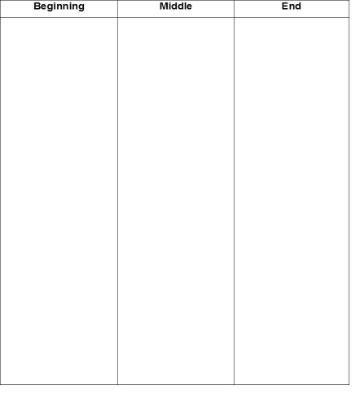
Discussion
Ask discussion questions of all 9 types.
Key Questions
- Elaborate on why White Fang misses the wild.
- How has White Fang changed now that he no longer lives in the wild?
- In your own words, explain how Weeden Scott breaks his leg. Where was he? Who was he with? How did it happen?
- How did White Fang rescue Weeden Scott?
- What would have happened if White Fang did not help Weeden Scott?
- Describe how White Fang uses his talent to promote the common good for the Scott family.
- Explain how the other family members grow to love and appreciate White Fang.
- Describe a time when you didn’t like someone at first and over time you eventually you grew to love and appreciate him or her.
- Describe the relationship between White Fang and the Collie. How has their relationship changed over time?
- Predict what you think will happen next.
Analyze
Analyze the key paragraph.
Key Paragraph, p. 294-295
“The days came and went, streaming their unbroken sunshine over the Santa Clara Valley. But as they grew shorter and White Fang’s second winter in the Southland came on, he made a strange discovery. Collie’s teeth were no longer sharp. There was a playfulness about her nips and a gentleness that prevented them from really hurting him. He forgot that she had made life a burden to him, and when she disported herself around him he responded solemnly, striving to be playful and becoming no more than ridiculous. One day she led him off on a long chase through the back-pasture land into the woods. It was the afternoon that the master was to ride, and White Fang knew it. The horse stood saddled and waiting at the door. White Fang hesitated. But there was that in him deeper than all the law he had learned, than the customs that had molded him, than his love for the master, than the very will to live of himself; and when, in the moment of his indecision, Collie nipped him and scampered off, he turned and followed after. The master rode alone that day; and in the woods, side by side, White Fang ran with Collie, as his mother, Kiche, and old One Eye had run long years before in the silent Northland forest” (p. 294-295).
Extend
Write
Have each student write a short product based on today’s prompt to connect to the unit theme.
White Fang misses the wild and the cold. Jack London titles this chapter The Call of the Wild. In an informative paragraph, explain why you think Jack London chose this title. Provide three reasons to support your answer.
Close
Close by extending today’s lesson to life and the world.
Day 25
Outcomes for Today
Outcomes for Today
W2. Write informative/explanatory texts to examine a topic and convey ideas, concepts, and information through the selection, organization, and analysis of relevant content.
a.) Introduce a topic clearly, previewing what is to follow; organize ideas, concepts, and information, using strategies such as definition, classification, comparison/contrast, and cause/effect; include formatting (e.g., headings), graphics (e.g., charts, tables), and multimedia when useful to aiding comprehension.
b.) Develop the topic with relevant facts, definitions, concrete details, quotations, or other information and examples.
c.) Use appropriate transitions to create cohesion and clarify the relationships among ideas and concepts.
d.) Use precise language and domain-specific vocabulary to inform about or explain the topic.
e.) Establish and maintain a formal style.
f.) Provide a concluding statement or section that follows from and supports the information or explanation presented.
W4. Produce clear and coherent writing in which the development, organization, and style are appropriate to task, purpose, and audience. (Grade-specific expectations for writing types are defined in standards 1-3.)
W7. Conduct short research projects to answer a question, drawing on several sources and generating additional related, focused questions for further research and investigation. W10. Write routinely over extended time frames (time for research, reflection, and revision) and shorter time frames (a single sitting or a day or two) for a range of discipline-specific tasks, purposes, and audiences.
Prepare
Background
Gather background knowledge about a place, time, event, person, or thing.
Did Jack London write other books?
Between 1900 and 1916, he completed more than 50 fiction and nonfiction books, hundreds of short stories and numerous articles. Several of the books and many of the short stories are classics and still popular; some have been translated into as many as 70 languages. Among his most well-known books are Call of the Wild, White Fang, The Sea Wolf, Martin Eden.
Source and book list: http://jacklondonpark.com/jack-london-books.html
Yukon, formerly Yukon Territory, territory of northwestern Canada, an area of rugged mountains and high plateaus. It is bounded by the Northwest Territories to the east, by British Columbia to the south, and by the U.S. state of Alaska to the west, and it extends northward above the Arctic Circle to the Beaufort Sea. The capital is Whitehorse.
Word Wall
Here are five vocabulary words to teach and add to the Word Wall.
|
convicted (295) |
warden (295) |
greedy (297) |
possessions (298) |
anguish (298) |
Read
Review
Review the timeline from the beginning every day.
Read
Read the selection, usually in a Shared Reading Read React Predict Cycle of 2-3 pages.
Read 295-303
|
Setting |
Characters |
Pages |
|
Sierra Vista in the Santa Clara Valley also referred to as the Southland |
White Fang, Weeden Scott, Weedon Scott’s family, Collie, Jim Hall, a surgeon, and a litter of puppies. |
295-303 |
Respond
Timeline
Agree on the facts in today’s reading, and list the 3-5 most important on the Timeline.
Students might mention:
- A prisoner, Jim Hall, escapes and tries to seek justice by going to Weeden Scott’s home to kill Scott’s father (Judge Scott) and his family. White Fang attacks Jim Hall. Jim Hall shoots White Fang. White Fang’s attack kills Jim Hall.
- White Fang saves the family and is badly injured. A surgeon helps White Fang slowly recover.
- When White Fang recovers the family calls him the Blessed Wolf.
- The Collie has a litter of pups and White Fang is blessed and happy.
Map
Add to ongoing class activities like a KWL chart or map: where did the characters go?
Map
Finalize and review your class map of the path mentioned in the novel from the Yukon Territory to Santa Clara Valley, California.
Conflict Chart
Finalize and review the class conflict chart. As a class reflect on the conflicts that involve:
Man vs. man
Man vs. nature
Animal vs. man
Animal vs. nature
Explore
Activity
Explore the reading more deeply with a visual or oral language activity.
Fill out the Plot Profile Chart
- Decide on the 10 most important events in the story, chapter or segment you are analyzing. List them in order in the rows at the bottom of the chart. If you go back the Beginning-Middle-End Chart, this will be easier to do.
- Decide on a scale of 1 [low] to 10 [high] how intense you think this event is, and mark your score in the appropriate box.
- Connect the marks in the boxes to form a graph.
- This graph will help you to profile the plot. How it looks will depend on the story you are reading and whether you are plotting an entire story, or a chapter or segment.
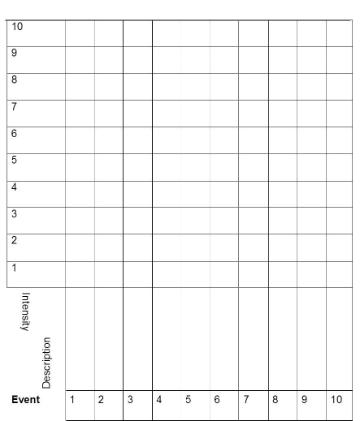
Discussion
Ask discussion questions of all 9 types.
Key Questions
- Who is Jim Hall? Select a quote from today’s reading that describes Jim Hall’s character. Explain why you choose that quote.
- Why was Jim Hall arrested and imprison? How is Judge Scott related to Jim Hall’s imprisonment?
- Why does Jim Hall want to kill Judge Scott?
- Explain how Jim Hall’s environment has helped him become a violent human.
- How is Jim Hall similar to White Fang?
- In your own words, describe the series of events that lead to Jim Scott’s death.
- How does White Fang uses his talent to protect the Scott family? How is this an example of leadership requiring engagement?
- Select a quote from today’s reading that proves the Scott family loves and appreciates White Fang.
- Explain why White Fang is called the Blessed Wolf.
- Predict what you think will happen next.
Analyze
Analyze the key paragraph.
Key Paragraph, p. 298
“On one such night, while all the house slept, White Fang awoke and lay very quietly. And very quietly he smelled the air and read the message it bore of a strange god’s presence. And to his ears came sounds of the strange god’s movements. White Fang burst into no furious outcry. It was not his way. The strange god walked softly, but more softly walked White Fang, for he had no clothes to rub against the flesh of his body. He followed silently. In the Wild he had hunted live meat that was infinitely timid, and he knew the advantage of surprise. The strange god paused at the foot of the great staircase and listened, and White Fang was as dead, so without movement was he as he watched and waited. Up that staircase the way led to the love-master and to the love-master’s dearest possessions. White Fang bristled, but waited. The strange god’s foot lifted. He was beginning the ascent. Then it was that White Fang struck. He gave no warning, with no snarl anticipated his own action. Into the air he lifted his body in the spring that landed him on the strange god’s back. White Fang clung with his fore-paws to the man’s shoulders, at the same time burying his fangs into the back of the man’s neck. He clung on for a moment, long enough to drag the god over backward. Together they crashed to the floor. White Fang leaped clear, and, as the man struggled to rise, was in again with the slashing fangs” (p. 298).
Extend
Write
Have each student write a short product based on today’s prompt to connect to the unit theme.
White Fang becomes the Blessed Wolf after saving the Scott family from a Jim Hall. As a news reporter, write an informative article that explains how White Fang stopped Jim Hall. Why was Jim Hall at the Scott family house? What was he trying to do? How did White Fang stop him? What was the final outcome of the incident?
Conduct a final reflection about White Fang’s leadership. In a second part of your article, explain whether or not White Fang demonstrates leadership requires engagement. Does White Fang use his time and talent to promote the common good and better his community? Provide three reasons to support your response.
Close
Close by extending today’s lesson to life and the world.