Lesson Plan
Death Be Not Proud
40
60
90
Day 1
Outcomes for Today
Prepare
Background
Gather background knowledge about a place, time, event, person, or thing.
What is a memoir?
A memoir is a piece of autobiographical writing, usually shorter in nature than a comprehensive autobiography. The memoir, often tries to capture certain highlights or meaningful moments in one's past. The memoir may be more emotional and concerned with capturing particular scenes, or a series of events, rather than documenting every facet of a person's life.
Word Wall
Here are five vocabulary words to teach and add to the Word Wall.
|
endure (3) |
gallant (5) |
prominent (7) |
abstract (8) |
radiant (10) |
Read
Review
Review the timeline from the beginning every day.
Read
Read the selection, usually in a Shared Reading Read React Predict Cycle of 2-3 pages.
Foreword pg. 3- 10
Respond
Timeline
Agree on the facts in today’s reading and list the 3-5 most important on the timeline.
Students might mention:
- Johnny was born in Paris November 4th 1929, his early years were spent in Vienna and London before returning to the United States.
- He attended schools in Connecticut, New York City and Massachusetts before dying on June 30, 1947 at age 17. He was to attend Harvard.
- Johnny was operated on by Dr. Putnam for brain tumor.
- Johnny tried to keep bad news from his parents and was very concerned about how they would handle the bad news of his condition.
- Johnny’s early interests included art, music, chess, weather and gardening.
- While at Deerfield Johnny was the first student to take five subjects in a single year.
- Johnny had a strong interest and passion for science, specifically atomic physics.
- In February 1945 Johnny wrote a theme on atomic fission, seven months before Los Alamos and Hiroshima.
- John is described as shy, sensitive boy who chose friends carefully who was a daydreamer and loved fantasy.
Map
Add to ongoing class activities like a KWL chart or map: where did the characters go?
US and World Timeline
Death Be Not Proud takes place between Johnny’s birth on November 4th 1929 and his death June 30th 1947.
It is a time of great change in the US and the world. Keep a timeline that track critical events that occur in the US and worldwide along with Johnny’s life.
Theme Charts
Create a class theme chart of “Courage.” Once Johnny discovers he has a life-threatening tumor, he begins a journey undergoing a number of treatments. Even during this difficult circumstance the teenage boy faces this challenge with courage and perseverance. He continues to work hard, enjoy his hobbies and does not complain. After each chapter, write at least one example that demonstrates Johnny’s courage.
Create a class theme chart on “Adolescence.” Johnny is seventeen years old when he is fighting a deadly tumor. He is no longer a child nor an independent adult. He holds a childlike curiosity about science and experiments as well as an adult maturity while dealing with his illness. After the end of each chapter, bullet point examples of Johnny’s childlike curiosity and emotional maturity.
Explore
Activity
Explore the reading more deeply with a visual or oral language activity.
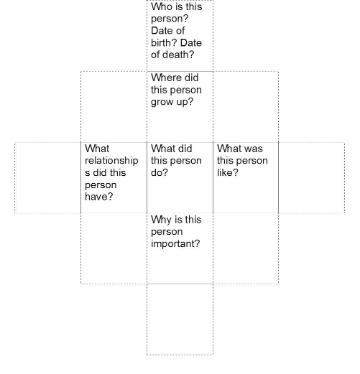
10c12 Cubing Biography
Using the information in today’s reading create a biography cube of Johnny’s life.
Analytic Cubing
Materials:
- desired cubing formats 1c1-1c12 copied on 8.5 x 11 or 11 x 17 paper
- cubing format 1c2 for cutting and folding directions
- pencils, pens, crayons, markers
- scissors, glue sticks or paste
Fill out the six squares by writing about the topic in each square.
- Six of the squares will have a question or topic listed inside the square. Six of the squares are information squares and the others are flaps that will help the cube hold together when you assemble the cube. Fill out only the information squares: the ones that have something already printed in them.
- In regard to your overall subject, answer the question in each box or write about the topic in each square. For example, if you are writing about an event, like a news story, you would use the 4c12 Cubing Who, What, When, Where, Why form. In the Who square write about who the story is about; in the What square write about what happened; in the When box write about when it happened; in the Where box, write about where it happened; in the Why box, write about why you think it happened.
- In each square write the basic, important information you know about this question or topic. Depending on the size of the box, this might be anywhere from 1 to 5 sentences.
Cut out the cube and assemble it following the directions on 2c12.
- Cut out the cube along all dotted lines on the form; this will sometimes mean cutting between squares. One of these might be an information square and one might be a flap.
- Fold the cube form on all lines to make it easier to assemble. Fold the form back – all the folds should be behind, instead of above, the printed side.
- Use a glue stick or paste to apply the adhesive to every shaded square. In you can’t make out the shading, use the glue stick on every flap. None of the information squares should have glue or paste on them.
- Fold the cube carefully following the directions on 2c12.
1c12 Cubing Directions: Assembling the Cube
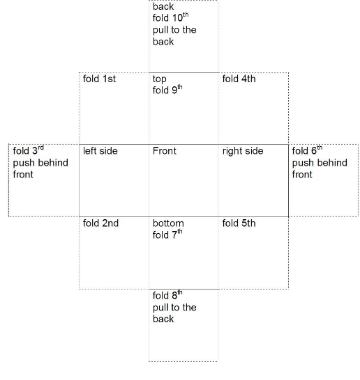
- Answer the question in each un-shaded box.
- Cut out the cube on each dotted line – do not cut any solid lines.
- Crease each solid line back to make it easier to fold.
- Put a little paste, glue, double-sided tape or a drafting dot on each shaded square.
Do not get paste or glue on the un-shaded squares. - Carefully fold the squares in the order specified, sticking squares to pasted surfaces underneath as you go.
10c12 Cubing Biography
Discussion
Ask discussion questions of all 9 types (see Day 1).
Key Questions (Foreword pg. 3- 10)
- Describe Johnny’s early years and his appearance.
- How does Johnny handle bad news?
- What is John Gunther’s goal of the book?
- Some of Johnny’s initial explorations and interests included what? How do they change? What becomes his ambition and fascination?
- How do Johnny’s parents support his passion and desire to play the bassoon?
- List and discuss other interests young Johnny Gunther had that shaped his personality.
- Johnny had some flaws, which flaws does John Gunther describe?
- What did Johnny accomplish at Deerfield that no student ever had? Why was this so unique?
- “You don’t understand at all. Arithmetic bores me. What I am interested in is mathematics.” What is the difference? What does Johnny mean?
- How does the timing of Johnny’s paper on atomic fission explain his abilities in science?
- How were his abilities as a high school student on par with those of top scientists worldwide?
- In what was Johnny’s personality described by his father?
- What were the description of Johnny based upon the two letters on page 10?
Analyze
Analyze the key paragraph.
Key Passage, pg. 5
The doctor was pleased because the bone appeared to be growing back, but with a crying lack of tact he told Johnny, “Oh yes… it’s growing… but in the wrong direction, the wrong way.”
Johnny controlled himself and said nothing until the doctor left the room. His face had gone white and he was sick with sudden worry and harsh disappointment. Then he murmured to me, “Better not tell Mother it’s growing wrong.” (5)
Extend
Write
Have each student write a short product based on today’s prompt to connect to the unit theme.
After receiving the news from the insensitive doctor that the bone is growing back in the wrong direction Johnny’s thoughts are not about the news or feeling sorry for himself but about not telling his mother the bad news. He is more concerned about her feelings and not disappointing her than he is about his own diagnosis. What does this say about Johnny as a young man? What does he immediately think about when given bad news?
The CBL theme Leadership Requires Engagement definition reads; Leaders develop and dedicate their talents to promote the common good. This is where they choose to spend their time and effort, Leadership requires positive civic engagement. It is making sure that the communities I am part of are better because I am in them. And that I am better because of the communities I choose to be part of.
In an informative paragraph explain why Johnny decided not to tell his mother about the bone growing back in the wrong direction.
Consider the following question:
- Is he showing leadership qualities?
- Does he have an impact on this community or does the community impact him? Provide reasons for your opinion.
- Is this the kind of son you would like to have?
Close
Close by extending today’s lesson to life and the world.
- Describe a time when you withheld information from your parents/friends.
- Do you consider this lying? Why or why not?
Day 2
Outcomes for Today
Prepare
Background
Gather background knowledge about a place, time, event, person, or thing.
Who was John Gunther?
John Gunther lived between August 30, 1901 and May 29, 1970. He was an American journalist and author whose success came primarily in the 1940s and 1950s.The books that made Gunther famous in his time were the “Inside” series of continental surveys. For each book, Gunther traveled extensively through the area the book covered, interviewed political, social, and business leaders, talked with average people, reviewed area statistics, and then wrote a lengthy overview of what he had learned and how he interpreted it.
About Inside Europe (published in 1936), Gunther wrote, "This book has had a striking success all over the world. I was fortunate in that it appeared at just the right time, when the three totalitarian dictators took the stage and people began to be vitally interested in them."
Word Wall
Here are five vocabulary words to teach and add to the Word Wall.
|
prowess (11) |
minute (13) |
mature (15) |
luscious (18) |
complex (19) |
Read
Review
Review the timeline from the beginning every day.
Read
Read the selection, usually in a Shared Reading Read React Predict Cycle of 2-3 pages.
Foreword pg. 10 – 19 begin with “Another of our friends”
Respond
Timeline
Agree on the facts in today’s reading and list the 3-5 most important on the timeline.
Students might mention:
- Johnny was a bright likable, messy and absent-minded boy.
- Johnny had so many hobbies that he planned to give up five or six
- Johnny’s wishes at age 13 were; happiness, do something good for the world and an extra week’s vacation.
- The things he would like to change included; to be more talkative, to be a better athlete, to stop putting things off and to be tidier.
- The three things that bothered him most were; school problems, studies, sports and relations to other boys.
- Johnny’s parents made sure that he spent equal amounts of quality time with each of them in spite of being divorced.
- Frances; Johnny’s mother taught him to read, think for himself, and to admire wisdom, truth and beauty.
- Although more interested in science then reading Johnny subscribed to the New York Times while at Deerfield.
- After hearing his father’s broadcast about Russia and fleet movements around the Atlantic and Mediterranean Johnny asks questions his father never even considered.
- Johnny’s criticisms of school included: too much attention to marks, too much religion, no time to develop his own interests and that group discipline is unfairly imposed.
- Johnny had will power enough to drop 15lbs by limiting his calories to 1200 calories per day.
- Johnny was obedient and never complained he liked good things and disliked bad things.
Map
Add to ongoing class activities like a KWL chart or map: where did the characters go?
US and World Timeline
Death Be Not Proud takes place between Johnny’s birth on November 4th 1929 and his death June 30th 1947.
It is a time of great change in the US and the world. Keep a timeline that track critical events that occur in the US and worldwide along with Johnny’s life.
Theme Charts
Continue the class theme chart of “Courage.” Once Johnny discovers he has a life-threatening tumor, he begins a journey undergoing a number of treatments. Even during this difficult circumstance the teenage boy faces this challenge with courage and perseverance. He continues to work hard, enjoy his hobbies and does not complain. After each chapter, write at least one example that demonstrates Johnny’s courage.
Continue the class theme chart on “Adolescence.” Johnny is seventeen years old when he is fighting a deadly tumor. He is no longer a child nor an independent adult. He holds a childlike curiosity about science and experiments as well as an adult maturity while dealing with his illness. After the end of each chapter, bullet point examples of Johnny’s childlike curiosity and emotional maturity.
Explore
Activity
Explore the reading more deeply with a visual or oral language activity.
KWL Chart: What You Know, Want to Know, and Learn
- You can do this chart for any topic you are trying to learn about (Tumors, Cancer, or a topic of your choice).
- This can be done on worksheets, or written on a big piece of paper, like chart paper or butcher paper. This can also be written on a white board or black board; the shape of the chart is easy to copy.
- When you are analyzing a story, you can copy a KWL chart on a piece of paper and quickly take the story apart. This can be a helpful strategy on a test. This can use the same strategy for a nonfiction topic, a problem or a case study.
- You can do this individually, in pairs, in a small group, or as part of a large group.
4g6 Character Profile Chart
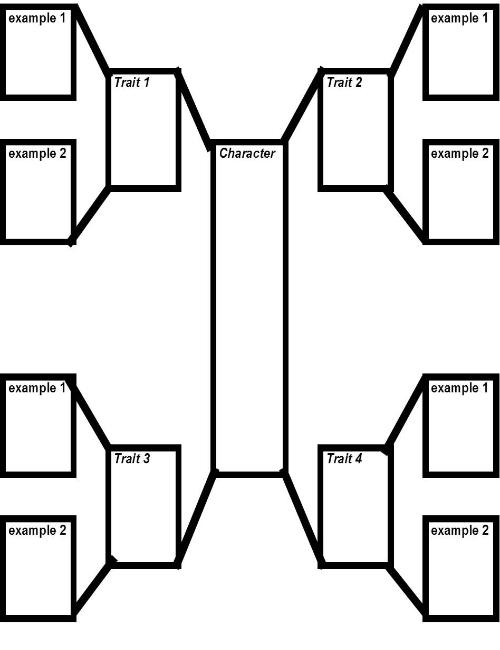
Fill out the Character Profile Chart on each character you wish to analyze
- Write the name of the character in the box in the middle of the chart.
- Think of 4 characteristics, or traits, that the character has. Describe each with a key word or phrase and write it down in one of the 4 boxes that surround the name.
- For each trait, find 2 concrete examples of it in the story. Write each in one of the 2 boxes attached to each trait box. Continue this until you have 2 examples for each of the 4 traits.
Discussion
Ask discussion questions of all 9 types (see Day 1).
Key Questions (Foreword pg. 10 – 19 begin with “Another of our friends”)
- What insight into Johnny’s personality was exposed by a letter to his camp counselor?
- In what ways were Johnny’s early flaws a preview to his personality later in life?
- When the discussion of crazy came up what did Johnny provide?
- In terms of hobbies how would you describe Johnny’s point of view?
- At thirteen while visiting his doctor how did Johnny answer questions regarding; things he wished for, what he would change if he were a magician and what things bother him most? How do his answers provide more background into his view of life?
- To what lengths did Johnny’s parents go to provide him with a “normal” life and seeing both parents despite their divorce?
- What impact on Johnny’s personality did Frances have? What gifts did he receive from her?
- Why do you think John never discusses anything Johnny picked up from him or traits of his Johnny got?
- Although not a great reader what did Johnny regularly do while at Deerfield that would prove otherwise?
- In what ways did Johnny show his intellect on November 7th, 1942 after learning of fleet movements in the Atlantic and Mediterranean? How did this surprise his father?
- What were his chief complaints and criticisms when it came to school? What is your opinion on them?
- How did others feel about Johnny? What reaction would people have toward him?
- Did Johnny’s personality or attitude waver or change even when he was sick how?
Analyze
Analyze the key paragraph.
Key Passage, pg. 18-19
It was almost impossible to make him lose his temper, and during the whole course of his illness and the frightful demands it made on him, I scarcely ever heard him utter a serious word of protest or complaint. He was always obedient—if only because he wanted so desperately to get well. Johnny was a careful boy; he was truly modest and he believed in the goodness of people—he gave out something, so that people entering a room felt at once a warm, compelling, sunny contact. But he was, like most exceptional children, a very complex character. (18-19)
Extend
Write
Have each student write a short product based on today’s prompt to connect to the unit theme.
John Gunther is describing more about his son Johnny’s personality. He discusses how Johnny kept his composure and maintained his integrity even in the face of his illness. His outlook on life was still positive as he was modest and believed in the good side of people. His father goes on to describe the feeling people got when he came into their presence and they responded to him.
In an explanatory paragraph discuss how Johnny’s father’s describes Johnny. Write a second informative paragraph that explains how this description of Johnny fits into the definition of the quarter theme Leadership Requires Engagement.
Consider the following questions:
- Are his father’s feelings aligned to the theme?
- How does he have impact his community? Provide examples from the book as supports for your opinion.
Close
Close by extending today’s lesson to life and the world.
- How do you think your parents would describe you?
- How is it different or similar to your own perception of yourself?
Day 3
Outcomes for Today
Prepare
Background
Gather background knowledge about a place, time, event, person, or thing.
What is polio?
Polio (also called poliomyelitis) is a contagious, historically devastating disease that was virtually eliminated from the Western hemisphere in the second half of the 20th century. Although polio has plagued humans since ancient times, its most extensive outbreak occurred in the first half of the 1900s before the vaccination created by Jonas Salk became widely available in 1955.
At the height of the polio epidemic in 1952, nearly 60,000 cases with more than 3,000 deaths were reported in the United States alone. However, with widespread vaccination, wild-type polio, or polio occurring through natural infection, was eliminated from the United States by 1979 and the Western hemisphere by 1991.
Signs and Symptoms
Polio is a viral illness that, in about 95% of cases, actually produces no symptoms at all (called asymptomatic polio). In the 4% to 8% of cases in which there are symptoms (called symptomatic polio), the illness appears in three forms:
- a mild form called abortive polio (most people with this type may not even suspect they have it because their sickness is limited to mild flu-like symptoms such as mild upper respiratory infection, diarrhea, fever, sore throat, and a general feeling of being ill)
- a more serious form associated with aseptic meningitis called non-paralytic polio (1%-5% show neurological symptoms such as sensitivity to light and neck stiffness)
- a severe, debilitating form called paralytic polio (this occurs in 0.1%-2% of cases)
Word Wall
Here are five vocabulary words to teach and add to the Word Wall.
|
manuscript (21) |
implored (23) |
averted (24) |
prodded (30) |
bustle (33) |
Read
Review
Review the timeline from the beginning every day.
Read
Read the selection, usually in a Shared Reading Read React Predict Cycle of 2-3 pages.
Pg 21 - 33
Respond
Timeline
Agree on the facts in today’s reading and list the 3-5 most important on the timeline.
Students might mention:
- March 1946 Johnny spent spring break in New York seeing Broadways shows including Show Boat and Antigone.
- Following his check up with Dr. Traeger Johnny complained of a stiff neck, his father was not concerned as he just received a clean bill of health.
- The third week of April Johnny was in the Deerfield infirmary for a stiff neck but no evidence of polio.
- On Thursday April 25th Dr. Hahn informed Johnny’s parents that he believed Johnny has a brain tumor.
- Dr. Hahn referred the Gunther’s to Dr. Tracy Putnam, who was in his opinion the best man for Johnny.
- While driving with Dr. Putnam and Frances to Deerfield John quickly came to the realization that Johnny was going to die.
- Johnny was surprised to see his parent at Deerfield, he believed he had polio.
- The nurse accompanying Johnny to Greenfield noticed he stumbled and he eyes were coordinating. After reporting the news to Dr. Johnson Johnny was scheduled for his first spinal tap.
- John had a great respect for Dr. Tracy Putnam as a doctor and as a man.
- Johnny was poked prodded and tested by a team of doctors
- Johnny went through the ventriculogram test which entails drilling holes through the skull
- Johnny went through the first operation on April 29th, 1946 for over six hours
- Johnny’s father learned as much as he could about the brain and brain tumors over the next week
- Dr. Harvey Cushing created a surgical technique for removing brain tomors after opening the patient’s skull
- Dr. Putnam announced to Johnny’s parents that the tumor was the size of an orange and was able to remove half.
Map
Add to ongoing class activities like a KWL chart or map: where did the characters go?
US and World Timeline
Death Be Not Proud takes place between Johnny’s birth on November 4th 1929 and his death June 30th 1947.
It is a time of great change in the US and the world. Keep a timeline that track critical events that occur in the US and worldwide along with Johnny’s life.
Theme Charts
Continue the class theme chart of “Courage.” Once Johnny discovers he has a life-threatening tumor, he begins a journey undergoing a number of treatments. Even during this difficult circumstance the teenage boy faces this challenge with courage and perseverance. He continues to work hard, enjoy his hobbies and does not complain. After each chapter, write at least one example that demonstrates Johnny’s courage.
Continue the class theme chart on “Adolescence.” Johnny is seventeen years old when he is fighting a deadly tumor. He is no longer a child nor an independent adult. He holds a childlike curiosity about science and experiments as well as an adult maturity while dealing with his illness. After the end of each chapter, bullet point examples of Johnny’s childlike curiosity and emotional maturity.
Explore
Activity
Explore the reading more deeply with a visual or oral language activity.
Discussion Questions
What are the facts?
Literal Questions
Who
What
When
Where
How
Why
How is the text structured?
Structural Questions
Setting (when, where, weather)
Characters
Characterization (description, does, says, are said about)
Plot (problem, barriers, resolution)
Conflict (nature, self, society, others)
Tone (attitude)
Mood (atmosphere)
What are the major ideas in the text?
Idea Questions
Theme
Who learns what
Value
Thoughts
How does the author do what he/she does in the text?
Craft Questions
Style
Effects
Writing
How is this work like/unlike other works by this author?
Author Questions
Text & Context
History
Impression
How is this work like/ unlike other texts you have read?
Literature Questions
Analysis
Synthesis
Basis for comparisons: Element
How does text relate to your life?
Life Questions
Life questions, problems, decisions
Age & development
The world
Your world
What do you think of this text?
Evaluate Questions
Impression
Preference
Value Continuity Clarification Conflict
Culture
Counter-culture
What do you think will happen next?
Inference Questions
Predictions
Tentative conclusions
Partial information
Anticipation
Creating a sense
4g6 Character Profile Chart
Fill out the Character Profile Chart on each character you wish to analyze
- Write the name of the character in the box in the middle of the chart.
- Think of 4 characteristics, or traits, that the character has. Describe each with a key word or phrase and write it down in one of the 4 boxes that surround the name.
- For each trait, find 2 concrete examples of it in the story. Write each in one of the 2 boxes attached to each trait box. Continue this until you have 2 examples for each of the 4 traits.
Open Mind Portrait: Create an Open Mind Portrait of a Character
Materials:
- large piece of stiff paper for each character, like 11x17 oak tag
- paper for bubbles with scissors and glue sticks
- pencils, pens, crayons, markers
- construction or tissue paper, scissors and glue sticks if desired
Step One: Create a large head shot of the character
- Imagine what you think the character looks like from the descriptions in the text as well as your imagination. You can make a list of these details to help you draw the character, if you wish.
- Decide how much of the character you wish to show: just the head and face? from the shoulders up? from the waist up? the whole person? You might want to include at least the shoulders to include some clothing details. You might want to show the size differences between characters.
- Draw the characters head shot including the face on the large piece of paper. You could also cut the paper to form the head.
- Illustrate your portrait with colors, construction paper or whatever will make the character colorful.
Step Two: Place cartoon bubbles of character thoughts around the portrait
- Cut cartoon bubbles out.
- Write things the character thinks, or says to himself, on each bubble.
- Put the bubbles up around the portrait.
Step Three: Add bubbles as you learn new things about the character
- Read the story further and identify new things you have learned about the character, or ways the character has changed.
- Follow step 2 to create and place additional bubbles.
Discussion
Ask discussion questions of all 9 types (see Day 1).
Key Questions (Pg 21 – 33)
- What was the importance of Johnny going with Frances to a dinner for Winston Churchill?
- Johnny’s chief complaint being in the infirmary revolved around?
- How did Dr. Johnson go forward with treatment and testing for Johnny?
- On Thursday, April 25th what news did John get regarding Johnny from Dr. Hahn?
- How was Dr. Hahn’s response to Johnny’s dad an important prediction about the severity of his disease?
- After receiving the news from Dr. Hahn how did the Gunther’s respond? What does it say about their family resolve?
- Describe the realization that John came to quickly as he drove to Deerfield with Frances and Dr. Putnam.
- What prognosis did Johnny expect to get from the doctors?
- Who was ultimately responsible for Johnny getting the proper medical treatment?
- What made Johnny feel like quite the guinea pig?
- In what way did John describe Johnny’s doctors?
- What things did the Gunther’s discover about doctors?
- How did Johnny describe Dr. Tracy Putnam? Why was he so important?
- In what ways did John minimize his initial prognosis? Why did he believe this to be?
- What was the test designed by Dr. Dandy of Johns Hopkins? Why was it so interesting?
- As an educated man what was John’s response to Johnny’s illness between Friday and Monday?
- Explain how Johnny was able to have cancer and not have cancer at the same time.
- What importance did Dr. Harvey Cushing play in Johnny’s illness?
- Describe in detail the technique that Dr. Cushing developed.
- Why was Dr. Traeger’s giving up a day of his own practice to attend Johnny’s surgery a unique situation?
- What news did Dr. Putnam share with Johnny’s parents following surgery?
Analyze
Analyze the key paragraph.
Key Passage, pg. 30
Between the Friday and the Monday I tried to find out something about brain tumors. I prodded through several texts full of the frightful jargon of medical writers, and consulted Traeger almost hour by hour.
A tumor is a growth. What I asked about first of all was whether or not Johnny had cancer. All cancers are tumors, but not all tumors are cancers by any means. By one definition, Johnny did have cancer, by another he did not. That is, a brain tumor (though it may strike the spinal cord in some rare case) never metastasizes, i.e. spreads through the body to attack liver or bones or what not. (30)
Extend
Write
Have each student write a short product based on today’s prompt to connect to the unit theme.
Upon learning that Johnny has been diagnosed with brain tumors John sets out to learn as much as he can since that it what educated men do. He comes across a dilemma regarding if Johnny’s diagnosis is cancer or not. He finds that the area is grey and unclear.
Write an informative paragraph summarizing John’s findings about tumors and cancer. Explain what he learned about Johnny’s condition. Include one quote from the text in your paragraph.
Close
Close by extending today’s lesson to life and the world.
- Describe when you were really sick.
- What did you do to get better?
- Who helped take care of you?
Day 4
Outcomes for Today
Prepare
Background
Gather background knowledge about a place, time, event, person, or thing.
What is schizophrenia?
Schizophrenia is a mental illness that usually strikes in late adolescence or early adulthood, but can strike at any time in life. The signs and symptoms vary from individual to individual, but all people with the disorder show one or more of the following symptoms:
|
Delusions: These are beliefs that are not true, such as feeling people are following or trying to hurt them, believing other people can read their minds, or beliefs that they have special powers or abilities. |
|
Hallucinations: This usually takes the form of hearing voices that are not there, but people with schizophrenia may also see, smell, taste, and feel things that are not there. |
|
Bizarre behavior: This can be expressed in many different ways. In short, the individual behaves in ways that seem inappropriate or strange to other people. |
|
Disorganized speech: The individual speaks in ways that are hard to understand. For instance, sentences might not make sense, or topic of conversation changes with little or no connection between sentences. Sometimes speech is completely incomprehensible. |
|
"Negative symptoms": This includes lack of motivation or interest, diminished cognitive functioning, and decreased emotional expression. Individuals may lose interest in attending to their own personal hygiene, have little interest in interacting with others, and rarely seem to feel or express strong emotions. |
In addition to these above symptoms, people with schizophrenia suffer a decline in their level of functioning; for instance, they may not be able to work at a job that requires the same level of skill or concentration as the job they held before they became ill required, or they may lose all ability to withstand the pressures of the working world. They may show a decline in their ability to attend to household chores or all the demands of raising their children, and/or they may not be able to have a full social life anymore.
Sometimes schizophrenia is a chronic condition, and the individual afflicted is constantly experiencing hallucinations or other symptoms of the disorder. Other people have periods of time when they are relatively symptom-free but have periods of more acute psychosis. Every individual is different, and every person with schizophrenia experiences the disease in a different way.
Word Wall
Here are five vocabulary words to teach and add to the Word Wall.
|
enormously(34) |
corridor (35) |
drastic (35) |
subsequent (37) |
paralysis (46) |
Read
Review
Review the timeline from the beginning every day.
Read
Read the selection, usually in a Shared Reading Read React Predict Cycle of 2-3 pages.
Pg. 34 – 46
Respond
Timeline
Agree on the facts in today’s reading and list the 3-5 most important on the timeline.
Students might mention:
- Johnny claims he heard the doctors drilling the holes in his skull, his brains sloshing around and believed the drill bit to be three-eighths of an inch.
- Johnny made a quick recovery, he was able to eat a beefsteak six days post op, drew parabolas on the eighth and walked the corridor alone on the eleventh.
- The day after the operation he asked his dad to bring him his physics text from the hospital then demanded his parents read to him.
- Johnny believed he was schizophrenic, he based this on what he previously read and that something drastic happened to his brain.
- After being convinced he was not schizophrenic Johnny believed he was going to lose his eyesight, his memory and his mind.
- Johnny became depressed, excitable and worried about the schoolwork he was missing.
- Twelve days after the operation Johnny announced he wanted to write a letter, to Dr. Albert Einstein regarding electromagnetic fields and gravitational fields.
- Johnny was unaware of the severity of his illness, his parents tried hard to keep the news from him.
- Upon learning about Johnny’s condition John went to the library to research more on his condition.
- Johnny’s parents kept the severity of his tumor from him, his recovery is going well but he is frustrated and wants to return to school.
- Johnny believed that a blow to the head caused his tumor.
Map
Add to ongoing class activities like a KWL chart or map: where did the characters go?
US and World Timeline
Death Be Not Proud takes place between Johnny’s birth on November 4th 1929 and his death June 30th 1947.
It is a time of great change in the US and the world. Keep a timeline that track critical events that occur in the US and worldwide along with Johnny’s life.
Theme Charts
Continue the class theme chart of “Courage.” Once Johnny discovers he has a life-threatening tumor, he begins a journey undergoing a number of treatments. Even during this difficult circumstance the teenage boy faces this challenge with courage and perseverance. He continues to work hard, enjoy his hobbies and does not complain. After each chapter, write at least one example that demonstrates Johnny’s courage.
Continue the class theme chart on “Adolescence.” Johnny is seventeen years old when he is fighting a deadly tumor. He is no longer a child nor an independent adult. He holds a childlike curiosity about science and experiments as well as an adult maturity while dealing with his illness. After the end of each chapter, bullet point examples of Johnny’s childlike curiosity and emotional maturity.
Explore
Activity
Explore the reading more deeply with a visual or oral language activity.
Open Mind Portrait of Johnny
You have now read four days of John Guther’s memoir to his son Johnny. Create an open mind portrait of Johnny. You will add thought bubbles to his OMP every couple days.
You could use different colors for the beginning, middle and end of the story. Remember in the beginning you are introduced to the setting, the characters and the problems they have. In the middle you learn about the roadblocks to the characters solving their problems, and conflicts occur. In the end of the story those conflicts reach a peak and then resolve with a resolution of the character’s problems.
Postcard
Pretend you are Johnny and write to a classmate at Deerfield. Inform them of the recent events that have transpired in your life since you left Deerfield in an ambulance. Include where you have been taken, what you been through and what you’re up to now in your recovery.
Discussion
Ask discussion questions of all 9 types (see Day 1).
Key Questions (pg. 34 – 46)
- Why was the nurse dumfounded when Johnny responded to her request? What caused her to react?
- How was it possible for Johnny to recovery so quickly?
- Why does Johnny ask for the physics text and demand that his parents read to him?
- Why did Johnny believe his was schizophrenic? How did he come to his conclusion?
- What does Johnny think will happen to him next?
- What topic does Johnny ask Albert Einstein to discuss with him? Why is this so amazing?
- How were the Gunther’s tempted to boast about Johnny? What was the irony behind the timing?
- Why did John Gunther believe “we had to shield him from definite, explicit knowledge”?
- What two assets did Johnny have? Which in your opinion was greater and why?
- How did Johnny respond when Dr. Putnam broke the news to him? How would you have handled and dealt with such news?
- What impact did Johnny have on the nursing staff? What kind of patient was he?
- Was the justification Dr. Putnam gave regarding leaving Johnny’s skull open? What other information regarding Johnny’s condition did John learn during this visit with Putnam?
- What reasoning did Johnny’s parents have for lying to him about the tumor? What it justified?
- What was the motivated Johnny to obey the doctor’s orders? How did he do so?
- How did Johnny theorize the cause of his tumor? Was he correct?
- What was the story behind the prayer Johnny wrote?
- How did Johnny’s mother Frances respond to him?
- On May 28 the lives of Johnny and his family changed. In what way? How?
- Why did the doctors keep the news of Johnny’s tumor being a “glio” a secret?
Analyze
Analyze the key paragraph.
Key Passage, pg. 41
Then the next day Putnam called me into his office, with Lester Mount, his youthful associate who carried on to the end, standing by. What Johnny had was much worse than they had feared; it was not an astrocytoma but something called an astroblastoma undergoing transformation. Now Putnam explained why he had not closed the skull but had left open, covered only buy a flap of scalp, an area in the head about as big as my hand. This was to provide “decompression” i.e., to allow the tumor, if it continued to grow, to bulge outward, instead of inward which would destroy the brain. If Putnam had sealed up the skull with bone or a plate, Johnny would have been dead in a month. (41)
Extend
Write
Have each student write a short product based on today’s prompt to connect to the unit theme.
Dr. Putnam explains to John that Johnny’s condition is much worse and more severe than they had originally believed. Dr. Putnam then provides explanation for leaving Johnny’s skull open and only covered by his scalp. If Dr. Putnam had sealed Johnny’s skull the brain would have grown inward instead of outward and he would be dead in a month’s time.
Leadership Requires Engagement definition includes the following explanation that we have consistently looked at through the novel. Leaders develop and dedicate their talents to promote the common good. This is where they choose to spend their time and effort. In what ways do you believe Dr. Putnam exemplified the definition? Do you believe in his explanation to Johnny’s parents he promoted the common good?
In an informative paragraph explain Dr. Putnam’s decision as well as his explanation. Be sure to use three examples from the reading to support your opinion.
Close
Close by extending today’s lesson to life and the world.
- How would you feel if you were Johnny?
- What advice would you give Johnny?
Day 5
Outcomes for Today
Prepare
Background
Gather background knowledge about a place, time, event, person, or thing.
What does a radiologist do?
A radiologist is a medical doctor that uses technology, computers, medical imaging and medical equipment like MRI, computed tomography (CT Scans), and ultrasound to assist other doctors in figuring out issues related to their patients' medical conditions. Radiological exams are absolute necessities in the medical evaluation of any patient and radiologist is the one that interprets these.
The radiologist also plays a major role in the diagnosis and follow up of various cancers. For example, radiologists use chest x-rays and chest CTs to check for presence or progression of lung cancer. A radiologist would also perform routine mammograms on women to make sure that those that develop cancer get that identified in its earliest stage.
Word Wall
Here are five vocabulary words to teach and add to the Word Wall.
|
tremendous (48) |
gradually (49) |
contradictory (49) |
avert(54) |
bulging (54) |
Read
Review
Review the timeline from the beginning every day.
Read
Read the selection, usually in a Shared Reading Read React Predict Cycle of 2-3 pages.
Pg. 47 - 56
Respond
Timeline
Agree on the facts in today’s reading and list the 3-5 most important on the timeline.
Students might mention:
- Johnny was discharged from the hospital on June 1st, but he had to get x-ray treatments daily until June 20th.
- The x-ray treatment took a lot out of Johnny.
- The radiologist had to determine the benefits verses the risks of the treatment.
- To cope with the x-ray treatment Johnny believed it was designed to help with post-op swelling as opposed to anything with the tumor.
- Johnny’s parents hid the Britannica volume that covered brain tumors to prevent him from learning too much.
- The summer of 1946 was a haze for Johnny’s dad with running back and forth to New York every ten days for checkups.
- Johnny’s father questioned why his son’s illness attacked his strongest and best part.
- The Bulge or the Bump got slowly bigger to the size of a tennis ball on the side of Johnny’s head.
- On July 17th the bump on Johnny’s head opened and leaked pus, he would have to have his head dressed and bandaged daily until he died.
- Wilder Penfield of Montreal was considered a magician in the field by other brain surgeons.
- Penfield informed Johnny’s parents directly “Your child had a malignant glioma, and it will kill him.”
Map
Add to ongoing class activities like a KWL chart or map: where did the characters go?
US and World Timeline
Death Be Not Proud takes place between Johnny’s birth on November 4th 1929 and his death June 30th 1947.
It is a time of great change in the US and the world. Keep a timeline that track critical events that occur in the US and worldwide along with Johnny’s life.
Theme Charts
Continue the class theme chart of “Courage.” Once Johnny discovers he has a life-threatening tumor, he begins a journey undergoing a number of treatments. Even during this difficult circumstance the teenage boy faces this challenge with courage and perseverance. He continues to work hard, enjoy his hobbies and does not complain. After each chapter, write at least one example that demonstrates Johnny’s courage.
Continue the class theme chart on “Adolescence.” Johnny is seventeen years old when he is fighting a deadly tumor. He is no longer a child nor an independent adult. He holds a childlike curiosity about science and experiments as well as an adult maturity while dealing with his illness. After the end of each chapter, bullet point examples of Johnny’s childlike curiosity and emotional maturity.
Explore
Activity
Explore the reading more deeply with a visual or oral language activity.
Open Mind Portrait
Add thought bubbles to your Johnny Gunther OMP
4g6 Character Profile Chart
Fill out another 4g6 Johnny based upon what we have learned about him so recently.
Fill out the Character Profile Chart on each character you wish to analyze
- Write the name of the character in the box in the middle of the chart.
- Think of 4 characteristics, or traits, that the character has. Describe each with a key word or phrase and write it down in one of the 4 boxes that surround the name.
- For each trait, find 2 concrete examples of it in the story. Write each in one of the 2 boxes attached to each trait box. Continue this until you have 2 examples for each of the 4 traits.
Discussion
Ask discussion questions of all 9 types (see Day 1).
Key Questions (pg. 47 - 56)
- After being released from the hospital what did Johnny do between June 1 and June 20?
- Why was the x-ray treatment discontinued on June 20th?
- What was the defense mechanism Johnny used during his x-ray treatment?
- How did Johnny’s parents prevent him from learning about tumors? Would they be able to do this with current technology?
- What was the worst burden Johnny’s parents dealt with on a daily basis?
- How did the Gunther’s spend the summer of 1946?
- Why was the Madison house a perfect place for Johnny’s convalescence?
- How did Johnny pass his time at the Madison house? What did he do to stay busy?
- What was the question John Gunther asked himself incessantly?
- What did Johnny mean when he said “The worst thing is to worry too little, not too much. Let’s keep up a tension.”?
- What happened on Wednesday July 17th? What impact did it have?
- What made Wilder Penfield of Montreal receive consideration for being a magician?
- How did Penfield change the way Johnny’s case was perceived?
- What fears were thrust upon the Gunther’s following the diagnosis by Penfield?
Analyze
Analyze the key paragraph.
Key Passage, pg. 50 - 51
He was vehemently worried that his illness might upset our future plans and about how much it was costing and about Frances’s work and my book. I was less than halfway through Inside U.S.A. and hopelessly behind. Johnny knew that the deadline for delivering the MS was October 1, and he knew perfectly well that I could never make it. His first question when I came out, expressed with lively irony and disbelief in the veracity of what I would tell him, was usually, “Well, how many whole chapters did you write yesterday?” Then: “You’d better hurry!” As to the work Frances was doing he would remonstrate with her gently and then encourage her, “Remember your destiny, Mother!”. (50 - 51)
Extend
Write
Have each student write a short product based on today’s prompt to connect to the unit theme.
Johnny was worried that his illness would have a negative impact on his parent’s life and future plans. He was constantly checking on their progress on projects they were working on as well as motivating them to finish and become everything the possibly could become. How were the lives of John and Frances Gunther better for having Johnny as their son? In spite of his illness he still went above and beyond to support his parents personally and professionally.
Write an explanatory paragraph describing Johnny’s leadership skills while fighting his tumor. How does Johnny Gunther embody Leadership Requires Engagement as the theme states, “It is making sure that the communities I am part of are better because I am in them.” How does Johnny make his family and community a better place?
Close
Close by extending today’s lesson to life and the world.
- Give an example of your leadership abilities.
- How can you better serve your family and community?
Day 6
Outcomes for Today
Prepare
Background
Gather background knowledge about a place, time, event, person, or thing.
What is mustard gas?
Mustard gas is a chemical weapon which is classified as a vesicant, meaning that it causes blisters and lesions on the skin and in the respiratory tract. This chemical weapon was infamously used during the First World War, and this usage undoubtedly contributed to the decision to ban the use of such weapons in war in the Geneva Protocol of 1925. Mustard gas, also known as sulfur mustard or H, is among the list of chemical weapons in the Chemical Weapons Convention of 1993, which bans the production, use, sale, or stockpiling of such weapons.
Despite the fact that this chemical weapon is called mustard gas, it's not a gas, but rather a very thick, volatile liquid. The plumes of mustard gas which wafted over the trenches of the First World War were created by aerosolizing the liquid, typically by encasing it in fired projectiles. Once aerosolized, sulfur mustard can endure for several days in the water and soil it settles on.
What is Chemotherapy?
Chemotherapy was first used in the 1940's to treat cancer when it was discovered that mustard gas, which was used for chemical warfare, had also suppressed lymphoma and leukemia. This discovery was made during autopsies of people who had died from mustard gas. The agent was then injected into a cancer patient who had non-Hodgkin's lymphoma. The patient's tumors reduced in size, though for just a few weeks, but this was the first step in using chemicals to treat cancer.
Word Wall
Here are five vocabulary words to teach and add to the Word Wall.
|
extraordinary (58) |
affixed (59) |
reasonably (59) |
restoring (64) |
impatient (65) |
Read
Review
Review the timeline from the beginning every day.
Read
Read the selection, usually in a Shared Reading Read React Predict Cycle of 2-3 pages.
Bottom of pg. 56 (paragraph beginning with Now we struck) – 67
Respond
Timeline
Agree on the facts in today’s reading and list the 3-5 most important on the timeline.
Students might mention:
- John wrote or telephoned doctors all over the country to see if any of them had any new discoveries regarding brain tumors.
- After reading an article in the Sunday Times Frances began searching out the uses of mustard gas in the treatment of tumors.
- It took cooperation and much bending of the rules to get Dr. Burchenal to be able to work at Medical Center.
- Johnny considered science fiction simply “bad fiction and no science”.
- Frances’ brave and understanding spirit was crucial to Johnny getting through that summer.
- Johnny began his mustard gas treatment between August 1 and 5. It was the first time it had been tried on a brain tumor.
- The first series of the mustard gas treatment did great benefits to Johnny.
- Johnny spent time in the country doing schoolwork, a family tree, listed all the doctors he worked with and mathematical odds for poker.
- With the help of Mr. Weaver he did a liquefaction of ammonia.
- Max Gerson used unorthodox treatments on cancer based on dietary changes.
- When Johnny learned he was going into town for further treatment he became seriously upset for the first time.
Map
Add to ongoing class activities like a KWL chart or map: where did the characters go?
US and World Timeline
Death Be Not Proud takes place between Johnny’s birth on November 4th 1929 and his death June 30th 1947.
It is a time of great change in the US and the world. Keep a timeline that track critical events that occur in the US and worldwide along with Johnny’s life.
Theme Charts
Continue the class theme chart of “Courage.” Once Johnny discovers he has a life-threatening tumor, he begins a journey undergoing a number of treatments. Even during this difficult circumstance the teenage boy faces this challenge with courage and perseverance. He continues to work hard, enjoy his hobbies and does not complain. After each chapter, write at least one example that demonstrates Johnny’s courage.
Continue the class theme chart on “Adolescence.” Johnny is seventeen years old when he is fighting a deadly tumor. He is no longer a child nor an independent adult. He holds a childlike curiosity about science and experiments as well as an adult maturity while dealing with his illness. After the end of each chapter, bullet point examples of Johnny’s childlike curiosity and emotional maturity.
Explore
Activity
Explore the reading more deeply with a visual or oral language activity.
1g6 setting chart
Fill out the Setting Chart
- Describe the place where the story takes place in the where box on the chart. This includes the location, geography, scenery and other details about the place.
- Describe the time of day or day of the week the story begins in the time box on the chart. This box is important if the story of the part you are analyzing takes place in a short period of time.
- Describe the weather in the weather box of the chart. Is it sunny, stormy, snowing, all of the above, none of the above? Sometimes the weather matters, sometimes not. Sometimes it is critical.
Describe the time period in which the story is taking place in the when box on the chart. Is this a contemporary story, or does it take place in the past or the future? Give details about this past or future time if this is the case.
Discussion
Ask discussion questions of all 9 types (see Day 1).
Key Questions (Bottom of pg. 56 (paragraph beginning with Now we struck) – 67)
- In what way did Johnny’s parents go forward after getting the death sentence from Penfield? Why do you think they did this?
- Do you believe it was right for Johnny’s parents to write the top tumor specialist across the country asking them “Did they know anything new?”?
- What treatment of tumors did Frances discover and investigate after reading the Sunday Times?
- What frustration did the Gunther’s experience while trying to find a doctor to use mustard gas treatment on Johnny’s tumors?
- Where did the trail of mustard gas lead? What advice did they get that lead Johnny to begin the treatment?
- What protocol changes did the mustard gas cause? How did they make things happen?
- How did Johnny feel about science fiction?
- After Penfield’s visit how did Johnny’s personality change? What did he do differently?
- How were Johnny’s conversations different between his parents? Why do you believe he talked differently from Frances to John?
- When did he begin the mustard gas treatment? What side effects would Johnny have to deal with?
- How did Johnny respond to the mustard gas treatment?
- What did Johnny do to pass the time while in the country with Frances?
- Who was Mr. Weaver? What did he and Johnny accomplish?
- What impact did the visit by Mr. Boyden and Mr. Hayden have?
- What occurred on August 31st and what impact did this have?
- Who was Max Gerson? What did he do that was so special?
- What would the news of going into town for further treatment have on Johnny?
Analyze
Analyze the key paragraph.
Key Passage, pg. 60
He could not have survived this summer had it not been for his mother’s brave and understanding spirit. So that he would not be frightened she talked to him as if casually about the narrow escapes she and other people had had from Death, and it relieved him greatly to learn that several of those who he loved had almost died. She made the most of every medical ritual, and taught him to squeeze out of every conceivable occasion, no matter how painful, every atom of humor possible. (60.)
Extend
Write
Have each student write a short product based on today’s prompt to connect to the unit theme.
John attributes Johnny’s ability to survive the summer to Frances’ spirit and attitude. She did everything she could to explain how people overcome death to achieve life. She taught him that every minute is an experience that should be cherished and lived fully.
In an explanatory paragraph describe the impact Frances had upon Johnny that summer. Be sure to include examples from the text to support your explanation.
Close
Close by extending today’s lesson to life and the world.
- Who has deeply impacted your life?
- How are you a different person from knowing that person?
Day 7
Outcomes for Today
Prepare
Background
Gather background knowledge about a place, time, event, person, or thing.
Who was Dr. Gerson?
During the mid-fifties, just as Dr. Gerson was demonstrating some of his most dramatic results with a nutritional treatment for cancer, chemotherapy started to be used by establishment medicine. The reason was the general disillusion with the results of surgery and radiation in the treatment of cancer patients. The chemotherapeutic drugs were supposed to stop the fast reproduction of tumor cells - and thus stop cancer. Originally, these highly toxic agents were based on the mustard gas of warfare of which there was a huge remaining supply after the end of World War II. When these drugs soon were found to be too toxic and at best only temporarily effective, new combinations were compounded all supposedly stopping or slowing the multiplication of fast growing tissue.
Chemotherapy was just being introduced toward the end of Dr. Gerson's practice in New York, shortly before he died. He talks about his experience with Johnny Gunther in Appendix II of A Cancer Therapy Results of 50 Cases, p. 415. Johnny was possibly the only patient Dr. Gerson treated after he had been given chemotherapy. The book describes the terrible response, the swollen arm, the severe bone marrow depression and the doctor's expectation that Johnny would quickly die. Nobody suspected that Dr. Gerson could reverse some of the damage. But Dr. Gerson could not have known what the Gerson doctors in Mexico have discovered after years of working with cancer patients who had previously been given chemotherapy, namely that these heavy drugs are released back into the system and cause the prior poisoning symptoms to show up once more. This generally happens after some six months on the Gerson Therapy. That was also Dr. Gerson's experience with Johnny Gunther - but he did not know that it was due to the prior chemotherapy treatment. He took the blame for Johnny's death, assuming that the only cause was the treatment with hormones which he had applied.
Word Wall
Here are five vocabulary words to teach and add to the Word Wall.
|
misery (68) |
pessimistic (69) |
strive (69) |
appalled (77) |
cascaded (78) |
Read
Review
Review the timeline from the beginning every day.
Read
Read the selection, usually in a Shared Reading Read React Predict Cycle of 2-3 pages.
Pg. 68 - 80
Respond
Timeline
Agree on the facts in today’s reading and list the 3-5 most important on the timeline.
Students might mention:
- As September rolled around Johnny’s condition initially worsened then improved as his blood count rose, the wound healed and the bump on his skull began going down.
- Gerson took Johnny off penicillin, he prevented any transfusions, and he demanded that Johnny get nothing but rest for a series of weeks.
- Gerson’s diet was saltless and fatless, with little protein.
- Gerson wanted Johnny to be free of as much waste as possible to combat illness and build healthy cells.
- Subsisting on the diet meant a great deal of fruit juices and fresh vegetables as well as 4-5 enemas a day to totally wash and cleanse the system.
- One of the skeptical doctors said “If this thing works, we can chuck millions of dollars’ worth of equipment in the river, and get rid of cancer by cooking carrots in a pot.”
- All Johnny’s vegetables had to be cooked with no added water or steam, couldn’t be prepared with aluminum and the fruits had to be squeezed in a non-metallic squeezer.
- Johnny had to take over 30 minerals and vitamins daily, he began to lose taste for food and became depressed over it.
- By the end of September Johnny’s pupils were almost normal, his blood count was up to normal and the bump was smaller.
- Johnny’s parents were worried that once Gerson took over the more “straight-laced” physicians would no longer treat Johnny; this was not the case.
- Gerson was a dictator as a doctor.
- Johnny wanted a glass of milk, an artichoke with hollandaise sauce, spaghetti and meatballs and a chocolate ice-cream soda as his meal when the Gerson diet was over.
- Frances worked hard at keeping Johnny’s morale up.
- Johnny adored parties, so on his 17th birthday Mrs. Seeley made an imitation ice cream for him
- Tuberculosis used to be called “consumption” because it consumes.
Map
Add to ongoing class activities like a KWL chart or map: where did the characters go?
US and World Timeline
Death Be Not Proud takes place between Johnny’s birth on November 4th 1929 and his death June 30th 1947.
It is a time of great change in the US and the world. Keep a timeline that track critical events that occur in the US and worldwide along with Johnny’s life.
Theme Charts
Continue the class theme chart of “Courage.” Once Johnny discovers he has a life-threatening tumor, he begins a journey undergoing a number of treatments. Even during this difficult circumstance the teenage boy faces this challenge with courage and perseverance. He continues to work hard, enjoy his hobbies and does not complain. After each chapter, write at least one example that demonstrates Johnny’s courage.
Continue the class theme chart on “Adolescence.” Johnny is seventeen years old when he is fighting a deadly tumor. He is no longer a child nor an independent adult. He holds a childlike curiosity about science and experiments as well as an adult maturity while dealing with his illness. After the end of each chapter, bullet point examples of Johnny’s childlike curiosity and emotional maturity.
Explore
Activity
Explore the reading more deeply with a visual or oral language activity.
Create a recipe book for Johnny’s diet
Based upon the restrictions of Dr. Gerson create a 1 recipe for Johnny’s new diet. Draw a picture of the dish. Add the collection of recipes together to create a recipe book.
OMP of Johnny
Add bubbles to your open mind portrait of Johnny based upon today’s reading.
Discussion
Ask discussion questions of all 9 types (see Day 1).
Key Questions (pg. 68 - 80)
- Why was one doctor so casual when Johnny entered the Gerson nursing home?
- How did Johnny surprise everyone?
- What plan did Gerson have for Johnny’s treatment?
- Why did Gerson make a change to Johnny’s diet?
- How did Gerson’s patients subsist?
- Why were so many enemas important?
- What did Johnny’s new diet consist of? What was he not allowed to eat?
- How were his foods to be prepared? What were the number of minerals and vitamins that Johnny had to take on a daily basis?
- What was Johnny’s attitude to all of this?
- What changes occurred in September?
- Describe the impact this had on Johnny’s father John Gunther?
- How did the doctors react to Johnny’s treatment by Gerson? What fears did Johnny’s father have?
- What did Johnny want to eat after the diet was over?
- How did the doctors react to Johnny’s bloody nose?
- What did Frances do for Johnny to keep his morale high?
- What did John learn about Johnny while he played chess with Max Kopf?
- How did Johnny celebrate his 17th birthday?
- Why would Johnny become hostile towards his dad?
- What does John mean when he says “Let’s give him Kleenex.” for his Dad’s Christmas present?
- How did they portray cancer? Describe one theory
- What was tuberculosis called? Why?
- What makes a human being what he is?
- Describe the perplexing situation that was building.
- What plans did the doctors have?
Analyze
Analyze the key paragraph.
Key Passage, pg. 72 - 73
I left Mrs. Seely’s one evening and walked to the corner and had a cup of coffee, almost insane with sudden hope. I was beside myself with a violent and incredulous joy. Johnny was going to recover after all! I thought of all the surgeons and the specialists and how dumfounded they would be; I thought of all our friends and their sympathy and how the burden of grief would be lifted to a whole small community. Johnny was going to pull through, after all, despite everything, and get well! He was going to beat this evil, lawless thing! He’d show the surgeons how a boy with a real will to live could live!
Extend
Write
Have each student write a short product based on today’s prompt to connect to the unit theme.
As Johnny’s health improved John Gunther was so happy he couldn’t contain himself. He now felt Johnny was going to recover and looked forward to seeing the surgeons and specialist who previously gave them no hope. He thought of the friends who provided sympathy and support and the impact of the community as a whole who have ridden the rollercoaster with the family during Johnny’s illness. John attributed Johnny’s will to live as the reason for beating the illness that he describes as evil and lawless.
Leadership Requires Engagement quarter theme states “It is making sure that the communities I am part of are better because I am in them. And that I am better because of the communities I choose to be part of”. Today John Gunther describes the impact the community has had on the family through Johnny’s illness.
Write an explanatory paragraph describing the importance of community during trying times for family. Include how can the outpouring of a community support can aide in the healing of an individual illness.
Close
Close by extending today’s lesson to life and the world.
- Describe a time when you felt the support of your community?
- Who makes up your community?
Day 8
Outcomes for Today
Prepare
Background
Gather background knowledge about a place, time, event, person, or thing.
What was Deerfield Academy?
Deerfield Academy is an independent secondary school committed to high standards of scholarship, citizenship, and personal responsibility. Through a rigorous liberal arts curriculum, extensive co-curricular program, and supportive residential environment, Deerfield encourages each student to develop an inquisitive and creative mind, sound body, and strong moral character. Set in a historic village bounded by river, hills, and farms, Deerfield inspires reflection, study and play, abiding friendships, and a defining school spirit. A vibrant, ethical community that embraces diversity, the Academy prepares students for leadership in a rapidly changing world that requires global understanding, environmental stewardship, and dedication to service.
|
Founded: |
1797 |
||||
|
|
||||
|
Enrollment: |
While the enrollment at Deerfield varies slightly each year, the target enrollment of the school is 620 students. Approximately 74 day students attend Deerfield, and our population is 50/50 male/female. US: 38 states; international: 88 students from 24 countries |
||||
|
Tuition: |
For the 2010-2011 school year: Boarding $43,800; Day: $31,400; Town of Deerfield Day Student: $14,550. Fees: Health Center, Boarding $390 (Day $165), Books, $910. Technology Fee for the Laptop Program, $675. |
||||
|
Community Service: |
Students serve as mentors to Deerfield elementary school children, help at a shelter for transient populations, build homes for Habitat for Humanity, visit nursing home residents, help at the Food Bank, serve as Big Brothers and Big Sisters in the Franklin County Big Brother/Big Sister Program, and more. During school vacations, students can participate in numerous international service programs. |
||||
|
Dining: |
There are seven sit-down family style meals a week in which nine students and a faculty member are assigned to a table. They stay with this table for all sit-down meals for a three-week period. |
Word Wall
Here are five vocabulary words to teach and add to the Word Wall.
|
immaculate (81) |
remarkable (82) |
adequate (84) |
commotion (87) |
remnants (88) |
Read
Review
Review the timeline from the beginning every day.
Read
Read the selection, usually in a Shared Reading Read React Predict Cycle of 2-3 pages.
Read pg. bottom of 80 - 92
Respond
Timeline
Agree on the facts in today’s reading and list the 3-5 most important on the timeline.
Students might mention:
- Mount performed an exhaustive neurological test on Johnny.
- Johnny was excited when he was finally allowed to wash his hair with real shampoo.
- Gerson said “Your son is saved!” Mount said the exact opposite.
- Johnny was disappointed not to be returning to Deerfield but began working with two tutors on his education.
- Johnny sent a letter to Deerfield headmaster Mr. Boyden over his concerns with finishing school and entering Harvard in the fall and asking for his help.
- Boyden sent Johnny’s physics teacher Mr. Haynes to encourage Johnny.
- Johnny sent letters to Mr. Bill asking for an adequate algebra exam, to Mr. Boyden updating him on his studies as well as his plan and Mr. Haynes sharing his success on the N.Y. regents exam and the 46 chemical experiments he’s completed and will be writing up.
- Putnam, Traeger and Gerson talked for hours regarding Johnny’s next treatment plan. They were unable to come up with a consensus.
- Gerson fought like a tiger against the other’s views, he believed the tumor was dead and was opposed to the operation.
- Johnny agreed operation was the course of action and correctly predicted the bump would open twice more.
- Johnny recovered with great leaps; playing chess, studying hard and seeing friends
- Doctor after doctor visited Johnny most surprised he was still alive.
- 13 Johnny was brought to the verge of tears when he learned his eyes were back to normal.
- Johnny was excited when his question was asked on the air during “Information Please”
- Johnny was allowed to go home for 36 hours over Christmas.
Map
Add to ongoing class activities like a KWL chart or map: where did the characters go?
US and World Timeline
Death Be Not Proud takes place between Johnny’s birth on November 4th 1929 and his death June 30th 1947.
It is a time of great change in the US and the world. Keep a timeline that track critical events that occur in the US and worldwide along with Johnny’s life.
Theme Charts
Continue the class theme chart of “Courage.” Once Johnny discovers he has a life-threatening tumor, he begins a journey undergoing a number of treatments. Even during this difficult circumstance the teenage boy faces this challenge with courage and perseverance. He continues to work hard, enjoy his hobbies and does not complain. After each chapter, write at least one example that demonstrates Johnny’s courage.
Continue the class theme chart on “Adolescence.” Johnny is seventeen years old when he is fighting a deadly tumor. He is no longer a child nor an independent adult. He holds a childlike curiosity about science and experiments as well as an adult maturity while dealing with his illness. After the end of each chapter, bullet point examples of Johnny’s childlike curiosity and emotional maturity.
Explore
Activity
Explore the reading more deeply with a visual or oral language activity.
4g6 Character Profile Chart
Fill out the Character Profile Chart on Johnny.
- Write the name of the character in the box in the middle of the chart.
- Think of 4 characteristics, or traits, that the character has. Describe each with a key word or phrase and write it down one of the 4 boxes that surround the name.
- For each trait, find 2 concrete examples of it in the story. Write each in one of the 2 boxes attached to each trait box. Continue this until you have 2 examples for each of the 4 traits.
OMP of Johnny
Add bubbles to your open mind portrait of Johnny based upon today’s reading
Fill out the Character Profile Chart on each character you wish to analyze
- Write the name of the character in the box in the middle of the chart.
- Think of 4 characteristics, or traits, that the character has. Describe each with a key word or phrase and write it down in one of the 4 boxes that surround the name.
- For each trait, find 2 concrete examples of it in the story. Write each in one of the 2 boxes attached to each trait box. Continue this until you have 2 examples for each of the 4 traits.
Discussion
Ask discussion questions of all 9 types (see Day 1).
Key Questions (pg. bottom of 80 - 92)
- What was the test that fascinated Johnny? What made Johnny feel this way?
- What event brought Johnny to shout with glee? Do you think this is normal? How would you feel?
- How was the tumor actually lucky for Johnny?
- What is the possible explanation for two doctors having opposite opinions? Gerson believed Johnny was saved while Mount said the opposite.
- Describe what John calls the most remarkable things in this story. Why does he believe this?
- Why did Johnny send the first letter to Mr. Boyden? What did he hope to accomplish by it?
- How did Mr. Boyden respond? Do you think the principal at your school would do the same?
- How did Johnny’s condition worsen sharply?
- Who meet to discuss his condition? What was the decision?
- What was Gerson’s view on Johnny’s condition?
- What plan was finally adopted and agreed upon after great discussion among the team of doctors?
- Johnny’s opinion on his treatment plan was what? What else would he predict successfully?
- What news did Gerson share after his emergency impromptu surgery?
- How was Johnny following the surgery?
- What were the results of the surgery?
- Describe his feelings when he learned that his eyes were normal.
- How would you describe Johnny’s view of people.
- How did Christmas go for the Gunther family that year?
Analyze
Analyze the key paragraph.
Key Passage, pg. 86
My sister was with Johnny and me when he got this news that the eyes were normal. I never knew till this moment just how anguishing was the strain that he strove so hard to conceal. He jumped bolt upright; then slowly, proudly, very slowly and proudly, he relaxed downward to the pillow, while across his face spread the most beatifically happy expression I have ever seen on a human being, and his eyes—normal eyes now—filled just to the brim with tears, but did not spill over, as he smiled with relief, pride and exhaustion that comes from intolerable strain.
Extend
Write
Have each student write a short product based on today’s prompt to connect to the unit theme.
Johnny gets word that his eyes are normal and his father for the first time realizes the pressure and the strain that Johnny has inflicted upon himself trying to keep secret how he felt about his illness. He was brought to the edge of tears but not tears of pain but happiness, relief and pride from the exhausting journey he had been through to this point.
Why do you think Johnny kept his feeling secret? Who was he trying to protect? The quarter theme Leadership Requires Engagement states “It is making sure that the communities I am part of are better because I am in them. And that I am better because of the communities I choose to be part of.”
In an explanatory paragraph, describe how Johnny exemplified this part of the theme. Be clear and concise in your explanation.
Close
Close by extending today’s lesson to life and the world.
- If you were Johnny would you keep your feelings secret?
- How often do you complain about minor discomforts?
Day 9
Outcomes for Today
Prepare
Background
Gather background knowledge about a place, time, event, person, or thing.
What is amnesia?
Stedman's Medical Dictionary defines amnesia as "a disturbance in the memory of information stored in long-term memory, in contrast to short-term memory, manifested by total or partial inability to recall past experiences." Amnesia is a condition in which someone can't recall stored memories, like their mom's maiden name or what happened last Christmas, but they may recall the knock-knock joke their little brother told them a few seconds ago.
Word Wall
Here are five vocabulary words to teach and add to the Word Wall.
|
spectacular (93) |
deliberate (94) |
incessantly (98) |
recurrence (98) |
flinched (100) |
Read
Review
Review the timeline from the beginning every day.
Read
Read the selection, usually in a Shared Reading Read React Predict Cycle of 2-3 pages.
Pg. 93 – 102
Respond
Timeline
Agree on the facts in today’s reading and list the 3-5 most important on the timeline.
Students might mention:
- Johnny made a spectacular improvement during the winter for unknown reasons.
- In mid-February Johnny dealt with an attack of trembling and amnesia.
- Frances came up with a technique for handling Johnny’s amnesia attacks.
- After Johnny asked incessant questions about his schoolwork, Harvard entrance exams, his diet and when he could return to Deerfield.
- In March Johnny went through periods of various degrees coordination and vision.
- Johnny became obsessed with getting into Harvard, making up his schoolwork at Deerfield and graduating with his class.
- Frances enrolled Johnny at New York Tutoring School.
- Johnny formally applied to Harvard.
- On April 12 Johnny took his College Board exams.
- Johnny took in a number of shows; The Best Years of Our Lives, Brigadoon, Joan of Lorraine and Finian’s Rainbow.
- Johnny wrote out a series of hints to help his dad with chess.
- Although happy John finished Inside USA he was less than excited about his writing to help with ads.
Map
Add to ongoing class activities like a KWL chart or map: where did the characters go?
US and World Timeline
Death Be Not Proud takes place between Johnny’s birth on November 4th 1929 and his death June 30th 1947.
It is a time of great change in the US and the world. Keep a timeline that track critical events that occur in the US and worldwide along with Johnny’s life.
Theme Charts
Continue the class theme chart of “Courage.” Once Johnny discovers he has a life-threatening tumor, he begins a journey undergoing a number of treatments. Even during this difficult circumstance the teenage boy faces this challenge with courage and perseverance. He continues to work hard, enjoy his hobbies and does not complain. After each chapter, write at least one example that demonstrates Johnny’s courage.
Continue the class theme chart on “Adolescence.” Johnny is seventeen years old when he is fighting a deadly tumor. He is no longer a child nor an independent adult. He holds a childlike curiosity about science and experiments as well as an adult maturity while dealing with his illness. After the end of each chapter, bullet point examples of Johnny’s childlike curiosity and emotional maturity.
Explore
Activity
Explore the reading more deeply with a visual or oral language activity.
Fill out the Character Interaction Chart for Johnny, Frances, and John.
- Choose 3 characters you have profiled and wish to analyze. Fill the name of each character in one of the 3 boxes.
- Each character box has another character box on each side. On the side of the first character box near the second character box, write down what the first character thinks about the second character, and how the first character interacts or gets along with, the second character.
- Then do the same thing for how the second character thinks about and interacts with the first, in the second characters box.
- Continue doing this until you have filled out each box: the second for the third, the third for the second, the third for the first and the first for the third.
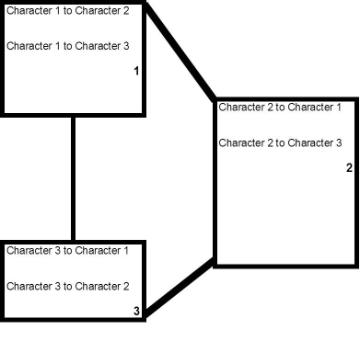
Discussion
Ask discussion questions of all 9 types (see Day 1).
Key Questions (pg. 93 – 102)
- How and why did Johnny make his winter important?
- Who were Johnny’s two mentors?
- How was Frances holding up under the strain?
- What changes occurred on February 19th?
- How did the doctors view Johnny’s amnesia?
- What technique did Frances use for handling the amnesia attacks?
- What changes Johnny deal with in March?
- What impact do you think passing his classes at Deerfield had on Johnny’s health?
- What was so surprising about his scores?
- Why was April 12th an important day? Who arranged the day?
- What shows did Johnny take in?
- How did Johnny attempt to help his father’s chess game?
- What were Johnny’s feelings about his father’s book Inside USA?
Analyze
Analyze the key paragraph.
Key Passage, pg. 94
Frances had rehearsed this with him several times, though she had a horror of doing the actual injection herself. In fact one of the reasons he did it alone was to spare her. They called it “bayonet practice.”
Steadily, too, she helped him in physical activity. She taught him to be deliberate about almost every physical movement, so that he picked his stance carefully and knew exactly what he was going to do next before doing it. The stronger parts of his body must, she told him, be trained to assist those weaker; more and more his good right side must take up the burden from the other; she showed him how his right hand could unobtrusively assist the left. (94)
Extend
Write
Have each student write a short product based on today’s prompt to connect to the unit theme.
Frances prepared Johnny for the injections he would need to take, she also taught him move, use his body to help with strengths aiding weaknesses without bringing attention to himself while out in public.
Leaders develop and dedicate their talents to promote the common good.
This is where they choose to spend their time and effort, Leadership requires positive civic engagement. It is making sure that the communities I am part of are better because I am in them. And that I am better because of the communities I choose to be part of.
In an explanatory paragraph describe how Frances Gunther exemplifies the definition of Leadership Requires Engagement as it is defined above. Provide three examples for the text to support your answer.
Close
Close by extending today’s lesson to life and the world.
- What word of encouragement would you say to Johnny?
- What do you predict will happen next?
Day 10
Outcomes for Today
Prepare
Background
Gather background knowledge about a place, time, event, person, or thing.
Who was Ernie Pyle?
Ernie Pyle, the son of a farmer, was born in 1900. After studying journalism at Indiana University he found work on a small newspaper in La Porte, Indiana. In 1923 he moved to the Washington Daily News and eventually became the paper's managing editor.
In 1932 he was commissioned to write a travel column for the Scripps-Howard newspaper chain. He did this until the outbreak of the Second World War when he became a war correspondent. He moved to England in 1940 where he reported on the Blitz for the New York World Telegram.
Pyle went with the US Army to North Africa in November 1942. This was followed by the invasions of Sicily and Italy. He also accompanied Allied troops during the Normandy landings and witnessed the liberation of France. By 1944 Pyle had established himself as one of the world's outstanding reporters and Time hailed him as "America's most widely read war correspondent."
In 1945 Pyle was awarded the Pulitzer Prize for journalism. Later that year he went with US troops to Okinawa. On 17th April, 1945, Ernie Pyle was killed by a Japanese sniper while on a routine patrol on 17th April, 1945.
Word Wall
Here are five vocabulary words to teach and add to the Word Wall.
|
annoyed (104) |
gesture (104) |
immense (106) |
splendid (107) |
despair (106) |
Read
Review
Review the timeline from the beginning every day.
Read
Read the selection, usually in a Shared Reading Read React Predict Cycle of 2-3 pages.
Red pg. 103 – 112
Respond
Timeline
Agree on the facts in today’s reading and list the 3-5 most important on the timeline.
- John and Frances went to doctors across New York City to seek advice and direction for what they were trying to deal with.
- Johnny became annoyed having to interrupt his studies by spending two days in Neurological.
- The bump on Johnny’s head was like stone again and Mount could barely evacuate a drop from it.
- Mount gave a very grim and depressing outlook offering no hope; informing John to take Johnny home and allow him to do exactly what he wants to do and die happy.
- Penfield offered some hope based upon the fact that even the best are mistaken.
- While doing an experiment at the Tutoring School, Johnny burned through a Pyrex flask, a metal laboratory desk and the floor with anhydrous lithium hydride.
- Johnny sneaked out of the house to see a newsreel at a Translux.
- John and Frances struggled with the balance of protecting Johnny and giving him simple freedoms.
- Johnny called the barber “the executioner” and “the guillotine” as he knew a barbering meant a big operation.
- John lied to Johnny about going to the tenth floor for a test as opposed to a longer procedure.
- Mount said he “took two handfuls” later explained he went in 11 cm and didn’t reach healthy brain tissue.
- After surgery Johnny was told by Gerson he could eat anything but eggs.
Map
Add to ongoing class activities like a KWL chart or map: where did the characters go?
US and World Timeline
Death Be Not Proud takes place between Johnny’s birth on November 4th 1929 and his death June 30th 1947.
It is a time of great change in the US and the world. Keep a timeline that track critical events that occur in the US and worldwide along with Johnny’s life.
Theme Charts
Continue the class theme chart of “Courage.” Once Johnny discovers he has a life-threatening tumor, he begins a journey undergoing a number of treatments. Even during this difficult circumstance the teenage boy faces this challenge with courage and perseverance. He continues to work hard, enjoy his hobbies and does not complain. After each chapter, write at least one example that demonstrates Johnny’s courage.
Continue the class theme chart on “Adolescence.” Johnny is seventeen years old when he is fighting a deadly tumor. He is no longer a child nor an independent adult. He holds a childlike curiosity about science and experiments as well as an adult maturity while dealing with his illness. After the end of each chapter, bullet point examples of Johnny’s childlike curiosity and emotional maturity.
Explore
Activity
Explore the reading more deeply with a visual or oral language activity.
6g6 Venn Diagram Chart
Compare and contrast Johnny’s life before he had a tumor and once he was diagnosed with a tumor.
5g6 Character Interaction Chart
Complete a character interaction chart to discuss the relationships between Johnny and his parents.
6g6 Venn Diagram Chart

Discussion
Ask discussion questions of all 9 types (see Day 1).
Key Questions (pg. 103 – 112)
- How did Johnny respond to Frances helping him get more organized?
- Why did Johnny ask his parents to request they “Bring poker chips. And money.”?
- How did Johnny make his dad feel when he questioned him about the review of Ernie Pyle’s last book?
- What information did the doctors have regarding Johnny’s future?
- Why was April 25th a tremendous day?
- Why was Johnny chocked with disappointment and filled with despair?
- What caused some hope again?
- How did Penfield imply that Johnny could be saved? What needed to be done?
- What happened when Johnny made anhydrous lithium hydride?
- Why was the decision made to stop the diet?
- How did Johnny respond to being told the diet was over?
- What caused the stiff fight? Why? What was the end result?
- What was the major news and event surrounding the April 29th appointment with Neurological?
- What was Johnny’s reaction to seeing the barber? Why did he feel this way? What did he anticipate?
- Why did John have to lie to Johnny? Do you believe it was justified?
- What news did Mount share after surgery?
- What changes do you see in Johnny?
- How has Johnny’s personality changed?
Analyze
Analyze the key paragraph.
Key Passage, pg. 105
I took him home after a brief talk with Mount. It was all hopeless now. What Johnny had now, the pathologist said, was one of the worst forms of tumor, glioma multiforme; moreover the specimen Mount got showed many mitiotic figures: i.e., the production of malignant cells was rapidly increasing. All neurologists are pessimists. I tried to argue with the diagnosis by pointing out how generally well Johnny still was. And indeed the doctors were astonished to the point stupefaction that he had been able to take those college entrance exams. But Mount, so kind and decent, could offer no hope at all when we asked him what to do next. He said, “Let Johnny do exactly what he wants to do and die happy.” (105)
Extend
Write
Have each student write a short product based on today’s prompt to connect to the unit theme.
Mount gives John some very difficult news that Johnny has no hope, the tumor is spreading and it was one of the worst forms of tumors. When John tried to argue Mount the response was simply to allow Johnny to do what he wants and let him die happy. In spite of the news he shared John still believed that Mount was kind and decent.
If you were in John’s shoes would you still feel the same way about the doctor?
It is making sure that the communities I am part of are better because I am in them. And that I am better because of the communities I choose to be part of.
Are the Gunthers better for Mount being their doctor?
In an informative paragraph explain how John can still believe Mount is a kind and decent person even though he believes there is no hope for Johnny. Provide three facts to support your answer.
Close
Close by extending today’s lesson to life and the world.
- How would you respond if you were John?
- Do you think Johnny can overcome this tumor? Why or why not?
Day 11
Outcomes for Today
Prepare
Background
Gather background knowledge about a place, time, event, person, or thing.
What is The New Yorker?
The New Yorker magazine has been a part of American culture for over 80 years. Aside from the cartoons that is has become famous for, the magazine has long been known for its short stories and editorial pieces written by some of the most famous writers of the 20th century. After venturing into the web print market, "The New Yorker" is working toward continuing its popularity well into the 21st century and beyond.
Word Wall
Here are five vocabulary words to teach and add to the Word Wall.
|
interval (113) |
cranium (116) |
vitality (118) |
yearning (120) |
loathed (121) |
Read
Review
Review the timeline from the beginning every day.
Read
Read the selection, usually in a Shared Reading Read React Predict Cycle of 2-3 pages.
Pg. 113 -127
Respond
Timeline
Agree on the facts in today’s reading and list the 3-5 most important on the timeline.
Students might mention:
- Johnny had a meltdown one afternoon in the solarium becoming aggressive and rude.
- Johnny called Dick Rovere of the New Yorker a “hatchet man”
- Trying to pretend and cover the tumor took a great deal out of Johnny
- Frances and Johnny spent their Sundays reading the Hebrew bible, the Christian Gospels, Hindu scriptures and Confucius.
- On May 25th Mr. Boyden called to inform Johnny’s he would graduate with his class at Deerfield.
- Johnny joined his classmates for the pre-graduation dinners and activities.
- The day before graduation was a strenuous and exhausting day for Johnny.
- Johnny made the ¼ mile walk to the Deerfield church and then slowly down the aisle to get his diploma from Mr. Flynt.
- Back in New York John had a long conversation with Davidoff about the possibility of using a new cancer and leukemia treatment on Johnny.
- Due to Johnny’s desperate love of life and his parent’s desperate love for him lead them to entertain every doctor and every possible treatment.
- Johnny became lethargic and testy during his last declining weeks.
- The previous successful treatment was chosen to repeat including; X-ray, mustard, diet and possibly another surgery.
Map
Add to ongoing class activities like a KWL chart or map: where did the characters go?
US and World Timeline
Death Be Not Proud takes place between Johnny’s birth on November 4th 1929 and his death June 30th 1947.
It is a time of great change in the US and the world. Keep a timeline that track critical events that occur in the US and worldwide along with Johnny’s life.
Theme Charts
Continue the class theme chart of “Courage.” Once Johnny discovers he has a life-threatening tumor, he begins a journey undergoing a number of treatments. Even during this difficult circumstance the teenage boy faces this challenge with courage and perseverance. He continues to work hard, enjoy his hobbies and does not complain. After each chapter, write at least one example that demonstrates Johnny’s courage.
Continue the class theme chart on “Adolescence.” Johnny is seventeen years old when he is fighting a deadly tumor. He is no longer a child nor an independent adult. He holds a childlike curiosity about science and experiments as well as an adult maturity while dealing with his illness. After the end of each chapter, bullet point examples of Johnny’s childlike curiosity and emotional maturity.
Explore
Activity
Explore the reading more deeply with a visual or oral language activity.
3g6 Plot Profile Chart
Graduation announcement
Create a graduation announcement for Johnny from Deerfield Academy. Include all the pertinent details for the ceremony.
Discussion
Ask discussion questions of all 9 types (see Day 1).
Key Questions (pg. 113 -127)
- What did Johnny think about the bandage? How did he process it?
- In what ways did Johnny’s personality change?
- How did Johnny great Mount? What did he request?
- What was Mount’s response?
- What does Johnny act toward?
- How did Johnny deal with people helping him?
- What physical changes begin to take place?
- How did Johnny want to write? Who should he attack?
- What news came on May 25th from Mr. Boyden?
- What impact did this have upon the Gunther family?
- What were Johnny’s feelings prior to the ceremony?
- Where was Johnny when he parents when to pick him up in the morning?
- How was Johnny’s health later in the day?
- Why do you think Johnny said “There’s no future to just sitting.”? to his mother?
- How did Johnny hold up physically to the day before graduation activities? What concerns did he have?
- What directions did Mrs. Albert D. Lasker give?
- What was the greatest obstacle to the new medicaments?
- How was Johnny’s prognosis from Davidoff in Montefiore?
- How did Davidoff explain Johnny’s condition? What insight did he offer?
- What motivated the Gunthers to try so many treatments and doctors? Do you agree with them?
- What course of action was decided upon? Do you agree?
- What did Dr. Ursalof call Johnny? Why?
Analyze
Analyze the key paragraph.
Key Passage, pg. 17 & 23
The effort to pretend that the tumor was nothing cost him dearly; the price of his invincible fight was great fatigue. It took a miserable lot out of him to pretend to ignore what he must have known to be the truth, that he wasn’t getting any better. The faraway look was in his eyes more often now. But it was impossible for us not to support his optimism, because any discouragement would have been a crushing blow. All he had now was his will to live. We had to keep that up at any cost. The cord of life was wearing very thin, and if we took away hope, it would be bound to snap. (117)
Everything that Johnny suffered was in a sense repaid by the few heroic moments of that walk down the center aisle of that church. This was his triumph and indomitable summation. Nobody who saw it will ever forget it, or be able to forget the sublime strength of will and character it took. (123)
Extend
Write
Have each student write a short product based on today’s prompt to connect to the unit theme.
Johnny wore down a great deal from trying to battle the tumor and pretend that nothing was wrong. Johnny’s will to live and optimism were crucial to him staying strong, his parents were bound and determined to support him. The act of his walking down the aisle to receive his diploma is one of triumph and celebration that would not be forgotten by anyone who was in attendance watching him.
Pretend you are a newspaper reporter. Write an informative article that describes the graduation ceremony. Include an explanatory paragraph about Johnny and his will to graduate under challenging circumstances. Be sure to make up a quote from Johnny to include in your article.
Close
Close by extending today’s lesson to life and the world.
- What do you imagine your high school graduation to be like?
- How determined are you to graduate?
Day 12
Outcomes for Today
Prepare
Background
Gather background knowledge about a place, time, event, person, or thing.
Who was Sinclair Lewis?
American novelist, playwright, and social critic who gained popularity with satirical novels. Sinclair Lewis won the Nobel Prize for Literature in 1930, the first given to American. His total output includes 22 novels and three plays. Though Lewis criticized at times the American way of living, his basic view of the "American human comedy" was optimistic. He gained fame with Main Street, a study of idealism and reality in a narrow-minded small-town. "Main Street is the continuation of main Streets everywhere." Lewis's next novel, BABBITT (1922), was a merciless portrait of a Midwestern businessmen. His hometown, Zenith, is a version of Gopher Prairie, although Zenith is much bigger. George F. Babbitt, forty-six years old, yearns for freedom but in his world art and culture are in the service of business. "To George F. Babbitt, as to most prosperous citizens of Zenith, his motor-car was poetry and tragedy, love and heroism.
Word Wall
Here are five vocabulary words to teach and add to the Word Wall.
|
alluded (128) |
fleeting (129) |
exhilarated (130) |
tedious (133) |
placidly (138) |
Read
Review
Review the timeline from the beginning every day.
Read
Read the selection, usually in a Shared Reading Read React Predict Cycle of 2-3 pages.
Pg. 127 – 142
Respond
Timeline
Agree on the facts in today’s reading and list the 3-5 most important on the timeline.
Students might mention:
- Johnny was given permission to go to the country for a couple days; Frances went up early to prepare the downstairs for him.
- Putnam supported Davidoff’s suggestion of more X-ray treatments.
- On June 27, Johnny was hit with a bad bout of amnesia.
- Johnny found a way to use the sleeve of his jacket to help hold the fork while eating.
- Johnny’s grip on life was lessening but John didn’t feel it was emergency level yet.
- John called Frances and told her to come in Sunday even though she had plans for Tuesday.
- Sunday turned out to be one of Johnny’s best days; he was overly intimate and affectionate toward John.
- During his trip to Memorial for blood work and final clearance for the trip to the country nobody saw marked change or reason for alarm; no intimation of impending disaster
- Traeger left Sinclair Lewis in Williamstown to return to New York as he had a feeling Johnny would die that weekend.
- Johnny came down with a bad headache, having him call Connie to send over morphine and John to return home and call Traeger.
- Johnny vomited which was a warning sign for the Gunther’s.
- John cancelled a dentist appointment as Johnny’s condition worsened.
- Traeger examined Johnny and told his parents “He’s dying” he had a cerebral hemorrhage.
- Mount rushed to the Gunther residence; remarkably Johnny recognized him.
- Mount informed John he had never seen a tumor so fierce and rigid.
- Johnny was moved by ambulance to a nearby hospital
- Johnny received oxygen, glucose infusion and transfusion.
- Johnny never regained consciousness and died without fear, pain or know he would die.
- Johnny died at 11:02pm, John held his arms and felt the warmth gradually go away.
- His funeral was a double ceremony officiated by Rabbi Newman and Mr. Neale of the Unitarian church
- Hundreds of letter of condolence came in from around the world.
- Traeger gave the Gunthers Johnny’s autopsy report; saying Johnny’s body would provide important information to the neurological institute.
Map
Add to ongoing class activities like a KWL chart or map: where did the characters go?
US and World Timeline
Death Be Not Proud takes place between Johnny’s birth on November 4th 1929 and his death June 30th 1947. It is a time of great change in the US and the world. Keep a timeline that track critical events that occur in the US and worldwide along with Johnny’s life.
Theme Charts
Continue the class theme chart of “Courage.” Once Johnny discovers he has a life-threatening tumor, he begins a journey undergoing a number of treatments. Even during this difficult circumstance the teenage boy faces this challenge with courage and perseverance. He continues to work hard, enjoy his hobbies and does not complain. After each chapter, write at least one example that demonstrates Johnny’s courage.
Continue the class theme chart on “Adolescence.” Johnny is seventeen years old when he is fighting a deadly tumor. He is no longer a child nor an independent adult. He holds a childlike curiosity about science and experiments as well as an adult maturity while dealing with his illness. After the end of each chapter, bullet point examples of Johnny’s childlike curiosity and emotional maturity.
Explore
Activity
Explore the reading more deeply with a visual or oral language activity.
Obituary
Create an obituary for Johnny.
Gravestone
Design a gravestone for Johnny.
Discussion
Ask discussion questions of all 9 types (see Day 1).
Key Questions (pg. 127 – 142)
- How was Johnny’s outlook and opinion of American schools?
- Who was Dean Gummere? What did he do? What kind of impact did this have?
- Describe the news Putnam and Traeger brought. How did Johnny react?
- What was Putnam’s suggestions?
- Why was June 27th an awful morning? What change occurred?
- What items did Johnny pack for his summer trip? Do you think it was strange?
- What changes now began in Johnny’s behavior?
- Why do you think John insisted that Frances return home? How would you have handled this situation?
- What does Johnny pack for the summer? What does this say about his focus?
- While getting his summer clearance at Memorial what happened that the doctors didn’t pick up on?
- Why did Traeger leave his holiday weekend with Sinclair Lewis suddenly?
- What event triggered concern on Frances part? Why would this be cause for alarm?
- What prognosis did Traeger give? How was this a surprise?
- What impact did Traeger’s call have on Mount?
- What news did Mount share with John and Frances regarding Johnny’s progress?
- What events provided more undue stress on Frances and John?
- How did John describe Johnny as he approached death and finally died?
- Describe Johnny as he lay in the chapel.
- How was his funeral service unique?
- What were the “whys” that John posed?
- What news did Traeger share with John and Frances that provided some comfort?
Analyze
Analyze the key paragraph.
Key Passage, pg. 140
Letters came in like an avalanche, until we counted them by the hundred. He was just a boy of seventeen; yet what an imprint he made on anybody who ever met him! There were condolences from camp counselors who had not seem him for year and from a barber in a downtown hotel; from the Negro elevator boy in my office building and the proprietors of a friendly restaurant on Madison Avenue; from playwrights, judges, politicians, old Chicago friends whom we had not seen in years, from teachers and doctors and newspaper folk, old schoolmates, several of those who had seen him graduate at Deerfield, movie people, poets, acquaintances from faroff days in Vienna, physicists, his godfather in Washington, the doormen at our apartment building, refugees from Europe, his devoted governess Milla, scores of writers, and above all people who had never meet him or us – parents whose sons had also died. (140)
Extend
Write
Have each student write a short product based on today’s prompt to connect to the unit theme.
The volume of letters that the Gunther’s received following Johnny’s was amazing to them. People from across the country, all areas or his life regardless age, race, or social status. Johnny impacted people around the world. The quarter theme is Leadership Requires Engagement, it is defined as “Leaders develop and dedicate their talents to promote the common good. This is where they choose to spend their time and effort, Leadership requires positive civic engagement. It is making sure that the communities I am part of are better because I am in them. And that I am better because of the communities I choose to be part of”.
Pretend you are Johnny. Write a journal entry, 1-2 explanatory paragraphs, describe how you felt after receiving the enormous amounts of letters. End your journal entry with an informative paragraph describing your desire to be a leader and role model to others.
Close
Close by extending today’s lesson to life and the world.
- When have you received praise?
- How did it make you feel?
- What did you do to earn praise?
Day 13
Outcomes for Today
Prepare
Background
Gather background knowledge about a place, time, event, person, or thing.
What is the “A generation of Vipers” by Wylie?
This is the book that made Philip Wylie famous in 1944. Philip Wylie is bitter and caustic. He calls his book "a sermon," but feels no need to be charitable in his attacks.
Wylie pleads for a more rational society, one that is based on sound psychological principles. For those who agree with him, his book is a reaffirmation; for those who don't, it stimulates the circulation.
Wylie, one of the founders of The New Yorker, attacks everything imaginable, from politics to religion to mothers. He could give H.L Mencken a run for his money as the most opinionated person of the 20th century. Considering the world hasn't improved much in the last 50 years, much of what he says has great relevance today
Word Wall
Here are five vocabulary words to teach and add to the Word Wall.
|
excerpts (145) |
outbreak (147) |
compose (149) |
tendency (152) |
astonished (156) |
Read
Review
Review the timeline from the beginning every day.
Read
Read the selection, usually in a Shared Reading Read React Predict Cycle of 2-3 pages.
Pg. 145 - 167
Respond
Timeline
Agree on the facts in today’s reading and list the 3-5 most important on the timeline.
Students might mention:
- The summer of 1939 Johnny attended camp in Lake Placid, N.Y where his interest included; music and science.
- Johnny enjoyed music, science and trips to museums while at camp.
- Johnny travelled with Frances to California visiting Yosemite National Park and Griffith Observatory.
- While at Riverdale in 1941, Johnny wrote John to complain about being forced to do things he didn’t want to do.
- In 1943, Johnny writes John to tell him of the challenges of being a fisherman and from then on he has decided to eat store bought fish.
- In writing to Frances, Johnny described his room as being the extreme opposite from too painfully neat.
- Johnny describes his Indian stamp collection and his improvement on the Chess Club.
- Johnny sent a letter to John detailing the effect of water on his experiment in detailed chemical formula.
- In letters to friends and teachers Johnny was upbeat of his condition and very focused on returning to Deerfield and his studies.
Map
Add to ongoing class activities like a KWL chart or map: where did the characters go?
US and World Timeline
Death Be Not Proud takes place between Johnny’s birth on November 4th 1929 and his death June 30th 1947.
It is a time of great change in the US and the world. Keep a timeline that track critical events that occur in the US and worldwide along with Johnny’s life.
Theme Charts
Continue the class theme chart of “Courage.” Once Johnny discovers he has a life-threatening tumor, he begins a journey undergoing a number of treatments. Even during this difficult circumstance the teenage boy faces this challenge with courage and perseverance. He continues to work hard, enjoy his hobbies and does not complain. After each chapter, write at least one example that demonstrates Johnny’s courage.
Continue the class theme chart on “Adolescence.” Johnny is seventeen years old when he is fighting a deadly tumor. He is no longer a child nor an independent adult. He holds a childlike curiosity about science and experiments as well as an adult maturity while dealing with his illness. After the end of each chapter, bullet point examples of Johnny’s childlike curiosity and emotional maturity.
Explore
Activity
Explore the reading more deeply with a visual or oral language activity.
Create a book cover
Create a book cover for Johnny’s parents to put the compilation of his letters they saved over the years. Decorate it with images that would be symbolic of Johnny’s passions while he was alive.
Discussion
Ask discussion questions of all 9 types (see Day 1).
Key Questions (pg. 145 - 167)
- How would you describe Johnny is the early years?
- How would you describe Johnny the summer of ’39? What were his interests?
- What places of interest did Johnny visit while travelling to California the summer of 1941 with Frances?
- While writing from Riverdale in 1941what was the tone of his letters to John?
- What news did Johnny include in his 1943 birthday update to John?
- How did Johnny’s adventures as a fisherman turn out? What eventually happened?
- What things did Johnny write home about in letters written from Deerfield in 1943 and 1944?
- How was Johnny progressing with his Indian stamp collection and chess playing?
- What was Johnny’s tone in the letter written to John in 1945?
- How did the January 13th letter to John explain Johnny’s passion for science and chemistry?
- How did Johnny describe Presbyterian Hospital to his friend in May of 1946? What was the reason he was in the hospital at this time?
- What mood did Johnny present in letters to Mr.Boyden and Mr. Weaver in 1946?
Analyze
Analyze the key paragraph.
Key Passage, pg. 153
In the beginning of the summer we decided that I should go fishing every Friday and catch some fish for dinner. After a few times I found I didn’t like it because I kept thinking about how I would feel if I were the fish. Mutti thought that I ought to fish anyway and not think about how the fish feels. But when I took her fishing and she tried to dehook the fish, she immediately changed her views on the subject. Now we buy our fish. (153)
Extend
Write
Have each student write a short product based on today’s prompt to connect to the unit theme.
In a letter to John in August of 1943, Johnny describes his experiences fishing, the challenges he faced and how he thought through the process. Johnny was unsure about fishing but Frances encouraged him to continue and not think about it. Johnny does and then when Frances joins him one day she agrees with him and they decide to buy their fish in the future.
The quarter theme Leadership Requires Engagement definition includes “It is making sure that the communities I am part of are better because I am in them. And that I am better because of the communities I choose to be part of”. How does Johnny make the communities better around him and in what ways does he improve his communities.
In an explanatory paragraph describe how Johnny is a better person for his time with Frances. Write a second explanatory paragraph describing how Frances is a better person for being around Johnny.
Close
Close by extending today’s lesson to life and the world.
- What can you do to encourage others to be better people?
- Do you strive to be a better person? Why or why not?
Day 14
Outcomes for Today
Prepare
Background
Gather background knowledge about a place, time, event, person, or thing.
What is V-J Day?
V-J Day (with V-J denoting "Victory over Japan" or "Victory in Japan") is the day that the Empire of Japan surrendered to the Allied forces, effectively ending World War II. The informal surrender occurred on August 14, 1945, followed by the formal surrender on September 2, 1945. V-J Day can be considered any one of three days: August 14 or 15, or September 2, but most observances occur on August 14.
Word Wall
Here are five vocabulary words to teach and add to the Word Wall.
|
sporadically (168) |
wandering (172) |
swapped (174) |
contentment (175) |
romped (185) |
Read
Review
Review the timeline from the beginning every day.
Read
Read the selection, usually in a Shared Reading Read React Predict Cycle of 2-3 pages.
Pg. 168 – 185
Respond
Timeline
Agree on the facts in today’s reading and list the 3-5 most important on the timeline.
Students might mention:
- Johnny sporadically kept a diary for years; he carried his notebook with him everywhere and wrote in it secretly.
- Johnny perfected magic tricks by March 22nd
- In the summer of 1945 Johnny felt ½ the time his conscious mind was asleep or wandering which he accounted for procrastination.
- May 31, 1946 Johnny was impressed and happy that Dr. Einstein responded to his letter.
- November 10, 1946 wrote in his diary that after two months he had finally “accepted” Dr. Gerson’s diet.
- Mid November 1946 Johnny discussed divorce with his parents, he felt like he got it all straightened out and believed he had wonderful parents.
- Johnny was happy to get permission to go home for Christmas.
- April 13th, 1947 Johnny took seven hours of College Board exams.
- Johnny underwent a second operation in May 1947.
- Johnny was happy to arrive at Deerfield May 30th despite the fact he had to stay in the infirmary.
- After arriving home the first week of June, Johnny went to the public library a couple times to learn more about liquid NH3.
- In the back of his diary he had a list of chemical and math formulas, and gifts he planned to get his parents.
- His last entry was the “Hebrew Toast: Le Hy-eem—To Life.”
Map
Add to ongoing class activities like a KWL chart or map: where did the characters go?
US and World Timeline
Death Be Not Proud takes place between Johnny’s birth on November 4th 1929 and his death June 30th 1947.
It is a time of great change in the US and the world. Keep a timeline that track critical events that occur in the US and worldwide along with Johnny’s life.
Theme Charts
Continue the class theme chart of “Courage.” Once Johnny discovers he has a life-threatening tumor, he begins a journey undergoing a number of treatments. Even during this difficult circumstance the teenage boy faces this challenge with courage and perseverance. He continues to work hard, enjoy his hobbies and does not complain.
After each chapter, write at least one example that demonstrates Johnny’s courage.
Continue the class theme chart on “Adolescence.” Johnny is seventeen years old when he is fighting a deadly tumor. He is no longer a child nor an independent adult. He holds a childlike curiosity about science and experiments as well as an adult maturity while dealing with his illness. After the end of each chapter, bullet point examples of Johnny’s childlike curiosity and emotional maturity.
Explore
Activity
Explore the reading more deeply with a visual or oral language activity.
Create a cover for Johnny’s diary
Johnny kept a diary from 1945 to his death in 1947. Create a cover that represents Johnny’s life, dreams and passions. This should be easy as you have read so much about him.
Fill out the Beginning-Middle-End Chart
- Decide what the most important events in the story are. You may want to jot down a list.
- Decide whether each event is part of the beginning, middle or end or the story. Then write a phrase describing each event in the correct column. Remember in the beginning you are introduced to the setting, the characters and the problems they have. In the middle you learn about the roadblocks to the characters solving their problems, and conflicts occur. In the end of the story those conflicts reach a peak and then resolve with a resolution of the character’s problems.
- If the events in a column are not in the order they took place, number the items in the column.
- If you analyzing a chapter or segment of a larger story, all of the events might be in 1 or 2 columns, understood as part of the larger story. Or it might work to analyze the beginning, middle and end of just this part.
Discussion
Ask discussion questions of all 9 types (see Day 1).
Key Questions (pg. 168 – 185)
- What was the Gunther Philosophy according to Johnny the summer of 1945?
- What conclusion did Johnny come up with during his self-analysis?
- How did Johnny feel about Dr. Einstein’s response?
- On November 29th 1946 what lesson did Johnny admit to having not learned?
- How did Johnny respond to the Book of the Month Club accepting John’s book? Why do you think he felt this way?
- What request did Johnny want to make of Dr. Gerson’s assistant?
- How does Johnny relieve himself of worries?
- December 22nd 1946 Johnny describes his days. What do they look like?
- What “facts about operation” did Johnny share?
- How does the tone of Johnny’s January 8th diary entry give a look into his attitude?
- What epiphany did Johnny come up with on Wednesday February 19th, 1947, A.D.?
- What chemical reaction did Johnny research multiple times at the Public Library? What was its significance?
- After the 2nd operation how long was Johnny confined to the hospital?
- How was Johnny’s time at Deerfield based upon the May 30th entry into his diary?
- What residual effects did he still experience from surgery while at Deerfield?
- How did finishing “Human Destiny” by Du Nouy impact Johnny?
- The back of Johnny’s notebook provided an important view into who he was. What did it say his priorities were?
- How were Johnny’s last words written inside the back cover the perfect explanation of how he lived life?
Analyze
Analyze the key paragraph.
Key Passage, pg. 168
Sporadically for some years Johnny kept a diary, at Frances’s suggestion and under her encouragement. When he became ill he carried his notebook wherever he went; on any trip to the hospital, no matter how brief, two things were musts: the recorder and his diary. He told her once, “You put it on my desk so gently. You didn’t tell me to use it. You just it gently on my desk, remember, and then I began using it, and I’m so glad.” (168)
Extend
Write
Have each student write a short product based on today’s prompt to connect to the unit theme.
With quiet and gentle encouragement from Frances, Johnny began writing in his diary, when he became ill it went everywhere with him. The theme of the quarter is Leadership Requires Engagement and we define it as “Leaders develop and dedicate their talents to promote the common good. This is where they choose to spend their time and effort, Leadership requires positive civic engagement. It is making sure that the communities I am part of are better because I am in them. And that I am better because of the communities I choose to be part of”.
In an explanatory paragraphs describe how Frances exemplifies the theme of Leadership Requires Engagement based upon her handling of the diary with Johnny. Refer back to the key paragraph to provide your evidence in your explanation.
Close
Close by extending today’s lesson to life and the world.
- What would you do if you were Francis?
- What advice would you give Johnny?
Day 15
Outcomes for Today
Prepare
Background
Gather background knowledge about a place, time, event, person, or thing.
What is grief?
In today’s reading Frances, Johnny’s mother writes of losing Johnny from her own perspective, sharing experiences, and dealing with her sense of loss and grief.
Grief is a reaction to a major loss. It is most often an unhappy and painful emotion. Grief may be triggered by the death of a loved one. People also can experience grief if they have an illness for which there is no cure, or a chronic condition that affects their quality of life.
Everyone feels grief in their own way. However, there are common stages to the process of mourning. It starts with recognizing a loss and continues until a person eventually accepts that loss. People's responses to grief will be different, depending on the circumstances of the death.
Word Wall
Here are five vocabulary words to teach and add to the Word Wall.
|
impending (187) |
complex (188) |
grief (190) |
nonsense (193) |
exult (195) |
Read
Review
Review the timeline from the beginning every day.
Read
Read the selection, usually in a Shared Reading Read React Predict Cycle of 2-3 pages.
Pg. 186 – 195
Respond
Timeline
Agree on the facts in today’s reading and list the 3-5 most important on the timeline.
Students might mention:
- Frances reflects on the fifteen months Johnny battled the brain tumor and what her thought process was on a daily basis.
- Frances explained the myriad of questions she had while Johnny was dying.
- The single theme of the many letters received following Johnny’s death was sympathy of God’s will in the unexplainable loss.
- Frances didn’t believe Johnny had been singled out by God for any reason.
- Frances shared how she constantly prayed and felt that God was always with them during the journey.
- Frances didn’t feel her grief was desolation or rebellion toward universal law or deity but much simpler and sadder.
- Remembering all of Johnny’s passions and favorites was cause for pain to Frances as he would no longer enjoy them.
- Although many of his ambitions went unfulfilled Johnny did achieve his graduation from Deerfield with his class.
- Frances explains that during the last summer at Madison she wrote in her diary when she couldn’t sleep; usually about facing death and not being afraid.
- Frances lists and describes activities, books, conversations and things she and Johnny did together.
- Frances regrets and shares feelings of failure and guilt over losing Johnny young.
- Frances wishes they had been able to fulfill some of Johnny’s last hearts desires.
- Frances shares the feelings she has when seeing parents who are impatient, tired, or bored with their children.
- Frances describes how she feels she could have loved Johnny more and how that would have looked.
Map
Add to ongoing class activities like a KWL chart or map: where did the characters go?
US and World Timeline
Death Be Not Proud takes place between Johnny’s birth on November 4th 1929 and his death June 30th 1947.
It is a time of great change in the US and the world. Keep a timeline that track critical events that occur in the US and worldwide along with Johnny’s life.
Theme Charts
Finish the class theme chart of “Courage.” Once Johnny discovers he has a life-threatening tumor, he begins a journey undergoing a number of treatments. Even during this difficult circumstance the teenage boy faces this challenge with courage and perseverance. He continues to work hard, enjoy his hobbies and does not complain. After each chapter, write at least one example that demonstrates Johnny’s courage.
Finish the class theme chart on “Adolescence.” Johnny is seventeen years old when he is fighting a deadly tumor. He is no longer a child nor an independent adult. He holds a childlike curiosity about science and experiments as well as an adult maturity while dealing with his illness. After the end of each chapter, bullet point examples of Johnny’s childlike curiosity and emotional maturity.
Reflect on the two class theme charts. Discuss what lesson you think the author wants the reader to take away from this story?
Explore
Activity
Explore the reading more deeply with a visual or oral language activity.
Fill out the Plot Profile Chart
- Decide on the 10 most important events in the story, chapter or segment you are analyzing. List them in order in the rows at the bottom of the chart. If you go back to the Beginning-Middle-End Chart, this will be easier to do.
- Decide on a scale of 1 [low] to 10 [high] how intense you think this event is, and mark your score in the appropriate box.
- Connect the marks in the boxes to form a graph.
- This graph will help you to profile the plot. How it looks will depend on the story you are reading and whether you are plotting an entire story, or a chapter or segment.
3g6 Plot Profile Chart
Discussion
Ask discussion questions of all 9 types (see Day 1).
Key Questions (pg. 186 – 195)
- How did Frances handle fifteen months of Johnny’s illness?
- What did Johnny’s impending death lead to?
- Why do you believe that Frances wished she loved Johnny more? Where do her feelings of guilt come from?
- What did Frances learn from the experience of losing Johnny?
- What was the wave that John and Frances rode?
- When and how did Frances and John learn that Johnny knew all along how grave his illness was?
- How does Frances find grief?
- What do the things that Johnny loved do to Frances?
- The one thing closest to Johnny’s heart was? What did this say about his priorities and passions?
- What were the ambitions that Johnny was able to achieve in his young life?
- How did Frances and Johnny attend church? Which religion did they worship with?
- What did Frances wish for?
- Describe the impact on Frances when she saw the headline about the Yale-Harvard game.
Analyze
Analyze the key paragraph.
Key Passage, pg. 193
We always discussed things a little ahead. In a way I was experimenting with Johnny as he dreamed of doing with his elements, as artists do with their natural materials. I was trying to create of him a newer kind of human being: an aware person, without fear, and with love: a sound individual, adequate to life anywhere on earth, and living life everywhere and always. We would talk about all this as our experiment together. (193)
Extend
Write
Have each student write a short product based on today’s prompt to connect to the unit theme.
Frances shares what she was trying to accomplish as she was raising Johnny. Did she accomplish her goals? Was she a good mother? Were her methods of mothering and parenting wise?
In an explanatory paragraph discuss Frances’ parenting. How do you feel about the direction her parenting? Include 2-3 examples to support your explanation.
Close
Close by extending today’s lesson to life and the world.
- What did you like and dislike about this memoir?
- What would you include in your memoir?