Lesson Plan
Dead Man Walking
40
60
90
Day 1
Outcomes for Today
Prepare
Background
Gather background knowledge about a place, time, event, person, or thing.
Which countries practice capital punishment?
Presently, more than half of the countries in the international community have abolished the death penalty completely, de facto, or for ordinary crimes. However, 58 countries retain the death penalty, including China, Iran, the United States, and Vietnam all of which rank among the highest for international executions in 2003.
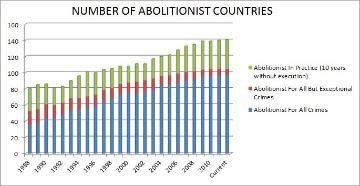
In 1977, just 16 countries had abolished the death penalty for all crimes. By 1988, 35 countries had done so and another 18 had abolished the death penalty for all but exceptional crimes like treason, and 27 more were considered abolitionist in practice because they had not carried out an execution in over 10 years. As of May 2013, 140 countries were abolitionist in law or practice.
Source: http://www.amnestyusa.org/our-work/issues/death-penalty/us-death-penalty-facts/death-penalty-trends
Word Wall
Here are five vocabulary words to teach and add to the Word Wall.
|
residents-3 |
affluence-5 |
status quo-6 |
witness-7 |
vulnerable-8 |
Read
Review
Review the timeline from the beginning every day.
Read
Read the selection, usually in a Shared Reading Read React Predict Cycle of 2-3 pages.
Read p. 1-12
|
Setting |
Characters |
Pages |
|
St. Thomas housing project and Louisiana State Penitentiary at Angola |
Sister Helen, Patrick, Chava |
Intro - 12 |
|
Hope House facility |
Sister Helen, her students |
3 |
|
Death Row Louisiana State Penitentiary |
Patrick Sonnier |
4 |
|
St. Martinville, Louisiana |
St. Martinville Residents |
4 |
|
519 St. Andrew Street |
Sister Helen, Nuns |
5 |
|
Terre Haute, Indiana |
Sister Helen, Sister Marie Augusta Weal |
5 |
|
Baton Rouge, Louisiana |
Sister Helen, Sister Helen’s Family |
6 |
|
Baton Rouge Bus |
Sister Helen, Elise Gauthier, Victim |
7 |
Respond
Timeline
Agree on the facts in today’s reading and list the 3-5 most important on the timeline.
Students might mention:
- Chava Colon asks Sister Helen Prejean to become pen pals with a prison inmate. Page 3.
- Sister Helen accepts. Page 3.
- Sister Helen learns the specifics of her pen pal’s crime, which involves the rape and murder of a teenage couple. Page 4.
- Sister Helen reflects on the Sisters of St. Joseph and how she came to her approach to social justice after a lecture in 1980. Page 5.
- Sister Helen reflects on her upper middle class up bringing and early impressions of the black community. Page 6.
- In St. Thomas, Sister Helen works with high school students, food stamp recipients, single parents, and residents on minimum wage. Page 6.
- Sister Helen reflects on the larger system of disadvantage toward the working poor. Page 6.
- She notes that nearly everyone she meets in St. Thomas has a family member in prison. Page 9.
- Sister Helen is given the name of the inmate she will be writing and sees his photo. Page 11.
- She sends him three photos: one of Jesus, one of a lake, and one of her on a horse. Page 11.
- Two of the photos are sent back due to prison mail size stipulations. Only the photo of her on the horse goes through. Page 11.
Map
Add to ongoing class activities like a KWL chart or map: where did the characters go?
Leadership Poster:
- Collaborate with students create a class T Chart. This can be a live, online document that students have shared access to (Google Document or Google Spreadsheet).
- Label one column “Examples of Good Leadership” and the other side “Examples of Poor Leadership”.
- Through the readings, reflect on the characters’ leadership and bullet point examples of characters demonstrating good leadership or poor leadership.
Leadership Poster Extension:
- During this unit, encourage students to follow the local and world news, using a variety of mediums (newspapers, online sources, etc.).
- Have students periodically input a headline/article of a “Examples of Good Leadership” and “Examples of Poor Leadership” in their local community and in the world on the document. Discuss the additions the next day in class.
- For all of the items in the “Examples of Good Leadership” column, have students write one thing they can do to take action and support the individuals, groups, or organizations that are acting to promote the common good.
- For all of the items in the “Examples of Poor Leadership” column, have students write an idea on how the leader can be more engaged.
- In each situation, helping may involve writing a letter, getting more informed, volunteering, etc.
- Have students choose one item to take action on. They should report their action and results to the class.
Explore
Activity
Explore the reading more deeply with a visual or oral language activity.
1g6Portrait: Create an Open Mind Portrait of a Sister Helen
You will add thought bubbles to her OMP every couple days.
You could use different colors for the beginning, middle and end of the story. Remember in the beginning you are introduced to the setting, the characters and the problems they have. In the middle you learn about the roadblocks to the characters solving their problems, and conflicts occur. In the end of the story those conflicts reach a peak and then resolve with a resolution of the character’s problems.
Materials:
- Large piece of stiff paper for each character, like 11x17 oak tag
- Paper for bubbles with scissors and glue sticks
- Markers, crayons, pens, pencils, or paint
- Construction or tissue paper, scissors and glue sticks if desired
Discussion
Ask discussion questions of all 9 types (see Day 1).
Key Questions
- Describe Sister Helen Prejean. Why do you think she wrote this book?
- Explain why Sister Helen decides to correspond with an inmate on death row.
- Why does Sister Helen decide to work with the poor?
- Describe Sister Helen’s childhood. How does her background compare to her life as a nun?
- How does Sister Helen use her talents to promote the common good? How is does she demonstrate leadership?
- While in St. Thomas, where does Sister Helen find inspiration?
- How does a young boy from St. Thomas show that people of all ages can be an example of a positive leader?
- Describe Patrick Sonnier. Why is he on death row?
- Explain why Patrick is lonely. How does Patrick spend his days while in prison?
- How does Sister Helen become in contact with Patrick?
Analyze
Analyze the key paragraph.
Key Paragraph – p.7
“My parents never acted mean to black people, even though they never questioned the system of racial discrimination that permeated every aspect of life. Daddy, an attorney, represented a slew of black clients, charging them five dollars for his services, and he helped several families buy property and, eventually, own their own homes. It would take me a long time to understand how systems inflict pain and hardship in people’s lives and to learn that being kind in an unjust system is not enough.”
Extend
Write
Have each student write a short product based on today’s prompt to connect to the unit theme.
The author, Sister Helen, describes her childhood and her call to become a nun. In an explanatory paragraph, describe Sister Helen and her passion for social justice. How do you think Sister Helen’s childhood influenced her passion for social justice? What series of events led Sister Helen to advocate for social justice? What social justice issues is Sister Helen passionate about? “Leadership requires positive civic engagement.” How does Sister Helen demonstrate positive civic engagement?
Close
Close by extending today’s lesson to life and the world.
Provide an example when you positively contributed to your family, friends, or community. How can you positively impact your school community in the future?
Day 2
Outcomes for Today
Prepare
Background
Gather background knowledge about a place, time, event, person, or thing.
How did Europe influence the death penalty in the U.S.?
Britain influenced America's use of the death penalty more than any other country. When European settlers came to the new world, they brought the practice of capital punishment. The first recorded execution in the new colonies was that of Captain George Kendall in the Jamestown colony of Virginia in 1608. Kendall was executed for being a spy for Spain. In 1612, Virginia Governor Sir Thomas Dale enacted the Divine, Moral and Martial Laws, which provided the death penalty for even minor offenses such as stealing grapes, killing chickens, and trading with Indians.
Source: http://www.deathpenaltyinfo.org/part-i-history-death-penalty
Word Wall
Here are five vocabulary words to teach and add to the Word Wall.
|
indigent-13 |
correspondents-13 |
defendant-14 |
transcripts-14 |
condemned-17 |
Read
Review
Review the timeline from the beginning every day.
Read
Read the selection, usually in a Shared Reading Read React Predict Cycle of 2-3 pages.
Read p. 13-22
|
Setting |
Characters |
Pages |
|
St. Thomas housing project and Louisiana State Penitentiary at Angola |
Sister Helen, Patrick, Chava |
13-22 |
|
The Prison Coalition Office |
Sister Helen, Chava |
14 |
Respond
Timeline
Agree on the facts in today’s reading and list the 3-5 most important on the timeline.
Students might mention:
- After seeing her picture and reading her letter, Sonnier agrees to write with Sister Helen. Page 12.
- He asks that she not speak to him in religious parables. She agrees to speak plainly. Page 13.
- They become steady correspondents. Page 13.
- Sister Helen visits the Prison Coalition and reads graphic transcripts of the crime and the eventual guilty verdict from the jury. Page 14.
- Patrick Sonnier continues to write. Page 18.
- Sister Helen reflects on death penalty evolution and transition from hangings to electrocutions. Page 18.
- Sister Helen offers to visit Patrick in prison. Page 22.
Map
Add to ongoing class activities like a KWL chart or map: where did the characters go?
Leadership Poster:
- Continue to collaborate with students create a class T Chart of “Examples of Good Leadership” and “Examples of Poor leadership”. This can be a live, online document that students have shared access to (Google Document or Google Spreadsheet).
- Continue to reflect on the characters’ leadership and bullet point examples of characters demonstrating good leadership or poor leadership.
Leadership Poster Extension:
- Continue to encourage students to follow the local and world news, using a variety of mediums (newspapers, online sources, etc.).
- Periodically students should continue input a headline/article of “Examples of Good Leadership” and “Examples of Poor Leadership” in their local community and in the world on the document. Discuss the additions the next day in class.
- For all of the items in the “Examples of Good Leadership” column, have students write one thing they can do to take action and support the individuals, groups, or organizations that are acting to promote the common good.
- For all of the items in the “Examples of Poor Leadership” column, have students write an idea on how the leader can be more engaged.
- In each situation, helping may involve writing a letter, getting more informed, volunteering, etc. Encourage students choose one item to take action on. They should report their action and results to the class.
Explore
Activity
Explore the reading more deeply with a visual or oral language activity.
KWL Chart: What You Know, Want to Know, and Learn about the death penalty?
Step One: Read the chapter or segment you wish to analyze
Step Two: Fill out the K [know] column: what do you know?
Step Three: Fill out the W [want] column: what do you want to know?
Step Four: Fill out the L [learned] column: what have you learned?
Discussion
Ask discussion questions of all 9 types (see Day 1).
Key Questions
- Describe what Sister Helen learns from Patrick’s files.
- Describe Patrick’s trial. Do you think it was a fair trial? Why or why not?
- Who is Eddie? Why was he sentence to life in prison and not sentenced to the death penalty?
- Describe the relationship between Eddie and Patrick.
- How do you think Eddie feels about his sentence? Why?
- How does Sister Helen react after reading Patrick’s files?
- Do you think the death penalty is a form of justice? Why or why not?
- Explain why inmates receive court-appointed attorneys for the state courts but not for federal appeals.
- What are the implications of not having an attorney for federal appeals?
- Explain Sister Helen’s views of the death penalty. How is her approach an example of leadership?
- Would she want her death avenged? Why or why not?
Analyze
Analyze the key paragraph.
Key Paragraph – p.17
“A boy and girl, their young lives budding, unfolding. Snipped. And their parents, condemned to wonder for the rest of their lives about their children’s last tortured hours; sentenced for the rest of their days to fear for their families, their other children; startled out of their sleep at night by dreams of the terror that ripped their children from them. The details of the depravity stun me. It is like the spinning merry-go-round that I had once tried to climb aboard when I was a child, but it was spinning too fast and it threw me to the ground.”
Extend
Write
Have each student write a short product based on today’s prompt to connect to the unit theme.
Pretend you are a news reporter. In an informative article describe why Patrick is on death row. How did Patrick and Eddie choose to spend their time and efforts? Were they a positive example of leadership? Explain. What series of events lead Patrick to death row? How was Eddie involved in the murder crime? Describe Patrick and Eddie’s trials. What sentences did Patrick and Eddie receive?
Close
Close by extending today’s lesson to life and the world.
Do you think life in prison or the death sentence is a harsher punishment? Explain. If you were murdered, would you want your murderer to be sentenced with the death penalty or life in prison? Explain.
Day 3
Outcomes for Today
Prepare
Background
Gather background knowledge about a place, time, event, person, or thing.
What is the history of Angola State Prison?
In 1880, Major James purchased an 8,000-acre plantation in West Feliciana Parish called Angola (named after the area in Africa where the former slaves came from). He began keeping some inmates there at what used to be the Old Slave Quarters, which later became Camp A. (Camp A is no longer used to house inmates.) Primarily, however, inmates worked on levee construction on the Mississippi River outside either Angola or the penitentiary in Baton Rouge. In 1894, Major James died and his son took over the lease. However, the 1890’s were years of reform and the public was shocked by newspaper accounts of brutality inflicted upon inmates. On January 1, 1901, the State of Louisiana resumed control of all inmates after 55 years of the lease system.
Source: http://www.angolamuseum.org/history/history/#sthash.qJWtCOjC.dpuf
Word Wall
Here are five vocabulary words to teach and add to the Word Wall.
|
violate-28 |
paranoid-31 |
devoted-32 |
inmates-33 |
restition-36 |
Read
Review
Review the timeline from the beginning every day.
Read
Read the selection, usually in a Shared Reading Read React Predict Cycle of 2-3 pages.
Read p. 23-32
|
Setting |
Characters |
Pages |
|
Louisiana State Penitentiary – Angola |
Sister Helen, chaplain, Patrick, |
23-32 |
|
The Penitentiary Administration Building |
Sister Helen, Prison Administration, Chaplin |
27 |
|
The Prison Visitor Center |
Sister Helen, Patrick Sonnier, Guards |
28 |
Respond
Timeline
Agree on the facts in today’s reading and list the 3-5 most important on the timeline.
Students might mention:
- Patrick categorizes Sister Helen as a Spiritual Advisor. This means she will be with him when he dies. Page 23.
- Months pass before she is formally confirmed in this role. She will have go to the prison Chaplin and receive confirmation to become an advisor. Page 23.
- Sister Helen drives to meet the Chaplin in July of 1982. Page 23.
- Sister Helen identifies that she and the Chaplin have different approaches to their faith. Page 25.
- The Chaplin offers her warnings, and then grants her permission to serve as spiritual advisor. Page 25
- She is formally confirmed to be the advisor from prison authorities. Page 26.
- Sister Helen is let into death row and is locked behind four doors. She feels uneasy. Page 28.
- Patrick meets with Sister Helen. He gives her a picture frame he created out of cigarette packages. Page 28.
- In their meeting, Sonnier reflects on his troubled past. He is glad to have someone to talk to. Page 28- 29.
- His past includes changing schools, troubled relationships with women, and probation beginning at age 9. Page 28-29.
- When visiting time ends, Sister Helen is ready to leave and go home. Page 31.
- She continues to write with Patrick and visits once a month.
- Sister Helen decides to visit Patrick Sonnier’s brother Eddie. Page 32.
Map
Add to ongoing class activities like a KWL chart or map: where did the characters go?
Leadership Poster:
- Continue to collaborate with students create a class T Chart of “Examples of Good Leadership” and “Examples of Poor leadership”. This can be a live, online document that students have shared access to (Google Document or Google Spreadsheet).
- Continue to reflect on the characters’ leadership and bullet point examples of characters demonstrating good leadership or poor leadership.
Leadership Poster Extension:
- Continue to encourage students to follow the local and world news, using a variety of mediums (newspapers, online sources, etc.).
- Periodically students should continue input a headline/article of “Examples of Good Leadership” and “Examples of Poor Leadership” in their local community and in the world on the document. Discuss the additions the next day in class.
- For all of the items in the “Examples of Good Leadership” column, have students write one thing they can do to take action and support the individuals, groups, or organizations that are acting to promote the common good.
- For all of the items in the “Examples of Poor Leadership” column, have students write an idea on how the leader can be more engaged.
- In each situation, helping may involve writing a letter, getting more informed, volunteering, etc. Encourage students choose one item to take action on. They should report their action and results to the class.
Explore
Activity
Explore the reading more deeply with a visual or oral language activity.
4g6 character profile chart
Fill out the Character Profile Chart on Patrick
- Write Patrick’s name in the box in the middle of the chart.
- Think of 4 characteristics, or traits, that the character has. Describe each with a key word or phrase and write it down one of the 4 boxes that surround the name.
- For each trait, find 2 concrete examples of it in the story. Write each in one of the 2 boxes attached to each trait box. Continue this until you have 2 examples for each of the 4 traits.
Discussion
Ask discussion questions of all 9 types (see Day 1).
Key Questions
- Leadership requires engagement. It is making sure that the communities I am part of are better because I am in them. How does Sister Helen improve her community by visiting Patrick?
- Describe the Catholic chaplain of the prison. What are his impressions of the prisoners?
- Describe Angola Prison and its brutal history. Describe the connection between the prison system and the institution of slavery.
- Describe Sister Helen’s first impression of the Patrick.
- What does Patrick give Sister Helen? What do you think this gesture reveals about Patrick’s character?
- Describe Patrick’s childhood and family.
- Why did Patrick and Eddie hunt rabbits? What does this reveal about their social economic class?
- How does Patrick take responsibility for his livelihood?
- How do you think Patrick’s sentence affects his daughter, Star?
- Why don’t you think Patrick talks about his crime to Sister Helen?
- Why does Sister Helen believe she should also reach out to the victims’ families?
Analyze
Analyze the key paragraph.
Key Paragraph – p. 27- 28
“It’s not a ward in a hospital where sick people wait to die. People here wait to be taken out of their cells and killed. This is the Unites States of America and these are government officials in charge and there’s a law sanctioning and upholding what is going on here, so it al must be legitimate and jus, or so one compartment of my brain tells me, the part that studied civics in high school, the part that wants to trust that my country would never violate the human rights of its citizens.”
Extend
Write
Have each student write a short product based on today’s prompt to connect to the unit theme.
Sister Helen describes her first visit with Patrick and the oddity of visiting a death row institution. What do you think were Patrick’s first impressions were of Sister Helen? Pretend you are Patrick. Write a journal entry that explains your visit with Sister Helen. In an explanatory paragraph, describe your thoughts of Sister Helen and how you think she will be helpful as a spiritual director. Consider the following questions to develop your answer: What were your first impressions of Sister Helen? Why do you think she wanted to visit you? What did you and Sister Helen talk about? How do you think Sister Helen will help you in this difficult time in your life? Why was it important that you requested her to visit as a spiritual advisor rather than a friend?
Close
Close by extending today’s lesson to life and the world.
How can you reach out to people who seem lonely? What do you do when you are lonely?
Day 4
Outcomes for Today
Prepare
Background
Gather background knowledge about a place, time, event, person, or thing.
Who is Dorothy Day?
Dorothy Day was an activist who worked for social causes as pacifism and women's suffrage through the prism of the Catholic Church. Intrigued by the Catholic faith for years, Dorothy Day converted in 1927. In 1933, she co-founded The Catholic Worker, a newspaper promoting Catholic teachings that became very successful and spawned the Catholic Worker Movement, which tackled issues of social justice guided by its religious principles. Day also helped establish special homes to help those in need.
Source: http://www.biography.com/people/dorothy-day-9268575#early-life
Word Wall
Here are five vocabulary words to teach and add to the Word Wall.
|
confession-38 |
remorse-39 |
pending-40 |
trigger man-40 |
moral-41 |
Read
Review
Review the timeline from the beginning every day.
Read
Read the selection, usually in a Shared Reading Read React Predict Cycle of 2-3 pages.
Read p. 33-43
|
Setting |
Characters |
Pages |
|
Louisiana State Penitentiary – Angola |
Sister Helen, Patrick, Eddie, Tom Dybdahl Millard Farmer |
33-42 |
|
Lock Down Tier |
Eddie Sonnier |
33 |
|
The Prison Visiting Room |
Sister Helen, Eddie Sonnier |
33 |
|
Sister Helen’s Mothers House |
Sister Helen’s Mother, Sister Helen |
40 |
Respond
Timeline
Agree on the facts in today’s reading and list the 3-5 most important on the timeline.
Students might mention:
- Sister Helen meets with Eddie. Page 33.
- She can see he is disturbed and capable of participating in the murders. Page 34-36.
- Eddie describes his life in prison including write-ups and attacks from inmates. Page 34.
- In July of 1983 Sister Helen receives a call from Patrick. He has been given his execution date. Page 34.
- She begins visiting him once and week and encourages others to write. Page 34.
- Patrick gets measured for the electric chair. Page 35.
- Sister Helen goes for a special 4-hour visit days before the execution. They are unsure if Patrick will receive a stay. Page 36.
- Sister Helen and Patrick discuss the murders for the first time. Patrick describes involvement and guilt but does not claim committing the actual murders himself.
- As Sister Helen drives away from the Prison, she hears on the radio that Patrick was granted a stay. Page 40.
- They send more letters and share favorite bible verses.
- Sister Helen meets with Eddie. He admits to being the killer, but most tangibly shows regret for being locked up. Page 41.
- On October 1983, Sister Helen hears that Patrick’s appeal has been denied. Page 42.
- She decides to reach out to Millard Farmer, an attorney that defends death row inmates. Page 43.
Map
Add to ongoing class activities like a KWL chart or map: where did the characters go?
Leadership Poster:
- Continue to collaborate with students create a class T Chart of “Examples of Good Leadership” and “Examples of Poor leadership”. This can be a live, online document that students have shared access to (Google Document or Google Spreadsheet).
- Continue to reflect on the characters’ leadership and bullet point examples of characters demonstrating good leadership or poor leadership.
Leadership Poster Extension:
- Continue to encourage students to follow the local and world news, using a variety of mediums (newspapers, online sources, etc.).
- Periodically students should continue input a headline/article of “Examples of Good Leadership” and “Examples of Poor Leadership” in their local community and in the world on the document. Discuss the additions the next day in class.
- For all of the items in the “Examples of Good Leadership” column, have students write one thing they can do to take action and support the individuals, groups, or organizations that are acting to promote the common good.
- For all of the items in the “Examples of Poor Leadership” column, have students write an idea on how the leader can be more engaged.
- In each situation, helping may involve writing a letter, getting more informed, volunteering, etc. Encourage students choose one item to take action on. They should report their action and results to the class.
Explore
Activity
Explore the reading more deeply with a visual or oral language activity.
Continue to update the OMP of Sister Helen and the Character Profile Chart of Patrick.
Write a letter
Since Eddie and Robert do not visit each other often, write a letter as Eddie to Robert. This letter can be words of comfort, an apology, or a reflection of happy childhood memories. As Robert, write a response to Eddie’s letter.
Discussion
Ask discussion questions of all 9 types (see Day 1).
Key Questions
- Compare and contrast Patrick and Eddie. How are they similar? In what ways are they different?
- Describe Sister Helen’s visit with Eddie.
- Why do you think Eddie prefers lock-down?
- Explain why the guards weigh and measure Patrick.
- How do you think Patrick feels when he learns about his execution day?
- How does Sister Helen take initiative to help Patrick? How is this an example of “Leadership requires engagement”?
- Who is Tom Dybdahl? How does he attempt to help Patrick? Was he successful? Explain.
- Why does Sister Helen want to be with Patrick at the moment of his death?
- How does Patrick feel about his death? What is he most concerned about?
- How does Patrick describe the night of the murder?
- Why did Patrick confess to the murder?
- Explain why Eddie did not confess to the murder. How do you think Eddie felt during the trial?
- Who is Millard Farmer? How can he help Patrick? How has he demonstrated leadership within his profession?
Analyze
Analyze the key paragraph.
Key Paragraph – p. 38
“Nobody was supposed to get killed. Eddie was upset. We had just gotten him out of jail. He had come unglued over a girl who was pregnant with his child. She wouldn’t marry him, and he had gone to her house with a sawed-off shotgun, cut the telephone wires, and threatened to shoot her and her whole family. They had him put in jail and every day Mama was calling me at work. ‘Get your brother out. Get my baby out.’ We got him out, got the charge dropped, but his nerves was messed up. Something I think the boy David said to him teed him off and he shot the kids. I should’ve known he could blow. I shouldn’t have let us get mixed up in the bad things we was doing.”
Extend
Write
Have each student write a short product based on today’s prompt to connect to the unit theme.
Pretend you are Eddie. Write a journal entry that explains the true events during the night of the murder. In an informative paragraph describe the series of events. What took place first, second, and third? Explain the choices that you made. Explain why Patrick confessed to the murder.
Close
Close by extending today’s lesson to life and the world.
How does family play an important part in this chapter, both in the lives of the criminals and victims families? How does family shape your life and worldview?
Day 5
Outcomes for Today
Prepare
Background
Gather background knowledge about a place, time, event, person, or thing.
What is structural violence?
Structural violence refers to systematic ways in which social structures harm or otherwise disadvantage individuals. Structural violence is subtle, often invisible, and often has no one specific person who can (or will) be held responsible (in contrast to behavioral violence). For example, Americans use of the automobile involves the acceptance of 50,000 deaths a year on the roads of America.
Source: http://www.structuralviolence.org/structural-violence/
Word Wall
Here are five vocabulary words to teach and add to the Word Wall.
|
declare-48 |
unconstitutional-48 |
jury-48 |
juvenile-48 |
predommatly-49 |
Read
Review
Review the timeline from the beginning every day.
Read
Read the selection, usually in a Shared Reading Read React Predict Cycle of 2-3 pages.
Read p. 44-55
|
Setting |
Characters |
Pages |
|
The Prison Visiting Room |
Patrick Sonnier, Sister Helen |
51 |
|
Hope House
|
Sister Helen, Sister Lilianne |
53 |
|
Store along Highway 66 |
Sister Helen, Catholic Archbishop |
54 |
Respond
Timeline
Agree on the facts in today’s reading and list the 3-5 most important on the timeline.
Students might mention:
- Sister Helen asks Millard Farmer to help with Patrick’s case in November of 1983. Page 43.
- He agrees to help and asks that the transcripts are sent over. Page 43.
- Patrick is having trouble sleeping. He has seen a sketch of what the electric chair looks like in the newspaper. Page 44.
- Millard’s associate Kimellen comes to speak with Sister Helen about the background of the case. He drives out Christmas Day and expresses urgency. Page 44.
- Sister Helen takes Millard Farmer to speak with Patrick in prison. Page 44.
- Millard identifies issues in the case. First, that the prosecutor used too many “strikes” excusing jurors. He also discovered that the prosecutor told jury that Patrick was incapable of rehabilitation during the trail sentencing portion. Page 45.
- These issues were inappropriate but the defense missed the opportunity to object. Page 45.
- Millard believes that the trial attorney failed Patrick most during the sentencing portion of the trial. No one was brought in to speak to his character. Page 47.
- Sister Helen learns about the Supreme Court’s approach to the death penalty and specific states called, “The Death Belt”. Page 50.
- Millard explains legal issues to Patrick and how the appeal with work. Page 51.
- Millard suggests that Sister Helen work to mobilize the religious community to pressure the governor to grant clemency. – Page 53.
- Sister Helen and Sister Lilianne go to Bishop Ott and ask him to speak to the governor. Page 53.
- Sister Helen Phones the Archbishop of New Orleans. He agrees to contact the governor and ask that clemency be granted. Page 54.
- A clinical psychological classifies Patrick’s rehabilitation potential as positive. Sister Helen feels hope. Page 55.
Map
Add to ongoing class activities like a KWL chart or map: where did the characters go?
Leadership Poster:
- Continue to collaborate with students create a class T Chart of “Examples of Good Leadership” and “Examples of Poor leadership”. This can be a live, online document that students have shared access to (Google Document or Google Spreadsheet).
- Continue to reflect on the characters’ leadership and bullet point examples of characters demonstrating good leadership or poor leadership.
Leadership Poster Extension:
- Continue to encourage students to follow the local and world news, using a variety of mediums (newspapers, online sources, etc.).
- Periodically students should continue input a headline/article of “Examples of Good Leadership” and “Examples of Poor Leadership” in their local community and in the world on the document. Discuss the additions the next day in class.
- For all of the items in the “Examples of Good Leadership” column, have students write one thing they can do to take action and support the individuals, groups, or organizations that are acting to promote the common good.
- For all of the items in the “Examples of Poor Leadership” column, have students write an idea on how the leader can be more engaged.
- In each situation, helping may involve writing a letter, getting more informed, volunteering, etc. Encourage students choose one item to take action on. They should report their action and results to the class.
Explore
Activity
Explore the reading more deeply with a visual or oral language activity.
Continue to update the OMP of Sister Helen and the Character Profile Chart of Patrick
Bookmark
On one side of bookmark write down examples of how Sister Helen demonstrates leadership according the definition we use in the theme Leadership Requires Engagement. Keep adding examples as you continue reading the story. Use this as a tool to add to the class leadership poster.
Discussion
Ask discussion questions of all 9 types (see Day 1).
Key Questions
- Explain the blunders made during Patrick’s trial.
- Why was it important for someone to speak about Patrick’s character during his trial?
- Explain Farmer’s agreement that the courts are violating Patrick’s right to a fair trial.
- If the court denies peoples’ right to a fair trial, how does this demonstrate unjust leadership within the court?
- What are the common characteristics of those who receive capital sentencing?
- How does Patrick match those characteristics?
- Explain Millard’s observation about race and capital sentencing.
- Explain Millard’s defense strategy.
- How do Millard and Sister Helen seek support from government and religious leaders?
- Describe how these leaders have the power to influence Patrick’s fate.
Analyze
Analyze the key paragraph.
Key Paragraph – p. 50
Finally Millard says, summing it all up, race, poverty, and geography determine who gets the death penalty – if the victim is white, if the defendant is poor, and whether or not the local D.A. is willing to hear a plea-bargain.
Extend
Write
Have each student write a short product based on today’s prompt to connect to the unit theme.
Option 1: Sister Helen becomes enlightened to the injustice of the criminal justice system. Pretend you are Sister Helen and write an article that describes the injustice of the death penalty. In an informative paragraph, describe how race and social class play into account of those who are prosecuted for murder. How do these two characteristics (race and class) factor into the death penalty sentence. Provide three facts to support your answer.
Option 2: There were many flaws in Patrick’s initial defense. Millard has strong opinions about the injustice of the criminal justice system. In an informative paragraph, describe the errors and missed opportunities in Patrick’s first trial. Include a description of Millard defense strategy. Provide three reasons Millard believes the courts should accept Patrick’s appeal.
Close
Close by extending today’s lesson to life and the world.
How do you think the current criminal justice system can be improved? What changes would you make to make these improvements?
Day 6
Outcomes for Today
Prepare
Background
Gather background knowledge about a place, time, event, person, or thing.
Who is Albert Camus?
Albert Camus was born on November 7, 1913, in Mondovi, French Algeria. Camus became known for his political journalism, novels, and essays during the 1940s. His best-known works, including The Stranger (1942) and The Plague (1947), are exemplars of absurdism. Camus won the Nobel Prize for Literature in 1957 and died on January 4, 1960, in Burgundy, France.
Source: http://www.biography.com/people/albert-camus-9236690
Word Wall
Here are five vocabulary words to teach and add to the Word Wall.
|
conversation-60 |
vow-60 |
crucial-63 |
testimony-62 |
miscarriage-62 |
Read
Review
Review the timeline from the beginning every day.
Read
Read the selection, usually in a Shared Reading Read React Predict Cycle of 2-3 pages.
Read p. 56-67
|
Setting |
Characters |
Pages |
|
Bill Quigely’s house |
Bill Quigely, Bill Quigley’s family
|
60 |
|
The Pardon Board |
Sister Helen, Chairperson, Board members |
61 |
|
Sister Helen’s bedroom |
Sister Helen |
62 |
|
Mayflower Street Building |
Sister Helen, Board members, Lloyd LeBlanc |
63 |
|
Mayflower Street parking lot |
Sister Helen, Bill Quigley, supporters, Pardon Board Members |
65 |
Respond
Timeline
Agree on the facts in today’s reading and list the 3-5 most important on the timeline.
Students might mention:
- Sister Helen goes to meet with the Governor. They expect a private meeting but are brought to a public one with television cameras. Page 55.
- In the meeting, the governor shows publically that he intends to uphold executions. His mind was made up before the meeting began. Page 56.
- Sister Helen reflects on everyone involved says they are just doing their job. Page 57.
- She reflects on the pardon power the governor has. Page 57.
- Millard, Kimellen, Joe, and Sister Helen drive home from the meeting in silence. They know their next step is to prepare for the Pardon Board hearing and to file appeals to the courts. Page 58.
- Sister Helen takes home volumes of manuscripts and outlines her questions. Page 58-59.
- Bill Quigley, a local attorney from New Orleans helps with the case as well. Page 58.
- Patrick is moved to the death house. Page 60.
- Millard assures Sister Helen Patrick is not going to die. Page 61.
- Sister Helen and her team present to the Pardon Board. Page 63-65
- At the meeting, Sister Helen meets parents of the victims. They ask why she had not reached out to them. Page 64.
- The appeal is denied. Page 66.
- Sister Helen begins making funeral arrangements for Patrick. Page 67.
Map
Add to ongoing class activities like a KWL chart or map: where did the characters go?
Leadership Poster:
- Continue to collaborate with students create a class T Chart of “Examples of Good Leadership” and “Examples of Poor leadership”. This can be a live, online document that students have shared access to (Google Document or Google Spreadsheet).
- Continue to reflect on the characters’ leadership and bullet point examples of characters demonstrating good leadership or poor leadership.
Leadership Poster Extension:
- Continue to encourage students to follow the local and world news, using a variety of mediums (newspapers, online sources, etc.).
- Periodically students should continue input a headline/article of “Examples of Good Leadership” and “Examples of Poor Leadership” in their local community and in the world on the document. Discuss the additions the next day in class.
- For all of the items in the “Examples of Good Leadership” column, have students write one thing they can do to take action and support the individuals, groups, or organizations that are acting to promote the common good.
- For all of the items in the “Examples of Poor Leadership” column, have students write an idea on how the leader can be more engaged.
- In each situation, helping may involve writing a letter, getting more informed, volunteering, etc. Encourage students choose one item to take action on. They should report their action and results to the class.
Explore
Activity
Explore the reading more deeply with a visual or oral language activity.
Continue to update the OMP of Sister Helen and the Character Profile Chart of Patrick
Bookmark: Talent-Time-Engagement
Inmates on death row are restricted by how they can use their time and talent. Many inmates possess extraordinary talents and leadership but were not use to promote the common good. Think about your talents. Do you utilize your talents for the common good? Leadership requires engagement, how can you use your time and talent for positive civic engagement? Create a bookmark to design a leadership plan.
Materials:
- Pieces of stiff paper [like oak tag] 3-5 inches wide and 5-10 inches long
- Some combination of pencil, pen, crayon, or marker
- Construction paper, scissors and glue sticks if desired
Step One: Create a vision of your life 10 years from now.
- Imagine what you would like your life to be like 10 years from today. Where or in what kind of housing will you be living? Where will you be working? What will you be doing? How will you be getting around? What relationships will you be in? What will you be doing in your non-work hours?
- On the top third of one side of the bookmark fill in pictures, words or symbols that represent your vision.
Comment: This is a successful vision. This should be a vision that you, your parents and grandparents, your teachers and people who know you [as well as your friends] would be proud to see you have accomplished.
Ensure your 10-year plan excludes criminal activity.
Step Two: Create a plan to achieve your vision in 10 years: what has to happen?
- Brainstorm a list of what has to happen between now and 10 years from now to achieve this vision. Compare lists with someone else and select the 10 most important things that have to happen.
- On the bottom two-thirds of the bookmark, underneath your vision, write 10 important things that have to happen in the next 10 years. This is your plan.
Step Three: Keep track of efforts to achieve your vision by following your plan.
- Every day, or as often as you like during this unit, consider: what have you done in the last 24 hours to get closer to your vision by following something on your plan? You can review this in pairs.
- On the back of the bookmark, starting at the top, write the date and what you did in a couple of words. Write in small letters keeping all of one day’s information in the same row. You want to have room for many entries during this unit.
Discussion
Ask discussion questions of all 9 types (see Day 1).
Key Questions
- Who is Archbishop Phillip Hanna? How does he use his position of leadership to advocate on Patrick’s behalf?
- Describe Archbishop Hanna’s previous views on the death penalty. Why do you think his views changed?
- Describe the team of leaders Sister Helen organizes to meet with Governor Edwards.
- Explain Governor Edwards’ personal opinion of the death penalty. Why doesn’t he prevent Patrick’s death sentence?
- Do leaders have to believe in the laws they enforce? Why or why not?
- Who is Howard Marsellus? How does he take advantage of his leadership position? Can leaders be punished for corruption?
- Describe the series of events and outcome of the Pardon Board.
- Who is Lloyd LeBlanc? Why is he disappointed in Sister Helen?
- Do you think Sister Helen should have reached out to the victim’s family? Why or why not?
- Explain Le Blac’s point of view on the death penalty.
- Compare and contrast the feeling of the victim’s parents and Patrick’s mother.
Analyze
Analyze the key paragraph.
Key Paragraph – p. 57
“’I tried to get the legislator to remove the whole process from the governor, but I recognized that in the final analysis some one person has to have to take an affirmative action to make it happen. The whole process is in the judicial system; then, all of a sudden, in the last thirty days to have it sitting on the heart and mind and soul of one man is a very difficult position to be in.’ In 1978 he transferred responsibility for signing the death warrants from the governor to the sentencing judge, a task that in most other states remains with the governor.”
Extend
Write
Have each student write a short product based on today’s prompt to connect to the unit theme.
Sister Helen talks to the governor about his leadership responsibilities when implementing the death penalty and the moral grief it causes. In an informative paragraph describe the leaders that have the power to enforce the death penalty. Who are the people that are enforcing capital punishment? Who has the power to overturn the death sentence? Who has the power to influence these leaders? How does Sister Helen use her influence to foster support against capital punishment?
Close
Close by extending today’s lesson to life and the world.
What would you do if you were Howard Marsellus? Do you think Howard Marsellus feels good about his decision to not to stop Patrick’s death sentence?
Day 7
Outcomes for Today
Prepare
Background
Gather background knowledge about a place, time, event, person, or thing.
In reference to today’s reading, what does Susan Jacoby say about revenge in her book, Wild Justice: the Evolution of Revenge?
As Jacoby sees it, the word ''revenge'' has taken on pejorative connotations today; contemporary psychiatric theory, after all, has taught us that the instinct to retaliate is unhealthy, and urges us, instead, to ''forgive and forget.'' At the same time, there has been a loss of confidence in the ability of our public institutions to dispense fair and measured retribution: not only are we increasingly skeptical about our criminal justice system, but with the decline in religious faith we are also less inclined to believe that scores will be justly settled by God on Judgment Day. Given the ineradicable human need to believe in ''just deserts,'' this dual development, Jacoby believes, can only lead to frustration and wilder and more personal displays of revenge.
Source: http://www.nytimes.com/1983/10/24/books/books-of-the-times-250006.html
Word Wall
Here are five vocabulary words to teach and add to the Word Wall.
|
detector-72 |
generator-72 |
self-serving-73 |
meditate-74 |
arrangement-75 |
Read
Review
Review the timeline from the beginning every day.
Read
Read the selection, usually in a Shared Reading Read React Predict Cycle of 2-3 pages.
Read p. 68-80
|
Setting |
Characters |
Pages |
|
Sister Helen’s Mother’s House |
Sister Helen, Sister Helen’s Mother |
68 |
|
The Prison Visiting Room |
Sister Helen, Prisoners, Families of Prisoners |
69 |
|
Prison Vehicle |
Guard, Sister Helen |
71 |
|
Prison Guards |
Female Operators |
71 |
|
The Death House |
Sister Helen, Patrick Sonnier |
72 |
|
Sam Dalton’s office |
Sister Helen, Sam Dalton, Patrick’s supporters |
74 |
|
The Prison Hospital |
Captain Rabelais |
79 |
Respond
Timeline
Agree on the facts in today’s reading and list the 3-5 most important on the timeline.
Students might mention:
- Sister Helen goes to her mother’s house to rest. She has trouble believing Patrick will be killed. Page 69.
- She visits with Eddie in prison. He gives her a letter to give to the Governor. It states that he is the killer. Page 69.
- She gets permission from the prison to bring the letter out with her. Page 69.
- Sister Helen is driven to the death house to visit with Patrick. She observes the procedure and guards with rifles. Page 72.
- Patrick gives Sister Helen his own letter to the governor. He expresses frustration over not being able to speak on his behalf at his hearing. Page 74.
- The letters are given to the government and then to James Hodge, a reporter that Sister Helen respects. Page 75.
- Sister Helen goes back and fourth between her mothers home and to wait with Patrick in the death chamber. Page 76-78.
- She selects music for him to hear and a small prayer service. Page 77.
- Sister Helen has a dream that Patrick is alive in the future and sitting on a couch in her living room. Page 78.
- Sister Helen faints from fatigue and hunger. She is brought into the prison hospital. Page 79.
- The Warden appears and takes her to lunch. Page 80.
Map
Add to ongoing class activities like a KWL chart or map: where did the characters go?
Leadership Poster:
- Continue to collaborate with students create a class T Chart of “Examples of Good Leadership” and “Examples of Poor leadership”. This can be a live, online document that students have shared access to (Google Document or Google Spreadsheet).
- Continue to reflect on the characters’ leadership and bullet point examples of characters demonstrating good leadership or poor leadership.
Leadership Poster Extension:
- Continue to encourage students to follow the local and world news, using a variety of mediums (newspapers, online sources, etc.).
- Periodically students should continue input a headline/article of “Examples of Good Leadership” and “Examples of Poor Leadership” in their local community and in the world on the document. Discuss the additions the next day in class.
- For all of the items in the “Examples of Good Leadership” column, have students write one thing they can do to take action and support the individuals, groups, or organizations that are acting to promote the common good.
- For all of the items in the “Examples of Poor Leadership” column, have students write an idea on how the leader can be more engaged.
- In each situation, helping may involve writing a letter, getting more informed, volunteering, etc. Encourage students choose one item to take action on. They should report their action and results to the class.
Explore
Activity
Explore the reading more deeply with a visual or oral language activity.
Continue to update the OMP of Sister Helen and the Character Profile Chart of Patrick
Fill out the Character Interaction Chart for Sister Helen, Patrick, and Millard
- Choose 3 characters you have profiled and wish to analyze. Fill the name of each character in one of the 3 boxes.
- Each character box has another character box on each side. On the side of the first character box near the second character box, write down what the first character thinks about the second character, and how the first character interacts or gets along with, the second character.
- Then do the same thing for how the second character thinks about and interacts with the first, in the second characters box.
- Continue doing this until you have filled out each box: the second for the third, the third for the second, the third for the first and the first for the third.
Discussion
Ask discussion questions of all 9 types (see Day 1).
Key Questions
- Describe Sister Helen’s circle of support and loving community. How does she spread this love and care for others?
- How does Eddie take responsibility for his actions?
- How do you think Eddie feels about Patrick’s execution?
- How might Eddie and Patrick’s letters change the outcome of Patrick’s fate?
- Describe the characteristics of the prison guards.
- Explain the outcome of the Pardon Board hearing.
- Why does Sister Helen drive to New Orleans? How does Sister Helen demonstrate persistence and leadership?
- Describe Sister Helen’s challenge of fighting for Patrick’s life (through appeal boards and courts) while helping Patrick prepare for death.
- Who is Warden Maggio? How does he justify his profession? Do you think he is a murder? Why or why not?
- Why was Sister Helen taken to the prison hospital?
Analyze
Analyze the key paragraph.
Key Paragraph – p. 74
“Such powerlessness before his executioners is one thing, but in the hands of his attorneys too? I feel terrible that I followed Millard’s judgment without question I haven’t practice blind obedience like this since the old days of convent life, when I obeyed by superiors unthinkingly.”
Extend
Write
Have each student write a short product based on today’s prompt to connect to the unit theme.
Option 1: Sister Helen exposes that she blindly followed Millard’s judgment without questioning his decisions. She alludes to the importance of questioning the judgment of leadership. Throughout history there are examples of immoral leaders. Think of a personal or historical example where groups of people followed a leader of poor or immoral judgment (For example, some may argue Napoleon, Hitler, Mao Zedong, Idi Amin, Kim Jong Un). Provide three reasons why it is important to question the judgment and choices of leaders.
Option 2: Eddie claims responsibility for the murder and confesses through a note. As Eddie, write a note that confesses to the murder. Include one informative paragraph that describes why you didn’t confess sooner and a second informative paragraph that explains why you wanted to write this note. End the note with an apology.
Close
Close by extending today’s lesson to life and the world.
When do you feel most loved? How do you show your love to your family and friends?
Day 8
Outcomes for Today
Prepare
Background
Gather background knowledge about a place, time, event, person, or thing.
Do most Americans prefer the death sentence over other forms of punishment?
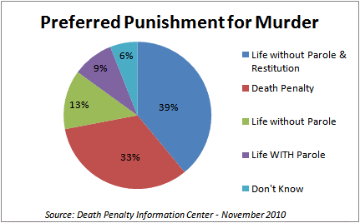
A majority of the U.S. public now prefers alternatives over the death penalty as the best punishment for the crime of murder. More and more U.S. states are abandoning the death penalty as a broken system. 19 U.S. states plus the District of Columbia have abolished the death penalty, and six more states have not carried out an execution in 10 years or more. In 2014, only seven states carried out any executions at all. In May 2015 Nebraska became the most recent state to abolish the death penalty.
Source: http://www.amnestyusa.org/our-work/issues/death-penalty/us-death-penalty-facts/death-penalty-trends
Word Wall
Here are five vocabulary words to teach and add to the Word Wall.
|
compliments-87 |
protocol-87 |
chaplain-89 |
accompanied-89 |
disposal-90 |
Read
Review
Review the timeline from the beginning every day.
Read
Read the selection, usually in a Shared Reading Read React Predict Cycle of 2-3 pages.
Read p. 81-95
|
Setting |
Characters |
Pages |
|
Death House |
Sister Helen, Patrick Sonnier, Guards |
86 |
|
Witness Seating |
Sister Helen, Millard, Bill Quigley, Families of victims |
91 |
Respond
Timeline
Agree on the facts in today’s reading and list the 3-5 most important on the timeline.
Students might mention:
- Sister Helen and a priest offer Patrick communion and play him a hymn with the words “Be not afraid.” Page 81 – Page 82.
- Sister Helen encourages Patrick to share his feelings. He says he is scared and thanks her for loving him. Page 82.
- Sister Helen’s brother and sister have come to drive her home. Page 83.
- Eddie’s letter is printed in the Times-Picayune. Sister Helen meets with him. They both still have some hope. Page 83.
- The next time Sister Helen returns to the death house, Captain Rabelais has food ready for her. Page 84.
- Patrick has his final meal. Sister Helen joins him but feels too disturbed to eat. Page 86.
- Patrick announces that he is leaving Sister Helen all of his possessions. Page 88.
- Patrick leaves a goodbye note for Eddie. Page 89.
- Patrick writes his own date of death in his family bible beside other names of family members and their timelines. Page 90.
- The witnesses, press, and prison officials take their places in the death house. Bill Quigely and Millard Farmer stand beside Sister Helen. Page 91.
- Sister Helen promises to receive communion for herself and Patrick when he is gone. Page 91
- Sister Helen reads Patrick a verse from Isaiah. They say goodbye to one another. Patrick says he loves her and she reciprocates. Page 93.
- Patrick apologizes to Mr. LeBlanc. Mr. Bourque is confused why he is left out from the apology.
- Sister Helen closes her eyes when Patrick is killed. She opens them and sees his hand curled upward. Page 93-94.
- Sister Helen and her team are in shock. On the way home she has to get out of the car to throw up. Page 95.
Map
Add to ongoing class activities like a KWL chart or map: where did the characters go?
Leadership Poster:
- Continue to collaborate with students create a class T Chart of “Examples of Good Leadership” and “Examples of Poor leadership”. This can be a live, online document that students have shared access to (Google Document or Google Spreadsheet).
- Continue to reflect on the characters’ leadership and bullet point examples of characters demonstrating good leadership or poor leadership.
Leadership Poster Extension:
- Continue to encourage students to follow the local and world news, using a variety of mediums (newspapers, online sources, etc.).
- Periodically students should continue input a headline/article of “Examples of Good Leadership” and “Examples of Poor Leadership” in their local community and in the world on the document. Discuss the additions the next day in class.
- For all of the items in the “Examples of Good Leadership” column, have students write one thing they can do to take action and support the individuals, groups, or organizations that are acting to promote the common good.
- For all of the items in the “Examples of Poor Leadership” column, have students write an idea on how the leader can be more engaged.
- In each situation, helping may involve writing a letter, getting more informed, volunteering, etc. Encourage students choose one item to take action on. They should report their action and results to the class.
Explore
Activity
Explore the reading more deeply with a visual or oral language activity.
Complete the Character Profile Chart of Patrick
Fill out the Character Interaction Chart for Patrick, Sister Helen, and Lloyd LeBlanc
- Choose 3 characters you have profiled and wish to analyze. Fill the name of each character in one of the 3 boxes.
- Each character box has another character box on each side. On the side of the first character box near the second character box, write down what the first character thinks about the second character, and how the first character interacts or gets along with, the second character.
- Then do the same thing for how the second character thinks about and interacts with the first, in the second characters box.
- Continue doing this until you have filled out each box: the second for the third, the third for the second, the third for the first and the first for the third.
Discussion
Ask discussion questions of all 9 types (see Day 1).
Key Questions
- Compare and contrast Sister Helen and the prison chaplain.
- How does Patrick first come to experience love?
- How do you think a supportive and loving family and/or community of friends (or lack there of) impacts a person’s life?
- Explain why Patrick feels angry towards his victims.
- Why does Sister Helen encourage Patrick to prepare last words of love and not hate?
- Describe the challenge of acting with love during life’s most difficult circumstances.
- How does Patrick express love during his last moments of life?
- How do the prison workers contribute to the execution?
- Describe the procedure before the execution. Explain the technicality of this process.
- How does Sister Helen comfort Patrick during before execution? How does her example influence him?
- Describe Patrick’s last words. How do you think his last moment of life impacts the witnesses?
Analyze
Analyze the key paragraph.
Key Paragraph – p. 94
“’Look how shamefully secret this whole thing is,” Millard says. “ A few select witnesses brought deep inside this prison in the dead of night to watch a man be killed. If most people in Louisiana would see what the state did tonight, they would throw up.’”
Extend
Write
Have each student write a short product based on today’s prompt to connect to the unit theme.
Pretend you are a news reporter. Write an article about Patrick’s execution. In an explanatory paragraph describe the process of the execution and the interactions among the witnesses involved. Include as many details as possible. Describe the execution process and the secrecy of the process. What was Patrick’s last meal? What were Patrick’s last words? Describe Patrick’s interactions with Sister Helen before his death. How did Sister Helen provide a source of comfort for Patrick? Who else was present at the execution?
Close
Close by extending today’s lesson to life and the world.
Describe a time when you supported a loved one during a difficult time. How have others helped you in times of trouble?
Day 9
Outcomes for Today
Prepare
Background
Gather background knowledge about a place, time, event, person, or thing.
How likely is it for a convicted criminal to be sentenced with the death penalty?
Approximately two percent of those convicted of crimes that make them eligible for the death penalty actually receive a death sentence. Each prosecutor decides whether or not to seek the death penalty. Local politics, the location of the crime, plea bargaining, and pure chance affect the process and make it a lottery of who lives and who dies.
Source: http://www.amnestyusa.org/our-work/issues/death-penalty/us-death-penalty-facts/death-penalty-and-arbitrariness
Word Wall
Here are five vocabulary words to teach and add to the Word Wall.
|
blur-97 |
grief-97 |
preceded-97 |
dignity-99 |
possession-106 |
Read
Review
Review the timeline from the beginning every day.
Read
Read the selection, usually in a Shared Reading Read React Predict Cycle of 2-3 pages.
Read p. 96-106
|
Setting |
Characters |
Pages |
|
The Death House Parking Lot |
Ann Quigley |
96 |
|
The Rabenhorst Funeral Home |
The Sonniers, Sister Helen, Nuns |
97 |
|
Roselawn Cemetery |
The Sonniers, Sister Helen, Nuns |
98 |
|
Sister Helen’s Mother’s House |
Sister Helen, Sister Helen’s family |
100 |
Respond
Timeline
Agree on the facts in today’s reading and list the 3-5 most important on the timeline.
Students might mention:
- Sister Helen and her team reflect on the energy and resources that went into killing a single person. Page 96.
- She is given a sleeping pill to get some rest. Page 97.
- Patrick’s funeral takes place the next day. It serves a double goodbye for the family – it is the last time they will see Patrick or Eddie. Page 98.
- A reporter accuses Sister Helen of being in love with Patrick. She finds this amusing and explains that she loved him and Christ taught us to love each other. Page 99.
- Sister Helen, Ann, and her mother go through Patrick’s belongings. Page 100.
- Sister Helen reflects on the head of Corrections, C. Paul Phelps. Their approach differs; he tries to show faith while working within the system vs. opposing it. Page 101.
- Sister Helen travels with her sister to visit the Sonniers and deliver Patrick’s possessions. Page 106.
Map
Add to ongoing class activities like a KWL chart or map: where did the characters go?
Leadership Poster:
- Continue to collaborate with students create a class T Chart of “Examples of Good Leadership” and “Examples of Poor leadership”. This can be a live, online document that students have shared access to (Google Document or Google Spreadsheet).
- Continue to reflect on the characters’ leadership and bullet point examples of characters demonstrating good leadership or poor leadership.
Leadership Poster Extension:
- Continue to encourage students to follow the local and world news, using a variety of mediums (newspapers, online sources, etc.).
- Periodically students should continue input a headline/article of “Examples of Good Leadership” and “Examples of Poor Leadership” in their local community and in the world on the document. Discuss the additions the next day in class.
- For all of the items in the “Examples of Good Leadership” column, have students write one thing they can do to take action and support the individuals, groups, or organizations that are acting to promote the common good.
- For all of the items in the “Examples of Poor Leadership” column, have students write an idea on how the leader can be more engaged.
- In each situation, helping may involve writing a letter, getting more informed, volunteering, etc. Encourage students choose one item to take action on. They should report their action and results to the class.
Explore
Activity
Explore the reading more deeply with a visual or oral language activity.
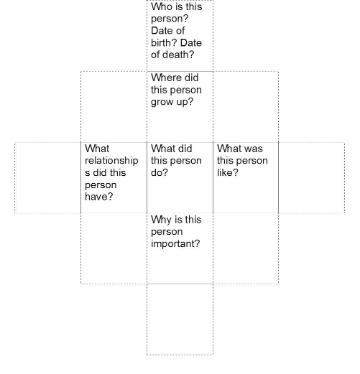
Create a biographic cube of Patrick.
Six of the squares are information squares and the others are flaps that will help the cube hold together when you assemble the cube. Fill out only the information squares and follow directions to assemble the cube. Fill out his information in the boxes before you fold cube.
2c12 Cubing Directions: Assembling the Cube

- Answer the question in each un-shaded box.
- Cut out the cube on each dotted line – do not cut any solid lines.
- Crease each solid line back to make it easier to fold.
- Put a little paste, glue, double-sided tape or a drafting dot on each shaded square.
Do not get paste or glue on the un-shaded squares. - Carefully fold the squares in the order specified sticking squares to pasted surfaces underneath as you go.
10c12 Cubing Biography
Discussion
Ask discussion questions of all 9 types (see Day 1).
Key Questions
- Who is Ann? How does she use her talents to promote the common good?
- Describe the series of events after Patrick’s death.
- How does Sister Helen prepare Patrick’s funeral?
- Who attends the funeral? How does this provide an opportunity for grief and mourning?
- Who is C. Paul Phelps? Explain his views on the death penalty.
- Describe C. Phelps leadership position. How does this enable him to influence the death penalty?
- Compare and contrast Sister Helen and C. Phelps approach to creating change.
- Provide an example of creating change through the law. Provide an example of creating change through opposing the norm.
- Workers that contribute to the execution want to remain anonymous. Why?
- Do you think the workers that contribute to an execution demonstrate positive civic engagement? Why or why not?
- Who is Gladys Sonnier? How does she defend Patrick?
Analyze
Analyze the key paragraph.
Key Paragraph – p. 101
“Who killed this man? Nobody. Everybody can argue that he or she was just doing a job – the governor, the warden, the head of the Department of Corrections, the district attorney, the judge, the jury, the pardon Board, the witness to the execution. Nobody feels personally responsible for the death of this man.”
Extend
Write
Have each student write a short product based on today’s prompt to connect to the unit theme.
Sister Helen talks about the workers that contribute to the execution of prisoners on death row. Pretend you are the execution. In an explanatory paragraph describe your thoughts on your job and contribution to the execution. Do you believe you are participating in a state-sectioned crime? Why or why not? Provide three reasons to support your answer. What leadership role do you have to influence the execution? Who do you think is ultimately responsible for the execution?
Close
Close by extending today’s lesson to life and the world.
If you were to leave all your earthly possessions with only one person after your death, who would you chose? Why? Why is it important to mourn someone when they die?
Day 10
Outcomes for Today
Prepare
Background
Gather background knowledge about a place, time, event, person, or thing.
How many death sentences happen per year?
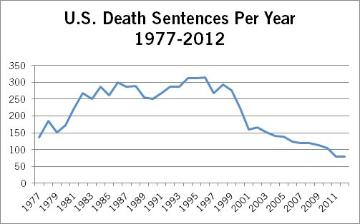
Annual death sentences in the U.S. have dropped dramatically since the year 2000. In the last eight years the number of death sentences has been lower than any time since reinstatement of the death penalty in 1976. In 2014 there were 72 death sentences, the lowest number on record since 1976.
Executions have declined as well, from a high of 98 in 1999 to just 35 in 2014, the lowest in 20 years; there were 43 executions in 2011 and 2012 and 39 in 2013.
Source: http://www.amnestyusa.org/our-work/issues/death-penalty/us-death-penalty-facts/death-penalty-trends
Word Wall
Here are five vocabulary words to teach and add to the Word Wall.
|
mass-107 |
misrepresentated-107 |
indelible-108 |
martyr-108 |
outrage-109 |
Read
Review
Review the timeline from the beginning every day.
Read
Read the selection, usually in a Shared Reading Read React Predict Cycle of 2-3 pages.
Read p. 107-117
|
Setting |
Characters |
Pages |
|
The Hope House |
Sister Helen, Millard, Tom |
112 |
|
The Motherhouse |
Sister Helen |
112 |
|
Julian Murray’s Office
|
Bill Quigley, Sister Helen, attorneys, civil rights and religious leaders |
115 |
Respond
Timeline
Agree on the facts in today’s reading and list the 3-5 most important on the timeline.
Students might mention:
- Sister Helen provides the Sonniers with Patrick’s belongs, including a photo album. Page 107.
- Patrick’s family asks that Sister Helen write a letter to the editor showing their point of view. She agrees. Page 107.
- Sister Helen returns to the Hope House. She helps residents work on a newsletter and book of poetry. Page 107-108.
- After being put down in the press, reporter Liz Scott comes to interview Sister Helen about her feelings. Page 110 - 111.
- Sister Helen reflects on the death penalty’s lack of effectiveness in impacting the murder rate. Page 110.
- Sister Helen meets with Tom and Millard to discuss legal representation for death-row inmates. Page 112.
- Sister Helen goes to her annual retreat to recharge and further reflect. Page 112.
- After the retreat she goes to a meeting about the death penalty with an array of community leaders. Page 115.
- They decide to create a walk to raise awareness. It will take place that October. Page 116.
- Sister Helen decides to commit herself to this work. Page 117.
- She agrees to take on a new inmate to council named Robert Lee Willie. Page 117.
Map
Add to ongoing class activities like a KWL chart or map: where did the characters go?
Leadership Poster:
- Continue to collaborate with students create a class T Chart of “Examples of Good Leadership” and “Examples of Poor leadership”. This can be a live, online document that students have shared access to (Google Document or Google Spreadsheet).
- Continue to reflect on the characters’ leadership and bullet point examples of characters demonstrating good leadership or poor leadership.
Leadership Poster Extension:
- Continue to encourage students to follow the local and world news, using a variety of mediums (newspapers, online sources, etc.).
- Periodically students should continue input a headline/article of “Examples of Good Leadership” and “Examples of Poor Leadership” in their local community and in the world on the document. Discuss the additions the next day in class.
- For all of the items in the “Examples of Good Leadership” column, have students write one thing they can do to take action and support the individuals, groups, or organizations that are acting to promote the common good.
- For all of the items in the “Examples of Poor Leadership” column, have students write an idea on how the leader can be more engaged.
- In each situation, helping may involve writing a letter, getting more informed, volunteering, etc. Encourage students choose one item to take action on. They should report their action and results to the class.
Explore
Activity
Explore the reading more deeply with a visual or oral language activity.
Continue to update the OMP of Sister Helen
Death Penalty Abolishment Flyer
Draw or paint and write a flyer that Sister Helen or death row abolitionist would use during their awareness raising events. Include 5 facts about the death penalty.
Discussion
Ask discussion questions of all 9 types (see Day 1).
Key Questions
- Compare and contrast how Patrick was displayed in the press and Patrick’s family’s impressions of him.
- Describe the articles written about Patrick’s execution.
- How does Sister Helen react to this media coverage?
- Compare and contrast Patrick’s execution with the death of David LeBlanc and Loretta Bourque.
- Sister Helen identifies the need for more spiritual advisors and legal support for death row cases. How does she take the leadership initiative to address those needs?
- Explain Sister Helen’s argument that the death penalty is retributive.
- Explain Bishop Ott’s public views on the death penalty.
- Since Bishop Ott is a religious leader, how can his opinion influence other leaders and the public?
- Describe the Supreme Court’s ruling in Georgia.
- How do the death row abolitionist raise awareness of the death penalty?
- How does Sister Helen use education as a tool to inform death penalty supporters about the ineffectiveness of this practice?
Analyze
Analyze the key paragraph.
Key Paragraph – p. 110
“Evidence that executions do not deter crime is conclusive. In the U.S. the murder rate is no higher in states that do not have the death penalty than those that do.”
Extend
Write
Have each student write a short product based on today’s prompt to connect to the unit theme.
Sister Helen becomes more involved with abolishing the death penalty. She realizes the need to inform community leaders and the public of the injustice of capital punishment. In an explanatory paragraph describe Sister Helen’s argument that the death penalty is ineffective. What facts does she present? Provide three reasons to support this statement. Describe how Sister Helen is leading the death row abolitionists’ efforts. How is this an example of “Leadership requires engagement”?
Close
Close by extending today’s lesson to life and the world.
Describe a social justice issue you are passionate about. How can you raise awareness about this social injustice?
Day 11
Outcomes for Today
Prepare
Background
Gather background knowledge about a place, time, event, person, or thing.
How are death row inmates legally represented and counseled?
The failure to provide adequate counsel to capital defendants and death row prisoners is a defining feature of the American death penalty. Whether a defendant will be sentenced to death typically depends more on the quality of his legal team than any other factor. While some lawyers have provided outstanding representation to capital defendants, few defendants facing capital charges can afford to hire an attorney, so they are appointed attorneys who are frequently overworked, underpaid, and/or inexperienced in trying death penalty cases. In some cases, lawyers representing defendants in capital trials have slept through parts of trial, shown up in court intoxicated, and failed to do any work at all in preparation for the sentencing phase.
Source: http://www.eji.org/deathpenalty/counsel and http://www.amnestyusa.org/our-work/issues/death-penalty/us-death-penalty-facts/death-penalty-and-arbitrariness
Word Wall
Here are five vocabulary words to teach and add to the Word Wall.
|
spiritual advisor-118 |
brutality-119 |
criminally insane-119 |
jurisdiction-119 |
jeopardized-121 |
Read
Review
Review the timeline from the beginning every day.
Read
Read the selection, usually in a Shared Reading Read React Predict Cycle of 2-3 pages.
Read p. 118-128
|
Setting |
Characters |
Pages |
|
Warden Blackburn’s Office |
Sister Helen, Warden Blackburn |
120 |
|
Sister Helen’s new house |
Sister Helen, Ann Barker and Leigh Scardina |
125 |
|
The Louisiana State Penitentiary |
Sister Helen, Guards, Robert Willie |
126 |
Respond
Timeline
Agree on the facts in today’s reading and list the 3-5 most important on the timeline.
Students might mention:
- Sister Helen learns about Robert Willie’s crimes. He killed an 18-year-old girl named Faith Harvey. They also raped another teenage girl and left a young boy paralyzed. Page 118.
- Sister Helen is familiar with Vernon Harvey’s name. He has spoken publically about wanting to watch Willie fry in the electric chair. Page 118.
- Sister Helen sends her first letter to Willie. Page 119.
- Sister Helen feels that prison wants to block women from being advisors to inmates. Fortunately the warden agrees that the only thing that bars a spiritual advisor from prison is if they pose a threat to security. Page 120.
- Sister Helen further organizes the details of the October walk from New Orleans to Baton Rouge. Page 125.
- She recognizes that her new devotion to the death penalty’s abolition means giving up much of her work at St. Thomas. Page 125.
- Sister Helen goes to meet Robert Willie six month’s after Patrick Sonnier’s execution. Page 126.
- Sister Helen reflected on the drive home that Robert Willie was not what she expected. He was polite, soft spoken and intelligent. Page 128.
Map
Add to ongoing class activities like a KWL chart or map: where did the characters go?
Leadership Poster:
- Continue to collaborate with students create a class T Chart of “Examples of Good Leadership” and “Examples of Poor leadership”. This can be a live, online document that students have shared access to (Google Document or Google Spreadsheet).
- Continue to reflect on the characters’ leadership and bullet point examples of characters demonstrating good leadership or poor leadership.
Leadership Poster Extension:
- Continue to encourage students to follow the local and world news, using a variety of mediums (newspapers, online sources, etc.).
- Periodically students should continue input a headline/article of “Examples of Good Leadership” and “Examples of Poor Leadership” in their local community and in the world on the document. Discuss the additions the next day in class.
- For all of the items in the “Examples of Good Leadership” column, have students write one thing they can do to take action and support the individuals, groups, or organizations that are acting to promote the common good.
- For all of the items in the “Examples of Poor Leadership” column, have students write an idea on how the leader can be more engaged.
- In each situation, helping may involve writing a letter, getting more informed, volunteering, etc. Encourage students choose one item to take action on. They should report their action and results to the class.
Explore
Activity
Explore the reading more deeply with a visual or oral language activity.
Continue to update the OMP of Sister Helen
Postcard
Materials: Index cards, blank if possible 3.5 or larger
Directions: Write a post card to Robert, Joseph, or Vernon Harvey. On one side create an inspiring or an encouraging image.
On the other side detailed advice in clear and concise paragraph.
Discussion
Ask discussion questions of all 9 types (see Day 1).
Key Questions
- Who is Robert Lee Willie? Explain why he is on death row.
- Who is Joseph Vaccaro? Why is he serving life in prison? Why wasn’t he given a death row sentence?
- Describe Vernon Harvey. How does he feel about the death penalty?
- Why is there a resistance against female spiritual advisors in the prisons?
- Who is Frank C. Blackburn? Describe his leadership positions.
- Explain Blackburn’s views of the death penalty.
- How do religious leaders influence the public perception of what is moral and what is unethical?
- Describe how Sister Helen becomes Robert’s spiritual advisor.
- Explain Sister Helen’s first impression of Robert.
- Describe Robert’s class action lawsuit against the penitentiary. What are the demands of the prisoners on death row?
Analyze
Analyze the key paragraph.
Key Paragraph – p. 127
“He’s aware that ‘time’s gettin’ short’ and says how he’s been reading and studying every law book he can get his hands on. ‘When you’re in a place like this you learn the law fast. Let’s just say you have special motivation.’”
Extend
Write
Have each student write a short product based on today’s prompt to connect to the unit theme.
Sister Helen begins to council Robert Lee Willie. In an explanatory paragraph describe Robert and his character. What is his reaction to being sentence on death row? How does he demonstrate initiative and leadership even while on death row? How does this leadership benefit other inmates?
Close
Close by extending today’s lesson to life and the world.
Describe a time when you campaigned for a cause. What did you do? Were you successful in reaching your goals? Why or why not?
Day 12
Outcomes for Today
Prepare
Background
Gather background knowledge about a place, time, event, person, or thing.
What is the cost of the death penalty in the U.S.?
- A 2003 legislative audit in Kansas found that the estimated cost of a death penalty case was 70% more than the cost of a comparable non-death penalty case. Death penalty case costs were counted through to execution (median cost $1.26 million). Non-death penalty case costs were counted through to the end of incarceration (median cost $740,000). (December 2003 Survey by the Kansas Legislative Post Audit)
- In Tennessee, death penalty trials cost an average of 48% more than the average cost of trials in which prosecutors seek life imprisonment. (2004 Report from Tennessee Comptroller of the Treasury Office of Research)
- In Maryland death penalty cases cost 3 times more than non-death penalty cases, or $3 million for a single case. (Urban Institute, The Cost of the Death Penalty in Maryland, March 2008)
- In California the current system costs $137 million per year; it would cost $11.5 million for a system without the death penalty. (California Commission for the Fair Administration of Justice, July 2008)
Source: http://www.amnestyusa.org/our-work/issues/death-penalty/us-death-penalty-facts/death-penalty-cost
Word Wall
Here are five vocabulary words to teach and add to the Word Wall.
|
inefficieny-130 |
marginal-130 |
segregate-130 |
energetically-130 |
committee-131 |
Read
Review
Review the timeline from the beginning every day.
Read
Read the selection, usually in a Shared Reading Read React Predict Cycle of 2-3 pages.
Read p. 128-140
|
Setting |
Characters |
Pages |
|
The Outskirts of New Orleans |
Sister Helen, 40 participants and reporters |
128 |
|
Baton Rouge |
Sister Helen, participants, reporters, and protestors including Vernon Harvey |
132 |
|
The Vernon’s Home |
The Vernons, Sister Helen |
133 |
Respond
Timeline
Agree on the facts in today’s reading and list the 3-5 most important on the timeline.
Students might mention:
- Sister Helen and her team begin the March to raise awareness about the death penalty. – Page 128.
- Participants walk 25 miles each day. They do this for three days. Page 130-131.
- Vernon Harvey is waiting to speak with Sister Helen. They agree to meet with his wife at his home. Page 132.
- Sister Helen goes to meet with the Harvey’s. They describe the details of Faith’s murder. Faith had been stabbed 17 times. Page 133 - 135.
- Mr. Vernon breaks down when discussing his daughter’s murder. Page 136.
- Mr. Vernon described his interaction with Willie. He felt Willie was being cocky, she he told him he wanted to see him killed. Page 137.
- Sister Helen informs them that she is going to be Robert Willie’s spiritual advisor. Page 138.
- The next time they see each other will be at Wille’s Pardon Board hearing. The Vernons will expect Sister Helen to take their side after hearing the specifics of their loss. Page 140.
Map
Add to ongoing class activities like a KWL chart or map: where did the characters go?
Leadership Poster:
- Continue to collaborate with students create a class T Chart of “Examples of Good Leadership” and “Examples of Poor leadership”. This can be a live, online document that students have shared access to (Google Document or Google Spreadsheet).
- Continue to reflect on the characters’ leadership and bullet point examples of characters demonstrating good leadership or poor leadership.
Leadership Poster Extension:
- Continue to encourage students to follow the local and world news, using a variety of mediums (newspapers, online sources, etc.).
- Periodically students should continue input a headline/article of “Examples of Good Leadership” and “Examples of Poor Leadership” in their local community and in the world on the document. Discuss the additions the next day in class.
- For all of the items in the “Examples of Good Leadership” column, have students write one thing they can do to take action and support the individuals, groups, or organizations that are acting to promote the common good.
- For all of the items in the “Examples of Poor Leadership” column, have students write an idea on how the leader can be more engaged.
- In each situation, helping may involve writing a letter, getting more informed, volunteering, etc. Encourage students choose one item to take action on. They should report their action and results to the class.
Explore
Activity
Explore the reading more deeply with a visual or oral language activity.
Continue to update the OMP of Sister Helen.
6g6 Venn Diagram Chart
Use a Venn Diagram to compare and contrast Patrick and Robert.

Discussion
Ask discussion questions of all 9 types (see Day 1).
Key Questions
- Compare and contrast Patrick and Robert’s character.
- How do you think Sister Helen’s experience advising Patrick with help in counseling Robert?
- What facts does Sister Helen present about the death penalty during the march to Baton Rouge?
- Describe counter-protest at the end of the march. How does this encounter create tension?
- Describe Sister Helen’s visit with Faith’s parents.
- How do the parents explain the murder of their daughter?
- Describe the parent’s feelings. How do you think they are recovering from their daughter’s death? Do you think they will feel that justice has been served after the execution? Why or why not?
- How did Vernon contribute to sending Robert to death row? Why does he want to be a pro-death penalty leader?
- How does Sister Helen offer her support to the victim’s families?
- Why do you think it would be challenging for Faith’s parents to receive support from Sister Helen?
Analyze
Analyze the key paragraph.
Key Paragraph – p. 130
“If we believe that murder is wrong and not admissible in our society, then it has to be wrong for everyone, not just individuals but governments as well….It involves all of us. We’re all complicit. Government can only continue killing if we give it power. It’s time to take that power back.”
Extend
Write
Have each student write a short product based on today’s prompt to connect to the unit theme.
Explain why it is difficult for the public to view death row inmates as humans. In an explanatory paragraph describe how criminals are portrayed. What does the media focus on? How can the media better portray inmates in a more human light? How can a more human portrayal of the prisoner make it more difficult to execute death row inmates? Explain.
Close
Close by extending today’s lesson to life and the world.
What are your impressions of criminals? Do you think your impressions of inmates are changing while reading this book? Explain.
Day 13
Outcomes for Today
Prepare
Background
Gather background knowledge about a place, time, event, person, or thing.
Who is Sister Helen?
Sister Helen Prejean was born on April 21, 1939, in Baton Rouge, Louisiana. She joined the Sisters of St. Joseph of Medaille in 1957 (now know as the Congregation of St. Joseph) and received a B.A. in English and Education from St. Mary’s Dominican College, New Orleans in 1962. In 1973, she earned an M.A. in Religious Education from St. Paul’s University in Ottawa, Canada. She has been the Religious Education Director at St. Frances Cabrini Parish in New Orleans, the Formation Director for her religious community, and has taught junior and senior high school students.
Source: http://www.sisterhelen.org/biography/
Video: Recent interviews with Sister Helen (130 minutes)
http://www.sisterhelen.org/audiovideo/
Video: Recent interviews with Sister Helen (10 minutes)
https://www.youtube.com/watch?v=b-qWMoWHSa4
Other multimedia achieves
http://www.sisterhelen.org/press-multimedia-archives/
Word Wall
Here are five vocabulary words to teach and add to the Word Wall.
|
retribution-142 |
society-142 |
betrayal-142 |
boundless-143 |
eligible-143 |
Read
Review
Review the timeline from the beginning every day.
Read
Read the selection, usually in a Shared Reading Read React Predict Cycle of 2-3 pages.
Read p. 141-154
|
Setting |
Characters |
Pages |
|
Twenty-six mile causeway |
Vernon Harvey, Sister Helen, |
141 |
|
Lake Pontchartrain |
Sister Helen |
144 |
|
The Louisiana State Penitentiary |
Sister Helen, Robert Willie |
144 |
Respond
Timeline
Agree on the facts in today’s reading and list the 3-5 most important on the timeline.
Students might mention:
- Sister Helen reflects on Faith Hathaway’s final moments. Page 141.
- Sister Helen reflects on state laws and nonnegotiable long-term imprisonment options. Page 143.
- Sister Helen visits Robert again. He blames the murder on Joe and only admits to being an accomplice. Page 145.
- Sister Helen and Robert have a long conversation about the Vernon’s, their loss, the state’s power to kill someone, and the things he misses. Page 148.
- Sister Helen is unsure as to if Robert is capable of taking ownership for his role in the murder. Page 150.
- Sister Helen goes through Willie’s records. He was arrested over 30 times. Page 152.
- Sister Helen familiarizes herself with the sequence of events involving the court proceedings. She notes an instance of impropriety during jury selection. Page 154.
Map
Add to ongoing class activities like a KWL chart or map: where did the characters go?
Leadership Poster:
- Continue to collaborate with students create a class T Chart of “Examples of Good Leadership” and “Examples of Poor leadership”. This can be a live, online document that students have shared access to (Google Document or Google Spreadsheet).
- Continue to reflect on the characters’ leadership and bullet point examples of characters demonstrating good leadership or poor leadership.
Leadership Poster Extension:
- Continue to encourage students to follow the local and world news, using a variety of mediums (newspapers, online sources, etc.).
- Periodically students should continue input a headline/article of “Examples of Good Leadership” and “Examples of Poor Leadership” in their local community and in the world on the document. Discuss the additions the next day in class.
- For all of the items in the “Examples of Good Leadership” column, have students write one thing they can do to take action and support the individuals, groups, or organizations that are acting to promote the common good.
- For all of the items in the “Examples of Poor Leadership” column, have students write an idea on how the leader can be more engaged.
- In each situation, helping may involve writing a letter, getting more informed, volunteering, etc. Encourage students choose one item to take action on. They should report their action and results to the class.
Explore
Activity
Explore the reading more deeply with a visual or oral language activity.
Continue to update the OMP of Sister Helen
Interview with Sister Helen
Create an interview between Sister Helen and a news reporter. Ask questions about her role in supporting death row inmates, her views on the death penalty, and how she is a leader of abolishing the death penalty. Include a written transcript, video, or audio recording of the interview.
Discussion
Ask discussion questions of all 9 types (see Day 1).
Key Questions
- Describe Sister Helen’s reflections upon retuning to New Orleans.
- What do you think Faith’s last moments of life were like?
- What advise would you give the Harvey’s in order to help them reconcile Faith’s death?
- Why do you think Sister Helen’s visit with the Harvey’s was one of the most difficult times of her life?
- Describe the punishment for murder across 40 U.S. states.
- Why don’t you think Richard feels sympathy for Vernon and Elizabeth Harvey?
- How can Robert die with integrity? How do you think Sister Helen can help in achieve a death with integrity?
- How does Robert take the opportunity to fight for his life? How does this demonstrate “Leadership requires Engagement”?
- Describe what Sister Helen learns about Robert through his files?
- How affective was Robert’s defense counsel?
- Describe the significance of the jury. Explain the jury’s leadership role and the importance to lead with integrity and responsibility.
Analyze
Analyze the key paragraph.
Key Paragraph – p. 144
“Support for the death penalty also drops dramatically – well below the majority - when the alternative is presented of long term imprisonment (at least 25 years) for offenders plus restitution by the offender of the victim’s family.”
Extend
Write
Have each student write a short product based on today’s prompt to connect to the unit theme.
Sister Helen proposes an alternative punishment to the death penalty. Pretend you are Sister Helen. Write a speech that explains the need for an alternative punishment. Provide three reasons why an alternative punishment is important in order to the respect the dignity of human life. How can the death penalty be a crime? Can the death penalty eliminate the pain of the victims’ families? Is the death penalty a true form of justice?
Close
Close by extending today’s lesson to life and the world.
What do you think would be the best alternative to the death penalty for criminal convicted of murder? Does your state practice capital punishment?
Day 14
Outcomes for Today
Prepare
Background
Gather background knowledge about a place, time, event, person, or thing.
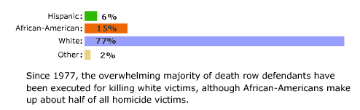
In a 1990 report, the non-partisan U.S. General Accounting Office found "a pattern of evidence indicating racial disparities in the charging, sentencing, and imposition of the death penalty." The study concluded that a defendant was several times more likely to be sentenced to death if the murder victim was white. This has been confirmed by the findings of many other studies that, holding all other factors constant, the single most reliable predictor of whether someone will be sentenced to death is the race of the victim.
From initial charging decisions to plea bargaining to jury sentencing, African-Americans are treated more harshly when they are defendants, and their lives are accorded less value when they are victims. All-white or virtually all-white juries are still commonplace in many localities.
A report sponsored by the American Bar Association in 2007 concluded that one-third of African-American death row inmates in Philadelphia would have received sentences of life imprisonment if they had not been African-American.
Source: http://www.amnestyusa.org/our-work/issues/death-penalty/us-death-penalty-facts/death-penalty-and-race
Word Wall
Here are five vocabulary words to teach and add to the Word Wall.
|
recruited-156 |
grief-158 |
unresponsive-162 |
grovel-163 |
defendants-164 |
Read
Review
Review the timeline from the beginning every day.
Read
Read the selection, usually in a Shared Reading Read React Predict Cycle of 2-3 pages.
Read p. 155-169
|
Setting |
Characters |
Pages |
|
The Hearing Meeting Room |
Sister Helen and Robert |
165 |
|
Rowlett Texas |
Howard Marsellus |
169 |
Respond
Timeline
Agree on the facts in today’s reading and list the 3-5 most important on the timeline.
Students might mention:
- Farmer, Craft, and Sister Helen are preparing for Robert’s Pardon Board hearing. Page 157.
- Sister Helen is nervous to speak to the board. It is the same one that upheld Patrick Sonnier’s sentence. Page 158.
- Sister Helen has different images of what Faith Hathaway would say to the board. Page 159.
- Robert and Sister Helen speak to the board. Page 61.
- Sister Helen advises Robert to stop emphasizing political dynamics that have led to his execution. He agrees and understands that narrative will not help him. Page 162.
- Sister Helen sees members of the board arrive in nice cars. Page 163.
- John Craft begins by speaking to the board. Robert’s mother follows with her testimony. Page 165.
Map
Add to ongoing class activities like a KWL chart or map: where did the characters go?
Leadership Poster:
- Continue to collaborate with students create a class T Chart of “Examples of Good Leadership” and “Examples of Poor leadership”. This can be a live, online document that students have shared access to (Google Document or Google Spreadsheet).
- Continue to reflect on the characters’ leadership and bullet point examples of characters demonstrating good leadership or poor leadership.
Leadership Poster Extension:
- Continue to encourage students to follow the local and world news, using a variety of mediums (newspapers, online sources, etc.).
- Periodically students should continue input a headline/article of “Examples of Good Leadership” and “Examples of Poor Leadership” in their local community and in the world on the document. Discuss the additions the next day in class.
- For all of the items in the “Examples of Good Leadership” column, have students write one thing they can do to take action and support the individuals, groups, or organizations that are acting to promote the common good.
- For all of the items in the “Examples of Poor Leadership” column, have students write an idea on how the leader can be more engaged.
- In each situation, helping may involve writing a letter, getting more informed, volunteering, etc. Encourage students choose one item to take action on. They should report their action and results to the class.
Explore
Activity
Explore the reading more deeply with a visual or oral language activity.
Continue to update the OMP of Sister Helen
Fill out the Character Profile Chart for Robert
- Write the name of the character in the box in the middle of the chart.
- Think of 4 characteristics, or traits, that the character has. Describe each with a key word or phrase and write it down one of the 4 boxes that surround the name.
- For each trait, find 2 concrete examples of it in the story. Write each in one of the 2 boxes attached to each trait box. Continue this until you have 2 examples for each of the 4 traits.
Discussion
Ask discussion questions of all 9 types (see Day 1).
Key Questions
- Why does John Croft advise that Robert drop his position as a political prisoner?
- Describe the people on Pardon Board.
- Explain Robert’s stance as a political prisoner.
- Why are the Pardon Board members obligated to follow the governor’s wishes?
- Explain the how Marion Farmers reelection campaign impacted his decision about Patrick’s death penalty sentence.
- Describe Sister Helen’s visit with Robert.
- Describe Roberts’s presentation to the Pardon Board.
- Why does Sister Helen advise Robert not to bring up politics? What does she suggest is the better strategy?
- Why doesn’t Robert want his mother at the hearing?
- Who is Marcia Blum? How does she help Robert?
- Describe the Pardon Board hearing.
- What is the larger message of Sister Helen showing up to the Pardon Board on separate occasions? How does this make her a leader?
- What were the flaws of Roberts’s first case?
Analyze
Analyze the key paragraph.
Key Paragraph – p. 165
“He ends with a quote from Dostoyevsky, that famous quote about how a society is judged not by how it treats its upstanding citizens, but how it treats it’s criminals.”
Extend
Write
Have each student write a short product based on today’s prompt to connect to the unit theme.
Pretend you are Liz Scott and you are writing an article on Robert Willie and Vernon and Elizabeth Harvey. In an explanatory paragraph describe the Pardon Board hearing. Set the scene of all who are present and where they are sitting.
Close
Close by extending today’s lesson to life and the world.
What advice would you give Robert? What advice would you give Robert’s mom?
Day 15
Outcomes for Today
Prepare
Background
Gather background knowledge about a place, time, event, person, or thing.
Who is Mahatma Gandhi?
Revered the world over for his nonviolent philosophy of passive resistance, Mohandas Karamchand Gandhi was known to his many followers as Mahatma, or “the great-souled one.” He began his activism as an Indian immigrant in South Africa in the early 1900s, and in the years following World War I became the leading figure in India’s struggle to gain independence from Great Britain. Known for his ascetic lifestyle–he often dressed only in a loincloth and shawl–and devout Hindu faith, Gandhi was imprisoned several times during his pursuit of non-cooperation, and undertook a number of hunger strikes to protest the oppression of India’s poorest classes, among other injustices. After Partition in 1947, he continued to work toward peace between Hindus and Muslims. Gandhi was shot to death in Delhi in January 1948 by a Hindu fundamentalist.
Source: http://www.history.com/topics/mahatma-gandhi
Word Wall
Here are five vocabulary words to teach and add to the Word Wall.
|
scrutinized-166 |
bureaucratic-167 |
arrogant-167 |
court proceedings-168 |
unanimously-168 |
Read
Review
Review the timeline from the beginning every day.
Read
Read the selection, usually in a Shared Reading Read React Predict Cycle of 2-3 pages.
Read p. 166-180
|
Setting |
Characters |
Pages |
|
The Louisiana State Penitentiary |
Robert Willie, Sister Helen |
178 |
|
Major Kendall Coordy’s office is |
Major Coordy, Sister Helen |
180 |
Respond
Timeline
Agree on the facts in today’s reading and list the 3-5 most important on the timeline.
Students might mention:
- Robert’s Mother breaks down when speaking about her son. Sister Helen takes her out of the room and comforts her. Page 166.
- Sister Helen addresses the board. She reminds them that she has spoken to them before and tells them about Patrick Sonnier’s death. She describes her visits with the Harveys, Robert Willie, and her views on the death penalty. Page 166.
- Ms. Marsellus explains that the board did not make the death penalty, they only offer recommendations for the governor. Sister Helen dislikes this line of thinking. Page 167.
- Marion Farmer presents to the board. The Harvey’s speak next and ask the board to uphold the sentence. Page 168.
- The board decides unanimously that the governor allow the sentence to stand. Page 168.
- Sister Helen speaks with Howard Marsellus about his background on the Pardon Board, including the corrupt system and his acceptance of bribes. Page 169 - 174.
Map
Add to ongoing class activities like a KWL chart or map: where did the characters go?
Leadership Poster:
- Continue to collaborate with students create a class T Chart of “Examples of Good Leadership” and “Examples of Poor leadership”. This can be a live, online document that students have shared access to (Google Document or Google Spreadsheet).
- Continue to reflect on the characters’ leadership and bullet point examples of characters demonstrating good leadership or poor leadership.
Leadership Poster Extension:
- Continue to encourage students to follow the local and world news, using a variety of mediums (newspapers, online sources, etc.).
- Periodically students should continue input a headline/article of “Examples of Good Leadership” and “Examples of Poor Leadership” in their local community and in the world on the document. Discuss the additions the next day in class.
- For all of the items in the “Examples of Good Leadership” column, have students write one thing they can do to take action and support the individuals, groups, or organizations that are acting to promote the common good.
- For all of the items in the “Examples of Poor Leadership” column, have students write an idea on how the leader can be more engaged.
- In each situation, helping may involve writing a letter, getting more informed, volunteering, etc. Encourage students choose one item to take action on. They should report their action and results to the class.
Explore
Activity
Explore the reading more deeply with a visual or oral language activity.
Continue to update the OMP of Sister Helen and the Character Profile Chart of Robert
Interview the Pardon Board
Create interview questions for the Pardon Board as a collective. Ask questions about their role in executing the death penalty. Ask about their personal feels and moral values towards the death penalty and whether or not their values conflict with their responsibilities of their jobs. For each questions, write a hypothetical answer.
Discussion
Ask discussion questions of all 9 types (see Day 1).
Key Questions
- Why do you think Sister Helen request that the board takes personal responsibility of the executions they approve.
- Describe the power and authority of the Pardon Board. What is their leadership position? How do they strive to promote the common good?
- What other options can the board choose from besides the death penalty?
- Do you think the board is personally responsible for their approved executions? Why or why not?
- Explain the board’s deliberation.
- Explain why Howard Marsellus was in prison. How is his story an example of how individuals can influence each other in decision-making?
- Describe Sister Helen’s conversation with Marsellus after his release from prison.
- Describe the Pardon Board review of Tim Baldwin.
- Explain the corruption of the Pardon Board.
- Do you think the Pardon Board was given too much power by deciding prisoners’ fate? Explain.
Analyze
Analyze the key paragraph.
Key Paragraph – p. 171
“Are you saying that if the Pardon Board recommends the death sentence, then the governor has something to stand behind and can say that he’s only following the recommendation of the Board, and that way he doesn’t have to face the political fallout of commuting a sentence?”
Extend
Write
Have each student write a short product based on today’s prompt to connect to the unit theme.
The Pardon Board system entrusts its members with the responsibility to decide the fate of death row inmates. With time, Marsellus comes to realize his individual responsibility. Pretend you are Marsellus. Write a journal entry that explains why you believe you are personally responsible for the fate of prisoners on death row. In an explanatory paragraph, describe your change of heart about your role in enforcing the death penalty. Why did you not believe that you were personally responsible for the death penalty sentence? Describe the corruption of the Pardon Board. Why do you now accept responsibility for the death penalty process? (Provide two reasons).
Close
Close by extending today’s lesson to life and the world.
Describe a time when you felt guilty after making a decision. How did you learn from this experience?
Day 16
Outcomes for Today
Prepare
Background
Gather background knowledge about a place, time, event, person, or thing.
How does geography factor into death penalty decisions?
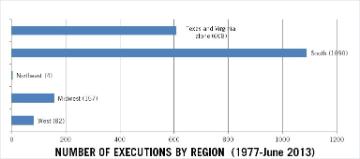
Since the U.S. Supreme Court reinstated the death penalty in 1976, 82% of all executions have taken place in the South. The Northeast accounts for less than 1% of executions.
Word Wall
Here are five vocabulary words to teach and add to the Word Wall.
|
sensitive-178 |
privacy-178 |
confided-182 |
assassinate-182 |
mediate-183 |
Read
Review
Review the timeline from the beginning every day.
Read
Read the selection, usually in a Shared Reading Read React Predict Cycle of 2-3 pages.
Read p. 181-193
|
Setting |
Characters |
Pages |
|
The Death House |
Sister Helen, Robert Willie |
184 |
|
Captain Rabelais’s office |
Sister Helen, Warden |
190 |
|
Highway 61 |
Sister Helen |
193 |
Respond
Timeline
Agree on the facts in today’s reading and list the 3-5 most important on the timeline.
Students might mention:
- The reporter Liz Scott tells Sister Helen how hurt and upset the Harveys are. Page 175.
- Robert Willie’s trail date is set for December 28th. Sister Helen begins visiting him every week. Page 176.
- Sister Helen also visits Robert’s mother and aunt. They feel judged and abandoned by their community. Page 176.
- Robert sends the Warden a Christmas card. Page 177.
- Robert’s biggest concern is for his mother. Page 179.
- Major Coordy asks to speak with Sister Helen in his office. He talks about the process of being involved in executions and the guilt that he carries. Mr. Coordy later dies of a heart attack. Page 181.
- Robert says he wants Sister Helen with him in the death house before he dies. Page 181.
- Robert does an interview with the press where expresses admiration for Hitler and Castro. He talks about the pride he still has despite his approaching execution date. Page 182.
Map
Add to ongoing class activities like a KWL chart or map: where did the characters go?
Leadership Poster:
- Continue to collaborate with students create a class T Chart of “Examples of Good Leadership” and “Examples of Poor leadership”. This can be a live, online document that students have shared access to (Google Document or Google Spreadsheet).
- Continue to reflect on the characters’ leadership and bullet point examples of characters demonstrating good leadership or poor leadership.
Leadership Poster Extension:
- Continue to encourage students to follow the local and world news, using a variety of mediums (newspapers, online sources, etc.).
- Periodically students should continue input a headline/article of “Examples of Good Leadership” and “Examples of Poor Leadership” in their local community and in the world on the document. Discuss the additions the next day in class.
- For all of the items in the “Examples of Good Leadership” column, have students write one thing they can do to take action and support the individuals, groups, or organizations that are acting to promote the common good.
- For all of the items in the “Examples of Poor Leadership” column, have students write an idea on how the leader can be more engaged.
- In each situation, helping may involve writing a letter, getting more informed, volunteering, etc. Encourage students choose one item to take action on. They should report their action and results to the class.
Explore
Activity
Explore the reading more deeply with a visual or oral language activity.
Continue to update the OMP of Sister Helen and the Character Profile Chart of Robert
6g6 Venn Diagram Chart
Compare and contrast the feelings of the mothers of Faith and Robert. How do you think their emotions are similar and different?
Discussion
Ask discussion questions of all 9 types (see Day 1).
Key Questions
- Why did Vernon and Elizabeth Harvey feel used by Sister Helen?
- Describe Vernon and Elizabeth Harvey’s pain during this time. How can Sister Helen be a friend to the Vernon and Elizabeth while opposing the death penalty of their daughter’s murder?
- In what way is the relationship between Sister Helen and Vernon and Elizabeth similar to two opposing baseball teams?
- Leading up to the execution date, describe Sister Helen’s visits with Robert.
- Describe how Robert’s mother and aunt feel as they wait for Robert’
- Describe Robert emotions and feelings during this time of waiting.
- Why is Robert forced to wear a black box on his hands?
- Describe the result of the Department of Corrections lawsuit.
- What will change as a result of the lawsuit? How is this an example of leadership producing change?
- Explain the decision Robert needs to make regarding his last words.
- How does Major Cody feel about the death penalty?
- Do you think executing the death penalty gets easier with time? Why or why not?
- Describe Robert’s interview. How do you think this will negatively impact public perception of death row inmates?
Analyze
Analyze the key paragraph.
Key Paragraph – p. 179
“I hope my death gives the Harveys some peace. I really do. Maybe my death will help them get some relief, some peace.”
Key Paragraph – p. 182
“To a reporter for NBC news he says he’d like to talk with the executioner face to face and say, “ Hey, man, you shouldn’t be killing people for no four hundred dollars. You shouldn’t be killing people for the government.”
Extend
Write
Have each student write a short product based on today’s prompt to connect to the unit theme.
Pretend you are Robert. As your execution date draws near you feel remorse. Write an apology letter to the Harveys. In an explanatory paragraph describe what you are feeling during this time. Explain the suffering you think the Harvey’s may be experiencing. Provide three key reasons for why you are sorry. End your letter with a request for their forgiveness.
Close
Close by extending today’s lesson to life and the world.
Describe a time when you apologized to someone. Do you think that made the situation better or worse? Explain.
Day 17
Outcomes for Today
Prepare
Background
Gather background knowledge about a place, time, event, person, or thing.
What are recent examples of wrongful convictions of the death penalty?
Since 1973, 151 people have been released from death rows throughout the country due to evidence of their wrongful convictions. In 2003 alone, 10 wrongfully convicted defendants were released from death row.
In 2014 in North Carolina Henry McCollum and Leon Brown charges were dismissed. The two brothers were 19 and 15 and both men were intellectually disabled when they confessed to rape and murder. They maintained their innocence since trial, saying they did not know they were signing a confession. In 2010 Brown contacted the North Carolina Innocence Inquiry Commission, which discovered DNA evidence that implicated another person. Both men were freed in 2014 based on the DNA.
Source: http://www.amnestyusa.org/our-work/issues/death-penalty/us-death-penalty-facts/death-penalty-and-innocence
Word Wall
Here are five vocabulary words to teach and add to the Word Wall.
|
surveillance-185 |
pathologist-186 |
congressperson-187 |
polygraph-191 |
denounced-193 |
Read
Review
Review the timeline from the beginning every day.
Read
Read the selection, usually in a Shared Reading Read React Predict Cycle of 2-3 pages.
Read p. 185-199
|
Setting |
Characters |
Pages |
|
The Death House |
Sister Helen, Guards, Robert Willie |
199 |
Respond
Timeline
Agree on the facts in today’s reading and list the 3-5 most important on the timeline.
Students might mention:
- Robert asks Sister Helen if she can help him take a lie detector test. He wants to show his mother he wasn’t the killer. – Page 186
- Sister Helen spends time with Robert in the death house. She confronts him about his comments to the reporter. Page 189.
- Robert takes the polygraph tests but the results are inconclusive due to stress. Page 191.
- Sister Helen drives to Baton Rouge and reflects on Bible verses about murder. Page 194.
Map
Add to ongoing class activities like a KWL chart or map: where did the characters go?
Leadership Poster:
- Continue to collaborate with students create a class T Chart of “Examples of Good Leadership” and “Examples of Poor leadership”. This can be a live, online document that students have shared access to (Google Document or Google Spreadsheet).
- Continue to reflect on the characters’ leadership and bullet point examples of characters demonstrating good leadership or poor leadership.
Leadership Poster Extension:
- Continue to encourage students to follow the local and world news, using a variety of mediums (newspapers, online sources, etc.).
- Periodically students should continue input a headline/article of “Examples of Good Leadership” and “Examples of Poor Leadership” in their local community and in the world on the document. Discuss the additions the next day in class.
- For all of the items in the “Examples of Good Leadership” column, have students write one thing they can do to take action and support the individuals, groups, or organizations that are acting to promote the common good.
- For all of the items in the “Examples of Poor Leadership” column, have students write an idea on how the leader can be more engaged.
- In each situation, helping may involve writing a letter, getting more informed, volunteering, etc. Encourage students choose one item to take action on. They should report their action and results to the class.
Explore
Activity
Explore the reading more deeply with a visual or oral language activity.
Continue to update the OMP of Sister Helen and the Character Profile Chart of Robert
1g6Portrait: Create an Open Mind Portrait of Major Cody
Step One: create a large headshot of the character
- Imagine what you think the character looks like from the descriptions in the text as well as your imagination. You can make a list of these details to help you draw the character, if you wish.
- Decide how much of the character you wish to show: just the head and face? from the shoulders up? from the waist up? the whole person? You might want to include at least the shoulders to include some clothing details. You might want to show the size differences between characters.
- Draw the characters headshot including the face on the large piece of paper. You could also cut the paper to form the head.
- Illustrate your portrait with colors, construction paper, or whatever will make the character colorful.
Step Two: place cartoon bubbles of thoughts around the portrait
- Cut cartoon bubbles out.
- Write things the character thinks, or says to himself, on each bubble.
- Put the bubbles up around the portrait.
Discussion
Ask discussion questions of all 9 types (see Day 1).
Key Questions
- Explain Robert’s reasoning for destroying government buildings.
- Explain why Sister Helen states violence is a simple solution.
- Explain the hard work of working in a democracy.
- Describe the connection Robert feels with his prison mates.
- Compare and contrast Roberts experience in Marion prison in California with his prison experience on death row.
- Why does Robert request a polygraph test?
- Explain why the polygraph test may not be accurate.
- Though Robert is in the last moments of life, what choices could he still make?
- How does Sister Helen prepare Robert to die with peace?
- How does she demonstrate leadership in her interactions with Robert and the prison staff?
Analyze
Analyze the key paragraph.
Key Paragraph – p. 189
“I have to keep positioning myself inwardly to grasp the reality of imminent death, because Robert Willie, through mysterious resources of his own, seems to have a firm foothold in the present moment and is calm and obviously enjoying this conversation very much.”
Extend
Write
Have each student write a short product based on today’s prompt to connect to the unit theme.
Sister Helen reflects on one of her last conversations with Robert and his ability to live in the present moment and enjoy the “now” and not worry about the future or regret the past. Reflect on the importance of living in the present. In an explanatory paragraph, describe how living in the present help humans overcome challenges and difficult circumstances as well as enjoy happy moments. Provide three reasons to support your answer.
Close
Close by extending today’s lesson to life and the world.
How can we change the injustices of government systems? How can citizens use their rights and voting power to better their community?
Day 18
Outcomes for Today
Prepare
Background
Gather background knowledge about a place, time, event, person, or thing.
What factors lead to a wrongful conviction with the death penalty?
Factors leading to wrongful convictions include:
- Inadequate legal representation
- Police and prosecutorial misconduct
- Perjured testimony and mistaken eyewitness testimony
- Racial prejudice
- Jailhouse "snitch" testimony
- Suppression and/or misinterpretation of mitigating evidence
- Community/political pressure to solve a case
Word Wall
Here are five vocabulary words to teach and add to the Word Wall.
|
oysters-206 |
procedures-207 |
agony-208 |
deranged-209 |
jaunty-210 |
Read
Review
Review the timeline from the beginning every day.
Read
Read the selection, usually in a Shared Reading Read React Predict Cycle of 2-3 pages.
Read p. 194-211
|
Setting |
Characters |
Pages |
|
The Death House |
Sister Helen, Guards, Robert Willie |
199 |
Respond
Timeline
Agree on the facts in today’s reading and list the 3-5 most important on the timeline.
Students might mention:
- Sister Helen continues to reflect on Christianity and murder. She concludes on Gandhi’s assessment that if everyone took and eye for an eye the world would be blind. Page 196.
- Robert says goodbye to his family. He is not allowed to hug them. Page 201.
- Robert has final moments with Sister Helen. He asks her to have him buried in his boots. Page 202.
- Robert is surprised by the emotion he feels. Page 203.
- He asks Sister Helen about the process of what will happen next. He has his final meal. Page 203-207.
- Robert is embarrassed for Sister Helen to see his tattoos. Page 209.
- Sister Helen reads Robert the Gospel of John and they say their goodbyes. Page 210.
- Robert says that he hopes his death gives the Harveys some relief. Page 210
- Robert is killed. Sister Helen does not close her eyes this time. Page 211.
Map
Add to ongoing class activities like a KWL chart or map: where did the characters go?
Leadership Poster:
- Continue to collaborate with students create a class T Chart of “Examples of Good Leadership” and “Examples of Poor leadership”. This can be a live, online document that students have shared access to (Google Document or Google Spreadsheet).
- Continue to reflect on the characters’ leadership and bullet point examples of characters demonstrating good leadership or poor leadership.
Leadership Poster Extension:
- Continue to encourage students to follow the local and world news, using a variety of mediums (newspapers, online sources, etc.).
- Periodically students should continue input a headline/article of “Examples of Good Leadership” and “Examples of Poor Leadership” in their local community and in the world on the document. Discuss the additions the next day in class.
- For all of the items in the “Examples of Good Leadership” column, have students write one thing they can do to take action and support the individuals, groups, or organizations that are acting to promote the common good.
- For all of the items in the “Examples of Poor Leadership” column, have students write an idea on how the leader can be more engaged.
- In each situation, helping may involve writing a letter, getting more informed, volunteering, etc. Encourage students choose one item to take action on. They should report their action and results to the class.
Explore
Activity
Explore the reading more deeply with a visual or oral language activity.
Complete Robert’s Character Profile Chart
Interview with Robert
Create an interview between Robert. Find out what life challenge he has faced and overcome. Include a written transcript, video, or audio recording of the interview.
Discussion
Ask discussion questions of all 9 types (see Day 1).
Key Questions
- Describe how Robert prepares for this execution.
- How does Sister Helen think the death penalty will be abolished?
- Do you think public executions would change social perceptions of the death penalty?
- Describe Roberts visit with his family members.
- How does Robert demonstrate maturity and leadership at the end of his family visit?
- Describe the results of the polygraph test.
- How does Sister Helen support Robert during his last moments of life?
- Describe Robert’s first impression of Sister Helen? Compare this to his preconceived assumptions about her.
- Describe Robert’s last words.
- Explain the impact of these words for the Vernon Harvey, Sister Helen, his family, and society.
Analyze
Analyze the key paragraph.
Key Paragraph – p. 197
“That, I believe, is what it’s going to take to abolish the death penalty in this country: we must persuade the American people that government killings are too costly for us, not only financially but – more important – morally.” – Page 197.
Key Paragraph – p. 197
“I am convinced that if executions were made public, the torture and violence would be unmasked, and we would be shamed into abolishing executions.”
Key Paragraph – p. 207
“It would be a good thing for people to see what they are really doing, executing people. I’ll bet if they saw it, it would change some minds..”
Extend
Write
Have each student write a short product based on today’s prompt to connect to the unit theme.
Option 1: The procedure to complete the execution is calculated in a timely routine that could overlook the humanity of the inmate. Pretend you are Sister Helen and you want to raise awareness about the death penalty by writing an article that informs readers of the execution process and highlight Robert’s humanity. In an informative paragraph describe the step-by-step process leading up to Robert’s execution. Provide three details that portray Robert’s humanity.
Option 2: Pro-death penalty advocates, often refer to the “eye for an eye” passage in Exodus. Sister Helen argues that this passage is taken out of its original context. In an explanatory paragraph, describe Sister Helen’s argument of the original context of this passage. Provide three details from the novel that support Sister Helen’s statement.
Close
Close by extending today’s lesson to life and the world.
What is your favorite meal? Why do you think prisoners are given their choice of a last meal before their execution?
Day 19
Outcomes for Today
Prepare
Background
Gather background knowledge about a place, time, event, person, or thing.
What is the process of using lethal injections to carry out the death penalty?
All states and the federal government use lethal injection as their primary method of execution. States use a variety of protocols using one, two, or three drugs. The three-drug protocol uses an anesthetic or sedative, typically followed by pancuronium bromide to paralyze the inmate and potassium chloride to stop the inmate's heart. The one or two-drug protocols typically use a lethal dose of an anesthetic or sedative.
Source: http://www.deathpenaltyinfo.org/lethal-injection
Video Sister Helen speaks about lethal injection (3 minutes): http://www.sisterhelen.org/tortured-to-death/
Word Wall
Here are five vocabulary words to teach and add to the Word Wall.
|
vengeance-215 |
noble-215 |
inaugurated-217 |
anticipation-217 |
racial bias-220 |
Read
Review
Review the timeline from the beginning every day.
Read
Read the selection, usually in a Shared Reading Read React Predict Cycle of 2-3 pages.
Read p. 212-222
|
Setting |
Characters |
Pages |
|
The ABC affiliate station |
Sister Helen, Reporter |
214 |
|
Outside of the Prison |
Sister Helen, The Harveys |
214 |
|
Funeral Home |
Willie family, Sister Helen, Minister |
222 |
Respond
Timeline
Agree on the facts in today’s reading and list the 3-5 most important on the timeline.
Students might mention:
- Sister Helen is tired but agrees to do a television interview after the execution. Page 214.
- The interviewer expresses that many Americans favor capital punishment because they feel that there are some crimes where death is the appropriate sentence. Page 215.
- Sister Helen reflects on the private nature of executions and the transition to shots vs. electrocutions. Page 217.
- Sister Helen reviews systematic issues with executions, including a list of people sent to death row in error who were later released. Page 219.
- Sister Helen spends time with Robert’s family at his funeral. His mother Elizabeth holds her and cries. Page 221.
Map
Add to ongoing class activities like a KWL chart or map: where did the characters go?
Leadership Poster:
- Continue to collaborate with students create a class T Chart of “Examples of Good Leadership” and “Examples of Poor leadership”. This can be a live, online document that students have shared access to (Google Document or Google Spreadsheet).
- Continue to reflect on the characters’ leadership and bullet point examples of characters demonstrating good leadership or poor leadership.
Leadership Poster Extension:
- Continue to encourage students to follow the local and world news, using a variety of mediums (newspapers, online sources, etc.).
- Periodically students should continue input a headline/article of “Examples of Good Leadership” and “Examples of Poor Leadership” in their local community and in the world on the document. Discuss the additions the next day in class.
- For all of the items in the “Examples of Good Leadership” column, have students write one thing they can do to take action and support the individuals, groups, or organizations that are acting to promote the common good.
- For all of the items in the “Examples of Poor Leadership” column, have students write an idea on how the leader can be more engaged.
- In each situation, helping may involve writing a letter, getting more informed, volunteering, etc. Encourage students choose one item to take action on. They should report their action and results to the class.
Explore
Activity
Explore the reading more deeply with a visual or oral language activity.
Continue to update the OMP of Sister Helen
Write a eulogy for Robert
Create a eulogy for Robert by providing a brief history of his life (use the biographical cube as a reference), detailing his accomplishments, and highlighting a happy memory.
Discussion
Ask discussion questions of all 9 types (see Day 1).
Key Questions
- Describe the Harvey’s reaction to Robert’s execution.
- Describe Sister Helen’s interview after Robert’s execution.
- Compare and contrast Sister Helen and the Harvey’s reflection after Robert’s execution.
- How does a televised interview publicize the issues with executions? How does Sister Helen conduct herself?
- Compare and contrast the modern day execution private execution with public executions for decades past.
- What do you think the execution accomplished? Explain.
- Do you think justice was served? Why or why not?
- Describe the history of the death penalty in England.
- Describe Robert’s funeral.
- How do you think Robert’s family felt after the execution? How do you think it their emotions compare to the Harvey’s feelings?
Analyze
Analyze the key paragraph.
Key Paragraph – p. 221
“’Oh, Robert, Robert, my boy, O God, help me,’ she says weeping. ‘Oh, Robert, how much I love you,’ and she leans over to kiss him and faints, collapsing on the floor. ‘Mama! Mama!’ Todd says and he begins to cry. Elizabeth is brought to an adjoining parlor and remains for the rest of the service.”
Extend
Write
Have each student write a short product based on today’s prompt to connect to the unit theme.
After Robert’s execution, both Robert’s family and the Harvey’s felt strong emotions. Pretend you are a family member from the Harvey’s family or from Robert’s family. Write a journal entry reflecting on Robert’s execution. In an explanatory paragraph describe your joys and relief or your pain and sorrow. Provide three reasons to justify your sentiments.
Close
Close by extending today’s lesson to life and the world.
Describe a time when you attended a funeral. What could you do to help yourself or others feel better after a death?
Day 20
Outcomes for Today
Prepare
Background
Gather background knowledge about a place, time, event, person, or thing.
Why is there a shortage of drugs used in lethal injections?
As drug shortages and actions by pharmaceutical manufacturers have made it more difficult for prisons to obtain the drugs used in lethal injections, some states have turned to compounding pharmacies as sources of execution drugs. Compounding pharmacies do not face the same approval process for their products that large manufacturers face, leading to concerns about the safety and efficacy of their products.
Source: http://www.deathpenaltyinfo.org/compounding-pharmacies
Word Wall
Here are five vocabulary words to teach and add to the Word Wall.
|
assuage-226 |
traumatized-231 |
restitution-233 |
spokesperson-233 |
devastated-234 |
Read
Review
Review the timeline from the beginning every day.
Read
Read the selection, usually in a Shared Reading Read React Predict Cycle of 2-3 pages.
Read p. 223-232
|
Setting |
Characters |
Pages |
|
Loyola University |
Sister Helen, The Harveys |
223 |
|
The Harvey’s home |
The Harveys, Sister Helen |
224 |
|
Louisiana Supreme Court Building |
Sister Helen |
226 |
|
Prison gates |
Sister Helen, The Harveys, opposing crowds |
227 |
|
Victims Support Group |
Sister Helen, The Harveys, 12 attendees |
230 |
Respond
Timeline
Agree on the facts in today’s reading and list the 3-5 most important on the timeline.
Students might mention:
- Sister Helen attends a weekend seminar at Loyola University two years after Robert’s execution. Page 223.
- The Harveys attend. Sister Helen notes that they have not missed an execution and have been public advocates for the death penalty. Page 223.
- She avoids them at the conference. Page 223.
- She is surprised when the Harveys approach her and asks that she comes to see them. Page 224.
- Sister Helen goes to visit them and brings them a pie. Page 224.
- The Harveys talk about the support groups they have started for victims families and resources available to them. They highlight tips that they wish they had known during their experience. These include impact victim statements and working with law enforcement. Page 225.
- Vernon still mourns Elizabeth and cries. Page 226.
- Months later, the Harveys and Sister Helen meet again during a rally. Although on opposing sides, Sister Helen shares her microphone and let’s Elizabeth speak about victim’s assistance.
- The next time they meet outside the prison gates, their opposition communities are hostile.
- After an unpleasant interaction with victim’s families, Sister Helen stays and talks with the Harveys. They invite her to a victim’s support group meeting. Page 228.
- Sister Helen is moved by the support group and decides to start one of her own where the homicide rate is the highest in the city. Page 232
Map
Add to ongoing class activities like a KWL chart or map: where did the characters go?
Leadership Poster:
- Continue to collaborate with students create a class T Chart of “Examples of Good Leadership” and “Examples of Poor leadership”. This can be a live, online document that students have shared access to (Google Document or Google Spreadsheet).
- Continue to reflect on the characters’ leadership and bullet point examples of characters demonstrating good leadership or poor leadership.
Leadership Poster Extension:
- Continue to encourage students to follow the local and world news, using a variety of mediums (newspapers, online sources, etc.).
- Periodically students should continue input a headline/article of “Examples of Good Leadership” and “Examples of Poor Leadership” in their local community and in the world on the document. Discuss the additions the next day in class.
- For all of the items in the “Examples of Good Leadership” column, have students write one thing they can do to take action and support the individuals, groups, or organizations that are acting to promote the common good.
- For all of the items in the “Examples of Poor Leadership” column, have students write an idea on how the leader can be more engaged.
- In each situation, helping may involve writing a letter, getting more informed, volunteering, etc. Encourage students choose one item to take action on. They should report their action and results to the class.
Explore
Activity
Explore the reading more deeply with a visual or oral language activity.
Continue to update the OMP of Sister Helen
Fill out the Beginning-Middle-End Chart
- Decide what the most important events in the story are. You may want to jot down a list.
- Decide whether each event is part of the beginning, middle or end or the story. Then write a phrase describing each event in the correct column. Remember in the beginning you are introduced to the setting, the characters and the problems they have. In the middle you learn about the roadblocks to the characters solving their problems, and conflicts occur. In the end of the story those conflicts reach a peak and then resolve with a resolution of the character’s problems.
- If the events in a column are not in the order they took place, number the items in the column.
- If you analyzing a chapter or segment of a larger story, all of the events might be in 1 or 2 columns, understood as part of the larger story. Or it might work to analyze the beginning, middle and end of just this part.
Discussion
Ask discussion questions of all 9 types (see Day 1).
Key Questions
- Describe how Sister Helen reconnects with the Harveys.
- How do the Harveys help others? How do the Harveys take their experience dealing with the murder of their daughter to help others?
- Explain how their civic engagement is an example of strong leadership. How does their support to victims’ families improve their community?
- Explain how this might be difficult and challenging for the Harveys.
- Explain how Sister Helen and the Harveys respect each other even though they have different beliefs about the death penalty.
- What does Sister Helen learn when Vernon inviters her to a Parents of Murdered Children’s Meeting?
- Describe the stories shared at this meeting.
- How does Sister Helen respond to the needs of victim families?
- Explain how this is an example of leadership?
- What steps does Sister Helen take to organize support behind victim families?
Analyze
Analyze the key paragraph.
Key Paragraph – p. 230
“My husband and I are getting a separation. We just have different ways of dealing with our son’s death. He wanted to get rid of all his clothes right away. I wanted to keep the. He said he had to move on in his life and I’m still grieving. ‘Until death do us part’ has a new meaning for me.”
Extend
Write
Have each student write a short product based on today’s prompt to connect to the unit theme.
Sister Helen attends a victim’s support group meeting and is surprised by the unknown struggles of family and friends face. In an explanatory paragraph, describe the legal and emotional challenges faced by victims’ families and friends. Provide three examples to support your answer.
Close
Close by extending today’s lesson to life and the world.
Describe a time when you worked together with someone who had an opposing viewpoint. Why is it important to find middle ground and opportunities for collaboration?
Day 21
Outcomes for Today
Prepare
Background
Gather background knowledge about a place, time, event, person, or thing.
Are juveniles and mentally ill people exempt from the death penalty?
In March 2005, the United States Supreme Court ruled that the death penalty for those who had committed their crimes under 18 years of age was cruel and unusual punishment and hence barred by the Constitution. For more information, research Roper v. Simmons.
Source: http://www.deathpenaltyinfo.org/juveniles-and-death-penalty
The execution of the insane – someone who does not understand the reason for, or the reality of, his or her punishment - violates the U.S. Constitution (Ford v. Wainwright, 1986). The Ford decision left the determination of sanity up to each state. Constitutional protections for those with other forms of mental illness are minimal, however, and dozens of prisoners have been executed despite suffering from serious mental illness. The National Association of Mental Health has estimated that five to ten percent of those on death row have serious mental illness.
Source: http://www.amnestyusa.org/pdfs/DeathPenaltyFactsMay2012.pdf
Word Wall
Here are five vocabulary words to teach and add to the Word Wall.
|
plagues-237 |
recuperating-235 |
genocide-237 |
investigators-239 |
eager-239 |
Read
Review
Review the timeline from the beginning every day.
Read
Read the selection, usually in a Shared Reading Read React Predict Cycle of 2-3 pages.
Read p. 233-245
|
Setting |
Characters |
Pages |
|
New Orleans Veterans Hospital |
Vernon Harvey, Sister Helen |
235 |
|
Survive Victims Assistance Group Meeting |
Dianne Kidner, Mary Riley, Sister Helen |
236 |
|
A Chapel in St. Martinville Mr. LeBlanc’s office |
Lloyd LeBlanc, Sister Helen |
242 |
Respond
Timeline
Agree on the facts in today’s reading and list the 3-5 most important on the timeline.
Students might mention:
- Sister Helen selects the name Survive for her support group. The Harveys like the name. Page 235.
- Sister Helen receives a call from Elizabeth Harvey. She says that Vernon isn’t doing well and that she thinks he would appreciate a visit from her. Page 235.
- Sister Helen visits him and they enjoy a debate. Page 235.
- In January 1991, Sister Helen attends Survive meeting and listens to difficult stories. Page 237.
- In addition to reliving painful details, families of victims talk about their own day-to-day hardship. Some discuss suicidal thoughts or substance abuse. Page 238.
- Sister Helen notes that for many of the families the criminal is still at large. Page 239.
- Sister Helen becomes friends with Mary Riley, and they combine activism. Page 241.
- Sister Helen drives to pray with Mr. LeBlanc at St. Martinville Chapel. Page 242.
- Mr. LeBlanc reflects on his family’s grieving process, grave visits and how he has coped. He says during prayer time he prays for everyone, especially the poor and suffering. He says he prays for the Sonniers too. Page 242
- He gives her funds for her prison ministry. He knows that she continues to visit Eddie Sonnier. Page 243.
- Sister Helen reflects on the symbolism of a rosary and prays together with Mr. LeBlanc. She notes that he would have been content with the imprisonment of Patrick Sonnier. Page 244.
- Mr. LeBlanc acknowledges that it is difficult to overcome feelings of bitterness and revenge and offer forgiveness. He thinks about his son and what his life would have held had it not been taken. Page 245.
Map
Add to ongoing class activities like a KWL chart or map: where did the characters go?
Leadership Poster:
- Finish the class T Chart of “Examples of Good Leadership” and “Examples of Poor leadership” and reflect on the all the examples posted.
- For all of the items in the “Examples of Good Leadership” column, have students write one thing they could hypothetically do in order to support the individuals, groups, or organizations that are acting to promote the common good.
- For all of the items in the “Examples of Poor Leadership” column, have students write an idea on how the leader could have been more engaged.
Leadership Poster Extension:
- Finish the document of headlines and articles of “Examples of Good Leadership” and “Examples of Poor Leadership” in their local community.
- Discuss the action and leadership initiatives students performed to contribute to good leadership.
Explore
Activity
Explore the reading more deeply with a visual or oral language activity.
Complete the OMP of Sister Helen
Fill out the Plot Profile Chart
- Decide on the 10 most important events in the story, chapter or segment you are analyzing. List them in order in the rows at the bottom of the chart. If you go back the Beginning-Middle-End Chart, this will be easier to do.
- Decide on a scale of 1 [low] to 10 [high] how intense you think this event is, and mark your score in the appropriate box.
- Connect the marks in the boxes to form a graph.
- This graph will help you to profile the plot. How it looks will depend on the story you are reading and whether you are plotting an entire story, or a chapter or segment.
Discussion
Ask discussion questions of all 9 types (see Day 1).
Key Questions
- Why is Vernon in the hospital?
- Describe Sister Helen’s visit with Vernon.
- Describe the Survive meeting Sister Helen attends.
- Explain what trends and patterns Sister Helen learns about murder prosecutions.
- In what way does the criminal justice system disrespects victims of murder.
- Describe the prayer session between Sister Helen and Lloyd LeBlanc.
- Compare and contrast how Vernon and Lloyd’s reconciliation process.
- Describe the positive contributions both men have mad as an outcome of a murder.
- How is this an example of leadership?
- Explain how the death penalty caused more grief for all families involved.
Analyze
Analyze the key paragraph.
Key Paragraph – p. 245
“Forgiveness is never going to be easy. Each day it must be prayed for and struggled for and won.”
Key Paragraph – p. 226 (from last weeks reading)
“Vernon begins to cry. He just can’t get over Faith’s death, he says. It happened six years ago but for him it’s like yesterday, and I realize that now, with Robert Willie dead, he doesn’t have an object for his rage. He’s been deprived of that, too. I know that he could watch Robert killed a thousand times and it could never assuage his grief.”
Extend
Write
Have each student write a short product based on today’s prompt to connect to the unit theme.
Option 1: Lloyd and Vernon processed the death of their children differently. Lloyd has been able to reconcile his lost, yet Vernon still suffers from pain and grief. Pretend you are Lloyd and write a letter of support to Vernon. In an explanatory paragraph describe the importance of forgiveness in order to reconcile the pain of death. Provide three suggestions on how he can heal his pain.
Option 2: Sister Helen reflects on Lloyd’s ability to forgive and live with peace regardless after a horrific tragedy. In an explanatory paragraph, describe Lloyd’s character. How does he lead and teach others through examples of positive actions and choices. Provide three examples to support your answer.
Close
Close by extending today’s lesson to life and the world.
If you were able to create and implement laws, what changes you would you make to ensure that the criminal justice system was fair? How can racial and class injustice be improved in your community?