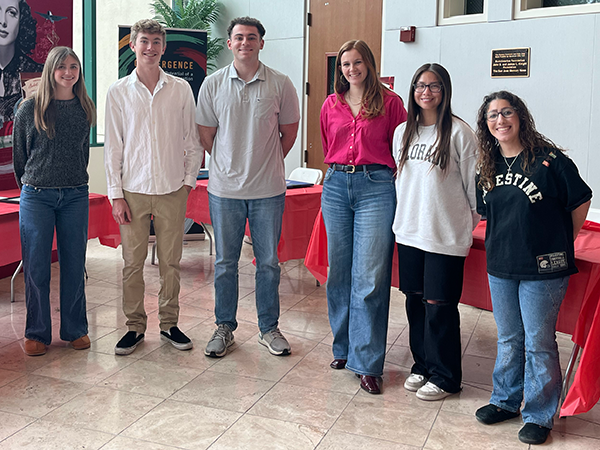
The 2025-2026 CAH Student Fellows Program concluded with a showcase featuring interdisciplinary student research projects in the arts and humanities. Guests enjoyed refreshments and raffle prizes while learning about projects from the following students (L-R): Elise Fendon ’26 (Studio Art), Morgan Drake ’26 (Studio Art), Anthony Ventura ’26 (English), Sophie Copple ’26 (English, French and Francophone Studies), Ava Garcia ’28 (Biology), and Ayden Eways ’27 (Political Science, Music).
Dear College Faculty and Staff,
At the end of Week 7, I know many of you are hunkering down as we approach the end of the academic year. Even with that, I am thrilled to see how many of you are submitting to College Notes this quarter! It is a testament to how busy we all are and a great way to see the breadth and depth of the work you all do.
This issue was so large that we’ve decided to split it into two. Please look for an off-cycle edition of College Notes next Friday. This ensures we share everyone’s notes in a timely way without having such a long issue. (Though you’ll see this issue is still substantive).
Here is a well-known poem by Marianne Moore that is especially relevant for the month of May at a university – a time of struggle with the end of the academic year and, simultaneously, a moment of exceptional growth, creativity, and production.
Sincerely,
Daniel Nevertheless
By Marianne Moore
you've seen a strawberry
that's had a struggle; yet
was, where the fragments met,
a hedgehog or a star-
fish for the multitude
of seeds. What better food
than apple seeds - the fruit
within the fruit - locked in
like counter-curved twin
hazelnuts? Frost that kills
the little rubber-plant -
leaves of kok-sagyyz-stalks, can't
harm the roots; they still grow
in frozen ground. Once where
there was a prickley-pear -
leaf clinging to a barbed wire,
a root shot down to grow
in earth two feet below;
as carrots from mandrakes
or a ram's-horn root some-
times. Victory won't come
to me unless I go
to it; a grape tendril
ties a knot in knots till
knotted thirty times - so
the bound twig that's under-
gone and over-gone, can't stir.
The weak overcomes its
menace, the strong over-
comes itself. What is there
like fortitude! What sap
went through that little thread
to make the cherry red! HighlightsTwo Santa Clara University alumni were recognized among this year’s Pulitzer Prize honorees. Maggie Beidelman ’09 (English), Deputy Director of Visuals at the San Francisco Chronicle, was part of the collaborative team that won the Pulitzer Prize for explanatory journalism for an investigation into how insurance companies drastically underpay wildfire survivors. Jack Gillum ’06 (Political Science), a reporter for the Wall Street Journal, was named a finalist for the Pulitzer Prize for public service for his article, “How the Epstein Scandal Fractured Trump’s Relationship With MAGA.” Beidelman and Gillum join past Pulitzer winners Stephen Hobbs ’11 (Communication, Political Science) and Tatiana Sanchez ’10 (English, Communication). All four participated in the Communication Department’s journalism program and reported for The Santa Clara student newspaper, with Gillum serving as editor-in-chief for three years. “Our journalism program provides students with opportunities to build the skills that propel them forward into this kind of important professional work,” said Lisa Davis (Communication), adviser to the newspaper. "These amazing Bronco journalism alums are an inspiration to our current student journalists."

Maria Judnick's (English) article, "Slovene Immigrants & The Rise of San Francisco Beer" was recently published by CraftBeer.com, a website run by the Brewers Association. Maria is one of five journalists awarded $750 as part of the North American Guild of Beer Writers' 2025 Diversity in Beer Writing Grant, which receives support from Allagash Brewing Company.
Beth Demmon, grant co-coordinator and editor of this piece, shared that, “The NAGBW Diversity in Beer Writing grant program’s goal is to highlight stories that are both uniquely personal while remaining universally compelling, which can be a hard balance to strike. Maria Judnick's idea to tie her family’s Slovene American history into the rise of San Francisco’s brewing industry at first seemed to be a hard hill to climb, but she managed to do so and achieved the grant’s goal perfectly. Working with her to balance the right tone of personal history and historical facts was a pleasure and resulted in a story that only she could have told.” Maria relied on research pulled from a wide array of sources, including an interview with beer historian Brian Alberts. But, she most enjoyed sharing the stories of both her uncle and father for this article.
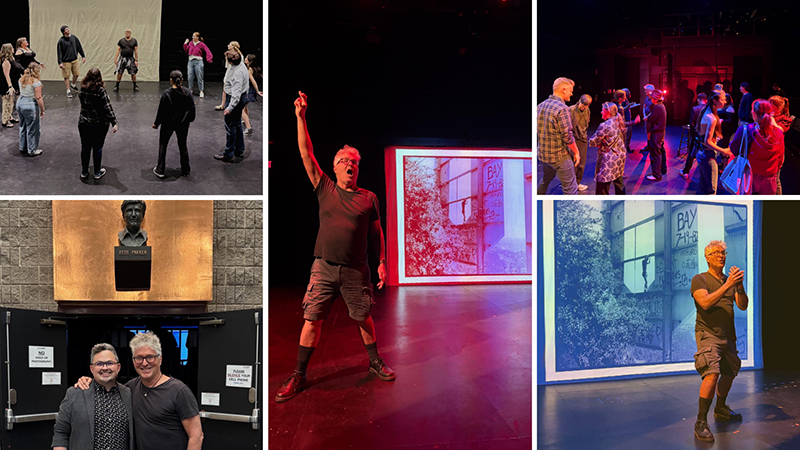 Top Left: Students participate in a performance creation workshop led by Tim Miller. Bottom Left: Benjamin Gillespie with Tim Miller in front of the Fess Parker Studio Theatre. Middle and Bottom Right: Tim Miller performing A Body in the O. Top Right: Post-show discussions on stage in the Fess Parker Studio Theatre. Top Left: Students participate in a performance creation workshop led by Tim Miller. Bottom Left: Benjamin Gillespie with Tim Miller in front of the Fess Parker Studio Theatre. Middle and Bottom Right: Tim Miller performing A Body in the O. Top Right: Post-show discussions on stage in the Fess Parker Studio Theatre.
Benjamin Gillespie (Theatre and Dance) brought the distinguished queer performance artist Tim Miller to campus for a two-day residency hosted by the Department of Theatre and Dance. Miller presented his award-winning solo performance A Body in the O to a full and enthusiastic audience in the Fess Parker Studio Theatre on Saturday, April 18, followed by a lively onstage conversation. Drawing on his decades-long career as a pioneering queer solo performer, the piece reflects on the evolution of LGBTQ+ rights in the United States and underscores the ongoing importance of social justice movements in advocating for marginalized communities.
In addition, Tim Miller led an interactive workshop with SCU students and guests, offering hands-on approaches to autobiographical storytelling and solo performance. Participants explored techniques for translating personal experience into compelling performance, engaging questions of voice, embodiment, and audience connection. The workshop culminated in the sharing of original monologues, with feedback from Miller to support further development.
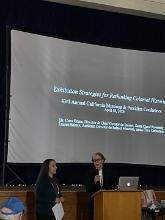
The de Saisset Museum's Director and Chief Curator, Ciara Ennis (Art and Art History), and Assistant Director Lauren Baines ’08 (Theatre Arts), co-presented "Exhibition Strategies for Rethinking Colonial Histories" at the 43rd Annual Californian Missions & Presidios Conference held at Mission Dolores, San Francisco, on April 18. This joint presentation focused on the exhibition "Monica Rodriguez: Californiana," curated by Ciara Ennis; the Flat Files exhibition "Shifting Relationships with the Land," curated by Lauren Baines and Collections Manager Summer Olsen with Ohlone Consultants Monica V. Arellano and Isabella Gomez ’27 (Philosophy), and REAL Intern, Lucas Gustin ’27 (Art History); and the de Saisset's permanent exhibition "California Stories from Thámien to Santa Clara." These projects took place at the de Saisset in Fall 2025.
Utilizing historical and archival material to link the past with the present, these interdisciplinary and transhistorical research-based exhibitions provided an alternative lens through which to examine the impact of the Alta California mission system (1769-1833) on the people, land, religion, and culture.
Image: "Exhibition Strategies for Rethinking Colonial Histories." Co-presented by Ciara Ennis and Lauren Baines.
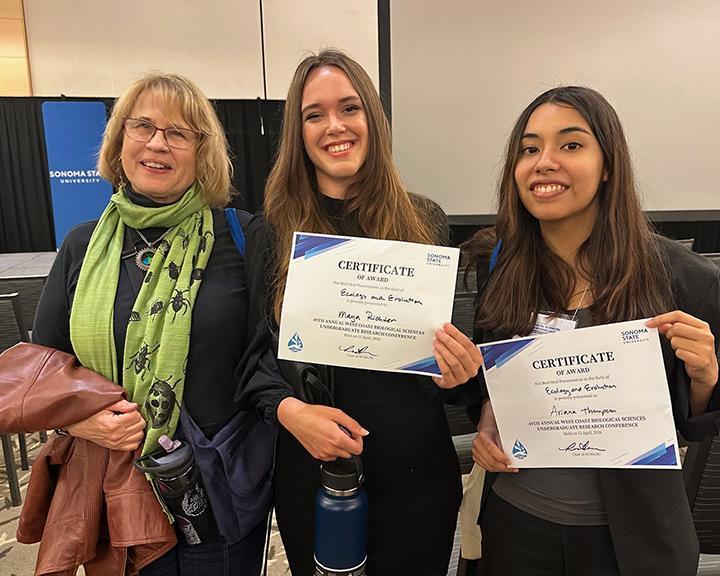 Janice Edgerly-Rooks with biology students Maya Richter and Ariana Thompson. Janice Edgerly-Rooks with biology students Maya Richter and Ariana Thompson.
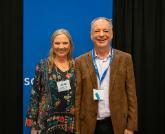
Biology students and faculty participated in the 49th Annual West Coast Biological Sciences Undergraduate Research Conference at Sonoma State University on Saturday, April 11. The keynote address, "Getting chased up the mountain- life at high elevation in the face of environmental change" was given by Elizabeth Dahlhoff and her long time collaborator Nathan Rank (SSU Biology), in photo at right.
Students did an amazing job presenting their original research as posters or talks. Santa Clara University was very well represented with the following biology students and their advisors participating: Tyler Kang '27 (Biology, Neuroscience), Diego Valderrama '26 (Biology), Cameron Zirkel '26 (Public Health Science), and Alena Gagnon '27 (Political Science) advised by Brian Bayless; Ximena Garcia-Isabelli '26 (Environmental Science) advised by Dawn Hart; Ashray Bangalore '26 (Biology) advised by Yaamini Venkataraman; and Karina Martinez '26 (Biology, Neuroscience), Dante Cable '26 (Biology), and Evan Hackstadt '27 (Computer Science) advised by Justen Whittall. Ariana Thompson '27 (Neuroscience) and Maya Richter '27 (Biology, Environmental Science), advised by Janice Edgerly-Rooks, won best student talk in Ecology and Evolution.
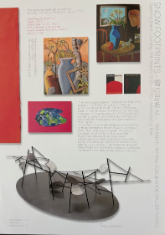
Kelly Detweiler (Art and Art History) exhibited in Niseko, Japan, at the Kiyoe Gallery, commemorating the life and work of Asuka Kunimatsu. He was the primary speaker during the exhibit, which featured work by Detweiler and the work of Asuka Kunimatsu and Kenji Otaki. The series of exhibits between SCU artists and artists from Hokkaido began in 1988 and has resulted in no less than twelve exhibits in Japan and the U.S. over the years.
In April, Kelly also had a solo exhibit at the Birdhouse Gallery in San Francisco during the month of April. The exhibit titled “Wingin It” featured thirty works, including wooden sculpture and paintings on wood and canvas.
Image: Exhibition poster for Kiyoe Gallery.
Caleb González (English) recently published a co-authored article entitled "Refusing Assimilation, Respecting Agency: A Consent-Based Theory and Practice of Creative Writing" in College English, a flagship journal from the National Council of Teachers of English (NCTE) for teachers of writing. The article is shaped in part by his MFA experience in Creative Nonfiction. The article is also founded upon the important work of Felicia Rose Chavez (author of The Antiracist Creative Writing Workshop, Haymarket Books, 2021). González and Janelle Adsit (Professor of English (Cal Poly Humboldt University) offer a theory and practice of creative writing through the lens of consent.
Additionally, Caleb was recently featured on The Big Rhetorical Podcast for his work as an editorial board member with the First-Year Composition Archive (FYCA)—a digital archive that serves as an emerging and growing resource for scholars and teachers who seek to learn more about first-year writing, teaching resources, and pedagogical developments. The podcast episode is available on Spotify, Apple Podcasts and SoundCloud.
On April 28, Chris Tirres (Religious Studies) participated in an online roundtable celebrating the work of Monica A. Coleman, a leading process theologian and professor of Africana Studies at the University of Delaware. The conversation was centered around the applicability of Alfred North Whitehead’s ‘metaphysics of becoming’ to contemporary liberation theologies. Conference papers will be published in a special issue of the American Journal for Theology and Philosophy.
Chris is also recently featured in the “Called to Lead” Podcast Series, which is sponsored by SCU’s Markey Center for Leadership and Ministry. In this episode, Chris joins John Rinaldo to discusses “Latino Ministry, Liberation, and the Wisdom of Lived Faith.”
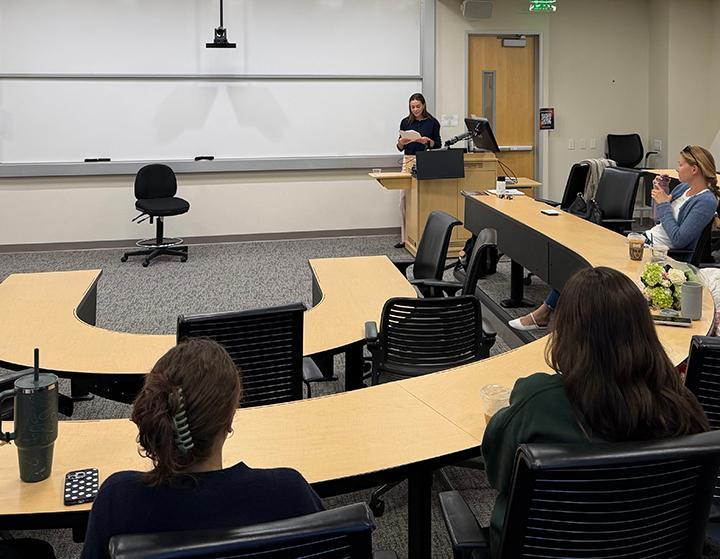 Nora Pulizzi presents her paper to audience members at History Day 2026. Nora Pulizzi presents her paper to audience members at History Day 2026.
On Wednesday, April 29, the History Department hosted its 4th annual History Day. Six students presented their research:
- Nora Pulizzi '26 (History), "Erosion of Gibraltar: WWI as Catalyst for a Dissolution of Union Life in Butte, Montana"
- Noah Bruening '28 (History), "Newsletters and Governments-in-Exile: War Resisters in Canada during the Vietnam War 1968-1970"
- Christina McManus '26 (English, History), "The Atwood Moment: A Microhistory of Cultural Book Banning in the United States"
- Jacklyn Alonzo Heredia '26 (Ethnic Studies, Political Science, History), "'Quedándonos Quietos': Guatemalan Migrants and the Unfulfilled Promise of Safety"
- Francesca Tapper '26 (Women's & Gender Studies, History), "The Bruja Endures: Tracing Brujería Across the Guatemalan Diaspora"
- Nate Symkowick '26 (History), "Semiconductors Under the Rising Sun"
Embioptera research hits the big time. These unique insects are featured in a new children’s book, Bug Power, extolling the “amazing abilities of bugs” by Stephanie A. Dole (Storey Publishing, 2026). Each chapter illustrates insectan superpowers, just like superheroes of comic book fame. These powers include invisibility, luminescence, poisonous blood, body armor, stunt flying and web slinging, to name a few. That last power is epitomized by embiopterans, the research focus of Janice Edgerly-Rooks’ (Biology) “Team Embia.” A two-page spread, including photographs taken in SCDI, highlights the webspinner’s ability to eject silk from her front feet. Every aspect of their superpowers demonstrated in the book is based on research conducted at SCU, including: the thinnest silks known, at nano-scale dimensions, determined in collaboration with Grace Stokes (Chemistry and Biochemistry) and Rich Barber (Physics), silk spinning style to weave their cozy home with Brody Sandel (Biology), and remarkable waterproof silk (with Grace and Rich). The fact that the webspinners under threat run backwards to avoid triggering release of silk fibers from their silk ejectors was also discovered in collaboration with a team from Kiel University in Germany and students in Animal Behavior (BIOL 165). A wonderful aspect of the book is the connection framed by the author between the remarkable abilities of insects, bioinspiration and potential inspiration for material scientists.
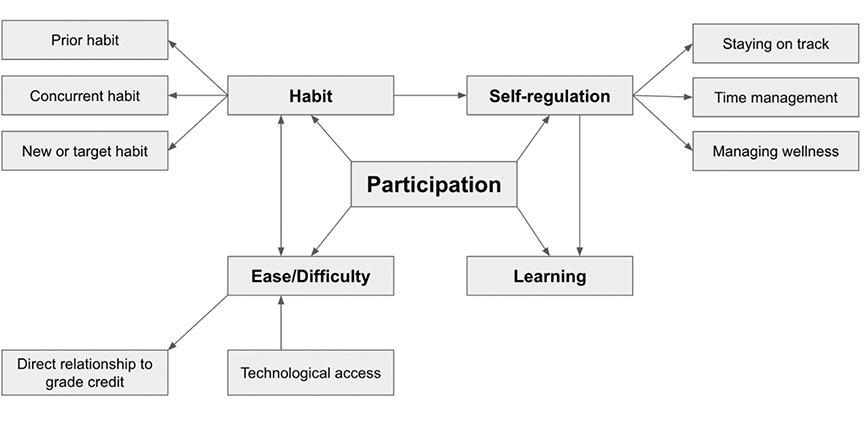 Proposed factors and relationships among motivations for participation. Participation behaviors in the exploratory study were motivated by ease, habit, self-regulation, and learning. Students opted for easy ways to participate, either because they were already habitual, or were easy to develop habits around. Students opted for habitual forms of participation, because they contributed to their ability to self-regulate their course progress, time, wellness, and learning. Proposed factors and relationships among motivations for participation. Participation behaviors in the exploratory study were motivated by ease, habit, self-regulation, and learning. Students opted for easy ways to participate, either because they were already habitual, or were easy to develop habits around. Students opted for habitual forms of participation, because they contributed to their ability to self-regulate their course progress, time, wellness, and learning.
Mathew Gomes (English) recently published the article, "Embodying Class Participation: An Intersectional Self-Study of How and Why Students Participate" in the Spring 2026 issue of Composition Forum. The article is motivated by needs for intersectional, student-involved class participation research, and reports the results of an exploratory study of student participation disaggregated by race and ethnicity, gender, disability, and their intersections. Surveying students (n=42) about their identities, attempts to participate, and motivations for participation, Gomes found White students attempted on-time work at a greater rate, while Latinx students attempted it less than peers. Female students attempted exit ticket reflections more often than peers, and male Latinos attempted labor reflections less often. Students' explanations about their motivations emphasized ease, habits, self-regulation, and learning. Disabled participants cited habits more, and White men cited self-regulation less. The study contributes to scholarship in participation and assessment, with implications for classroom assessment and policies, and concludes with directions for future research and a classroom heuristic.
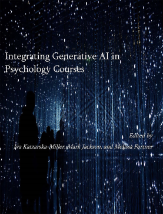
Tim Urdan (Psychology) and two undergraduate co-authors, Katie Firtch '27 (Psychology) and Ellie White '27 (Psychology, Child Studies) published a chapter titled "Helping undergraduate students understand the uses and abuses of AI in statistics and methods classes." This chapter describes how AI can be used effectively by students and presents a case study of using AI modules created in the Psychology Department for use in our stats and methods courses. The book, Integrating Generative AI in Psychology Courses, is open-access and was published by the Society for the Teaching of Psychology.
Maggie Levantovskaya (English) published a creative nonfiction essay titled to " To Tend the Garden," which is about the complicated notion of recovery in the context of chronic illness. The essay braids together an exploration of her newfound love of gardening and her longterm effort to accept life with lupus, an incurable disease. Specifically, she delves into the problem of focusing on the concepts of restoration and cure and existing in a culture that values a pain-free life.
Got IT Questions or Issues?
Stop by the virtual IT drop-in sessions with Charles Deleon! These sessions are designed to provide faculty and staff in the College of Arts and Sciences a friendly and casual setting for addressing general IT questions and concerns. Feel free to drop in and out at any time during the scheduled session, whether you have a quick question, need assistance with something and don't know where to start, or simply want to learn more about our IT resources.
Biweekly. Next sessions: Friday, May 15 and May 29, 11:30 a.m.–12:30 p.m.
Zoom link
|
|
Exit... Pursued by a Bear
May 8 - 17, (Thu-Sat 8 p.m., Sun 2 p.m.) | Fess Parker Studio Theatre
Nan decides to take things into her own hands when dealing with her abusive husband, Kyle, and the evening unfolds to be emotional and absurd. With the help of her cheerleader bestie Simon and new found friend Sweetheart, Nan & Kyle take a not always pleasant walk down memory lane. Using duct tape, honey and raw meat Nan finds the freedom she is seeking in this smart, dark revenge comedy.
Tickets available at SCU•Presents Performing Arts Center
This play contains mature themes, adult language and staged violence. Recommended for ages 13+ |
|
|
Studio Art Exhibition and Digital Design Showcase
May 13 to June 12, 9 a.m. - 4 p.m. | Edward M. Dowd Art and Art History Building
Reception: May 15, 5 p.m., Dowd Lobby
Graduating seniors in the Studio Art Program exhibit their capstone art projects. |
|
|
20th Annual Art History Symposium
3:30 - 5 p.m. | Dowd Lobby
|
|
|
Beyond Static: Theory and Opportunities in Time-Varying Electromagnetic Materials and Systems
4 - 5 p.m. | SCDI 1308
Come hear Kurt Schab (SCU Electrical and Computer Engineering) motivate exciting work in the field of modern RF electronics and explain how it depends on physics fundamentals. Want to know how modern antennas really work for that phone of yours? Want to hear how materials can be creatively used to provide advanced physics capabilities and motivate new and intriguing tricks-of-the-trade to make modern technology work? Join the Department of Physics and Engineering Physics for the talk and enjoy learning something new! |
Faculty Development
|
|
Faculty Sabbatical Information Session
noon - 1 p.m. | Varsi Hall 222
Join us to learn more about sabbaticals, including how the current sabbatical and evaluation processes work. This session is co-hosted with the Research Office. Provost Jim Glaser will give some brief remarks about the process and answer questions. Lunch will be served! |
|
|
Grading: Strategies, Successes, and Lessons Learned
1 - 2 p.m. | Varsi Hall 222
Faculty from across disciplines will share grading practices and strategies they have integrated into their own classes. The examples shared will range from ways to streamline grading processes while maximizing student opportunities for learning, navigating questions of AI and academic integrity, and even ways to maximize teaching strengths and target goal-focused areas of growth through reflective grading practices. Note that lunch will be served starting at 12:30 p.m. with a session start time of 1 p.m. |
|
|
Third Thursdays Shut Up & Write
9 a.m. - Noon | Varsi Hall 222
Writing Retreat – Quiet Time to Write & Recharge. Need a space to focus on that article, book chapter, or grant proposal? Shut Up & Write offers structured time, a quiet environment, and a supportive atmosphere to make serious progress on your writing. |
|
|
Intersectionality of Social and Spatial Justice: Competing Paradigms for the Management and Design of Maximum‑Security Prisons in the United States and Norway
12:10 - 1:15 p.m. | LC129 Learning Commons
The Brown Bag in the Humanities presents Mohammed Chaichian (Sociology). Drawing on a comparative analysis of “punishment” and “rehabilitation” paradigms in the criminal justice field and using available sources and documents, will discuss and visualize the projection of these divergent approaches onto the management and spatial design of ADX Florence (Colorado) and Halden maximum-security prisons in the U.S. and Norway. Bring your lunch! |
|
|
The Sinatra Series – Music@Noon - Music for Mezzo-soprano and String Quartet
Noon | Music Recital Hall
|
|
|
Faculty Lunch Time Conversation with Robin Tremblay-McGaw
Noon - 12:45 p.m. | de Saisset Museum
Robin Tremblay-McGaw (English) will walk through Jonathan Calm’s exhibition To Wherever, Forever. |
|
|
Writing Forward Reading Series
6 p.m. | St. Clare Room
Join the English Department for an event featuring acclaimed novelist David James Keaton alongside faculty from the Creative Writing Program. Featured readers include Tim Myers, Miah Jeffra, Daniel Summerhill, Kai Harris, Claudia McIsaac, Kirk Glaser, Maria Judnick, and Maggie Levantovskaya. |
|
|
Spring Jazz Band & Combos Festival
May 20 & 21, 7 p.m. | Music Recital Hall
Passion and precision blend in an unforgettable celebration of live jazz. Join SCU’s talented Jazz Band as they breathe new life into time-honored hits from jazz greats, create innovative improvisations, and explore brand new compositions. Whether you’re a jazz lover or a newcomer, join us for captivating concerts that are sure to have you bopping to the beat. |
|
|
Teresia Hinga Memorial Dedication
5:30 p.m. | Kenna Lawn
Join the Department of Religious Studies for a brief ceremony to honor theologian, scholar, colleague and friend, teacher and mentor, mother and grandmother Teresia Hinga, founding member of the Circle of Concerned African Women. The memorial is in the form of a Japanese Maple tree planted on the Kenna lawn, accompanied by a plaque. |
|
|
A Conversation on Truth, Justice, Radical Hope, and the Soul of Democracy with Cornel West
3:30-5 p.m. | Locatelli Center
Join us for a dynamic conversation with author, scholar, and activist Cornel West. An independent candidate for president in 2024, West is recognized for his pointed critiques on politics, race and justice. West will be interviewed by Christopher Tirres (Religious Studies). |
|
|