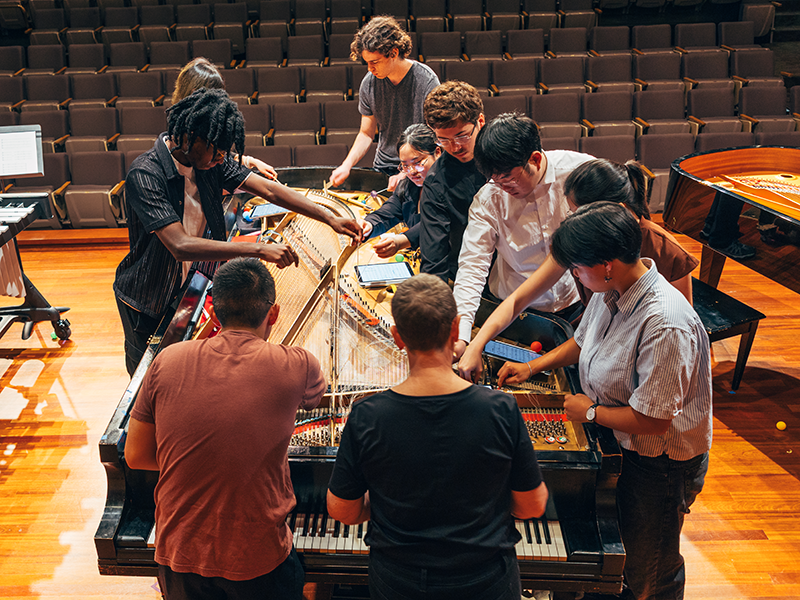
SCU's New Music Ensemble rehearsing on the bowed piano with 2024-26 Sinatra Chair Teresa McCollough (Music). The ensemble performed a newly commissioned piece, Arrullo anochecido: Twilight Lullaby, by alumnus Nicolás Lell Benavides '10 along with other works during Teresa's final Sinatra performance on June 5. Ensemble members include: Sandy Cai ’28 (Accounting and Information Systems), Alisa Cheng ’27 (Accounting and Information Systems), Jason Corn ’26 (Electrical Engineering, Music), Lancy Ding ’26 (Biology), Will Hu ’26 (Music), Addison Nguyen ’26 (Computer Science), A'Zhae Turay ’26 (Mechanical Engineering), Samuel Yancey ’26 (Music), Marilyn Yuan ’27 (Psychology). Watch the performance!
Dear College Faculty and Staff,
We had some terrible news this week about first-year political science and communication major, Alexia Kuvshinikov. My heart goes out to those of you who knew and taught her and, of course, her family.
Last issue, we inadvertently listed incoming faculty member Elivia Shaw as an acting assistant professor, when in actuality, she will begin here at SCU as an assistant professor.
I am happy to congratulate all of our faculty who earned rank and tenure promotions this year, as President Sullivan announced just before our new faculty College Notes issue. This is always a monumental milestone in an academic career representing years of scholarship, teaching, and service to our University. This recognition is not merely a reflection of past accomplishments, but it is a vote of confidence in each faculty member’s vision and future contributions to this vibrant community.
Awarded Tenure and Promotion to the Rank of Associate Professor
- Pearl Barros, Religious Studies
- Omar Davila, Child Studies
- Kimberly Dill, Philosophy
- Evelyn Ferraro, Modern Languages and Literatures
- Smita Ghosh, Mathematics and Computer Science
- Mathew Gomes, English
- Sonia Gomez, History
- Susan Kennedy, Philosophy
- Qiuwen Li, Art and Art History
- Elyse Raby, Religious Studies
- Daniel Summerhill, English
Promotion to the Rank of Professor
- Kathryn Bruchmann, Psychology
- Cruz Medina, English
- Brody Sandel, Biology
- Paul Schutz, Religious Studies
- Eric Yang, Philosophy
Promotion to the Rank of Associate Teaching Professor
- Megan Gudgeirsson, History
- George Schaeffer, Mathematics and Computer Science
- Mukta Sharangpani, Gender and Sexuality Studies
- Erik Sunderman, Theatre and Dance
Promotion to the Rank of Teaching Professor
- Madeline Cronin, Philosophy
- Lisa Davis, Communication
- Mohammed Kadalah, Modern Languages and Literatures
- Gregory Wigmore, History
This will be a long issue again as we’re trying to get all our submissions in before we all disperse for the summer. College Notes will appear in your inbox monthly during the summer and will resume bi-weekly in September.
In remembrance of Alexia, I offer you this poem by Barbara Crooker, the prolific Pennsylvania poet.
I wish you all a restful summer after we wrap up this academic year!
Sincerely,
Daniel Grief
By Barbara Crooker
is a river you wade in until you get to the other side.
But I am here, stuck in the middle, water parting
around my ankles, moving downstream
over the flat rocks. I'm not able to lift a foot,
move on. Instead, I'm going to stay here
in the shallows with my sorrow, nurture it
like a cranky baby, rock it in my arms.
I don't want it to grow up, go to school, get married.
It's mine. Yes, the October sunlight wraps me
in its yellow shawl, and the air is sweet
as a golden Tokay. On the other side,
there are apples, grapes, walnuts,
and the rocks are warm from the sun.
But I'm going to stand here,
growing colder, until every inch
of my skin is numb. I can't cross over.
Then you really will be gone.
Highlights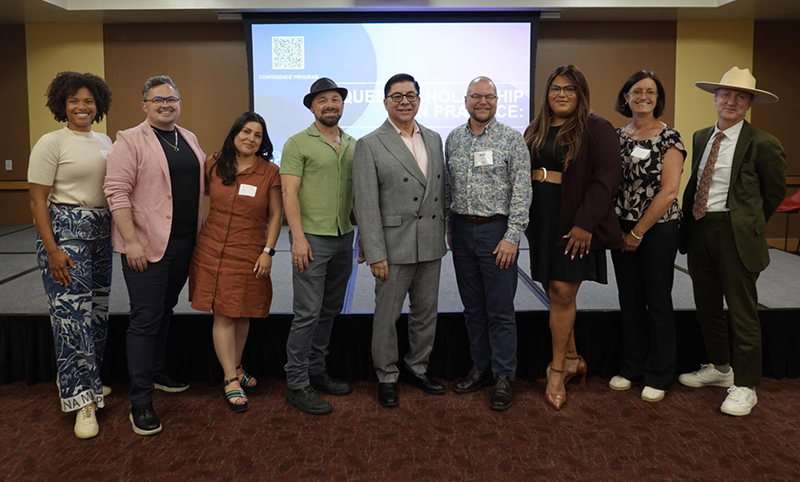 (L-R): CiAuna Heard, Benjamin Gillespie, Michelle Velasquez-Potts, Miah Jeffra, Fred Ferrer, Paul Gilbert, Ruby Mendoza, Sonja Mackenzie, Daniel Press. Photo taken at the inaugural SCU Queer Scholarship Conference in May. (L-R): CiAuna Heard, Benjamin Gillespie, Michelle Velasquez-Potts, Miah Jeffra, Fred Ferrer, Paul Gilbert, Ruby Mendoza, Sonja Mackenzie, Daniel Press. Photo taken at the inaugural SCU Queer Scholarship Conference in May.
The College of Arts and Sciences is celebrating the first year of the LGBTQ+ Studies Faculty Cluster Hire. The five new faculty members: Ruby Mendoza (English), Paul Gilbert (Public Health), Michelle Velasquez-Potts (Gender and Sexuality Studies), Miah Jeffra (English), and Benjamin Gillespie (Theater and Dance) have already made a tremendous impact on the campus community. In addition to publishing articles, winning awards, and presenting at conferences around the world, they have all been busy contributing to the Santa Clara University community. Paul Gilbert taught a research methods class and guided students in a national interview study of the ways that institutions of higher education support—or fail to support—their transgender and gender diverse students. Ruby Mendoza brought non-binary author Caro De Robertis to campus to speak on their newly published book on an oral history of trans experiences across the county. Miah Jeffra co-curated, with Lauren Baines ’08 (Theatre Arts), the de Saisset museum exhibit “Where From / Where To?” which explores the idea of home as both anchor and horizon. Michelle Velasquez-Potts joined the SCU LGBTQ+ Working Group on Equity, Justice, and Belonging and helped plan and organize the inaugural SCU Queer Scholarship Conference on campus last month. And Ben Gillespie brought the award-winning queer performance artist, Tim Miller, to campus for a creative workshop and presentation of his award-winning show A Body in the O. We look forward to participating in all the ways our newest colleagues will continue to help SCU grow.
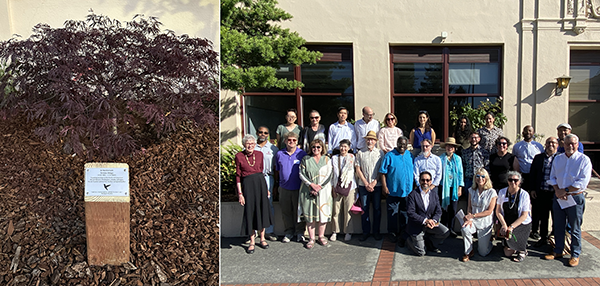
On Thursday, May 21, members of the Religious Studies Department and of the wider University community held a dedication for a newly planted tree and plaque in memory of our beloved colleague, Teresia Mbari Hinga, who passed away three years ago. Teresia was a professor in the Religious Studies Department for 18 years, where she taught global feminist theologies, ethics, and African spiritualities. Her generosity and joyful spirit made her beloved by students and colleagues alike.
Kimberly Dill (Philosophy) recently presented her in-progress piece, "Animating the Night: Entangled Environmental Values & the Preservation of Natural Darkness” during the closed sessions of the 2026 MOTH Festival of Ideas in London, May 14-16. The MOTH Festival of Ideas is an interdisciplinary program and conference, dedicated to the theoretical and practical pursuit of extending ethical, legal, and relational considerations and protections to more-than-human beings, including animals, plants, and fungi. The Festival of Ideas grows out of the work conducted by the MOTH ("More-Than-Human Life") Program at the NYU School of Law.
Kimberly's goal in “Animating the Night […]” is to more tightly interweave four diverse threads in the overarching dialectic on the preservation of natural darkness: animal ethics, aesthetics, the philosophy of mind, and environmental ethics. More precisely, she claims that the proper aesthetic appreciation of nocturnal animals requires appreciating their animacy, or capacity for sentience. Paired with an enactivist framework—on which cognition is fundamentally embodied and environmentally embedded—this entails that the proper aesthetic appreciation of nocturnal animals requires appreciating the natural darkness that makes their unique forms of cognition, perception, and sentience possible. Altogether, this reveals that natural darkness is not merely instrumentally valuable, but is also constitutively necessary for proper animal aesthetic and ethical regard.
Photo by Marie Jacquemin (@mariejacquemn)
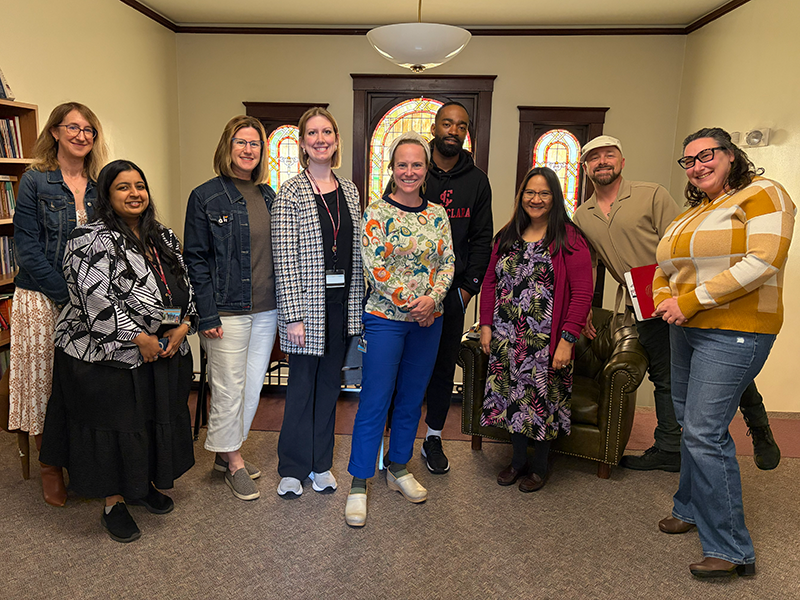
The English Department Curriculum Committee (Heather Turner, Daniel Summerhill, Supurna Dasgupta, Amy Lueck, Miah Jeffra, and José Villagrana) hosted a professional development workshop for Archbishop Mitty High School English teachers (Amy Olein, Patrice Miramontes, Tina Otayco, and Beth Madia). The workshop focused on current best practices in college English classrooms including curricular reform and student engagement in relation to the proliferation of generative AI.
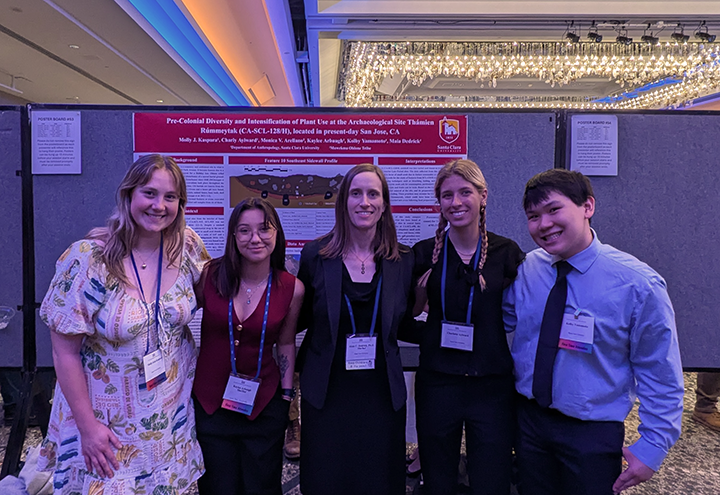 (L-R): Molly Jean Kaspura, Kaylee Arbaugh, Maia Dedrick, Charly Aylward, and Kolby Yamamoto with their poster. (L-R): Molly Jean Kaspura, Kaylee Arbaugh, Maia Dedrick, Charly Aylward, and Kolby Yamamoto with their poster.
On April 30 in San Francisco, Anthropology majors Molly Jean Kaspura ’26, Kaylee Arbaugh ’28, Charly Aylward ’26, and Kolby Yamamoto ’26 presented a poster at the Society for American Archaeology Annual Meeting. Their research addressed pre-colonial plant foodways (ca. AD 1530) through the study of samples from thermal features excavated at an archaeological site in what is now downtown San Jose. They spent countless hours since Winter quarter 2025 sorting samples under microscopes (funded by a Dean's Grant) to isolate and identify plant seeds, then analyzed the implications of their findings for the diversification and intensification of plant collecting practices of the time. The work was completed with the permission of Monica V. Arellano of the Muwekma Ohlone Tribe, who was also a co-author of the poster. The research was advised by Maia Dedrick (Anthropology). Regional archaeologists supported students with their research, connecting them to the samples (Chris Canzonieri, Lee Panich (Anthropology)) and mentored them in seed identification (Angela Armstrong-Ingram, Eric Wohlgemuth). Their findings demonstrate site residents' reliance on diverse grasses, native clover, and other herbs. A 2FURS Grant supported student conference participation, and a Provost's Research Grant funded student research time. Students Olivia Black ’26 (Psychology) and Sophia Phillips ’29 (Anthropology) also participated in sample sorting.
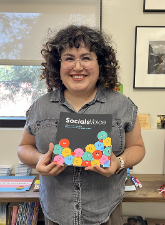
A new educational e-book, titled SocialsVoice: Latino Youth Research on Social Media and Mental Health, examines the intersection of social media, stigma, and mental health as perceived by Latino youth. Led by PI Melissa DuPont-Reyes (Columbia University) and co-authored by Victoria Mello, Alice P. Villatoro (Public Health), and Lu Tang (Texas A&M University), the authors translated participant-generated insights directly for public consumption.
The study addressed a critical research gap by centering Latino youth social media perspectives through a collaborative digital curation project. Youth analyzed the content and messaging of online clips, established a user-donated media archive, and co-created summary videos to share these insights with their families. By prioritizing the public release of initial findings in a publicly available e-book, the authors aimed to educate and empower families on the complexity of social media and mental health as well as equip advocates, educators, and policymakers with the real-world evidence needed to reshape the youth digital landscape.
Ultimately, this project represents a deep commitment to participatory research: returning data directly to the communities that generated it to foster digital resilience.
Image: Alice P. Villatoro holding a physical copy of "SocialsVoice: Latino Youth Research on Social Media and Mental Health."
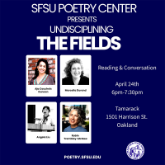
On Friday, April 24, in Oakland, Robin Tremblay-McGaw (English) read poems along with Marcella Durand, Aja Couchois Duncan, and Angela Liu at the invitation of San Francisco State University's Poetry Center as part of the Undisciplining the Fields series curated by Tonya Foster.
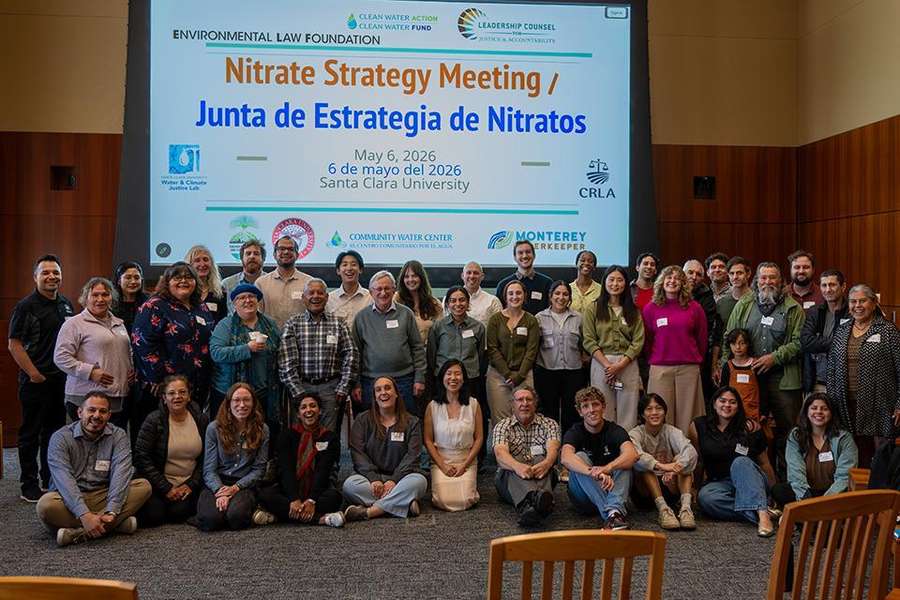 Nitrate Strategy Meeting Group. Photo Credit: Andrew Schatz '26 (Environmental Science). Nitrate Strategy Meeting Group. Photo Credit: Andrew Schatz '26 (Environmental Science).
Iris Stewart-Frey (Environmental Studies and Sciences), with support from the Environmental Justice and the Common Good Initiative and the Water and Climate Justice Lab organized a one-day conference on May 6 at SCU. The conference goal was to develop further strategies to reduce groundwater contamination in California's Central Valley and Salinas Valleys. Over 50 representatives from a ~15 organization strong coalition of environmental organizations (i.e. Community Water Center, CRLA, Natural Resources Defense Council), community committees, and academia attended and heard community testimony on contaminated water and illness, shared information, and developed strategic goals for nitrate regulatory programs (such as CV-SALTS, Ag 4.0, and the Dairy Order) and clean water advocacy. Stewart-Frey and Jake Dialesandro (Environmental Studies and Sciences) presented new findings on how nitrate in groundwater varies in space and time, especially near Concentrated Animal Feeding Operations (CAFOs). Several students from the Water and Climate Justice Lab contributed to the analysis and supported the logistics of the conference: Sam Lei ’26 (Environmental Science), Casper Huang ’27 (Environmental Studies), Bri Guingona ’25 (Environmental Studies), Anna Keenan ’26 (Environmental Science, French and Francophone Studies), Rachel Lin-Peistrup ’26 (Environmental Science), Austin Kaneko ’26 (Environmental Science), Sophia Toribio ’28 (Political Science, Environmental Studies), and Victoria Romic ’27 (Environmental Science).
Nancy Unger (History, emerita) was featured on the podcast episode " Bad Romance: Divorce in the Gilded Age." The episode examines divorces among the elite, including the Vanderbilts and the Astors, and Nancy discusses the slow evolution of attitudes toward divorce. The podcast, The Gilded Gentleman, is hosted by Carl Raymond.
Nancy was also quoted in "Clarence Thomas Against Progressivism—and Progressives" by Ruth Marcus in The New Yorker. Nancy, a scholar of the long Gilded Age and Progressive Era, defended the original progressives against a recent attack by Justice Thomas.
Brita A. Bookser (Child Studies) recently published her article, " Teaching with Rigorous Imagination When "No Education is Politically Neutral," in English Education. This article describes the theory and praxis at the heart of her Child Studies course, Anti-Racist and Decolonial Praxis in Early Childhood Contexts (CHST 6). Drawing from bell hooks' assertion that "no education is politically neutral," this article animates praxis rooted in a critical analysis of the system of education. By engaging with scholarship, in-class activities, and a project, students go beyond critiquing dominant scripts in education to imagining possibilities toward social justice, namely by centering critical trans, hip-hop-based, and abolitionist pedagogies in early childhood education. Perhaps most valuable is that this article showcases examples of student work and describes how the course design and pedagogy have evolved with time, reflection, and imagination about teaching in higher education.
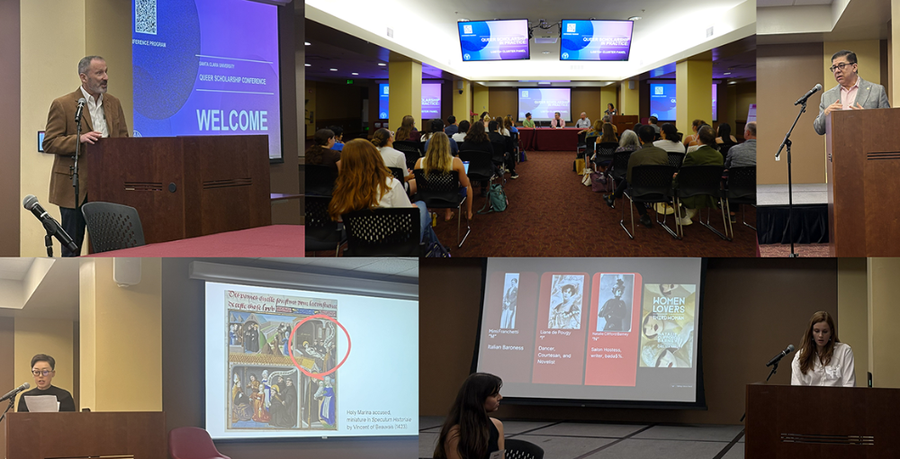 The inaugural SCU Queer Scholarship Conference on May 14th organized by the LGBTQ+ Equity, Justice, and Belonging Working Group. Top: Provost Jim Glaser (l), and alumnus Fred Ferrer '80 (r) both delivered opening remarks at the conference. Bottom: Haruka Cho (Religious Studies) presents on the "Queer Theologies" panel (l), Sophie Copple '26 (English, French and Francophone Studies) presents on the "Queer Literatures" panel (r). The inaugural SCU Queer Scholarship Conference on May 14th organized by the LGBTQ+ Equity, Justice, and Belonging Working Group. Top: Provost Jim Glaser (l), and alumnus Fred Ferrer '80 (r) both delivered opening remarks at the conference. Bottom: Haruka Cho (Religious Studies) presents on the "Queer Theologies" panel (l), Sophie Copple '26 (English, French and Francophone Studies) presents on the "Queer Literatures" panel (r).
Santa Clara University hosted its inaugural Queer Scholarship Conference on May 14th in the California Mission Room. The event brought together students, faculty, staff, alumni, and community members to share LGBTQ+ research and scholarship. Sponsored by the LGBTQ+ Equity, Justice, and Belonging Working Group, the Office of Diversity and Inclusion, the Office of Multicultural Learning, and the Department of Gender and Sexuality Studies, the conference highlighted interdisciplinary research and community engagement across campus.
The conference opened with a land acknowledgment and remarks from LGBTQ+ Working Group co-facilitators CiAuna Heard (Gender and Sexuality) and Sonja Mackenzie (Public Health), followed by remarks from Provost James Glaser and SCU alum Fred Ferrer '80 (Psychology), Hon. '14. A faculty panel, “Queer Scholarship in Practice,” featured Benjamin Gillespie (Theatre and Dance), Miah Jeffra (English), Michelle Velasquez-Potts (Gender and Sexuality Studies), Paul Gilbert (Public Health), and Ruby Mendoza (English) discussing queer scholarship, pedagogy, and interdisciplinary research.
Additional mixed student and faculty panels focused on "Queer Literatures" and "Queer Theologies," and there was also a poster session on "Lived Experiences of LGBTQ+ Students Across Institutions" featuring ongoing collaborative interdisciplinary projects at the university. The conference concluded with a panel on queer theologies. Organizers hope the event will become an annual celebration of LGBTQ+ scholarship.
Desirée Forsythe (Biology) and colleagues published a paper titled, "“It's because of me – I made myself get here”: First-Generation College Students in STEM Motivations for, and Experiences with, Academic Advising."
Academic advising plays a major role in shaping undergraduate STEM students’ experiences through college. However, despite the critical nature of advising, there have been relatively few studies on the topic. Additionally, few studies have investigated how different kinds of advising (i.e. through an advising center versus a faculty member) may impact students in different ways. This study investigated first-generation college students’ experiences through the lens of community cultural wealth. The authors found several themes such as balancing independence and pressures to succeed, identity as a source for empowerment and motivation, wanting reassurance and support from advisors, as well as negative outcomes during interactions with advisors. The article concludes with recommendations from student participants on how to improve academic advising.
On May 13, Andrea Pappas (Art and Art History) met with the cast and crew of the Laguna Playhouse via Zoom regarding their upcoming production of Red - a play about the artist Mark Rothko written by John Logan. They had questions about Rothko's career, motivation as an artist, and his artistic process. The play stages a fictitious encounter between Rothko and his studio assistant during the time Rothko was executing a commission for a mural-sized suite of paintings for the Seagram Building.
Mateo J. Carrillo (History) presented a chapter of his book manuscript (currently under contract with the University of North Carolina Press) on May 26, at the XLIV Latin American Studies Association (LASA) International Congress in Paris, France. Joining Mateo on the panel entitled "Nature, Nations, and Citizens: The Fraught Republicanism of National Infrastructure Development in Latin America" were co-presenters Frederico Freitas (North Carolina State University), Maria Angeles Picone (Boston College), and discussant Lise Sedrez (Universidade Federal do Rio de Janeiro).
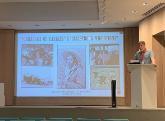
Image: Mateo Carrillo presenting at LASA 2026 on May 26, at the FIAP auditorium in Paris.

An article by Heather Clydesdale (Art and Art History) titled “Beyond Beitou: Library Architecture and Civic Resilience in Taiwan” was published in the Journal of Architectural Design and History. Heather argues that the 2006 Beitou Branch Library by the firm Bioarchitecture Formosana (Jiu dian 九典) established a new paradigm for library architecture in Taiwan. By considering how the building was positioned strategically in natural, historical, social, and civic landscapes, Heather argues that it is a manifestation of what Kenneth Frampton calls “critical regionalism.” Further, she traces library initiatives during the period of Japanese colonialism (1895-1945), the Mass Education Movement in the early 20th century, and more recent efforts by the Taiwan Ministry of Education. Connecting architecture to political theories shaped by Alexandre Lefebvre and John Rawls, among others, Heather suggests that the Beitou paradigm demonstrates how public architecture can constitute a “colloquial expression of liberal democracy” and promulgate “common sense” that lies at the core of a democracy’s civic values. The article is part of a special issue on “Heritage Cities and Conflict.” Heather's research was supported by the Taiwan Ministry of Foreign Affairs’ Taiwan Fellowship.
Image: Bioarchitecture Formosana, Beitou Branch Library, exterior, 2006 (photograph by H. Clydesdale, 2025).
Matthew Bell (Psychology) presented "A behavior analyst goes to Washington DC: Science policy in the federal government" at the 52nd Annual Meeting of the Association for Behavior Analysis International in San Francisco, He detailed his experience serving as a AAAS Science and Technology Policy Fellow (STPF) from 2023 to 2025 at the U.S. National Science Foundation where his primary focus was on scientific integrity policy. His scientific integrity work was a springboard for examining intersections with a number of different policy areas including AI, DEIA, and open science. He concluded his talk with a call to action, urging behavior analysts to seek policymaking roles at all levels of government, emphasizing that they will be the most effective advocates for the field's potential impact on public policy.
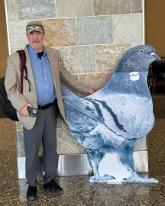
Image: "Coo" says the pigeon (featuring Matt Bell).
Benjamin Gillespie (Theatre and Dance) published the lead article in Theatre Survey, 67.2 (May 2026) titled “ Back to the (Retro) Future: Aging, Gentrification, and the Excavation of the Queer Past in Split Britches’ Lost Lounge.” In the article, Gillespie examines how the pioneering lesbian-feminist performance duo Split Britches (Peggy Shaw and Lois Weaver) mobilizes butch/femme aesthetics and queer nostalgia to challenge ageism and urban gentrification in their 2009 performance Lost Lounge. Drawing on queer studies, age studies, and performance theory, the essay argues that Split Britches' later work functions as an embodied archive, preserving queer histories and communities threatened by cultural erasure and neoliberal notions of progress. Published as the cover article for the field’s leading journal, the essay contributes to ongoing conversations about aging, memory, and LGBTQ+ performance. The script for Lost Lounge will be published in Gillespie's forthcoming book Split Britches: Fifty Years On (University of Michigan Press, Spring 2027).
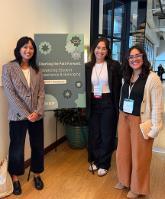
Giselle Laiduc (Psychology) was recently invited to attend a specialized convening in Washington, D.C., organized by the Institute of Higher Education Policy. The event, "Charting the Path Forward: Advancing Student Experience and Belonging," brought together policy experts, researchers, and practitioners to exchange innovative ideas and identify actionable strategies for integrating student belonging into broader student success efforts in a rapidly changing educational landscape.
Image: Giselle Laiduc with Lauren McLeese (Institute of Higher Education Policy) and Paulette Garcia Peraza (CSU Sacramento) pictured at the convening.
Tom Plante (Psychology) recently published the article, " Catholic integrated psychotherapy needs foundational research to progress and flourish: A call for an ambitious research agenda, in Integratus: The Journal of the Catholic Psychotherapy Association.
Abstract: Catholic integrated psychotherapeutic strategies and interventions must be grounded in quality evidence-based research in order to be accepted and to flourish in the mental health marketplace. Although the Catholic Church is 2,000 years old and offers numerous practices, rituals, and traditions that we expect provide spiritual health, healing, and well-being, we often assume that they also provide psychological, behavioral, relational, and even physical health and healing. However, state-of-the-art research using methodological and statistical sophistication is lacking. The purpose of this article is to underscore the need for quality empirical research, including randomized clinical trials to demonstrate the effectiveness of various elements of Catholic engagement with mental health benefits to warrant integrating them into our psychotherapeutic interventions.
Additionally, the article offers suggested directions for programs of research in the hope that they will inspire and motivate graduate students and young scholars launching their careers in Catholic integrated psychotherapy.
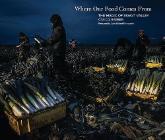
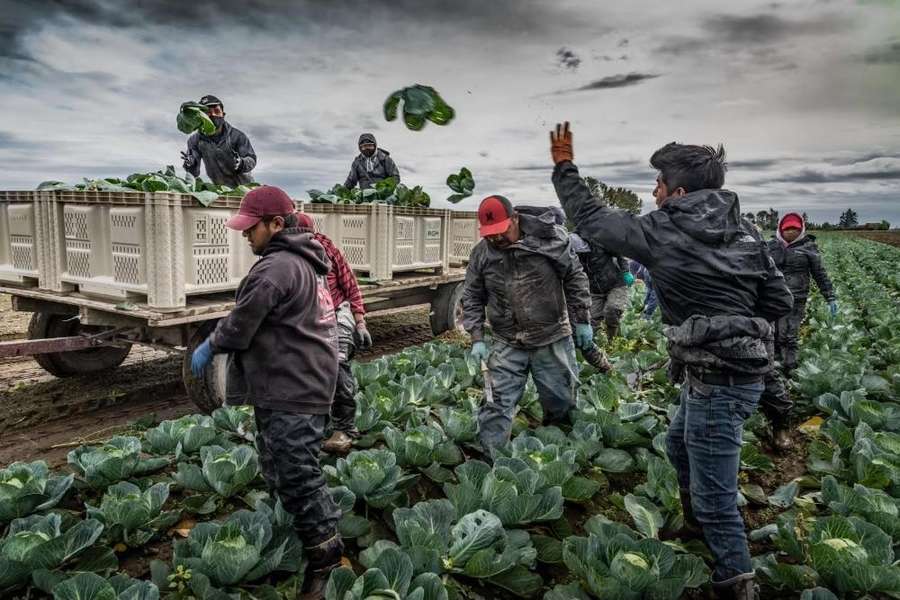 "Flying Cabbages" used with permission. "Flying Cabbages" used with permission.
John Farnsworth (Environmental Studies and Sciences, emeritus) wrote the foreword to Craig J. Barber’s Where Our Food Comes From: The Magic of Skagit Valley, a photographic tribute to local farm workers that was published last week. The author, being a person of few words who prefers his art to speak for him, asked John to read the foreword at the book launch, which took place at the Skagit County Historical Museum and was attended by an estimated 250 people, an all-time record for a museum event. Book sales were brisk, and although three cartons of books were on hand, all copies sold out. An exhibit of Barber’s photography will remain open at the museum throughout the summer.
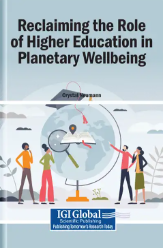
Chad Raphael (Communication) published two chapters on teaching about sustainability and communication. “ Sustainability Communication,” published in Introduction to Sustainability (edited by Tai Munro), addresses how communication is essential to our understanding of sustainability, the purposes and areas of sustainability communication, and opportunities for learning about this topic by researching and intervening in campus sustainability. Chad also published “ Using the Campus for Applied Learning about Sustainability through Transformative Pedagogy and Communication,” in Reclaiming the Role of Higher Education in Planetary Wellbeing, edited by Crystal Neumann. This chapter discusses curricular and pedagogical frameworks for designing transformative, experiential, campus-based learning about sustainability, and how communication can serve as a lens for understanding and addressing contemporary crises of sustainability and justice across the curriculum.
Jeffrey Burkholder (Modern Languages and Literatures) recently published an article titled “La recherche d’une critique sensible : Proust et la critique thématique” in the journal Inter-lignes. The article examines a mode of literary study that recognizes the essential role of emotion and perception in the construction of knowledge. It also discusses that role in the institutional context of doctoral dissertations, academic scholarship, and teaching. Elsewhere, the spring 2026 issue of the Bulletin d’Informations Proustiennes has edited a round table discussion where Jeff discusses the representation of nature in Marcel Proust’s aesthetics.
On June 7, Kyle Berg '26 (Environmental Studies) won the annual Escape from Alcatraz triathlon (1.5-mile swim, 18-mile bike ride, and 8-mile run). His winning time was 02:13:49.
Image by Geanine Jamison.
|
|
Summer Academic Technology classes calendar
|
|
|
Retired & Retiring Annual Faculty Brunch
10-11:30 AM | Library Arcade
We warmly invite you to the annual Retired and Retiring Faculty Brunch! Join us for our annual brunch to reconnect with retired and retiring colleagues and to chat with Provost Jim Glaser. |
Faculty Development
|
|
All-Day Accessibility Working Session
8:30 AM - 4:30 PM | Williman Room, Benson Memorial Center
Need additional time and support to get next year's course materials remediated to meet new federal digital accessibility standards? Faculty Development will host full day working sessions dedicated to helping you get your Summer and Fall 2026 course materials ready in community with others!
Breakfast and lunch provided, as well as a $200 stipend to faculty who complete the session and submit an accessible course (or significantly improved accessibility score) at the end of the event.
Attendees are expected to stay until the end of the day-long event and submit updated course materials to qualify for the stipend. Note: you are welcome to attend multiple all-day sessions, but each faculty member will only be eligible for one stipend. See below for schedule details.
Also held on June 23, September 3 & 11. |
|
|