Lesson Plan
Lord of the Flies
40
60
90
Day 1
Outcomes for Today
W3. Write narratives to develop real or imagined experiences or events using effective technique, relevant descriptive details, and well-structured event sequences.
a.) Engage and orient the reader by establishing a context and point of view and introducing a narrator and/or characters; organize an event sequence that unfolds naturally and logically.
b.) Use narrative techniques, such as dialogue, pacing, and description, to develop experiences, events, and/or characters.
c.) Use a variety of transition words, phrases, and clauses to convey sequence and signal shifts from one frame to another.
d.) Use precise words and phrases, relevant descriptive details, and sensory language to capture the action and convey experiences and events.
e.) Provide a conclusion that follows from and reflects on the narrated experiences or events.
Prepare
Background
Gather background knowledge about a place, time, event, person, or thing.
What is a conch shell? What does it look like?
A conch Shell is a spiral shell of a gastropod, often used as a horn.
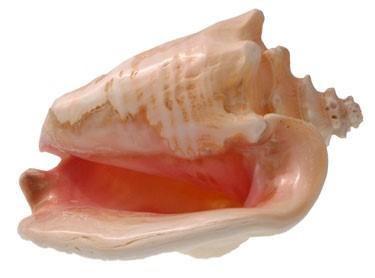
Source: http://dictionary.reference.com/browse/conch
http://cf067b.medialib.glogster.com/media/51/51723fbc452b9643b2bf01016909732f93b4064b32c077bc6dfa466e660dc90e/conch-shell-beautyshot.jpg

Word Wall
Here are five vocabulary words to teach and add to the Word Wall.
|
fair |
scar |
foliage |
lodgments |
enmity |
Read
Review
Review the timeline from the beginning every day.
Read
Read the selection, usually in a Shared Reading Read React Predict Cycle of 2-3 pages.
Read p. 7-18
|
Setting |
Characters |
Pages |
|
the jungle |
Ralph, Piggy |
7-18 |
Respond
Timeline
Agree on the facts in today’s reading and list the 3-5 most important on the timeline.
Students might mention:
- Two boys meet in the jungle.
- We learn that the boys are named Ralph and Piggy.
- Ralph and Piggy begin to explore the island.
- Ralph finds a conch shell in the water.
- Ralph blows the conch shell and other boys come out of the forest.
Map
Add to ongoing class activities like a KWL chart or map: where did the characters go?
- new character information can be added to an Open Mind Portrait
- an answer can be added to a question from the KWL Chart
- a new location or change can be added to the map
KWL Chart: What You Know, Want to Know, and Learn
Materials:
- KWL Chart
Step One: Read the first segment pages 7-18.
Step Two: Fill out the K [know] column: what do you know?
- What key things do you know from the story or explanation you have read so far? This might be who, what, where, when, why, or how information.
- Write this information concisely in the K [What do you know?] column.
Step Three: Fill out the W [want] column: what do you want to know?
- Given what you know, what would you like to know about this story or topic, about what has happened or will happen in the future?
- Write this information concisely in the W [What do you want to know?] column.
Step Four: Fill out the L [learned] column: what have you learned?
- As you read more of the story, or learn more about the topic, ask yourself what you have learned. Do you have answers to any of the questions in your W column: what you wanted to know?
- Write this information concisely in the L [What have you learned?] column. You may want to do this at various times as you learn. You may want to check off the questions in the W column when you answer them in the L column.
Explore
Activity
Explore the reading more deeply with a visual or oral language activity.
This activity will help the students to understand the feelings and experiences of the characters in the novel.
Introduction: In this activity, each student will create a Suitcase Bookmark. The students will imagine that they are one of the boys on the island. The students will make a suitcase bookmark and will include the items that they would take with them if they were on a deserted island, like the boys in the novel. They will choose their items and then illustrate their choices.
Materials:
- pieces of stiff paper 6-10 inches wide and 5-10 inches long
- pencils, pens, crayons, markers
- construction paper, glue sticks, scissors
Activity:
- Introduce the activity.
- Hand out materials.
Students will make a suitcase bookmark filled with items that they would take if they were stranded on a deserted island like the characters in the novel. Students should decide whether they would take things for survival, things for entertainment, or things for comfort. After completing today’s reading, students should begin to brainstorm items that they would take in their suitcase bookmark. Students should then begin to illustrate those items.
Discussion
Ask discussion questions of all 9 types (see Day 1).
Key Questions
- How did the boys end up on the island?
- Where are they from? Why did they leave?
- Why aren’t there any adults?
- Why does Ralph call the other boy Piggy, even though Piggy asked him not to?
- Why does Piggy tell Ralph his nickname? Does he trust Ralph too much?
- On page 16, why does Ralph say that Piggy is irrelevant?
- Do you think it will be a problem that there are no adults? Why or why not?
- Why is the conch shell significant?
- Describe Piggy and Ralph’s appearance. What kind of people do they represent in society?
Analyze
Analyze the key paragraph.
Key Paragraph - pg. 15
“Ralph looked through him. Here at last was the imagined but never fully realized place leaping into real life. Ralph’s lips parted in a delighted smile and Piggy, taking the smile to himself as a mark of recognition, laughed with pleasure.”
Extend
Write
Have each student write a short product based on today’s prompt to connect to the unit theme.
Write two narrative paragraphs about how Ralph feels being on the island, compared to how you would feel if you were in his position.
Consider the following:
- Why does Ralph seem to be happy about being on an island?
- Would he be this happy if there were adults on the island?
- Do you think you would react the same way? Why or why not?
- How would you react?
- Do you think that Ralph will always feel so happy to be on the island? What could go wrong?
Close
Close by extending today’s lesson to life and the world.
- What would be the first thing you would do if you survived a plane crash?
- Describe a time in your life where you were responsible for yourself.
Day 2
Outcomes for Today
W3. Write narratives to develop real or imagined experiences or events using effective technique, relevant descriptive details, and well-structured event sequences.
a.) Engage and orient the reader by establishing a context and point of view and introducing a narrator and/or characters; organize an event sequence that unfolds naturally and logically.
b.) Use narrative techniques, such as dialogue, pacing, and description, to develop experiences, events, and/or characters.
c.) Use a variety of transition words, phrases, and clauses to convey sequence and signal shifts from one frame to another.
d.) Use precise words and phrases, relevant descriptive details, and sensory language to capture the action and convey experiences and events.
e.) Provide a conclusion that follows from and reflects on the narrated experiences or events.
Prepare
Background
Gather background knowledge about a place, time, event, person, or thing.
What is an allegory?
An allegory uses symbolic figures, objects, and actions to convey truths or generalizations about human conduct or experience. Characters often personify abstract concepts or types, and the action of the narrative usually stands for something not explicitly stated. Symbolic allegories, in which characters may also have an identity apart from the message they convey, have frequently been used to represent political and historical situations.
For example, In the Lord of the Flies, the island represents the world. While reading think about what each character symbolizes. Source: http://www.merriam-webster.com/dictionary/allegory
Word Wall
Here are five vocabulary words to teach and add to the Word Wall.
|
creature |
muddled |
sympathy |
jumble |
canopy |
Read
Review
Review the timeline from the beginning every day.
Read
Read the selection, usually in a Shared Reading Read React Predict Cycle of 2-3 pages.
Read p. 18-28
|
Setting |
Characters |
Pages |
|
the beach |
Ralph, Piggy, Johnny, other boys |
18-25 |
|
the island |
Ralph, Jack, Simon |
25-28 |
Respond
Timeline
Agree on the facts in today’s reading and list the 3-5 most important on the timeline.
Students might mention:
- Ralph and Piggy meet the other boys.
- The boys start talking about what they should do, and they decide to explore the island.
- Ralph, Jack, and Simon go to explore the island and Piggy is left behind.
Map
Add to ongoing class activities like a KWL chart or map: where did the characters go?
The Lord of the Flies is an allegory. Complete this symbolism chart to discuss hot different objects and characters represent something else.
|
Object or character |
What does this object or character represent? |
Explain how you know this object or character is symbolized to stand for something else. |
|
Island |
|
|
|
Conch Shell |
|
|
|
Ralph |
|
|
|
Piggy |
|
|
|
Piggy’s Glasses |
|
|
|
Jack |
|
|
|
Simon |
|
|
|
Roger |
|
|
|
Signal Fire |
|
|
|
The Beast |
|
|
|
The Lord of the Flies |
|
|
|
|
|
|
|
|
|
|
Civilization vs. Savagery Poster:
Collaborate with students create a class T Chart. This can be a live, online document that students have shared access to (Google Document or Google Spreadsheet).
- Label one column “Civilization” and the other side “Savagery”.
- At the end of each reading or at the end of the week write down which ideas, behaviors, and decisions are civilized/moral/disciplined and which ideas, behaviors, and decisions are wild/brutal/barbaric.
Explore
Activity
Explore the reading more deeply with a visual or oral language activity.
After making a list of things to bring in their suitcase, students should start illustrating or cutting out the images that they will take in their suitcase.
These items should be things that the students think would make their lives and their survival easier on a deserted island. Students should consider bringing items like matches, food, blankets, flares, etc.
Discussion
Ask discussion questions of all 9 types (see Day 1).
Key Questions
- On page 20, what does it mean when it says that the boys are “wearily obedient”?
- Describe the choirboys? How do they know each other?
- Why does Piggy feel excluded? How is he different from the other boys?
- What is appealing to the other boys about Ralph? Why do they elect him to be the chief even though they don’t know him?
- Why doesn’t Ralph apologize to Piggy when he has the chance?
- How does Ralph include Jack in a leadership position?
- What can the boys eat?
- What does it mean now that the boys know they are on an island?
- What challenges do you predict will happen?
Analyze
Analyze the key paragraph.
Key Paragraph - pg. 22
“The joy of voting was almost as pleasing as the conch. Jack started to protest but the clamor changed from the general wish for a chief to an election by acclaim of Ralph himself. None of the boys could have found good reason for this; what intelligence had been shown was traceable to Piggy, while the most obvious leader was Jack. But there was a stillness about Ralph as he sat that marked him out; there was his size, and attractive appearance; and most obscurely, yet most powerfully, there was the conch. The being that had blown that, had sat waiting for them on the platform with the delicate thing balanced on his knees, was set apart.”
Extend
Write
Have each student write a short product based on today’s prompt to connect to the unit theme.
Has there ever been a time where you have been excluded from a group the way that Piggy is being excluded? How did you feel? Why were you excluded? Write two narrative paragraphs comparing your experience with Piggy’s experience. Why was Piggy excluded from the group? What makes him different?
Close
Close by extending today’s lesson to life and the world.
- What can you do to make sure your classmates are included?
- What can you do to include yourself in the group?
Day 3
Outcomes for Today
W3. Write narratives to develop real or imagined experiences or events using effective technique, relevant descriptive details, and well-structured event sequences.
a.) Engage and orient the reader by establishing a context and point of view and introducing a narrator and/or characters; organize an event sequence that unfolds naturally and logically.
b.) Use narrative techniques, such as dialogue, pacing, and description, to develop experiences, events, and/or characters.
c.) Use a variety of transition words, phrases, and clauses to convey sequence and signal shifts from one frame to another.
d.) Use precise words and phrases, relevant descriptive details, and sensory language to capture the action and convey experiences and events.
e.) Provide a conclusion that follows from and reflects on the narrated experiences or events.
Prepare
Background
Gather background knowledge about a place, time, event, person, or thing.
Where are the boys from? Is this important? How does the world that they are used to contrast with their world on the island?
The boys are from Britain during a profoundly transformative period in the early 1950s. A principal driver of change was a major growth in population, matched by rapidly rising expectations about lifestyle. The social and cultural changed to be more individualistic and less deferential. The moral code from 1945 broke down, a process formalized by legal changes in the 1960s. In 1945, Britain still had the largest empire in the world. This empire had largely been granted independence by 1964.
Source: http://www.bbc.co.uk/history/british/modern/overview_1945_present_01.shtml
Word Wall
Here are five vocabulary words to teach and add to the Word Wall.
|
hiatus |
flailed |
induced |
ebullience |
errant |
Read
Review
Review the timeline from the beginning every day.
Read
Read the selection, usually in a Shared Reading Read React Predict Cycle of 2-3 pages.
Read p. 28-32
|
Setting |
Characters |
Pages |
|
the island |
Ralph, Jack, Simon |
28-32 |
|
the platform |
Ralph, other boys |
32-38 |
Respond
Timeline
Agree on the facts in today’s reading and list the 3-5 most important on the timeline.
Students might mention:
- Ralph, Jack, and Simon continue to survey the island.
- They see a pig, but Jack doesn’t kill it.
- Ralph blows the conch to call another assembly of all of the boys.
- The boys start making a signal fire to help them be rescued.
Map
Add to ongoing class activities like a KWL chart or map: where did the characters go?
The Lord of the Flies is an allegory. Complete this symbolism chart to discuss hot different objects and characters represent something else.
Civilization vs. Savagery Poster:
Collaborate with students create a class T Chart. This can be a live, online document that students have shared access to (Google Document or Google Spreadsheet).
- Label one column “Civilization” and the other side “Savagery”.
- At the end of each reading or at the end of the week write down which ideas, behaviors, and decisions are civilized/moral/disciplined and which ideas, behaviors, and decisions are wild/brutal/barbaric.
Explore
Activity
Explore the reading more deeply with a visual or oral language activity.
Students should continue to work on their illustrations for the items that they will take in their suitcase bookmark. Students should also begin working on their suitcase bookmark by cutting out a piece of stiff construction paper. Students should decorate their bookmark so that it looks like a suitcase.
Discussion
Ask discussion questions of all 9 types (see Day 1).
Key Questions
- On page 29, what does it mean when it says the boys are enjoying the “right of domination”?
- Why are the boys so happy to be alone on the island?
- Would you be happy? Why or why not?
- Do you think that happiness will wear off? Why or why not?
- Why does Ralph not want to believe in the “beastie”?
- What role does Piggy play?
- Why does he say the other boys are like little kids?
- Why does Piggy want them to be more like adults?
- What do you predict will happen next?
Analyze
Analyze the key paragraph.
Key Paragraph pg. 31
“The three boys rushed forward and Jack drew his knife again with a flourish. He raised his arm in the air. There came a pause, a hiatus, the pig continued to scream and the creepers to jerk, and the blade continued to flash at the end of a bony arm. The pause was only long enough for them to understand what an enormity the downward stroke would be. Then the piglet tore loose from the creepers and scurried into the undergrowth. They were left looking at each other and the place of terror.”
Extend
Write
Have each student write a short product based on today’s prompt to connect to the unit theme.
Write a narrative paragraph about why the boys elect Ralph as chief, and some of the things that could go wrong as a result of this election.
When answering the question above, consider the following:
- What gives Ralph his authority among the other boys?
- Why do they elect him as their leader, even though they don’t really know him or his ability to lead?
- Why do you think Ralph will be a good leader?
- Describe what makes a good leader?
- Are there examples of good leaders in your life? If so, who are they?
Close
Close by extending today’s lesson to life and the world.
- Describe a time when you were in a leadership position.
- What are the challenges of being a good leader?
Day 4
Outcomes for Today
W3. Write narratives to develop real or imagined experiences or events using effective technique, relevant descriptive details, and well-structured event sequences.
a.) Engage and orient the reader by establishing a context and point of view and introducing a narrator and/or characters; organize an event sequence that unfolds naturally and logically.
b.) Use narrative techniques, such as dialogue, pacing, and description, to develop experiences, events, and/or characters.
c.) Use a variety of transition words, phrases, and clauses to convey sequence and signal shifts from one frame to another.
d.) Use precise words and phrases, relevant descriptive details, and sensory language to capture the action and convey experiences and events.
e.) Provide a conclusion that follows from and reflects on the narrated experiences or events.
Prepare
Background
Gather background knowledge about a place, time, event, person, or thing.
What are the basic things the boys need for survival?
In No Particular Order The 5 Basic Needs Are:
Personal protection (maintaining a 98.6 core body temperature)
- Clothing
- Fire
- Shelter
- Sustenance
- Water
- Food
- Communication
- Navigation
- By electronic means, radio, beacon, etc
- Ground to air signals
- Health
- First aid
- Hygiene
- Travel
- Walking out
Every one of the five basic needs could be more important than the other depending on the time or circumstances. But all will play a role in your ultimate recovery.
Source: http://www.realitysurvival.com/the-5-basic-needs-of-a-survival-situation/
Word Wall
Here are five vocabulary words to teach and add to the Word Wall.
|
officious |
Indignant |
pall |
recrimination |
tumult |
Read
Review
Review the timeline from the beginning every day.
Read
Read the selection, usually in a Shared Reading Read React Predict Cycle of 2-3 pages.
Read p. 39-47
|
Setting |
Characters |
Pages |
|
on the mountain |
Ralph and the boys, Jack, Piggy |
39-47 |
Respond
Timeline
Agree on the facts in today’s reading and list the 3-5 most important on the timeline.
Students might mention:
- All of the boys except Piggy build a fire.
- The boys use Piggy’s glasses to start the fire.
- The boys make more plans about what to do on the island.
- The fire spreads throughout the island.
- Piggy notices that some of the little kids are gone.
Map
Add to ongoing class activities like a KWL chart or map: where did the characters go?
The Lord of the Flies is an allegory. Complete this symbolism chart to discuss hot different objects and characters represent something else.
Civilization vs. Savagery Poster:
Collaborate with students create a class T Chart. This can be a live, online document that students have shared access to (Google Document or Google Spreadsheet).
- Label one column “Civilization” and the other side “Savagery”.
- At the end of each reading or at the end of the week write down which ideas, behaviors, and decisions are civilized/moral/disciplined and which ideas, behaviors, and decisions are wild/brutal/barbaric.
Explore
Activity
Explore the reading more deeply with a visual or oral language activity.
Discussion Questions
What are the facts?
Literal Questions
Who
What
When
Where
How
Why
How is the text structured?
Structural Questions
Setting (when, where, weather)
Characters
Characterization (description, does, says, are said about)
Plot (problem, barriers, resolution)
Conflict (nature, self, society, others)
Tone (attitude)
Mood (atmosphere)
What are the major ideas in the text?
Idea Questions
Theme
Who learns what
Value
Thoughts
How does the author do what he/she does in the text?
Craft Questions
Style
Effects
Writing
How is this work like/unlike other works by this author?
Author Questions
Text & Context
History
Impression
How is this work like/ unlike other texts you have read?
Literature Questions
Analysis
Synthesis
Basis for comparisons: Element
How does text relate to your life?
Life Questions
Life questions, problems, decisions
Age & development
The world
Your world
What do you think of this text?
Evaluate Questions
Impression
Preference
Value Continuity Clarification Conflict
Culture
Counter-culture
What do you think will happen next?
Inference Questions
Predictions
Tentative conclusions
Partial information
Anticipation
Creating a sense
Discussion
Ask discussion questions of all 9 types (see Day 1).
Key Questions
- Do you agree with Jack that the boys need to have rules? Why or why not?
- On page 44, what does it mean when it says that the island “made him savage”?
- Why don’t the boys like Piggy?
- Why doesn’t he tell them his real name?
- Do you agree with Piggy that the boys need a better plan to survive?
- Are the other boys worried about survival?
- Do you think that the boys’ reaction to being on a deserted island is normal? Why or why not?
- How would you react?
- What do you predict will happen next?
Analyze
Analyze the key paragraph.
Key Paragraph - pg. 39-40
“Together, joined in an effort by the burden, they staggered up the last steep of the mountain. Together, they chanted One! Two! Three! And crashed the log on to the great pile. Then they stepped back, laughing with triumphant pleasure, so that immediately Ralph had to stand on his head. Below them, boys were still laboring, though some of the small ones had lost interest and were searching this forest for fruit. Now the twins, with unsuspected intelligence, cam up the mountain with armfuls of dried leaves and dumped them against the pile. One by one, as they sensed that the pile was complete, the boys stopped going back for more and stood, with the pink, shattered top of the mountain around them. Breath came evenly by now, and sweat dried.
Ralph and Jack looked at each other while society paused around them. The shameful knowledge grew in them and they did not know how to begin confession.”
Extend
Write
Have each student write a short product based on today’s prompt to connect to the unit theme.
Write two narrative paragraphs about the kind of society on the island and how it compares to our society in the United States today.
When answering the question above, consider the following:
- What makes a society?
- What kind of society are the boys creating on the island?
- What kind of society do we live in?
- What kind of society do you think would be most effective for survival?
Close
Close by extending today’s lesson to life and the world.
- If you created a new society, how would it be different to the society you live in today?
- What do you like about your society and culture?
Day 5
Outcomes for Today
W3. Write narratives to develop real or imagined experiences or events using effective technique, relevant descriptive details, and well-structured event sequences.
a.) Engage and orient the reader by establishing a context and point of view and introducing a narrator and/or characters; organize an event sequence that unfolds naturally and logically.
b.) Use narrative techniques, such as dialogue, pacing, and description, to develop experiences, events, and/or characters.
c.) Use a variety of transition words, phrases, and clauses to convey sequence and signal shifts from one frame to another.
d.) Use precise words and phrases, relevant descriptive details, and sensory language to capture the action and convey experiences and events.
e.) Provide a conclusion that follows from and reflects on the narrated experiences or events.
Prepare
Background
Gather background knowledge about a place, time, event, person, or thing.
How to build a shelter in the wilderness?
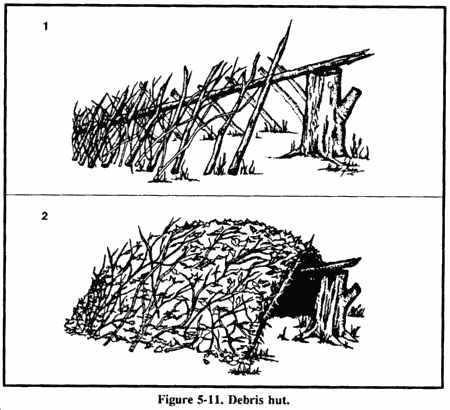
Debris Hut
For warmth and ease of construction, this shelter is one of the best. When shelter is essential to survival, build this shelter.
To make a debris hut (Figure 5-11)--
- Build it by making a tripod with two short stakes and a long ridgepole or by placing one end of a long ridgepole on top of a sturdy base.
- Secure the ridgepole (pole running the length of the shelter) using the tripod method or by anchoring it to a tree at about waist height.
- Prop large sticks along both sides of the ridgepole to create a wedge-shaped ribbing effect. Ensure the ribbing is wide enough to accommodate your body and steep enough to shed moisture.
- Place finer sticks and brush crosswise on the ribbing. These form a latticework that will keep the insulating material (grass, pine needles, leaves) from falling through the ribbing into the sleeping area.
- Add light, dry, if possible, soft debris over the ribbing until the insulating material is at least 1 meter thick--the thicker the better.
- Place a 30-centimeter layer of insulating material inside the shelter.
- At the entrance, pile insulating material that you can drag to you once inside the shelter to close the entrance or build a door.
- As a final step in constructing this shelter, add shingling material or branches on top of the debris layer to prevent the insulating material from blowing away in a storm.
Source: http://www.wilderness-survival.net/shelters-2.php
Word Wall
Here are five vocabulary words to teach and add to the Word Wall.
|
festooned |
roused |
abyss |
vicissitudes |
declivities |
Read
Review
Review the timeline from the beginning every day.
Read
Read the selection, usually in a Shared Reading Read React Predict Cycle of 2-3 pages.
Read p. 48-57
|
Setting |
Characters |
Pages |
|
the forest |
Jack |
48-49 |
|
the lagoon |
Jack, Ralph |
49-55 |
|
the forest |
Simon, Jack, Ralph |
55-57 |
Respond
Timeline
Agree on the facts in today’s reading and list the 3-5 most important on the timeline.
Students might mention:
- Jack hunts a pig, but is unsuccessful.
- The boys start building huts by the lagoon.
- Jack and Ralph argue about what is more important, fire or shelter.
- Simon goes to explore the forest.
Map
Add to ongoing class activities like a KWL chart or map: where did the characters go?
The Lord of the Flies is an allegory. Complete this symbolism chart to discuss hot different objects and characters represent something else.
Civilization vs. Savagery Poster:
Collaborate with students create a class T Chart. This can be a live, online document that students have shared access to (Google Document or Google Spreadsheet).
- Label one column “Civilization” and the other side “Savagery”.
- At the end of each reading or at the end of the week write down which ideas, behaviors, and decisions are civilized/moral/disciplined and which ideas, behaviors, and decisions are wild/brutal/barbaric.
Explore
Activity
Explore the reading more deeply with a visual or oral language activity.
Fill out the Venn Diagram Box
- Compare Jack’s and Ralph’s leadership styles. Describe Jack’s leadership style in one circle. Describe Ralph’s leadership style in the other circle.
- Where the 2 circles overlap, write the way these two are alike.
- Where the circles are distinct, write down how each is different.
Discussion
Ask discussion questions of all 9 types (see Day 1).
Key Questions
- Why do you think Jack has a “compulsion to track down and kill”?
- How is he becoming more savage?
- What is more important for the boys' survival, fire or shelter? Why?
- Why do the boys remember the first day on the island as “glamorous”? What was glamorous about that day?
- Why aren’t all of the boys helping with the huts and the fire?
- What is the difference of hunting or being hunted? How do these feelings differ?
- What efforts are the boys making to be rescued?
- What efforts are the boys making to survive for a longer period of time on the island?
- What do you predict will happen next?
Analyze
Analyze the key paragraph.
Key Paragraph pg. 53
“ ‘If you’re hunting sometimes you catch yourself feeling as if—’ He flushed suddenly. ‘There’s nothing in it of course. Just a feeling. But you can feel as if you’re not hunting, but—being hunted, as if something’s behind you all the time in the jungle.”
Extend
Write
Have each student write a short product based on today’s prompt to connect to the unit theme.
Write a narrative paragraph describing why you think the boys should take their situation more seriously if they want to be rescued? Describe why they too dependent on the idea that they will be rescued? Explain the significant danger of being stranded on an island and the importance of being rescued.
Close
Close by extending today’s lesson to life and the world.
- Would you rather be rescued or survive on the island?
- Describe a time when you needed help from a police officer or emergency official.
Day 6
Outcomes for Today
W3. Write narratives to develop real or imagined experiences or events using effective technique, relevant descriptive details, and well-structured event sequences.
a.) Engage and orient the reader by establishing a context and point of view and introducing a narrator and/or characters; organize an event sequence that unfolds naturally and logically.
b.) Use narrative techniques, such as dialogue, pacing, and description, to develop experiences, events, and/or characters.
c.) Use a variety of transition words, phrases, and clauses to convey sequence and signal shifts from one frame to another.
d.) Use precise words and phrases, relevant descriptive details, and sensory language to capture the action and convey experiences and events.
e.) Provide a conclusion that follows from and reflects on the narrated experiences or events.
Prepare
Background
Gather background knowledge about a place, time, event, person, or thing.
What is a sundial?
The sundial is the earliest type of timekeeping device, which indicates the time of day by the position of the shadow of some object exposed to the Sun's rays. As the day progresses, the Sun moves across the sky, causing the shadow of the object to move and indicating the passage of time.
Source: http://dictionary.reference.com/browse/sundial
Word Wall
Here are five vocabulary words to teach and add to the Word Wall.
|
blatant |
chastisement |
incursion |
detritus |
sinewy |
Read
Review
Review the timeline from the beginning every day.
Read
Read the selection, usually in a Shared Reading Read React Predict Cycle of 2-3 pages.
Read p. 58-67
|
Setting |
Characters |
Pages |
|
the island |
the boys, Maurice, Roger, Henry, Simon |
58-64 |
|
the bathing pool |
Ralph, Simon, Maurice, Piggy |
64-67 |
Respond
Timeline
Agree on the facts in today’s reading and list the 3-5 most important on the timeline.
Students might mention:
- Roger watches the younger boys.
- Jack rubs charcoal on his face as a mask for hunting.
- Piggy suggests making a sundial, but the other boys turn it down.
- Piggy sees smoke and thinks it’s a ship. The boys run to see if the signal fire is still burning, but it’s dead.
Map
Add to ongoing class activities like a KWL chart or map: where did the characters go?
The Lord of the Flies is an allegory. Complete this symbolism chart to discuss hot different objects and characters represent something else.
Civilization vs. Savagery Poster:
Collaborate with students create a class T Chart. This can be a live, online document that students have shared access to (Google Document or Google Spreadsheet).
- Label one column “Civilization” and the other side “Savagery”.
- At the end of each reading or at the end of the week write down which ideas, behaviors, and decisions are civilized/moral/disciplined and which ideas, behaviors, and decisions are wild/brutal/barbaric.
Explore
Activity
Explore the reading more deeply with a visual or oral language activity.
Students will complete series of charts that will help them to gain a better grasp on the characters, setting, and themes of the novel.
Introduction: Students will complete charts that will help them give more in-depth thought to the important elements of the novel.
Materials:
- Venn Diagram Chart
- Setting Chart
- Character Interaction Chart
Activity:
- Introduce the activity
- Hand out materials
After completing today’s reading, students should work on a Venn Diagram Chart that compares their old life with their new life on the island. Students should label each circle with “Old life” and “New life”, and the overlap in the middle will be where the students include elements that are similar between their old lives and their new lives. This will help the students to understand how different life on the island is on the island, as opposed to their old life.
Students will complete series of charts that will help them to gain a better grasp on the characters, setting, and themes of the novel.
Introduction: Students will complete charts that will help them give more in-depth thought to the important elements of the novel.
Materials:
- Venn Diagram Chart
- Setting Chart
- Character Interaction Chart
Activity:
- Introduce the activity
- Hand out materials
After completing today’s reading, students should work on a Venn Diagram Chart that compares their old life with their new life on the island. Students should label each circle with “Old life” and “New life”, and the overlap in the middle will be where the students include elements that are similar between their old lives and their new lives. This will help the students to understand how different life on the island is on the island, as opposed to their old life.
Discussion
Ask discussion questions of all 9 types (see Day 1).
Key Questions
- Do you think it is dangerous for the boys to give up the hope of being rescued? Why or why not?
- Why do the “littluns” obey Ralph?
- What does he represent to them?
- Why does Maurice feel bad for doing something bad even though there are no parents to watch or punish him?
- What is the “old life” that the boys think about?
- How do the boys change when they put on the masks?
- Why do they become something different?
- Why does Piggy suggest making a sundial? Why is this idea turned down?
- Describe the frustration of the fire being dead.
Analyze
Analyze the key paragraph.
Key Paragraph - pg. 58
“The first rhythm that they became used to was the slow swing from dawn to quick dusk. They accepted the pleasures of morning, the bright sun, the whelming sea and sweet air, as a time when play was good and life so full that hope was not necessary and therefore forgotten. Toward noon, as the floods of light fell more nearly to the perpendicular, the stark colors of the morning were smoothed in pearl and opalescence; and the heat—as though the impending sun’s height gave it momentum—became a blow that they ducked, running to the shade and lying there, perhaps even sleeping.”
Extend
Write
Have each student write a short product based on today’s prompt to connect to the unit theme.
Write a narrative paragraph about the boys on the island.
When answering the question above, consider the following:
- Do you think they should be more focused on their survival, or is it okay that they just want to hunt and have fun?
- Do you think their rescue is inevitable?
- Is Piggy useless or is he the only one who really seems to care about rescue and survival?
- Is Piggy too serious about their situation, or is he right to be worried about rescue and survival?
Close
Close by extending today’s lesson to life and the world.
- Describe a time when you went camping.
- What were some of the challenges of living away from your house?
Day 7
Outcomes for Today
W3. Write narratives to develop real or imagined experiences or events using effective technique, relevant descriptive details, and well-structured event sequences.
a.) Engage and orient the reader by establishing a context and point of view and introducing a narrator and/or characters; organize an event sequence that unfolds naturally and logically.
b.) Use narrative techniques, such as dialogue, pacing, and description, to develop experiences, events, and/or characters.
c.) Use a variety of transition words, phrases, and clauses to convey sequence and signal shifts from one frame to another.
d.) Use precise words and phrases, relevant descriptive details, and sensory language to capture the action and convey experiences and events.
e.) Provide a conclusion that follows from and reflects on the narrated experiences or events.
Prepare
Background
Gather background knowledge about a place, time, event, person, or thing.
Who is the author
William Golding's parents brought him up to be a scientist. But he always had an interest in reading and writing, and at Oxford University he shifted from the sciences to literature. Golding fought in World War II, and was involved in the D-Day landing at Normandy. His experience in the war greatly influenced his views of human nature. After the war, he began writing novels in addition to teaching. Lord of the Flies was Golding's first novel, published in 1954, and was a critically acclaimed bestseller in both England and the United States. Though Golding never again achieved the same commercial success, he continued to write and went on to publish many more novels, including The Scorpion God (1971), Darkness Visible (1979), and Fire Down Below (1989). He won the Nobel Prize for literature in 1983 and died in 1993.
Source: http://www.litcharts.com/lit/lord-of-the-flies
Word Wall
Here are five vocabulary words to teach and add to the Word Wall.
|
vaguely |
hoarsely |
somber |
malevolently |
parody |
Read
Review
Review the timeline from the beginning every day.
Read
Read the selection, usually in a Shared Reading Read React Predict Cycle of 2-3 pages.
Read p. 67-75
|
Setting |
Characters |
Pages |
|
the fire |
Ralph, Simon, Maurice, Piggy, Jack |
67-75 |
Respond
Timeline
Agree on the facts in today’s reading and list the 3-5 most important on the timeline.
Students might mention:
- The fire goes out and the ship is out of sight.
- Jack caught and killed a pig.
- Jack and Ralph argue over the importance of the fire.
- Jack attacks Piggy and breaks his glasses.
- The boys cook the pig.
- Ralph blows the conch and calls an assembly.
Map
Add to ongoing class activities like a KWL chart or map: where did the characters go?
The Lord of the Flies is an allegory. Complete this symbolism chart to discuss hot different objects and characters represent something else.
Civilization vs. Savagery Poster:
Collaborate with students create a class T Chart. This can be a live, online document that students have shared access to (Google Document or Google Spreadsheet).
- Label one column “Civilization” and the other side “Savagery”.
- At the end of each reading or at the end of the week write down which ideas, behaviors, and decisions are civilized/moral/disciplined and which ideas, behaviors, and decisions are wild/brutal/barbaric.
Explore
Activity
Explore the reading more deeply with a visual or oral language activity.
Students will complete a Venn Diagram Chart comparing kids and adults. Because the island is filled with children, Piggy is always wishing that there were adults around. This diagram will help students to understand the differences between kids and adults. One circle should be marked “Kids” and the other should be marked “Adults”. The overlap will be where students discuss the similarities between the two groups.
Discussion
Ask discussion questions of all 9 types (see Day 1).
Key Questions
- Do you think this incident made the boys take rescue more seriously?
- Why doesn’t Ralph apologize to Jack?
- How does Ralph assert his power over the other boys?
- Why won’t Jack give Piggy any of the meat?
- How might Jack breaking Piggy’s glasses foreshadow of future events?
- How does Jack show responsibility in this chapter? How does he fail to take responsibility?
- Why is Jack so possessive of the pig?
- Why do you think Ralph is calling an assembly? What does he want to talk to the boys about?
- Why do the boys like to reenact the pig hunt?
Analyze
Analyze the key paragraph.
Key Paragraph - pg. 70
“He noticed Ralph’s scarred nakedness, and the somber silence of all four of them. He sought, charitable in his happiness, to include them in the thing that had happened. His mind was crowded with memories; memories of the knowledge that had come to them when they closed in on the struggling pig, knowledge that they had outwitted a living thing, imposed their will upon it, taken away its life like a long satisfying drink.”
Extend
Write
Have each student write a short product based on today’s prompt to connect to the unit theme.
Write a narrative paragraph about Jack’s hunt of the pig.
When answering the question above, consider the following:
- Why is killing the pig so satisfying for Jack?
- Why does he enjoy taking the life of another creature?
- What clues show us that Jack might be changing?
- How is this hunt different from the first hunt when Jack hesitates?
Close
Close by extending today’s lesson to life and the world.
- Describe a time when you made a big feast?
- What were you celebrating?
Day 8
Outcomes for Today
W3. Write narratives to develop real or imagined experiences or events using effective technique, relevant descriptive details, and well-structured event sequences.
a.) Engage and orient the reader by establishing a context and point of view and introducing a narrator and/or characters; organize an event sequence that unfolds naturally and logically.
b.) Use narrative techniques, such as dialogue, pacing, and description, to develop experiences, events, and/or characters.
c.) Use a variety of transition words, phrases, and clauses to convey sequence and signal shifts from one frame to another.
d.) Use precise words and phrases, relevant descriptive details, and sensory language to capture the action and convey experiences and events.
e.) Provide a conclusion that follows from and reflects on the narrated experiences or events.
Prepare
Background
Gather background knowledge about a place, time, event, person, or thing.
How are the boys able to use Piggy’s glasses to start a fire? What are other ways that they could start a fire on the island?
It Only Takes a Spark
You have your fire pit and a nice collection of wood. The only thing between you and a nice evening roasting s'mores is a spark. There are many "primitive" methods for starting a fire, and some are easier than others. Patience and calm are good practices to employ when attempting to start your fire. The following are techniques you can use with items found or on-hand.
Lens Method -- this technique involves using a magnifying glass on a sunny day. You can also use a disassembled camera lens or binoculars:
- Pile some tinder in the center of the fire pit.
- Hold the lens about a foot from the tinder.
- Angle the lens so the sun concentrates a small hot spot.
- The starter should begin to smolder very quickly.
- Blow on the tinder to ignite it and place small kindling twigs until the fire is stable.
Battery Method -- if you're stranded with your car or find wreckage from a boat or plane, you can use the battery to create your spark:
- Find some wire from the car or wreckage -- any engine wire will work.
- Attach two pieces of wire to each battery terminal.
- Get your tinder and touch the wires together above it.
- This should create a spark and the tinder will smolder.
- Pick the tinder up and blow on it.
- Once it lights, quickly transfer it to your fire pit and add small kindling.
Soda Can and Chocolate Method -- because many people fail to pack out their refuse, chances are you can find a soda can in the woods. If you have some chocolate, toothpaste or powdered cleanser on hand, use this method:
- Smear some chocolate or an abrasive onto the bottom of the soda can.
- Use the wrapper or some cloth to rub it into the can to polish it.
- Add more chocolate as needed and continue to rub for about 30 minutes.
- Wash the abrasive off the can with some water. Your goal is a shiny, reflective surface.
- Once you have a good surface, angle the can toward the sun and hold a piece of tinder about an inch away from the center of the can.
- Like a convex lens, the can will produce a concentrated hot spot and your tinder will begin to smolder.
- Gently blow on the tinder until it ignites and quickly transfer it to your fire pit.
WARNING -- do not eat the used chocolate or toothpaste. It contains aluminum and is highly toxic
Source: http://adventure.howstuffworks.com/survival/wilderness/how-to-start-a-fire2.htm
Word Wall
Here are five vocabulary words to teach and add to the Word Wall.
|
jeeringly |
untrodden |
apex |
testily |
derisive |
Read
Review
Review the timeline from the beginning every day.
Read
Read the selection, usually in a Shared Reading Read React Predict Cycle of 2-3 pages.
|
Setting |
Characters |
Pages |
|
the beach |
Ralph |
76 |
|
the assembly |
Ralph, the boys, Jack |
76-86 |
Respond
Timeline
Agree on the facts in today’s reading and list the 3-5 most important on the timeline.
Students might mention:
- Ralph calls an assembly.
- Ralph tells the boys that they need to follow through on their plans.
- Ralph says that the fire is the most important thing for their survival.
- Jack replies to Ralph’s speech.
Map
Add to ongoing class activities like a KWL chart or map: where did the characters go?
The Lord of the Flies is an allegory. Complete this symbolism chart to discuss hot different objects and characters represent something else.
Civilization vs. Savagery Poster:
Collaborate with students create a class T Chart. This can be a live, online document that students have shared access to (Google Document or Google Spreadsheet).
- Label one column “Civilization” and the other side “Savagery”.
- At the end of each reading or at the end of the week write down which ideas, behaviors, and decisions are civilized/moral/disciplined and which ideas, behaviors, and decisions are wild/brutal/barbaric.
Explore
Activity
Explore the reading more deeply with a visual or oral language activity.
After completing today’s reading, students will complete a Setting Chart for the setting of the novel to date. Students will include important details about the setting, including the time period, the location, the time, and the weather. The setting plays an important role in this novel, and it is important for the students to be aware of that.
Discussion
Ask discussion questions of all 9 types (see Day 1).
Key Questions
- How does Ralph begin to change?
- What does Ralph start to realize?
- Why isn’t Piggy a good leader?
- What makes a good leader?
- Do you think the fire is the most important thing?
- Why have things changed with the boys? How are they different from when they came to the island?
- What are the boys afraid of? Are there beasts?
- Is Ralph still a good leader?
- What do you predict will happen next?
Analyze
Analyze the key paragraph.
Key Paragraph pg. 76
“Ralph chose the firm strip as a path because he needed to think, and only here could he allow his feet to move without having to watch them. Suddenly, pacing by the water, he was overcome with astonishment. He found himself understanding the wearisomeness of this life, where every path was an improvisation and a considerable part of one’s waking life was spent watching one’s feet.”
Extend
Write
Have each student write a short product based on today’s prompt to connect to the unit theme.
Write a narrative paragraph explaining the boys’ fear of the beast.
When answering the question above, consider the following:
- Why is the idea of the beast so frightening to the boys if they don’t know if it really exists?
- Do you think they are afraid of the beast because they can’t see it?
- Do you think the idea of the beast is scarier than the beast itself?
- Why is the beast such an important issue for the boys on the island?
Close
Close by extending today’s lesson to life and the world.
- What are you afraid of?
- Why do you think you have this fear? Is it from a past experience? Do other people you admire have this same fear?
Day 9
Outcomes for Today
W3. Write narratives to develop real or imagined experiences or events using effective technique, relevant descriptive details, and well-structured event sequences.
a.) Engage and orient the reader by establishing a context and point of view and introducing a narrator and/or characters; organize an event sequence that unfolds naturally and logically.
b.) Use narrative techniques, such as dialogue, pacing, and description, to develop experiences, events, and/or characters.
c.) Use a variety of transition words, phrases, and clauses to convey sequence and signal shifts from one frame to another.
d.) Use precise words and phrases, relevant descriptive details, and sensory language to capture the action and convey experiences and events.
e.) Provide a conclusion that follows from and reflects on the narrated experiences or events.
Prepare
Background
Gather background knowledge about a place, time, event, person, or thing.
What are the developmental changes of children between the ages of 10-12 years of age?
- The age between ten and twelve is generally a time when children get a view of approaching adulthood.
- There are important physical and sexual changes for your child especially if she is a girl.
- Social relationships can be unsettled for girls and very competitive for boys.
- Activities, sports and clubs can help them to feel good about themselves and form safe relationships outside the family.
- Your children still need guidance and safe limits from you but they also need to be a little more independent.
Source: http://www.cyh.com/healthtopics/healthtopicdetails.aspx?p=114&np=122&id=1865
Word Wall
Here are five vocabulary words to teach and add to the Word Wall.
|
lamentation |
sough |
infinite |
perilous |
decorum |
Read
Review
Review the timeline from the beginning every day.
Read
Read the selection, usually in a Shared Reading Read React Predict Cycle of 2-3 pages.
Read p. 86-94
|
Setting |
Characters |
Pages |
|
the assembly |
Percival, Jack, Ralph, the other boys |
86-94 |
Respond
Timeline
Agree on the facts in today’s reading and list the 3-5 most important on the timeline.
Students might mention:
- Percival begins to cry and the other little boys starting crying too.
- Jack and Ralph talk to the other boys about the beasts.
- The little boys run away.
- Ralph thinks about giving up being chief, but Piggy convinces him to remain as chief.
Map
Add to ongoing class activities like a KWL chart or map: where did the characters go?
The Lord of the Flies is an allegory. Complete this symbolism chart to discuss hot different objects and characters represent something else.
Civilization vs. Savagery Poster:
Collaborate with students create a class T Chart. This can be a live, online document that students have shared access to (Google Document or Google Spreadsheet).
- Label one column “Civilization” and the other side “Savagery”.
- At the end of each reading or at the end of the week write down which ideas, behaviors, and decisions are civilized/moral/disciplined and which ideas, behaviors, and decisions are wild/brutal/barbaric.
Explore
Activity
Explore the reading more deeply with a visual or oral language activity.
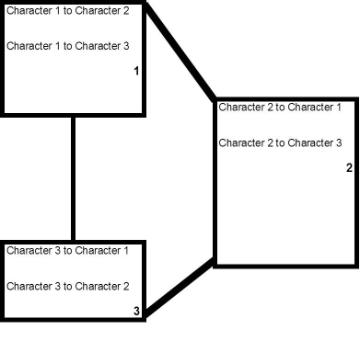
After completing today’s reading, students will begin to work on a Character Interaction Chart for Ralph, Jack, and Piggy. Students will analyze the interactions between those characters, including how the characters feel about one another, how they interact, and how they get along.
5g6 Character Interaction Chart
Discussion
Ask discussion questions of all 9 types (see Day 1).
Key Questions
- Why is Percival crying? Why do the other boys start crying too?
- Why does Jack keep denying the beast?
- Why is Ralph so focused on following the rules?
- Why does Jack say that Ralph favors Piggy? Do you agree?
- How do Jack and Ralph differ?
- Whose approach do you think will be more helpful to the boys?
- Why is Ralph afraid to blow the conch?
- On page 92, what does “We’ll soon be animals.” mean?
- Why does Ralph begin thinking about giving up his position as chief?
Analyze
Analyze the key paragraph.
Key Paragraph - pg. 92
“Ralph answered in the cautious voice of one who rehearses a theorem.
‘If I blow the conch and they don’t come back; then we’ve had it. We shan’t keep the fire going. We’ll be like animals. We’ll never be rescued.’
‘If you don’t blow, we’ll soon be animals anyway. I can’t see what they’re doing but I can hear.’”
Extend
Write
Have each student write a short product based on today’s prompt to connect to the unit theme.
Write three narrative paragraphs about Ralph as a leader and the characteristics of a responsible chief.
When answering the question above, consider the following:
- Do you think Ralph should have decided to give up being chief?
- Do you think that would be helpful to the boys?
- Who do you think would become the leader? Why?
- Would that person be a better leader than Ralph? Why?
- Would Piggy be a good replacement? Why or why not?
- Would Jack be a good replacement? Why or why not?
Close
Close by extending today’s lesson to life and the world.
- What characteristic do you have that make you a good leader?
- Describe a time when you were the leader in a group or in a school project.
Day 10
Outcomes for Today
W3. Write narratives to develop real or imagined experiences or events using effective technique, relevant descriptive details, and well-structured event sequences.
a.) Engage and orient the reader by establishing a context and point of view and introducing a narrator and/or characters; organize an event sequence that unfolds naturally and logically.
b.) Use narrative techniques, such as dialogue, pacing, and description, to develop experiences, events, and/or characters.
c.) Use a variety of transition words, phrases, and clauses to convey sequence and signal shifts from one frame to another.
d.) Use precise words and phrases, relevant descriptive details, and sensory language to capture the action and convey experiences and events.
e.) Provide a conclusion that follows from and reflects on the narrated experiences or events.
Prepare
Background
Gather background knowledge about a place, time, event, person, or thing.
What war is being fought when this story takes place?
World War II influenced the themes and setting of Lord of the Flies. The war changed the way people in general and William Golding in particular viewed the world. World War I was for many years called the War to End All Wars. World War II proved that idea wrong and created a new sense that people are inherently warlike, power hungry, and savage. While the world war raging in Lord of the Flies is not World War II, it can be viewed as Golding's version of World War III. Only a few brief references to the war outside the boys' island appear in the novel, but references to an atom bomb blowing up an airport and the "Reds" make it clear that the war involves nuclear weapons and places capitalist allies including the British against the communist "Reds."
Word Wall
Here are five vocabulary words to teach and add to the Word Wall.
|
bore |
fitful |
contours |
Yearning |
embroiled |
Read
Review
Review the timeline from the beginning every day.
Read
Read the selection, usually in a Shared Reading Read React Predict Cycle of 2-3 pages.
Rea p. 95-104
|
Setting |
Characters |
Pages |
|
the shelters |
Ralph, Piggy, Simon |
95-96 |
|
the fire |
The boys, the twins |
96-99 |
|
the assembly |
Ralph, Sam, Eric, Piggy, Jack |
99-103 |
|
the island |
Ralph, Jack, Simon, the boys |
103-105 |
Respond
Timeline
Agree on the facts in today’s reading and list the 3-5 most important on the timeline.
Students might mention:
- A parachuter lands on the island in the middle of the night.
- The younger boys tell Ralph that they saw a beast.
- The twins tell the story of seeing the beast.
- Jack calls for the boys to hunt the beast.
- The boys plan to go look for the beast.
Map
Add to ongoing class activities like a KWL chart or map: where did the characters go?
The Lord of the Flies is an allegory. Complete this symbolism chart to discuss hot different objects and characters represent something else.
Civilization vs. Savagery Poster:
Collaborate with students create a class T Chart. This can be a live, online document that students have shared access to (Google Document or Google Spreadsheet).
- Label one column “Civilization” and the other side “Savagery”.
- At the end of each reading or at the end of the week write down which ideas, behaviors, and decisions are civilized/moral/disciplined and which ideas, behaviors, and decisions are wild/brutal/barbaric.
Explore
Activity
Explore the reading more deeply with a visual or oral language activity.
Open Mind Portrait: Create an Open Mind Portrait of Ralph
Materials:
- large piece of stiff paper for each character, like 11x17 oak tag
- paper for bubbles with scissors and glue sticks
- markers, crayons, pens, pencils, or paint
- construction or tissue paper, scissors and glue sticks if desired
Step One: create a large head shot of the character
- Imagine what you think the character looks like from the descriptions in the text as well as your imagination. You can make a list of these details to help you draw the character, if you wish.
- Decide how much of the character you wish to show: just the head and face? from the shoulders up? from the waist up? the whole person? You might want to include at least the shoulders to include some clothing details. You might want to show the size differences between characters.
- Draw the characters head shot including the face on the large piece of paper. You could also cut the paper to form the head.
- Illustrate your portrait with colors, construction paper or whatever will make the character colorful.
Step Two: place cartoon bubbles of character thoughts around the portrait
- Cut cartoon bubbles out.
- Write things the character thinks, or says to himself, on each bubble.
- Put the bubbles up around the portrait.
Discussion
Ask discussion questions of all 9 types (see Day 1).
Key Questions
- Why doesn’t Ralph blow the conch?
- Why does Piggy stay while the others go on the hunt?
- Do you think that they boys should still use the conch?
- Are there negative consequences that could come from not using the conch?
- Why does Simon doubt the existence of the beast?
- Do you think Ralph likes being chief? Why or why not?
- What were Sam and Eric responsible for?
- Describe Ralph’s dream.
- What do you think will happen next?
Analyze
Analyze the key paragraph.
Key Paragraph pg. 98
“Ralph was dreaming. He had fallen asleep after what seemed hours of tossing and turning noisily among the dry leaves. Even the sounds of nightmare from the other shelters no longer reached him, for he was back to where he came from, feeding the ponies with sugar over the garden wall. Then someone was shaking his arm, telling him that it was time for tea.”
Extend
Write
Have each student write a short product based on today’s prompt to connect to the unit theme.
Write a 2-3 narrative paragraphs about the struggles and battles that are presented in this book.
When answering the question above, consider the following:
- What role does war play in this novel?
- Do they boys seem to be concerned with the war that is going on in the world?
- Is there a war going on among the boys on the island? If so, what is that war about?
- Are there struggles between characters and the morals of those characters?
Close
Close by extending today’s lesson to life and the world.
- Describe a time when you failed to fulfill your responsibilities?
- What was the consequence?
Day 11
Outcomes for Today
W3. Write narratives to develop real or imagined experiences or events using effective technique, relevant descriptive details, and well-structured event sequences.
a.) Engage and orient the reader by establishing a context and point of view and introducing a narrator and/or characters; organize an event sequence that unfolds naturally and logically.
b.) Use narrative techniques, such as dialogue, pacing, and description, to develop experiences, events, and/or characters.
c.) Use a variety of transition words, phrases, and clauses to convey sequence and signal shifts from one frame to another.
d.) Use precise words and phrases, relevant descriptive details, and sensory language to capture the action and convey experiences and events.
e.) Provide a conclusion that follows from and reflects on the narrated experiences or events.
Prepare
Background
Gather background knowledge about a place, time, event, person, or thing.
Where did the parachutist come from?
A dead parachutist floats down from the sky after military airplanes battle above the island. The parachute lands on rocks and creates a frightening shadow on the ground. The dead man’s head floats with the strength of the wind.
Word Wall
Here are five vocabulary words to teach and add to the Word Wall.
|
chasms |
leviathan |
plinth |
dun |
mutinously |
Read
Review
Review the timeline from the beginning every day.
Read
Read the selection, usually in a Shared Reading Read React Predict Cycle of 2-3 pages.
Read p. 104-114
|
Setting |
Characters |
Pages |
|
the island |
Ralph, Jack, Simon, the boys |
104-109 |
|
the jungle |
Ralph, Jack, Simon, the boys |
109-114 |
Respond
Timeline
Agree on the facts in today’s reading and list the 3-5 most important on the timeline.
Students might mention:
- Ralph goes to explore the bridge while the others wait.
- Jack joins Ralph to explore.
- The boys see smoke even though the fire is out.
- The boys hunt a pig.
- Ralph throws his spear at the pig.
Map
Add to ongoing class activities like a KWL chart or map: where did the characters go?
The Lord of the Flies is an allegory. Complete this symbolism chart to discuss hot different objects and characters represent something else.
Civilization vs. Savagery Poster:
Collaborate with students create a class T Chart. This can be a live, online document that students have shared access to (Google Document or Google Spreadsheet).
- Label one column “Civilization” and the other side “Savagery”.
- At the end of each reading or at the end of the week write down which ideas, behaviors, and decisions are civilized/moral/disciplined and which ideas, behaviors, and decisions are wild/brutal/barbaric.
Explore
Activity
Explore the reading more deeply with a visual or oral language activity.
This activity will help the students to better understand the events that happen in the story, and will also help students to understand the importance of the island in the novel.
Introduction: Students will create a map of the island in the novel, including all of the important places in the novel. The students will use the text to create an illustration of the island. Students will also note where important events have taken place.
Materials:
- Construction paper or white paper
- Scissors, glue
- Markers, pencils, pens, crayons
Activity:
- Introduce the activity
- Hand out materials
After completing today’s reading, students will begin to plan their map of the island. Students should use the text in their planning, trying to make a map that is as accurate as possible. Students should begin working on their map of the island.
Discussion
Ask discussion questions of all 9 types (see Day 1).
Key Questions
- Describe Ralph and Jack’s exploration of the bridge.
- Why does Jack come to help Ralph explore?
- Do you think the boys still respect Ralph or is he losing their respect?
- Why does Ralph say that the boys continue to wear their clothes?
- What does the ocean represent to Ralph?
- Why does Ralph finally have the chance to daydream while they’re hunting?
- Why does spearing the boar win respect from the boys?
- How does this change Ralph’s view of hunting?
- How are the boys holding onto their past?
Analyze
Analyze the key paragraph.
Key Paragraph pg. 107
“The others, waiting in the grass, saw Jack and Ralph unharmed and broke cover into the sunlight. They forgot the beast in the excitement of exploration. They swarmed across the bridge and soon were climbing and shouting. Ralph stood now, one hand against an enormous red block, a block large as a mill wheel that had been split off and hung, tottering. Somberly he watched the mountain. He clenched his fist and beat hammer-wise on the red wall at his right. His lips were tightly compressed and his eyes yearned beneath the fringe of hair.”
Extend
Write
Have each student write a short product based on today’s prompt to connect to the unit theme.
Write a 2-3 narrative paragraph about how the boys incorporate or reject things from their old lives.
When answering the question above, consider the following:
- How do habit, custom, and tradition from their old lives affect the boys on the island?
- Are they trying to hold on to things from the past, or are they trying to reject things from the past? Why or why not?
- Do you think that keeping things like rules and order will benefit the boys, or will they be better off if they abandon such things? Why or why not?
Close
Close by extending today’s lesson to life and the world.
- What customs are important to you?
- What custom would you like to start or create?
Day 12
Outcomes for Today
W3. Write narratives to develop real or imagined experiences or events using effective technique, relevant descriptive details, and well-structured event sequences.
a.) Engage and orient the reader by establishing a context and point of view and introducing a narrator and/or characters; organize an event sequence that unfolds naturally and logically.
b.) Use narrative techniques, such as dialogue, pacing, and description, to develop experiences, events, and/or characters.
c.) Use a variety of transition words, phrases, and clauses to convey sequence and signal shifts from one frame to another.
d.) Use precise words and phrases, relevant descriptive details, and sensory language to capture the action and convey experiences and events.
e.) Provide a conclusion that follows from and reflects on the narrated experiences or events.
Prepare
Background
Gather background knowledge about a place, time, event, person, or thing.
What can you eat to survive in the wild?
In a survival situation, you have to take advantage of everything available to eat. Most wilderness areas are full of natural food, ranging from plants to insects. The food sources you can exploit are determined by the habitat you are in. Vary your diet to make sure you get the appropriate proportions of fat, protein, carbohydrates, minerals and vitamins.
Meat and fish are good sources of protein and fat and provide virtually everything a long-term survivor would need. However, at the first stage of a survival situation, plants are the most appropriate diet as plants are easily accessible and contain the necessary carbohydrates.
Source: http://www.wilderness-survival-skills.com/survivalfood.html
Word Wall
Here are five vocabulary words to teach and add to the Word Wall.
|
ruefully |
clamber |
sagely |
mockery |
bravado |
Read
Review
Review the timeline from the beginning every day.
Read
Read the selection, usually in a Shared Reading Read React Predict Cycle of 2-3 pages.
Read p. 114-123
|
Setting |
Characters |
Pages |
|
the forest |
Robert, Ralph, Jack |
114-116 |
|
along the rocks |
Robert, Jack, the boys, Simon |
116-118 |
|
the pig-run |
Ralph, Jack, the boys, Roger |
118-120 |
|
the mountain |
Ralph, Jack, Roger |
120-123 |
Respond
Timeline
Agree on the facts in today’s reading and list the 3-5 most important on the timeline.
Students might mention:
- The boys play like Robert is a pig and they’re hunters.
- The boys keep going on their hunt for the beast.
- Simon volunteers to go back and tell Piggy that the other boys won’t be back until after dark.
- Jack goes to investigate the beast and tells Ralph and Roger that he saw something.
Map
Add to ongoing class activities like a KWL chart or map: where did the characters go?
The Lord of the Flies is an allegory. Complete this symbolism chart to discuss hot different objects and characters represent something else.
Civilization vs. Savagery Poster:
Collaborate with students create a class T Chart. This can be a live, online document that students have shared access to (Google Document or Google Spreadsheet).
- Label one column “Civilization” and the other side “Savagery”.
- At the end of each reading or at the end of the week write down which ideas, behaviors, and decisions are civilized/moral/disciplined and which ideas, behaviors, and decisions are wild/brutal/barbaric.
Explore
Activity
Explore the reading more deeply with a visual or oral language activity.
Open Mind Portrait: Create an Open Mind Portrait of Jack
Materials:
- large piece of stiff paper for each character, like 11x17 oak tag
- paper for bubbles with scissors and glue sticks
- markers, crayons, pens, pencils, or paint
- construction or tissue paper, scissors and glue sticks if desired
Step One: create a large head shot of the character
- Imagine what you think the character looks like from the descriptions in the text as well as your imagination. You can make a list of these details to help you draw the character, if you wish.
- Decide how much of the character you wish to show: just the head and face? from the shoulders up? from the waist up? the whole person? You might want to include at least the shoulders to include some clothing details. You might want to show the size differences between characters.
- Draw the characters head shot including the face on the large piece of paper. You could also cut the paper to form the head.
- Illustrate your portrait with colors, construction paper or whatever will make the character colorful.
Step Two: place cartoon bubbles of character thoughts around the portrait
- Cut cartoon bubbles out.
- Write things the character thinks, or says to himself, on each bubble.
- Put the bubbles up around the portrait.
Discussion
Ask discussion questions of all 9 types (see Day 1).
Key Questions
- Why do the boys get so carried away in their game with Robert?
- How have the boys become more violent?
- How do you think their violence will come into play in the future?
- What does Ralph mean when he says he’s going to make decisions like he’s playing chess?
- What does Ralph learn from Piggy?
- Why is Jack so intent on climbing up the mountain?
- What do you think he will find?
- What is Jack trying to prove?
- What is going on between Ralph and Jack as they climb the mountain?
Analyze
Analyze the key paragraph.
Key Paragraph pg. 122
“Now that his physical voice was silent, the inner voice of reason, and other voices too, made themselves heard. Piggy was calling him a kid. Another voice told him not to be a fool; and the darkness and desperate enterprise gave the night a kind of dentist’s chair unreality.”
Extend
Write
Have each student write a short product based on today’s prompt to connect to the unit theme.
Write a narrative paragraph about the conscious thoughts or as the author calls the inner voice of reason
When answering the question above, consider the following:
- What is the inner voice of reason that they talk about?
- Does everybody have an inner voice of reason that tells them the difference between right and wrong?
- Does the voice fade or change as the boys spend more time on the island? How?
Close
Close by extending today’s lesson to life and the world.
- Describe a time when you made a decision based on your inner voice of reason.
- Was it a good decision? Why?
Day 13
Outcomes for Today
W3. Write narratives to develop real or imagined experiences or events using effective technique, relevant descriptive details, and well-structured event sequences.
a.) Engage and orient the reader by establishing a context and point of view and introducing a narrator and/or characters; organize an event sequence that unfolds naturally and logically.
b.) Use narrative techniques, such as dialogue, pacing, and description, to develop experiences, events, and/or characters.
c.) Use a variety of transition words, phrases, and clauses to convey sequence and signal shifts from one frame to another.
d.) Use precise words and phrases, relevant descriptive details, and sensory language to capture the action and convey experiences and events.
e.) Provide a conclusion that follows from and reflects on the narrated experiences or events.
Prepare
Background
Gather background knowledge about a place, time, event, person, or thing.
What is a mutiny?
Mutiny is a situation in which a group of people (such as sailors or soldiers) refuse to obey orders and try to take control away from the person who commands them.
Source: http://www.merriam-webster.com/dictionary/mutiny
Word Wall
Here are five vocabulary words to teach and add to the Word Wall.
|
prefect |
expectantly |
rebuke |
sodden |
laden |
Read
Review
Review the timeline from the beginning every day.
Read
Read the selection, usually in a Shared Reading Read React Predict Cycle of 2-3 pages.
Read p. 124-133
|
Setting |
Characters |
Pages |
|
the beach |
Ralph, Piggy, Jack, Simon |
124-127 |
|
the assembly |
Ralph, Piggy, Simon |
128-129 |
|
the beach |
Ralph, Piggy, Simon, the boys |
129-132 |
|
the forest |
Simon |
132-133 |
Respond
Timeline
Agree on the facts in today’s reading and list the 3-5 most important on the timeline.
Students might mention:
- Ralph tells Piggy about the beast.
- Jack blows the conch and calls an assembly.
- Jack tries a mutiny, but no one agrees with him in front of Ralph.
- The boys plan to move the fire down to the beach.
- Piggy and Ralph see that Bill, Roger, and Maurice have left to join Jack.
Map
Add to ongoing class activities like a KWL chart or map: where did the characters go?
The Lord of the Flies is an allegory. Complete this symbolism chart to discuss hot different objects and characters represent something else.
Civilization vs. Savagery Poster:
Collaborate with students create a class T Chart. This can be a live, online document that students have shared access to (Google Document or Google Spreadsheet).
- Label one column “Civilization” and the other side “Savagery”.
- At the end of each reading or at the end of the week write down which ideas, behaviors, and decisions are civilized/moral/disciplined and which ideas, behaviors, and decisions are wild/brutal/barbaric.
Explore
Activity
Explore the reading more deeply with a visual or oral language activity.
Students should continue to work on their illustrations of the island. If students have finished their drawings, they should being to note the important events that have taken place on the island.
For example, students should note the assembly platform where the boys elected Ralph as chief. Students should note these locations as well as explain why these are significant moments in the novel.
Discussion
Ask discussion questions of all 9 types (see Day 1).
Key Questions
- What does the conch represent?
- Does it represent the same things that it did when they first arrived on the island?
- How is Ralph using the conch against Jack?
- Is Jack right about Ralph’s ability as a leader? Why or why not?
- How do you think Jack’s departure will affect the others?
- What do you think the boys should do about the beast?
- What does it mean that the greatest ideas are the simplest?
- Do you agree? Why or why not?
- What do you predict will happen next?
Analyze
Analyze the key paragraph.
Key Paragraph - pg. 129
“The greatest ideas are the simplest. Now that there was something to be done they worked with passion. Piggy was so full of delight and expanding liberty in Jack’s departure, so full or pride in his contribution to the good of society, that he helped to fetch wood.”
Extend
Write
Have each student write a short product based on today’s prompt to connect to the unit theme.
The island seems to provide the boys with everything that they need, but also completely terrifies them. What causes this? Write a narrative paragraph about the role of the island in the novel.
When answering the question above, consider the following:
- How does the island change at night?
- What bring these changes - the darkness, the boys’ imagination, or both?
- Does the island make the boys more savage, or do they do that themselves?
Close
Close by extending today’s lesson to life and the world.
- What advice would you give to Ralph?
- What advice would you give to Jack?
Day 14
Outcomes for Today
W3. Write narratives to develop real or imagined experiences or events using effective technique, relevant descriptive details, and well-structured event sequences.
a.) Engage and orient the reader by establishing a context and point of view and introducing a narrator and/or characters; organize an event sequence that unfolds naturally and logically.
b.) Use narrative techniques, such as dialogue, pacing, and description, to develop experiences, events, and/or characters.
c.) Use a variety of transition words, phrases, and clauses to convey sequence and signal shifts from one frame to another.
d.) Use precise words and phrases, relevant descriptive details, and sensory language to capture the action and convey experiences and events.
e.) Provide a conclusion that follows from and reflects on the narrated experiences or events.
Prepare
Background
Gather background knowledge about a place, time, event, person, or thing.
Why do you think this book is called Lord of the Flies?
The phrase "lord of the flies" is a translation of the Greek "Beelzebub," a devil mentioned in the New Testament. In the Bible, Beelzebub sometimes seems to be Satan himself, and at other times seems to be Satan's most powerful lieutenant.
Source: http://www.litcharts.com/lit/lord-of-the-flies
Word Wall
Here are five vocabulary words to teach and add to the Word Wall.
|
demonic |
drove |
reeking |
vivid |
taboo |
Read
Review
Review the timeline from the beginning every day.
Read
Read the selection, usually in a Shared Reading Read React Predict Cycle of 2-3 pages.
Read p. 133-144
|
Setting |
Characters |
Pages |
|
the beach |
Jack, the boys |
133 |
|
the forest |
Jack, the boys |
133-137 |
|
the forest |
Simon |
137-138 |
|
the beach |
Ralph, Piggy |
138-142 |
|
the forest |
Simon, the Lord of the Flies |
143-144 |
Respond
Timeline
Agree on the facts in today’s reading and list the 3-5 most important on the timeline.
Students might mention:
- Jack announces himself as chief of the new tribe.
- Jack and his group go hunting and kill a sow.
- Simon finds the head of the dead sow.
- Jack and his group raid Ralph’s group and steal fire.
- Simon talks to the Lord of the Flies.
Map
Add to ongoing class activities like a KWL chart or map: where did the characters go?
The Lord of the Flies is an allegory. Complete this symbolism chart to discuss hot different objects and characters represent something else.
Civilization vs. Savagery Poster:
Collaborate with students create a class T Chart. This can be a live, online document that students have shared access to (Google Document or Google Spreadsheet).
- Label one column “Civilization” and the other side “Savagery”.
- At the end of each reading or at the end of the week write down which ideas, behaviors, and decisions are civilized/moral/disciplined and which ideas, behaviors, and decisions are wild/brutal/barbaric.
Explore
Activity
Explore the reading more deeply with a visual or oral language activity.
Open Mind Portrait: Create an Open Mind Portrait of Piggy
Materials:
- large piece of stiff paper for each character, like 11x17 oak tag
- paper for bubbles with scissors and glue sticks
- markers, crayons, pens, pencils, or paint
- construction or tissue paper, scissors and glue sticks if desired
Step One: create a large head shot of the character
- Imagine what you think the character looks like from the descriptions in the text as well as your imagination. You can make a list of these details to help you draw the character, if you wish.
- Decide how much of the character you wish to show: just the head and face? from the shoulders up? from the waist up? the whole person? You might want to include at least the shoulders to include some clothing details. You might want to show the size differences between characters.
- Draw the characters head shot including the face on the large piece of paper. You could also cut the paper to form the head.
- Illustrate your portrait with colors, construction paper or whatever will make the character colorful.
Step Two: place cartoon bubbles of character thoughts around the portrait
- Cut cartoon bubbles out.
- Write things the character thinks, or says to himself, on each bubble.
- Put the bubbles up around the portrait.
Discussion
Ask discussion questions of all 9 types (see Day 1).
Key Questions
- Why do the boys still wear the black caps?
- Why does Jack just want to forget the beast?
- Why does Jack say that he’ll lure the boys away from the conch instead of away from Ralph?
- Are Jack and his group afraid of the forest? Why or why not?
- What is the Lord of the Flies? Why is this the title of the novel?
- Why does Ralph want to think like a grown-up?
- Why don’t the other boys understand the importance of the fire?
- Why did Piggy think Jack would want to take the conch?
- What is happening to Simon?
Analyze
Analyze the key paragraph.
Key Paragraph - pg. 139
“‘I’m scared.’
He saw Piggy look up; and blundered on.
‘Not of the beast. I mean I’m scared of that too. But nobody else understands about the fire. If someone threw you a rope when you were drowning. If a doctor said take this because if you don’t take it you’ll die—you would, wouldn’t you? I mean?’”
Extend
Write
Have each student write a short product based on today’s prompt to connect to the unit theme.
Write a narrative paragraph about Jack’s transformation.
When answering the question above, consider the following:
- Why does Jack feel safe from shame behind the paint?
- Why does Jack feel as though he can hide behind the paint, even though everyone still knows that it’s he?
- How does wearing the paint change Jack?
Close
Close by extending today’s lesson to life and the world.
- Have you ever had an experience like this where you feel power from becoming someone you are not?
- Why do you think you felt this way?
Day 15
Outcomes for Today
W3. Write narratives to develop real or imagined experiences or events using effective technique, relevant descriptive details, and well-structured event sequences.
a.) Engage and orient the reader by establishing a context and point of view and introducing a narrator and/or characters; organize an event sequence that unfolds naturally and logically.
b.) Use narrative techniques, such as dialogue, pacing, and description, to develop experiences, events, and/or characters.
c.) Use a variety of transition words, phrases, and clauses to convey sequence and signal shifts from one frame to another.
d.) Use precise words and phrases, relevant descriptive details, and sensory language to capture the action and convey experiences and events.
e.) Provide a conclusion that follows from and reflects on the narrated experiences or events.
Prepare
Background
Gather background knowledge about a place, time, event, person, or thing.
What are the spiritual allusions in this novel?
Most of the boys on the island either hide behind civilization, denying the beast's existence, or succumb to the beast's power by embracing savagery. But in Lord of the Flies, Golding presents an alternative to civilized suppression and beastly savagery. This is a life of religion and spiritual truth-seeking, in which men look into their own hearts, accept that there is a beast within, and face it squarely.
Simon occupies this role in Lord of the Flies, and in doing so he symbolizes all the great spiritual and religious men, from Jesus to Buddha to nameless mystics and shamans, who have sought to help other men accept and face the terrible fact that the beast they fear is themselves. Of all the boys, only Simon fights through his own fear to discover that the "beast" at the mountaintop is just a dead man. But when Simon returns with the news that there's no real beast, only the beast within, the other boys kill him. Not just the savages, not just the civilized boys—all the boys kill Simon, because all of the boys lack the courage Simon displayed in facing the beast.
Source: http://www.litcharts.com/lit/lord-of-the-flies/themes
Word Wall
Here are five vocabulary words to teach and add to the Word Wall.
|
brassy |
glum |
interspersed |
toiled |
abominable |
Read
Review
Review the timeline from the beginning every day.
Read
Read the selection, usually in a Shared Reading Read React Predict Cycle of 2-3 pages.
Read p. 149-150
|
Setting |
Characters |
Pages |
|
the forest |
Simon |
145-147 |
|
the bathing pool |
Ralph, Piggy |
147-148 |
|
the beach |
Ralph, Piggy, Jack, the boys |
148-154 |
Respond
Timeline
Agree on the facts in today’s reading and list the 3-5 most important on the timeline.
Students might mention:
- Simon passes out by the pig’s head, then wakes up.
- Simon encounters the beast and reveals its true identity.
- Ralph and Piggy come to Jack’s tribe during their feast.
- The storm starts and Jack’s tribe starts dancing.
- Simon comes out of the forest and the boys think he is the beast and attack him.
Map
Add to ongoing class activities like a KWL chart or map: where did the characters go?
The Lord of the Flies is an allegory. Complete this symbolism chart to discuss hot different objects and characters represent something else.
Civilization vs. Savagery Poster:
Collaborate with students create a class T Chart. This can be a live, online document that students have shared access to (Google Document or Google Spreadsheet).
- Label one column “Civilization” and the other side “Savagery”.
- At the end of each reading or at the end of the week write down which ideas, behaviors, and decisions are civilized/moral/disciplined and which ideas, behaviors, and decisions are wild/brutal/barbaric.
Explore
Activity
Explore the reading more deeply with a visual or oral language activity.
Continue OMP for Ralph, Jack, and Piggy by adding bubbles as you learn new things about the character
- Read the story further and identify new things you have learned about the character, or ways the character has changed.
Follow step 2 to create and place additional bubbles
Discussion
Ask discussion questions of all 9 types (see Day 1).
Key Questions
- Based on the title of the chapter, what do you think this chapter will be about?
- What does Simon discover about the beast?
- Describe Simon’s characteristics and how they differ from the rest of the boys.
- What is so appealing to the boys about Jack’s tribe?
- Do you think Jack will abuse his new power? Why or why not?
- What kind of society has Jack’s tribe created?
- How is it more savage than Ralph’s?
- What happened to Simon? Why do the boys attack him?
- How does Jack use fear to control the other boys?
Analyze
Analyze the key paragraph.
Key Paragraph - pg. 149-150
“His tone conveyed a warning, given out of the pride of ownership, and the boys ate faster while there was still time. Seeing there was no immediate likelihood of a pause, Jack rose from the log that was his throne and sauntered to the edge of the grass. He looked down from behind his paint at Ralph and Piggy. They moved a little farther off over the sand and Ralph watched the fire as he ate. He noticed, without understanding, how the flames were visible now against the dull light. Evening was come, not with calm beauty but with the threat of violence.”
Extend
Write
Have each student write a short product based on today’s prompt to connect to the unit theme.
Write a narrative paragraph explaining whether or not evil lies in every human heart?
When answering the question above, consider the following:
Do you think that all of the boys on the island are evil?
Provide evidence from the text that proves that there is evil in every human heart?
Explain whether or not there are any exceptions to this evil?
Are you permanently an evil person, if you do an evil thing?
Close
Close by extending today’s lesson to life and the world.
- Describe a time when you faced a fear?
- How can you confront a current fear?
Day 16
Outcomes for Today
W3. Write narratives to develop real or imagined experiences or events using effective technique, relevant descriptive details, and well-structured event sequences.
a.) Engage and orient the reader by establishing a context and point of view and introducing a narrator and/or characters; organize an event sequence that unfolds naturally and logically.
b.) Use narrative techniques, such as dialogue, pacing, and description, to develop experiences, events, and/or characters.
c.) Use a variety of transition words, phrases, and clauses to convey sequence and signal shifts from one frame to another.
d.) Use precise words and phrases, relevant descriptive details, and sensory language to capture the action and convey experiences and events.
e.) Provide a conclusion that follows from and reflects on the narrated experiences or events.
Prepare
Background
Gather background knowledge about a place, time, event, person, or thing.
What are the power dynamics on the island?
Within the larger battle of civilization and savagery ravaging the boys's community on the island, Lord of the Flies also depicts in great detail the relationships and power dynamics between the boys. In particular, the novel shows how boys fight to belong and be respected by the other boys. The main way in which the boys seek this belonging and respect is to appear strong and powerful. And in order to appear strong and powerful, boys give in to the savage instinct to ignore, pick on, mock, or even physically abuse boys who are weaker than them. Over and over, Lord of the Flies shows instances where a boy who feels vulnerable will save himself by picking on a weaker boy.
Source: http://www.litcharts.com/lit/lord-of-the-flies/themes
Word Wall
Here are five vocabulary words to teach and add to the Word Wall.
|
befouled |
loathing |
stifled |
assimilating |
theological |
Read
Review
Review the timeline from the beginning every day.
Read
Read the selection, usually in a Shared Reading Read React Predict Cycle of 2-3 pages.
Read p. 155-164
|
Setting |
Characters |
Pages |
|
the beach |
Ralph, Piggy, the twins |
155-158 |
|
the rocks |
Roger |
158 |
|
the beach |
Roger, Jack, Jack’s tribe |
158-161 |
|
the beach |
Ralph, Piggy, Sam, Eric |
162-164 |
Respond
Timeline
Agree on the facts in today’s reading and list the 3-5 most important on the timeline.
Students might mention:
- Piggy talks to Ralph about Simon.
- Roger comes to Jack’s tribe.
- Jack plans another hunt and feast.
- Jack plans to steal fire from Piggy and Ralph.
- Ralph and Piggy try to figure out how to keep the fire going.
Map
Add to ongoing class activities like a KWL chart or map: where did the characters go?
The Lord of the Flies is an allegory. Complete this symbolism chart to discuss hot different objects and characters represent something else.
Civilization vs. Savagery Poster:
Collaborate with students create a class T Chart. This can be a live, online document that students have shared access to (Google Document or Google Spreadsheet).
- Label one column “Civilization” and the other side “Savagery”.
- At the end of each reading or at the end of the week write down which ideas, behaviors, and decisions are civilized/moral/disciplined and which ideas, behaviors, and decisions are wild/brutal/barbaric.
Explore
Activity
Explore the reading more deeply with a visual or oral language activity.
Variations of this Open Mind Portrait for Ralph, Jack, and Piggy.
- You can use this process for any character in the story
- You can use bubbles for what the character says, says to himself or herself, or does. You could make each of these different colors if you wish.
- You could add bubbles for what the character learns, or ways the character changes, and use different colors for each.
- You could use different colors for the beginning, middle and end of the story. Remember in the beginning you are introduced to the setting, the characters and the problems they have. In the middle you learn about the roadblocks to the characters solving their problems, and conflicts occur. In the end of the story those conflicts reach a peak and then resolve with a resolution of the character’s problems.
- You could use different colors for the phases you see in a story or the development of a particular character.
- Instead of using bubbles you could write the bubble contents on the back of the portrait. You could use any of the variations above with color or print, or create columns or boxes for different categories or phases.
- You could literally open the head like a hinge and list the contents [as though they were escaping from the space] using any of these variations.
- You could make an Open Mind Portrait of yourself using any of the above variations.
Discussion
Ask discussion questions of all 9 types (see Day 1).
Key Questions
- Why does Ralph laugh when Piggy says that he’s still chief because he has the conch?
- Why has the conch lost its power?
- Why is Piggy trying to separate himself and Ralph from the other boys?
- Why does Ralph say that what happened to Simon was an accident?
- What happened to the boys to make them attack Simon?
- Why do Ralph and the twins deny and avoid talking about the feast?
- Why is Jack’s tribe full of savagery?
- What does the significance of the fire? What does fire symbolize?
- What do you predict will happen during the next hunt and feast?
Analyze
Analyze the key paragraph.
Key Paragraph - pg. 163
“He held out his hand and twisted the fingers into a fist.
‘There’s only one thing we can do to get out of this mess. Anyone can play at hunting, anyone can get us meat—'
He looked from face to face. Then, at the moment of greatest passion and conviction, that curtain flapped in his head and he forgot what he had been driving at. He knelt there, his fist clenched, gazing solemnly from one to the other. Then the curtain whisked back.”
Extend
Write
Have each student write a short product based on today’s prompt to connect to the unit theme.
Write a paragraph explaining the consequences and problems with irresponsible authority.
When answering the question above, consider the following:
- What does Ralph mean when he talks about irresponsible authority?
- Who is Ralph talking about?
- What makes a leader irresponsible?
- Are there any examples from your own life of someone who uses authority in an irresponsible way?
- Is that an abuse of power? Why or why not?
Close
Close by extending today’s lesson to life and the world.
- How can we hold our leaders (teachers, parents, and politicians) responsible for their power?
- Explain an example of someone abusing their power.
Day 17
Outcomes for Today
W3. Write narratives to develop real or imagined experiences or events using effective technique, relevant descriptive details, and well-structured event sequences.
a.) Engage and orient the reader by establishing a context and point of view and introducing a narrator and/or characters; organize an event sequence that unfolds naturally and logically.
b.) Use narrative techniques, such as dialogue, pacing, and description, to develop experiences, events, and/or characters.
c.) Use a variety of transition words, phrases, and clauses to convey sequence and signal shifts from one frame to another.
d.) Use precise words and phrases, relevant descriptive details, and sensory language to capture the action and convey experiences and events.
e.) Provide a conclusion that follows from and reflects on the narrated experiences or events.
Prepare
Background
Gather background knowledge about a place, time, event, person, or thing.
What is the difference between civilization and savagery?
Civilization: an advanced state of human society, in which a high level of culture, science, industry, and government has been reached.
Savagery: barbaric state or condition; barbarity.
Source: http://dictionary.reference.com/browse/savagery http://dictionary.reference.com/browse/civilization?s=t
Word Wall
Here are five vocabulary words to teach and add to the Word Wall.
|
supposing |
woebegone |
composite |
hysteria |
myopia |
Read
Review
Review the timeline from the beginning every day.
Read
Read the selection, usually in a Shared Reading Read React Predict Cycle of 2-3 pages.
Read p. 164-173
|
Setting |
Characters |
Pages |
|
the beach |
Ralph, Piggy, Sam, Eric, Jack’s tribe |
164-168 |
|
the platform |
Ralph, Piggy, Sam, Eric |
169-173 |
Respond
Timeline
Agree on the facts in today’s reading and list the 3-5 most important on the timeline.
Students might mention:
- Ralph, Piggy, and his tribe are attacked by Jack’s tribe.
- Jack’s tribe steals Piggy’s glasses.
- Ralph blows the conch and calls an assembly with his remaining tribe members.
- Ralph and the boys plan how to get Piggy’s glasses back.
Map
Add to ongoing class activities like a KWL chart or map: where did the characters go?
The Lord of the Flies is an allegory. Complete this symbolism chart to discuss hot different objects and characters represent something else.
Civilization vs. Savagery Poster:
Collaborate with students create a class T Chart. This can be a live, online document that students have shared access to (Google Document or Google Spreadsheet).
- Label one column “Civilization” and the other side “Savagery”.
- At the end of each reading or at the end of the week write down which ideas, behaviors, and decisions are civilized/moral/disciplined and which ideas, behaviors, and decisions are wild/brutal/barbaric.
Explore
Activity
Explore the reading more deeply with a visual or oral language activity.
Continue OMP for Ralph, Jack, and Piggy by adding bubbles as you learn new things about the character
- Read the story further and identify new things you have learned about the character, or ways the character has changed.
- Follow step 2 to create and place additional bubbles
Discussion
Ask discussion questions of all 9 types (see Day 1).
Key Questions
- Why does Ralph dream about the bus center? Why is it appealing?
- How is it different from the world on the island?
- Why do the boys feel a sudden urgency to be rescued?
- Why does Piggy protect the conch, but not his glasses?
- What will happen to Ralph’s group now that they don’t have Piggy’s glasses?
- Describe how Jack’s tribe stole Piggy’s glasses.
- On page 172, what does it mean when Ralph talks about the “liberation into savagery”?
- Why do you think the boys stole the fire from Ralph and Piggy instead of just asking?
- Describe Ralph’s plan to rescue the glasses.
Analyze
Analyze the key paragraph.
Key Paragraph - pg. 170
“‘Just an ordinary fire. You’d think we could do that, wouldn’t you? Just a smoke signal so we can be rescued. Are we savages or what? Only now there’s no signal going up. Ships may be passing. Do you remember how he went hunting and the fire went out and a ship passed by? And they all think he’s best as chief. Then there was, there was…that’s his fault too. If it hadn’t been for him it would never have happened. Now Piggy can’t see, and they came, stealing’—Ralph’s voice ran up---‘at night, in darkness, and stole our fire. They stole it. We’d have given them fire if they’d asked. But they stole it and the signal’s out and we can’t ever be rescued. Don’t you see what I mean? We’d have given them fire for themselves only they stole it. I—'”
Extend
Write
Have each student write a short product based on today’s prompt to connect to the unit theme.
Write 2-3 narrative paragraphs about how the boys are making decisions on the island.
When answering the question above, consider the following:
Do you think Jack has the same ideas of right and wrong as Piggy?
How do Jack’s morals and ethics differ from the morals and ethics of Piggy and Ralph?
Has Jack lost his sense of what is right and wrong? How do you know?
Have you ever had an experience where you must choose between doing something right and doing something wrong?
What choice did you make? Was it the right choice?
Close
Close by extending today’s lesson to life and the world.
- Describe a time when someone took something from you without asking.
- Is taking something small still stealing? Why or why not?
Day 18
Outcomes for Today
W3. Write narratives to develop real or imagined experiences or events using effective technique, relevant descriptive details, and well-structured event sequences.
a.) Engage and orient the reader by establishing a context and point of view and introducing a narrator and/or characters; organize an event sequence that unfolds naturally and logically.
b.) Use narrative techniques, such as dialogue, pacing, and description, to develop experiences, events, and/or characters.
c.) Use a variety of transition words, phrases, and clauses to convey sequence and signal shifts from one frame to another.
d.) Use precise words and phrases, relevant descriptive details, and sensory language to capture the action and convey experiences and events.
e.) Provide a conclusion that follows from and reflects on the narrated experiences or events.
Prepare
Background
Gather background knowledge about a place, time, event, person, or thing.
How does author William Golding depict human nature?
William Golding once said that in writing Lord of the Flies he aimed to trace society's flaws back to their source in human nature. By leaving a group of English schoolboys to fend for themselves on a remote jungle island, Golding creates a kind of human nature laboratory in order to examine what happens when the constraints of civilization vanish and raw human nature takes over. In Lord of the Flies, Golding argues that human nature, free from the constraints of society, draws people away from reason toward savagery.
The makeshift civilization the boys form in Lord of the Flies collapses under the weight of their innate savagery: rather than follow rules and work hard, they pursue fun, succumb to fear, and fall to violence. Golding's underlying argument is that human beings are savage by nature, and are moved by primal urges toward selfishness, brutality, and dominance over others. Though the boys think the beast lives in the jungle, Golding makes it clear that it lurks only in their hearts.
Source: http://www.litcharts.com/lit/lord-of-the-flies/themes
Word Wall
Here are five vocabulary words to teach and add to the Word Wall.
|
vitality |
accord |
truculently |
inscrutably |
talisman |
Read
Review
Review the timeline from the beginning every day.
Read
Read the selection, usually in a Shared Reading Read React Predict Cycle of 2-3 pages.
Read p. 173-181
|
Setting |
Characters |
Pages |
|
the beach |
Ralph, the boys |
173-174 |
|
Castle Rock |
Ralph, Piggy, Sam, Eric, Roger, Jack |
174-181 |
Respond
Timeline
Agree on the facts in today’s reading and list the 3-5 most important on the timeline.
Students might mention:
- Ralph and his group set out towards Jack’s tribe.
- Ralph tells the savages that he is calling an assembly.
- Ralph confronts Jack about Piggy’s glasses.
- Jack has Sam and Eric tied up.
- The rock falls on Piggy, crushing the conch and killing him.
Map
Add to ongoing class activities like a KWL chart or map: where did the characters go?
The Lord of the Flies is an allegory. Complete this symbolism chart to discuss hot different objects and characters represent something else.
Civilization vs. Savagery Poster:
Collaborate with students create a class T Chart. This can be a live, online document that students have shared access to (Google Document or Google Spreadsheet).
- Label one column “Civilization” and the other side “Savagery”.
- At the end of each reading or at the end of the week write down which ideas, behaviors, and decisions are civilized/moral/disciplined and which ideas, behaviors, and decisions are wild/brutal/barbaric.
Explore
Activity
Explore the reading more deeply with a visual or oral language activity.
OMP Writing for Piggy
- You could use the OMP to help write a character sketch, or to help decide what a character might do in a story.
Discussion
Ask discussion questions of all 9 types (see Day 1).
Analyze
Analyze the key paragraph.
Extend
Write
Have each student write a short product based on today’s prompt to connect to the unit theme.
Write a narrative paragraph about morals and ethics in relation to the actions of the boys on the island.
When answering the question above, consider the following:
- Why is Jack so insulted when Ralph calls him a thief? Why does this hurt Jack?
- Jack doesn’t seem to care about being involved in Simon’s murder, but he is insulted by being called a thief. What could be the cause of this?
- Does Jack still feel some connection to the morals and ethics of his old life, even though he has become more savage?
- Why does Jack care what Ralph says at all? Is this threatening to Jack’s power?
Close
Close by extending today’s lesson to life and the world.
- Describe a time when you lost a loved one.
- What advice would you give Ralph?
Day 19
Outcomes for Today
W3. Write narratives to develop real or imagined experiences or events using effective technique, relevant descriptive details, and well-structured event sequences.
a.) Engage and orient the reader by establishing a context and point of view and introducing a narrator and/or characters; organize an event sequence that unfolds naturally and logically.
b.) Use narrative techniques, such as dialogue, pacing, and description, to develop experiences, events, and/or characters.
c.) Use a variety of transition words, phrases, and clauses to convey sequence and signal shifts from one frame to another.
d.) Use precise words and phrases, relevant descriptive details, and sensory language to capture the action and convey experiences and events.
e.) Provide a conclusion that follows from and reflects on the narrated experiences or events.
Prepare
Background
Gather background knowledge about a place, time, event, person, or thing.
How does author Golding depict civilization?
Although Golding argues that people are fundamentally savage, drawn toward pleasure and violence, human beings have successfully managed to create thriving civilizations for thousands of years. So that disproves Golding's theory about human nature being savage, right? Wrong. The famous psychologist Sigmund Freud argued that without the innate human capacity to repress desire, civilization would not exist. In Lord of the Flies, Golding makes a similar argument. He depicts civilization as a veil that through its rules and laws masks the evil within every individual. So even while civilizations thrive, they are merely hiding the beast. They have not destroyed it.
The Lord of the Flies is a chronicle of civilization giving way to the savagery within human nature, as boys shaped by the supremely civilized British society become savages guided only by fear, superstition, and desire. And even before the boy's become fully savage under Jack, Golding shows hints of the savage beast within society by showing Piggy's love of food, the way the boys laugh when Jack mocks Piggy, and all the boys' irrational fear of the "beast." And as the boys on the island shed civilization for savagery, the adults of the supposedly "civilized" world outside the island are engaged in a savage and brutal worldwide nuclear war.
Source: http://www.litcharts.com/lit/lord-of-the-flies/themes
Word Wall
Here are five vocabulary words to teach and add to the Word Wall.
|
elaborate |
rouse |
acrid |
inimical |
ululation |
Read
Review
Review the timeline from the beginning every day.
Read
Read the selection, usually in a Shared Reading Read React Predict Cycle of 2-3 pages.
Read p. 181-191
|
Setting |
Characters |
Pages |
|
Castle Rock |
Jack, Roger, Sam, Eric |
181-183 |
|
the forest |
Ralph, Sam, Eric |
183-191 |
Respond
Timeline
Agree on the facts in today’s reading and list the 3-5 most important on the timeline.
Students might mention:
- Sam and Eric are forced to join Jack’s tribe.
- Ralph flees and ends up in the forest.
- Ralph sneaks up to the lookout to talk to Sam and Eric.
- Sam and Eric tell Ralph that Jack is planning to hunt him.
- Ralph plans for the next day when Jack will come for him.
Map
Add to ongoing class activities like a KWL chart or map: where did the characters go?
The Lord of the Flies is an allegory. Complete this symbolism chart to discuss hot different objects and characters represent something else.
Civilization vs. Savagery Poster:
Collaborate with students create a class T Chart. This can be a live, online document that students have shared access to (Google Document or Google Spreadsheet).
- Label one column “Civilization” and the other side “Savagery”.
- At the end of each reading or at the end of the week write down which ideas, behaviors, and decisions are civilized/moral/disciplined and which ideas, behaviors, and decisions are wild/brutal/barbaric.
Explore
Activity
Explore the reading more deeply with a visual or oral language activity.
OMP Writing for Jack
- You could use the OMP to help write a character sketch, or to help decide what a character might do in a story.
Discussion
Ask discussion questions of all 9 types (see Day 1).
Key Questions
- Why does Ralph say that Bill is no longer the same person?
- Why won’t Jack ever leave Ralph alone?
- Why is Ralph so disturbed by the skull?
- Why has Ralph’s “sense” caused him to be an outsider?
- What do you think Jack will do if he catches Ralph?
- What is the significance of Ralph comparing the Lord of the Flies skull to the white conch shell?
- What is the significance of Ralph taking the Lord of the Flies stake with the intention to impale Jack?
- What do Sam and Eric tell Ralph?
- What do you predict will happen next?
Analyze
Analyze the key paragraph.
Key Paragraph - pg. 186
“Ralph moaned faintly. Tired though he was, he could not relax and fall into a well of sleep for fear of the tribe. Might it not be possible to walk boldly into the forest, say—‘I’ve got pax,’ laugh lightly, and sleep among the others? Pretend they were still boys, schoolboys who had said, ‘Sir, yes, sir’—and worn caps? Daylight might have answered yes; but darkness and the horrors of death said no. Lying there in the darkness, he knew he was an outcast.”
Extend
Write
Have each student write a short product based on today’s prompt to connect to the unit theme.
Write three narrative paragraphs about the dangers in following a leader without thinking for yourself.
When answering the question above, consider the following:
- Why don’t any of the other boys think it was wrong for Jack to steal and kill?
- Why do they follow Jack blindly? What is dangerous about this?
- Why is it dangerous that the boys don’t seem to think for themselves?
- Have you ever done something just because someone else told you to without even thinking about whether what you were doing was right or wrong?
Close
Close by extending today’s lesson to life and the world.
- How will you responsibly question leadership?
- Describe a time when you followed the wrong directions.
Day 20
Outcomes for Today
W3. Write narratives to develop real or imagined experiences or events using effective technique, relevant descriptive details, and well-structured event sequences.
a.) Engage and orient the reader by establishing a context and point of view and introducing a narrator and/or characters; organize an event sequence that unfolds naturally and logically.
b.) Use narrative techniques, such as dialogue, pacing, and description, to develop experiences, events, and/or characters.
c.) Use a variety of transition words, phrases, and clauses to convey sequence and signal shifts from one frame to another.
d.) Use precise words and phrases, relevant descriptive details, and sensory language to capture the action and convey experiences and events.
e.) Provide a conclusion that follows from and reflects on the narrated experiences or events.
Prepare
Background
Gather background knowledge about a place, time, event, person, or thing.
How does author Golding depict savagery?
The "beast" is a symbol Golding uses to represent the savage impulses lying deep within every human being. Civilization exists to suppress the beast. By keeping the natural human desire for power and violence to a minimum, civilization forces people to act responsibly and rationally, as boys like Piggy and Ralph do in Lord in the Flies. Savagery arises when civilization stops suppressing the beast: it's the beast unleashed. Savages not only acknowledge the beast, they thrive on it and worship it like a god. As Jack and his tribe become savages, they begin to believe the beast exists physically—they even leave it offerings to win its favor to ensure their protection. Civilization forces people to hide from their darkest impulses, to suppress them. Savages surrender to their darkest impulses, which they attribute to the demands of gods who require their obedience.
Source: http://www.litcharts.com/lit/lord-of-the-flies/themes
Word Wall
Here are five vocabulary words to teach and add to the Word Wall.
|
instinctively |
suppressed |
crepitation |
cowered |
decipher |
Read
Review
Review the timeline from the beginning every day.
Read
Read the selection, usually in a Shared Reading Read React Predict Cycle of 2-3 pages.
Read p. 191-202
|
Setting |
Characters |
Pages |
|
the forest |
Ralph, Jack’s tribe |
191-200 |
|
the beach |
Ralph, officer |
200-202 |
Respond
Timeline
Agree on the facts in today’s reading and list the 3-5 most important on the timeline.
Students might mention:
- Ralph sees the boys coming towards him.
- Ralph tries to escape from the savages.
- Jack’s tribe sets the island on fire to try to get Ralph to come out.
- Ralph wakes up and sees a ship and an officer who saw the signal fire.
Map
Add to ongoing class activities like a KWL chart or map: where did the characters go?
The Lord of the Flies is an allegory. Complete this symbolism chart to discuss hot different objects and characters represent something else.
Civilization vs. Savagery Poster:
Collaborate with students create a class T Chart. This can be a live, online document that students have shared access to (Google Document or Google Spreadsheet).
- Label one column “Civilization” and the other side “Savagery”.
- At the end of each reading or at the end of the week write down which ideas, behaviors, and decisions are civilized/moral/disciplined and which ideas, behaviors, and decisions are wild/brutal/barbaric.
Explore
Activity
Explore the reading more deeply with a visual or oral language activity.
OMP Writing Ralph
- You could use the OMP to help write a character sketch, or to help decide what a character might do in a story.
Discussion
Ask discussion questions of all 9 types (see Day 1).
Key Questions
- Do you think Ralph will be able to survive on his own even if he can get away from Jack’s tribe?
- Why does Jack set the whole island on fire, even though he is destroying the fruit that they rely on for food?
- Why is Jack so consumed with hunting Ralph?
- Things might have started as a game, but didn’t end that way. What accounts for this change?
- How was Ralph right about the fire being most important?
- Why does Ralph tell the officer that he’s the boss?
- Why does Ralph cry for the end of innocence? Whose innocence?
- What do you think will happen to the boys once they return to the island?
- Do you think they will be charged for murder or be praised for being heroes for surviving on the island? Why?
Analyze
Analyze the key paragraph.
Key Paragraph - pg. 202
“Ralph looked at him dumbly. For a moment he had a fleeting picture of the strange glamour that had once invested the beaches. But the island was scorched up like dead wood—Simon was dead—and Jack had… The tears began to flow and sobs shook him. He gave himself up to them now for the first time on the island; great, shuddering spasms of grief that seemed to wrench his whole body. His voice rose under the black smoke before the burning wreckage of the island; and infected by that emotion, the other little boys began to shake and sob too. And in the middle of them, with filthy body, matted hair, and unwiped nose, Ralph wept for the end of innocence, the darkness of man’s heart, and the fall through the air of the true, wise friend called Piggy.”
Extend
Write
Have each student write a short product based on today’s prompt to connect to the unit theme.
Write 2-3 narrative paragraphs about what will happen to the boys after they go home.
When answering the question above, consider the following:
- What do you think will happen to the boys when they return to their old lives?
- Will they just forget about what happened on the island?
- Do you think they will be permanently changed because of what happened?
- Do you think Jack will realize that what he did was wrong?
- Do you think any of the boys should be punished for what happened to Simon and Piggy? Why or why not?
- Is there anything that justifies the actions of Jack and his savage tribe?
Close
Close by extending today’s lesson to life and the world.
- Would you recommend this book to a friend? Why or why not?
- What did you learn about responsibility from this novel?