Lesson Plans
The Call of the Wild
40
60
90
Day 1
Outcomes for Today
W2. Write informative/explanatory texts to examine a topic and convey ideas, concepts, and information through the selection, organization, and analysis of relevant content.
- ) Introduce a topic clearly, previewing what is to follow; organize ideas, concepts, and information, using strategies such as definition, classification, comparison/contrast, and cause/effect; include formatting (e.g., headings), graphics (e.g., charts, tables), and multimedia when useful to aiding comprehension.
- ) Develop the topic with relevant facts, definitions, concrete details, quotations, or other information and examples.
- ) Use appropriate transitions to create cohesion and clarify the relationships among ideas and concepts.
- ) Use precise language and domain-specific vocabulary to inform about or explain the topic.
- ) Establish and maintain a formal style.
- ) Provide a concluding statement or section that follows from and supports the information or explanation presented.
- W4. Produce clear and coherent writing in which the development, organization, and style are appropriate to task, purpose, and audience. (Grade-specific expectations for writing types are defined in standards 1-3.)
- W7. Conduct short research projects to answer a question, drawing on several sources and generating additional related, focused questions for further research and investigation.
- W10. Write routinely over extended time frames (time for research, reflection, and revision) and shorter time frames (a single sitting or a day or two) for a range of discipline-specific tasks, purposes, and audiences.
Prepare
Background
Gather background knowledge about a place, time, event, person, or thing.
What is the Yukon Gold rush?
During the 1890’s many in America were in desperate times. Bank and business failures forced many Americans from their jobs. In 1896 gold was discovered in the Yukon Territory of Alaska/Canada. It wasn’t until men arrived in California with it in 1897 that it was widely publicized. At that point over 100,000 left their homes and made the treacherous journey to the Yukon Territory in search of gold.
Who is Jack London?
Jack London was born on January 12, 1876 in San Francisco, California. His father, W. H. Wellman, was a soldier, scout, backwoodsman, trapper, and wanderer. Jack's family was very poor so he had to get a job at the age of ten. Jack took the name of his stepfather and became Jack London. Jack sold newspapers on the streets before going to school. After school he sold the evening newspaper. All the money he earned selling papers went to support his family.
At the age of 15 Jack left home and school. By age 17 he found a job on a sealing schooner to hunt seals off the coasts of Japan and Russia. By age 20 he moved to the Klondike to prospect for gold. At age 26 Jack was a reporter for the Hearst newspaper chain.
Jack began writing each morning. He would write 1000 words. Jack had an ability to recognize when he had reached this limit and would often stop in the middle of a sentence. From 1907 to 1910, Jack began a round-the-world trip on his yacht, the Snark. On this trip, he and his wife came down with a fever they had contracted in the islands they had visited. He had to return to the San Francisco Bay area to recover from this fever. At this time, he began building his ranch and spent much time on horseback. Jack wrote more than 50 books in the early 1900's including both fiction and non-fiction, hundreds of short stories, and numerous articles on a wide range of topics. Some of the most popular books are White Fang (1905) and The Call of the Wild (1903). Jack London died in Santa Rosa in 1916 at the age of 40.
Word Wall
Here are five vocabulary words to teach and add to the Word Wall.
|
myth (1) |
rebel (1) |
inherent (1) |
strenuous (2) |
plunging (2) |
Read
Review
Review the timeline from the beginning every day.
Read
Read the selection, usually in a Shared Reading Read React Predict Cycle of 2-3 pages.
Read 1-9 (introduction)
|
Setting |
Characters |
Pages |
|
Jack London |
1-2 |
|
|
San Francisco Bay Area |
Jack London, Flora Wellman, John London |
2-3 |
|
Experiencing the world |
Jack London |
3-9 |
Respond
Timeline
Agree on the facts in today’s reading, and list the 3-5 most important on the Timeline.
Students might mention:
- Jack London was an American Myth who built intertwined his factual life with fantasy to create wonderful stories;
- Jack London’s life started in poverty and he was able to utilize his experiences to teach himself life lessons and become successful;
- The circumstances of his birth were always a hindrance on him;
- His mother was not a stable adult force. She was always scheming making it hard for Jack as he grew up;
- · Jack traveled the world working and spent time in the Yukon Territory. That is where he developed the characters for The Call of the Wild.
Map
Add to ongoing class activities like a KWL chart or map: where did the characters go?
Map
Create a map of the west coast, from the Yukon Territory to San Diego, and mark places along the path mentioned in the novel.
Conflict Chart:
Create a class conflict chart (see example below)
|
1st person or thing involved in the conflict |
2nd person or thing involved in the conflict |
example and page from the book |
illustration |
|
|
Man Jack |
Vs |
man Mother |
2-3 Mother never was able to maintain a stable life for him |
You should be looking for conflicts that involve (but are not limited to J)
Man vs. man
Man vs. nature
Animal vs. man
Animal vs. nature
As the characters change or are involved in a conflict add them to the chart.
Explore
Activity
Explore the reading more deeply with a visual or oral language activity.
Venn Diagram
Create a Venn diagram. Compare Jack’s life in the Bay area to his experiences as he worked in the Yukon Territory and in his various other jobs.

Discussion
Ask discussion questions of all 9 types.
Key Questions
- Why do you think Jack London is described as an American Myth? What does that term represent?
- What characteristics of an American did Jack value portray?
- Why did his relationship with his mother and her inability to stabilize his life affect him?
- In what ways did Jack’s stepfather benefit him?
- What did Jack understand he had to do in order to find success?
- Why did Jack move to the Yukon Territory?
- Compare Jack’s life in the Bay area to his like in Yukon Territory.
- Formulate a theory that explains how Jack developed the characters for The Call of the Wild.
- Why did Jack relate to Buck as a character?
- 10. Do you think Jack is an example of Leadership requires engagement? Why or why not?
Analyze
Analyze the key paragraph.
Key Paragraph, p. 3
“London was determined to succeed. In this urge to escape from the working class lay another anchor for London’s individualism; in his actual position in the working class was the foundation for his sympathy for the masses and for socialism. The way to climb the social ladder was, of course, through business, enterprise and individualism; the way to eliminate the cellar of society was through revolutionary socialism” (p. 3).
Extend
Write
Have each student write a short product based on today’s prompt to connect to the unit theme.
Jack used his experiences to guide him through life. At a fairly young age he realized that he can either be a victim or he can become an individual and create his own circumstances to change his position in life.
In an informative paragraph, explain how Jack used his individualism to grow out of his position and find success. What tools did he rely on? Explain why individualism is a key component to success.
Close
Close by extending today’s lesson to life and the world.
Day 2
Outcomes for Today
W2. Write informative/explanatory texts to examine a topic and convey ideas, concepts, and information through the selection, organization, and analysis of relevant content.
- ) Introduce a topic clearly, previewing what is to follow; organize ideas, concepts, and information, using strategies such as definition, classification, comparison/contrast, and cause/effect; include formatting (e.g., headings), graphics (e.g., charts, tables), and multimedia when useful to aiding comprehension.
- ) Develop the topic with relevant facts, definitions, concrete details, quotations, or other information and examples.
- ) Use appropriate transitions to create cohesion and clarify the relationships among ideas and concepts.
- ) Use precise language and domain-specific vocabulary to inform about or explain the topic.
- ) Establish and maintain a formal style.
- ) Provide a concluding statement or section that follows from and supports the information or explanation presented.
- W4. Produce clear and coherent writing in which the development, organization, and style are appropriate to task, purpose, and audience. (Grade-specific expectations for writing types are defined in standards 1-3.)
- W7. Conduct short research projects to answer a question, drawing on several sources and generating additional related, focused questions for further research and investigation.
- W10. Write routinely over extended time frames (time for research, reflection, and revision) and shorter time frames (a single sitting or a day or two) for a range of discipline-specific tasks, purposes, and audiences.
Prepare
Background
Gather background knowledge about a place, time, event, person, or thing.
What is Darwinism?
Darwinism is a biological theory that was developed by Charles Darwin (and others). He states that, “all species of organisms arise and develop through the natural selection of small, inherited variations that increase the individual’s ability to compete, survive, and reproduce. This is also called the Darwinian Theory often referred to as “survival of the fittest.”
The introduction discusses one of the themes of The Call of the Wild survival of the fittest. This theme is clearly stated when investigating Buck throughout the novel but there is a sub-context of Social Darwinism that underlies Jack London’s life as he tries to survive as a writer and in life.
Word Wall
Here are five vocabulary words to teach and add to the Word Wall.
|
allegory (9) |
reverts (9) |
triumph (9) |
fidelity (12) |
depiction (12) |
Read
Review
Review the timeline from the beginning every day.
Read
Read the selection, usually in a Shared Reading Read React Predict Cycle of 2-3 pages.
Read 10-14
|
Setting |
Characters |
Pages |
|
Overview of Jack London’s writings |
Jack London, Buck |
9-10 |
|
Overview of Jack London’s life |
Jack London, White Fang, Buck |
10-13 |
Respond
Timeline
Agree on the facts in today’s reading, and list the 3-5 most important on the Timeline.
Student might mention:
- Jack London becomes an important writer with the publication of The Call of the Wild.
- Three themes are discussed
- The story of Buck, who learns to survive.
- Biographical story of Jack London as he had to survive as a child, and struggle for success.
- Examining Social Darwinism by highlighting the fact that man may become hardened by circumstances but can and will triumph.
- White Fang and The Call of the Wild are compared.
- White Fang is a story of progress and The Call of the Wild is a story of regression.
Map
Add to ongoing class activities like a KWL chart or map: where did the characters go?
Map
Create a map of the west coast, from the Yukon Territory to San Diego, and mark places along the path mentioned in the novel.
Conflict Chart:
Create a class conflict chart (see example below)
|
1st person or thing involved in the conflict |
2nd person or thing involved in the conflict |
example and page from the book |
illustration |
|
|
Man Jack |
Vs |
man Mother |
2-3 Mother never was able to maintain a stable life for him |
You should be looking for conflicts that involve (but are not limited to)
Man vs. man
Man vs. nature
Animal vs. man
Animal vs. nature
As the characters change or are involved in a conflict add them to the chart.
Explore
Activity
Explore the reading more deeply with a visual or oral language activity.
Theme Chart
The introduction discusses the themes of the novel. Create a “T” for the class. On one side list the themes. As you read about them give examples of each from the novel.
Discussion
Ask discussion questions of all 9 types.
Key Questions
- What does the literary term “allegory” mean?
- Based on what you learned about Darwinism, what is the difference between Social Darwinism and Scientific Darwinism?
- Provide an example of Social Darwinism.
- Provide an example of Scientific Darwinism.
- Which form do you think people are more pressured by?
- Why do you think the author is choosing to focus on a character that reverts back to its true calling?
- Do you think people at some point want to revert back to their beginnings? Why or why not?
- What is the act of civilization?
- Once civilized what circumstances can lead to you becoming uncivilized? If that occurs will your conscious mind revert you back?
- Predict the outcome of the Call of the Wild.
Analyze
Analyze the key paragraph.
Key Paragraph, p. 10
“The novel has three levels, the first and narrative one the story of a dog, Buck, who reverts to type, learns to survive in a wolf-life, and eventually becomes a wolf. The second, or biographical level, revels what London himself lived and felt in climbing out of the abyss of poverty and deprivation to prestige as a writer and wealth” (p. 10).
Extend
Write
Have each student write a short product based on today’s prompt to connect to the unit theme.
The above mentions two of the three themes of the novel. Jack London lives a life of poverty with little or no stability growing up. For many of his adult years he is works and lives a very transitional life. Once he becomes a published writer he suddenly has status and wealth. Most people would think that going from “rags” to “riches” would be a wonderful life change. Jack London struggled with it and it became a theme of The Call of the Wild.
Think about Jack London’s life and going from “rags” to “riches”. In an informative paragraph, explain how that sudden change could potentially be mentally and physically difficult for a person. Write one paragraph to explain how sudden change could be mentally difficult. Write a second paragraph to explain how sudden change can be physically difficult. Use information from primary and secondary sources. Think about social pressures that are placed on the rich that Jack would be forced to learn about and adapt to.
Close
Close by extending today’s lesson to life and the world.
Day 3
Outcomes for Today
W2. Write informative/explanatory texts to examine a topic and convey ideas, concepts, and information through the selection, organization, and analysis of relevant content.
- ) Introduce a topic clearly, previewing what is to follow; organize ideas, concepts, and information, using strategies such as definition, classification, comparison/contrast, and cause/effect; include formatting (e.g., headings), graphics (e.g., charts, tables), and multimedia when useful to aiding comprehension.
- ) Develop the topic with relevant facts, definitions, concrete details, quotations, or other information and examples.
- ) Use appropriate transitions to create cohesion and clarify the relationships among ideas and concepts.
- ) Use precise language and domain-specific vocabulary to inform about or explain the topic.
- ) Establish and maintain a formal style.
- ) Provide a concluding statement or section that follows from and supports the information or explanation presented.
- W4. Produce clear and coherent writing in which the development, organization, and style are appropriate to task, purpose, and audience. (Grade-specific expectations for writing types are defined in standards 1-3.)
- W7. Conduct short research projects to answer a question, drawing on several sources and generating additional related, focused questions for further research and investigation.
- W10. Write routinely over extended time frames (time for research, reflection, and revision) and shorter time frames (a single sitting or a day or two) for a range of discipline-specific tasks, purposes, and audiences.
Prepare
Background
Gather background knowledge about a place, time, event, person, or thing.
What is individualism and socialism?
The basic definition of individualism is the “belief in the primary importance of the individual and in the virtues of self-reliance and personal independence. A doctrine advocating freedom from government regulation in the pursuit of a person's economic goals. The basic definition of socialism is a system of social organization in which the means of producing and distributing goods is owned collectively or by a centralized government that often plans and controls the economy.
The author describes Jack London as a socialist but as he becomes a more prevalent author and citizen he realizes the need for individualism in American Society. He wants people to value their strengths and become self-sufficient not have to rely on government to survive.
Word Wall
Here are five vocabulary words to teach and add to the Word Wall.
|
estranged (13) |
alienated (13) |
serenity (14) |
intentions (14) |
contradictions (14) |
Read
Review
Review the timeline from the beginning every day.
Read
Read the selection, usually in a Shared Reading Read React Predict Cycle of 2-3 pages.
Read 13-18
|
Setting |
Characters |
Pages |
|
Jack London’s life and beliefs |
Jack London |
13-18 |
Respond
Timeline
Agree on the facts in today’s reading, and list the 3-5 most important on the Timeline.
Students might mention:
- Jack London struggles with his political beliefs. He is a socialist at heart but as his circumstances change and he begins to work and succeed he realizes the value of individualism.
- Individualism eventually dominated his belief system.
- London’s success was difficult for him and he failed at his marriages and at life.
- He began drinking heavily and his writing suffered.
- His personal relationships suffered, he chose to withdraw, and he was afflicted with many health issues and ailments.
- London died of a drug overdose at the age of 40 years old.
- London was brought up between the Civil War and the beginning of World War I. The changing America affected him and he did not know how to deal with the shift in attitude from collectiveness to individualist ways.
- London left his socialist beliefs he maintained that people needed to be taught to survive on their own and not rely on others.
Map
Add to ongoing class activities like a KWL chart or map: where did the characters go?
Map
Create a map of the west coast, from the Yukon Territory to San Diego, and mark places along the path mentioned in the novel.
Conflict Chart:
Create a class conflict chart (see example below)
|
1st person or thing involved in the conflict |
2nd person or thing involved in the conflict |
example and page from the book |
illustration |
|
|
Man Jack |
Vs |
man Mother |
2-3 Mother never was able to maintain a stable life for him |
You should be looking for conflicts that involve (but are not limited to)
Man vs. man
Man vs. nature
Animal vs. man
Animal vs. nature
As the characters change or are involved in a conflict add them to the chart.
Theme Chart
The introduction discusses the themes of the novel. Create a “T” for the class. On one side list the themes. As you read about them give examples of each from the novel.
Explore
Activity
Explore the reading more deeply with a visual or oral language activity.
Venn Diagram
Compare and contrast socialism to individualism. You can use this chart to write a compare and contrast essay when you are finished.
Author Cube
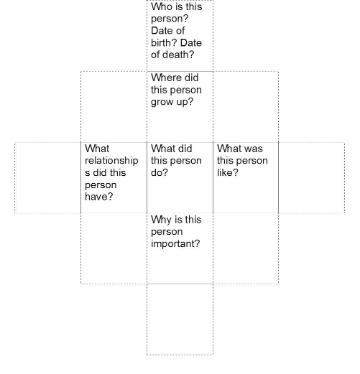
Use the Biography Cube format to create a cube for Jack London. Students can use the introduction and on-line sources to get additional information. Cubes can be used as mobiles and to write a biographical essay.
Discussion
Ask discussion questions of all 9 types.
Key Questions
- What are the pros and cons of socialism?
- What are the pros and cons of individualism?
- Based on the definition of socialism and individualism which system do you favor?
- In what ways does socialism “promote the common good”? How does individualism “promote the common good”?
- In your own words, explain how Jack London is an example of “rags” to “riches”.
- Jack London was never truly happy. What do you think he was searching for? Do you think he ever would have been happy or did he allow his circumstances to shape him?
- How do you stay true to yourself and your past without allowing it to control all of your life decisions?
- How did the industrial age affect many American’s and their lifestyles? What opportunities presented themselves to people?
- Describe Jack London’s desire for social justice.
- What does the term social justice mean? What role do all people have in “social justice”?
Analyze
Analyze the key paragraph.
Key Paragraph, p. 17
“He still raised a cry for justice, sympathy, service, and unselfishness in transforming society, “He who by understanding, becomes converted to the gospel of service…will serve kindness so that brutality, will perish…And he who is strong will serve the weak that they may become strong” (p. 17).
Extend
Write
Have each student write a short product based on today’s prompt to connect to the unit theme.
Jack London was a self-proclaimed socialist but as he succeeded he became more of an individualist. The above passage discusses both philosophies. In an informative paragraph explain Jack’s change in philosophies. Include accurate and detailed references to the text or to other works.
When answering the question above, consider the following:
- Describe how both philosophies have become ingrained in Jack London’s belief system.
- Why is it important that he wants the strong to teach the weak?
- How does this conflict with his socialist beliefs?
- How is it helpful to humankind to teach the weak to help themselves?
- Do you think this ideal is still personified in America today? Why or why not?
Close
Close by extending today’s lesson to life and the world.
Day 4
Outcomes for Today
W2. Write informative/explanatory texts to examine a topic and convey ideas, concepts, and information through the selection, organization, and analysis of relevant content.
- ) Introduce a topic clearly, previewing what is to follow; organize ideas, concepts, and information, using strategies such as definition, classification, comparison/contrast, and cause/effect; include formatting (e.g., headings), graphics (e.g., charts, tables), and multimedia when useful to aiding comprehension.
- ) Develop the topic with relevant facts, definitions, concrete details, quotations, or other information and examples.
- ) Use appropriate transitions to create cohesion and clarify the relationships among ideas and concepts.
- ) Use precise language and domain-specific vocabulary to inform about or explain the topic.
- ) Establish and maintain a formal style.
- ) Provide a concluding statement or section that follows from and supports the information or explanation presented.
- W4. Produce clear and coherent writing in which the development, organization, and style are appropriate to task, purpose, and audience. (Grade-specific expectations for writing types are defined in standards 1-3.)
- W7. Conduct short research projects to answer a question, drawing on several sources and generating additional related, focused questions for further research and investigation.
- W10. Write routinely over extended time frames (time for research, reflection, and revision) and shorter time frames (a single sitting or a day or two) for a range of discipline-specific tasks, purposes, and audiences.
Prepare
Background
Gather background knowledge about a place, time, event, person, or thing.
What is a St. Bernard? What is a Scotch Shepherd dog? What is their purpose?
A St. Bernard was originally used to locate freezing and helpless travelers during snowstorms, the Saint Bernard now uses his intelligence and strength in conformation and obedience competitions, cart pulling and weight pulling. Although powerful and muscular in build, Saints possess a gentle and dignified temperament. Their coats can be long or short and range in color from deep brown to brown-yellow. White markings are required.
Scotch Collies a.k.a Scotch Shepherd are very multi-purpose. There is one line that is being bred towards a "Squirrel Dog" type, though it still has the traditional look and temperament of the Scotch Collie. Most Scotch Collies can be used as hunting dogs; however, their primary focus is as a herding dog, and is nowadays kept as a house pet by some. They are excellent with children. Scotch Collies generally get along with other dogs and are usually good with non-canine pets. Depending on the individual dog and the humans that surround him, they are friendly to reserved and or aloof with strangers. It is a natural instinct for a dog to have an order in their pack.
Buck’s father was a St. Bernard and his mother a Scotch Shepherd. He was a natural fit to be sold to those traveling north to look for gold due to his size and his ability to work.
Word Wall
Here are five vocabulary words to teach and add to the Word Wall.
|
groping (21) |
veranda (21) |
realm (22) |
egotistical (22) |
treachery (23) |
Read
Review
Review the timeline from the beginning every day.
Read
Read the selection, usually in a Shared Reading Read React Predict Cycle of 2-3 pages.
Read 21-24
|
Setting |
Characters |
Pages |
|
Home in Santa Clara, CA |
Buck, Judge Miller, Judge Miller’s family |
21-23 |
|
Traveling to train station |
Buck, Manuel, man |
23-24 |
Respond
Timeline
Agree on the facts in today’s reading, and list the 3-5 most important on the Timeline.
Students might mention:
- Buck had a wonderful life in Santa Clara. He had full reign over the ranch that he lived on and was a respected animal.
- Buck hunted with the judge’s sons, looked out for his daughters, and was a great companion to the judge.
- Buck made sure that he lived a dignified life and was not a house pet or a kennel dog.
- Buck encountered Manuel a gardener at the house who had betting debts;
- Buck trusted him to go for a walk.
- Manuel sold him to a stranger to be sold in the Arctic as a work dog.
Map
Add to ongoing class activities like a KWL chart or map: where did the characters go?
Map
Create a map of the west coast, from the Yukon Territory to San Diego, and mark places along the path mentioned in the novel. Today add Santa Clara.
Conflict Chart:
Create a class conflict chart (see example below)
|
1st person or thing involved in the conflict |
2nd person or thing involved in the conflict |
example and page from the book |
illustration |
|
|
Man Jack |
Vs |
man Mother |
2-3 Mother never was able to maintain a stable life for him |
You should be looking for conflicts that involve (but are not limited to)
Man vs. man
Man vs. nature
Animal vs. man
Animal vs. nature
As the characters change or are involved in a conflict add them to the chart.
Theme Chart
The introduction discusses the themes of the novel. Create a “T” for the class. On one side list the themes. As you read about them give examples of each from the novel.
Explore
Activity
Explore the reading more deeply with a visual or oral language activity.
Open Mind Portrait
Create an OMP of Buck. What do you think Buck is thinking and feeling about his life in Santa Clara? What is he thinking and feeling when he encounters the stranger? Add 5-7 thoughts to your OMP.
Discussion
Ask discussion questions of all 9 types.
Key Questions
- In your own words, describe Buck’s life in Santa Clara.
- Explain Buck’s responsibilities on the ranch.
- Do you think Buck lived a life of a leader that promoted the common good? Why or why not?
- Why does Buck choose not to become a pampered pet?
- Describe the sequence of events that lead to Buck becoming a work dog.
- Buck was “dog napped” by someone with a gambling problem. How have other people’s vices negatively affected you or changed your life?
- Elaborate on the reasons why Buck learned to trust humans.
- Do you think that Buck was wrong to trust Manuel or do you think that he would have been sold regardless?
- Based on what you know of Buck’s life now and the Yukon Territory. How do you think Buck’s life will change?
- Predict whether or not Buck will survive in the Artic as a work dog. Explain your prediction.
Analyze
Analyze the key paragraph.
Key Paragraph, p. 23
“Buck had accepted the rope with quiet dignity. To be sure, it was an unwonted performance: But he had learned to trust in men that he knew, and to give them credit for a wisdom that outreached his own. But when the ends of the rope were placed in the stranger’s hands he growled menacingly” (p. 23).
Extend
Write
Have each student write a short product based on today’s prompt to connect to the unit theme.
Think about Buck’s life right now. He has everything he needs and a little of what he wants. He has learned to trust and also to be trusted. What happens when that trust starts to fade?
Write an explanatory paragraph that describes a time in your life that you lost trust in someone or someone lost trust in you. What was the situation? Who did it involve? How did it affect your relationships with others after that? Be detailed and specific.
Close
Close by extending today’s lesson to life and the world.
Day 5
Outcomes for Today
W2. Write informative/explanatory texts to examine a topic and convey ideas, concepts, and information through the selection, organization, and analysis of relevant content.
- ) Introduce a topic clearly, previewing what is to follow; organize ideas, concepts, and information, using strategies such as definition, classification, comparison/contrast, and cause/effect; include formatting (e.g., headings), graphics (e.g., charts, tables), and multimedia when useful to aiding comprehension.
- ) Develop the topic with relevant facts, definitions, concrete details, quotations, or other information and examples.
- ) Use appropriate transitions to create cohesion and clarify the relationships among ideas and concepts.
- ) Use precise language and domain-specific vocabulary to inform about or explain the topic.
- ) Establish and maintain a formal style.
- ) Provide a concluding statement or section that follows from and supports the information or explanation presented.
- W4. Produce clear and coherent writing in which the development, organization, and style are appropriate to task, purpose, and audience. (Grade-specific expectations for writing types are defined in standards 1-3.)
- W7. Conduct short research projects to answer a question, drawing on several sources and generating additional related, focused questions for further research and investigation.
- W10. Write routinely over extended time frames (time for research, reflection, and revision) and shorter time frames (a single sitting or a day or two) for a range of discipline-specific tasks, purposes, and audiences.
Prepare
Background
Gather background knowledge about a place, time, event, person, or thing.
What does it mean to “break” a dog or an animal?
The term Dog Breaking also refers to Dog Training. This term can also be used interchangeably with other animals like, horse breaking etc. Most common schools of thought use very consistent training and trust will build a sound animal human working relationship with immediate corrections when the animal has done something wrong.
In this chapter Buck meets the man in the Red Sweater. He uses a more violent approach to breaking Buck. Since Buck has been traveling he has not had food or water, and been tormented by the men on the road. He is quick to learn the man in the red-sweater with a club can beat him.
Word Wall
Here are five vocabulary words to teach and add to the Word Wall.
|
intolerable (25) |
wounded (25) |
calamity (25) |
fury (17) |
slouch (28) |
Read
Review
Review the timeline from the beginning every day.
Read
Read the selection, usually in a Shared Reading Read React Predict Cycle of 2-3 pages.
Read 25-31
|
Setting |
Characters |
Pages |
|
Traveling north |
Buck, tormentors, saloon keeper |
25-26 |
|
Seattle, WA |
Buck, man in the red sweater |
26-29 |
|
On the Norwhal |
Buck, Curly, Perrault, Francois |
29-31 |
Respond
Timeline
Agree on the facts in today’s reading, and list the 3-5 most important on the Timeline.
Students might mention:
- Buck was tormented as he continued on his journey north. He had not had food or water for days.
- He realized that the men wanted him to react so he learned to ignore them.
- He got to Seattle, WA. He was sold to a man in a red sweater. The man let him out and began to break/beat him.
- Buck realized that he was beaten not broken. The man fed him, gave him water, and treated him with respect.
- Buck learned that he was no match to a club and he learned his place in the pack.
- He saw people come and go and take dogs with them. He was unsure of his future. He was happy to stay where he was.
- Two men came to purchase him. They knew he was a strong and unique dog. They were government workers from Canada.
- Buck and another dog Curly left with them on a ship.
Map
Add to ongoing class activities like a KWL chart or map: where did the characters go?
Map
Create a map of the west coast, from the Yukon Territory to San Diego, and mark places along the path mentioned in the novel. Today add Seattle, WA.
Conflict Chart:
Create a class conflict chart (see example below)
|
1st person or thing involved in the conflict |
2nd person or thing involved in the conflict |
example and page from the book |
illustration |
|
|
Man Jack |
Vs |
man Mother |
2-3 Mother never was able to maintain a stable life for him |
You should be looking for conflicts that involve (but are not limited to)
Man vs. man
Man vs. nature
Animal vs. man
Animal vs. nature
As the characters change or are involved in a conflict add them to the chart.
Theme Chart
The introduction discusses the themes of the novel. Create a “T” for the class. On one side list the themes. As you read about them give examples of each from the novel.
Explore
Activity
Explore the reading more deeply with a visual or oral language activity.
Open Mind Portrait
Add to your OMP for Buck. What do you think he is thinking and feeling now that he has been broken? Add 5-7 new thoughts to your OMP.
Setting Sketch
Sketch the scene on page 28 where Buck and the man in the red sweater and building trust with one another.
Discussion
Ask discussion questions of all 9 types.
Key Questions
- The author describes Buck’s wounded pride on page 25. What does it mean to have your pride wounded? How can that affect you and your actions towards others?
- What is an “alpha” dog? What concepts surround being “alpha”?
- Do you think an “alpha” dog is an example of “leadership requires engagement”? Does an alpha dog engage with others to promote the common good? Why or why not?
- Page 28, “He was beaten; but he was not broken”. What does that mean for Buck?
- Have you ever been in a similar situation? What did you choose to do?
- Elaborate the reasons why Buck became comfortable with the man in the Red Sweater.
- Why didn’t Buck want to be chosen to go with new owners?
- Describe Buck’s reaction when he got off the ship and it was snowing.
- The men laughed at Buck’s response to the snow; which embarrassed Buck. Why would Buck feel ashamed when he was in a new environment?
- Did the men have any right to make fun of him?
Analyze
Analyze the key paragraph.
Key Paragraph, p. 29-30
“They were a new kind of men to Buck (of which he was destined to see many more), and while he developed no affection for them, he none the less grew honestly to respect them. He speedily learned that Perrault and Francois were fair men, calm and impartial in administering justice, and too wise in the way of dogs to be fooled by dogs” (p. 29-30).
Extend
Write
Have each student write a short product based on today’s prompt to connect to the unit theme.
The author describes the relationship between Buck and his new owners. He describes Buck as not liking the men but he respected them. What is the difference between like and respect? Can you have one without the other?
Write an explanatory paragraph that describes the relationship between respect and affection. Be as detailed as possible and include references to the text. You can use your own experiences.
Close
Close by extending today’s lesson to life and the world.
Day 6
Outcomes for Today
W2. Write informative/explanatory texts to examine a topic and convey ideas, concepts, and information through the selection, organization, and analysis of relevant content.
- ) Introduce a topic clearly, previewing what is to follow; organize ideas, concepts, and information, using strategies such as definition, classification, comparison/contrast, and cause/effect; include formatting (e.g., headings), graphics (e.g., charts, tables), and multimedia when useful to aiding comprehension.
- ) Develop the topic with relevant facts, definitions, concrete details, quotations, or other information and examples.
- ) Use appropriate transitions to create cohesion and clarify the relationships among ideas and concepts.
- ) Use precise language and domain-specific vocabulary to inform about or explain the topic.
- ) Establish and maintain a formal style.
- ) Provide a concluding statement or section that follows from and supports the information or explanation presented.
- W4. Produce clear and coherent writing in which the development, organization, and style are appropriate to task, purpose, and audience. (Grade-specific expectations for writing types are defined in standards 1-3.)
- W7. Conduct short research projects to answer a question, drawing on several sources and generating additional related, focused questions for further research and investigation.
- W10. Write routinely over extended time frames (time for research, reflection, and revision) and shorter time frames (a single sitting or a day or two) for a range of discipline-specific tasks, purposes, and audiences.
Prepare
Background
Gather background knowledge about a place, time, event, person, or thing.
What is a dog sled team and why are they used?
Sled dog teams have been used in the northern territory for the better part of the 19th century. Due to in climate weather the dogs were used to pull sleds for freight and also basic transportation. Smaller dog teams were best since a typical working dog can consume 5000-8000 calories when working. The dogs are taught to be harnessed together in a line and pull the sled to various commands. A well trained team will run at the same pace making it a effective and efficient form of transportation when there are no roads or other options.
The link listed gives an overview of modern sled teams. Some of which is interactive.
http://www.pbs.org/wnet/nature/episodes/sled-dogs-an-alaskan-epic/introduction/3146/
The link gives a historical perspective of sleds and some of their parts and uses.
http://www.alaska.net/~dogdrivr/old_sleds.htm
Word Wall
Here are five vocabulary words to teach and add to the Word Wall.
|
primordial (31) |
antagonist (32) |
introspective (33) |
diabolically (33) |
retaliate (36) |
Read
Review
Review the timeline from the beginning every day.
Read
Read the selection, usually in a Shared Reading Read React Predict Cycle of 2-3 pages.
Read 31-40
|
Setting |
Characters |
Pages |
|
Dyea Beach |
Buck, Curly, Spitz, Francois |
31-33 |
|
Camp |
Buck, Perrault, Francois, Spitz, Dave, Billie, Sol-leks, |
33-35 |
|
Dyea Canon |
Buck, Perrault, Francois, Spitz, Dave, Billie, Sol-leks, rest of the team |
35-37 |
|
Camp |
Buck, dog team members |
37-40 |
Respond
Timeline
Agree on the facts in today’s reading, and list the 3-5 most important on the Timeline.
Students might mention:
- Buck has trouble adjusting to his new environment.
- He witnessed the death of Curly and the “law of club and fang.”
- He learned the basics of pulling on the team and was quick to learn;
- Buck was well respected by Perrault and Francois. He learned fast, was strong, and a good team member.
- Buck had to learn to sleep and survive in the snow. Billee was able to show him how and where to sleep.
- Buck was placed in a spot on the team where he could learn from the other dogs. He realized that it was better to “mend his ways” than to retaliate at the other dogs.
- Buck learned to take care of himself and to fend for his own food. He also learned basic survival and comfort measures to live better on the trail.
Map
Add to ongoing class activities like a KWL chart or map: where did the characters go?
Map
Create a map of the west coast, from the Yukon Territory to San Diego, and mark places along the path mentioned in the novel. Today: Add Dyea Beach and Lake Bennett
Conflict Chart:
Create a class conflict chart (see example below)
|
1st person or thing involved in the conflict |
2nd person or thing involved in the conflict |
example and page from the book |
illustration |
|
|
Man Jack |
Vs |
man Mother |
2-3 Mother never was able to maintain a stable life for him |
You should be looking for conflicts that involve (but are not limited to)
Man vs. man
Man vs. nature
Animal vs. man
Animal vs. nature
As the characters change or are involved in a conflict add them to the chart.
Theme Chart
The introduction discusses the themes of the novel. Create a “T” for the class. On one side list the themes. As you read about them give examples of each from the novel.
Explore
Activity
Explore the reading more deeply with a visual or oral language activity.
Who’s Who of Dogs?
Create a dog chart.
- List the dogs that are currently on the team;
- List their position on the team;
- What is their personality?
- How do they survive?
- What role do they play on the team?
Discussion
Ask discussion questions of all 9 types.
Key Questions
- What does the literary term “antagonist” mean?
- What life changes did Buck encounter once they reached Dyea Beach? List the obvious but also the internal changes that have occurred in him?
- What is Spitz’s role on the team? Do groups of people have similar roles? How do you deal with someone like Spitz?
- Buck started to like working and pulling. What aspects of the team and work did Buck appreciate?
- On page 37 the author discusses Buck’s instincts coming alive. Do people have natural instincts? What has happened to them over the years? In what ways can we learn to get our instincts back?
Analyze
Analyze the key paragraph.
Key Paragraph, p. 36
“Buck had been purposely between Dave and Sol-leks so that he might receive instruction. Apt scholar that he was, they were equally apt teachers, never allowing him to linger long in error, and enforcing their teaching with their sharp teeth. Dave was fair and wise” (p. 36).
Extend
Write
Have each student write a short product based on today’s prompt to connect to the unit theme.
It takes a gift to be a good teacher and to be a good student. Perrault and Francois were gifted in being able to recognize the skills of each member on their team. Think about your role as a student and teachers (good and bad) you have had over the years. What qualities does each need to possess in order to succeed?
Write a 2-3 paragraph essay describing the qualities of being a “good student” and being a “good teacher”. Use your personal experience to relate details of your experiences in the classroom. Communicate your ideas clearly and communicate the significance of those events to the reader.
Close
Close by extending today’s lesson to life and the world.
Day 7
Outcomes for Today
W2. Write informative/explanatory texts to examine a topic and convey ideas, concepts, and information through the selection, organization, and analysis of relevant content.
- ) Introduce a topic clearly, previewing what is to follow; organize ideas, concepts, and information, using strategies such as definition, classification, comparison/contrast, and cause/effect; include formatting (e.g., headings), graphics (e.g., charts, tables), and multimedia when useful to aiding comprehension.
- ) Develop the topic with relevant facts, definitions, concrete details, quotations, or other information and examples.
- ) Use appropriate transitions to create cohesion and clarify the relationships among ideas and concepts.
- ) Use precise language and domain-specific vocabulary to inform about or explain the topic.
- ) Establish and maintain a formal style.
- ) Provide a concluding statement or section that follows from and supports the information or explanation presented.
- W4. Produce clear and coherent writing in which the development, organization, and style are appropriate to task, purpose, and audience. (Grade-specific expectations for writing types are defined in standards 1-3.)
- W7. Conduct short research projects to answer a question, drawing on several sources and generating additional related, focused questions for further research and investigation.
- W10. Write routinely over extended time frames (time for research, reflection, and revision) and shorter time frames (a single sitting or a day or two) for a range of discipline-specific tasks, purposes, and audiences.
Prepare
Background
Gather background knowledge about a place, time, event, person, or thing.
What is integrity?
Integrity is adherence to moral and ethical principles; being sound in moral character, being totally honest. It can also be whole, entire, or undiminished—to preserve the integrity of a family or of an empire. A very simplistic definition is: Doing the right thing when no one else is looking.
In today’s reading, and throughout the novel, we are going to look at Buck and also the people he comes in contact with to determine if they are living their lives with integrity.
Word Wall
Here are five vocabulary words to teach and add to the Word Wall.
|
cunning (40) |
pandemonium (41) |
treacherously (42) |
exertion (43) |
descend (44) |
Read
Review
Review the timeline from the beginning every day.
Read
Read the selection, usually in a Shared Reading Read React Predict Cycle of 2-3 pages.
Read 40-46
|
Setting |
Characters |
Pages |
|
Lake le Barge |
Buck, Spitz |
40-41 |
|
Lake le Barge |
Buck, sled team, Perrault, Francois, pack of wild dogs |
41-42 |
|
On the trail, in forest, back at camp |
Buck, sled team, Perrault, Francois, wild dogs |
42-43 |
|
On the trail |
Buck, sled team, Perrault, Francois, Dolly, Spitz |
44-45 |
Respond
Timeline
Agree on the facts in today’s reading, and list the 3-5 most important on the Timeline.
Students might mention:
- Buck is adapting to life on the trail.
- He and Spitz are still rivals and having difficulties.
- Spitz stole his sleeping place. Buck decided to fight him. The camp was then attacked by a pack of wild dogs.
- They lost a half day trying to recover from the attack. They headed out. They trail was harsh. Cold temperatures and many ice bridges.
- The dogs and men were tired but had to push hard to make up for last time.
- Buck’s feet were not as hardy as the other dogs; Francois made him dog shoes from his moccasins. His feet finally adapted.
- Dolly went mad on the trail. She chased after Buck. He ran after her and brought her back through camp where she was killed by François.
- Once he returned he was resting and Spitz took that opportunity to attack him.
Map
Add to ongoing class activities like a KWL chart or map: where did the characters go?
Map
Create a map of the west coast, from the Yukon Territory to San Diego, and mark places along the path mentioned in the novel.
Conflict Chart:
Create a class conflict chart (see example below)
|
1st person or thing involved in the conflict |
2nd person or thing involved in the conflict |
example and page from the book |
illustration |
|
|
Man Jack |
Vs |
man Mother |
2-3 Mother never was able to maintain a stable life for him |
You should be looking for conflicts that involve (but are not limited to J)
Man vs. man
Man vs. nature
Animal vs. man
Animal vs. nature
As the characters change or are involved in a conflict add them to the chart.
Theme Chart
The introduction discusses the themes of the novel. Create a “T” for the class. On one side list the themes. As you read about them give examples of each from the novel.
Explore
Plot Profile Chart
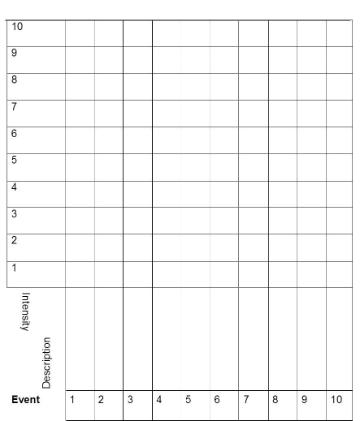
Create a PPC for today’s reading. Choose 10 items that were significant in the reading and rate them on a scale of 1-10 based on their intensity. You can use the PPC to write a summary of the reading or discuss the plot of a chapter or selection.
Setting Chart
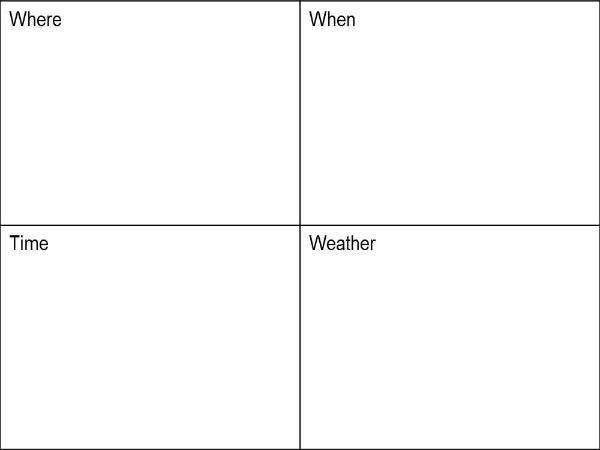
Use information given in this selection to fill out a setting chart on the reading. You can use the chart to write a descriptive paragraph or essay.
Open Mind Portrait
Add to your OMP of Buck. What is he thinking and feeling today on the trail? Add 5-7 new thoughts to his OMP.
Discussion
Ask discussion questions of all 9 types.
Key Questions
- What does the title of this chapter, “The Dominant and Primordial Beast”, say about Buck and his personality?
- In your own words describe Buck’s life on the trail.
- What does Spitz have to gain by constantly growling at Buck? What has Buck done to deserve such ill treatment?
- Have you ever had people in your life who treat you poorly regardless of how you treat them? How do you deal with that kind of situation?
- Where did the wild husky team come from? What happened to its drivers?
- What were conditions like on the trail? What did they have to do to get through the ice? What kept happening to the team?
- Why did Francois make Buck dog shoes from his moccasins? Do you think Francois uses his time and talent to better his community?
- Dolly went mad? What does that term mean? Is madness similar in people and in dogs?
- Buck is dealing with a lot in the chapter; Spitz, the wild dogs, the trail, and Dolly. Explain the challenges Buck faced in this chapter.
- Do you think Buck handled his situations as a leader? Do you think used his time or talent to better his community? Explain why or why not.
Analyze
Analyze the key paragraph.
Key Paragraph, p. 40
“The Dominant primordial beast was strong in Buck, and under the fierce conditions of trail life it grew and grew. Yet it was a secret growth. His new-born cunning gave him poise and control. He was busy adjusting himself to the new life to feel at ease, and not only did he not pick fights, but he avoided them whenever possible. A certain deliberateness characterized his attitude. He was not prone to rashness and precipitated action; and in the bitter hatred between him and Spitz he betrayed no impatience, shunning all offensive acts” (p. 40).
Extend
Write
Have each student write a short product based on today’s prompt to connect to the unit theme.
Jack used his experiences to guide him through life. At a fairly young age he realized that he can either be a victim or he can become an individual and create his own circumstances to change his position in life.
In an informative paragraph, explain how Jack used his individualism to grow out of his position and find success. What tools did he rely on? Explain why individualism is a key component to success.
Close
Close by extending today’s lesson to life and the world.
Day 8
Outcomes for Today
W2. Write informative/explanatory texts to examine a topic and convey ideas, concepts, and information through the selection, organization, and analysis of relevant content.
- ) Introduce a topic clearly, previewing what is to follow; organize ideas, concepts, and information, using strategies such as definition, classification, comparison/contrast, and cause/effect; include formatting (e.g., headings), graphics (e.g., charts, tables), and multimedia when useful to aiding comprehension.
- ) Develop the topic with relevant facts, definitions, concrete details, quotations, or other information and examples.
- ) Use appropriate transitions to create cohesion and clarify the relationships among ideas and concepts.
- ) Use precise language and domain-specific vocabulary to inform about or explain the topic.
- ) Establish and maintain a formal style.
- ) Provide a concluding statement or section that follows from and supports the information or explanation presented.
- W4. Produce clear and coherent writing in which the development, organization, and style are appropriate to task, purpose, and audience. (Grade-specific expectations for writing types are defined in standards 1-3.)
- W7. Conduct short research projects to answer a question, drawing on several sources and generating additional related, focused questions for further research and investigation.
- W10. Write routinely over extended time frames (time for research, reflection, and revision) and shorter time frames (a single sitting or a day or two) for a range of discipline-specific tasks, purposes, and audiences.
Prepare
Background
Gather background knowledge about a place, time, event, person, or thing.
What is aurora borealis?
Polar lights (aurora polaris) are a natural phenomenon found in both the northern and southern hemispheres that can be truly awe inspiring. Northern lights are also called by their scientific name, aurora borealis, and southern lights are called aurora australis. The origin of the aurora begins on the surface of the sun when solar activity ejects a cloud of gas. Scientists call this a coronal mass ejection (CME). If one of these reaches earth, taking about 2 to 3 days, it collides with the Earth’s magnetic field. This field is invisible, and if you could see its shape, it would make Earth look like a comet with a long magnetic ‘tail’ stretching a million miles behind Earth in the opposite direction of the sun. When a coronal mass ejection collides with the magnetic field, it causes complex changes to happen to the magnetic tail region. These changes generate currents of charged particles, which then flow along lines of magnetic force into the Polar Regions. These particles are boosted in energy in Earth’s upper atmosphere, and when they collide with oxygen and nitrogen atoms, they produce dazzling auroral light. The lights also affect communications and other events on earth.
In today’s reading Buck gets his first glimpse at the northern lights as they continue their travels on the trail.
For more information or to study more on space storms/aurora borealis visit:
Word Wall
Here are five vocabulary words to teach and add to the Word Wall.
|
prospered (46) |
apprehension (47) |
articulate (48) |
insidious (49) |
awe (49) |
Read
Review
Review the timeline from the beginning every day.
Read
Read the selection, usually in a Shared Reading Read React Predict Cycle of 2-3 pages.
Read 47-53
|
Setting |
Characters |
Pages |
|
On the trail |
Spitz, Buck, Pike |
46-47 |
|
Dawson |
Team of dogs, Francois, Parrault |
47-48 |
|
On the trail |
Team of dogs, Francois, Parrault |
49 |
|
Tahkeena River |
Team of dogs, rabbit |
49-51 |
|
Tahkeena River |
Buck and Spitz |
52-53 |
Respond
Timeline
Agree on the facts in today’s reading, and list the 3-5 most important on the Timeline.
Students might mention:
- Buck and Spitz continued their rivalry. Buck began to interfere with Spitz and the other dogs—standing up for them when he could.
- He began to undermine Spitz’s authority on the trail and the dogs became harder to handle.
- He learned to undermine Spitz when Francois and Parrault were not looking so he would not be whipped.
- The dogs continued to quarrel with one.
- One of the dogs started to hunt a rabbit and missed. The rest of the dogs joined in the chase.
- Spitz split from the pack and then attacked Buck.
- Buck and Spitz finally had to fight for dominance. Although Spitz was a more experience fighter Buck was able to compete.
- Buck killed Spitz.
Map
Add to ongoing class activities like a KWL chart or map: where did the characters go?
Map
Create a map of the west coast, from the Yukon Territory to San Diego, and mark places along the path mentioned in the novel.
Conflict Chart:
Create a class conflict chart (see example below)
|
1st person or thing involved in the conflict |
2nd person or thing involved in the conflict |
example and page from the book |
illustration |
|
|
Man Jack |
Vs |
man Mother |
2-3 Mother never was able to maintain a stable life for him |
You should be looking for conflicts that involve (but are not limited to)
Man vs. man
Man vs. nature
Animal vs. man
Animal vs. nature
As the characters change or are involved in a conflict add them to the chart.
Theme Chart
The introduction discusses the themes of the novel. Create a “T” for the class. On one side list the themes. As you read about them give examples of each from the novel.
Explore
Activity
Explore the reading more deeply with a visual or oral language activity.
Postcard
Pretend you are Buck. Write a postcard home to the judge. Tell him about your journey so far and what you have learned. Describe the struggles that you are having with Spitz. On the opposite side sketch a picture of the northern lights or of their journey so far. Make sure you also include a proper address.
Character Profile Chart
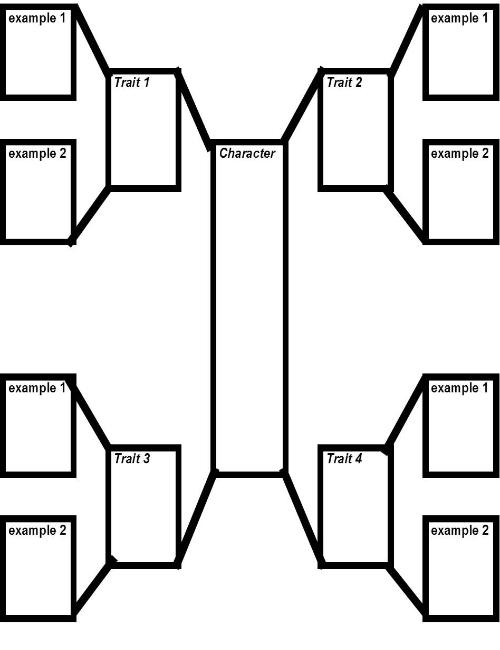
Create a CPC for Buck. Based on what you have learned about him so far fill out two character traits. Make sure you give examples from the reading to support your findings.
Discussion
Ask discussion questions of all 9 types.
Key Questions
- Today’s reading begins with Francois describing Buck as, “Dat Buck two devils.” What does he mean by this description of Buck?
- Do you think the description of Buck as “two devils” is Buck’s true nature or who he has become due to the circumstances of his life now?
- What did Buck want from Spitz? Did he want mastery of the team or to be left alone and respected? Explain your answer.
- In what ways did Buck begin to undermine Spitz and the team?
- Do you think Buck was letting the team down by his behavior? Or do you think Buck was trying to help? Explain your response.
- Do you think Buck’s choices bettered his community? Why or why not?
- How did the discipline affect the dogs on the trail? What did they begin to do? Do you think they will be able to restore their team? How?
- Describe the series of events that lead to Buck killing Spitz.
- Has Buck show leadership requires engagement in the way he deals with Spitz? What could he be doing different?
- Predict who take the “alpha dog” or leadership position now that Spitz is out of the picture.
Analyze
Analyze the key paragraph.
Key Paragraph, p. 46
“It was inevitable that the clash for leadership should come. Buck wanted it. He wanted it because it was his nature, because he had been gripped tight by that nameless, incomprehensible pride of trail and trace—that pride which holds dogs in the toil to the last grasp, which lures them to die joyfully in the harness, and breaks their hearts if they are cut out of the harness” (p. 46).
Extend
Write
Have each student write a short product based on today’s prompt to connect to the unit theme.
The author describes the ethics of a good worker and a good work animal. He describes Buck of having learned great pride for doing what he is doing and knows that if he doesn’t get to work he will be heartbroken. We all have things we do, that we do with pride. If we lose the opportunity to participate in that activity we would be heartbroken, or a goal that we have set for something in our future.
Write two informative paragraphs describing an activity or goal that you take pride in. Use concrete details that describe your feelings for the activity or goal. Explain why this is important to you with as much detail as possible.
Close
Close by extending today’s lesson to life and the world.
Day 9
Outcomes for Today
W2. Write informative/explanatory texts to examine a topic and convey ideas, concepts, and information through the selection, organization, and analysis of relevant content.
- ) Introduce a topic clearly, previewing what is to follow; organize ideas, concepts, and information, using strategies such as definition, classification, comparison/contrast, and cause/effect; include formatting (e.g., headings), graphics (e.g., charts, tables), and multimedia when useful to aiding comprehension.
- ) Develop the topic with relevant facts, definitions, concrete details, quotations, or other information and examples.
- ) Use appropriate transitions to create cohesion and clarify the relationships among ideas and concepts.
- ) Use precise language and domain-specific vocabulary to inform about or explain the topic.
- ) Establish and maintain a formal style.
- ) Provide a concluding statement or section that follows from and supports the information or explanation presented.
- W4. Produce clear and coherent writing in which the development, organization, and style are appropriate to task, purpose, and audience. (Grade-specific expectations for writing types are defined in standards 1-3.)
- W7. Conduct short research projects to answer a question, drawing on several sources and generating additional related, focused questions for further research and investigation.
- W10. Write routinely over extended time frames (time for research, reflection, and revision) and shorter time frames (a single sitting or a day or two) for a range of discipline-specific tasks, purposes, and audiences.
Prepare
Background
Gather background knowledge about a place, time, event, person, or thing.
What is the role of a leader?
The most basic definition of a leader is; one who leads or guides. However, to be a true leader many other traits and qualities must be working together. Leaders must have the ability to inspire a team, they need to be responsible and dependable, good leaders need to recognize and acknowledge the contributions and ideas of other members and they need to be able to celebrate with their team (among many other things).
In today’s reading Buck expects to take on the leadership role of the team since he killed Spitz. After much negotiation with the men he finally gets his point across. It turns out that Buck is a much better leader than they ever could have imagined.
Word Wall
Here are five vocabulary words to teach and add to the Word Wall.
|
coveted (53) |
gleefully (53) |
sheepishly (55) |
triumphantly (55) |
deluged (56) |
Read
Review
Review the timeline from the beginning every day.
Read
Read the selection, usually in a Shared Reading Read React Predict Cycle of 2-3 pages.
Read 53-56
|
Setting |
Characters |
Pages |
|
Camp |
Buck, Perrault, Francois |
53 |
|
Leashing the team |
Buck, Perrault, Francois |
54-55 |
|
On the trail |
Buck (lead dog), the team, Perrault, Francois |
55-56 |
Respond
Timeline
Agree on the facts in today’s reading, and list the 3-5 most important on the Timeline.
Students might mention:
- Buck returned to the camp after the fight. The men realized that the troubles would be gone with Spitz gone;
- They chose a new lead dog, Sol-leks. Buck was angry and refused to take his position. Lead dog place was rightfully his;
- He revolted against the men for over an hour until they decided to give him the place;
- They returned to the trail. Buck was an excellent lead;
- He was: quick thinking, he encouraged his team mates to give equally on the trail, he was fair, and he was able to bring solidarity back to the team.
Map
Add to ongoing class activities like a KWL chart or map: where did the characters go?
Map
Create a map of the west coast, from the Yukon Territory to San Diego, and mark places along the path mentioned in the novel.
Conflict Chart:
Create a class conflict chart (see example below)
|
1st person or thing involved in the conflict |
2nd person or thing involved in the conflict |
example and page from the book |
illustration |
|
|
Man Jack |
Vs |
man Mother |
2-3 Mother never was able to maintain a stable life for him |
You should be looking for conflicts that involve (but are not limited to)
Man vs. man
Man vs. nature
Animal vs. man
Animal vs. nature
As the characters change or are involved in a conflict add them to the chart.
Theme Chart
The introduction discusses the themes of the novel. Create a “T” for the class. On one side list the themes. As you read about them give examples of each from the novel.
Explore
Activity
Explore the reading more deeply with a visual or oral language activity.
Poster
Create a leadership poster. Think of one or two leadership traits that you value and sketch a representation of them. Think or a quote or find one that represents that trait to you—add it to your poster.
Open Mind Portrait
What do you think Buck is thinking and feeling as he negotiates for leadership on the team? Add 5-7 new thoughts to your OMP.
Character Profile Chart
Add two more traits to the COC you started yesterday. Make sure you use examples from the reading to support your traits.
Discussion
Ask discussion questions of all 9 types.
Key Questions
- Do you think the kill of Spitz gives Buck rightful mastership over the team? Explain why or why not?
- Explain why the men believe their troubles would be gone with Spitz gone.
- Why would they place Sol-leks in the lead position before Buck?
- Do you think Buck should respect the men’s decision? Why or why not?
- Describe the series of events that lead Buck to become the leader of the team?
- What characteristics would make a good leader of the team?
- What skills do you think Buck is missing for the position? Can those skills be taught?
- Do leaders have all of the skills they need or do they learn them along the way? How do leaders learn how to lead?
- What traits did Buck use to lead the team?
- What affect did those traits have on them? Why did this surprise the men?
Analyze
Analyze the key paragraph.
Key Paragraph, p. 55
“Highly as the dog-driver had fore valued Buck, with his two devils, he found, while the day was yet young, that he had undervalued. At a bound Buck took up the duties of leadership and where judgment was required, and quick thinking and quick acting, he showed himself superior even to Spitz, of whom Francois had never seen an equal” (p. 55).
Extend
Write
Have each student write a short product based on today’s prompt to connect to the unit theme.
Buck was not given a chance at leadership and was always in Spitz’s shadow. If he had not stood up for himself he would not have been given the opportunity to lead or show what he was capable of.
In an informative paragraph to explain why it was important for Buck to show his skills to the men. Do you think he would have been given another opportunity or did he need to make one for himself?
Have you ever been in a similar situation where you had to SHOW that you were the right person for the job? In an informative paragraph explain whether or not leaders wait for things to happen to them or if they make things happen for themselves? Explain.
Close
Close by extending today’s lesson to life and the world.
Day 10
Outcomes for Today
W2. Write informative/explanatory texts to examine a topic and convey ideas, concepts, and information through the selection, organization, and analysis of relevant content.
- ) Introduce a topic clearly, previewing what is to follow; organize ideas, concepts, and information, using strategies such as definition, classification, comparison/contrast, and cause/effect; include formatting (e.g., headings), graphics (e.g., charts, tables), and multimedia when useful to aiding comprehension.
- ) Develop the topic with relevant facts, definitions, concrete details, quotations, or other information and examples.
- ) Use appropriate transitions to create cohesion and clarify the relationships among ideas and concepts.
- ) Use precise language and domain-specific vocabulary to inform about or explain the topic.
- ) Establish and maintain a formal style.
- ) Provide a concluding statement or section that follows from and supports the information or explanation presented.
- W4. Produce clear and coherent writing in which the development, organization, and style are appropriate to task, purpose, and audience. (Grade-specific expectations for writing types are defined in standards 1-3.)
- W7. Conduct short research projects to answer a question, drawing on several sources and generating additional related, focused questions for further research and investigation.
- W10. Write routinely over extended time frames (time for research, reflection, and revision) and shorter time frames (a single sitting or a day or two) for a range of discipline-specific tasks, purposes, and audiences.
Prepare
Background
Gather background knowledge about a place, time, event, person, or thing.
What kinds of ethics do work animals possess?
Working animals are not like typical pets. They are trained to do a job well and take pride in their work efforts. Working animals are bred to hold specific jobs and even when they are “off duty” they are still watching and waiting for their next task. Many animals suffer once they retire. They are so used to working on a daily basis that something becomes lost in their soul. Many working animals give up or become very sickly. In this chapter Dave became ill. His driver did everything possible to lighten his work load. However, he still approached the sled to be put into his place daily. The drivers decided to let him continue to pull until he could no longer do it. Dave fell in his place driving with the team.
Word Wall
Here are five vocabulary words to teach and add to the Word Wall.
|
monotonous (57) |
heredity (57) |
morose (59) |
halt (60) |
remnant (60) |
Read
Review
Review the timeline from the beginning every day.
Read
Read the selection, usually in a Shared Reading Read React Predict Cycle of 2-3 pages.
Read 57-61
|
Setting |
Characters |
Pages |
|
Trail back to Dawson |
Scotch half breed, Buck, dog team |
57 |
|
In camp by the fire |
Scotch half breed, Buck, |
57-58 |
|
On the trail and in camp |
Men in camp, the dogs, Dave |
59-61 |
Respond
Timeline
Agree on the facts in today’s reading, and list the 3-5 most important on the Timeline.
Students might mention:
- The team was given a new driver for their return trip to Dawson. Buck did not like the work or the driver but he excelled anyway.
- At night he would sit by the fire and recall his life in Santa Clara and recalled his ancestors.
- The trip was hard; heavy load, they were in poor condition, and the weather was horrible.
- The dogs were always tended to first at the end of the day;
- Dave was not doing well.
- He seemed to be ill. His driver would tend to him but he grew weaker and cry with pain.
- They decided to pull him off the train and give another dog his spot. He bit and barked at the dog and finally chewed through the traces so the sled could not go.
- They returned him to his spot and he pulled until he could no longer keep up. He fell on the trail and the teams passed him.
- His driver shot him on the trail doing the one thing he was passionate about.
Map
Add to ongoing class activities like a KWL chart or map: where did the characters go?
Map
Create a map of the west coast, from the Yukon Territory to San Diego, and mark places along the path mentioned in the novel. Today add Santa Clara.
Conflict Chart:
Create a class conflict chart (see example below)
|
1st person or thing involved in the conflict |
2nd person or thing involved in the conflict |
example and page from the book |
illustration |
|
|
Man Jack |
Vs |
man Mother |
2-3 Mother never was able to maintain a stable life for him |
You should be looking for conflicts that involve (but are not limited to)
Man vs. man
Man vs. nature
Animal vs. man
Animal vs. nature
As the characters change or are involved in a conflict add them to the chart.
Theme Chart
The introduction discusses the themes of the novel. Create a “T” for the class. On one side list the themes. As you read about them give examples of each from the novel.
Explore
Activity
Explore the reading more deeply with a visual or oral language activity.
Sketch
Based on the description of the “other man” described on page 58. Sketch him sitting by the fire with Buck.
Open Mind Portrait
Add to the OMP of Buck. What do you think he is thinking and feeling with his new driver and new job? What about with the loss of Dave to the team? Add 5-7 new thoughts to your OMP.
Discussion
Ask discussion questions of all 9 types.
Key Questions
- What is the role of animals and humans in the pack? How are those roles determined?
- The dogs are described as being fierce fighters. Why didn’t the dogs bother Buck anymore?
- Buck enjoys sitting by the fire at night. What things did he miss? What thoughts were on his mind?
- If you were taken to a remote location like Buck was—what would you miss and think about?
- At night when they pulled into camp the dogs were tended to first. Why are they the priority?
- Do you think domesticated animals are given a priority? Compare and contrast how working animals and domesticated animals are treated.
- Dave is sick. What do you think is wrong with him? Why is he so intent on returning to his place in the sled?
- If you were sick like he is would you want to continue to work? What is driving him?
- How did the driver handle Dave’s situation?
- Do you think the driver handled the situation with Dave well? What else could he have done?
Analyze
Analyze the key paragraph.
Key Paragraph, p. 59
“Each night the dogs were attended to first. They ate before the rivers ate, and no man sought his sleeping-robe till he had seen to the feet of the dogs he drove. Still, their strength went down. Since the beginning of winter they had travelled eighteen hundred miles; and eighteen hundred miles will tell upon life of the toughest” (p. 59).
Extend
Write
Have each student write a short product based on today’s prompt to connect to the unit theme.
The dogs have been driven hard. They needed a longer rest and were not given one. Pretend you are Buck. Write a letter to your driver. In two informative paragraphs explain that your team should get a longer break. Provide two reasons to support your claim.
Close
Close by extending today’s lesson to life and the world.
Day 11
Outcomes for Today
W2. Write informative/explanatory texts to examine a topic and convey ideas, concepts, and information through the selection, organization, and analysis of relevant content.
- ) Introduce a topic clearly, previewing what is to follow; organize ideas, concepts, and information, using strategies such as definition, classification, comparison/contrast, and cause/effect; include formatting (e.g., headings), graphics (e.g., charts, tables), and multimedia when useful to aiding comprehension.
- ) Develop the topic with relevant facts, definitions, concrete details, quotations, or other information and examples.
- ) Use appropriate transitions to create cohesion and clarify the relationships among ideas and concepts.
- ) Use precise language and domain-specific vocabulary to inform about or explain the topic.
- ) Establish and maintain a formal style.
- ) Provide a concluding statement or section that follows from and supports the information or explanation presented.
- W4. Produce clear and coherent writing in which the development, organization, and style are appropriate to task, purpose, and audience. (Grade-specific expectations for writing types are defined in standards 1-3.)
- W7. Conduct short research projects to answer a question, drawing on several sources and generating additional related, focused questions for further research and investigation.
- W10. Write routinely over extended time frames (time for research, reflection, and revision) and shorter time frames (a single sitting or a day or two) for a range of discipline-specific tasks, purposes, and audiences.
Prepare
Background
Gather background knowledge about a place, time, event, person, or thing.
Why had so many men and now women rushed to the Klondike?
Women were also attracted to the Gold Rush. One out of ten travelers were women. They went for many reasons. Some wanted to travel with their families. Others were independent and wanted to prospect for themselves. The women felt that they were strong enough for the journey and were able to fend for themselves.
Over a thousand women crossed over the Chilkoot or White Pass trail between 1896 and 1900. Women went into the Klondike with male relatives and on their own. Some who traveled alone signed on to cook and clean for groups of men in return for help in moving their provisions across the passes and down the Yukon River.
In today’s reading we meet Mercedes. She was traveling with her brother and husband. Sadly, the three of them were not equipped to be in the Kondike and made many mistakes that would or could affect their ability to survive? These are the stories women whose lives were caught up in the Klondike Gold Rush in very different ways.
http://www.postalmuseum.si.edu/gold/women.html
Word Wall
Here are five vocabulary words to teach and add to the Word Wall.
|
wretched (62) |
chaffering (63) |
sympathetically (65) |
scattered (66) |
weary (68) |
Read
Review
Review the timeline from the beginning every day.
Read
Read the selection, usually in a Shared Reading Read React Predict Cycle of 2-3 pages.
Read 62-69
|
Setting |
Characters |
Pages |
|
Skagway |
Buck, the dog team, the Scotch half breed |
62-63 |
|
Skagway |
Buck, the dog team, Charles, Mercedes, Hal |
63 |
|
Skagway |
Buck, the dog team, Charles, Mercedes, Hal, men on the street (on-lookers) |
63-68 |
|
On the trail |
Buck, the dog team, Charles, Mercedes, Hal New dogs to the team |
68-69 |
Respond
Timeline
Agree on the facts in today’s reading, and list the 3-5 most important on the Timeline.
Students might mention:
- The dogs pulled into Skagway. They were tired and worn out. The team and the men needed a rest.
- They rested for three days and the men got new orders. The dogs that were not fit to continue working were sold.
- The team was sold to a family who had no idea what they were doing or how to work dogs.
- The women tried to protect the dogs from being whipped. They were over loaded and not prepared to make the journey.
- By-standers tried to give them advice. They chose not to take it.
- They left on their journey. They did not feed the dogs properly, were not packed well, and were not efficient in caring for the dogs or for the camp.
- As they traveled they had to get rid of some of the dogs. Buck and his team continued to do the best they could under the circumstances.
Map
Add to ongoing class activities like a KWL chart or map: where did the characters go?
Map
Create a map of the west coast, from the Yukon Territory to San Diego, and mark places along the path mentioned in the novel. Today add Seattle, WA.
Conflict Chart:
Create a class conflict chart (see example below)
|
1st person or thing involved in the conflict |
2nd person or thing involved in the conflict |
example and page from the book |
illustration |
|
|
Man Jack |
Vs |
man Mother |
2-3 Mother never was able to maintain a stable life for him |
You should be looking for conflicts that involve (but are not limited to)
Man vs. man
Man vs. nature
Animal vs. man
Animal vs. nature
As the characters change or are involved in a conflict add them to the chart.
Theme Chart
The introduction discusses the themes of the novel. Create a “T” for the class. On one side list the themes. As you read about them give examples of each from the novel.
Explore
Character Interaction Chart
Start a Character Interaction Chart between Charles, Hal, and Mercedes. Use examples from the reading to help support your interactions.
Open Mind Portrait
Add to your OMP for Buck. What do you think he is thinking and feeling as he has been traded again? What is reaction to the new people who are not equipped to handle the team? Do you think he has any concerns? Add 5-7 new thoughts to your OMP.
Poster
Create a poster that describes the things you NEED to take on the trail for a journey.
- This is an educational poster for people who have never been on the trail before;
- Your goal is to educate them on the best things to travel with;
- Be descriptive and clear.
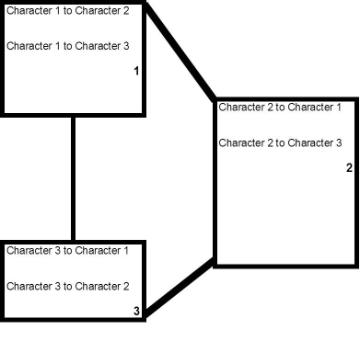
Discussion
Ask discussion questions of all 9 types.
Key Questions
- What is the condition of the team? Why were they driven so hard? What gain did it serve their masters to push them so much?
- A family purchased the team. Why was Buck concerned by the new owners?
- Why is there a need for order for the dogs?
- If someone can barely care for themselves, do you think they should be responsible for caring for others? Why or why not?
- There were many people in the town that had much more experience than the family. Why wouldn’t they ask for help?
- What conclusions can you draw when someone is unwilling to ask for help?
- Hal is trying to lead the dogs with force and they are not working well. However, they have crossed the territory 4 times and done great work. What do the dogs need from their driver?
- Do you think Hal is capable of driving them? Explain why or why not.
- If you were on the trail what would you take? What is the difference between needs and wants?
- What are the general needs of the dogs? Do Hal and Charles have any right taking the dogs on the trail when they are ill equipped to care for them?
- What advice would you give Hal and Charles?
Analyze
Analyze the key paragraph.
Key Paragraph, p. 67
“Buck and his comrades looked upon them with disgust, and though he speedily taught them their places and what not to do, he could not teach them what to do. They did not take kindly to trace and trail. With the exception of the two mongrels, they were bewildered and spirit-broken by the strange savage environment in which they found themselves and by ill treatment they had received. The two mongrels were without spirit at all; bones were the only things breakable about them” (p. 67).
Extend
Write
Have each student write a short product based on today’s prompt to connect to the unit theme.
Buck and the team although worn out were able to survive the treatment brought on by the family. They were able to withstand the abuse because of their spirit. What is spirit? How would you describe your spirit? Think about historical events in which people were not broken because of their spirits. Write two explanatory paragraphs describing the human and animal spirit. Why is it so important to survival in harsh conditions?
Close
Close by extending today’s lesson to life and the world.
Day 12
Outcomes for Today
W2. Write informative/explanatory texts to examine a topic and convey ideas, concepts, and information through the selection, organization, and analysis of relevant content.
- ) Introduce a topic clearly, previewing what is to follow; organize ideas, concepts, and information, using strategies such as definition, classification, comparison/contrast, and cause/effect; include formatting (e.g., headings), graphics (e.g., charts, tables), and multimedia when useful to aiding comprehension.
- ) Develop the topic with relevant facts, definitions, concrete details, quotations, or other information and examples.
- ) Use appropriate transitions to create cohesion and clarify the relationships among ideas and concepts.
- ) Use precise language and domain-specific vocabulary to inform about or explain the topic.
- ) Establish and maintain a formal style.
- ) Provide a concluding statement or section that follows from and supports the information or explanation presented.
- W4. Produce clear and coherent writing in which the development, organization, and style are appropriate to task, purpose, and audience. (Grade-specific expectations for writing types are defined in standards 1-3.)
- W7. Conduct short research projects to answer a question, drawing on several sources and generating additional related, focused questions for further research and investigation.
- W10. Write routinely over extended time frames (time for research, reflection, and revision) and shorter time frames (a single sitting or a day or two) for a range of discipline-specific tasks, purposes, and audiences.
Prepare
Background
Gather background knowledge about a place, time, event, person, or thing.
What is spring and summer like in the Yukon? What happens to the days?
Weather in the Yukon was extreme. In the winter, the temperatures were in the 20-30’s but with the wind chill factor could get down to -50 degrees. Due to the angle of the sun and the rotation of the earth the northern territory can have days where the sun is only our 3-5 hours.
In the spring, the temperatures are in the 50-60’s. The ice melts and the bottom is said, “to have dropped out”. That indicates that the snow and ice melts closer to the ground first and that you can walk into ice holes without seeing them and parish. During the spring and summer the days become increasingly longer as much as 16-18 hours of day light depending on your location and time of year. The climate in Skagway, Alaska is unique climate. It is sandwiched between the wet, temperate rainforest and the dry Yukon Interior. Tucked away at the northern end of the Lynn Canal Skagway is considerably drier than its Southeast Alaska neighbors with only 26.1 inches of precipitation.
While others areas in the southeast are known for their damp climate Skagway is famous for its winds. In fact, the word Skagway derives from the Tlingit word which means, “Where the water bunches up.” This is referring to the white caps that are frequently seen in the Northern Lynn Canal. The same transportation corridors that the stampeders traveled along also carry strong winds through the valleys of Skagway and Dyea. The low-lying passes, such as the Chilkoot trail and the White Pass, which became historic routes to the Klondike gold fields, are unique breaks in the coastal mountain range.
While these gaps allowed for the people to move between the coast and the interior, they are also the only path for the howling winds to move over the mountains. Windy days with sustained winds of 15-20 mph are common, and gusts of 40 mph are not infrequent.
Word Wall
Here are five vocabulary words to teach and add to the Word Wall.
|
cherished (70) |
chivalrous (70) |
fluttered (72) |
halted (73) |
rouse (74) |
Read
Review
Review the timeline from the beginning every day.
Read
Read the selection, usually in a Shared Reading Read React Predict Cycle of 2-3 pages.
Read 70-76
|
Setting |
Characters |
Pages |
|
In camp |
Hal, Charles, Mercedes, the dog team |
70-71 |
|
On the trail |
Hal, Charles, Mercedes, the dog team |
71-73 |
|
White River |
John Thornton, Hal, Charles, Mercedes, dog team |
73-76 |
Respond
Timeline
Agree on the facts in today’s reading, and list the 3-5 most important on the Timeline.
Students might mention:
- Charles, Hal, and Mercedes are constantly bickering;
- Due to their fighting they neglect the camp, themselves, and the dogs;
- The dogs are starving and the trail is too hard for the humans;
- The dogs did their best to pull the overweight sleigh, but they were starving. Mercedes would no longer walk so they had to pull her too;
- Hal continued to whip and beat the dogs. He killed Billie on the trail and left him behind;
- They arrived at the head of the White River at John Thornton’s camp. He advised them to stop traveling due to the change in weather and conditions on the trail;
- They did not listen to him. Hal proceeded to beat the dogs until they got up. Buck did not. He had a bad feeling about the trail and he lay down rather than go. He continued to get beat;
- John Thornton came to his rescue. As the team left the bottom fell out of the trail and the team and people died.
Map
Add to ongoing class activities like a KWL chart or map: where did the characters go?
Map
Create a map of the west coast, from the Yukon Territory to San Diego, and mark places along the path mentioned in the novel. Today: Add Dyea Beach and Lake Bennett
Conflict Chart:
Create a class conflict chart (see example below)
|
1st person or thing involved in the conflict |
2nd person or thing involved in the conflict |
example and page from the book |
illustration |
|
|
Man Jack |
Vs |
man Mother |
2-3 Mother never was able to maintain a stable life for him |
You should be looking for conflicts that involve (but are not limited to)
Man vs. man
Man vs. nature
Animal vs. man
Animal vs. nature
As the characters change or are involved in a conflict add them to the chart.
Theme Chart
The introduction discusses the themes of the novel. Create a “T” for the class. On one side list the themes. As you read about them give examples of each from the novel.
Explore
Activity
Explore the reading more deeply with a visual or oral language activity.
Sketch
Based on the description on page 71 sketch the condition that Buck is currently in. Use any medium that you choose.
Or
Based on the description on page 72-73 the author describes the beautiful spring weather and views that they are seeing. Sketch their present location.
Open Mind Portrait
Add to your OMP of Buck. What is he thinking and feeling as the humans choose not to care for the animals? How is their attitude and the trail affecting him? Add 5-7 new thoughts to your OMP.
Setting Chart
Using the information from today’s reading fill out a setting chart. You can use the information to write a descriptive paragraph.
Discussion
Ask discussion questions of all 9 types.
Key Questions
- Why do you think Hal, Charles, and Mercedes choose to go to the Yukon?
- What got in the way of their success on the trail?
- Why are the men choosing to give into Mercedes wishes? What does that say about all of their characters?
- On page 72 the author describes the condition of the dogs. Reread this section. In your own words, describe the condition of the dogs.
- How could that have been avoided?
- Hal and Charles asked John Thornton his advice without any indication that they would take it. What were they trying to prove by not listening? Thornton knew they were not going to listen, so why did he bother talking to them anyway?
- Thornton witnessed the men beating the dogs, why didn’t he step in sooner?
- Why did Buck choose to be beaten instead of getting up? What did he know about his future?
- As people, we tend to shy away from the advice of people who know more than we do. Why do we ask if we are going to choose to not listen?
- Do you think Hal and Charles are using their time and talent to promote the common good? What can they do to better their team?
Analyze
Analyze the key paragraph.
Key Paragraph, p. 74
“Buck refused to move under the rain of heavier blows which now fell upon him. Like his mares, he was barely able to get up, but, unlike them, he had made up his mind not to get up. He had a vague feeling of impending doom. This had been strong upon him when he pulled into the bank, and it had not departed from him” (p. 74).
Extend
Write
Have each student write a short product based on today’s prompt to connect to the unit theme.
Buck had a “gut feeling” that something bad was going to occur. Although, it was in his nature to work and demonstrate leadership requires engagement on the trail he decided not to fight and accept the doom that was going to come to him one way or another. He was fortunate of having John Thornton come to his rescue.
Think about a time that you choose to listen to your “gut” or your “intuition”. Describe the situation and what occurred. What was the outcome? Who was involved?
Write two explanatory paragraphs that describe the situation and gives details about your perspective.
Close
Close by extending today’s lesson to life and the world.
Day 13
Outcomes for Today
W2. Write informative/explanatory texts to examine a topic and convey ideas, concepts, and information through the selection, organization, and analysis of relevant content.
- ) Introduce a topic clearly, previewing what is to follow; organize ideas, concepts, and information, using strategies such as definition, classification, comparison/contrast, and cause/effect; include formatting (e.g., headings), graphics (e.g., charts, tables), and multimedia when useful to aiding comprehension.
- ) Develop the topic with relevant facts, definitions, concrete details, quotations, or other information and examples.
- ) Use appropriate transitions to create cohesion and clarify the relationships among ideas and concepts.
- ) Use precise language and domain-specific vocabulary to inform about or explain the topic.
- ) Establish and maintain a formal style.
- ) Provide a concluding statement or section that follows from and supports the information or explanation presented.
- W4. Produce clear and coherent writing in which the development, organization, and style are appropriate to task, purpose, and audience. (Grade-specific expectations for writing types are defined in standards 1-3.)
- W7. Conduct short research projects to answer a question, drawing on several sources and generating additional related, focused questions for further research and investigation.
- W10. Write routinely over extended time frames (time for research, reflection, and revision) and shorter time frames (a single sitting or a day or two) for a range of discipline-specific tasks, purposes, and audiences.
Prepare
Background
Gather background knowledge about a place, time, event, person, or thing.
What are the commands of a dog team and what do they mean?
“Mushers” are the sled drivers (humans). They normally have no problem getting a sled to start but sometimes it is hard to get them to stop. Months of training goes into a sled team to get the dogs to work together.
The most common commands for a dog team are:
• Hike!: Get moving ("Mush" and "All Right" are sometimes also used).
• Kissing sound: Speed up, faster.
• Gee!: Turn to the right.
• Haw!: Turn to the left.
• Easy!: Slow down.
• Whoa: Stop.
• On By!: Pass another team or other distraction.
In today’s reading John Thornton challenges another man over Buck’s skills
as a sled dog. John is able to stand near Buck and give the commands and Buck obeys. He is able to complete the task that the men wagered over.
Word Wall
Here are five vocabulary words to teach and add to the Word Wall.
|
embrace (77) |
nudge (78) |
demonstrative (80) |
reputation (81) |
murmur (87) |
Read
Review
Review the timeline from the beginning every day.
Read
Read the selection, usually in a Shared Reading Read React Predict Cycle of 2-3 pages.
Read 76-88
|
Setting |
Characters |
Pages |
|
White River |
John Thornton, Buck, Skeet and Nig |
76-80 |
|
Dawson/Tanana |
John Thornton, Buck, Hans, and Pete, Black Burton |
80-81 |
|
Forty Mile Creek |
John Thornton, Buck, Hans, and Pete |
82-84 |
|
Dawson |
John Thornton, Buck, Hans, Pete, men in town |
84-88 |
Respond
Timeline
Agree on the facts in today’s reading, and list the 3-5 most important on the Timeline.
Student might mention:
- John Thornton and Buck became acquainted. Buck was able to rest and regain his strength and pride.
- The other dogs respected Buck and were willing to help him heal.
- John Thornton loved the dogs. It was the first time that Buck felt truly cared for and not in a business arrangement.
- As wonderful as his new life is he still had a desire for the wild.
- Buck was scared when John was not in his sight for fear that he would leave like everyone else had.
- Buck and John became close and respected on-another. On many occasions Buck saved John from the laws of nature and from people.
- John’s traveling partners were as kind and were respectful towards him.
- Buck was respected throughout the region. The greatest task was being able to start a sled, by himself that was 1000 lbs dead weight.
Map
Add to ongoing class activities like a KWL chart or map: where did the characters go?
Map
Create a map of the west coast, from the Yukon Territory to San Diego, and mark places along the path mentioned in the novel. Today: Add Dyea Beach and Lake Bennett
Conflict Chart:
Create a class conflict chart (see example below)
|
1st person or thing involved in the conflict |
2nd person or thing involved in the conflict |
example and page from the book |
illustration |
|
|
Man Jack |
Vs |
man Mother |
2-3 Mother never was able to maintain a stable life for him |
You should be looking for conflicts that involve (but are not limited to)
Man vs. man
Man vs. nature
Animal vs. man
Animal vs. nature
As the characters change or are involved in a conflict add them to the chart.
Theme Chart
The introduction discusses the themes of the novel. Create a “T” for the class. On one side list the themes. As you read about them give examples of each from the novel.
Explore
Activity
Explore the reading more deeply with a visual or oral language activity.
Cartoon
Based on the description of Buck saving John Thornton at the river on page 81-83, Draw a cartoon that summarizes what occurred on the river.
Hero Dog Poster
Buck is proving that he is a worthy dog with many skills and talents. Draw a poster that depicts Buck’s strengths and his abilities as a hero. Your poster should include but is not limited to:
- Bucks name and breed
- Skills he has obtained
- His trail abilities
- His personality and leadership traits
- Contact information
Discussion
Ask discussion questions of all 9 types.
Key Questions
- Skeet began to help Buck immediately. Due to all of the issues he has had with other dogs why would he trust her to help him heal?
- What is the difference in the relationship Buck has with John vs. the man in the red sweater, the Frenchmen, the half-breed, and the family?
- Buck loves being around John Thornton but still likes the primitive side of himself. If you had to choose a loving healthy environment and being wild what would you choose? Why?
- Buck fought a man that was threatening John Thornton. He was taken to a jury and found not guilty. What role does the miners meeting play in the Yukon? How does this help establish justice? Why is it needed?
- How do the miners use their time and talent to better their community? How is this an example of leadership requires engagement?
- What started to happen with Buck’s reputation?
- What did Buck need to be able to succeed?
- As Buck was pulling the sled John Thornton was offered much money for him. Why didn’t he take it?
- What would you have done in the similar situation? What role does Buck fill for John?
- Select quotes from today’s chapter that explain Buck and John’s relationship.
Analyze
Analyze the key paragraph.
Key Paragraph, p. 78
“For a long time after his rescue, Buck did not like John Thornton to get out of his sight. From the moment he left the tent to when he entered it again, Buck would follow at his heels, His transient masters since he had come into the Northland had bred in him a fear that no master could be permanent. He was afraid that Thornton would pass out of his life as Perrault and Francois and the Scotch half-breed had passed out. Even at night he was haunted by this fear” (p. 78).
Extend
Write
Have each student write a short product based on today’s prompt to connect to the unit theme.
Buck lives in fear that Thornton will also leave him. This is the first time he has had a loving home and someone who cared for him. Anyone that he has respected since he has been in the north has left him to others.
Write two informative paragraphs that explain Buck’s fears that Thornton will leave him. Do you think his fear legitimate? Explain why previous owners left Buck. Were these reasons justified? Does Buck have the right to fear for his situation?
Close
Close by extending today’s lesson to life and the world.
Day 14
Outcomes for Today
W2. Write informative/explanatory texts to examine a topic and convey ideas, concepts, and information through the selection, organization, and analysis of relevant content.
- ) Introduce a topic clearly, previewing what is to follow; organize ideas, concepts, and information, using strategies such as definition, classification, comparison/contrast, and cause/effect; include formatting (e.g., headings), graphics (e.g., charts, tables), and multimedia when useful to aiding comprehension.
- ) Develop the topic with relevant facts, definitions, concrete details, quotations, or other information and examples.
- ) Use appropriate transitions to create cohesion and clarify the relationships among ideas and concepts.
- ) Use precise language and domain-specific vocabulary to inform about or explain the topic.
- ) Establish and maintain a formal style.
- ) Provide a concluding statement or section that follows from and supports the information or explanation presented.
- W4. Produce clear and coherent writing in which the development, organization, and style are appropriate to task, purpose, and audience. (Grade-specific expectations for writing types are defined in standards 1-3.)
- W7. Conduct short research projects to answer a question, drawing on several sources and generating additional related, focused questions for further research and investigation.
- W10. Write routinely over extended time frames (time for research, reflection, and revision) and shorter time frames (a single sitting or a day or two) for a range of discipline-specific tasks, purposes, and audiences.
Prepare
Background
Gather background knowledge about a place, time, event, person, or thing.
What is a legend? What is a fable?
A legend is an unverified story that has been handed down from earlier times. Many are popular if they are believed to be historical. It can also be a romanticized or popular myth of modern times. A fable is a story about legendary persons and exploits.
In today’s reading Buck was able to help John pay off debts and he and the men were able to travel looking for a mine that was said to hold great wealth. They traveled the territory looking for the mine and living off the land.
Word Wall
Here are five vocabulary words to teach and add to the Word Wall.
|
shackle (89) |
loafing (90) |
dictate (93) |
truce (93) |
gorge (94) |
Read
Review
Review the timeline from the beginning every day.
Read
Read the selection, usually in a Shared Reading Read React Predict Cycle of 2-3 pages.
Read 89-94
|
Setting |
Characters |
Pages |
|
Dawson |
Buck, John Thornton and partners |
89 |
|
On the trail—looking for the treasure house |
Buck, John Thornton, Pete, Hans, new sled team |
89-90 |
|
Camp |
Buck, John Thornton, Pete, Hans, dog team, |
90-92 |
|
In the forest |
Buck, wild dog |
92-94 |
Respond
Timeline
Agree on the facts in today’s reading, and list the 3-5 most important on the Timeline.
Students might mention:
- Buck was able to earn $1600.00 for the men by pulling the sled. They were able to pay off debts and travel looking for a fabled/legend mine.
- They departed and traveled far into the woods.
- John Thornton hunted and they feasted on what they caught on the trail.
- Buck was enjoying the journey since there was no pressure.
- They did not find the mine but they found a river that was very productive with gold. The men mined and the dogs loafed.
- Buck loved the wilderness and camp but continued to be called by the wild.
- He answered one night. On his journey he met another wild dog. They earned each other’s trust and ran through the woods. They stopped for water and Buck remembered John Thornton and returned to the camp.
- He did not leave for two days.
Map
Add to ongoing class activities like a KWL chart or map: where did the characters go?
Map
Create a map of the west coast, from the Yukon Territory to San Diego, and mark places along the path mentioned in the novel. Today: Add Dyea Beach and Lake Bennett
Conflict Chart:
Create a class conflict chart (see example below)
|
1st person or thing involved in the conflict |
2nd person or thing involved in the conflict |
example and page from the book |
illustration |
|
|
Man Jack |
Vs |
man Mother |
2-3 Mother never was able to maintain a stable life for him |
You should be looking for conflicts that involve (but are not limited to)
Man vs. man
Man vs. nature
Animal vs. man
Animal vs. nature
As the characters change or are involved in a conflict add them to the chart.
Theme Chart
The introduction discusses the themes of the novel. Create a “T” for the class. On one side list the themes. As you read about them give examples of each from the novel.
Explore
Activity
Explore the reading more deeply with a visual or oral language activity.
Open Mind Portrait
Add to your OMP of Buck. What do you think he is thinking and feeling as he has helped his master earn money, as they have started off on a wonderful journey, and as he is able to pull as lead dog but also gets time-off as the men mine? What is he thinking as he starts to explore the wilderness? Add 5-7 new thoughts to your OMP.
Discussion
Ask discussion questions of all 9 types.
Key Questions
- “John Thornton asks little of man or nature,” page 89. What does it mean to ask little of man or nature?
- What does this trait say about John Thornton’s character?
- How would one have to live their life to embody this philosophy?
- Why did the team stop looking for the mine when they found the river?
- Should they continue to follow their dream of the mine? Why or why not?
- Buck is torn between two worlds. What is drawing him to the wild? What is keeping him in camp?
- How did Buck come to trust another wild dog?
- What does Buck learn from this wolf?
- Compare and contrast Buck’s life living in the wild and living in a camp.
- If you were Buck, would you live in the wild or a camp? Explain.
- Why was Buck quick to return to camp and John Thornton? What did they share?
Analyze
Analyze the key paragraph.
Key Paragraph, p. 94
“They stopped by a running stream to drink, and, stopping Buck remembered John Thornton. He sat down. The wolf started on toward the place from where the call surely came, then returned to him, sniffing noses and making actions as though to encourage him. But Buck turned and started slowly to back track. For the better part of an hour the wild brother ran by his side, whining softly. Then he sat down, pointed his nose upwards, and howled. It was a mournful howl, and as Buck held steadily on his way he heard it grow faint and fainter until it was lost in the distance” (p. 94).
Extend
Write
Have each student write a short product based on today’s prompt to connect to the unit theme.
In this selection Buck is answering the “call of the wild”. He meets a wolf who is willing to mentor him on the ways of the wild. He is enjoying his time when he remembers John Thornton and he is drawn back to the man. Buck is caught between two worlds; the world of the wild and the world of care and compassion.
What does Buck have to lose by leaving John Thornton? What does he have to gain by answering the call? Do you think either choice is bad for him? Write three informative paragraphs explaining Buck’s choices and the consequences of each. Explain which choice Buck should make. Give three reasons from the text and from other sources to support your claims.
Close
Close by extending today’s lesson to life and the world.
Day 15
Outcomes for Today
W2. Write informative/explanatory texts to examine a topic and convey ideas, concepts, and information through the selection, organization, and analysis of relevant content.
- ) Introduce a topic clearly, previewing what is to follow; organize ideas, concepts, and information, using strategies such as definition, classification, comparison/contrast, and cause/effect; include formatting (e.g., headings), graphics (e.g., charts, tables), and multimedia when useful to aiding comprehension.
- ) Develop the topic with relevant facts, definitions, concrete details, quotations, or other information and examples.
- ) Use appropriate transitions to create cohesion and clarify the relationships among ideas and concepts.
- ) Use precise language and domain-specific vocabulary to inform about or explain the topic.
- ) Establish and maintain a formal style.
- ) Provide a concluding statement or section that follows from and supports the information or explanation presented.
- W4. Produce clear and coherent writing in which the development, organization, and style are appropriate to task, purpose, and audience. (Grade-specific expectations for writing types are defined in standards 1-3.)
- W7. Conduct short research projects to answer a question, drawing on several sources and generating additional related, focused questions for further research and investigation.
- W10. Write routinely over extended time frames (time for research, reflection, and revision) and shorter time frames (a single sitting or a day or two) for a range of discipline-specific tasks, purposes, and audiences.
Prepare
Background
Gather background knowledge about a place, time, event, person, or thing.
What does it mean to be an individual?
An individual is a person or item that is set apart and is unique in form.
Someone or something that is willing to risk their self to stand alone for a cause or idea.
In today’s reading John Thornton describes Buck as a total individual. Stating, “that there has never been a dog like Buck before and that the mold was broken after he was made.” Buck possesses great qualities not just as a sled dog but as a leader.
Word Wall
Here are five vocabulary words to teach and add to the Word Wall.
|
ferocity (95) |
recollections (95) |
vigor (96) |
secrecy (96) |
protruded (97) |
Read
Review
Review the timeline from the beginning every day.
Read
Read the selection, usually in a Shared Reading Read React Predict Cycle of 2-3 pages.
Read
|
Setting |
Characters |
Pages |
|
The camp |
Buck, John Thornton, Pete, Hans, the dog team |
94-95 |
|
The wilderness |
Buck |
95-96 |
|
The Camp |
Buck, John Thornton, Pete, Hans |
96 |
|
The Wilderness |
Buck, moose |
97-99 |
Respond
Timeline
Agree on the facts in today’s reading, and list the 3-5 most important on the Timeline.
Students might mention:
- Buck stayed in camp for two days. He was not willing to let John Thornton out of his sight.
- He heard the call again and left the camp. He was looking for the wolf and didn’t find him. He enjoyed hunting and caring for himself.
- He would occasionally return to the camp and John Thornton realized that Buck was an individual and unique as a creature.
- He continued to look for the wolf and could not find him. As much as he liked hunting small game he wanted the challenge of bringing down something larger.
- He decided to hunt for a large moose.
Map
Add to ongoing class activities like a KWL chart or map: where did the characters go?
Map
Create a map of the west coast, from the Yukon Territory to San Diego, and mark places along the path mentioned in the novel. Today: Add Dyea Beach and Lake Bennett
Conflict Chart:
Create a class conflict chart (see example below)
|
1st person or thing involved in the conflict |
2nd person or thing involved in the conflict |
example and page from the book |
illustration |
|
|
Man Jack |
Vs |
man Mother |
2-3 Mother never was able to maintain a stable life for him |
You should be looking for conflicts that involve (but are not limited to)
Man vs. man
Man vs. nature
Animal vs. man
Animal vs. nature
As the characters change or are involved in a conflict add them to the chart.
Theme Chart
The introduction discusses the themes of the novel. Create a “T” for the class. On one side list the themes. As you read about them give examples of each from the novel.
Explore
Activity
Explore the reading more deeply with a visual or oral language activity.
Discussion
Ask discussion questions of all 9 types.
Key Questions
- What possessed Buck to stay in camp once he returned?
- Why do you think Buck was not willing to let John Thornton out of his sight?
- What circumstances changed him to desire the “call of the wild”?
- John Thornton describes Buck as a true individual. What qualities and traits does Buck possess that contribute to that?
- Do you think Buck was born with those traits or were they developed along the way? Explain.
- How did his trials and successes help him? Which do you think he learned from most?
- Do you think individuals are an example of leadership requires engagement? Why or why not? Can individuals better their community?
- Why did Buck want to kill a moose? What did he have to gain by that triumph? Does that desire promote the common good? Explain.
- How has Bucks perspective changed? What are his new desires?
- Describe a time when your perspective changed? How did that change your decisions and actions?
- Predict what would happen if Buck answered the “call of the wild”.
Analyze
Analyze the key paragraph.
Key Paragraph, p. 96
“‘Never was there such a dog,’ said John Thornton one day, as the partners watched Buck march out of camp.
‘When he was made, the mold was broke,’ said Pete” (p. 96).
Extend
Write
Have each student write a short product based on today’s prompt to connect to the unit theme.
Today’s reading focuses on Buck and his ability to be an individual. He was taught by others but also had a deep desire to succeed on his own. Throughout the book he stood for others and was a leader. In an informative paragraph explain how Buck is an example of an individual. Provide three examples from the text that support Buck’s ability to be an individual.
Close
Close by extending today’s lesson to life and the world.
Day 16
Outcomes for Today
W2. Write informative/explanatory texts to examine a topic and convey ideas, concepts, and information through the selection, organization, and analysis of relevant content.
- ) Introduce a topic clearly, previewing what is to follow; organize ideas, concepts, and information, using strategies such as definition, classification, comparison/contrast, and cause/effect; include formatting (e.g., headings), graphics (e.g., charts, tables), and multimedia when useful to aiding comprehension.
- ) Develop the topic with relevant facts, definitions, concrete details, quotations, or other information and examples.
- ) Use appropriate transitions to create cohesion and clarify the relationships among ideas and concepts.
- ) Use precise language and domain-specific vocabulary to inform about or explain the topic.
- ) Establish and maintain a formal style.
- ) Provide a concluding statement or section that follows from and supports the information or explanation presented.
- W4. Produce clear and coherent writing in which the development, organization, and style are appropriate to task, purpose, and audience. (Grade-specific expectations for writing types are defined in standards 1-3.)
- W7. Conduct short research projects to answer a question, drawing on several sources and generating additional related, focused questions for further research and investigation.
- W10. Write routinely over extended time frames (time for research, reflection, and revision) and shorter time frames (a single sitting or a day or two) for a range of discipline-specific tasks, purposes, and audiences.
Prepare
Background
Gather background knowledge about a place, time, event, person, or thing.
Who are the Yeehats?
The Yeehats were a tribe of Indians that were referenced in The Call of the Wild. The tribe is said to be located in the Yukon Territory. However, this tribe was made up by Jack London for the sake of the novel
Word Wall
Here are five vocabulary words to teach and add to the Word Wall.
|
magnetic (99) |
thicket (100) |
cessation (102) |
gaunt (103) |
abiding (104) |
Read
Review
Review the timeline from the beginning every day.
Read
Read the selection, usually in a Shared Reading Read React Predict Cycle of 2-3 pages.
Read 99-104
|
Setting |
Characters |
Pages |
|
In the wilderness |
Buck, the moose |
99-100 |
|
Trail back to camp |
Buck |
100 |
|
Camp |
Buck, the Yeehats |
101 |
|
Camp |
Buck, the remains of John Thornton, Pete, Hans, and the dog team |
102-103 |
|
Camp |
Buck, the wild wolves |
103-104 |
Respond
Timeline
Agree on the facts in today’s reading, and list the 3-5 most important on the Timeline.
Students might mention
- Buck pulled the great moose down after four days of hunting. He ate and rested and decided to return to camp;
- As he trotted he became more aware that something was wrong;
- Once he got close to camp he realized that the dogs and the men were dead;
- He continued scenting until he realized that John Thornton was also dead. He lost his head when he realized that he was dead;
- The Yeehat tribe was in camp. Buck viscously attacked them;
- He scattered them among the countryside. He returned to camp to try and get the full picture of what happened;
- While there a pack of wild wolves approached him. He fought them off with honor;
- He discovered one of the wolfs was the one he had run with and they formed a truce;
- The wolf elders accepted him and he began to run with them;
- The Yeehats were fearful of his legend and told his story for many years;
- They refused to hunt in his valley and they respected him for his abilities.
Map
Add to ongoing class activities like a KWL chart or map: where did the characters go?
Map
Create a map of the west coast, from the Yukon Territory to San Diego, and mark places along the path mentioned in the novel. Today: Add Dyea Beach and Lake Bennett
Conflict Chart:
Create a class conflict chart (see example below)
|
1st person or thing involved in the conflict |
2nd person or thing involved in the conflict |
example and page from the book |
illustration |
|
|
Man Jack |
Vs |
man Mother |
2-3 Mother never was able to maintain a stable life for him |
You should be looking for conflicts that involve (but are not limited to)
Man vs. man
Man vs. nature
Animal vs. man
Animal vs. nature
As the characters change or are involved in a conflict add them to the chart.
Theme Chart
The introduction discusses the themes of the novel. Create a “T” for the class. On one side list the themes. As you read about them give examples of each from the novel.
Explore
Activity
Explore the reading more deeply with a visual or oral language activity.
Open Mind Portrait
Add to your OMP of Buck. What is he thinking and feeling when he realized he lost John Thornton? What are his options? Add 5-7 new thoughts to your OMP.
Newspaper
Create a newspaper front page that depicts the highlights of the story. Your newspaper should include:
- Title;
- 3-5 News stories that summarize important events in the novel;
- 1 feature story that highlights a person or animal in the story;
- At least 2 illustrations;
- Weather information for the territory
- You can include additional information as you see fit. Be creative.
Discussion
Ask discussion questions of all 9 types.
Key Questions
- When Buck describes his magnetic needle, what is he referring to?
- How does Buck’s magnetic needle relate to his instincts?
- When Buck realizes that he has lost John Thornton he, “lost his head.” What is referred to by that quote?
- Describe the bond between John Thornton and Buck. Why was it so unique?
- How did Buck and John Thornton use their time and talent to better each other?
- When Buck realized that the camp was dead do you think he felt guilt or shame that he was not there? Do you think he could have avoided or helped save the team? What would you have done?
- What changed in Buck after he attacked the Yeehats?
- Do you think the Yeehats will forever respect the skills that Buck has? Explain.
- How was Buck accepted by the wolves? How did he choose to approach them when they came into camp? What does that say about his personality?
- Predict how Buck’s life will change.
Analyze
Analyze the key paragraph.
Extend
Write
Have each student write a short product based on today’s prompt to connect to the unit theme.
Buck has a choice on how to approach the pack of wild dogs. He can be aggressive and attack or he can choose to approach them on dignified terms. He has just lost his trusted friend and is alone in the world. He wants to pursue the “Call of the Wild” but most likely cannot do it on his own.
In an explanatory paragraph describe Buck’s choices. In a second paragraph, explain what Buck needs to do to survive from this day forward with the pack. Use personal experience and other sources to support your thesis. In a final paragraph, describe how can Buck use his talent to better the pack?
Close
Close by extending today’s lesson to life and the world.