Lesson Plan
Nothing But the Truth
40
60
90
Day 1
Outcomes for Today
Prepare
Background
Gather background knowledge about a place, time, event, person, or thing.
What is perspective?
Perspective is the ability to perceive things differently.
Have students watch the scene from Dead Poets Society on perspective.
Go to YouTube—search Dead Poets Society, new perspective
Point of View in literature--The perspective from which a speaker or writer recounts a narrative or presents information. Depending on the topic, purpose, and audience, writers of nonfiction may rely on the first-person point of view (I, we), the second-person (you, your), or the third-person (he, she, it, they).
In today’s reading point of view will be in both first person and third person. The novel will show three main points of view or perspectives on the same event. Notice as we read how the perspective is slightly different.
Word Wall
Here are five vocabulary words to teach and add to the Word Wall.
|
stead pg. 1 |
designated pg. 1 |
consult pg. 1 |
reluctantly pg. 4 |
carpe diem pg. 6 |
Read
Review
Review the timeline from the beginning every day.
Read
Read the selection, usually in a Shared Reading Read React Predict Cycle of 2-3 pages.
Read p. 1-11
|
Setting |
Characters |
Pages |
|
Memo format |
School |
1-2 |
|
From Diary of Phillip |
Phillip |
3-4 |
|
Letter from Mrs. Narwin |
Mrs. Narwin and her sister Anita |
4-5 |
|
Class |
Mr. Luster and students |
6-7 |
|
From Diary of Phillip |
Phillip |
7-8 |
|
School Memo |
School |
9 |
|
Phone call |
Phillip and Allison |
10-11 |
Respond
Timeline
Agree on the facts in today’s reading, and list the 3-5 most important on the Timeline.
Students might mention
- Memo of the morning routine expected at the school.
- Diary entry of Phil, a 9th grade boy, who thinks his English teacher is uptight and Jack London is boring.
- Phil is a runner and wants to go to the Olympics.
- Diary entry of the English teacher (Mrs. Narwin) talking about kids today lacking a love of literature.
- Mr. Lunser’s homeroom class sounds a bit chaotic.
Map
Add to ongoing class activities like a KWL chart or map: where did the characters go?
Slant Poster/ T Chart
As the facts of the suspension start to develop, create a T Chart or poster to track the different slants that the characters will use.
On one side list the character and the slant that is given (cite the page) on the other side list what actually occurred.
Explore
Activity
Explore the reading more deeply with a visual or oral language activity.
School Morning Exercises
Memo of your school’s morning activities.
Use a sense of humor and follow the format of author.
http://www.history.com/ to search “This Day in History” topics.
Open Mind Portrait
Create an OMP for either Mrs. Narwin or Phillip (you will continue this OMP throughout the reading.) What are they thinking or feeling as the novel begins. Add 3-5 thoughts to your OMP.
Discussion
Ask discussion questions of all 9 types.
Key Questions
- Why do you think they started the book with the Memo?
- What do you know about Phillip Malloy? What drives him as a student? List three facts.
- What do we know about Mrs. Narwin? List three facts.
- Mrs. Narwin writes about Phillip in her letter to her sister. Do you think her comments are based on fact or her opinion of him?
- How do you like the journal entry format so far? Why do you think the author chose this format? Would the book be effective if it was written in narrative form?
- What do we know about Mr. Lunser? How does he start the day? How do students perceive the seriousness of the announcements from his perspective?
Analyze
Analyze the key paragraph.
Key Paragraph
Page 1—point 3
3. Say, “Please all rise and stand at respectful, silent attention for the playing of our national anthem.”
Extend
Write
Have each student write a short product based on today’s prompt to connect to the unit theme.
The memo from the school district is that students should, “rise and stand at respectful, silent attention for the playing of our national anthem.” What do you think that statement means. What do you consider respectful, silent attention when the anthem plays? Do you think the national anthem was meant to be sung or listened to?
Write a one paragraph argument in which you state what your version of, “rise and stand at respectful, silent attention for the playing of our national anthem.”
Introduce claim(s), acknowledge alternate or opposing claims, and organize the reasons and evidence logically. Support claim(s) with logical reasoning and relevant evidence, using accurate, credible sources and demonstrating an understanding of the topic or text. Use words, phrases, and clauses to create cohesion and clarify the relationships among claim(s), reasons, and evidence. Establish and maintain a formal style. Provide a concluding statement or section that follows from and supports the argument presented.
Close
Close by extending today’s lesson to life and the world.
Extend the reading to the students’ lives or to the world.
Day 2
Outcomes for Today
Prepare
Background
Gather background knowledge about a place, time, event, person, or thing.
What is the role of the Board of Education?
The State Board of Education is the K-12 policy-making body for academic standards, curriculum, instructional materials, assessments and accountability. The SBE adopts instructional materials for use in grades kindergarten through eight. The SBE also adopts regulations (Title 5) to implement a wide variety of programs created by the Legislature, such as charter schools, and special education. In addition, the SBE has the authority to grant local education agency requests for waivers of certain provisions of the state Education Code. The SBE has 11 members, all of whom are appointed by the Governor and serve four-year, staggered terms, with the exception of the student member, who serves a one-year term. The State Superintendent of Public Instruction, who heads the CDE, serves as the SBE's executive officer and secretary.
There are county and local boards of education. Search your local board of education and search for their purpose.
In today’s reading the Superintendent writes a memo to the staff letting them know about the upcoming election and vote for funds.
Word Wall
Here are five vocabulary words to teach and add to the Word Wall.
|
symbolic pg. 12 |
vital pg. 14 |
entice pg. 15 |
beneficiaries pg. 15 |
reduced pg. 15 |
Read
Review
Review the timeline from the beginning every day.
Read
Read the selection, usually in a Shared Reading Read React Predict Cycle of 2-3 pages.
Read p. 12-19
|
Setting |
Characters |
Pages |
|
Exam |
Phillip, Mrs. Narwin |
12-13 |
|
Grant request |
Mrs. Narwin |
14-15 |
|
Memo |
Superintendent Seymour |
16-17 |
|
From Phillip |
Phillip |
18-19 |
Respond
Timeline
Agree on the facts in today’s reading, and list the 3-5 most important on the Timeline.
Students might mention
- Phil receives a memo stating his new homeroom teacher is Miss Narwin.
- Phil calls Allison and asks her about Call of the Wild.
- Phil writes an unacceptable answer to Miss Narwin’s essay question.
- Miss Narwin wants support from her principal to attend an extended teacher’s professional development conference.
Map
Add to ongoing class activities like a KWL chart or map: where did the characters go?
Slant Poster/ T Chart
As the facts of the suspension start to develop create a T Chart or poster to track the different slants that the characters will use.
On one side list the character and the slant that is given (cite the page) on the other side list what actually occurred.
Explore
Activity
Explore the reading more deeply with a visual or oral language activity.
Open Mind Portrait of Miss Narwin;
OMP of Phillip
Add to your OMP of Miss Narwin or of Phillip. What are they thinking and feeling? Add 3-5 new thoughts to your OMP.
Discussion
Ask discussion questions of all 9 types.
Key Questions
- Do you think Miss Narwin is out of touch as a teacher? Do you think she has a lot of latitude in what she teaches?
- Was Phillip’s response on her test appropriate? Do you think Miss Narwin was being fair by giving him a C-? Explain.
- Why does Miss Narwin want the grant funds? What does this say about her as an educator? What is she trying to accomplish with these funds?
- What is the threat from the Superintendent? Do you think schools should have more money or be more effective? Can they do both?
- How do you think Phil responded to the news that his homeroom teacher was changed?
- What are Phil and Miss Narwin’s impressions of one another?
- How would you try to get a kid like Phillip interested in books?
Analyze
Analyze the key paragraph.
Key Paragraph
Page 18:
I have been teaching a long time…I feel I am in need of new ideas, strategies, and concepts to keep my teaching vital. The truth is—and I believe I can speak honestly to you about this—I feel that sometimes I am a little out of touch with contemporary teaching, and just as important, the students who come before me these days…I want to find new works and new ways to entice the young people of today.
Extend
Write
Have each student write a short product based on today’s prompt to connect to the unit theme.
Miss Narwin has to convince her principal and superintendent that she should be able to attend the conference. Pretend you are Miss Narwin and you want to attend a conference to learn more strategies.
Write a one-paragraph argument in which you try to convince your principal she should find the funds to support you. Introduce your claim (what do you want?). Organize the reasons for your request logically (2-3). Support your claims with relevant evidence and organize your reasons logically. Use accurate sources. Use words and phrases to create cohesions and clarify the relationships. Establish formal style. Provide a conclusion that follows form and supports your argument.
Close
Close by extending today’s lesson to life and the world.
Extend the reading to the students’ lives or to the world.
Day 3
Outcomes for Today
Prepare
Background
Gather background knowledge about a place, time, event, person, or thing.
What are the eligibility requirements for athletics at your school? Consult your school handbook.
Why do you think these requirements are enforced at school? (for discussion)
GPA requirements are typically in place so students maintain balance. Education is the top priority and extracurricular activities are encouraged if grades are appropriate and at least a C average.
In today’s reading Phillip learns he cannot try out for the track team due to his grades. The coach continues to remind him of the “rule” but does a poor job of explaining why the rule is in place.
Word Wall
Here are five vocabulary words to teach and add to the Word Wall.
|
severely pg. 20 |
allocated pg. 20 |
foreseen pg. 20 |
admire pg. 20 |
tiresome pg. 25 |
Read
Review
Review the timeline from the beginning every day.
Read
Read the selection, usually in a Shared Reading Read React Predict Cycle of 2-3 pages.
Read p. 20-32
|
Setting |
Characters |
Pages |
|
School |
Peg |
20-21 |
|
Discussion |
Phillip and Coach Jamison |
21-24 |
|
Miss Narwin’s Class |
Miss Narwin, class, Phillip |
24-25 |
|
Home |
Phillip’s parents |
26-27 |
|
Home |
Phillip and his dad |
28-30 |
|
Letter |
Miss Narwin and her sister |
30-31 |
|
Phillip’s diary |
Phillip |
32 |
Respond
Timeline
Agree on the facts in today’s reading, and list the 3-5 most important on the Timeline.
Students might mention
- We learn that this district is facing a lack of funds and an upcoming vote.
- Phil is getting okay grades in everything except English.
- Miss Narwin is not able to secure any money for professional development.
- Coach talks with Phil and says he can’t even try out for the track team with a D on his report card.
Map
Add to ongoing class activities like a KWL chart or map: where did the characters go?
Slant Poster/ T Chart
As the facts of the suspension start to develop create a T Chart or poster to track the different slants that the characters will use.
On one side list the character and the slant that is given (cite the page) on the other side list what actually occurred.
Explore
Activity
Explore the reading more deeply with a visual or oral language activity.
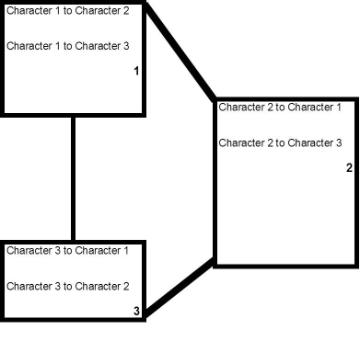
Character Interaction Chart.
Start tracking the interaction between:
Miss Narwin and the school administration,
Miss Narwin and Phillip,
Phillip and his parents
School Rule Poster
Create a poster that visually represents the basic school rules or rules you feel are important to a healthy school community.
Discussion
Ask discussion questions of all 9 types.
Key Questions
- What does the district’s motto mean? Where our children are educated, not just taught.
- What were the results of Miss Narwin asking for money? Do you think the principal was correct to tell Miss Narwin who got the money and why? What could the result of that knowledge be?
- What is the district’s predicament with money and what are the implications?
- What does Coach tell Phillip about his grades? Do you think the coach did a good job of explaining to Phillip the reason for the rule or ways to try and fix the situation?
- Do Phillip’s parents take time to hear what he is saying? Why is the difference between listening and hearing? What does Phillip need from them?
- Does Miss Narwin have a right to be upset she did not get the funds for her class? What are some reasons she might have been overlooked?
Analyze
Analyze the key paragraph.
Key Paragraph
Page 21:
Throughout the U.S., we find that the aging population (living on restricted and/or shrinking incomes in an inflation-prone world), along with reduced government support of education, conflicts with the needs of young people who live in a society that demands educational excellence even while promoting passive acceptance of mass-media culture.
Extend
Write
Have each student write a short product based on today’s prompt to connect to the unit theme.
If you didn’t have children in school, would you vote for a request that asked you for more money for the school system? Whose responsibility is it to educate students? The government? The taxpayers?
Write an argument in which you make a claim about whose responsibility it is to educate students. Introduce claim(s), acknowledge alternate or opposing claims, and organize the reasons and evidence logically. Support claim(s) with logical reasoning and relevant evidence, using accurate, credible sources and demonstrating an understanding of the topic or text. Use words, phrases, and clauses to create cohesion and clarify the relationships among claim(s), reasons, and evidence.
Establish and maintain a formal style. Provide a concluding statement or section that follows from and supports the argument presented.
Close
Close by extending today’s lesson to life and the world.
Extend the reading to the students’ lives or to the world.
Day 4
Outcomes for Today
Prepare
Background
Gather background knowledge about a place, time, event, person, or thing.
How do you resolve conflict?
The background today relates to offices but is very applicable to school, office, or life settings.
Conflict Resolution Techniques
Consider the following conflict resolution techniques to help resolve issues:
Listen, Then Speak Out
Believe it or not, just listening to an employee’s issue is the first and most important step in resolving conflict. You should simply listen to all parties involved to completely understand the nature of conflict, and then start troubleshooting solutions.
Gather the Group
As a leader, you’ll need to arrange a meeting with all involved parties to discuss the issue. Give everyone a chance to speak; this is a good opportunity to hear all sides and gain a full understanding of the conflict. Having a group meeting may also expedite a resolution that will satisfy everyone.
Be Impartial
Don’t take sides! In a leadership position, you shouldn’t display any sort of opinion that favors one person over another. If you are partial towards one person, try to access the situation from all sides to come up with a fair and reasonable solution.
Do Not Postpone Conflict Resolution
Address the conflict immediately. Otherwise, the situation could escalate and could affect employee performance. Just make sure not to address the situation too quickly or without careful consideration, as your decision will directly affect the demeanor and performance of your staff.
Promote Teamwork
Encouragement and motivations are powerful. Remind your staff of successful projects that required teamwork to complete. This is one of the most effective conflict resolution techniques and will really make the employees think about the importance of working in a team.
Broadcast Praise
As stated above, the power of encouragement and motivation can be multiplied when it is spread to recognize those who are modeling the teamwork and cooperation that is desired within any conflict. Try to give suitable models in these instances because behavior modeling can be risky if there are elements in the model that are undesirable.
In today’s reading it is clear that Miss Narwin and Phillip have a conflict with one another. They are each blaming one and other and basing their dislike for one another in false statements. At this point in time one of them needed to stop and address the other. Sometimes teens have to act like the adult and address the issue, sometimes parents should step in, or the teacher/coach should address the true issue.
Word Wall
Here are five vocabulary words to teach and add to the Word Wall.
|
transferred pg. 22 |
particular pg. 34 |
humming pg. 35 |
faculty pg. 36 |
discussion pg. 39 |
Read
Review
Review the timeline from the beginning every day.
Read
Read the selection, usually in a Shared Reading Read React Predict Cycle of 2-3 pages.
Read p. 33-39
|
Setting |
Characters |
Pages |
|
Bus |
Phillip and Ken |
33 |
|
Miss Narwin’s Class |
Miss Narwin, Phillip, Class |
34-35 |
|
Faculty room |
Miss Narwin and Mr. Benison |
36-37 |
|
Lunchroom |
Phillip and Todd Becker |
38-39 |
|
English Class |
Miss Narwin and class |
39 |
Respond
Timeline
Agree on the facts in today’s reading, and list the 3-5 most important on the Timeline.
Students might mention:
- Student’s homerooms were changed. Lots of confusion.
- Phillip starts humming the Star Spangled Banner in Miss Narwin’s homeroom class.
- Miss Narwin tells him to stop.
- Miss Narwin is frustrated that she did not get financial support.
- Phillip is angry he is in Miss Narwin’s class and she told him to stop singing. Some kids like her as a teacher, he does not.
Map
Add to ongoing class activities like a KWL chart or map: where did the characters go?
Slant Poster/ T Chart
As the facts of the suspension start to develop create a T Chart or poster to track the different slants that the characters will use.
On one side list the character and the slant that is given (cite the page) on the other side list what actually occurred.
Explore
Activity
Explore the reading more deeply with a visual or oral language activity.
Open Mind Portrait
Add to your OMP of Phillip or Miss Narwin. What do you think they are thinking and feeling? Add 3-5 new thoughts to your OMP.
Discussion
Ask discussion questions of all 9 types.
Key Questions
- What is Phillip’s feeling about being in Miss Narwin’s homeroom? What do you think he should do at this point to deal with the conflict? What do you think he is trying to accomplish by talking to others about her?
- What impact does it have on the reader to read lots of different characters’ perspectives? Are you starting to see slight variances in their perspectives? Give 1 or 2 examples.
- Do you think Miss Narwin could have addressed Phillip differently when he started humming? What could she have done? Give 1-2 examples.
- How has the issue with Phillip’s grades gotten twisted with the issue of the not being able to sing in class? What is he frustrated about? How is he dealing with that frustration?
Analyze
Analyze the key paragraph.
Key Paragraph
Page 37:
Benison: “Oh well, the term won’t last forever.”
Benison: Hey, the meaning of life.
Miss Narwin: Sometimes I wonder. Maybe I will get some coffee.
Extend
Write
Have each student write a short product based on today’s prompt to connect to the unit theme.
Have you ever heard the phrase, “you need to lose a few battles to win the war”?
In this exchange between Mr. Benison and Miss Narwin Mr. Benison does not seem as upset about Phillip singing/humming. His take, the term won’t last forever. They have approximately 40 days of school left. Do you think that Miss Narwin should stick by her principles or try to find a compromise with Phillip?
Write a one-paragraph argument in which you support or oppose Miss Narwin’s stance on this issue. Support your claim with logical reasoning and relevant evidence. Use accurate and credible sources. Use words and phrases to create cohesion and clarify the relationships. Establish and maintain formal style. Provide a concluding statement that follows form and supports the argument presented.
Close
Close by extending today’s lesson to life and the world.
Extend the reading to the students’ lives or to the world.
Day 5
Outcomes for Today
Prepare
Background
Gather background knowledge about a place, time, event, person, or thing.
What does it mean to be patriotic?
A patriot is one who loves their country and supports its authority and interests. Once can show patriotism in a variety of ways:
- Have respect for the flag, pledging allegiance to our flag, and knowing the national anthem.
- We can be engaged and involved in civic activities, being a responsible citizen, and following the laws of our country, even if we disagree, we have the responsibility to speak out.
- We can show patriotism be regarding all citizens as a family. Working together for the good of our country.
- We can support our troops and their families who are sacrificing for our country.
In today’s reading Phillip shares with his parents about the interaction in Miss Narwin’s class. His dad comes to speak with him telling him that they are on his side and they support him.
Word Wall
Here are five vocabulary words to teach and add to the Word Wall.
|
suppose pg. 41 |
obviously pg. 43 |
delicious pg. 45 |
civilized pg. 45 |
patriot pg. 48 |
Read
Review
Review the timeline from the beginning every day.
Read
Read the selection, usually in a Shared Reading Read React Predict Cycle of 2-3 pages.
Read p. 40-48
|
Setting |
Characters |
Pages |
|
Bus |
Phillip and Allison |
40 |
|
Main office |
Miss Narwin and Mr. Lunser |
41-42 |
|
Dinner |
Phillip and his parents |
42-45 |
|
Letter |
Miss Narwin and Anita |
45-46 |
|
Conversation |
Allison and Janet |
46-47 |
|
Conversation |
Phillip and his father |
47-48 |
Respond
Timeline
Agree on the facts in today’s reading, and list the 3-5 most important on the Timeline.
Students might mention:
- Phil makes trouble for Miss Narwin in her homeroom class by humming during the national
- Lots of students like Miss Narwin, but Phil thinks she has it out for him.
- Phillip tells his parents about Miss Narwin and the national anthem.
- His parents agree to support him.
Map
Add to ongoing class activities like a KWL chart or map: where did the characters go?
Slant Poster/ T Chart
As the facts of the suspension start to develop create a T Chart or poster to track the different slants that the characters will use.
On one side list the character and the slant that is given (cite the page) on the other side list what actually occurred.
Explore
Activity
Explore the reading more deeply with a visual or oral language activity.
Poster
Visit the following two links. Create a poster that depicts proper etiquette during the national anthem as well as proper flag etiquette.
Discussion
Ask discussion questions of all 9 types.
Key Questions
- What kind of attitude does Phil have toward Miss Narwin?
- What do Phil’s friends say to him when they find out he didn’t try out for the track team? Why isn’t Phillip telling them the truth? Do you think he has made the correlation between his failing grade and not being able to try out?
- Who does Phillip blame for his grade? Where should the responsibility be placed?
- Mr. Lunser and Miss Narwin have a conversation about the national anthem. What is your perspective of their conversation? How do you think he feels about it and Miss Narwin?
- Phillip and his parents have a family discussion about the event. What is your reaction to their conversation? Do you think Phillip is being entirely honest with them? What is he really mad about?
- Phillip’s dad speaks with him about not being able to sing. He refers to it as being personal, like praying. Do you think singing the anthem is personal? Or should everyone know the words and sign with it? Explain.
Analyze
Analyze the key paragraph.
Key Paragraph
Page 48
“Not being allowed to sing the “Star Spangled Banner”…well, that’s like, sort of, not being allowed, to you know, pray. A personal thing. And the personal thing, in America. ..the point is, it doesn’t seem right.
Extend
Write
Have each student write a short product based on today’s prompt to connect to the unit theme.
Mr. Malloy feels that Miss Narwin is wrong about not letting Phillip sing. He feels it is personal and she should not be stopping him. He encourages for Phillip to stand up for himself. Do you agree with him?
Write a one-paragraph argument in which you agree or oppose his statement. Introduce claim(s), acknowledge alternate or opposing claims, and organize the reasons and evidence logically. Support claim(s) with logical reasoning and relevant evidence, using accurate, credible sources and demonstrating an understanding of the topic or text. Use words, phrases, and clauses to create cohesion and clarify the relationships among claim(s), reasons, and evidence. Establish and maintain a formal style. Provide a concluding statement or section that follows from and supports the argument presented.
Close
Close by extending today’s lesson to life and the world.
Extend the reading to the students’ lives or to the world.
Day 6
Outcomes for Today
Prepare
Background
Gather background knowledge about a place, time, event, person, or thing.
What is the history of the Star Spangled Banner?
Francis Scott Key was a gifted amateur poet. Inspired by the sight of the American flag flying over Fort McHenry the morning after the bombardment, he scribbled the initial verse of his song on the back of a letter. Back in Baltimore, he completed the four-verse version and copied them onto a sheet of paper, probably making more than one copy. A local printer issued the new song as a broadside. Shortly afterward, two Baltimore newspapers published it, and by mid-October it had appeared in at least seventeen other papers in cities up and down the East Coast.
http://amhistory.si.edu/starspangledbanner/symbols-of-a-new-nation.aspx
In today’s reading Phillip starts to sing with the national anthem again. In this case he is asked to leave class. He is claiming he has a right to sing.
Visit the website above to tour the flag and history that surrounds it and the national anthem.
Word Wall
Here are five vocabulary words to teach and add to the Word Wall.
|
gleaming pg. 49 |
perilous pg. 49 |
gallantly pg. 49 |
insolence pg. 50 |
disobedient pg. 52 |
Read
Review
Review the timeline from the beginning every day.
Read
Read the selection, usually in a Shared Reading Read React Predict Cycle of 2-3 pages.
Read p. 49-58
|
Setting |
Characters |
Pages |
|
Miss Narwin’s Class |
Phillip and class |
49-50 |
|
Assistant Principal’s Office |
Phillip and Mr. Palleni |
50-53 |
|
Conversation |
Mr. Malloy and his boss |
53-54 |
|
Conversation |
Miss Narwin and her principal |
54-55 |
|
Conversation |
Mr. and Mrs. Malloy |
56 |
|
Conversation |
Phillip and his parents |
57-58 |
Respond
Timeline
Agree on the facts in today’s reading, and list the 3-5 most important on the Timeline.
Students might mention:
- Dad tells Phil he will stand behind him if he wants to stick up for his rights.
- Phil hasn’t exactly told his parents the truth about the story.
- Miss Narwin kicks Phil out of class the next day for continuing to hum after being asked to stop.
- Miss Narwin is told she cannot have the funding and that she should be the Master teacher.
Map
Add to ongoing class activities like a KWL chart or map: where did the characters go?
Slant Poster/ T Chart
As the facts of the suspension start to develop create a T Chart or poster to track the different slants that the characters will use.
On one side list the character and the slant that is given (cite the page) on the other side list what actually occurred.
Explore
Activity
Explore the reading more deeply with a visual or oral language activity.
Open Mind Portrait
Add to your OMP. What are the characters thinking and feeling? Add 3-5 new thoughts to your OMP.
Discussion
Ask discussion questions of all 9 types.
Key Questions
- Why is Phillip kicked out from class? Do you think his punishment is fitting to the crime?
- The principal wants to hear his side of the story. What are three facts about his side of the story?
- The principal tells him there is a school rule. The rule is in the form of a memo. Do you think the memo constitutes a rule? Explain. Why would a school put such a rule in place?
- Phillip has a new appreciation for his parents. Do you think they fully understand the situation at this point? What should they do to get clarity before they pledge full support of their son?
Analyze
Analyze the key paragraph.
Key Paragraph
Page 52
“How can you ask someone not to sing “The Star Spangled Banner”?
It’s the rule.
Is a memo a rule?
Phillip….
Extend
Write
Have each student write a short product based on today’s prompt to connect to the unit theme.
In today’s reading the Assistant Principal is telling Phillip not to break the rule and to stop singing. There is a trend in America that the public allows celebrities to sing the national anthem to them, but does not join in themselves.
Do you think the public should be encouraged or discouraged from singing the national anthem? Should a school have this rule in place?
Write an argument in which you support or oppose the public’s participation in the national anthem. Introduce claim(s), acknowledge alternate or opposing claims, and organize the reasons and evidence logically. Support claim(s) with logical reasoning and relevant evidence, using accurate, credible sources and demonstrating an understanding of the topic or text. Use words, phrases, and clauses to create cohesion and clarify the relationships among claim(s), reasons, and evidence. Establish and maintain a formal style. Provide a concluding statement or section that follows from and supports the argument presented.
Close
Close by extending today’s lesson to life and the world.
Extend the reading to the students’ lives or to the world.
Day 7
Outcomes for Today
Prepare
Background
Gather background knowledge about a place, time, event, person, or thing.
What are the components to a proper apology?
How To Give A Meaningful Apology
By Beverly Engel
Full article can be found at:
http://www.umass.edu/fambiz/articles/resolving_conflict/meaningful_apology.html
A meaningful apology is one that communicates what I call the three R's--regret, responsibility, and remedy.
- A statement of regret for having caused the inconvenience, hurt or damage. This includes an expression of empathy toward the other person, including an acknowledgement of the inconvenience, hurt, or damage that you caused the other person. Having empathy for the person you hurt or angered is the most important part of your apology. When you truly have empathy the other person will feel it. Your apology will wash over him or her like a healing balm. On the other hand, if you don't have empathy your apology will sound and feel empty.
- An acceptance of responsibility for your actions. This means not blaming anyone else for what you did and not making excuses for your actions but instead accepting full responsibility for what you did and for the consequences of your actions.
- A statement of your willingness to take some action to remedy the situation--either by promising to not repeat your action, a promise to work toward not making the same mistake again, a statement as to how you are going to remedy the situation (go to therapy) or by making restitution for the damages you caused. Apologizing to your spouse for having an affair is insulting unless you offer reassurances: It will never happen again because we will seek therapy, because I've quit my job, because I'll take you on my business trips.
Regret, Responsibility and Remedy
Unless all three of these elements are present, the other person will sense that something is missing in your apology and he or she will feel shortchanged somehow. Let's take a look at each element separately.
Regret
The desire to apologize needs to come from the realization that you have hurt someone or caused them some difficulty in their life. While your intention may not have been to hurt this person, you recognize that your action or inaction nevertheless did hurt or inconvenience them and for this, you feel bad. This regret or remorse needs to be communicated to the other person.
Examples:
- "I am so sorry. I know I hurt your feelings and I feel terrible about it."
- "I deeply regret having hurt you."
- "I am truly sorry for the pain I caused you."
Responsibility
For an apology to be effective it must be clear that you are accepting total responsibility for your actions or inaction. Therefore, your apology needs to include a statement of responsibility.
Examples:
- "I'm sorry; I realize that by being late I made us miss the first part of the movie."
- "I'm sorry. I know it is difficult for you to trust people and my lying to you hasn't made it any easier. I shouldn't have lied no matter how afraid I was of your reaction."
- "I'm sorry. You have every right to be angry with me. I shouldn't have said those words to you."
- "I'm so sorry. There's no excuse for my behavior and I know I hurt you deeply.
Remedy
While you can't go back and undo or redo the past, you can do everything within your power to repair the harm you caused. Therefore, a meaningful apology needs to include a statement in which you offer restitution in some way, an offer to help the other person, or a promise to take action so that you will not repeat the behavior.
Examples:
- "I'm sorry. Let me make it up to you. Next time the movie is on me."
- "I'm sorry for lying to you. I promise I won't do it again."
- "I'm sorry for talking to you like that. I'll work on letting you know when I don't like something instead of holding it all in and then exploding like that."
- "I'm sorry. I'm going to go into therapy so I can understand why I act the way I do."
http://www.umass.edu/fambiz/articles/resolving_conflict/meaningful_apology.html
In today’s reading Phillip is asked to apologize to Miss Narwin. However, he does not feel like he has done anything to apologize for.
Word Wall
Here are five vocabulary words to teach and add to the Word Wall.
|
disrespectful pg. 59 |
suspension pg. 61 |
provocative pg. 63 |
apology pg. 65 |
incident pg. 65 |
Read
Review
Review the timeline from the beginning every day.
Read
Read the selection, usually in a Shared Reading Read React Predict Cycle of 2-3 pages.
Read p. 59-71
|
Setting |
Characters |
Pages |
|
Homeroom class |
Phillip, Miss Narwin, class |
59-60 |
|
Assistant Principal’s Office |
Dr. Palleni and Phillip |
60-62 |
|
Miss Narwin’s Class |
Dr. Palleni and Miss Narwin |
62-63 |
|
Assistant Principal’s Office |
Dr. Palleni and Phillip |
64-65 |
|
Conversation |
Dr. Palleni and Phillip’s mom |
65-66 |
|
Conversation |
Mrs. and Mr. Malloy (Phillip’s mom and dad) |
67 |
|
Assistant Principal’s Office |
Dr. Palleni, Phillip, Phillip’s mom |
69-71 |
Respond
Timeline
Agree on the facts in today’s reading, and list the 3-5 most important on the Timeline.
Students might mention:
- The assistant principal thinks Phil is being disobedient in Narwin’s class.
- Phillip gets kicked out of Miss Narwin’s class for singing the National Anthem.
- The Assistant Principal tells him to apologize and they will not suspend him.
- Miss Narwin confirms that he was singing.
- Phillip gets suspended from school for breaking a rule.
Map
Add to ongoing class activities like a KWL chart or map: where did the characters go?
Slant Poster/ T Chart
As the facts of the suspension start to develop create a T Chart or poster to track the different slants that the characters will use.
On one side list the character and the slant that is given (cite the page) on the other side list what actually occurred.
Explore
Activity
Explore the reading more deeply with a visual or oral language activity.
Cartoon
Create a 6-panel cartoon in which you depict today’s reading.
Sketch the characters and give them thought bubbles to summarize the events.
Open Mind Portrait
Add to your OMP. What are the character’s thinking and feeling? Add 3-5 new thoughts to your OMP.
Discussion
Ask discussion questions of all 9 types..
Key Questions
- What are the various storylines the author is developing?
- Why won’t Phillip apologize? What does he want? Do you think he really cares about the National Anthem?
- What does Miss Narwin want? What is her impression about Phillip? What are her assumptions about him?
- Do you think that Dr. Palleni should move his class? What is a better alternative to suspension in this situation?
- What is Phillip being suspended for? Be specific.
- What is the ‘truth’ of Miss Narwin’s teaching?
Analyze
Analyze the key paragraph.
Key Paragraph
Page 62:
Palleni: “That’s all you have to say?
Palleni: Nothing is free.”
Phillip: It’s a free country.
Extend
Write
Have each student write a short product based on today’s prompt to connect to the unit theme.
Dr. Palleni tells Phillip that nothing is free in a free country. Think of the costs that are associated with freedom. Do all choices have a consequence either positive or negative?
Write a paragraph in which you agree with or oppose Dr. Palleni’s statement, “nothing is free.” Introduce claim(s), acknowledge alternate or opposing claims, and organize the reasons and evidence logically. Support claim(s) with logical reasoning and relevant evidence, using accurate, credible sources and demonstrating an understanding of the topic or text. Use words, phrases, and clauses to create cohesion and clarify the relationships among claim(s), reasons, and evidence. Establish and maintain a formal style. Provide a concluding statement or section that follows from and supports the argument presented.
Close
Close by extending today’s lesson to life and the world.
Extend the reading to the students’ lives or to the world.
Day 8
Outcomes for Today
Prepare
Background
Gather background knowledge about a place, time, event, person, or thing.
What is the First Amendment?
Congress shall make no law respecting an establishment of religion, or prohibiting the free exercise thereof; or abridging the freedom of speech, or of the press; or the right of the people peaceably to assemble, and to petition the Government for a redress of grievances.
The First Amendment Defined:
The First Amendment is a part of the Bill of Rights, which are the first 10 Amendments to the United States Constitution and the framework to elucidate upon the freedoms of the individual. The Bill of Rights were proposed and sent to the states by the first session of the First Congress. They were later ratified on December 15, 1791.
The first 10 Amendments to the United States Constitution were introduced by James Madison as a series of legislative articles and came into effect as Constitutional Amendments following the process of ratification by three-fourths of the States on December 15, 1791.
Stipulations of the 1st Amendment:
The First Amendment to the United States Constitution prohibits the passing or creation of any law, which establishes a religious body and directly impedes an individual’s right to practice whichever religion they see fit.
The First Amendment to the United States Constitution is a part of the Bill of Rights and the amendment which disables an entity or individual from practicing or enforcing a religious viewpoint which infringes on the freedom of speech, the right peaceable assemble, the freedom of the press, or which prohibits the petitioning for a governmental evaluation of grievances.
In its infancy, the First Amendment only applied to laws enacted by Congress; however, the following Gitlow v. New York, the Supreme Court developed that the Due Process Clause attached to the Fourteenth Amendment applies the fundamental aspects of the First Amendment to each individual state, including all local governments within those states.
The Establishment clause of the First Amendment is the primary pronouncement in the Amendment, stating that Congress cannot institute a law to establish a national religion for the preference of the U.S. government states that one religion does not favor another. As a result, the Establishment Clause effectively created a wall of separation between the church and state.
In today’s reading Phillip’s father comes home to hear Phillip’s side of the story. He thinks their neighbor, who is running for school board, will be interested in this information. He is speaking with a reporter and introduces the family to her. She will be able to report this story, AFTER she fact checks.
Word Wall
Here are five vocabulary words to teach and add to the Word Wall.
|
disturbance pg. 72 |
obscure pg. 74 |
advisable pg. 74 |
intrigues pg. 77 |
relevant pg. 79 |
Read
Review
Review the timeline from the beginning every day.
Read
Read the selection, usually in a Shared Reading Read React Predict Cycle of 2-3 pages.
Read p. 71-82
|
Setting |
Characters |
Pages |
|
School |
Memo’s to teacher and principle |
71-74 |
|
School |
Dr. Palleni and Miss Narwin |
74-75 |
|
Phone |
Ken and Phillip |
75-76 |
|
Phone |
Phillip and Allison |
76-77 |
|
Letter |
Miss Narwin and her sister |
77-78 |
|
Home |
Phillip and his mom and dad |
78-80 |
|
Neighbor’s |
Phillip, Mr. Malloy, Ted griffin |
81 |
Respond
Timeline
Agree on the facts in today’s reading, and list the 3-5 most important on the Timeline.
Students might mention:
- The AP moves Phillip’s homeroom class.
- He informs Miss Narwin he took care of the Malloy boy by suspending him.
- Miss Narwin did not agree with the punishment and wants to talk to him when he returns.
- Phillip’s friends learn of the suspension—with varying degrees of approval.
- Phillip tells his parents his side of the story.
- Malloy takes Phillip to meet their neighbor to tell him what happened.
Map
Add to ongoing class activities like a KWL chart or map: where did the characters go?
Slant Poster/ T Chart
As the facts of the suspension start to develop create a T Chart or poster to track the different slants that the characters will use.
On one side list the character and the slant that is given (cite the page) on the other side list what actually occurred.
Explore
Activity
Explore the reading more deeply with a visual or oral language activity.
Open Mind Portrait
Add to your OMP. What are the characters thinking and feeling? Add 3-5 new thoughts to your OMP.
Poster
Phillip was suspended. Create a poster that gives alternative punishments for his rule violation. Be creative and school appropriate. What would be a better way to punish him?
Discussion
Ask discussion questions of all 9 types.
Key Questions
- Do you find the story very realistic? Why or why not?
- Do you find the characters believable?
- What do you think is going to happen?
- Do you think the principal should transfer Phillip out of both classes?
- What is Miss Narwin’s reaction to the suspension? What is her plan when he returns to school? Do you think she will be too late to make a difference? Explain.
- In what way is Phillip trying to create conflict?
- What are the reactions of Phillip’s friends? Are their reactions based on fact or opinion? Explain.
- Do Phillip’s parents really listen to him? Do they leap to conclusions or try to get out all of the information? Explain. Give suggestions on questions they could ask or things they could do to help, not hinder the situation?
Analyze
Analyze the key paragraph.
Key Paragraph
Page 78
“Twice this week I had to send him out for being disruptive in a singularly disrespectful way. Our society is always asking schools to do what is not done at home. Then Joe Palleni (assistant principal) felt compelled to suspend him for a bit, something I have believed is productive.”
Extend
Write
Have each student write a short product based on today’s prompt to connect to the unit theme.
Miss Narwin acknowledges schools have been placed in a position to not only educate children but also discipline, to make up for what is not done at home. However, she does not agree with the suspension. Do you agree with her, have schools been placed in a position where they are fulfilling or assuming a role for parents? Think of the services schools provide (food, education, discipline, counseling services, safety, sports) should schools be just for education?
Write a one-paragraph argument in which you agree or oppose Miss Narwin. Introduce claim(s), acknowledge alternate or opposing claims, and organize the reasons and evidence logically. Support claim(s) with logical reasoning and relevant evidence, using accurate, credible sources and demonstrating an understanding of the topic or text. Use words, phrases, and clauses to create cohesion and clarify the relationships among claim(s), reasons, and evidence. Establish and maintain a formal style. Provide a concluding statement or section that follows from and supports the argument presented.
Close
Close by extending today’s lesson to life and the world.
Extend the reading to the students’ lives or to the world.
Day 9
Outcomes for Today
Prepare
Background
Gather background knowledge about a place, time, event, person, or thing.
What does it mean to put a “slant” on something?
A slant in writing or speaking is to present information so it conforms to a particular bias or so it appeals to a certain audience.
In today’s reading Phillip and his father speak to Ted Griffin their neighbor and the reporter. They present the information about the suspension but it has a slant that does not convey the entire story.
Word Wall
Here are five vocabulary words to teach and add to the Word Wall.
|
confidence pg. 83 |
condone pg. 83 |
particular pg. 85 |
values pg. 86 |
confidential pg. 89 |
Read
Review
Review the timeline from the beginning every day.
Read
Read the selection, usually in a Shared Reading Read React Predict Cycle of 2-3 pages.
Read p. 83-91
|
Setting |
Characters |
Pages |
|
Ted Griffen’s home |
Phillip, Mr. Mallow, Ted, Griffen, and Jennifer Stewart |
83-86 |
|
Conversation |
Jennifer Stewart and Dr. Seymour |
87-88 |
|
Conversation |
Jennifer Stewart and Dr. Doanne |
88-90 |
|
Home |
Phillip and his mother |
91 |
Respond
Timeline
Agree on the facts in today’s reading, and list the 3-5 most important on the Timeline.
Students might mention:
- Malloy and Phillip go and talk to their neighbor.
- Ken Griffen is running for school board and is being interviewed by an education reporter.
- The reporter asks questions. The answers are slanted on Phillip’s behalf.
- The reporter starts to fact check her story.
Map
Add to ongoing class activities like a KWL chart or map: where did the characters go?
Slant Poster/ T Chart
As the facts of the suspension start to develop create a T Chart or poster to track the different slants that the characters will use.
On one side list the character and the slant that is given (cite the page) on the other side list what actually occurred.
Explore
Activity
Explore the reading more deeply with a visual or oral language activity.
Open Mind Portrait
Add to your OMP for Phillip or Miss Narwin. What are they thinking and feeling? Add 3-5 new thoughts to your OMP.
Slant Poster/ T Chart
As the facts of the suspension start to develop create a T Chart or poster to track the different slants that the characters will use.
On one side list the character and the slant that is given (cite the page) on the other side list what actually occurred.
Discussion
Ask discussion questions of all 9 types.
Key Questions
- What did Phillip share with the reporter?
- How do Ted and Mr. Malloy describe their relationship and the tone of the neighborhood? Is that reality or their perceived reality for this story?
- Mr. Malloy states, “She’s always on the boys back. Bad teacher. Kids don’t like her.” Pg. 84 Is Mr. Malloy speaking with factual authority on Miss Narwin? What does he risk by sharing this information with a reporter, which is not entirely true?
- What is Jennifer doing? What is the role of the journalist? Do you think that present day journalist fact check? Explain? Why do journalist need to report responsibly? Explain.
- Why did Phillip get suspended? What is Jennifer asking? Is it the same issue? Explain.
Analyze
Analyze the key paragraph.
Key Paragraph
Pages 85-86
Mr. Griffen “I don’t intend to be silent on this issue. This is a school, and American school, and parents have the right to expect that certain things, like values, will be taught. Community values. Things I believe in. I mean that. Sincerely.”
Extend
Write
Have each student write a short product based on today’s prompt to connect to the unit theme.
What kind of values do you think Mr. Griffen is referring to? Do you think that it is the role of the school to instill values in children or is the role of the parents? Or both? If parents do not educate kids on values, should the school? What values are and should be taught by schools?
Write a one-paragraph argument in which you introduce claim(s), acknowledge alternate or opposing claims, and organize the reasons and evidence logically. Support claim(s) with logical reasoning and relevant evidence, using accurate, credible sources and demonstrating an understanding of the topic or text. Use words, phrases, and clauses to create cohesion and clarify the relationships among claim(s), reasons, and evidence. Establish and maintain a formal style. Provide a concluding statement or section that follows from and supports the argument presented.
Close
Close by extending today’s lesson to life and the world.
Extend the reading to the students’ lives or to the world.
Day 10
Outcomes for Today
Prepare
Background
Gather background knowledge about a place, time, event, person, or thing.
What are facts?
Can humans re-tell facts without interjecting perspective? For discussion.
A fact is something that exists. Reality. Truth.
In today’s reading the reporter starts calling the school administration and teacher to “fact check” the story she was told. She wants to make sure she is reporting accurate information.
Word Wall
Here are five vocabulary words to teach and add to the Word Wall.
|
dismissed pg. 94 |
disturbance pg. 94 |
pride pg. 99 |
insisting pg. 101 |
budget pg. 101 |
Read
Review
Review the timeline from the beginning every day.
Read
Read the selection, usually in a Shared Reading Read React Predict Cycle of 2-3 pages.
Read p. 92-104
|
Setting |
Characters |
Pages |
|
Conversation |
Reporter and Joseph Palleni |
92-93 |
|
Conversation |
Reporter and Miss Narwin |
93-95 |
|
Conversation |
Dr. Doane and Joseph Palleni |
96-97 |
|
Home |
Phillip |
97-98 |
|
Newspaper |
|
99-100 |
|
Conversation |
Dr. Doane and Dr. Seymour |
100-101 |
|
Conversation |
Ken and Phillip |
102 |
|
Home |
Phillip’s parents |
103-104 |
|
Conversation |
Miss Narwin and her sister |
104 |
Respond
Timeline
Agree on the facts in today’s reading, and list the 3-5 most important on the Timeline.
Students might mention:
- Reporter calls to fact check the story she was told by Phillip and his dad.
- Doane starts to call to talk to Miss Narwin and Mr. Palleni about the story.
- The reporter contacts many people asking for clarification about this issue.
- The principal did not know Phil was suspended.
- The superintendent states that there is no rule against singing the anthem.
Map
Add to ongoing class activities like a KWL chart or map: where did the characters go?
Slant Poster/ T Chart
As the facts of the suspension start to develop create a T Chart or poster to track the different slants that the characters will use.
On one side list the character and the slant that is given (cite the page) on the other side list what actually occurred.
Explore
Activity
Explore the reading more deeply with a visual or oral language activity.
Open Mind Portrait
Add to your OMP. What are the characters thinking and feeling? Add 3-5 new thoughts to your OMP.
STOP Sign
The events are starting to spin out of control.
Create a stop sign that you can use to signal/list three ways the characters could stop this situation from getting worse.
Discussion
Ask discussion questions of all 9 types.
Key Questions
- How does Allison’s impression of Miss Narwin differ from Phillip’s?
- How does Phil’s dad escalate the situation? How does Ted escalate the situation?
- What are 2 things Phillip’s parents should do before reacting?
- Is the reporter doing her due diligence? Explain.
- Before talking to the reporter what should the school staff do? Do they have an obligation to answer questions before they have all of the facts?
- How are the perspectives different? Explain.
Analyze
Analyze the key paragraph.
Key Paragraph
Page 94
Ms. Stewart: I am simply trying to get my facts correct. Wanting to be fair to all concerned. I am sure you can appreciate that.
Extend
Write
Have each student write a short product based on today’s prompt to connect to the unit theme.
Ms. Steward is fact checking her story. Do you think that in today’s information age reporters do their due diligence prior to reporting information? What are the consequences if they do not?
Write a 1-paragraph argument in which you support or oppose the need for reporters to present information unbiased and accurate. Introduce claim(s), acknowledge alternate or opposing claims, and organize the reasons and evidence logically. Support claim(s) with logical reasoning and relevant evidence, using accurate, credible sources and demonstrating an understanding of the topic or text. Use words, phrases, and clauses to create cohesion and clarify the relationships among claim(s), reasons, and evidence. Establish and maintain a formal style. Provide a concluding statement or section that follows from and supports the argument presented.
Close
Close by extending today’s lesson to life and the world.
Extend the reading to the students’ lives or to the world.
Day 11
Outcomes for Today
Prepare
Background
Gather background knowledge about a place, time, event, person, or thing.
What do you consider valid news sources? (for discussion)
There was a time that people got their news from 2-3 TV news stations, from the radio, and from the newspaper. As we have progressed into the information age there are news cycles for everything. The internet is a vast network of information and there are many outlets to get news. Due to sources trying to beat the other sources for stories and for information fact checking is not as thorough as it once was. You can find news that is biased toward any perspective that you need or want.
In today’s reading a news station is reporting on the story. A man calls in and mentions that the story is slanted towards the boy’s point of view and does not represent the teacher. The host of the show is getting ratings based on the sensationalism not on the facts.
Word Wall
Here are five vocabulary words to teach and add to the Word Wall.
|
taxes pg. 105 |
generation pg. 105 |
elemental pg. 105 |
affiliated pg. 106 |
scandal pg. 106 |
Read
Review
Review the timeline from the beginning every day.
Read
Read the selection, usually in a Shared Reading Read React Predict Cycle of 2-3 pages.
Read p. 105-116
|
Setting |
Characters |
Pages |
|
Radio |
Jack Barlow |
105-107 |
|
Superintendent |
Mrs. Harland and Dr. Seymour |
108 |
|
Radio |
Jack Barlow |
109-110 |
|
Conversation |
Dr. Seymour and Dr. Doane |
111 |
|
Radio |
Jack Barlow |
112 |
|
Conversation |
Dr. Doane and reporter |
113-114 |
|
Radio |
Jack Barlow |
114-116 |
Respond
Timeline
Agree on the facts in today’s reading, and list the 3-5 most important on the Timeline.
Students might mention:
- No one seems to understand that he was thrown out because he was disturbing class not because he was singing the anthem.
- The radio and media is picking up the story and inflaming public opinion.
- The principal, superintendent, and school board members are trying to sort the facts out.
Map
Add to ongoing class activities like a KWL chart or map: where did the characters go?
Slant Poster/ T Chart
As the facts of the suspension start to develop create a T Chart or poster to track the different slants that the characters will use.
On one side list the character and the slant that is given (cite the page) on the other side list what actually occurred.
Explore
Activity
Explore the reading more deeply with a visual or oral language activity.
Open Mind Portrait
Add to your OMP. What are the characters thinking and feeling? Add 3-5 new thoughts to your OMP.
Character Interaction Sheet
Add to the Character Interaction Chart you started. How are the characters interacting with one another?
Discussion
Ask discussion questions of all 9 types.
Key Questions
- Why is Ted using this issue in his speeches? Do you think he is passionate about this issue or using the issue as an opportunity to get elected? Explain.
- What did the superintendent know about the situation? Do you see a difference in why Phillip was suspended and what people know about the situation? What is the difference?
- How does the media affect the reaction of the principal and district? Would this be an issue if the media didn’t report on it? Do you feel like the media is reporting fairly?
- What is the difference between the Jack Barlow Show and the reported in the print media? Do they have different responsibilities? Explain.
- What is the “book salesman” trying to explain? Do you think he has a valid point?
Analyze
Analyze the key paragraph.
Key Paragraph
Page 115
Roger: No, I didn’t say that. I am not defending anyone. The story you read is just the boy’s, not the teacher’s. Why should you assume the teacher is wrong?
Extend
Write
Have each student write a short product based on today’s prompt to connect to the unit theme.
The caller is trying to make a point that there is more than one side to each story. Do you think he has a valid point? Is there a responsibility for the writer’s and reporters to accurately report the news? Do you agree with the caller or the radio host?
Write a one-paragraph argument in which you state the role of each party and what their position is. State if you agree or disagree with them. Introduce your claims. Acknowledge the alternate or opposing claim. Organize your reasons. Support your claim with logical reasons and evidence. Use words, phrases, and clauses to create cohesion. Provide a concluding statement in which supports your claim.
Close
Close by extending today’s lesson to life and the world.
Extend the reading to the students’ lives or to the world.
Day 12
Outcomes for Today
Prepare
Background
Gather background knowledge about a place, time, event, person, or thing.
What is a witness?
An individual who personally sees or perceives a thing, an eyewitness.
In today’s reading the school staff starts to interview “witnesses” from Miss Narwin’s class. Most of them admit to the principal that they weren’t really paying attention. Another interjects her opinion. Witnesses are supposed to base their report on the facts that they see or hear.
Word Wall
Here are five vocabulary words to teach and add to the Word Wall.
|
commotion pg. 117 |
deliberately pg. 117 |
chemistry pg. 118 |
infractions pg. 118 |
occurrence pg. 120 |
Read
Review
Review the timeline from the beginning every day.
Read
Read the selection, usually in a Shared Reading Read React Predict Cycle of 2-3 pages.
Read p. 117-127
|
Setting |
Characters |
Pages |
|
School Office |
Principal, Assistant Principal, Miss Narwin |
117-119 |
|
Memo |
Assistant Principal |
119 |
|
Conversation |
Dr. Doane and Ken |
120-122 |
|
Phone conversation |
Ken and Phillip |
122-123 |
|
Conversation |
Dr. Doane and Cynthia |
123-125 |
|
Speech |
Ted and the Rotary Club |
126 |
|
Conversation |
Dr. Doane and Allison |
126-127 |
Respond
Timeline
Agree on the facts in today’s reading, and list the 3-5 most important on the Timeline.
Students might mention:
- The principal and assistant principal are interviewing Miss Narwin and trying to get all of the facts from her.
- The assistant principal writes a draft of the events.
- The principal starts to interview witnesses to the event.
- Ted Griffen makes a speech about this event.
- The students interject their opinions into the events as well as the facts.
Map
Add to ongoing class activities like a KWL chart or map: where did the characters go?
Slant Poster/ T Chart
As the facts of the suspension start to develop create a T Chart or poster to track the different slants that the characters will use.
On one side list the character and the slant that is given (cite the page) on the other side list what actually occurred.
Explore
Activity
Explore the reading more deeply with a visual or oral language activity.
Open Mind Portrait
Add to your OMP. What do you think he is thinking and feeling? Add 3-5 new thoughts to your OMP.
Discussion
Ask discussion questions of all 9 types.
Key Questions
- How does Miss Narwin react to being interviewed?
- What does Dr. Doane ask Ken? Do you think she is encouraging him to remain impartial? What does Ken tell her?
- What does Dr. Doane ask Cynthia? Do you think she is encouraging her to remain impartial? What does Cynthia tell her? How do you think Dr. Doane will react to Cynthia’s account of the event?
- What was the gist of Ted’s speech?
- What does Dr. Doane ask Allison? Do you think she is encouraging her to remain impartial? What does Allison tell her? How do you think Allison is being factual about what she is telling Dr. Doane? Explain.
Analyze
Analyze the key paragraph.
Key Paragraph
Pages 119-120:
Reread entire memo
Extend
Write
Have each student write a short product based on today’s prompt to connect to the unit theme.
What did you think of the memo? Was it a fair representation of the ‘truth’?
Write a one-paragraph argument in which you support or oppose the facts in the memo. Introduce claim(s), acknowledge alternate or opposing claims, and organize the reasons and evidence logically. Support claim(s) with logical reasoning and relevant evidence, using accurate, credible sources and demonstrating an understanding of the topic or text. Use words, phrases, and clauses to create cohesion and clarify the relationships among claim(s), reasons, and evidence. Establish and maintain a formal style. Provide a concluding statement or section that follows from and supports the argument presented.
Close
Close by extending today’s lesson to life and the world.
Extend the reading to the students’ lives or to the world.
Day 13
Outcomes for Today
Prepare
Background
Gather background knowledge about a place, time, event, person, or thing.
What does the motto of New Hampshire, “Live Free or Die” mean?

State Emblem. The state emblem shall be of the following design: Within an elliptical panel, the longest dimension of which shall be vertical, there shall appear an appropriate replica of the Old Man of the Mountain; surrounding the inner panel, and enclosed within another ellipse, there shall be at the bottom of the design the words of any state motto which may be adopted by the general court; and at the top of the design, between the inner and outer elliptical panels, the words, New Hampshire, appropriately separated from the motto, if adopted, by one star on each side. Said emblem may be placed on all printed or related material issued by the state and its subdivisions relative to the development of recreational, industrial, and agricultural resources of the state.
New Hampshire Revised Statutes Annotated (RSA) 3:1
Anderson, Leon. History. Manual for the General Court 1981.
State Motto. The words "Live Free or Die," written by General John Stark, July 31, 1809, shall be the official motto of the state.
It was the 1945 Legislature that gave New Hampshire its official motto and emblem, as World War II approached a successful end.
The motto became "Live Free Or Die," as once voiced by General John Stark, the state’s most distinguished hero of the Revolutionary War, and the world famous Old Man of the Mountain was voted the official state emblem.
The motto was part of a volunteer toast which General Stark sent to his wartime comrades, in which he declined an invitation to head up a 32nd anniversary reunion of the 1777 Battle of Bennington in Vermont, because of poor health. The toast said in full: "Live Free Or Die; Death Is Not The Worst of Evils." The following year, a similar invitation (also declined) said: "The toast, sir, which you sent us in 1809 will continue to vibrate with unceasing pleasure in our ears, "Live Free Or Die; Death Is Not The Worst Of Evils."
http://www.nh.gov/nhinfo/emblem.html
The novel takes place in New Hampshire. This phrase has been referenced throughout the reading. The state motto supports what Ted and Phillip’s father “believe” that Phillip should be free to express the national anthem. However, in all situations every action has a reaction and although he has the freedom to sing the song he also has to deal with the consequences of breaking the rule.
Word Wall
Here are five vocabulary words to teach and add to the Word Wall.
|
raucous pg. 128 |
indicative pg. 129 |
animosity pg. 129 |
indicates pg. 129 |
preservation pg. 130 |
Read
Review
Review the timeline from the beginning every day.
Read
Read the selection, usually in a Shared Reading Read React Predict Cycle of 2-3 pages.
Read p. 128-139
|
Setting |
Characters |
Pages |
|
Memo |
Dr. Doane |
128-129 |
|
Telegrams |
All over the country |
130-131 |
|
Memo |
Dr. Seymour |
131-133 |
|
Home |
Phillips Parents |
133 |
|
Home |
Phillip, his parents |
134-135 |
|
Chamber of Commerce |
Ted |
135-136 |
|
Conversation |
Miss Narwin and her sister |
136-137 |
|
Conversation |
Miss Narwin and Dr. Doane |
137-138 |
|
Diary |
Phillip |
139 |
Respond
Timeline
Agree on the facts in today’s reading, and list the 3-5 most important on the Timeline.
Students might mention
- The school staff has to outline the incident for the district.
- They ask witnesses what they saw and heard.
- The memo’s start to slant to support the school.
- Telegrams start arriving at the school and at Phillip’s in support or opposition of one party.
Map
Add to ongoing class activities like a KWL chart or map: where did the characters go?
Slant Poster/ T Chart
As the facts of the suspension start to develop create a T Chart or poster to track the different slants that the characters will use.
On one side list the character and the slant that is given (cite the page) on the other side list what actually occurred.
Explore
Activity
Explore the reading more deeply with a visual or oral language activity.
Open Mind Portrait
Add to your OMP. What do you think he is thinking and feeling? Add 3-5 new thoughts to your OMP.
Venn Diagram
Create a Venn Diagram using the memos on page 128 and 131. Compare and contrast the facts in each memo. What is different and what is similar? Pay close attention to the words used.
You can use this Venn diagram to write a comparison paragraph or essay.

Discussion
Ask discussion questions of all 9 types.
Key Questions
- What is happening now in terms of people getting on the bandwagon?
- How are the telegrams starting to affect each side?
- Why do you think the school waited until now to talk to other students in the class? Should they have taken that action sooner?
- How does the original memo change be the time the final draft is written?
- Is the final memo written based on fact or does it have opinion in it? Explain.
- What role does the school and district play in making this a bigger or smaller story?
- How do interest groups affect this story? Do you think they are looking for facts or are they looking for a story and a “victim”?
Analyze
Analyze the key paragraph.
Key Paragraph
Page 128:
Re-read the entire memo
Extend
Write
Have each student write a short product based on today’s prompt to connect to the unit theme.
What did you think of the memo that Principal Doane re-wrote? Was it a fair representation of the ‘truth’?
Write a one-paragraph argument in which you support or oppose the facts in the memo. Introduce claim(s), acknowledge alternate or opposing claims, and organize the reasons and evidence logically. Support claim(s) with logical reasoning and relevant evidence, using accurate, credible sources and demonstrating an understanding of the topic or text. Use words, phrases, and clauses to create cohesion and clarify the relationships among claim(s), reasons, and evidence. Establish and maintain a formal style. Provide a concluding statement or section that follows from and supports the argument presented.
Close
Close by extending today’s lesson to life and the world.
Extend the reading to the students’ lives or to the world.
Day 14
Outcomes for Today
Prepare
Background
Gather background knowledge about a place, time, event, person, or thing.
What is truth?
Truth can be the conformity of fact or reality.
In today’s reading more people are forming their opinions. As they form their thoughts on the subject they seem to be tainted by their outside opinions and perspectives and experiences.
Word Wall
Here are five vocabulary words to teach and add to the Word Wall.
|
ability pg. 140 |
dismayed pg. 140 |
statement pg. 147 |
misconstrue pg. 148 |
prohibits pg. 149 |
Read
Review
Review the timeline from the beginning every day.
Read
Read the selection, usually in a Shared Reading Read React Predict Cycle of 2-3 pages.
Read p. 140- 151
|
Setting |
Characters |
Pages |
|
Letter |
Miss Narwin |
140-141 |
|
Conversation |
Dr. Seymour and Dr. Doane |
142-143 |
|
Home |
Phillip and his parents |
143-144 |
|
Bus |
Ken and Phillip |
145-146 |
|
School |
Miss Narwin and Dr. Doane |
146-148 |
|
School |
Phillip and Allison |
148-149 |
|
Memo |
School |
149 |
|
School/Class |
Mr. Lunser, Phillip, Students |
150-151 |
Respond
Timeline
Agree on the facts in today’s reading, and list the 3-5 most important on the Timeline.
Students might mention
- Telegrams and letters are arriving in support and opposition to Miss Narwin and the school.
- The superintendent is needing to issue a statement and take action on the situation to appease the voters
- Phillip’s parents continue to support him.
- Miss Narwin is not feeling supported by the school.
- Phillip’s homeroom was moved.
- The students are starting to make fun of him.
Map
Add to ongoing class activities like a KWL chart or map: where did the characters go?
Slant Poster/ T Chart
As the facts of the suspension start to develop create a T Chart or poster to track the different slants that the characters will use.
On one side list the character and the slant that is given (cite the page) on the other side list what actually occurred.
Explore
Activity
Explore the reading more deeply with a visual or oral language activity.
Open Mind Portrait—
Add to your OMP. What are they thinking and feeling as more of the story and reaction to it unfolds? Add 3-5 more thoughts to your OMP.
Postcard
Who do you support?
Write a postcard to the character in the book you support. Encourage them in their efforts based on the information you know about them. On the front illustrate a picture that represents your character.
Discussion
Ask discussion questions of all 9 types.
Key Questions
- How do the letters and telegrams affect the school staff and district? Do you think they would react the way they are if there was no public outcry?
- What are Phillip’s concerns about returning to school? Does the change in teacher alter his perception of the situation? Explain.
- How does Ken react when Philip tells him he is not out for track due to his grades? How does this information change Ken’s perspective? Explain.
- Miss Narwin reads the statement and feels it does not support her. Do you agree or disagree with her? Explain. How could it be changed to show support of the staff?
- How do Mr. Lunser and the other students treat Phillip? Are they being fair?
Analyze
Analyze the key paragraph.
Key Paragraph
Page 148:
Miss Narwin: He is a student. I am a teacher. Hands are not meant to be even.
Extend
Write
Have each student write a short product based on today’s prompt to connect to the unit theme.
Miss Narwin sees the school is trying to pacify the student and the district. In doing so, they do not support her authority in class. Do you think that teachers and people of authority should be supported? Do you agree or oppose her view above?
Write a one-paragraph argument in which you support or oppose her statement. Introduce your claim and acknowledge the opposing viewpoint. Support your claim with logical and relevant evidence using accurate sources. Use words, phrases, and clauses to create cohesion and clarify the relationship. Establish and maintain formal style. Provide a concluding statement that supports your claim.
Close
Close by extending today’s lesson to life and the world.
Extend the reading to the students’ lives or to the world.
Day 15
Outcomes for Today
Prepare
Background
Gather background knowledge about a place, time, event, person, or thing.
What is the difference between suspension and expulsion?
If a student is suspended from school they are removed from campus for a determined number of days (short term). When that time is done you can return to campus or to class. If a student is expelled they are removed from the school or district for a set amount of time (longer term) and cannot return until all conditions have been met.
In today’s reading Phillip is able to return to school after he has been suspended. He was sent home for 2 days for causing a disturbance in Miss Narwin’s class.
Word Wall
Here are five vocabulary words to teach and add to the Word Wall.
|
quote pg. 151 |
statement pg. 151 |
confess pg. 152 |
contemporary pg. 156 |
tenure pg. 157 |
Read
Review
Review the timeline from the beginning every day.
Read
Read the selection, usually in a Shared Reading Read React Predict Cycle of 2-3 pages.
Read p. 151-161
|
Setting |
Characters |
Pages |
|
Phone conversation |
Dr. Doane and reporter |
151-152 |
|
Conversation |
Phillip and students |
152-153 |
|
Letters |
Phillip |
153-154 |
|
Conversation |
Dr. Seymour and Ted |
154-157 |
|
Lunchroom |
Phillip and Todd |
157 |
|
Teachers Lunchroom |
Miss Narwin and Mr. Benison |
158 |
|
Classroom |
Miss Narwin and Phillip |
159 |
|
Field |
Phillip and Coach Jamison |
160 |
Respond
Timeline
Agree on the facts in today’s reading, and list the 3-5 most important on the Timeline.
Students might mention
- Phil is receiving many letters supporting him singing.
- The Superintendent wants the budget to pass and thinks that if he finds a way to fire Miss Narwin people will think the problem has been solved and will pass the budget.
- He is working with Ted, who is running for the School Board, to make this happen.
- Phil approaches Miss Narwin about doing extra work.
- She tells him his class has been switched and to leave the room.
Map
Add to ongoing class activities like a KWL chart or map: where did the characters go?
Slant Poster/ T Chart
As the facts of the suspension start to develop create a T Chart or poster to track the different slants that the characters will use.
On one side list the character and the slant that is given (cite the page) on the other side list what actually occurred.
Explore
Activity
Explore the reading more deeply with a visual or oral language activity.
Plot Profile Chart
Start a plot profile chart for today’s reading. Add 3-4 significant events. Rate them on a scale of 1-10 based on their intensity. Yu will add to this as you complete the novel.
Open Mind Portrait.
Add to your OMP. What is the character thinking and feeling based on today’s reading. Add 3-5 new thoughts.
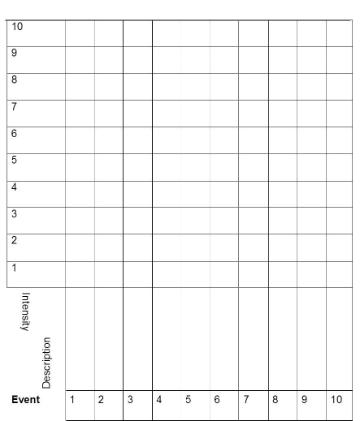
Discussion
Ask discussion questions of all 9 types.
Key Questions
- What are people communicating to Phil in their telegrams? Do you think they have an accurate view of the situation? Would their communication be different if they knew he had been kicked out after he learned he was getting a D and couldn’t go out for track? Explain.
- What transpires in the conversation between Al and Ted? What are the implications? What are they suggesting about Miss Narwin? Why.
- What are the attitudes of students and staff toward Miss Narwin and Phillip?
- What happens when Phillip asks Miss Narwin for work? Do you think he know what the outcomes would be?
- How is Coach Jamison toward Phillip? What does he want from his athletes?
Analyze
Analyze the key paragraph.
Key Paragraph
Page 156
Seymour about Miss Narwin:
“She says—this Narwin woman—yes, here—now, I’m quoting her. “The truth is…I feel that sometimes”—get this—“I am a little out of touch with contemporary teaching, and, just as important, the students who come before me.” In other words, she’s been around, what can I say, since history began.
Extend
Write
Have each student write a short product based on today’s prompt to connect to the unit theme.
What is Dr. Seymour referring to about Miss Narwin? Did he take her letter out of context? He is giving her a fair representation? Do you agree with what he is trying to do?
Write a one-paragraph argument in which you support or oppose Dr. Seymour and his representation of Miss Narwin. Introduce claim(s), acknowledge alternate or opposing claims, and organize the reasons and evidence logically. Support claim(s) with logical reasoning and relevant evidence, using accurate, credible sources and demonstrating an understanding of the topic or text. Use words, phrases, and clauses to create cohesion and clarify the relationships among claim(s), reasons, and evidence. Provide a concluding statement or section that follows from and supports the argument presented.
Close
Close by extending today’s lesson to life and the world.
Extend the reading to the students’ lives or to the world.
Day 16
Outcomes for Today
Prepare
Background
Gather background knowledge about a place, time, event, person, or thing.
What is a scapegoat?
A scapegoat is a person or group makes to bear the blame for others to suffer in their place.
In today’s reading Miss Narwin is getting the blame for Phillip’s suspension. The district is referring to her as out of touch and asking she take a leave of absence.
Word Wall
Here are five vocabulary words to teach and add to the Word Wall.
|
nerves pg. 161 |
refresher pg. 161 |
vaguely pg. 161 |
expedite pg. 162 |
sabbatical pg. 162 |
Read
Review
Review the timeline from the beginning every day.
Read
Read the selection, usually in a Shared Reading Read React Predict Cycle of 2-3 pages.
Read p. 161-167
|
Setting |
Characters |
Pages |
|
School |
Miss Narwin and Dr. Doane |
161-163 |
|
Home |
Phillip’s parents |
163-164 |
|
Conversation |
Miss Narwin and her sister |
164 |
|
Conversation |
Phillip and his father |
164-165 |
|
Downtown Association |
Ted Griffen |
165-166 |
|
Conversation |
Miss Narwin and reporter |
166-167 |
Respond
Timeline
Agree on the facts in today’s reading, and list the 3-5 most important on the Timeline.
Students might mention
- Gert tells Narwin what she should take a leave of absence.
- Phil is upset.
- Ted gives a speech stating that the solution is for the teacher to get more training.
- Ted also supports the budget and asks others to do the same.
- Duval, the reporter, will fly out to interview Narwin.
Map
Add to ongoing class activities like a KWL chart or map: where did the characters go?
Slant Poster/ T Chart
As the facts of the suspension start to develop create a T Chart or poster to track the different slants that the characters will use.
On one side list the character and the slant that is given (cite the page) on the other side list what actually occurred.
Explore
Activity
Explore the reading more deeply with a visual or oral language activity.
Plot Profile Chart
Add to the plot profile chart you started yesterday. Add 3-4 significant events. Rate them on a scale of 1-10 based on their intensity. You will add to this as you complete the novel.
Thoughtshot
Draw a sketch of Miss Narwin during her conversation with Dr. Doane. What do you think she is thinking when she is asked to take a leave of absence?
Discussion
Ask discussion questions of all 9 types.
Key Questions
- What is Dr. Doane asking Miss Narwin to do? Does Miss Narwin have the right to feel like she is being blamed?
- What is happening to Phillip? How is he reacting? Do you think he expected anything big to come from his singing/statement?
- How does Ted react/change his viewpoint toward the current board and budget? What is he trying to accomplish?
- Who is Mr. Duvall? What does he want from Miss Narwin? How is he trying to approach the situation? Do you think he shows wisdom?
- Why won’t Phillip go to school?
Analyze
Analyze the key paragraph.
Key Paragraph
Pages 167
Miss Narwin speaking to Mr. Duval:
That’s certainly true. People seem to believe that this boy is …rather special. Nobody seems to want to pay any attention to what actually happened. I’ve been asked to resign.
Extend
Write
Have each student write a short product based on today’s prompt to connect to the unit theme.
Punishments should fit the crime.
Is Miss Narwin being asked to resign or take a leave? What is the difference?
In each situation the consequence should fit the crime. Think about Phillip and Miss Narwin. Do you think that either of them should be without consequence? Do you think that the consequences are fitting to the situation?
Write a one-paragraph argument in which you support or oppose Miss Narwin being asked to take a leave. Introduce claim(s), acknowledge alternate or opposing claims, and organize the reasons and evidence logically. Support claim(s) with logical reasoning and relevant evidence, using accurate, credible sources and demonstrating an understanding of the topic or text. Use words, phrases, and clauses to create cohesion and clarify the relationships among claim(s), reasons, and evidence. Provide a concluding statement or section that follows from and supports the argument presented. Include a punishment you think is fitting to how she handled the situation.
Close
Close by extending today’s lesson to life and the world.
Extend the reading to the students’ lives or to the world.
Day 17
Outcomes for Today
Prepare
Background
Gather background knowledge about a place, time, event, person, or thing.
What is a snowball effect?
A snowball effect is a semi-scientific term in which you describe something that gradually gains momentum as time passes.
In the reading the situation with Phillip and Miss Narwin is an example of something significantly small taking on a life of its own as time passes.
Word Wall
Here are five vocabulary words to teach and add to the Word Wall.
|
ridiculous pg. 169 |
petition pg. 170 |
resign pg. 172 |
naïve pg. 172 |
eligible pg. 174 |
Read
Review
Review the timeline from the beginning every day.
Read
Read the selection, usually in a Shared Reading Read React Predict Cycle of 2-3 pages.
Read p. 168-177
|
Setting |
Characters |
Pages |
|
Phone conversation |
Miss Narwin and Dr. Doane |
168 |
|
Home |
Phillip and his parents |
168-169 |
|
Bus |
Ken and Phillip |
169-170 |
|
Phone conversation |
Phillip and his mom |
170-171 |
|
Phone conversation |
Phillip’s parents |
171 |
|
Phone conversation |
Miss Narwin and Mr. Duval |
172-175 |
|
Washington Academy |
Phillip and class |
176-177 |
Respond
Timeline
Agree on the facts in today’s reading, and list the 3-5 most important on the Timeline.
Students might mention
- Narwin decides to go to Florida to be with her sister.
- Phil doesn’t want to go to school.
- Eventually he goes to Washington Academy.
- He is asked to sing the national anthem, but says he can’t. He doesn’t know the words.
Map
Add to ongoing class activities like a KWL chart or map: where did the characters go?
Slant Poster/ T Chart
As the facts of the suspension start to develop create a T Chart or poster to track the different slants that the characters will use.
On one side list the character and the slant that is given (cite the page) on the other side list what actually occurred.
Explore
Activity
Explore the reading more deeply with a visual or oral language activity.
Plot Profile Chart
Complete a plot profile chart for today’s reading. Add 3-4 significant events. Rate them on a scale of 1-10 based on their intensity. You can use this to write a summary of the reading.
Open Mind Portrait
Complete your OMP. What are the characters thinking and feeling? Add 3-5 final thoughts.
Telegram
If you were writing a telegram (pro/con) to Miss Narwin, what would you write?
Discussion
Ask discussion questions of all 9 types.
Key Questions
- Why does Miss Narwin want to talk to the reporter? Does she have a point about the positives not being reported? Why isn’t positive news reported?
- What happened to the story? Why wasn’t it printed? Do you think it was unethical for Duval not to print Narwin’s story?
- Why do you think the budget was defeated?
- What event led to Phillip wanting to leave school? Is Coach Jamison acting responsibly? Explain.
- Did the novel end the way you thought it would?
- Were you surprised that both Narwin and Phil left the school?
Analyze
Analyze the key paragraph.
Key Paragraph
Page 172
Miss Narwin:
I think and I think. And—that boy—Phillip Malloy—for reasons I’ll never learn—decided to insult me, his classmates, and, as far as that goes, the national anthem. Yes, I sent him from my room. But it wasn’t I who sent him home. I objected to that. Objected strongly. Yes, I have been blamed for his suspension. It’s I who has been asked to resign.
Extend
Write
Have each student write a short product based on today’s prompt to connect to the unit theme.
Do you think that Miss Narwin is telling the full truth? Do you think Phillip intended to insult her, his classmates, and the national anthem?
Write a one-paragraph argument in which you defend or oppose Miss Narwin’s account. Introduce claim(s), acknowledge alternate or opposing claims, and organize the reasons and evidence logically. Support claim(s) with logical reasoning and relevant evidence, using accurate, credible sources and demonstrating an understanding of the topic or text. Use words, phrases, and clauses to create cohesion and clarify the relationships among claim(s), reasons, and evidence. Establish and maintain a formal style. Provide a concluding statement or section that follows from and supports the argument presented.
Close
Close by extending today’s lesson to life and the world.
Extend the reading to the students’ lives or to the world.
Day 18
Outcomes for Today
Prepare
Background
Gather background knowledge about a place, time, event, person, or thing.
Using the Slant Poster/T Chart you completed as a class.
Choose a perspective you feel is the best representation of the events in the novel—the side the represents the truth the best.
Miss Narwin
Phillip
School Administration
Write a 5-paragraph argument to support your claim. Introduce your claim, acknowledge alternate or opposing claims. Organize your reasons and evidence logically. Support your claim with logical reasoning and relevant evidence. Use accurate and credible sources. Use words, phrases, and clauses to create cohesion and clarify relationships. Establish and maintain formal style. Provide a concluding paragraph and statement, which follows form and supports the argument presented.
Word Wall
Here are five vocabulary words to teach and add to the Word Wall.
Read
Review
Review the timeline from the beginning every day.
Read
Read the selection, usually in a Shared Reading Read React Predict Cycle of 2-3 pages.
Respond
Timeline
Agree on the facts in today’s reading, and list the 3-5 most important on the Timeline.
Map
Add to ongoing class activities like a KWL chart or map: where did the characters go?
Explore
Activity
Explore the reading more deeply with a visual or oral language activity.
Discussion
Ask discussion questions of all 9 types.
Analyze
Analyze the key paragraph.
Extend
Write
Have each student write a short product based on today’s prompt to connect to the unit theme.
Close
Close by extending today’s lesson to life and the world.