Lesson Plans
Stuck in Neutral
40
60
90
Day 1
Outcomes for Today
W2. Write informative/explanatory texts to examine a topic and convey ideas, concepts, and information through the selection, organization, and analysis of relevant content.
a.) Introduce a topic clearly, previewing what is to follow; organize ideas, concepts, and information, using strategies such as definition, classification, comparison/contrast, and cause/effect; include formatting (e.g., headings), graphics (e.g., charts, tables), and multimedia when useful to aiding comprehension.
b.) Develop the topic with relevant facts, definitions, concrete details, quotations, or other information and examples.
f.) Provide a concluding statement or section that follows from and supports the information or explanation presented.
Prepare
Background
Gather background knowledge about a place, time, event, person, or thing.
Where is Seattle, Washington? What are Seattle’s points of interest?
Seattle is a coastal seaport city and the seat of King County, in the U.S. state of Washington. With an estimated 652,405 residents as of 2013, Seattle is the largest city in the Pacific Northwest region of North America and the fastest-growing major city in the United States. Seattle is home to the Space Needle, which was constructed for the 1962 World Expo, www.spaceneedle.com, the Pike’s Place Market and Warf region, as well as many sports teams, universities and industry. Locate Seattle on the map.
Word Wall
Here are five vocabulary words to teach and add to the Word Wall.
Introduce 5 important, useful words from today’s reading.
|
gripe (1) |
recall (2) |
conceited (3) |
retardate (4) |
normed (4) |
Read
Review
Start at the beginning and review the story so far.
- Mention the setting and main character.
- Point to each timeline item as you quickly review it.
Read
Read the selection, usually in a Shared Reading Read React Predict Cycle of 2-3 pages.
Read p. 1-5
|
Setting |
Characters |
Pages |
|
Seattle |
Shawn McDaniel Introduces his sister Cindy and Brother Paul |
1-5 |
Respond
Timeline
Agree on the facts in today’s reading, and list the 3-5 most important on the Timeline.
Discuss the story to fix the facts: who, what, when, where, and why. Decide on the 3-5 most important events and add these to the timeline.
Students might mention
- Narrator named Shawn is 14 years old he lives in Seattle.
- He thinks his father left his mother because of his condition.
- He is a “retarded” but he has not told us what kind yet.
- People think he can’t think or remember things, but he remembers everything he hears.
- He has two older siblings, a brother and a sister.
Map
Add to ongoing class activities like a KWL chart or map: where did the characters go?
Open Mind Portrait
New character information can be added to an Open Mind Portrait.
KWL Chart
An answer can be added to a question from the KWL Chart.
Map
A new location or change can be added to the map.
Explore
Activity
Explore the reading more deeply with a visual or oral language activity.
Bookmark
Create a bookmark that highlights the landmarks from the Seattle area.
Discussion
Ask discussion questions of all 9 types.
Key Questions
- Who is narrating the story?
- What kind of “voice” or energy does the narrator have?
- When did his parents get divorced and why does he think they did?
- Where does he live? Why is his perspective of the area different than many other peoples?
- What can you tell about the narrator? Based on the information you have learned about him would you want him as a friend? Explain.
- Shawn has the ability to remember everything he hears. If you had a gift what would you want it to be? Explain.
Analyze
Analyze the key paragraph.
Key Paragraph, p. 5
“This has gone on for eight years now. Every year, year in and year out. Yep, according to the world I’m dumb as a fence post. I’ve heard the docs explain why they think I’m so stupid to my parents and my parents explain it to their friends about a trillion times. They think it’s because my brain doesn’t work. They don’t know that is only partially true” (p. 5).
Extend
Write
Have each student write a short product based on today’s prompt to connect to the unit theme.
One literary device is called foreshadowing. It means to give hints to the reader about things that might happen later in the story. What do you the author might be foreshadowing in the above quote?
Write an informative/explanatory paragraph detailing to your reader that the author is foreshadowing in the above passage. Introduce your topic. Organize your ideas using strategies such as defining, classifications, and compare/contrast. Develop your topic with relevant facts. Conclude with a section that supports the information presented.
Final Writing Product
Research various different disabilities that people can have and their affects. Choose one that interests you
|
Day 1 |
Choose a disability that people can be born with or acquire (CP, Down’s Syndrome, autism) |
List three facts about this disability. Write a paragraph describing it. |
Close
Close by extending today’s lesson to life and the world.
Day 2
Outcomes for Today
W2. Write informative/explanatory texts to examine a topic and convey ideas, concepts, and information through the selection, organization, and analysis of relevant content.
a.) Introduce a topic clearly, previewing what is to follow; organize ideas, concepts, and information, using strategies such as definition, classification, comparison/contrast, and cause/effect; include formatting (e.g., headings), graphics (e.g., charts, tables), and multimedia when useful to aiding comprehension.
b.) Develop the topic with relevant facts, definitions, concrete details, quotations, or other information and examples.
f.) Provide a concluding statement or section that follows from and supports the information or explanation presented.
Prepare
Background
Gather background knowledge about a place, time, event, person, or thing.
What is Cerebral Palsy?
Cerebral Palsy is brain damage caused by brain injury or abnormal development of the brain that occurs while a child’s brain is still developing — before birth, during birth, or immediately after.
Cerebral palsy affects body movement, muscle control, muscle coordination, muscle tone, reflex, posture and balance. It can also impact fine motor skills, gross motor skills and oral motor functioning.
Those with cerebral palsy are most likely born with the condition, although some acquire the condition at birth or shortly thereafter depending on cause. Signs and symptoms of cerebral palsy may not always be apparent at birth. The child will likely experience a delay in development and growth milestones.
http://cerebralpalsy.org/about-cerebral-palsy/
In today’s reading, we learn that Shawn has Cerebral Palsy (CP). He was born with the condition and as he describes it he has no muscle control. Meaning he cannot function on his own. He has to be cared for 24/7 and have all needs met for him.
Word Wall
Here are five vocabulary words to teach and add to the Word Wall.
|
reflex (8) |
vocalize (8) |
eavesdropping (9) |
misunderstanding (10) |
neutral (11) |
Read
Review
Start at the beginning and review the story so far.
Read
Read the selection, usually in a Shared Reading Read React Predict Cycle of 2-3 pages.
Read p. 6-12
|
Setting |
Characters |
Pages |
|
Seattle |
Shawn |
6-11 |
|
Seattle |
Mom-Lindy |
11-12 |
Respond
Timeline
Agree on the facts in today’s reading, and list the 3-5 most important on the Timeline.
Students might mention
- Shawn describes what it is like to have cerebral palsy.
- He remembers everything he hears and sees.
- He is quite smart but no one knows this because he can’t communicate.
- He has no muscle control.
- He tries not to feel sorry for himself but it is hard.
- He tells us that his dad might be trying to kill him—out of love.
Map
Add to ongoing class activities like a KWL chart or map: where did the characters go?
Shawn Communication Poster
Shawn doesn’t have any muscle control and cannot communicate anything. Based on today’s reading what is one thing you think Shawn would like to communicate with his family? You will add a new communication as you read.
Explore
Activity
Explore the reading more deeply with a visual or oral language activity.
Open Mind Portrait
Create and OMP of Shawn. What initial things is Shawn sharing with us? What is he thinking? If he could communicate one thing what do you think it would be. What initial things is Shawn sharing with us? What is he thinking? How is he feeling?
Discussion
Ask discussion questions of all 9 types.
Key Questions
- What condition does Shawn have? What are the implications of his condition?
- What does Shawn know that his family does not know?
- What part of his condition would be the worst for you to deal with if you had CP?
- How does Shawn learn?
- Shawn describes his life as being “Stuck in Neutral”. What does that phrase mean to you? Think of a time in your life that you were stuck in neutral, what was that like to you?
- Do you have any predictions about why this person wants to kill Shawn?
Analyze
Analyze the key paragraph.
Key Paragraph, p. 9
“…Sounds to letters, letters to words, words to sentences—reading. Of course, nobody knows I can read. Like the captain says in Cool Hand Luke, ‘What we have here is a failure to communicate.’ In my case that’s kinda like calling the Grand Canyon a pothole.” (p. 9).
Extend
Write
Have each student write a short product based on today’s prompt to connect to the unit theme.
Shawn describes his ability to read but he cannot communicate to others that he can read. There is a failure to communicate. Communication can take on many different forms. Verbal, non-verbal, physical, etc.
Write a paragraph explaining forms of communication to your reader. Introduce your topic clearly. Your paragraph must be well organized. Develop your topic with relevant facts, concrete details, and quotations. Use appropriate transitions.
Final Writing Product
Using the disability you chose to research on day one, do the following exercise.
Feature Story
Write a story that details people with this disability or ability and how they have exceeded expectations of others and excelled in their abilities.
Close
Close by extending today’s lesson to life and the world.
Day 3
Outcomes for Today
W2. Write informative/explanatory texts to examine a topic and convey ideas, concepts, and information through the selection, organization, and analysis of relevant content.
a.) Introduce a topic clearly, previewing what is to follow; organize ideas, concepts, and information, using strategies such as definition, classification, comparison/contrast, and cause/effect; include formatting (e.g., headings), graphics (e.g., charts, tables), and multimedia when useful to aiding comprehension.
b.) Develop the topic with relevant facts, definitions, concrete details, quotations, or other information and examples.
f.) Provide a concluding statement or section that follows from and supports the information or explanation presented.
Prepare
Background
Gather background knowledge about a place, time, event, person, or thing.
Symbolism of black crows:
Throughout history, the crow has been associated with both positive and negative symbolic meanings. The most common are:
- Life magic; mystery of creation
- Destiny, personal transformation, alchemy
- Intelligence
- Higher perspective
- Being fearless, audacious
- Flexibility, adaptability
- Trickster, manipulative, mischievous
Other traditional meanings associate the crow with bad omen, death, and dark witchcraft. The crow also carries the power of prophetic insight and symbolizes the void or core of creation.
In today’s reading, Shawn and his dad are outside on the porch. His dad feels a crow is mocking him and that the crow wants to harm Shawn. It is at this point he realizes that his son is totally defenseless and cannot care for himself and is totally dependent for everything.
Word Wall
Here are five vocabulary words to teach and add to the Word Wall.
|
limp (15) |
ruined (16) |
pardon (16) |
intuition (18) |
cawed (19) |
Read
Review
Start at the beginning and review the story so far.
Read
Read the selection, usually in a Shared Reading Read React Predict Cycle of 2-3 pages.
Read p. 13-23
|
Setting |
Characters |
Pages |
|
Car |
Shawn, Mom, Cindy |
13-14 |
|
Side of the road |
Cindy, Mom, Shawn, dog |
14-15 |
|
Car |
Shawn, Mom, Cindy |
16-17 |
|
Porch at home |
Shawn, Mom, Dad |
18-19 |
|
Porch at home |
Shawn and Dad |
19-21 |
|
Porch at home |
Shawn, Mom, and Dad |
22-23 |
Respond
Timeline
Agree on the facts in today’s reading, and list the 3-5 most important on the Timeline.
Students might mention
- Shawn describes his closest encounter with death—watching a dog die.
- Shawn’s dad comes to visit for the 6th time in 14 years.
- His father is angry at Shawn’s condition and helplessness.
- Dad wants to end Shawn’s pain.
- We find out that Shawn’s father is actually a Pulitzer prized winning poet and a talk show host.
- He won the Pulitzer for writing a poem about his relationship with Shawn.
Map
Add to ongoing class activities like a KWL chart or map: where did the characters go?
Shawn Communication Poster
Shawn doesn’t have any muscle control and cannot communicate anything. Based on today’s reading, what is one thing you think Shawn would like to communicate with his family?
Explore
Activity
Explore the reading more deeply with a visual or oral language activity.
Postcard
If Shawn were to write Death a postcard what do you think he would say? Would he ask Death any questions? Write a paragraph from Shawn’s perspective to death. On the opposite side draw/sketch something significant from today’s reading.
Discussion
Ask discussion questions of all 9 types.
Key Questions
- What happens after the mother accidentally hits the dog? What impression of death does this leave Shawn with?
- Why did Cindy run to the dog? What do her actions say about her character? Explain.
- How does this encounter affect Shawn? How does he relate to not having a body just a soul?
- Think of your favorite activity. What would your life be like if you could only watch that activity but never experience it?
- When Shawn’s father comes to visit what does he mean when he says he doesn’t want Shawn to be in any more pain? Why do you think he feels that way?
- Shawn’s father realizes that Shawn cannot protect himself at all. He doesn’t know how he can be kept safe. Do you think this is a worry that just Shawn’s father has or is shared by parents universally? Can parents always keep their children safe? What can they do to try?
Analyze
Analyze the key paragraph.
Key Paragraph, p. 17
“Death. That was the closest I’ve ever been to it. I could feel what it was like, which was just like Cindy said—nothing, a big, fat nothing. It looked to me like when you die, you just, I don’t know, and your life just disappears. That day death stared at me through bloody eyes, and it terrified me” (p. 17).
Extend
Write
Have each student write a short product based on today’s prompt to connect to the unit theme.
We all eventually die, describe one thing you would want to change or do more often that encourages you to be your best, whole, undivided, principled self.
Write one paragraph in which you explain to your reader your One Thing. Introduce your topic. Organize your ideas and information for your reader. Develop your topic with relevant facts, details, and information. Use appropriate transitions to create flow. Conclude with a statement that supports your introduction.
Close
Close by extending today’s lesson to life and the world.
Day 4
Outcomes for Today
W2. Write informative/explanatory texts to examine a topic and convey ideas, concepts, and information through the selection, organization, and analysis of relevant content.
a.) Introduce a topic clearly, previewing what is to follow; organize ideas, concepts, and information, using strategies such as definition, classification, comparison/contrast, and cause/effect; include formatting (e.g., headings), graphics (e.g., charts, tables), and multimedia when useful to aiding comprehension.
b.) Develop the topic with relevant facts, definitions, concrete details, quotations, or other information and examples.
f.) Provide a concluding statement or section that follows from and supports the information or explanation presented.
Prepare
Background
Gather background knowledge about a place, time, event, person, or thing.
What is the Pulitzer Prize?
In the latter years of the 19th century, Joseph Pulitzer stood out as the very embodiment of American journalism. Hungarian-born, an intense indomitable figure, Pulitzer was the most skillful of newspaper publishers, a passionate crusader against dishonest government, a fierce, hawk-like competitor who did not shrink from sensationalism in circulation struggles, and a visionary who richly endowed his profession.
His innovative New York World and St. Louis Post-Dispatch reshaped newspaper journalism. Pulitzer was the first to call for the training of journalists at the university level in a school of journalism. And certainly, the lasting influence of the Pulitzer Prizes on journalism, literature, music, and drama is to be attributed to his visionary acumen.
In writing his 1904 will, which made provision for the establishment of the Pulitzer Prizes as an incentive to excellence, Pulitzer specified solely four awards in journalism, four in letters and drama, one for education, and four traveling scholarships. In letters, prizes were to go to an American novel, an original American play performed in New York, a book on the history of the United States, an American biography, and a history of public service by the press. http://www.pulitzer.org/historyofprizes
In today’s reading Shawn’s dad shares a poem he wrote about Shawn having CP. It was his hope that it would help heal him but it left him a permanent victim to Shawn and the disease. However, he won a Pulitzer for it, which he was able to capitalize on by involving the media to shed light on Shawn’s disease.
Word Wall
Here are five vocabulary words to teach and add to the Word Wall.
|
documentary (26) |
plight (26) |
hors d’oeuvres (27) |
flinched (27) |
encrusted (28) |
Read
Review
Start at the beginning and review the story so far.
Read
Read the selection, usually in a Shared Reading Read React Predict Cycle of 2-3 pages.
Read p. 24-30
|
Setting |
Characters |
Pages |
|
Home |
Shawn |
24-27 |
|
Kendell mansion |
Dad, Mom, public |
27-29 |
|
Home |
Shawn |
29-30 |
Respond
Timeline
Agree on the facts in today’s reading, and list the 3-5 most important on the Timeline.
Students might mention
- Shawn’s father reads his prize-winning poem.
- Shawn realizes that the poem doesn’t really help his dad; he becomes a permanent victim to it.
- Shawn thinks that the poem does not accurately describe him.
- Shawn’s dad became famous for this poem about his son.
Map
Add to ongoing class activities like a KWL chart or map: where did the characters go?
Shawn Communication Poster
Shawn doesn’t have any muscle control and cannot communicate anything. Based on today’s reading what is one thing you think Shawn would like to communicate with his family?
Explore
Activity
Explore the reading more deeply with a visual or oral language activity.
Open Mind Portrait
Add to your OMP for Shawn. What do you think he is thinking and feeling as he hears to poem that his father writes about him? When he is at the reading? And when he realizes his dad does not know how he is feeling? Add 3-5 new thoughts to your OMP?
Discussion
Ask discussion questions of all 9 types.
Key Questions
- Does Shawn feel his dad knows who he is?
- Shawn thinks his dad wants to kill him out of love, to stop his pain. Do you think there should be compassionate death? Under what circumstances? What are the moral and ethical reasons that we do not participate in compassionate death?
- Shawn describes himself in the poem as his father’s version of him, a two dimensional version. Would you be angry if someone wrote a poem about you that did not accurately reflect who you are but who they think you are?
- What did his father win? Does Shawn have any resent that his father won a prize by capitalizing on Shawn and his feelings?
- How does Shawn see his father? What does the rest of the world see? How are the two version of his dad accurate?
- Do you think Shawn has a good sense of humor?
Analyze
Analyze the key paragraph.
Key Paragraph, p. 26
“This makes it sound like the only reasons my dad would kill me are selfish ones. Honestly, I don’t believe that. Dad wants to kill me to save me from suffering. He’s afraid I’m trapped and in pain. He wants to kill me because he loves me” (p. 26).
Extend
Write
Have each student write a short product based on today’s prompt to connect to the unit theme.
Define and discuss the notion and use of irony in literature. Describe the irony in the passage above. What does this irony add to the story? Does it make it more suspenseful? More complex?
Write a one paragraph explanatory text in which you share with your reader about the use of irony in literature. Introduce your topic clearly. Develop your topic with relevant facts, details, and quotes if needed. Use appropriate transitions to create cohesion. As you write use precise language to convey your ideas. Provide a concluding stamen that supports your topic.
Final Writing Project
Using the disability you chose to research on day 1 of the lesson, find data about the disability. How many people have it, life span, and quality of life are topics you can look up. You can add these charts to your final project.
Close
Close by extending today’s lesson to life and the world.
Day 5
Outcomes for Today
W2. Write informative/explanatory texts to examine a topic and convey ideas, concepts, and information through the selection, organization, and analysis of relevant content.
a.) Introduce a topic clearly, previewing what is to follow; organize ideas, concepts, and information, using strategies such as definition, classification, comparison/contrast, and cause/effect; include formatting (e.g., headings), graphics (e.g., charts, tables), and multimedia when useful to aiding comprehension.
b.) Develop the topic with relevant facts, definitions, concrete details, quotations, or other information and examples.
f.) Provide a concluding statement or section that follows from and supports the information or explanation presented.
Prepare
Background
Gather background knowledge about a place, time, event, person, or thing.
What is an “autonomic, uncontrollable, systematic reflex”?
An autonomic reflex is the reflex system that governs and regulates the functions of that body which control such activities such as blood pressure, heart rate, sweating, and urination.
In Shawn’s life when he has his seizures his smiles and laughter just happen and he has no control over that part of his body as he is seizing. He enjoys the seizures but feels helpless that as he is experiencing the laughter and joy that he has, his family is sad.
Word Wall
Here are five vocabulary words to teach and add to the Word Wall.
|
disconnected (33) |
impulse (33) |
dependence (35) |
slither (36) |
homely (36) |
Read
Review
Start at the beginning and review the story so far.
Read
Read the selection, usually in a Shared Reading Read React Predict Cycle of 2-3 pages.
Read p. 31-37
|
Setting |
Characters |
Pages |
|
Home |
Shawn |
31-37 |
Respond
Timeline
Agree on the facts in today’s reading, and list the 3-5 most important on the Timeline.
Students might mention:
- Shawn talks about what it is like to have seizures.
- Shawn describes what it is like for his family when he is having a seizure.
- Seizures give him a sense of freedom because he feels his spirit leaves his body and he is able to move.
- Shawn mentions he goes to school.
Map
Add to ongoing class activities like a KWL chart or map: where did the characters go?
Shawn Communication Poster
Shawn doesn’t have any muscle control and cannot communicate anything. Based on today’s reading what is one thing you think Shawn would like to communicate with his family? You will add a new communication as you read.
Explore
Activity
Explore the reading more deeply with a visual or oral language activity.
Open Mind Portrait
Add to your OMP of Shawn. What do you think he is thinking and feeling as he describes his seizures and his family’s reaction to them/him? Add 3-5 new thoughts to your OMP.
KWL
At the beginning of the book, what did you know about people with CP and about seizures? What did you want to know? What have you learned? What additional questions do you have?
Discussion
Ask discussion questions of all 9 types.
Key Questions
- What happens during one of Shawn’s seizures? What do they do for Shawn that makes him appreciate them?
- How does his family react to his seizures? How would you react? Do you think their reaction is out of pity, concern, or fear? Explain.
- On page 33, Shawn describes how he is disconnected with his family. Do you think that term accurately describes his situation?
- On page 33, Shawn states, “Wouldn’t you rather be happy for no reason than unhappy for good reasons?” What is your preference? Explain.
Analyze
Analyze the key paragraph.
Key Paragraph, p. 35
“Of course, except for seizures, my life is one of total dependence. Once I started being able to sneak away from my body, seizures became very important to me. I love the feeling of movement, the pure joy of being able to fly. I love the feeling of escaping from my screwed-up, worthless body. I love my seizures because they give me the kind of life I imagine normal people enjoy, and then some. They give me freedom” (p. 35).
Extend
Write
Have each student write a short product based on today’s prompt to connect to the unit theme.
Imagine what it is like to be Shawn. What additional insights are revealed about Shawn through this chapter? How does the life inside his head (1st person narrator) differ from how he is perceived? Does that change your perception of what a person in a permanent vegetative state might be experiencing? Do you think people perceive you different than you are?
Write a one paragraph explanatory piece in which you share with your reader how you perceive yourself versus how others perceive you. Introduce your topic. Organize your ideas and concepts. Develop your topic with relevant facts and details. Use appropriate transactions to create cohesion. Conclude with a statement that supports your topic.
Close
Close by extending today’s lesson to life and the world.
Day 6
Outcomes for Today
W2. Write informative/explanatory texts to examine a topic and convey ideas, concepts, and information through the selection, organization, and analysis of relevant content.
a.) Introduce a topic clearly, previewing what is to follow; organize ideas, concepts, and information, using strategies such as definition, classification, comparison/contrast, and cause/effect; include formatting (e.g., headings), graphics (e.g., charts, tables), and multimedia when useful to aiding comprehension.
b.) Develop the topic with relevant facts, definitions, concrete details, quotations, or other information and examples.
f.) Provide a concluding statement or section that follows from and supports the information or explanation presented.
Prepare
Background
Gather background knowledge about a place, time, event, person, or thing.
What is the American with Disabilities Act?
The Americans with Disabilities Act (ADA) was signed into law on July 26, 1990, by President George H.W. Bush. The ADA is one of America's most comprehensive pieces of civil rights legislation that prohibits discrimination and guarantees that people with disabilities have the same opportunities as everyone else to participate in the mainstream of American life -- to enjoy employment opportunities, to purchase goods and services, and to participate in State and local government programs and services. Modeled after the Civil Rights Act of 1964, which prohibits discrimination on the basis of race, color, religion, sex, or national origin – and Section 504 of the Rehabilitation Act of 1973 -- the ADA is an "equal opportunity" law for people with disabilities.
To be protected by the ADA, one must have a disability, which is defined by the ADA as a physical or mental impairment that substantially limits one or more major life activities, a person who has a history or record of such an impairment, or a person who is perceived by others as having such an impairment. The ADA does not specifically name all of the impairments that are covered.
In today’s reading, Shawn describes his time at school. His father arrives with a cameraman to film something for PBS. He talks about the ADA and then need to educate our kids then he discusses the cost to educate Shawn ($35,000 per year). Those resources are given to educate a child that cannot learn and he feels it is irresponsible to spend that much money on Shawn and others like him.
Word Wall
Here are five vocabulary words to teach and add to the Word Wall.
|
incident (39) |
prerequisite (40) |
normalcy (40) |
continence (41) |
allocation (47) |
Read
Review
Start at the beginning and review the story so far.
Read
Read the selection, usually in a Shared Reading Read React Predict Cycle of 2-3 pages.
Read p. 38-48
|
Setting |
Characters |
Pages |
|
School
|
Shawn, William, and Becky |
38-40 |
|
Shawn, Mrs. Hare |
40-42 |
|
|
Shawn and other classmates |
42 |
|
|
Shawn, dad, camera man |
43-46 |
|
|
Shawn (having seizure), dad, camera man |
46-48 |
Respond
Timeline
Agree on the facts in today’s reading, and list the 3-5 most important on the Timeline.
Students might mention:
- Shawn describes his classroom at school.
- His father comes to visit his classroom with a cameraman and they begin taping.
- While they are taping, Shawn has a seizure.
- Shawn’s dad is making a video questioning why taxpayers are paying money to educate the uneducable.
Map
Add to ongoing class activities like a KWL chart or map: where did the characters go?
Shawn Communication Poster
Shawn doesn’t have any muscle control and cannot communicate anything. Based on today’s reading what is one thing you think Shawn would like to communicate with his family?
Explore
Activity
Explore the reading more deeply with a visual or oral language activity.
Open Mind Portrait
Add to your OMP of Shawn. What is thinking and feeling as he describes his time at school, his teachers, and his classmates? What are his thoughts and feelings as he hears his dad talk on camera? Add 3-5 new thoughts to your OMP.
Discussion
Ask discussion questions of all 9 types.
Key Questions
- Shawn describes Becky and William. Why does he respect William?
- Shawn describes his classroom like a zoo. Why do you think the author choose that word to describe the class and the students? Does it accurately reflect what Shawn is describing? Explain.
- Define the term “retard”. Why has that term become socially unacceptable? How does Shawn use it? Do you think it gives an accurate description of him? What term would you use?
- Shawn describes how the class is designed to make them normal but how you cannot make a person normal by copying values, beliefs, and traits? Do you agree or disagree with him? What is “normal”?
- Shawn’s father describes how Shawn is uneducable and can’t learn. He discusses how it takes $35,000 to educate a child like Shawn each year. How much does it cost to educate a “normal” child? Do you agree or disagree with Shawn’s dad that the money could be spent better at a different level? Explain.
- Shawn’s dad poses a question about the resources needed to “educate” Shawn but he does not propose a solution. What do you think should be done in this situation? How does the ADA factor into this equation?
Analyze
Analyze the key paragraph.
Key Paragraph, p. 38
“Shawn does not grow,
He stays the same…
His arms and legs
Are overcooked spaghetti
Lace with the bones of dead birds…
Behind his eyes it’s blank
As fog over snow” (p. 38).
Extend
Write
Have each student write a short product based on today’s prompt to connect to the unit theme.
Shawn’s dad is writing about Shawn. He uses both a metaphor and simile in this stanza. The metaphor is: his arms and legs are overcooked spaghetti. Do you think the use of metaphor here helps the reader visualize more clearly? He also uses a simile: Behind his eyes it’s blank as fog over snow.
Explain what you think Shawn’s dad means. What tone does he create?
Write a paragraph in which you explain to your reader how Shaw’s dad uses Metaphors and similes in his writing. Introduce your topic and preview what is to come next by organizing your ideas. Develop your topic using relevant facts. Use appropriate transitions to create cohesion in your writing. Use formal style and language. Use precise language. Provide a concluding statement, which supports your topic.
Final Writing Project
Write a news story that highlights the ADA. Give details of the cost and the social impact of the act.
Close
Close by extending today’s lesson to life and the world.
Day 7
Outcomes for Today
W2. Write informative/explanatory texts to examine a topic and convey ideas, concepts, and information through the selection, organization, and analysis of relevant content.
a.) Introduce a topic clearly, previewing what is to follow; organize ideas, concepts, and information, using strategies such as definition, classification, comparison/contrast, and cause/effect; include formatting (e.g., headings), graphics (e.g., charts, tables), and multimedia when useful to aiding comprehension.
b.) Develop the topic with relevant facts, definitions, concrete details, quotations, or other information and examples.
f.) Provide a concluding statement or section that follows from and supports the information or explanation presented.
Prepare
Background
Gather background knowledge about a place, time, event, person, or thing.
What is the Puget Sound area?
The Puget Sound region is an inland area of the Pacific Northwest in the U.S. state of Washington, including Puget Sound, the Puget Sound lowlands, and the surrounding region roughly west of the Cascade Range and east of the Olympic Mountains.
In today’s reading, Shawn describes where they live and his view as sits in his chair.
Word Wall
Here are five vocabulary words to teach and add to the Word Wall.
|
trembled (50) |
wreck (50) |
assured (51) |
intolerable (51) |
cowardly (51) |
Read
Review
Start at the beginning and review the story so far.
Read
Read the selection, usually in a Shared Reading Read React Predict Cycle of 2-3 pages.
Read p. 49-52
|
Setting |
Characters |
Pages |
|
Kitchen |
Shawn, mom, and dad |
49-50 |
|
Home |
Mom and Connie |
51 |
|
Home |
Dad and Shawn |
52 |
Respond
Timeline
Agree on the facts in today’s reading, and list the 3-5 most important on the Timeline.
Students might mention:
- Shawn recalls when his father left.
- He also recalls his mother and a friend speaking about how that was a cowardly act.
- Shawn recalls the similarities he shares with his dad.
Map
Add to ongoing class activities like a KWL chart or map: where did the characters go?
Shawn Communication Poster
Shawn doesn’t have any muscle control and cannot communicate anything. Based on today’s reading what is one thing you think Shawn would like to communicate with his family?
Explore
Activity
Explore the reading more deeply with a visual or oral language activity.
Open Mind Portrait
Add to your OMP of Shawn. What is he thinking and feeling as he shares what it was like when his dad left? What does he think if his dad for leaving the family? Add 3-5 new thoughts to your OMP.
Discussion
Ask discussion questions of all 9 types.
Key Questions
- Why did Shawn’s father leave? Do you think he is being fair to himself? His family? Or to Shawn by leaving? Explain.
- Shawn’s mom explains how she sometimes hates his dad but how she understands him not being able to watch his seizures. Do you think she is excusing his behavior?
- Do you consider Shawn’s dad a man? Explain.
- When has Shawn felt closest to his dad?
- Does he trust his dad?
Analyze
Analyze the key paragraph.
Key Paragraph, p. 51
“He’s weak and cowardly. Sometimes I hate him. But I know, too, that he just can’t stand seeing Shawn suffer with the seizures. Syd can’t stand the thought that Shawn might be trapped inside himself” (p. 51).
Extend
Write
Have each student write a short product based on today’s prompt to connect to the unit theme.
Sometimes very difficult decisions have multiple dimensions. Why do you think Shawn’s mother felt that Shawn’s father was a coward for leaving? Are their ways in which leaving had integrity if it was what he felt he had to do?
Write an explanatory paragraph in which you write define integrity and explain if Shawn’s dad had integrity by leaving his family. Use relevant facts as you write. Use appropriate transitions and concise language. Provide a conclusion that supports your opening statement.
Close
Close by extending today’s lesson to life and the world.
Day 8
Outcomes for Today
W2. Write informative/explanatory texts to examine a topic and convey ideas, concepts, and information through the selection, organization, and analysis of relevant content.
a.) Introduce a topic clearly, previewing what is to follow; organize ideas, concepts, and information, using strategies such as definition, classification, comparison/contrast, and cause/effect; include formatting (e.g., headings), graphics (e.g., charts, tables), and multimedia when useful to aiding comprehension.
b.) Develop the topic with relevant facts, definitions, concrete details, quotations, or other information and examples.
f.) Provide a concluding statement or section that follows from and supports the information or explanation presented.
Prepare
Background
Gather background knowledge about a place, time, event, person, or thing.
Who is Maxfield Parrish?
Maxfield Parrish prints have inspired millions because of the artist's unique way of using color. These unique and magical images will always have a permanent place in art history.
Maxfield Parrish was born July 25, 1870 in Philadelphia, to Stephen and Elizabeth Parrish. His given name was Frederick but he would later adopt the family name Maxfield as a middle, and then professional name.
His father was an acclaimed etcher and landscape painter who had a big influence on him as a young child. When his father began to notice his son's budding talent he took him under his wing and taught him all that he knew. In 1884 to 1886 his parents took him through Europe to see the great museums. While he was there he absorbed everything around him from the architecture and music to the machinery and nature.
In today’s reading, Shawn describes Ally’s beauty as a Maxfield Parrish painting.
Word Wall
Here are five vocabulary words to teach and add to the Word Wall.
|
invisible (54) |
oversize (56) |
mobile (56) |
immobile (56) |
bulbous (59) |
Read
Review
Start at the beginning and review the story so far.
Read
Read the selection, usually in a Shared Reading Read React Predict Cycle of 2-3 pages.
Read p. 53-60
|
Setting |
Characters |
Pages |
|
Living room |
Shawn, Cindy and friends |
53-55 |
|
Shawn’s room |
Shawn (dreaming about Ally) |
56-58 |
|
Shawn’s room |
Shawn |
58-60 |
Respond
Timeline
Agree on the facts in today’s reading, and list the 3-5 most important on the Timeline.
Students might mention:
- Shawn describes the advantages of being invisible.
- Shawn fantasizes about being loved by a new friend his sister brings home.
- He wonders what it would be like to love and be loved and known.
Map
Add to ongoing class activities like a KWL chart or map: where did the characters go?
Shawn Communication Poster
Shawn doesn’t have any muscle control and cannot communicate anything. Based on today’s reading what is one thing you think Shawn would like to communicate with his family?
Explore
Activity
Explore the reading more deeply with a visual or oral language activity.
Open Mind Portrait
Add to your OMP of Shawn. What is he thinking and feeling as he describes wanting to be loved and share his feelings with someone who can understand him? Add 3-5 new thoughts to your OMP.
Acrostic Poem
Create an acrostic poem using the letters L-O-V-E.
Discussion
Ask discussion questions of all 9 types.
Key Questions
- How do most people greet people who have a disability? How should you greet or approach someone who has a disability. Give specific examples of greeting someone who is blind, deaf, or severely disabled like Shawn.
- Shawn tries to explain the advantages of his disability. Do you think that makes him an optimist, pessimist, or a realist?
- What does Shawn want above all else?
- What do you think is the most frustrating portion of Shawn’s disability?
- Shawn describes wanting to feel love. What do you want to feel? Explain.
Analyze
Analyze the key paragraph.
Key Paragraph, p. 60
“For the first time in my life I’m thinking about being loved and being known somehow going together. What if somehow, some way, I could get somebody to love me and know me? What if there is a way that I could let somebody know that I am smart and that I like my life and that I don’t want to die!” (p. 60).
Extend
Write
Have each student write a short product based on today’s prompt to connect to the unit theme.
What do you think life would be like if people appreciated and loved one another for whom they truly were? What can you do in your life to promote love and appreciation? Do you try to really get to know people? This is a part of living a life with integrity.
Write a paragraph in which you inform your reader about the merits of being loved and being your true self. Introduce your topic Organize your ideas clearly. Support your topic with facts and details. You appropriate transitions to create cohesion. Provide a concluding statement, which supports your opening.
Close
Close by extending today’s lesson to life and the world.
Day 9
Outcomes for Today
W2. Write informative/explanatory texts to examine a topic and convey ideas, concepts, and information through the selection, organization, and analysis of relevant content.
a.) Introduce a topic clearly, previewing what is to follow; organize ideas, concepts, and information, using strategies such as definition, classification, comparison/contrast, and cause/effect; include formatting (e.g., headings), graphics (e.g., charts, tables), and multimedia when useful to aiding comprehension.
b.) Develop the topic with relevant facts, definitions, concrete details, quotations, or other information and examples.
f.) Provide a concluding statement or section that follows from and supports the information or explanation presented.
Prepare
Background
Gather background knowledge about a place, time, event, person, or thing.
What is Euthanasia and what are the pros and cons of it?
Proponents of euthanasia and physician-assisted suicide (PAS) contend that terminally ill people should have the right to end their suffering with a quick, dignified, and compassionate death. They argue that the right to die is protected by the same constitutional safeguards that guarantee such rights as marriage, procreation, and the refusal or termination of life-saving medical treatment.
Opponents of euthanasia and physician-assisted suicide contend that doctors have a moral responsibility to keep their patients alive as reflected by the Hippocratic Oath. They argue there may be a "slippery slope" from euthanasia to murder, and that legalizing euthanasia will unfairly target the poor and disabled and create incentives for insurance companies to terminate lives in order to save money.
In today’s reading, Shawn’s dad is doing a project in which he highlights a man who killed his son with a horrible and painful disability. He is trying to show the world that there is a complex issue when it comes to the pain and suffering the person with the disability has as well as their families.
Word Wall
Here are five vocabulary words to teach and add to the Word Wall.
|
absolute (63) |
anxiously (64) |
sarcastically (65) |
vulgar (68) |
controversial (69) |
Read
Review
Start at the beginning and review the story so far.
Read
Read the selection, usually in a Shared Reading Read React Predict Cycle of 2-3 pages.
Read p. 61-69
|
Setting |
Characters |
Pages |
|
Kitchen |
Shawn and mom |
61-62 |
|
Living room |
Mom, Cindy, Paul, and Shawn |
63-67 |
|
Living room |
Mom, Cindy, Paul and Shawn (discussing their dad) |
67-69 |
Respond
Timeline
Agree on the facts in today’s reading, and list the 3-5 most important on the Timeline.
Students might mention:
- Mom tells Cindy and Paul that their father is going to do a TV show about a man who killed his 2 year-old retarded son.
- She tells them that they are invited to join him on TV and talk about their lives with Shawn.
- Both Paul and Cindy are angry with their father for leaving them in the first place.
- They question whether or not he really cares.
- Shawn hears the entire conversation.
- Shawn realizes that his father is a brilliant businessman and he pays all of their bills and for his care.
Map
Add to ongoing class activities like a KWL chart or map: where did the characters go?
Shawn Communication Poster
Shawn doesn’t have any muscle control and cannot communicate anything. Based on today’s reading what is one thing you think Shawn would like to communicate with his family?
Explore
Activity
Explore the reading more deeply with a visual or oral language activity.
Open Mind Portrait
Add to your OMP of Shawn. What is he thinking and feeling as he thinks about his mom’s care and her absolute love? As he hears that his father is doing a project on a man who killed his son out of love? And as he realizes that his father is an amazing businessman? Add 3-5 new thoughts to your OMP.
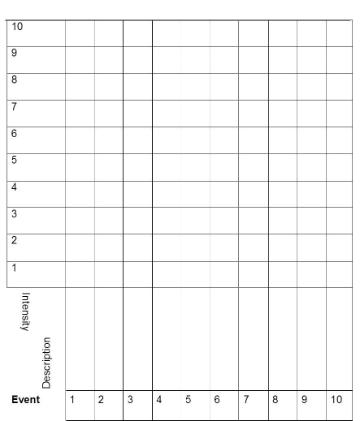
3g6 Plot Graph
On the bottom label three key events from the chapter. Rate each event on a scale of 1-10 based on its intensity. We will revisit this graph 2 more times before the book is over (day 9, 11, and 14). Do this in pencil in case you decide to change your mind as the novel progresses.
3g6 Plot Profile Chart
Discussion
Ask discussion questions of all 9 types.
Key Questions
- How do you think Shawn feels having his mom care for every need out of love for him? How does he feel about his mom?
- What project is his dad working on? Explain the merits of this project both pro and con.
- Do you think Shawn’s dad really cares or not? Why?
- Would you be angry if you were Paul or Cindy? Do you think their anger is justified?
- Shawn hears the entire conversation. How does he justify his dad’s project?
- Do you think his dad really wants to kill him? Give clues from the reading.
Analyze
Analyze the key paragraph.
Key Paragraph, p. 69
“‘I am sure Detraux is a hero to a lot of people. His son has a terrible seizure condition and was retarded…I loved my son too much to watch him suffer anymore…then he added that he’d killed his two-year-old son to ‘end my baby’s pain’’” (p. 69).
Extend
Write
Have each student write a short product based on today’s prompt to connect to the unit theme.
Shawn’s father is going on a talk show to highlight families who deal with children with severe disabilities. He is there to support euthanasia. Research Euthanasia. Write one expository paragraph in which you examine this topic and inform your reader. Introduce your topic. Develop your topic with relevant facts and details. Use appropriate transitions to create cohesion. Provide a concluding statement in which you support your opening statement.
Close
Close by extending today’s lesson to life and the world.
Day 10
Outcomes for Today
W2. Write informative/explanatory texts to examine a topic and convey ideas, concepts, and information through the selection, organization, and analysis of relevant content.
a.) Introduce a topic clearly, previewing what is to follow; organize ideas, concepts, and information, using strategies such as definition, classification, comparison/contrast, and cause/effect; include formatting (e.g., headings), graphics (e.g., charts, tables), and multimedia when useful to aiding comprehension.
b.) Develop the topic with relevant facts, definitions, concrete details, quotations, or other information and examples.
f.) Provide a concluding statement or section that follows from and supports the information or explanation presented.
Prepare
Background
Gather background knowledge about a place, time, event, person, or thing.
For discussion
Where is your news source from? Why is it different to learn different perspectives on various different issues?
In today’s reading, Dad and Cindy fly to LA for the taping of the Alice Ponds show. In this situation the news has covered on side of a story, a dad who killed his child and Shawn’s dad is trying to educate the public about what it is like to care for a child like Shawn.
Word Wall
Here are five vocabulary words to teach and add to the Word Wall.
|
excruciating ( 74) |
contradict (75) |
irreversible (77) |
terminal (77) |
agony (79) |
Read
Review
Start at the beginning and review the story so far.
Read
Read the selection, usually in a Shared Reading Read React Predict Cycle of 2-3 pages.
Read p. 70-83
|
Setting |
Characters |
Pages |
|
Home |
Mom, Dad, Paul, and Cindy |
70-72 |
|
Home |
Shawn |
73 |
|
TV |
Dad on the Alice Ponds Show |
74-77 |
|
TV |
Dad and Earl Detraux |
78-82 |
|
Home |
Mom, Paul, Cindy, and Shawn |
82-83 |
Respond
Timeline
Agree on the facts in today’s reading, and list the 3-5 most important on the Timeline.
Students might mention:
- The family watches the Alice Ponds TV show.
- Shawn’s dad is shown interviewing the father that killed his 2 year-old son.
- Shawn’s family is silent after watching and Shawn has another seizure.
Map
Add to ongoing class activities like a KWL chart or map: where did the characters go?
Shawn Communication Poster
Shawn doesn’t have any muscle control and cannot communicate anything. Based on today’s reading what is one thing you think Shawn would like to communicate with his family?
Explore
Activity
Explore the reading more deeply with a visual or oral language activity.
Reader’s Theater
Act out the chapter or at least the key scenes, such as Debrief Sydney’s conversation with Mr. Detraux. What are your thoughts about what Mr. Detraux did? What would you have done?
Open Mind Portrait
Add to your OMP of Shawn. What is he thinking and feeling as he watches his dad on the Alice Ponds Show? Add 3-5 new thoughts to your OMP.
Discussion
Ask discussion questions of all 9 types.
Key Questions
- How would you describe the Alice Ponds Show? What type of news or un-news do shows like that portray?
- Are there any shows in real life that remind you of how the author described this show? Why do people watch them? Do you think they are based on fact? Are accurate? Are well balanced? What are some other places you should get information that might be more reliable?
- Why do you think people watch sensationalized television?
- What is Sydney’s argument in terms of why parents might choose to act the way Mr. Detraux did? Based on the reading do you agree or disagree with what Earl Detraux?
Analyze
Analyze the key paragraph.
Key Paragraph, p. 70
“The Alice Ponds Show is one of the most popular programs in America. Alice appeals to an uneducated loud audience. Actually, most times I have ever seen it, it’s seemed pretty ridiculous…Alice opens her show in her typical style, introducing the day’s program in as controversial and outrageous manner as she can” (p. 70).
Extend
Write
Have each student write a short product based on today’s prompt to connect to the unit theme.
Based on the reading and the day’s opening question The Alice Ponds Show does not seem like a well-balanced news program.
Write an informative paragraph in which you educate/inform your reader about ways to better find well-balanced news. Introduce your topic clearly. Organize your writing logically. Develop your text with relevant facts and definitions. Form a concluding statement, which supports your opening.
Close
Close by extending today’s lesson to life and the world.
Day 11
Outcomes for Today
W2. Write informative/explanatory texts to examine a topic and convey ideas, concepts, and information through the selection, organization, and analysis of relevant content.
a.) Introduce a topic clearly, previewing what is to follow; organize ideas, concepts, and information, using strategies such as definition, classification, comparison/contrast, and cause/effect; include formatting (e.g., headings), graphics (e.g., charts, tables), and multimedia when useful to aiding comprehension.
b.) Develop the topic with relevant facts, definitions, concrete details, quotations, or other information and examples.
f.) Provide a concluding statement or section that follows from and supports the information or explanation presented.
Prepare
Background
Gather background knowledge about a place, time, event, person, or thing.
How do you keep kids safe?
It is important to do everything you can to keeps kids safe. It is important to set boundaries and limits that are reasonable and allow kids to explore within those limits. Sometimes you do have to say, “no”. In order for kids to be able to learn limits. In addition here are some other ways to keep kids safe (keep these in mind for brothers, sisters, nieces, nephews, or neighbors that you may know)
Teach your children that snakes, spiders and bees are not necessarily dangerous, but should be respected from a distance. In reality, animals such as cats and dogs are much more likely to harm your child, so respect for all animals must be taught. Keep your children within sight while in public places, such as malls and so forth. Do not let them wander off unless they're older children.
Choose a babysitter carefully, making sure the person will not neglect your children. When a family member is not available, consider using a sitter that a family member or trusted friend has recommended.
Explain and show your children how to Dial 911 (US). Instruct your child or children to stay with a group while waiting for the school bus; or to stay in front of the school while that they are waiting for you. Teach your children safety rules on play equipment, such as climbing on monkey bars or swimming pools. Although it can be fun for them, it can also be dangerous. Teaching your children about right and wrong will also help to keep them safe, especially in their teen years. Teach them the complexities of the real world, though - few things are black & white.
In today’s reading, Paul and Cindy are talking about Shawn’s safety. They are compelled and responsible to make sure he is safe. Shawn reflects on a time that his brother comes to his defense when two boys almost burned him. He knows he cannot be protected forever but is glad that his brother and sister feel responsible for him.
Word Wall
Here are five vocabulary words to teach and add to the Word Wall.
|
certainty (85) |
cumulus clouds (85) |
exhausted (85) |
terrified (93) |
quiver (93) |
Read
Review
Start at the beginning and review the story so far.
Read
Read the selection, usually in a Shared Reading Read React Predict Cycle of 2-3 pages.
Read p. 84-94
|
Setting |
Characters |
Pages |
|
Home |
Shawn (having seizure) |
84-86 |
|
Home |
Paul, Cindy, and Shawn |
86-88 |
|
Home |
Shawn and two strangers |
88-90 |
|
Home |
Shawn, two strangers, Paul, and Cindy |
91-94 |
Respond
Timeline
Agree on the facts in today’s reading, and list the 3-5 most important on the Timeline.
Students might mention:
- Shawn has another seizure and cannot hear the rest of the show.
- Shawn overhears Cindy and Paul talking about the TV show and about whether or not their dad would actually hurt Shawn out of love.
- Shawn has a flashback to a time Paul defended him against some neighborhood bullies.
Map
Add to ongoing class activities like a KWL chart or map: where did the characters go?
Shawn Communication Poster
Shawn doesn’t have any muscle control and cannot communicate anything. Based on today’s reading what is one thing you think Shawn would like to communicate with his family?
Explore
Activity
Explore the reading more deeply with a visual or oral language activity.
Plot Profile Chart (started on day 9)
Add to the PPC that you started on Day 9 you will finish on day 14. Add 3-4 events you felt are significant. Rate them on a scale of 1-10 based on their intensity. You will finish this chart on another day of the novel.
Discussion
Ask discussion questions of all 9 types.
Key Questions
- What compels Shawn to want to live?
- Do Paul and Cindy deserve a right to complain about their life with Shawn?
- Shawn, Paul, and Cindy share the same fear about their dad. What should they do with that information/concern? What happens to them if they do nothing and Sydney hurts Shawn?
- How has Shawn ‘s condition affected them positively and negatively?
- Do you think their desire to keep him safe is noble?
- Do you find Paul a credible character? Explain.
- Was there another way Paul could have handled the bullies?
Analyze
Analyze the key paragraph.
Key Paragraph, p. 84
“Months break over us
Shawn is dead,
Only he eats, breathes, defecates,
Trapped inside some kind of being
That no one will ever
Understand” (p. 84).
Extend
Write
Have each student write a short product based on today’s prompt to connect to the unit theme.
Write a paragraph and explain whether or not you think this is a powerful poem. What do you think about the word choice and the ideas? Do you think he could have done anything to get across his point more clearly? What about the tone and/or voice? Can you hear Shawn’s dad’s frustration and sadness?
Final Writing Project
Write a news/feature story that highlights the impact that living with a person with disabilities has on the family. Cite divorce rates, cost, loss of work, etc.
Close
Close by extending today’s lesson to life and the world.
Day 12
Outcomes for Today
W2. Write informative/explanatory texts to examine a topic and convey ideas, concepts, and information through the selection, organization, and analysis of relevant content.
a.) Introduce a topic clearly, previewing what is to follow; organize ideas, concepts, and information, using strategies such as definition, classification, comparison/contrast, and cause/effect; include formatting (e.g., headings), graphics (e.g., charts, tables), and multimedia when useful to aiding comprehension.
b.) Develop the topic with relevant facts, definitions, concrete details, quotations, or other information and examples.
f.) Provide a concluding statement or section that follows from and supports the information or explanation presented.
Prepare
Background
Gather background knowledge about a place, time, event, person, or thing.
What is security?
Security is the act of being protected from harm.
In today’s reading, Shawn remembers being held by his dad at the museum and how he felt secure and safe as his dad held him. He remembers the ride and the thrill but more importantly he remembers being safe and held.
Word Wall
Here are five vocabulary words to teach and add to the Word Wall.
|
negativity (96) |
condemned (96) |
self-pity (96) |
relied (96) |
contraption (96) |
Read
Review
Start at the beginning and review the story so far.
Read
Read the selection, usually in a Shared Reading Read React Predict Cycle of 2-3 pages.
Read p. 95-100
|
Setting |
Characters |
Pages |
|
Home |
Shawn |
95-96 |
|
Memories |
Shawn, dad, mom, Cindy, and Paul |
97-99 |
|
Home/memories |
Shawn |
99-100 |
Respond
Timeline
Agree on the facts in today’s reading, and list the 3-5 most important on the Timeline.
Students might mention:
- Shawn recalls some of his favorite memories.
- Shawn is still fearful of his dad.
- Shawn wants to make sure he is remembered.
Map
Add to ongoing class activities like a KWL chart or map: where did the characters go?
Shawn Communication Poster
Shawn doesn’t have any muscle control and cannot communicate anything. Based on today’s reading what is one thing you think Shawn would like to communicate with his family?
Explore
Activity
Explore the reading more deeply with a visual or oral language activity.
Prediction
Write a brief prediction of what you think will happen next in the novel. Brainstorm with a partner first and create a list of 3 possibilities. Write about the one you believe might happen.
Open Mind Portrait
Add to your OMP of Shawn. What is he thinking and feeling as he remembers his life and his experiences? What does he want most? Add 3-5 new thoughts to your OMP.
Discussion
Ask discussion questions of all 9 types.
Key Questions
- What are some of Shawn’s favorite memories? What are your favorite memories? How do memories help you over time?
- Do you think Shawn wants to die?
- What feeling did Shawn like about the simulator ride? He wants to feel safe is that a common desire for people and animals?
- What things make you feel secure?
- Shawn does not think that someone who reads the poem will know him. In what ways do you let people know you?
Analyze
Analyze the key paragraph.
Key Paragraph, p. 100
“The memories of us, once we die, are all that’s left of us. When I’m gone, maybe someone will pick up my dad’s poem ‘Shawn’; maybe it will be a year after I’m dead, maybe two years, maybe two hundred years” (p. 100).
Extend
Write
Have each student write a short product based on today’s prompt to connect to the unit theme.
How does it make you feel when you remember events in your life? How do you want others to remember you? Will they remember you as someone who continued to change for the better? How does time shape our memories?
Write an informative paragraph in which you tell your reader why memories (both good and bad) are needed. Introduce your topic. Give examples to support your topic. Write in a logical fashion. Use clauses and transitions to create cohesion in your writing. Conclude with a statement, which supports your opening.
Close
Close by extending today’s lesson to life and the world.
Day 13
Outcomes for Today
W2. Write informative/explanatory texts to examine a topic and convey ideas, concepts, and information through the selection, organization, and analysis of relevant content.
a.) Introduce a topic clearly, previewing what is to follow; organize ideas, concepts, and information, using strategies such as definition, classification, comparison/contrast, and cause/effect; include formatting (e.g., headings), graphics (e.g., charts, tables), and multimedia when useful to aiding comprehension.
b.) Develop the topic with relevant facts, definitions, concrete details, quotations, or other information and examples.
f.) Provide a concluding statement or section that follows from and supports the information or explanation presented.
Prepare
Background
Gather background knowledge about a place, time, event, person, or thing.
What are dreams?
Dreams are a series of thoughts, visions, and experiences that happen during sleep.
In today’s reading, Shawn visits his dad in a dream. In this situation, Shawn is able to speak and talk to his dad. He lets him know that he loves him and doesn’t want to die.
Word Wall
Here are five vocabulary words to teach and add to the Word Wall.
|
courage (102) |
respite (105) |
pleasantries (107) |
distracted (107) |
volunteered (108) |
Read
Review
Start at the beginning and review the story so far.
Read
Read the selection, usually in a Shared Reading Read React Predict Cycle of 2-3 pages.
Read p. 101-108
|
Setting |
Characters |
Pages |
|
Dad’s house |
Shawn & Dad |
101-103 |
|
Home |
Shawn, mom, Cindy, and friends |
104-105 |
|
Home |
Shawn and Vonda |
105-107 |
|
Home |
Shawn, Vonda, and dad |
107-108 |
Respond
Timeline
Agree on the facts in today’s reading, and list the 3-5 most important on the Timeline.
Students might mention:
- Shawn dreams that he visits his father at his dad’s house.
- He tries to tell his dad that he loves him and he doesn’t want to die.
- The father is so caught up in his own grief he doesn’t hear Shawn.
- Shawn awakens just as he is telling his dad he wants to live.
Map
Add to ongoing class activities like a KWL chart or map: where did the characters go?
Shawn Communication Poster
Shawn doesn’t have any muscle control and cannot communicate anything. Based on today’s reading what is one thing you think Shawn would like to communicate with his family? You will add a new communication as you read.
Explore
Activity
Explore the reading more deeply with a visual or oral language activity.
Book Cover
Create a new book cover.
Open Mind Portrait
Add to your OMP of Shawn. What is he thinking and feeling as he hears everyone leave, stays with his sitter, and then hears his dad arrive? Add 3-5 new thoughts to your OMP.
Discussion
Ask discussion questions of all 9 types.
Key Questions
- What do you think Shawn’s dream means?
- What do you think Shawn is trying to communicate to his father?
- Do you find it frustrating as the reader that Shawn can’t communicate in words?
- What does a respite caregiver do? How does having this care help families?
- Why do you think Shawn’s dad has arrived?
Analyze
Analyze the key paragraph.
Key Paragraph, p. 103
“‘I love you, Dad,’ I say, and in the instant before the dream ends, I add desperately, ‘I don’t want to die!’” (p. 103).
Extend
Write
Have each student write a short product based on today’s prompt to connect to the unit theme.
Do you find it frustrating as a reader that Shawn can’t communicate? Do you find yourself wanting to communicate for him? What would you say and whom would you want to talk to? Do you think the author does a credible job making you feel like you know what’s going on with the main character?
Write an informative paragraph in which you inform your reader what it would be like for you, not to be able to communicate. Write an opening statement. Support your statement with facts and definitions. Share your experiences with your reader. Conclude with a statement, which supports your thesis.
Final Writing Project
Write a news/feature story that highlights the services, organizations, and recreational support for people with the disability you chose.
Close
Close by extending today’s lesson to life and the world.
Day 14
Outcomes for Today
W2. Write informative/explanatory texts to examine a topic and convey ideas, concepts, and information through the selection, organization, and analysis of relevant content.
a.) Introduce a topic clearly, previewing what is to follow; organize ideas, concepts, and information, using strategies such as definition, classification, comparison/contrast, and cause/effect; include formatting (e.g., headings), graphics (e.g., charts, tables), and multimedia when useful to aiding comprehension.
b.) Develop the topic with relevant facts, definitions, concrete details, quotations, or other information and examples.
f.) Provide a concluding statement or section that follows from and supports the information or explanation presented.
Prepare
Background
Gather background knowledge about a place, time, event, person, or thing.
How do you build suspense in literature?
Choice—Create many potential paths to a defined goal. The first rule of suspense is to leave the plot open from the onset, but with a more or less clear objective. Detective novels follow this rule closely: The detective must solve a particular crime, but how he will solve it or what paths will unravel the mystery is unknown from the beginning. Hardy Boys novels consistently follow this rule, often resolving a known crime by an unexpected path.
Progression—Instill a sense of progression and movement in the plot. In Shakespeare's Romeo and Juliet, readers sense from the beginning that the couple will fall in love and, likewise, sense the way in which this will be problematic: They come from rival families. This sense of movement makes readers tense and draws them into the plot.
Intensity—Increase the intensity of the story as the reader approaches the climax. Raise the stakes of the crime. In literary mysteries, such as those by Agatha Christie, the perpetrator of the crime that the detective hopes to solve commits additional murders, or threatens those who are trying to catch him. As the detective comes closer to solving the crime, he also places himself in greater and greater danger. This heightens the excitement of the reader as he approaches the climax of the story.
Detail—Focus on details as the story progresses. Turnings of keys, door knocks, thumbs, clothing caught on hooks---these are the small details that raise the readers' attention level and draw them into the story. The more small details are included in the story, the more the reader will tend to imagine outcomes and possibilities, and this increases a sense of suspense. Most suspenseful works requires several chapters to cover the outcome of the mystery at hand because a successful redaction requires many details.
Close Calls—Finally, authors of suspenseful literature create close calls or "red herrings," a literary term for false solutions. This keeps the plot from becoming predictable and keeps readers on their toes. An author of a suspenseful work might progressively disprove all the usual suspects, leaving the reader wondering in greater anticipation who could have committed the crime. When readers' expectations are upset, they begin focusing with greater intensity on all clues or aspects of the plot, and this focus creates an atmosphere of suspense.
In today’s reading, the author creates a sense of suspense as Shawn’s dad stays with him. This feeling makes you want to know what is going to happen next.
Word Wall
Here are five vocabulary words to teach and add to the Word Wall.
|
quilt (110) |
rehearsed (110) |
composure (111) |
armistice (112) |
soaring (114) |
Read
Review
Start at the beginning and review the story so far.
Read
Read the selection, usually in a Shared Reading Read React Predict Cycle of 2-3 pages.
Read p. 109-author's note
|
Setting |
Characters |
Pages |
|
Shawn’s room |
Shawn, Dad |
109-114 |
|
Author’s note |
Author and his child |
|
Respond
Timeline
Agree on the facts in today’s reading, and list the 3-5 most important on the Timeline.
Students might mention:
- Shawn’s dad stays with him for the first time.
- Shawn’s dad talks about how much he loves him and how he saw him in a dream.
- Shawn’s wants him to know that he wants to live and he is a genius.
- Shawn’s dad talks about how complicated their situation is.
- Shawn is able to lock eyes with his dad and he is trying to communicate with him.
Map
Add to ongoing class activities like a KWL chart or map: where did the characters go?
Shawn Communication Poster
Shawn doesn’t have any muscle control and cannot communicate anything. Based on today’s reading what is one thing you think Shawn would like to communicate with his family?
Explore
Activity
Explore the reading more deeply with a visual or oral language activity.
Plot Profile Chart
Complete the PPC that you started on day 9 and added to on day 11. Add 3-4 events that are significant in this chapter. Rate their intensity on a scale of 1-10. Once your chart is complete you can use it to write a summary of the key events of the novel.
Write an ending
The novel ends with optional scenarios. Write an ending to the novel. What happens to Shawn? His dad? And the rest of the family?
Discussion
Ask discussion questions of all 9 types.
Key Questions
- What messages is Shawn’s dad trying to get across to him?
- What is Shawn trying to convey to his dad? What other ways could Shawn try to communicate with his dad?
- Shawn’s dad is trying to convey his love for his son. In what ways can you share love?
- What do you think happens to Shawn?
Analyze
Analyze the key paragraph.
Key Paragraph, p. 116
“In writing Stuck in Neutral, I wanted to invent a character, and how the world might be for that character, based on what life might be like for my son Sheehan. Is Sheehan a secret genius, like Shawn in this story? Does he like potato chips and rock and roll? Inside himself is he witty and funny and wise? Is he happy to be alive? I can’t say ‘yes’ to any of these questions. But I can’t say ‘no’ either. All anybody can honestly say is ‘I don’t know’—none of us really does” (p. 116).
Extend
Write
Have each student write a short product based on today’s prompt to connect to the unit theme.
Did the book end the way you thought it would? How did you like the ending? Would you have ended it differently? Does it make a difference to you that the author has a son like Shawn? What do you think about folks like Shawn? What kind of world do you think they live in? It takes integrity to take care of a son or daughter with this condition.
Write one paragraph in which you explain why it takes integrity to care for a child like Shawn. Write a strong opening statement. Use definitions to help clarify integrity. Give examples to support your statement. Use transitions and clauses to create cohesion. Conclude with a statement, which supports your thesis.
Final Writing Project
What do you think should happen to people like Shawn? Do you think his father and Earl are correct? Write an opinion article or statement, which summarizes your opinion.
Close
Close by extending today’s lesson to life and the world.
Final Writing Product
Final Writing Product:
The final writing project with is writing to explain or inform your reader. You will do this be creating a newspaper layout to share about a disability that you have researched and the impacts it has on families and society.
Research various different disabilities that people can have and their affects.
Choose one that interests you or you have been affected by.
Write informative/explanatory texts to examine a topic and convey ideas, concepts, and information through the selection, organization, and analysis of relevant content.
a.) Introduce a topic clearly, previewing what is to follow; organize ideas, concepts, and information, using strategies such as definition, classification, comparison/contrast, and cause/effect; include formatting (e.g., headings), graphics (e.g., charts, tables), and multimedia when useful to aiding comprehension.
b.) Develop the topic with relevant facts, definitions, concrete details, quotations, or other information and examples.
c.) Use appropriate transitions to create cohesion and clarify the relationships among ideas and concepts.
d.) Use precise language and domain-specific vocabulary to inform about or explain the topic.
e.) Establish and maintain a formal style.
f.) Provide a concluding statement or section that follows from and supports the information or explanation presented.
|
Day 1 News Story |
Choose a disability that people can be born with or acquire (CP, Down’s Syndrome, autism, deafness, blind, etc.) |
List three facts about this disability. Write a paragraph describing it. |
|
Day 2 Feature Story |
|
Write a story that details people with this disability or ability and how they have exceeded expectations. |
|
Day 4 Data |
|
Find data about the disability. How many people have it, life span, quality of life, etc. You can add these charts to your final project. |
|
Day 6 News |
Research the American with Disabilities Act |
Write a story that highlights the ADA. Give details of the cost and the social impact of the act. |
|
Day 11 |
Research the family |
Write a news/feature story that highlights the impact that living with a person with disabilities has on the family. Cite divorce rates, cost, loss of work, etc. |
|
Day 13 |
Services |
Write a news/feature story that highlights the services, organizations, and recreational support for people with the disability you chose. |
|
Day 14 |
Opinion |
What do you think should happen to people like Shawn? DO you think his father and Earl are correct? Write and opinion article or statement, which summarizes your opinion. |
- Put your stories together in a newspaper style format.
- You can add—weather, maps of the Seattle Area, and other information that you learned in the text.
- Add charts and graphs to give your reader data to support your stories.
- Use the standards outlined above as you write your paragraphs.
- Be creative.