Lesson Plans
Animal Farm
40
60
90
Day 1
Outcomes for Today
Prepare
Background
Gather background knowledge about a place, time, event, person, or thing.
What is the political origin of Old Major’s speech?
Old Major’s speech is drawn from several sources. In his introductory paragraph, he points out that the lives of animals are “miserable, laborious, and short” (28.) It seems clear that Orwell was encouraging the reader to recall Thomas Hobbes’ (1588-1679) book, Leviathan (1651), in which he argued that the natural state of Man was “…solitary, poore, nasty, brutish, and short.” Hobbes went on to argue that the best way to improve Man’s natural state and improve the lives of everyone was to put in place a strong central government.
References to Hobbes aside, most of Old Major’s ideas come from the works of Karl Marx (1818-1883) and Friedrich Engels (1820-1895.) In their Communist Manifesto (1848,) Marx and Engels argued that the roots of society’s problems lay in the eternal class struggle between the ruling class, the bourgeoisie, and the workers, the proletariat. According to them, the eventual end to the conflict between the classes will come through violent revolution and the establishment of a classless society, a communist society.
Word Wall
Here are five vocabulary words to teach and add to the Word Wall.
Introduce 5 important, useful words from today’s reading.
|
comrades (27) |
abolished (29) |
labour (labor) (29) |
rebellion (30) |
tyranny (30) |
Read
Review
Review the timeline from the beginning every day.
Read
Read the selection, usually in a Shared Reading Read React Predict Cycle of 2-3 pages.
Read p. 25-31, ending after “All animals are comrades” (p. 31).
|
Setting |
Characters |
Pages |
|
Manor Farm |
Mr. Jones, Mrs. Jones |
25 |
|
The animals |
25 |
|
|
Manor Farm, the barn |
Old Major; the pigs; the dogs - Bluebell, Jessie Pincher; hens; the cart horses – Boxer and Clover; the white goat, Muriel; the donkey, Benjamin; ducklings; the white mare, Mollie; the cat |
25-30 |
Respond
Timeline
Agree on the facts in today’s reading, and list the 3-5 most important on the Timeline.
Discuss the reading and add 3-5 events to the timeline.
- Discuss the story to fix the facts: who, what, when, where, and why.
- Decide on the 3-5 most important events and add these to the timeline.
Students might mention:
- Jones, the farmer at Manor Farm, is too drunk to take care of his farm properly.
- He and Mrs. Jones go to sleep.
- Major, the prize Middle White boar, has called a meeting to tell all the animals on the farm about a strange dream he had.
- The animals troop in, including Clover, a kind female carthorse, Boxer, a strong and respected horse, and Benjamin the donkey, the oldest animal on the farm.
- Old Major begins to speak; he first announces that he believes he will die of old age soon, and wants to pass on his wisdom first.
- Old Major talks about how difficult, short, and cruel the lives of animals are in England.
- He tells the animals that Man is the real enemy of animals, and points out all the things Man does and takes away from the animals of the farm.
- He encourages the animals to work hard toward rebellion against Man, and carry the message to future generations.
- Most importantly, he points out that all animals are comrades.
Map
Add to ongoing class activities like a KWL chart or map: where did the characters go?
Map
Begin a class map of the Manor Farm.
Explore
Activity
Explore the reading more deeply with a visual or oral language activity.
Cartoon Strip
Draw a cartoon strip illustrating the crimes committed against the animals by Mr. Jones and his workers. In each, show an injustice, and label it with a caption. Use headings and graphics in order to aid comprehension of your cartoon.
Discussion
Ask discussion questions of all 9 types.
Key Questions
- Who owns the farm?
- How does Mr. Jones treat the animals?
- In Animal Farm, which characters represent the bourgeoisie?
- Which characters represent the proletariat?
- How does the author introduce the characters to the reader?
- From the author’s description, do you think Boxer is a character of integrity?
- What does the author imply about Mollie’s character traits?
- What injustices does Old Major point out to his audience?
- Do you agree with Old Major that men are the enemies of animals?
- How do you think the animals will react to Old Major’s speech?
Analyze
Analyze the key paragraph.
Key Paragraph, p. 28
“Now, comrades, what is the nature of this life of ours? Let us face it: our lives are miserable, laborious, and short. We are born, we are given just so much food as will keep the breath in our bodies, and those of us who are capable of it are forced to work to the last atom of our strength; and the very instant that our usefulness has come to an end we are slaughtered with hideous cruelty. No animal in England knows the meaning of happiness or leisure after he is a year old. No animal in England is free. The life of an animal is misery and slavery; this is the plain truth” (p. 28).
Extend
Write
Have each student write a short product based on today’s prompt to connect to the unit theme.
Old Major speaks of the injustice that animals have to deal with in their everyday lives. All of them are immediately inspired by the truth in his words. However, his words are very formal.
Pretend you are an animal who heard Old Major’s speech. In your own words, explain it to a friend of yours who wasn’t present. Write a 1-2 paragraph informational letter explaining why you have joined the cause and why you think your friend should, too. Select significant and relevant facts and use a formal tone throughout the letter to contribute to a sense of cohesion and wholeness. When you have completed your assignment, be sure to reread your work in order to revise, edit and strengthen the quality of your writing.
Close
Close by extending today’s lesson to life and the world.
Community Connection
Animal Farm is a criticism of communism as practiced by the Soviet Union. Communism is only one school of thought of the many that influence modern governments. During this novel, take the opportunity to study and familiarize yourself with a variety of political theories and ideologies.
You may draw information from literary or informational texts to support analysis, reflection, and research. You may draw information from literary or informational texts to support analysis, reflection, and research. With each, ask the following questions:
- Under this philosophy, who is in power?
- Who makes decisions about the everyday lives of citizens?
- Who can vote?
- Who can own property?
- Does this ideology have a slogan or motto?
- What is an example of a country run under this philosophy?
- What is your opinion of this ideology?
- How would you summarize this idea in one sentence?
Today’s term: socialism.
Day 2
Outcomes for Today
Prepare
Background
Gather background knowledge about a place, time, event, person, or thing.
What is a mangel-wurzel?
Beasts of England lists mangel-wurzels as one of the riches that animals will possess in the future. Mangel-wurzel is a variety of beet, usually used as livestock feed.
Word Wall
Here are five vocabulary words to teach and add to the Word Wall.
|
majority (31) |
tremendous (31) |
uproar (31) |
tidings (32) |
toil (33) |
Read
Review
Review the timeline from the beginning every day.
Read
Read the selection, usually in a Shared Reading Read React Predict Cycle of 2-3 pages.
Read p. 31-34
|
Setting |
Characters |
Pages |
|
Manor Farm, in the barn |
Old Major, four rats, the dogs, the animals |
31-34 |
|
Manor Farm |
Mr. Jones, the animals |
34 |
Respond
Timeline
Agree on the facts in today’s reading and list the 3-5 most important on the timeline.
Students might mention:
- In the middle of Old Major’s speech, there is an interruption when rats appear and the dogs go after them.
- The animals take a vote, and decide that the rats are comrades.
- Old Major continues, saying that animals should not act like Man.
- He also tells them that animals are all brothers, and they should not tyrannise over one another.
- Old Major says that his dream was of his mother singing a song called Beasts of England.
- The song talks about an idyllic time in the future when all animals shall be free.
- Old Major teaches all the animals Beasts of England, and they enthusiastically sing it five times.
- The noise wakes Mr. Jones, who leaps out of bed with his shotgun, and shoots the wall of the barn.
- The meeting breaks up, and the animals go back to sleep.
Map
Add to ongoing class activities like a KWL chart or map: where did the characters go?
T-Chart
Create a class T-Chart comparing the beliefs and qualities of Marxism to the beliefs and qualities of Old Major’s theory of Animalism.
Map
Add to your map of Manor Farm.
Explore
Activity
Explore the reading more deeply with a visual or oral language activity.
Write a Stanza
Review the song, Beasts of England. Notice that the rhythm of the lines: 8 syllables, 7 syllables, 8 syllables, 7 syllables, and the rhyme scheme: A,B,C,B. Write an additional stanza of your own, using the existing rhythm and rhyme scheme. You can insert your stanza anywhere in the poem. You might choose to describe the revolution, or additional joys the animals will experience when they are free. Try to use devices such as metaphor, simile and analogy to manage the complexity of the topic. It’s up to you!
Discussion
Ask discussion questions of all 9 types.
Key Questions
- Why does Major use of words like “we,” “us,” “our,” and “comrades” in his speech?
- What other persuasive techniques can you identify in Old Major’s speech?
- According to Major, what are the worst habits of Man?
- Do you agree with Major about Man’s “bad habits?”
- Do you think that the animals will be able to treat each other as brothers? Why or why not?
- How does the author characterize the cat? Is she an animal to be trusted?
- Can you think of a song that inspires people the way Beasts of England inspires the animals? You can use literary or informational texts to support research.
- What is the ultimate goal of Old Major’s speech?
- Do you think Old Major expects the animals of Manor Farm to revolt?
- What is Mr. Jones’ first reaction to the unusual noise?
- Do you think Mr. Jones is a bad man? Why or why not?
Analyze
Analyze the key paragraph.
Key Paragraph, p. 31
“I have little more to say. I merely repeat, remember always your duty of enmity towards Man and all his ways. Whatever goes upon two legs is an enemy. Whatever goes upon four legs, or has wings, is a friend. And remember also that in fighting against Man, we must not come to resemble him. Even when you have conquered him, do not adopt his vices. No animal must ever live in a house, or sleep in a bed, or wear clothes, or drink alcohol, or smoke tobacco, or touch money, or engage in trade. All the habits of Man are evil. And, above all, no animal must ever tyrannise over his own kind. Weak or strong, clever or simple, we are all brothers. No animal must ever kill any other animal. All animals are equal” (p. 31).
Extend
Write
Have each student write a short product based on today’s prompt to connect to the unit theme.
In his speech, Old Major clearly states the evils of Man. He does not believe that human beings can be good, compassionate, or friendly to animals in any way. He lists the vices of mankind, but points out none of their virtues. Is it fair to label all of one species – or group – as evil, without taking into account the other side?
You are a human being who has witnessed Old Major’s speech. You’ve hidden in the barn, and now feel you must speak to defend Man. Write a paragraph in which you explain to theanimals that some human beings are the friends of animals. Use an anecdote to tell of how you or someone you know has helped animals in the past, and, while addressing the animals, use a tone that is both informative and appropriate. It is your job to explain to the animals that some good people do exist, people with integrity. Convey your ideas clearly; use formal speech and precise language to convey a unified whole.
Close
Close by extending today’s lesson to life and the world.
Community Connection
Animal Farm is a criticism of communism as practiced by the Soviet Union. Communism is only one school of thought of the many that influence modern governments. During this novel, take the opportunity to study and familiarize yourself with a variety of political theories and ideologies. You may draw information from literary or informational texts to support analysis, reflection, and research. With each, ask the following questions:
- Under this philosophy, who is in power?
- Who makes decisions about the everyday lives of citizens?
- Who can vote?
- Who can own property?
- Does this ideology have a slogan or motto?
- What is an example of a country run under this philosophy?
- What is your opinion of this ideology?
- How would you summarize this idea in one sentence?
Today’s term: communism
Day 3
Outcomes for Today
Prepare
Background
Gather background knowledge about a place, time, event, person, or thing.
Who were the major players in the Russian Revolution?
Nicholas II was the Tsar of Russia until he was overthrown in 1917. Vladimir Lenin and Leon Trotsky were the leaders of the communist party, and eventually took over the fledgling communist state, with Lenin assuming the dominant role. Josef Stalin was a minor political player during the revolution, but rose to power after Lenin’s death.
Word Wall
Here are five vocabulary words to teach and add to the Word Wall.
|
principles (36) |
achieved (37) |
devoted (37) |
expelled (39) |
possessions (39) |
Read
Review
Review the timeline from the beginning every day.
Read
Read the selection, usually in a Shared Reading Read React Predict Cycle of 2-3 pages.
Read p. 35-39, ending after “Jonas was expelled, and the Manor Farm was theirs” (p. 39).
|
Setting |
Characters |
Pages |
|
Manor Farm, three nights later, early March |
Old Major, animals |
35 |
|
Manor Farm, during the next three months |
Snowball, Napoleon, Squealer, Mollie, animals |
35-37 |
|
Moses, animals |
37 |
|
|
Boxer, Clover, animals |
37 |
|
|
animals, Mr. Jones, Jones’s workers, animals |
37-38 |
|
|
Manor Farm, June, Midsummer’s Eve |
Jones, his men, cows, animals |
38-39 |
|
Jones, his men, animals, Mrs. Jones |
39 |
Respond
Timeline
Agree on the facts in today’s reading and list the 3-5 most important on the timeline.
Students might mention:
- Old Major dies in his sleep three days after the big speech.
- During the next three months, the animals begin to prepare for the Rebellion.
- Two young boars, Snowball and Napoleon, emerge as leaders; they are assisted by the very persuasive Squealer.
- The pigs use Old Major’s idea to develop an ideology called Animalism, and begin to teach it to the other animals.
- Jones’s tame raven, Moses, distracts the animals by talking about Sugarcandy Mountain, the place animals go to when they die.
- Boxer and Clover are the animals most dedicated to Animalism.
- The animals hold a series of secret meetings in the barn, which always end with the singing of Beasts of England.
- One night in June, the animals go unfed, and the cows unmilked, because Jones is getting drunk in town.
- Due to their extreme hunger, the animals break into the store shed to get food.
- When Jones and his men try to stop them, the animals attack the men, and chase them off the farm.
Map
Add to ongoing class activities like a KWL chart or map: where did the characters go?
Map
Add some of the sites of the great Rebellion to your map of the Manor Farm.
Explore
Activity
Explore the reading more deeply with a visual or oral language activity.
Open Mind Portrait
Review the animal descriptions on pages 35 -37. Choose one (Snowball, Napoleon, Squealer, Mollie, Moses, Boxer, or Clover) and create an OMP for that animal. Draw her or him in such a way as to fit the author’s description, and also to demonstrate an understanding of that character’s personality. Use speech bubbles and thought bubbles to indicate the things he or she might say or think. Use headings and graphics if applicable.
Discussion
Ask discussion questions of all 9 types.
Key Questions
- Who are Snowball and Napoleon?
- What historical figures do Snowball and Napoleon represent?
- Why is Squealer’s persuasive talent so important to Snowball and Napoleon?
- Which pig do you predict will be more dominant – Snowball or Napoleon? Why? What clues do you have?
- What do Moses and his teaching of Sugarcandy Mountain represent?
- Why would the animals see the Sugarcandy Mountain stories as a threat to Animalism?
- Which historical figure is Mr. Jones modeled after?
- What are the similarities between Mr. Jones and his historical counterpart?
- What sets off the Rebellion?
- What do you think the animals will do now that they have control of the farm?
Analyze
Analyze the key paragraph.
Key Paragraph, p. 37-38
“Now, as it turned out, the Rebellion was achieved much earlier and more easily than anyone had expected. In past years Mr. Jones, although a hard master, had been a capable farmer, but of late he had fallen on evil days. He had become much disheartened after losing money in a lawsuit, and had taken to drinking more than was good for him. For whole days at a time he would lounge in his Windsor chair in the kitchen, reading the newspapers, drinking, and occasionally feeding Moses on crusts of bread soaked in beer. His men were idle and dishonest, the fields were full of weeds, the buildings wanted roofing, the hedges were neglected, and the animals were underfed” (p. 38).
Extend
Write
Have each student write a short product based on today’s prompt to connect to the unit theme.
The animals of Manor Farm have many reasons to be dissatisfied with life under Jones. The farm has deteriorated, and Jones seems to no longer care about the welfare of the animals on his farm. Do the animals have any option other than Rebellion?
Pretend you are one of the animals on the farm. Write a letter proposing a peaceful resolution to the animals’ problems. Be sure to list your grievances, and explain what you would like to change on Manor Farm. Explain to Jones why it would be in his best interest to negotiate with the animals, and offer some kind of compromise in exchange for better working conditions. Use devices such as metaphor, simile, and/or analogy to manage the complexity of the topics you are discussing. Maintain a formal tone throughout your writing. When you have completed your assignment, reread your writing in order to revise, edit and ultimately strengthen the coherence of your work.
Close
Close by extending today’s lesson to life and the world.
Community Connection
Animal Farm is a criticism of communism as practiced by the Soviet Union. Communism is only one school of thought of the many that influence modern governments. During this novel, take the opportunity to study and familiarize yourself with a variety of political theories and ideologies. You may draw information from literary or informational texts to support analysis, reflection, and research. With each, ask the following questions:
- Under this philosophy, who is in power?
- Who makes decisions about the everyday lives of citizens?
- Who can vote?
- Who can own property?
- Does this ideology have a slogan or motto?
- What is an example of a country run under this philosophy?
- What is your opinion of this ideology?
- How would you summarize this idea in one sentence?
Today’s term: democracy
Day 4
Outcomes for Today
Prepare
Background
Gather background knowledge about a place, time, event, person, or thing.
Why do the animals make the farmhouse a museum?
In this case, Orwell has art imitate life. After the Russian Revolution, the Soviets destroyed many relics of the aristocracy. Others they sold to raise funds for their new state. The residences of the Tsar, however, they preserved as museums. The Hermitage, the Winter Palace of the Romanovs in Saint Petersburg, was preserved with all of its art, and remains one of the most famous museums in the world.
Word Wall
Here are five vocabulary words to teach and add to the Word Wall.
|
ration (40) |
resolution (41) |
unanimous (41) |
commandments (42) |
benefit (43) |
Read
Review
Review the timeline from the beginning every day.
Read
Read the selection, usually in a Shared Reading Read React Predict Cycle of 2-3 pages.
Read p. 39-44
|
Setting |
Characters |
Pages |
|
Manor Farm, immediately after the Rebellion |
Snowball, Boxer, Napoleon, animals |
39-40 |
|
Manor Farm, the day after the Rebellion |
animals |
40-41 |
|
Inside the farmhouse |
Mollie, animals |
41-42 |
|
The barn |
Napoleon, Snowball, animals |
42 |
|
The gate of Animal Farm |
42 |
|
|
Outside the farm buildings |
42-44 |
Respond
Timeline
Agree on the facts in today’s reading and list the 3-5 most important on the timeline.
Students might mention:
- As soon as the men are gone, the animals destroy everything they didn’t like about Jones.
- According to Snowball, ribbons and decorations are considered clothes, and must therefore be destroyed.
- Napoleon makes sure everyone has a double ration of food.
- The next morning, the animals explore the farm that is now theirs.
- They enter the farmhouse, see the luxury the Joneses lived in, and agree that no animal will live in the house.
- They decide to preserve the house as a museum.
- The pigs reveal that they have learned to read and write.
- Snowball, on the front gate, paints out the name “Manor Farm,” and replaced it with “Animal Farm.”
- The pigs introduce the Seven Commandments of Animalism, and write them on the outside of the barn.
- The cows desperately need to be milked, which the pigs are able to take care of.
- When the animals wonder what they will do with the milk, Napoleon distracts them and encourages all to go out into the fields and bring in a record harvest.
- When the animals return for the night, they notice that the milk is gone.
Map
Add to ongoing class activities like a KWL chart or map: where did the characters go?
Map
Add to your map of the farm. Be sure to show the gate that now says “Animal Farm,” and the location of the Seven Commandments.
Seven Commandments/Ten Commandments T-Chart
If appropriate for your class, you might consider making a comparison chart between the animals’ Seven Commandments, and the Bible’s Ten Commandments.
Explore
Activity
Explore the reading more deeply with a visual or oral language activity.
Seven Commandments Poster
Review the 7 Commandments on p. 43. All of these commandments will have been broken by the end of the novel. Create a poster of the Seven Commandments.
- Leave blanks where the numbers should be.
- Add a space after each commandment.
- Skip a line after each commandment.
As we continue to read over the following weeks, your job is to keep track of the order in which the commandments are broken, and also to track who broke the commandment by placing her or his name in the space you left next to the commandment. Finally, your job is to amend each changed commandment as it is changed in the novel in the space provided by the skipped lines.
Discussion
Ask discussion questions of all 9 types.
Key Questions
- How did the animals react to their newfound freedom?
- What kind of leaders do you think Snowball and Napoleon will be?
- Why do you think the animals chose to preserve the farmhouse as a museum?
- What is an example of how Orwell uses humor to make his story more interesting?
- How many commandments are there?
- Do the animals’ Commandments share any similarities with any other commandments or set of rules you can think of?
- Which will be the first to be broken?
- What goal do the animals set for themselves? Are they showing integrity in their actions and choices?
- What do you think happened to the cow’s milk?
Analyze
Analyze the key paragraph.
Key Paragraph, p. 40
“In a very little while the animals had destroyed everything that reminded them of Mr. Jones. Napoleon then led them back to the store-shed and served out a double ration of corn to everybody, with two biscuits for each dog. Then they sang Beasts of England from end to end seven times running, and after that they settled down for the night and slept as they had never slept before” (p. 40).
Extend
Write
Have each student write a short product based on today’s prompt to connect to the unit theme.
Imagine what would happen if a group of animals took over a farm in your community. What would people think? How would neighbors respond? Would there be a reaction from the local authorities? It is in the interest of the animals to try to get the community on their side against Jones.
Pretend you are Snowball. Imagine that after having expelled Jones, you have been contacted by a reporter. Write a brief explanatory paragraph to answer the following question: Why did you and the other animals expel your masters? Write a strong opinion sentence and back it up with facts and evidence provided thus far. You might mention that Jones ignored the request you wrote yesterday for a peaceful resolution. Conclude by restating your opinion. Use devices such as simile, metaphor, and analogy to create cohesion and unified wholeness. Reread your work when you have completed the assignment to revise, edit and strengthen the clarity of your work.
Close
Close by extending today’s lesson to life and the world.
Community Connection
Animal Farm is a criticism of communism as practiced by the Soviet Union. Communism is only one school of thought of the many that influence modern governments. During this novel, take the opportunity to study and familiarize yourself with a variety of political theories and ideologies. You may draw information from literary or informational texts to support analysis, reflection, and research. With each, ask the following questions:
- Under this philosophy, who is in power?
- Who makes decisions about the everyday lives of citizens?
- Who can vote?
- Who can own property?
- Does this ideology have a slogan or motto?
- What is an example of a country run under this philosophy?
- What is your opinion of this ideology?
- How would you summarize this idea in one sentence?
Today’s term: fascism
Day 5
Outcomes for Today
Prepare
Background
Gather background knowledge about a place, time, event, person, or thing.
How is the flag of Animal Farm similar to that of the Soviet Union?
The flag of Animal Farm has a plain green background, with a horn and a hoof, representing the worker animals. The flag of the Soviet Union had a red background with a hammer, sickle, and star. The red represented the blood of the workers and peasants under the rule of the Tsar, and was always a popular color in Russia. (The words “red” and “beautiful” are the same in the Russian language.) The hammer represents the workers and the sickle the peasants. Both flags are plain, simple, and expressive of communist ideology.
Word Wall
Here are five vocabulary words to teach and add to the Word Wall.
|
admiration (46) |
leisure (46) |
intentions (47) |
debated (48) |
production (49) |
Read
Review
Review the timeline from the beginning every day.
Read
Read the selection, usually in a Shared Reading Read React Predict Cycle of 2-3 pages.
Read p. 45-49 ending after “…but the sparrows kept their distance” (p. 49).
|
Setting |
Characters |
Pages |
|
Animal Farm |
Pigs, Boxer, Clover, ducks, hens, Mollie, cat, Old Benjamin, animals |
45-47 |
|
Animal Farm, Sundays |
Snowball, Napoleon, animals |
48 |
|
Animal Farm, the harness-room |
Snowball, Napoleon, pigs, animals |
48-49 |
Respond
Timeline
Agree on the facts in today’s reading and list the 3-5 most important on the timeline.
Students might mention:
- The animals work very hard, and their first harvest is a success.
- The pigs are clever, and assume leadership over the farm.
- No one steals, all have more leisure time, and they take pleasure in producing their own food.
- Everyone admires Boxer, who takes up the motto “I will work harder!”
- All the animals have changed, except for Old Benjamin, who doesn’t seem any happier now that Jones is gone.
- On Sundays, the animals don’t work, but instead hold a Meeting where the animals make their plans for the week.
- Snowball and Napoleon are very active in the debates at meetings, but never agree.
- Snowball enthusiastically tries to set up committees for various causes around the farm, but they were generally unsuccessful.
Map
Add to ongoing class activities like a KWL chart or map: where did the characters go?
Map
Expand your map of Animal Farm. Be sure to locate the harness-room where the pigs have their headquarters.
Explore
Activity
Explore the reading more deeply with a visual or oral language activity.
Story Sketch
Based on the description on page 48, create an illustration of the Animal Farm flag. Be sure to use the appropriate colors. You might draw just the flag itself, or draw it on the flagpole, with the animals surrounding it! Incorporate headings and graphics to aid comprehension.
Discussion
Ask discussion questions of all 9 types.
Key Questions
- What is the initial result of the animals work?
- If Boxer’s motto is “I will work harder,” what is yours?
- How do you think Boxer will be rewarded for his consistent hard work?
- What do you think Old Benjamin means when he says, “Donkeys live a long time? None of you has ever seen a dead donkey” (47?)
- How do the animals make decisions about the farm?
- Why do you think Snowball’s committees are unsuccessful?
- Do you think that the idea of each animal working according to his capacity is a fair philosophy?
- Is there anyone on Animal Farm who isn’t pulling her or his own weight?
- Why do you think Orwell includes the character of the cat in the novel? Do you think her attitude is typical or atypical of a person in a communist society?
- What are the benefits of Animalism?
- Can you see any drawbacks to Animalism?
Analyze
Analyze the key paragraph.
Key Paragraph, p. 49
“…Snowball also busied himself with organising the other animals into what he called Animal Committees. He was indefatigable at this. He formed the Egg Production Committee for the hens, the Clean Tails League for the cows, the Wild Comrades’ Re-education Committee (the object of this was to tame the rats and rabbits), the Whiter Wool Movement for the sheep, and various others, beside instituting classes in reading and writing. On the whole, these projects were a failure. The attempt to tame the wild creatures, for instance, broke down almost immediately. They continued to behave very much as before and when treated with generosity, simply took advantage of it. The cat joined the Re-education Committee and was very active in it for some days. She was seen one day sitting on a roof and talking to some sparrows who were just out of her reach. She was telling them that all animals were now comrades and that any sparrow who chose could come and perch on her paw; but the sparrows kept their distance” (p. 49).
Extend
Write
Have each student write a short product based on today’s prompt to connect to the unit theme.
Snowball’s style of leadership is to encourage animals to actively participate in committees to improve Animal Farm. He is popular and has many ideas, but for some reason, many of them are unsuccessful. Is there a better way to encourage the animals to be politically active?
Pretend you are one of the animals on Animal Farm who has an idea for a committee. Write a memorandum (brief note or announcement) to Snowball proposing the new committee. Explain your idea, the name of the new committee, and why you with it will be a successful venture. Remember: you need Snowball’s and the pigs’ help to pull it off, so be sure to sell your idea persuasively!Use devices such as simile, metaphor and analogy to be as creative, coherent, and persuasive as possible. Bring your finished work to class and switch with a peer, who will revise and edit your work.
Close
Close by extending today’s lesson to life and the world.
Community Connection
Animal Farm is a criticism of communism as practiced by the Soviet Union. Communism is only one school of thought of the many that influence modern governments. During this novel, take the opportunity to study and familiarize yourself with a variety of political theories and ideologies. You may draw information from literary or informational texts to support analysis, reflection, and research. With each, ask the following questions:
- Under this philosophy, who is in power?
- Who makes decisions about the everyday lives of citizens?
- Who can vote?
- Who can own property?
- Does this ideology have a slogan or motto?
- What is an example of a country run under this philosophy?
- What is your opinion of this ideology?
- How would you summarize this idea in one sentence?
Today’s term: totalitarianism
Day 6
Outcomes for Today
Prepare
Background
Gather background knowledge about a place, time, event, person, or thing.
What percentage of the Russian population could read in 1917?
In 1917, less than 45% of the Russian population was literate. By 1939, about 80% of Soviet citizens were literate. The Soviets, of course, took credit for the increase in literacy, but some historians argue that the pre-Revolution government was already working toward increased literacy across Russia.
Word Wall
Here are five vocabulary words to teach and add to the Word Wall.
|
literate (49) |
decorate (50) |
maxim (50) |
manipulation (51) |
welfare (52) |
Read
Review
Review the timeline from the beginning every day.
Read
Read the selection, usually in a Shared Reading Read React Predict Cycle of 2-3 pages.
Read p. 49-53
|
Setting |
Characters |
Pages |
|
Animal Farm, autumn |
Pigs, dogs, Muriel, Benjamin, Clover, Boxer, Mollie, Snowball, Napoleon, Jessie, Bluebell, puppies, Squealer, animals |
49-53 |
Respond
Timeline
Agree on the facts in today’s reading and list the 3-5 most important on the timeline.
Students might mention:
- The animals begin to learn and read, with varying levels of success.
- The dogs, Muriel the goat and Benjamin learn to read quite well.
- Clover learns the entire alphabet, and Boxer learns the first four letters, but neither can make words.
- Mollie is uninterested in learning anything other than her name.
- None of the other animals can learn more than the letter A, and many can’t remember the Seven Commandments.
- Snowball decides to reduce the Seven Commandments to “Four legs good, two legs bad,” so that everyone can remember them.
- Napoleon doesn’t pay attention to what Snowball is doing, and instead takes the young puppies into the loft to educate them.
- The animals find out that the milk and apples are being consumed by the pigs.
- Squealer explains that pigs require milk and apples to feed their superior brains, and keep them in good health.
- Based on Squealer’s persuasion, the animals agree that the pigs can have all of the milk and the apples.
Map
Add to ongoing class activities like a KWL chart or map: where did the characters go?
Map
Add to your map of Animal Farm. Today, be sure to label the apple orchards and the loft where Napoleon is educating the puppies.
Explore
Activity
Explore the reading more deeply with a visual or oral language activity.
Seven Commandments Poster
Examine the Seven Commandments. Have any been broken thus far? If so, write the name of the animal that broke the Commandment next to it on your poster.
Cartoon
Refer to the key paragraph on page 62. Create a cartoon showing Squealer persuading the other animals that the pigs must have the milk and apples. Use thought bubbles to show what the animals are thinking. Use speech bubbles to show what Squealer is saying. In your cartoon, use headings, graphics, and multimedia when helpful to aid comprehension.
Discussion
Ask discussion questions of all 9 types.
Key Questions
- Why is literacy important?
- Which animals have an advantage over the others?
- How might the pigs use the fact that many animals cannot read to their advantage?
- Are all the animals equal?
- Why do you think Napoleon is so interested in educating the young dogs?
- How does Squealer justify giving all the milk and apples to the pigs?
- What would be the fair way to distribute the milk and the apples?
- How might he use his superior skills at arguing to his advantage?
- How does Squealer use the fear of Jones to manipulate the other animals on the farm?
- What trend do you see emerging on the farm?
- How does Squealer use the fear of Jones to manipulate the other animals on the farm?
- What trend do you see emerging on the farm?
- Are the animals living up to the tenets of Animalism?
Analyze
Analyze the key paragraph.
Key Paragraph, p. 52
“‘Comrades!’ he cried. ‘You do not imagine, I hope, that we pigs are doing this in a spirit of selfishness and privilege? Many of us actually dislike milk and apples. I dislike them myself. Our sole object in taking these things is to preserve our health. Milk and apples (this has been proved by Science, comrades) contain substances absolutely necessary to the well-being of a pig. We pigs are brainworkers. The whole management and organisation of this farm depend on us. Day and night we are watching over your welfare. It is for your sake that we drink that milk and eat those apples. Do you know what would happen if we pigs failed in our duty? Jones would come back! Yes, Jones would come back! Surely, comrades,’ cried Squealer almost pleadingly, skipping from side to side and whisking his tail, “surely there is no one among you who wants to see Jonas come back?” (p. 52).
Extend
Write
Have each student write a short product based on today’s prompt to connect to the unit theme.
The pigs have been found out! Somehow, Squealer manages to convince his fellow animals that the pigs are not selfish, but are acting in everyone’s best interest. Could you be as persuasive as Squealer?
Pretend you have been caught eating your little brother or sister’s candy. Write a paragraph that appeals to the reader’s emotions (similar to the one above) to convince her or him not to tell on you. Appeal to emotion by using devices such as simile, metaphor, and analogy. Use words or phrases that would be appropriate and helpful to explain why you are trying to help and that you ate the candy to help the family. You may find it helpful to research other persuasive US texts (such as the Declaration of Independence) to find inspiration. Use words and language that the founding fathers used in order to convey your message.
Close
Close by extending today’s lesson to life and the world.
Community Connection
Animal Farm is a criticism of communism as practiced by the Soviet Union. Communism is only one school of thought of the many that influence modern governments. During this novel, take the opportunity to study and familiarize yourself with a variety of political theories and ideologies. You may draw information from literary or informational texts to support analysis, reflection, and research. With each, ask the following questions:
- Under this philosophy, who is in power?
- Who makes decisions about the everyday lives of citizens?
- Who can vote?
- Who can own property?
- Does this ideology have a slogan or motto?
- What is an example of a country run under this philosophy?
- What is your opinion of this ideology?
- How would you summarize this idea in one sentence?
Today’s term: republican (not the U.S. political party)
Day 7
Outcomes for Today
Prepare
Background
Gather background knowledge about a place, time, event, person, or thing.
What is the significance of October?
The Great Battle of the Cowshed took place in October. The Russian Revolution occurred in October of 1917. Many public places and monuments in the Soviet Union referred to “Red October” in some way. Thus, many significant revelotions or rebellions have occurred in this month, and it has been referred to because of this fact several times.
Word Wall
Here are five vocabulary words to teach and add to the Word Wall.
|
perpetually (55) |
vague (55) |
distorted (56) |
ambush (57) |
conferred (59) |
Read
Review
Review the timeline from the beginning every day.
Read
Read the selection, usually in a Shared Reading Read React Predict Cycle of 2-3 pages.
Read p. 54-60
|
Setting |
Characters |
Pages |
|
Willingdon and the surrounding country |
Jones, Mr. Pilkington, Mr. Frederick, farmers, animals throughout the country |
54-56 |
|
October 12th, Animal Farm |
Jones, men, Snowball, Boxer, animals |
56-59 |
|
Animal Farm, after the battle |
Snowball, animals |
59-60 |
Respond
Timeline
Agree on the facts in today’s reading and list the 3-5 most important on the timeline.
Students might mention:
- News has spread of the animals’ successful rebellion against Jones.
- The other farmers in the area are sympathetic with Jones, but wonder if they can use the situation to their own advantage.
- Local farmers spread terrible rumors about Animal Farm, to make the idea of Rebellion unappealing to their animals.
- Soon, however, all the local animals have heard the true story, and start to rebel against their masters.
- On October 12th, Jones and his men try to invade animal farm.
- Led by Snowball, the animals successfully repel the attack, and run off the men.
- One sheep is killed, and Boxer knocks one of the young men unconscious.
- Boxer feels bad about killing the man (he actually didn’t), but Snowball points out that “‘The only good human being is a dead one’” (p. 59).
- Mollie runs off during the battle, and is found hiding in her stall.
- The animals bury the dead sheep.
- They create a military award “Animal Hero, First Class,” and award it to Snowball.
- The animals decide that the Battle of the Cowshed will be celebrated every October 12th by firing the gun they have now captured from Jones.
Map
Add to ongoing class activities like a KWL chart or map: where did the characters go?
Map
Add to your map of Animal Farm. Be sure to label where the Battle of the Cowshed took place.
Explore
Activity
Explore the reading more deeply with a visual or oral language activity.
Open Mind Portrait
Create an OMP of both Boxer and Snowball with the “dead” human beneath them. Use thought bubbles and speech bubbles to show what each is thinking and saying. You may wish to work in pairs or small groups. Incorporate graphics, headings and multimedia to aid comprehension.
Discussion
Ask discussion questions of all 9 types.
Key Questions
- What is the local human population’s initial response to the Rebellion at Animal Farm?
- What point is Orwell trying to make by naming the neighboring farms “Foxwood” and “Pinchfield?”
- Is spreading rumors an effective way of controlling a population? Why or why not?
- Why do the farmers ban the singing of Beasts of England?
- What strategy did Snowball use to win the Battle of the Cowshed?
- Who was injured or killed in the battle?
- Why do you think Boxer is so upset?
- What do you think Mollie will do next?
- Did Snowball deserve to be named an “Animal Hero, First Class?”
- Were there any animals other than Snowball and the dead sheep who should have been recognized as heroes?
Analyze
Analyze the key paragraph.
Key Passage, p. 59
“‘No sentimentality, comrade!’ cried Snowball, from whose wounds the blood was still dripping. ‘War is war. The only good human being is a dead one.’
‘I have no wish to take life, not even human life,’ repeated Boxer, and his eyes were full of tears” (p. 59).
Extend
Write
Have each student write a short product based on today’s prompt to connect to the unit theme.
During the Battle of the Cowshed, Boxer temporarily believes he killed one of the men who attacked. Boxer, a gentle soul, is sad over the death, but Snowball disagrees.
Pretend you are Boxer. In a paragraph, describe why you believe it is wrong to take a human life. Be creative with your response; utilize devices such as simile, metaphor and analogy to explain why you believe killing is an injustice. Is Animal Farm better off if no men died in the attack? When you have finished writing your paragraph, put it aside and revisit in in an hour – edit and revise your work.
Close
Close by extending today’s lesson to life and the world.
Community Connection
Animal Farm is a criticism of communism as practiced by the Soviet Union. Communism is only one school of thought of the many that influence modern governments. During this novel, take the opportunity to study and familiarize yourself with a variety of political theories and ideologies. You may draw information from literary or informational texts to support analysis, reflection, and research. With each, ask the following questions:
- Under this philosophy, who is in power?
- Who makes decisions about the everyday lives of citizens?
- Who can vote?
- Who can own property?
- Does this ideology have a slogan or motto?
- What is an example of a country run under this philosophy?
- What is your opinion of this ideology?
- How would you summarize this idea in one sentence?
Today’s term: absolute monarchy
Day 8
Outcomes for Today
Prepare
Background
Gather background knowledge about a place, time, event, person, or thing.
What were the differences between Trotsky and Stalin?
Trotsky was a persuasive speaker, known for his impassioned speeches and impressive ideas. Unfortunately, like Snowball, he wasn’t good at following through on his plans, and lots of his ideas failed. Stalin, like Napoleon, was a master of political intrigue. He spent time behind the scenes building alliances and gaining political influence throughout the Soviet government.
Word Wall
Here are five vocabulary words to teach and add to the Word Wall.
|
disputes (62) |
declared (64) |
faction (65) |
plentiful (65) |
uttering (65) |
Read
Review
Review the timeline from the beginning every day.
Read
Read the selection, usually in a Shared Reading Read React Predict Cycle of 2-3 pages.
Read p. 61-66, ending after “…indeed, they always found themselves in agreement with the one who was speaking at the moment” (p. 66).
|
Setting |
Characters |
Pages |
|
Animal Farm, winter |
Mollie, Clover |
61-62 |
|
Willingdon |
pigeons, Mollie, a fat red-faced man |
62 |
|
January, Animal Farm |
Snowball, Napoleon, pigs, sheep, animals |
62-64 |
|
January, Snowball’s study |
Snowball, Napoleon, animals |
64-65 |
|
January, Animal Farm |
Snowball, Napoleon, Benjamin, animals |
65-66 |
Respond
Timeline
Agree on the facts in today’s reading and list the 3-5 most important on the timeline.
Students might mention:
- In the winter, Mollie grows agitated.
- Clover confronts Mollie over rumors that she has been seen talking to Mr. Pilkington’s men.
- Mollie denies the accusations, and Clover finds ribbons and sugar in Mollie’s stall.
- Mollie disappears; it is later discovered that she has been seen harnessed to a nice cart, being fed with sugar.
- None of the animals mention Mollie again.
- In January, the animals decide that the pigs will make the decisions for a farm, which all the animals will then vote on.
- Snowball and Napoleon continue to disagree about everything.
- Snowball wants to build a windmill to supply the farm with electrical power, but Napoleon opposes his plans, of course.
- The animals all take sides, and the farm becomes increasingly divided.
- They also argue about how to best defend the farm; Napoleon wants them to train with weapons, Snowball wants to stir up rebellion on neighboring farms.
- The animals aren’t sure which pig is right, and can’t make up their minds what to do.
Map
Add to ongoing class activities like a KWL chart or map: where did the characters go?
Map
Add to your map of Animal Farm. Today, locate the hill on which Snowball proposes to build a windmill.
Explore
Activity
Explore the reading more deeply with a visual or oral language activity.
Seven Commandments Poster
Examine the Seven Commandments. Have any been broken thus far? If so, write the name of the animal that broke the Commandment next to it on your poster. Use graphics, headings and multimedia to aid comprehension.
Campaign Poster
Review Snowball’s and Napoleon’s slogans on page 65. Choose one, and use it to create a campaign poster. Remember: you are trying to persuade all of the animals to vote for the idea you support. Make your poster visually engaging and convincing; incorporate graphics, multimedia and headings when appropriate.
Discussion
Ask discussion questions of all 9 types.
Key Questions
- Why does Mollie choose to leave Animal Farm?
- Why do you think the other animals ignore Mollie’s defection?
- How has the governance of Animal Farm changed since the Rebellion?
- Who do you agree with: Napoleon or Snowball?
- How does Napoleon manipulate the animals?
- How does Snowball manipulate the animals?
- Which technique of manipulation/persuasion is more effective: Napoleon’s or Snowball’s?
- Why do you think Benjamin refuses to take a side?
- How do you think the farm would best be defended?
Analyze
Analyze the key paragraph.
Key Paragraph, p. 65
“The whole farm was deeply divided on the subject of the windmill. Snowball did not deny that to build it would be a difficult business. Stone would have to be carried and built up into walls, then the sails would have to be made and after that there would be need for dynamos and cables. (How these were to be procured, Snowball did not say.) But he maintained that it could all be done in a year. And thereafter, he declared, so much labour would be saved that the animals would only need to work three days a week. Napoleon, on the other hand, argued that the great need of the moment was to increase food production, and that if they wasted time on the windmill they would all starve to death. The animals formed themselves into two factions under the slogan, ‘Vote for snowball and the three-day week’ and ‘Vote for Napoleon and the full manger.’ Benjamin was the only animal who did not side with either faction. He refused to believe either that food would become more plentiful or that the windmill would save work. Windmill or no windmill, he said, life would go on as it had always gone on – that is, badly” (p. 65).
Extend
Write
Have each student write a short product based on today’s prompt to connect to the unit theme.
Both Napoleon and Snowball make excellent points about the windmill project. Snowball believes that it will improve the lives of the animals; Napoleon thinks that the project will make life worse for everyone. What do you think?
Choose a side and take a stance on the issue. As an animal, write a short article for the Animal Farm Times that explains why everyone should vote for your candidate’s plan. Be sure to include relevant and helpful transitions linking your ideas together. Use either evidence or a Commonly Accepted Belief in your persuasive paragraph or look to the ‘self-evident truths’ that Thomas Jefferson introduced in the Declaration of Independence for inspiration. Other literary, historical and informational texts can be helpful to aid research.
Close
Close by extending today’s lesson to life and the world.
Community Connection
Animal Farm is a criticism of communism as practiced by the Soviet Union. Communism is only one school of thought of the many that influence modern governments. During this novel, take the opportunity to study and familiarize yourself with a variety of political theories and ideologies. You may draw information from literary or informational texts to support analysis, reflection, and research. With each, ask the following questions:
- Under this philosophy, who is in power?
- Who makes decisions about the everyday lives of citizens?
- Who can vote?
- Who can own property?
- Does this ideology have a slogan or motto?
- What is an example of a country run under this philosophy?
- What is your opinion of this ideology?
- How would you summarize this idea in one sentence?
Today’s term: capitalist
Day 9
Outcomes for Today
Prepare
Background
Gather background knowledge about a place, time, event, person, or thing.
Why do the animals file past the skull of Old Major?
Again, in Orwell’s story, art imitates life. After Lenin’s death in January of 1924, his body was embalmed and put on display in a special mausoleum in Red Square. According to the Soviet government, Lenin was put on display by popular demand so that the general population could pay respect to their great leader. Except during wartime, his corpse has been on display ever since. Red Square was the sight of intimidating military parades, during which government officials reviewed the troops from atop Lenin’s tomb. Visitors can walk through the mausoleum and pay their respects to Lenin even today.
Word Wall
Here are five vocabulary words to teach and add to the Word Wall.
|
peculiar (67) |
assemble (68) |
menacing (69) |
protested (69) |
loyalty (70) |
Read
Review
Review the timeline from the beginning every day.
Read
Read the selection, usually in a Shared Reading Read React Predict Cycle of 2-3 pages.
Read p. 66-71, ending after “…all the animals dispersed” (p. 71).
|
Setting |
Characters |
Pages |
|
Animal Farm, the Sunday Meeting |
Snowball, Napoleon, animals |
66-67 |
|
Snowball, Napoleon, dogs, animals |
67-68 |
|
|
Napoleon, dogs, animals |
68-69 |
|
|
Animal Farm, after the Sunday Meeting |
Squealer, Boxer, animals |
69-70 |
|
Animal Farm |
Napoleon, Squealer, Minimus, pigs |
70-71 |
Respond
Timeline
Agree on the facts in today’s reading and list the 3-5 most important on the timeline.
Students might mention:
- On the day of the big vote, Snowball gives a long passionate speech to the animals.
- Napoleon says very little, and it looks like Snowball will win.
- Napoleon suddenly gives a whimper, and huge ferocious dogs appear and chase Snowball off of the farm.
- The dogs are the puppies that Napoleon has trained, and they treat him as their master.
- Napoleon announces that there will be no more Sunday meetings, and that the pigs will make the decisions.
- When some of the young pigs object, Napoleon’s dogs begin to growl.
- Later, Squealer tells the animals that Snowball was a criminal.
- Boxer adds “Napoleon is always right” to his motto.
- Every Sunday morning, the animals still meet to sing Beasts of England, and now they file past Old Major’s skull on the way into the barn.
- Napoleon reads out the orders for the week every Sunday, and there are no longer any debates.
Map
Add to ongoing class activities like a KWL chart or map: where did the characters go?
Map
Add to your map of Animal Farm. Be sure to include Old Major’s disinterred skull.
Explore
Activity
Explore the reading more deeply with a visual or oral language activity.
Seven Commandments Poster
Examine the Seven Commandments. More than one commandment has now been broken. Write the name of the animal that broke the Commandment next to it on your poster. Use graphics, headings and multimedia to aid comprehension.
Venn Diagram
Create a Venn Diagram comparing Napoleon and Snowball. How do their leadership styles compare?
6g6 Venn Diagram Chart

Editing Checklist
Create a list of 5-10 criteria that you think a descriptive, effective and coherent paragraph should have. How should it be organized? What words or phrases should be used? Which ones should be avoided?
Discussion
Ask discussion questions of all 9 types.
Key Questions
- Why does Napoleon feel threatened by Snowball?
- What do you think is Napoleon’s real goal?
- Why does Napoleon need the dogs?
- Is Napoleon holding up the tenets of Animalism?
- Why do you think Napoleon has the animals file past the skull of Old Major?
- What does Old Major represent to Animal Farm?
- What do you think life will be like now that Snowball is gone?
- Which of the Seven Commandments have now been broken?
- What would you say to Squealer in defense of Snowball?
Analyze
Analyze the key paragraph.
Key Paragraph, p. 70
“‘Bravery is not enough,’ said Squealer. ‘Loyalty and obedience are more important. And as to the Battle of the Cowshed, I believe the time will come when we shall find that Snowball’s part in it was much exaggerated. Discipline, comrades, iron discipline! That is the watchword for today. One false step, and our enemies would be upon us. Surely, comrades, you do not want Jones back?’” (p. 70).
Extend
Write
Have each student write a short product based on today’s prompt to connect to the unit theme.
We know Squealer is trying to sway the opinion of the animals. Even though they’ve all witnessed what Snowball has done for the animals, Squealer tries to convince them that Snowball was an evil influence. Luckily, you know better than to believe him.
Write a descriptive paragraph or two defending Snowball. Does Squeaker’s speech display integrity? Why or why not? Use informational texts to help you strengthen your opinions. Use devices such as simile, metaphor and analogy to boost the creativity, coherence and drama of your paragraph. When you have finished your assignment trade with a partner and use the editing checklist you created today to correct your partner’s writing. After you receive feedback, make sure to revise and edit your paper.
Close
Close by extending today’s lesson to life and the world.
Community Connection
Animal Farm is a criticism of communism as practiced by the Soviet Union. Communism is only one school of thought of the many that influence modern governments. During this novel, take the opportunity to study and familiarize yourself with a variety of political theories and ideologies. You may draw information from literary or informational texts to support analysis, reflection, and research. With each, ask the following questions:
- Under this philosophy, who is in power?
- Who makes decisions about the everyday lives of citizens?
- Who can vote?
- Who can own property?
- Does this ideology have a slogan or motto?
- What is an example of a country run under this philosophy?
- What is your opinion of this ideology?
- How would you summarize this idea in one sentence?
Today’s term: dictatorship
Day 10
Outcomes for Today
Prepare
Background
Gather background knowledge about a place, time, event, person, or thing.
What happened to Leon Trotsky?
Like Snowball and Napoleon, Trotsky and Stalin fought throughout the establishment of the Soviet state. Though ostensibly on the same side, they disagreed how to best improve and defend the new country. After Lenin’s death, their respective camps struggled for power, and Stalin, with his extensive political power, won. Trotsky was deported from Russia in 1929. He lived for many years in Mexico City, where he wrote many works criticizing Stalin. While in exile, he was tried in the Soviet Union for crimes against the state, and sentenced to death. After several attempts, Stalin’s agents successfully assassinated him in Mexico in 1940.
Word Wall
Here are five vocabulary words to teach and add to the Word Wall.
|
influence (71) |
sacrifice (73) |
frequently (74) |
sufficient (74) |
efficient (75) |
Read
Review
Review the timeline from the beginning every day.
Read
Read the selection, usually in a Shared Reading Read React Predict Cycle of 2-3 pages.
Read p. 71-77 ending after “…the animals were satisfied that they had been mistaken” (p. 77).
|
Setting |
Characters |
Pages |
|
Animal Farm, the third Sunday after Snowball is thrown out |
Napoleon, Squealer, animals |
71-72 |
|
Animal Farm the next year |
Napoleon, Muriel, Benjamin, Clover, Boxer, animals |
72-77 |
Respond
Timeline
Agree on the facts in today’s reading and list the 3-5 most important on the timeline.
Students might mention:
- Three weeks after Snowball is thrown out, Napoleon announces that the windmill will be built.
- The animals work extremely hard; they even work on Sundays.
- The harvest is less successful than the previous year, and the windmill is more difficult to build than expected.
- To get the proper stones, the animals have to drag a large boulder up to the top of the quarry, and then drop it to break them up.
- The animals find themselves running short of items that can’t be produced on the farm.
- Napoleon decides that they will sell some hay, and possibly some of the hens’ eggs.
- Napoleon also decided that they would hire a solicitor, Mr. Whymper, to take care of their business with the outside rule.
- The animals are uneasy because they believe this is a violation of a previous resolution.
- Squealer convinces them that they never voted against money or trade, and that it was just a rumor spread by Snowball.
Map
Add to ongoing class activities like a KWL chart or map: where did the characters go?
Map
Add the quarry and the windmill to your map of Animal Farm.
Explore
Activity
Explore the reading more deeply with a visual or oral language activity.
Seven Commandments Poster
Examine the Seven Commandments. Have any more Commandments been broken? Write the name of the animal that broke the Commandment next to it on your poster. Incorporate headings, graphics and multimedia when appropriate.
Cartoon Strip
Draw a cartoon strip that illustrates the technical procedure required to build the windmill. In each panel, you should show a different step of the windmill building process. Utilize headings, graphics and multimedia to aid comprehension of your comic strip.
Discussion
Ask discussion questions of all 9 types.
Key Questions
- If Napoleon was going to build the windmill anyway, why did he get rid of Snowball?
- Is the windmill worth the sacrifices the animals will have to make?
- Do the animals have any say in things anymore?
- What is the procedure for building the windmill?
- What do you think will happen to Boxer if he continues working at this pace?
- Why is Napoleon’s decision to trade with humans so shocking?
- Is Napoleon acting in the best interest of the animals?
- What do you think will happen to the animals that object to Napoleon’s plans?
- How does Squealer convince the animals that they were mistaken?
- At this point, which farm would you want to live on, Manor Farm or Animal Farm?
Analyze
Analyze the key paragraph.
Key Paragraph, p. 76-77
“Once again the animals were conscious of a vague uneasiness. Never to have any dealings with human beings, never to engage in trade, never to make use of money – had not these been among the earliest resolutions passed at that first triumphant Meeting after Jones was expelled? All the animals remembered passing such resolutions: or at least they thought that they remembered it. The four young pigs who had protested when Napoleon abolished the Meetings raised their voices timidly, but they were promptly silenced by a tremendous growling from the dogs. Then, as usual, the sheep broke into ‘Four legs good, two legs bad!’ and the momentary awkwardness was smoothed over…” (p. 77).
Extend
Write
Have each student write a short product based on today’s prompt to connect to the unit theme.
Although Napoleon’s actions seem contrary to Animalism, Squealer seems to believe that Napoleon is doing the right thing. Certainly he has found the solutions to some very real problems facing Animal Farm. Is it possible that he isn’t so bad after all?
From Napoleon’s point of view, write the introductory paragraph for an essay explaining why Animals are “good” and humans are “bad.” First, list some opening statistics that can be gained through informational texts. Then provide an opinion statement containing at least three reasons supporting your opinion. Which group shows the most integrity? How? Why? Be creative and descriptive; use metaphor, simile and analogy to boost the strength of your stance. Refer to the editing checklist you created yesterday once you have finished your assignment to begin the revision process.
Close
Close by extending today’s lesson to life and the world.
Community Connection
Animal Farm is a criticism of communism as practiced by the Soviet Union. Communism is only one school of thought of the many that influence modern governments. During this novel, take the opportunity to study and familiarize yourself with a variety of political theories and ideologies. You may draw information from literary or informational texts to support analysis, reflection, and research. With each, ask the following questions:
- Under this philosophy, who is in power?
- Who makes decisions about the everyday lives of citizens?
- Who can vote?
- Who can own property?
- Does this ideology have a slogan or motto?
- What is an example of a country run under this philosophy?
- What is your opinion of this ideology?
- How would you summarize this idea in one sentence?
Today’s term: theocracy
Day 11
Outcomes for Today
Prepare
Background
Gather background knowledge about a place, time, event, person, or thing.
Why did Orwell call his novel Animal Farm: A Fairy Story?
Both the Preface and Introduction to the novel attempt to answer that question. In the preface, Russell Baker argues that Animal Farm is actually a fable with a moral message, warning people about the dangers of communism. In the introduction, C.M. Woodhouse disagrees; he says that Orwell’s label of “fairy story” is correct, because, like a fairy story, the novel has a message, but it isn’t moral. Like “all the great fairy stories,” he argues, the message is “Life is like that – take it or leave it” (xxi.)
Word Wall
Here are five vocabulary words to teach and add to the Word Wall.
|
arranged (77) |
dignity (79) |
cryptic (81) |
despair (81) |
mournfully (81) |
Read
Review
Review the timeline from the beginning every day.
Read
Read the selection, usually in a Shared Reading Read React Predict Cycle of 2-3 pages.
Read p. 77-83
|
Setting |
Characters |
Pages |
|
Animal Farm, Mondays |
Mr. Whymper, Napoleon, animals |
77-78 |
|
Animal Farm |
Napoleon, Squealer, animals |
78-79 |
|
Animal Farm, outside the barn |
Muriel, Clover, Squealer, dogs, animals |
79-80 |
|
Animal Farm, autumn |
Benjamin, animals |
80-81 |
|
Animal Farm, during a November storm |
Napoleon, animals |
81-83 |
Respond
Timeline
Agree on the facts in today’s reading and list the 3-5 most important on the timeline.
Students might mention:
- Every Monday, Mr. Whymper comes to Animal Farm to get orders from Napoleon.
- The Animals are afraid of Whymper, but are proud to see their leader ordering around a human being.
- The neighboring farmers still believe Animal Farm will fail, but begin to negotiate business agreements with Napoleon.
- Napoleon allies himself with both Mr. Pilkington and Mr. Frederick at different times.
- The pigs move into the farmhouse and sleep in the beds.
- Clover gets Muriel to read the Fourth Commandment for her, and discovers it says “No animal shall sleep in a bed with sheets” (79.)
- Clover didn’t remember the part about sheets, but Squealer assures her it has always been so.
- The windmill makes good progress, but is completely destroyed during an autumn storm.
- After examining the destruction, Napoleon announces that Snowball is responsible.
- Snowball is immediately sentenced to death, and a reward offered for his capture.
- Napoleon announces that the windmill will immediately be rebuilt.
Map
Add to ongoing class activities like a KWL chart or map: where did the characters go?
Map
Add to your map of Animal Farm.
Explore
Activity
Explore the reading more deeply with a visual or oral language activity.
Seven Commandments Poster
Examine the Seven Commandments. The Fourth Commandments was certainly amended today. Write the name of the animal that broke the Commandment next to it on your poster. Use graphics, headings and multimedia, when appropriate, to aid comprehension.
Wanted Poster
Snowball is now a wanted pig. Create a wanted poster for him. Be sure to include a good picture of the criminal, as well as a list of his offenses against Animal Farm. Include the amount of the reward, and instructions on how to claim it. Headings, multimedia and graphics can be used to aid comprehension.
Discussion
Ask discussion questions of all 9 types.
Key Questions
- Is Napoleon breaking any rules by trading with Mr. Whymper?
- Why do the animals take pride in seeing the two trade together?
- What historical figures do Pilkington and Frederick represent?
- Why does Napoleon alternately ally himself with both farmers?
- How does Squealer excuse the pigs’ move into the farmhouse?
- Is there anything wrong with Napoleon taking over the farmhouse?
- Do you think Snowball destroyed the windmill?
- Is Snowball still around?
- If it wasn’t Snowball, why do you think the windmill was destroyed?
- What purpose does it serve to blame everything on Snowball?
Analyze
Analyze the key paragraph.
Key Paragraph, p. 78
“…Their relations with the human race were now not quite the same as they had been before. The human beings did not hate Animal Farm any less now that it was prospering; indeed, they hated it more than ever. Every human being held it as an article of faith that the farm would go bankrupt sooner or later, and, above all, that the windmill would be a failure. They would meet in the public-houses and prove to one another by means of diagrams that the windmill was bound to fall down, or that if it did stand up, then that it would never work. And yet, against their will, they had developed a certain respect for the efficiency with which the animals were managing their own affairs. One symptom of this was that they had begun to call Animal Farm by its proper name and ceased to pretend that it was called the Manor Farm. They had also dropped their championship of Jones, who had given up hope of getting his farm back and gone to live in another part of the country. Except through Whymper, there was as yet no contact between Animal Farm and the outside world, but there were constant rumours that Napoleon was about to enter into a definite business agreement either with Mr. Pilkington of Foxwood or with Mr. Frederick of Pinchfield – but never, it was noticed, with both simultaneously” (p. 78).
Extend
Write
Have each student write a short product based on today’s prompt to connect to the unit theme.
The human beings, while skeptical of Animal Farm, are beginning to respect Napoleon and his animals. They suspect that they may be able to benefit from trading with the animals, and are beginning to compete for the privilege.
Imagine that you are one of the neighboring farmers. Write a 1-2 paragraph letter to the animals describing why you respect the farm. Remember, integrity requires wholeness. How is integrity at play here? Why has your opinion of the farm changed? Be as detailed as possible; utilize simile, metaphor and analogy to aid coherence. When you have completed your assignment, spend time editing and revising your finished product.
Close
Close by extending today’s lesson to life and the world.
Community Connection
Animal Farm is a criticism of communism as practiced by the Soviet Union. Communism is only one school of thought of the many that influence modern governments. During this novel, take the opportunity to study and familiarize yourself with a variety of political theories and ideologies. You may draw information from literary or informational texts to support analysis, reflection, and research. With each, ask the following questions:
- Under this philosophy, who is in power?
- Who makes decisions about the everyday lives of citizens?
- Who can vote?
- Who can own property?
- Does this ideology have a slogan or motto?
- What is an example of a country run under this philosophy?
- What is your opinion of this ideology?
- How would you summarize this idea in one sentence?
Today’s term: anarchism
Day 12
Outcomes for Today
Prepare
Background
Gather background knowledge about a place, time, event, person, or thing.
What did Stalin do to make the Soviet Union appear prosperous?
Throughout his rule, Stalin attempted to put on a show for the outside world. Journalists were invited into the Soviet Union under strictly controlled conditions. Their movements were controlled by the Soviets, and they were taken to carefully staged areas where they could observe successful workers and happy collective farmers. In a famous example, Californian author John Steinbeck traveled with photographer Robert Capa to The Soviet Union in 1947. Their joint work A Russian Journal is full of pictures of hard working, smiling Soviets…partly because Capa’s film was confiscated and subjected to censors before they left. Though suspicious, foreign journalists had trouble finding evidence of the horrors allegedly taking place behind Stalin’s iron curtain. As Steinbeck writes, “We knew nothing about the things American papers were howling about – Russian military preparations, atomic research, slave labor, the political skullduggery of the Kremlin – we had no information about these things (206-7, A Russian Journal.)
Word Wall
Here are five vocabulary words to teach and add to the Word Wall.
|
triumph (84) |
reduced (85) |
emerge (86) |
procure (86) |
decreed (88) |
Read
Review
Review the timeline from the beginning every day.
Read
Read the selection, usually in a Shared Reading Read React Predict Cycle of 2-3 pages.
Read p. 84-88
|
Setting |
Characters |
Pages |
|
Animal Farm, winter |
Human beings, Boxer, Clover, Squealer, Napoleon, Mr. Whymper, animals |
84-86 |
|
Animal Farm, a Sunday morning at the end of January |
Squealer, hens, Napoleon, animals |
87 |
|
Animal Farm, spring |
Napoleon, dogs, animals |
87-88 |
Respond
Timeline
Agree on the facts in today’s reading and list the 3-5 most important on the timeline.
Students might mention:
- Throughout the extremely cold winter, the animals continue to build the windmill.
- The animals are always cold and usually hungry, because food is running low.
- To combat spreading rumors about Animal Farm, Mr. Whymper is conducted through areas that the animals have carefully constructed to look prosperous.
- Napoleon rarely leaves the farmhouse now, and always brings dogs as guards.
- One Sunday, Squealer announces that the hens will have to give up their eggs for sale.
- Some of the hens decide to go on strike, and intentionally destroy their eggs.
- Napoleon orders that the hens not be fed until the strike ends; nine hens die before they give in.
- In early spring, the animals discover that Snowball is sneaking into the farm at night and performing general destructive mischief.
- Napoleon examines the evidence, and confirms that Snowball is the culprit.
Map
Add to ongoing class activities like a KWL chart or map: where did the characters go?
Map
Add to your map of the Manor Farm.
Seven Commandments Poster
Examine the Seven Commandments. Were any new ones broken today? Write the name of the animal that broke the Commandment next to it on your poster. When appropriate, use graphics, headings and multimedia to aid comprehension.
Explore
Activity
Explore the reading more deeply with a visual or oral language activity.
5g6 Character Interaction Chart
Complete a character interaction chart analyzing the relationships between Napoleon, Squealer, and the rest of the animals. How does each see the other individual or group?
Discussion
Ask discussion questions of all 9 types.
Key Questions
- Why is the winter so difficult for Animal Farm?
- In the face of starvation, why is it important that the human beings not find out?
- What steps does Napoleon take to solve the problem of food shortage?
- Do you think it is fair to ask the hens to give up their eggs?
- Could Napoleon have employed another strategy to deal with the hens?
- Why does Napoleon have difficulty deciding who to sell the wood to?
- Do you believe Snowball is sneaking into the farm at night?
- Why does Napoleon make such a show of investigating Snowball?
- What purpose does Snowball serve?
- Do you think life on Animal Farm will get better or worse?
Analyze
Analyze the key paragraph.
Key Paragraph, p. 87
“…Napoleon acted swiftly and ruthlessly. He ordered the hens’ rations to be stopped, and decreed any animal giving so much as a grain of corn to a hen should be punished by death. The dogs saw to it that these orders were carried out. For five days the hens held out, then they capitulated and went back to their nesting boxes. Nine hens had died in the meantime…” (p. 87).
Extend
Write
Have each student write a short product based on today’s prompt to connect to the unit theme.
When the hens refuse to give up their eggs, they are potentially hurting the entire Farm. However, they believe that they are protecting their young and are well within their rights to act. Should they be required to sacrifice their eggs so that the other animals might benefit?
Do you agree with the hens’ decision? Write a paragraph explaining why or why not. Use evidence from the text as well as devices such as metaphor, simile and analogy to express your opinions concisely. Are the hens displaying integrity? Remember, integrity requires that the way I live my life is whole, entire, undivided, sound, coherent and principled. Integrity moves me to do difficult and new things, not just easy and accustomed things.
Close
Close by extending today’s lesson to life and the world.
Community Connection
Animal Farm is a criticism of communism as practiced by the Soviet Union. Communism is only one school of thought of the many that influence modern governments. During this novel, take the opportunity to study and familiarize yourself with a variety of political theories and ideologies. You may draw information from literary or informational texts to support analysis, reflection, and research. With each, ask the following questions:
- Under this philosophy, who is in power?
- Who makes decisions about the everyday lives of citizens?
- Who can vote?
- Who can own property?
- Does this ideology have a slogan or motto?
- What is an example of a country run under this philosophy?
- What is your opinion of this ideology?
- How would you summarize this idea in one sentence?
Today’s term: oligarchy
Day 13
Outcomes for Today
Prepare
Background
Gather background knowledge about a place, time, event, person, or thing.
What were the Great Purges?
From 1936-1938, millions of Soviet citizens were labeled as enemies of the state, and either executed or sent to gulags in Siberia. These people – those Stalin believed were his enemies – came from several major groups. Stalin had his political rivals tried and executed; most of the leaders of the original Revolution were exterminated under Stalin. The intelligentsia – these were the scholars, writers, scientists, and artists – were purged because of Stalin’s belief that they would oppose communism. The wealthy upper class disappeared, as well as many top army officials. Finally, the wealthier members of the peasant class – the landowners – were seen as bourgeoisie, and therefore eliminated. Although historical records aren’t complete, it is estimated that over 1 million Soviets were shot during this period, with possibly up to 12 million sent to labor camps.
Word Wall
Here are five vocabulary words to teach and add to the Word Wall.
|
vanity (89) |
critical (90) |
traitor (91) |
confess (92) |
slaughtered (93) |
Read
Review
Review the timeline from the beginning every day.
Read
Read the selection, usually in a Shared Reading Read React Predict Cycle of 2-3 pages.
Read p. 89-93, ending after “…the air was heavy with the smell of blood, which had been unknown there since the expulsion of Jones” (p. 93).
|
Setting |
Characters |
Pages |
|
Animal Farm, spring |
Squealer, Boxer, animals |
89-91 |
|
Animal Farm, four days later |
Napoleon, dogs, pigs, Boxer, hens, goose, sheep, animals |
91-93 |
Respond
Timeline
Agree on the facts in today’s reading and list the 3-5 most important on the timeline.
Students might mention:
- Squealer announces that Snowball has sold himself to Mr. Frederick, and has been secretly working with Jones since the Rebellion.
- The animals are shocked, because they remember Snowball’s bravery during the Battle of the Cowshed.
- Boxer objects, based on Snowball’s injury during the battle.
- Squealer says that Jones grazed Snowball intentionally, to make it look like he was fighting Jones.
- Squealer also describes Napoleon’s bravery during the Battle, which the animals had previously “forgotten.”
- Boxer says that he believes that Snowball was a hero in the beginning, but only became a traitor later; he changes his mind when Squealer says that Napoleon believes that Snowball was a traitor the whole time.
- Four days later, Napoleon has all the animals come to the yard.
- Suddenly, the dogs seize the four young pigs who spoke against Napoleon’s ideas, and drag them in front of him.
- The dogs also attack Boxer, but he defends himself.
- At Napoleon’s order, the pigs confess that they have been helping Snowball, and the dogs rip their throats out.
- Napoleon asks if anyone else has anything to confess, and several animals come forward, confess their “crimes,” and are killed on the spot.
Map
Add to ongoing class activities like a KWL chart or map: where did the characters go?
Map
Add the yard where the deadly meeting took place to your map of Animal Farm.
Seven Commandments Poster
Examine the Seven Commandments. Were any new ones broken today? Write the name of the animal that broke the Commandment next to it on your poster. When appropriate, include graphics, headings, and multimedia to aid comprehension.
Explore
Activity
Explore the reading more deeply with a visual or oral language activity.
Acrostic Poem
Create an Acrostic poem using the word Animalism.
- Let the first lines begin with the idealism behind Animalism.
- As you get to the second “a,” let the focus of your lines turn to the horrors of animalism.
- Use creative and artistic lettering. You may even wish to change the font to signify the change in direction the farm has taken.
- Incorporate devices such as simile, metaphor and analogy
Discussion
Ask discussion questions of all 9 types.
Key Questions
- Why does the idea of Snowball’s continuing treachery frighten the animals?
- What does Napoleon allege about Snowball?
- How does Squealer explain away Snowball’s bravery at the Battle of the Cowshed?
- Is Boxer an animal of integrity? How do you know?
- How does Napoleon deal with his enemies?
- What changes Napoleon’s mind about attacking Boxer?
- Why do the young pigs confess?
- Do you think they really committed the crimes they confessed to?
- Were the actions of all the animals worth a death sentence?
- What was the vision for Animal Farm at the beginning of the novel?
- How has the vision of Animalism changed?
- What do you think the lesson is in this story?
- How do you think the animals will respond to the executions?
Analyze
Analyze the key paragraph.
Key Paragraph, p. 93
“The three hens who had been the ringleaders in the attempted rebellion over the eggs now came forward and stated that Snowball had appeared to them in a dream and incited them to disobey Napoleon’s orders. They, too, were slaughtered. Then a goose came forward and confessed to having secreted six ears of corn during the last year’s harvest and eaten them in the night. Then a sheep confessed to having urinated in the drinking pool – urged to do this, so she said, by Snowball – and two other sheep confessed to having murdered an old ram, an especially devoted follower of Napoleon, by chasing him round and round a bonfire when he was suffering from a cough. They were all slain on the spot. And so the tale of confessions and executions went on, until there was a pile of corpses lying before Napoleon’s feet and the air was heavy with the smell of blood, which had been unknown there since the expulsion of Jones” (p. 93).
Extend
Write
Have each student write a short product based on today’s prompt to connect to the unit theme.
Several animals confess to crimes, always blaming Snowball in some way. What motivates them to do so is unclear, but it is possible that in their fear, they hoped blaming Snowball would protect them from harm.
Write an anonymous note to Napoleon urging him to show mercy to Snowball’s “conspirators.” Remind him of the original tenets of Animalism, and ask him to spare your friends from execution. Perhaps you should use a quote from the Seven Commandments, Declaration of Independence, or other significant American documents/addresses. Finally, appeal to emotion to convince him through the use of simile, metaphor, and/or analogy. When you have finished drafting your note, be sure to edit and revise your work.
Close
Close by extending today’s lesson to life and the world.
Community Connection
Animal Farm is a criticism of communism as practiced by the Soviet Union. Communism is only one school of thought of the many that influence modern governments. During this novel, take the opportunity to study and familiarize yourself with a variety of political theories and ideologies. You may draw information from literary or informational texts to support analysis, reflection, and research.With each, ask the following questions:
- Under this philosophy, who is in power?
- Who makes decisions about the everyday lives of citizens?
- Who can vote?
- Who can own property?
- Does this ideology have a slogan or motto?
- What is an example of a country run under this philosophy?
- What is your opinion of this ideology?
- How would you summarize this idea in one sentence?
Today’s term: libertarian
Day 14
Outcomes for Today
Prepare
Background
Gather background knowledge about a place, time, event, person, or thing.
What were collectivization and the Five Year Plans?
The model the pigs create for Animal Farm is based on the idealized collective farms imagined by the Soviet state. Stalin believed that Soviet agriculture was hopelessly backward and outdated. (He was correct.) His plan to modernize the Soviet Union was to collectivize agriculture. This required peasant farmers to combine their land into large, group-owned farms. Individuals would no longer own the land or the means of production – it would be owned by everyone on the collective together. Along with collectivization, the government put in place a series of Five Year Plans that laid out production quotas and scaled increases in production. Philosophically, they believed that collective farms would be more efficient and fairer for the workers, and therefore production could increase.
Many landowners refused to give up their land to the collectives, and were sent to gulags or killed as a result. In addition, when theory proved false, and production fell short of goals, Stalin became incensed. He insisted that peasants were holding back grain for themselves, and sent officials to confiscate millions of pounds of food from the peasants. Most of the grain was deported to pay for Stalin’s ambitions plans to modernize the Soviet Union. In the meantime, millions starved. No one is sure how many died, but estimates are as high as 20 million across the Soviet Union in the 1930s. In 1933, as many as 25,000 people a day died in the Ukraine alone.
Word Wall
Here are five vocabulary words to teach and add to the Word Wall.
|
treachery (93) |
huddled (94) |
prevent (95) |
composed (96) |
express (93) |
Read
Review
Review the timeline from the beginning every day.
Read
Read the selection, usually in a Shared Reading Read React Predict Cycle of 2-3 pages.
Read p. 93-97
|
Setting |
Characters |
Pages |
|
Animal Farm, the hill near the windmill |
Clover, Muriel, Benjamin, Boxer, and all the other animals except the pigs and the dogs |
93-94 |
|
Clover, Muriel, Benjamin, and all the other animals except Boxer, the pigs and the dogs |
94-96 |
|
|
Clover, Muriel, Benjamin, Squealer, and all the other animals except Boxer, the pigs and the dogs |
96 |
|
|
Animal Farm |
Minimus, the animals |
96-97 |
Respond
Timeline
Agree on the facts in today’s reading and list the 3-5 most important on the timeline.
Students might mention:
- After the executions, all of the animals (except the pigs and dogs,) huddle together near the windmill.
- They silently think about how, for the first time, an animal has killed another animal.
- Boxer decides to deal with the situation by working even harder, and he goes to work on the windmill.
- The other animals look at their property, and think about why they rebelled in the first place.
- Clover remembers how she wanted to protect other weaker animals, and how she wanted all the animals to be happy.
- They know they are better off than they were with Jones, but still feel there is something wrong.
- The animals sing Beasts of England slowly and mournfully.
- Squealer shows up with two dogs, and announces that it is now forbidden to sing Beasts of England.
- Beasts of England has been replaced with a new song that celebrates their new, established society.
- The animals don’t like the new song nearly as well.
Map
Add to ongoing class activities like a KWL chart or map: where did the characters go?
Map
Add to your map of Animal Farm.
Seven Commandments Poster
Examine the Seven Commandments. There was definitely one broken today. Write the name of the animal that broke the Commandment next to it on your poster. When appropriate, include headings, graphics, and multimedia to aid comprehension.
Explore
Activity
Explore the reading more deeply with a visual or oral language activity.
Animal Farm Anthem
Now that Beasts of England has been banned, the animals need a new patriotic anthem. They don’t like the one that Minimus wrote; can you do a better job? Write a song about Animal Farm to sing when they raise the flag on Sunday mornings. Think about the national anthem of the United States; research the lyrics and tune. What literary devices are present in this anthem? How can you incorporate elements of the United States national anthem in your own anthem? Make sure the song is appropriately inspiring, and easy enough for all the animals to learn.
Discussion
Ask discussion questions of all 9 types.
Key Questions
- How do the animals feel after the executions?
- Were you shocked by Napoleon’s murder of the animals?
- How does Boxer react to the execution of the “traitors?”
- How does Clover’s reaction differ from Boxer’s?
- What was the original motivation of the Rebellion?
- Why is Clover loyal to Napoleon, even though she doesn’t approve of his actions?
- Why does Napoleon change the Farm’s song from Beasts of England to Animal Farm?
- Do you think banning the song was a wise move on Napoleon’s part?
- Why is the new song less inspiring than the old one?
Analyze
Analyze the key paragraph.
Key Paragraph, p. 95-96
“…As Clover looked down the hillside her eyes filled with tears. If she could have spoken her thoughts, it would have been to say that this was not what they had aimed at when they had set themselves years ago to work for the overthrow of the human race. These scenes of terror and slaughter were not what they had looked forward to on that night when old Major first stirred them to rebellion. If she herself had had any picture of the future, it had been of a society of animals set free from hunger and the whip, all equal, each working according to his capacity, the strong protecting the weak, as she had protected the lost brood of ducklings with her foreleg on the night of Major’s speech. Instead – she did not know why – they had come to a time when no one dared speak his mind, when fierce, growling dogs roamed everywhere, and when you had to watch your comrades torn to pieces after confessing to shocking crimes. There was no thought of rebellion or disobedience in her mind. She knew that, even as things were, they were far better off than they had been in the days of Jones, and that before all else it was needful to prevent the return of the human beings. Whatever happened she would remain faithful, work hard, carry out the orders that were given to her, and accept the leadership of Napoleon. But still, it was not for this that she and all the other animals had hoped and toiled. It was not for this that they had built the windmill and faced the bullets of Jones’s gun. Such were her thoughts, though she lacked the words to express them” (p. 95-96).
Extend
Write
Have each student write a short product based on today’s prompt to connect to the unit theme.
The author, George Orwell, has written a cautionary tale. He warns against the potential pitfalls of communist revolution. He is also condemning the Soviet Union, and specifically Stalin’s brutal policies.
Think about what Orwell is trying to caution the reader about in today’s reading. Write a paragraph describing what you think Orwell’s main message is in this novel. Then back up your statement with examples from the novel and predictions of what you believe will happen on Animal Farm. Be logical in your argument, and include a concession. When you have completed your assignment, spend time revising and editing your finished product.
Close
Close by extending today’s lesson to life and the world.
Community Connection
Animal Farm is a criticism of communism as practiced by the Soviet Union. Communism is only one school of thought of the many that influence modern governments. During this novel, take the opportunity to study and familiarize yourself with a variety of political theories and ideologies. You may draw information from literary or informational texts to support analysis, reflection, and research. With each, ask the following questions:
- Under this philosophy, who is in power?
- Who makes decisions about the everyday lives of citizens?
- Who can vote?
- Who can own property?
- Does this ideology have a slogan or motto?
- What is an example of a country run under this philosophy?
- What is your opinion of this ideology?
- How would you summarize this idea in one sentence?
Today’s term: tribalism
Day 15
Outcomes for Today
Prepare
Background
Gather background knowledge about a place, time, event, person, or thing.
What was the Molotov-Ribbentrop Pact?
The Molotov-Ribbentrop Pact was a mutual non-aggression treaty between Hitler’s Nazi Germany and Stalin’s communist Russia. Both agreed to remain neutral if either became involved in war with a third party. What was secret at the time was the agreement between Stalin and Hitler to divide areas of Eastern Europe between the two nations. Stalin was trying to avoid being drawn into a war with the German military machine, as had happened in WWI. Hitler was attempting to delay war with Russia long enough to gain control over the rest of Europe. The pact ended when Germany invaded Russia in 1941, surprising Stalin and requiring a shaky cooperation with the Allied countries. Like Stalin, Napoleon played his neighbors off of one another until he was betrayed by the one he thought was his friend.
Word Wall
Here are five vocabulary words to teach and add to the Word Wall.
|
conditions (99) |
alarmed (101) |
plot (101) |
task (101) |
contemplated (103) |
Read
Review
Review the timeline from the beginning every day.
Read
Read the selection, usually in a Shared Reading Read React Predict Cycle of 2-3 pages.
Read p. 98-103, ending after “…but Squealer was soon able to convince them that their memories had been at fault” (p. 103).
|
Setting |
Characters |
Pages |
|
Animal Farm, a few days later |
Clover, Benjamin, Muriel, animals |
98 |
|
Animal farm, as the years go by |
Squealer, Minimus, Napoleon, pigs, animals |
98-101 |
|
Napoleon, Whymper, Frederick, Pilkington, Pinkeye, animals |
101-103 |
Respond
Timeline
Agree on the facts in today’s reading and list the 3-5 most important on the timeline.
Students might mention:
- A few days later, the animals remember the Sixth Commandment, and find that it has now been amended to read, “No animal shall kill any other animal without cause” (p. 98).
- The animals work hard, but have less and less food, despite Squealer’s claims that they have increased production.
- Napoleon rarely appears outside the farmhouse, and is now referred to formally as “our Leader, Comrade Napoleon.”
- Minimus writes a poem that describes Napoleon like a god, and it is pained on the barn wall, along with Napoleon’s portrait.
- Frederick and Pilkington are still bidding on the wood.
- Rumors about Snowball’s treachery persist, and Napoleon even employs a food taster to avoid being poisoned.
- Napoleon agrees to trade with Pilkington, and start to hate Frederick, who is said to torture his animals.
- Napoleon forbids the birds to spread Animalism on Pilkington’s farm, Foxwood.
- Napoleon continues to blame the farm’s problems on Snowball.
- The pigs announce that Snowball never received “Animal hero, First Class,” and that was just a rumor spread by Snowball.
Map
Add to ongoing class activities like a KWL chart or map: where did the characters go?
Map
Add to your map of Animal Farm. Be sure that the neighboring farms, Pinchfield and Foxwood, are labeled at the edges of your map. When appropriate, use headings and graphics.
Seven Commandments Poster
Examine the Seven Commandments. Were there any new ones broken today? Write the name of the animal that broke the Commandment next to it on your poster. Include headings, graphics and multimedia to aid comprehensions.
Explore
Activity
Explore the reading more deeply with a visual or oral language activity.
Integrity Chart
Make a chart that illustrates which characters have integrity and which do not. For at least two characters in each column, list an example of her or his integrity or lack thereof. Remember, integrity requires wholeness. Which characters have lives that are whole, entire, undivided, sound, coherent and principled? Whois moved to do difficult and new things, not just easy and accustomed things?
Add a Stanza
Review the poem on pages 100 and 101. Note the rhythm and the rhyme scheme (6,6,12,6,6,6,6)(A,A,B,C,C,C,B). Add a fourth stanza that tells the truth about Napoleon.
Discussion
Ask discussion questions of all 9 types.
Key Questions
- Are the animals better off than they were during Jones’s time?
- What motivates the animals to keep working?
- Why does Napoleon stay isolated in the farmhouse?
- Do you think the animals are still equal?
- Why do the animals refer to Napoleon by title rather than name?
- Is there truth in Minimus’s poem?
- Why do you think Napoleon is taking so long in deciding who to sell the lumber to?
- What does Pilkington receive in exchange for trade with Animal Farm?
- Why don’t the pigs allow the animals to attack Pinchfield Farm and free Frederick’s animals?
- How many times do you think the pigs can change history before the animals catch on?
Analyze
Analyze the key paragraph.
Key Paragraph, p. 99-100
“Napoleon was now never spoken of simply as ‘Napoleon.’ He was always referred to in formal style as ‘our Leader, Comrade Napoleon,’ and the pigs liked to invent for him such titles as Father of All Animals, Terror of Mankind, Protector of the Sheep-fold, Ducklings’ Friend, and the like. In his speeches, Squealer would talk with the tears rolling down his cheeks of Napoleon’s wisdom, the goodness of his heart, and the deep love he bore to all animals everywhere, even and especially the unhappy animals who still lived in ignorance and slavery on other farms…” (p. 99-100).
Extend
Write
Have each student write a short product based on today’s prompt to connect to the unit theme.
Names are important indicators of one’s identity, status, and relationship. Reflect on the different names given to Napoleon.
Write a paragraph in which you present your own name for this character. What do you think he should be called? Why is this an appropriate name for him? What does it tell you about his character? Be creative: utilize metaphor, simile, and analogy to strengthen your ideas. When you have completed the first draft of your paragraph, be sure to edit and revise it in order to make your ideas stronger and more coherent.
Close
Close by extending today’s lesson to life and the world.
Community Connection
Animal Farm is a criticism of communism as practiced by the Soviet Union. Communism is only one school of thought of the many that influence modern governments. During this novel, take the opportunity to study and familiarize yourself with a variety of political theories and ideologies. You may draw information from literary or informational texts to support analysis, reflection, and research. With each, ask the following questions:
- Under this philosophy, who is in power?
- Who makes decisions about the everyday lives of citizens?
- Who can vote?
- Who can own property?
- Does this ideology have a slogan or motto?
- What is an example of a country run under this philosophy?
- What is your opinion of this ideology?
- How would you summarize this idea in one sentence?
Day 16
Outcomes for Today
Prepare
Background
Gather background knowledge about a place, time, event, person, or thing.
What happened to the Soviet Union during World War II?
World War II was a devastating event for the Soviet Union. Invaded by their ally, Nazi Germany, in 1941, the Soviets were unprepared for a full-scale modern land and air war. In addition, Stalin’s determination to hold back the Nazis at all costs led to millions of civilian casualties. Over 1.5million people died during the 872-day siege of Leningrad (St. Petersburg) alone. All in all, over 23 million Soviets died from 1941-1945, which accounted for about 14% of the total population. Like the animals of Animal Farm losing their windmill, the Soviet people suffered the most losses of any country during the war.
Word Wall
Here are five vocabulary words to teach and add to the Word Wall.
|
primitive (103) |
impending (104) |
rigid (107) |
ceased (108) |
flung (108) |
Read
Review
Review the timeline from the beginning every day.
Read
Read the selection, usually in a Shared Reading Read React Predict Cycle of 2-3 pages.
Read p. 103-108, ending after “The windmill had ceased to exist!” (p. 108).
|
Setting |
Characters |
Pages |
|
Animal Farm, autumn |
Whymper, Napoleon, dogs, animals |
103 |
|
Animal Farm, two days later |
Napoleon, pigs, Boxer, animals |
103-106 |
|
Animal Farm, three days after the timber sale |
Napoleon, animals |
106 |
|
Animal Farm, the next day |
Frederick, men, Napoleon, Boxer, Benjamin, animals |
106-108 |
Respond
Timeline
Agree on the facts in today’s reading and list the 3-5 most important on the timeline.
Students might mention:
- In the autumn, the animals finish the windmill, but still need to get the machinery to run it.
- Two days after, Napoleon announces that he has sold the timber to Frederick, which shocks the animals.
- Now, Pilkington is the official enemy of Animal Farm.
- Napoleon insists that Frederick pay him in cash, and all the animals come by to see Napoleon and the money.
- Three days later, Whymper delivers the news that the money was counterfeit.
- Napoleon sentences Frederick to death, and warns the animals to expect him to attack.
- Frederick and his men do indeed attack the next day, and Pilkington does not come to help.
- The men attack the windmill, but the animals are confident that they cannot hurt it.
- However, they use explosives and the windmill completely disappears.
Map
Add to ongoing class activities like a KWL chart or map: where did the characters go?
Map
Add to your map of Animal Farm. Where will Napoleon plant his barley?
Seven Commandments Poster
Examine the Seven Commandments. Were there any new ones broken today? Write the name of the animal that broke the Commandment next to it on your poster. When appropriate, use headings, graphics and multimedia to aid comprehension.
Explore
Activity
Explore the reading more deeply with a visual or oral language activity.
Invitation
Create an invitation or poster inviting everyone to attend the Grand Opening of Napoleon Windmill. Be sure there is a picture of the windmill on your work, a date and time for the event, and mention at least one fact or piece of information about the windmill. When appropriate, use headings, graphics and multimedia to aid comprehension.
Discussion
Ask discussion questions of all 9 types.
Key Questions
- What happens to the morale of the animals when the windmill is finished?
- Why are the animals shocked by Napoleon’s announcement that he will sell the wood to Frederick?
- What is the problem with changing sides as Napoleon has?
- How was Frederick able to cheat Frederick?
- Are you surprised at Frederick’s behavior?
- Is Napoleon an effective leader? How do you know? What would you do now, if you were Napoleon?
- What happened to the windmill?
- Is there anything the animals could have done to prevent what happened?
- How will the destruction of the windmill affect the morale of the animals?
- What would you advise the animals to do at this point?
Analyze
Analyze the key paragraph.
Key Paragraph, p. 106
“Napoleon called the animals together immediately and in a terrible voice pronounced the death sentence upon Frederick. When captured, he said, Frederick should be boiled alive. At the same time he warned them that after this treacherous deed the worst was to be expected. Frederick and his men might make their long-expected attack at any moment. Sentinels were placed at all the approaches to the farm. In addition, four pigeons were sent to Foxwood with a conciliatory message, which it was hoped might re-establish good relations with Pilkington” (p. 106).
Extend
Write
Have each student write a short product based on today’s prompt to connect to the unit theme.
Napoleon has played a dangerous game, allying himself alternately with Pilkington and Frederick. Now that Frederick has betrayed Animal Farm, Napoleon wishes to be friends with Pilkington again. How can he best achieve this?
Recall a time in which you have had to make a difficult decision and chose a side. Describe the situation in 1-2 paragraphs. Incorporate devices such as simile, metaphor and analogy to be as coherent as possible. How were you showing integrity in your choice? What was the outcome? When you have finished a draft of the assignment, take time to revise and edit your work.
Close
Close by extending today’s lesson to life and the world.
Community Connection
Animal Farm is a criticism of communism as practiced by the Soviet Union. Communism is only one school of thought of the many that influence modern governments. During this novel, take the opportunity to study and familiarize yourself with a variety of political theories and ideologies. You may draw information from literary or informational texts to support analysis, reflection, and research. With each, ask the following questions:
- Under this philosophy, who is in power?
- Who makes decisions about the everyday lives of citizens?
- Who can vote?
- Who can own property?
- Does this ideology have a slogan or motto?
- What is an example of a country run under this philosophy?
- What is your opinion of this ideology?
- How would you summarize this idea in one sentence?
Today’s term: principality
Day 17
Outcomes for Today
Prepare
Background
Gather background knowledge about a place, time, event, person, or thing.
How did Stalin attempt to change history?
After Stalin took control following Lenin’s death, he went to great lengths to paint himself as the natural successor to Lenin. Though he played only a minor role in the October Revolution, he had historical documents altered to make it appear that he was present. Popular films were changed, with him inserted into scenes as Lenin’s right-hand man. From these same accounts, he had other figures, such as Trotsky, removed from history. Napoleon follows the same pattern – demonizing Trotsky, and making up great deeds for himself.
Word Wall
Here are five vocabulary words to teach and add to the Word Wall.
|
contemptible (108) |
foundations (109) |
solemn (109) |
conduct (110) |
procession (110) |
Read
Review
Review the timeline from the beginning every day.
Read
Read the selection, usually in a Shared Reading Read React Predict Cycle of 2-3 pages.
Read p. 108-113
|
Setting |
Characters |
Pages |
|
Animal Farm, the day of Frederick’s attack |
Frederick, men, Napoleon, Boxer, Jessie, Bluebell, dogs, animals |
108-109 |
|
Napoleon, Squealer, Boxer, Clover, animals |
109-111 |
|
|
Animal Farm, a few days after the Battle of the Windmill |
Napoleon, Squealer, Muriel, pigs, animals |
111-113 |
Respond
Timeline
Agree on the facts in today’s reading and list the 3-5 most important on the timeline.
Students might mention:
- Immediately after the windmill is blown up, the animals attack Frederick and their men.
- A cow, three sheep, and two geese are killed, but many men were injured as well, and the animals drive them off.
- Sadly, the animals assess the severe damage to the windmill.
- Squealer, who somehow missed the battle, encourages the animals to celebrate their victory.
- Boxer plainly doesn’t think much of their victory, and merely feels old.
- The other animals are inspired by the victory, though, and after they bury their dead, they celebrate.
- Napoleon invents a new military honor, which he confers on himself.
- A few days later, the pigs drink a case of whiskey they find in the farmhouse, and act very strangely.
- The next morning, Squealer announces that Napoleon is dying, and issues a decree that drinking alcohol will be punishable by death.
- Later, he makes a miraculous recovery, and decides to sow a pasture with barley.
- One night, the animals find Squealer at the foot of the Seven Commandments with a broken ladder and a pot of white paint.
- A few days later, Muriel notices that the Fifth Commandment has been changed to “No animal shall drink alcohol to excess.”
Map
Add to ongoing class activities like a KWL chart or map: where did the characters go?
Map
Add to your map of Animal Farm. Where will Napoleon plant his barley?
Seven Commandments Poster
Examine the Seven Commandments. Were there any new ones broken today? Write the name of the animal that broke the Commandment next to it on your poster. When appropriate, incorporate headings, graphics and multimedia to aid comprehension.
Explore
Activity
Explore the reading more deeply with a visual or oral language activity.
Cube
Cube what happened during the Battle of the Windmill.
11c12 Cubing an Action
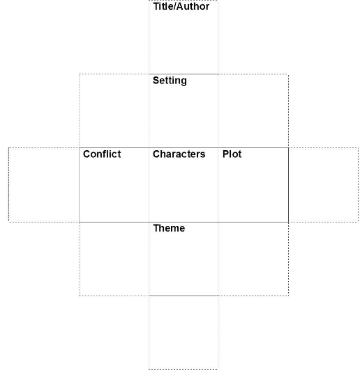
Discussion
Ask discussion questions of all 9 types.
Key Questions
- How do the animals react to the destruction of the windmill?
- How does Boxer’s reaction to the events of the day differ from Squealer’s reaction?
- Where was Squealer during the battle?
- What do you think will happen to Boxer when he is too old to work?
- Why do the pigs drink the whiskey they find?
- What is Napoleon’s original reaction to the whiskey?
- What is the meaning of Squealer’s ladder accident outside the barn?
- Which Commandment has now been altered?
Analyze
Analyze the key paragraph.
Key Paragraph, p. 112-113
“But a few days later Muriel, reading over the Seven Commandments to herself, noticed that there was yet another of them which the animals had remembered wrong. They had thought the Fifth Commandment was “No animal shall drink alcohol,” but there were two words that they had forgotten. Actually the Commandment read: ‘No animal shall drink alcohol to excess’” (p. 112-113).
Extend
Write
Have each student write a short product based on today’s prompt to connect to the unit theme.
One of the original tenets of animalism was an abstention from using alcohol. Once the pigs try it, they change their minds, but recognize the importance of not drinking too much. Even in the human community, this is a controversial issue.
Explain what you believe the animals should do: either abstain or partake in alcohol. Write 1-2 paragraphs about your opinions on the matter. Support your opinion with evidence from the text. Also, research the temperance movement that occurred in the early 20th century in the US. How are the animals faced with a similar situation? What choice would show the most integrity? When you have completed a draft of the assignment, make time to edit, revise and strengthen your work.
Close
Close by extending today’s lesson to life and the world.
Community Connection
Animal Farm is a criticism of communism as practiced by the Soviet Union. Communism is only one school of thought of the many that influence modern governments. During this novel, take the opportunity to study and familiarize yourself with a variety of political theories and ideologies. You may draw information from literary or informational texts to support analysis, reflection, and research. With each, ask the following questions:
- Under this philosophy, who is in power?
- Who makes decisions about the everyday lives of citizens?
- Who can vote?
- Who can own property?
- Does this ideology have a slogan or motto?
- What is an example of a country run under this philosophy?
- What is your opinion of this ideology?
- How would you summarize this idea in one sentence?
Today’s term: autocracy
Day 18
Outcomes for Today
Prepare
Background
Gather background knowledge about a place, time, event, person, or thing.
What happened to retirees in the Soviet Union?
As on Animal Farm, the Soviet Union did have a retirement, or pension, plan for its workers. Unlike the Soviet Union, this plan was actually put into effect. People could retire at a certain age and receive a set pension. However, this pension was quite low, and kept most Soviets near the poverty level when they retired. As worker shortages increased, pensions were decreased, offering incentive for retirement-age citizens to continue work. As a result, pensioners were either required to work in old age, or be supported by their families.
Word Wall
Here are five vocabulary words to teach and add to the Word Wall.
|
ambition (114) |
formulated (114) |
contrary (115) |
contract (117) |
increases (118) |
Read
Review
Review the timeline from the beginning every day.
Read
Read the selection, usually in a Shared Reading Read React Predict Cycle of 2-3 pages.
Read p. 114-119, ending after “…had been inflicted by Napoleon’s teeth” (p. 119).
|
Setting |
Characters |
Pages |
|
Animal Farm |
Boxer, Clover, Benjamin |
114 |
|
Squealer, Napoleon, pigs, animals |
114-119 |
Respond
Timeline
Agree on the facts in today’s reading and list the 3-5 most important on the timeline.
Students might mention:
- After the Battle of the Windmill, Boxer’s split hoof takes a long time to heal, and it bothers him quite a bit.
- Clover and Benjamin encourage Boxer not to work as hard, but he wants to see the windmill rebuilt before he retires.
- Boxer’s twelfth birthday – the age of retirement – is due in the summer of the following year.
- Rations were reduced, except for the pigs and the dogs.
- The animals can no longer remember what life was like under Jones, and believe Squealer that they are better off.
- Napoleon has many children with the farm’s four sows.
- Napoleon begins educating the young pigs, and decides that a school will be built later.
- Pigs are now allowed to wear green ribbons on their tales on Sunday.
- While most of the animals are hungry, the pigs seem to be getting fatter, and have a pint of beer daily.
- In April, Animal Farm becomes a Republic, and they elect Napoleon President.
- It is revealed that Snowball was fighting with Jones in the Battle of the Cowshed, and his wounds were actually inflicted not by Jones, but by Napoleon’s teeth.
Map
Add to ongoing class activities like a KWL chart or map: where did the characters go?
Map
Add to your map to Animal Farm.
Explore
Activity
Explore the reading more deeply with a visual or oral language activity.
Campaign Poster
Create a campaign poster to elect Napoleon to the office of President. Include a visual and a campaign slogan. Include headings, graphics and multimedia to aid comprehension.
Discussion
Ask discussion questions of all 9 types.
Key Questions
- When do you think Boxer will be able to retire?
- Are the animals worse off under Napoleon than they were under Snowball?
- Are the animals all equal? How do you know?
- What do you think Napoleon will teach the young pigs in their school?
- What does Orwell mean when he writes that hardships “were partly offset by the fact the life nowadays had a greater dignity than it had had before” (117?)
- Why do people (and in this case animals) like public ceremonies and events?
- What is the irony of the term “Spontaneous Demonstration?”
- Is there another animal who might have made a better President than Napoleon?
- Why is no one complaining or protesting the fact that the pigs are better fed than the rest?
Analyze
Analyze the key paragraph.
Key Paragraph, p. 115
“Meanwhile life was hard. The winter was as cold as the last one had been, and food was even shorter. Once again all rations were reduced, except those of the pigs and the dogs. A too rigid equality in rations, Squealer explained, would have been contrary to the principles of Animalism. In any case he had no difficulty in proving to the other animals that they were not in reality short of food, whatever the appearances might be. For the time being, certainly, it had been found necessary to make a readjustment of rations (Squealer always spoke of it as a “readjustment,” never as a “reduction”), but in comparison with the days of Jones, the improvement was enormous…” (p. 115).
Extend
Write
Have each student write a short product based on today’s prompt to connect to the unit theme.
Squealer is a gifted speaker indeed. He is able to keep the animals from revolting by convincing them that their lives are better than they were under Jones. He even convinces them that “the improvement was enormous” (115.)
Was the improvement enormous? Write 1-2 paragraphs either supporting or refuting this claim. What evidence do you have to show that the improvements are/are not enormous? When you have completed a draft of the assignment, take time to revise, edit and strengthen your writing.
Close
Close by extending today’s lesson to life and the world.
Community Connection
Animal Farm is a criticism of communism as practiced by the Soviet Union. Communism is only one school of thought of the many that influence modern governments. During this novel, take the opportunity to study and familiarize yourself with a variety of political theories and ideologies. You may draw information from literary or informational texts to support analysis, reflection, and research. With each, ask the following questions:
- Under this philosophy, who is in power?
- Who makes decisions about the everyday lives of citizens?
- Who can vote?
- Who can own property?
- Does this ideology have a slogan or motto?
- What is an example of a country run under this philosophy?
- What is your opinion of this ideology?
- How would you summarize this idea in one sentence?
Today’s term: federalism
Day 19
Outcomes for Today
Prepare
Background
Gather background knowledge about a place, time, event, person, or thing.
What is euthanasia?
Euthanasia is the killing of a person, usually by painless means, who is elderly or terminally ill. It is illegal in most places in the U.S., and remains extremely controversial. Some believe it to be the humane reaction to a person in pain. Others believe it is murder. Though the term is not specifically mentioned here, it is implied that one of the animals is euthanized after falling ill.
Word Wall
Here are five vocabulary words to teach and add to the Word Wall.
|
accumulated (120) |
altered (120) |
faltered (120) |
astonished (122) |
ignorant (124) |
Read
Review
Review the timeline from the beginning every day.
Read
Read the selection, usually in a Shared Reading Read React Predict Cycle of 2-3 pages.
Read p. 119-124, ending after “Boxer was never seen again” (p. 124).
|
Setting |
Characters |
Pages |
|
Animal Farm, summer |
Moses, animals |
119-120 |
|
Boxer, Clover, Benjamin, animals |
120-121 |
|
|
Boxer, Clover, Benjamin |
121 |
|
|
Boxer, Clover, Benjamin, Squealer, animals |
121-122 |
|
|
Boxer, Clover, Benjamin, Muriel, animals, man |
122-124 |
Respond
Timeline
Agree on the facts in today’s reading and list the 3-5 most important on the timeline.
Students might mention:
- Moses the raven reappears on the farm, and continues to preach about Sugarcandy Mountain.
- The pigs allow Moses to stay, even though they say his stories are lies.
- Boxer’s hoof heals, and he works even harder, but is slightly less strong than before.
- One evening, Boxer collapses, and the pigs decide to send him to the hospital.
- Two days later, a man in a wagon arrives to collect Boxer.
- The animals cheer and wave Boxer off, thinking he is going to the hospital.
- Benjamin reads the writing on the wagon, and tells the animals that the man is a horse slaughterer.
- The animals cry out to Boxer, and he tries to escape, but is too weak to break out of the wagon.
- Boxer is never seen again.
Map
Add to ongoing class activities like a KWL chart or map: where did the characters go?
Map
Add to your map of Animal Farm. Perhaps mark the spot where Boxer fell, and his stall in the barn.
Explore
Activity
Explore the reading more deeply with a visual or oral language activity.
Open Mind Portrait
Create an Open Mind Portrait for Boxer as he is carted off in the wagon. What is he thinking now that he is leaving Animal Farm, possibly forever? Do you believe he is living with integrity?
Discussion
Ask discussion questions of all 9 types.
Key Questions
- Why do the pigs tolerate Moses and his stories?
- What does Boxer hope will happen now that he is sick?
- What are Boxers plans for retirement?
- Who has actually come to pick up Boxer?
- What happens to Boxer?
- Why do you think Napoleon sent Boxer with a horse slaughterer?
- Are you surprised by what has happened to Boxer?
- Why don’t the other animals revolt?
- What does this say about their revolution?
- How do you think Squealer will excuse the pigs’ actions toward Boxer?
Analyze
Analyze the key paragraph.
Key Paragraph, p. 123
“‘Fools! Fools!’ shouted Benjamin, prancing round them and stamping the earth with his small hoofs. ‘Fools! Do you not see what is written on the side of that van?’” (p. 123).
Extend
Write
Have each student write a short product based on today’s prompt to connect to the unit theme.
One of the seven original commandments of Animal Farm was “No animal shall kill any other animal. Of course the pigs have amended the commandment to read, “No animal shall kill any other animal without cause.” Napoleon and Squealer would likely argue that this was a case of euthanasia, or mercy killing. Others may see it as murder, pure and simple.
Research the case of Lenny and George in John Steinbeck’s Of Mice and Men. Do you consider George’s death murder? How is it similar to the death that has occurred in today’s reading of Animal Farm?
In 1-2 paragraphs, respond to the topic of killing in these two foundational works of American literature. Be as concise as possible; include simile, metaphor and analogy to aid comprehension. When you have completed this assignment, make sure to revise and edit your work.
Close
Close by extending today’s lesson to life and the world.
Community Connection
Animal Farm is a criticism of communism as practiced by the Soviet Union. Communism is only one school of thought of the many that influence modern governments. During this novel, take the opportunity to study and familiarize yourself with a variety of political theories and ideologies. You may draw information from literary or informational texts to support analysis, reflection, and research. With each, ask the following questions:
- Under this philosophy, who is in power?
- Who makes decisions about the everyday lives of citizens?
- Who can vote?
- Who can own property?
- Does this ideology have a slogan or motto?
- What is an example of a country run under this philosophy?
- What is your opinion of this ideology?
- How would you summarize this idea in one sentence?
Today’s term: parliamentary
Day 20
Outcomes for Today
Prepare
Background
Gather background knowledge about a place, time, event, person, or thing.
What is a “cult of personality?”
Napoleon follows the classic example of a leader creating a “cult of personality” around himself. Stalin is one of the most famous examples of this concept in history. Through propaganda and manipulation of the media and the arts, Stalin made himself into an extreme celebrity. He was the focus of movies, art, literature, music, and poetry. Statues and portraits of him were visible everywhere in the Soviet Union. Like Napoleon, he had many strange titles, such as “Father of Nations” and “Great Architect of Communism.” Through clever self-promotion, he attained a god-like status. Everyone looked up to him, respected him, and took his word as law.
Word Wall
Here are five vocabulary words to teach and add to the Word Wall.
|
spite (124) |
circulated (125) |
graphic (125) |
sole (125) |
stout (127) |
Read
Review
Review the timeline from the beginning every day.
Read
Read the selection, usually in a Shared Reading Read React Predict Cycle of 2-3 pages.
Read p. 124-128
|
Setting |
Characters |
Pages |
|
Animal Farm, three days after Boxer is taken away |
Squealer, animals |
124-125 |
|
Animal Farm, the Sunday meeting |
Napoleon, pigs, animals |
125-126 |
|
Animal Farm |
Clover, Benjamin, Moses, pigs, animals |
127-128 |
Respond
Timeline
Agree on the facts in today’s reading and list the 3-5 most important on the timeline.
Students might mention:
- Three days later, Squealer announces that Boxer died in the hospital.
- Squealer claims to have been at Boxer’s deathbed, where he witnessed his last words.
- Squealer claims that the wagon that took Boxer used to belong to a horse slaughterer, and had simply not been re-painted since the veterinarian purchased it.
- The animals feel better knowing that Boxer received the best care possible.
- At the Sunday meeting, Napoleon gives a speech in Boxer’s memory, and explains that the farm will send flowers for his grave in Willingdon.
- A few days later, the pigs hold a memorial banquet, which includes a case of whiskey.
- As the years go by, only a few of the original animals remain alive on the farm.
- The farm is more successful and slightly larger; the windmill is even completed.
- The luxuries originally promised that would result from the electric generator in the windmill never appear.
- Napoleon says that true happiness comes from living simply and adhering to Animalism.
Map
Add to ongoing class activities like a KWL chart or map: where did the characters go?
Map
Add to your map of Animal Farm. The windmill is now completed, and there are two more fields to add.
Explore
Activity
Explore the reading more deeply with a visual or oral language activity.
Memorial Stone
Boxer, the Rebellion’s most dedicated worker – is now gone. His body was buried elsewhere, but you will create a memorial at Animal Farm in his honor. Design a memorial to honor Boxer’s memory. It can be a monument, a stone, or anything you would like. Be sure to include some text about Boxer’s life and contribution to Animalism. Include headings, graphics and/or multimedia to aid comprehension.
Discussion
Ask discussion questions of all 9 types.
Key Questions
- According to Squealer, what happened to Boxer?
- Again, according to Squealer, what were Boxer’s last words?
- How does Squealer respond to the accusation that Boxer was sent to a horse slaughterer?
- What do you think really happened to Boxer?
- How do you think the pigs got the money to buy the case of whiskey? What happened to Jones?
- Do the animals ever retire?
- What is life like on Animal Farm now that the years have passed? Is integrity intact?
- Is the reality of life on Animal Farm what the animals expected when they first rebelled against Jones?
- Would life have been any different if they hadn’t expelled Snowball?
Analyze
Analyze the key paragraph.
Key Paragraph, p. 127
“Years passed. The seasons came and went, the short animal lives fled by. A time came when there was no one who remembered the old days before the Rebellion, except Clover, Benjamin, Moses the raven, and a number of the pigs” (p. 127).
Extend
Write
Have each student write a short product based on today’s prompt to connect to the unit theme.
As the years fly by, young people are often unaware of their own parents’ histories. Important events are forgotten, and people become ignorant. Certainly, many of the animals of Animal Farm know nothing of life before the revolution other than what Squealer may have told them.
Pretend you are Clover, and write a history of Animal Farm from your point of view. Write 1-2 paragraphs in which you tell your life story, and explain all that you have witnessed in your life. Be as descriptive as possible and feel free to use devices such as simile, metaphor and analogy. When you have finished a draft, revise and edit your work to create a stronger assignment.
Close
Close by extending today’s lesson to life and the world.
Community Connection
Animal Farm is a criticism of communism as practiced by the Soviet Union. Communism is only one school of thought of the many that influence modern governments. During this novel, take the opportunity to study and familiarize yourself with a variety of political theories and ideologies. You may draw information from literary or informational texts to support analysis, reflection, and research. With each, ask the following questions:
- Under this philosophy, who is in power?
- Who makes decisions about the everyday lives of citizens?
- Who can vote?
- Who can own property?
- Does this ideology have a slogan or motto?
- What is an example of a country run under this philosophy?
- What is your opinion of this ideology?
- How would you summarize this idea in one sentence?
Today’s term: authoritarian
Day 21
Outcomes for Today
Prepare
Background
Gather background knowledge about a place, time, event, person, or thing.
What lifestyle did Stalin enjoy?
Although Stalin, like Napoleon, encouraged his people to live simply and frugally, Stalin himself enjoyed a lavish lifestyle. He occupied a suite in the Kremlin, the former home of the Tsars in Moscow. In addition, he had a half dozen country homes, all of which were luxurious and well furnished. He certainly did not lead by example!
Word Wall
Here are five vocabulary words to teach and add to the Word Wall.
|
enormous (129) |
hardship (130) |
professed (130) |
awkwardly (132) |
considerable (132) |
Read
Review
Review the timeline from the beginning every day.
Read
Read the selection, usually in a Shared Reading Read React Predict Cycle of 2-3 pages.
Read p. 129-134, ending after “…while his favorite sow appeared in the watered silk dress which Mrs. Jones had been used to wear on Sundays” (p. 134).
|
Setting |
Characters |
Pages |
|
Animal Farm |
Squealer, pigs, dogs, animals |
129 |
|
Animal Farm, early summer |
Squealer, sheep |
129-131 |
|
Clover, Squealer, Napoleon, pigs, sheep, Clover, Benjamin, animals |
131-134 |
Respond
Timeline
Agree on the facts in today’s reading and list the 3-5 most important on the timeline.
Students might mention:
- Even though the farm is richer, only the dogs and pigs are any wealthier.
- The pigs don’t do the physical work of the farm; they do the organizational and administrative work.
- Life goes on the same way it always has, and none can remember if life was better or worse during Jones’s time.
- The animals still have hope for the future, and take great pride in Animal Farm.
- Even if life was hard, the animals are happy that they are all equal.
- One day, Squealer takes the sheep to the other end of the farm to teach them a new song.
- Soon after, the animals were all frightened by the sight of a sheep walking on its hind legs.
- Napoleon appears, carrying a whip.
- The sheep begin to bleat “Four legs good, two legs better.”
- Clover notices something is wrong with the Seven Commandments.
- Benjamin reads the only Commandment left: “All animals are equal, but some animals are more equal than others.”
- The pigs now act more like men, and even wear clothes.
Map
Add to ongoing class activities like a KWL chart or map: where did the characters go?
Map
Add to your map of Animal Farm.
Explore
Activity
Explore the reading more deeply with a visual or oral language activity.
Seven Commandments Poster
Examine the Seven Commandments. Were there any new ones broken today? Write the name of the animal that broke the Commandment next to it on your poster. When appropriate, incorporate graphics, multimedia and headings to aid comprehension.
3g6 Plot Profile Chart
Complete a Plot Profile Chart for the novel. What were the ten most important events in the novel? Why do you believe they are important?
3g6 Plot Profile Chart
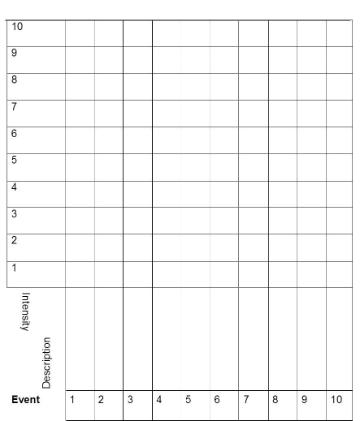
Discussion
Ask discussion questions of all 9 types.
Key Questions
- What is the job of the pigs on the farm?
- Is the animals’ life any different than it was under Jones?
- What is Benjamin’s opinion of life under Animalism?
- What factors make the animals proud of Animal Farm?
- How does Squealer use the sheep to promote the pigs’ agenda?
- How is the new Commandment different from the original Seven?
- What do the pigs mean by “some animals are more equal than others?”
- What is symbolized by the actions of the pigs?
- How do you think the novel will end?
Analyze
Analyze the key paragraph.
Key Paragraph, p. 133
“For once Benjamin consented to break his rule, and he read out to her what was written on the wall. There was nothing there now except a single Commandment. It ran:
All animals are equal
but some animals are more equal than others
(p. 133).
Extend
Write
Have each student write a short product based on today’s prompt to connect to the unit theme.
From the pigs’ point of view, Animalism is still in effect. The animals control their own farm, no man is in charge, and most animals (except the pigs and dogs) share the resources of the farm equally.
From the author’s point of view, the pigs have violated the spirit of Animalism. They’ve broken all of the commandments, began walking on two legs, and even act like humans.
Do you believe that the pigs are acting outside the tenants of Animalism? Write 1-2 explaining why or why not. Be as descriptive as possible. Draw on personal experience as well as evidence from the book to support your idea. When you have completed a draft of your assignment, revise and edit your work to strengthen your ideas.
Close
Close by extending today’s lesson to life and the world.
Community Connection
Animal Farm is a criticism of communism as practiced by the Soviet Union. Communism is only one school of thought of the many that influence modern governments. During this novel, take the opportunity to study and familiarize yourself with a variety of political theories and ideologies. You may draw information from literary or informational texts to support analysis, reflection, and research. With each, ask the following questions:
- Under this philosophy, who is in power?
- Who makes decisions about the everyday lives of citizens?
- Who can vote?
- Who can own property?
- Does this ideology have a slogan or motto?
- What is an example of a country run under this philosophy?
- What is your opinion of this ideology?
- How would you summarize this idea in one sentence?
Today’s term: feudalism
Day 22
Outcomes for Today
Prepare
Background
Gather background knowledge about a place, time, event, person, or thing.
What was Orwell’s opinion of communist Russia?
In our time, political speech and writing are largely the defense of the indefensible. Things like the continuance of British rule in India, the Russian purges and deportations, the dropping of the atom bombs on Japan, can indeed be defended, but only by arguments which are too brutal for most people to face, and which do not square with the professed aims of the political parties. Thus political language has to consist largely of euphemism, question-begging and sheer cloudy vagueness. Defenseless villages are bombarded from the air, the inhabitants driven out into the countryside, the cattle machine-gunned, the huts set on fire with incendiary bullets: this is called pacification. Millions of peasants are robbed of their farms and sent trudging along the roads with no more than they can carry: this is called transfer of population or rectification of frontiers. People are imprisoned for years without trial, or shot in the back of the neck or sent to die of scurvy in Arctic lumber camps: this is called elimination of unreliable elements. Such phraseology is needed if one wants to name things without calling up mental pictures of them. Consider for instance some comfortable English professor defending Russian totalitarianism. He cannot say outright, "I believe in killing off your opponents when you can get good results by doing so." Probably, therefore, he will say something like this:
"While freely conceding that the Soviet regime exhibits certain features which the humanitarian may be inclined to deplore, we must, I think, agree that a certain curtailment of the right to political opposition is an unavoidable concomitant of transitional periods, and that the rigors which the Russian people have been called upon to undergo have been amply justified in the sphere of concrete achievement."”
An Excerpt from Orwell’s 1943 Essay entitled, “Politics and the English Language”
Word Wall
Here are five vocabulary words to teach and add to the Word Wall.
|
equality (134) |
dispelled (135) |
prosperity (136) |
subsist (136) |
suppressed (137) |
Read
Review
Review the timeline from the beginning every day.
Read
Read the selection, usually in a Shared Reading Read React Predict Cycle of 2-3 pages.
Read p. 134-139
|
Setting |
Characters |
Pages |
|
Animal Farm |
Farmers, Mr. Pilkington, Clover, Napoleon, pigs, animals |
134-139 |
Respond
Timeline
Agree on the facts in today’s reading and list the 3-5 most important on the timeline.
Students might mention:
- One day, a large group of farmers appears at the farm, and the pigs show them around.
- That night, the pigs host a dinner for the men in the farmhouse.
- The other animals peer in the windows, and see the men and pigs toasting each other.
- Mr. Pilkington toasts the pigs for their excellent management of the farm, and for treating the other animals just like men would.
- Napoleon’s toast mentions the goodwill he has toward the men, and promises that many of the ways of animals will change.
- The animals will no longer call each other “comrade,” and the horse and hoof will be removed from their flag.
- Finally, Napoleon says that the name “Animal Farm” will be changed back to “Manor Farm.”
- The pigs and men cheer, but later get into a drunken fight over cards.
- Clover and the other animals realize that it is now impossible to tell the pigs apart from men.
Map
Add to ongoing class activities like a KWL chart or map: where did the characters go?
Map
Finish your map of Animal Farm.
Explore
Activity
Explore the reading more deeply with a visual or oral language activity.
Story Sketch
Draw a sketch of the pigs and men around the table during Napoleon’s toast. Be sure to emphasize the similarity in their appearance. Utilize headings, graphics and multimedia to aid comprehension.
Discussion
Ask discussion questions of all 9 types.
Key Questions
- What was so impressive about the farm to Napoleon’s guests?
- What are the things that Napoleon promises to change about the farm?
- Do you think the farm needs a new name?
- How is this farm different from the one the pigs chased Jones off?
- How do the animals feel when they see the pigs with the men?
- Why does Orwell compare the pigs to men?
- Who is Orwell truly criticizing in the novel Animal Farm?
- Do you think there will be another revolution?
- What would be your advice to the new brand of revolutionary looking to overthrow the oppression of the ruling pig class?
- How would you instill compassion in everyone?
- How might you attempt to prevent class stratification over time?
Analyze
Analyze the key paragraph.
Key Paragraph, p. 135-136
“…They had been nervous about the effects upon their own animals, or even upon their human employees. But all such doubts were now dispelled. Today he and his friends had visited Animal Farm and inspected every inch of it with their own eyes, and what did they find? Not only the most up-to-date methods, but a discipline and an orderliness which should be an example to all farmers everywhere. He believed that he was right in saying that the lower animals on Animal Farm did more work and received less food than any animals in the county. Indeed, he and his fellow-visitors today had observed many features which they intended to introduce on their own farms immediately” (p. 135-136).
Extend
Write
Have each student write a short product based on today’s prompt to connect to the unit theme.
In Animal Farm, Orwell parallels the story of Russia’s Communist revolution under Vladimir Lenin, through the expulsion and murder of Leon Trotsky, into the creation Totalitarian State under Joseph Stalin. In doing so, he warns the reader of the human tendency towards class stratification. He further warns the reader that the ruling class will use the power of language and propaganda to further manipulate the social order to their advantage. He points out pitfalls of the working class, such as ignorance, self-centeredness, and laziness. His message is not so much that this thirst for power could take place, but rather that it is taking place and must be combated. If ignorance, self-centeredness, greed and laziness are the pitfalls, then education, the protection of workers’ rights, compassion for others, a commitment to justice, and a commitment to thinking things through before you act are ways of avoiding being taken advantage of.
Your final writing project is to write an explanatory essay in which you describe your support of education, workers’ rights, justice, or thinking things through. How do these qualities display integrity? Your arguments should be logical in their approach, but also appeal to the reader’s emotions. You should reference incidents and quotations from the novel to support your opinion, as well as your own personal experiences. You should also appeal to commonly accepted beliefs. Include a concession, and avoid using arguments based on “unclear thinking.” Include an introduction and a conclusion. Remember to place your best arguments at the beginning and end of your essay. During the process of writing this assignment, take time to revise, reflect and edit your work to strengthen the quality of your writing and organization of ideas.
Close
Close by extending today’s lesson to life and the world.
Community Connection
Animal Farm is a criticism of communism as practiced by the Soviet Union. Communism is only one school of thought of the many that influence modern governments. During this novel, take the opportunity to study and familiarize yourself with a variety of political theories and ideologies. You may draw information from literary or informational texts to support analysis, reflection, and research. With each, ask the following questions:
- Under this philosophy, who is in power?
- Who makes decisions about the everyday lives of citizens?
- Who can vote?
- Who can own property?
- Does this ideology have a slogan or motto?
- What is an example of a country run under this philosophy?
- What is your opinion of this ideology?
- How would you summarize this idea in one sentence?
Today’s term: federation