Lesson Plans
Bridge to Terabithia
40
60
90
Day 1
Outcomes for Today
W3. Write narratives to develop real or imagined experiences or events using effective technique, relevant descriptive details, and well-structured event sequences.
- Engage and orient the reader by establishing a context and point of view and introducing a narrator and/or characters; organize an event sequence that unfolds naturally and logically.
- Use narrative techniques, such as dialogue, pacing, and description, to develop experiences, events, and/or characters.
- Provide a conclusion that follows from and reflects on the narrated experiences or events.
Prepare
Background
Gather background knowledge about a place, time, event, person, or thing.
What is the setting and context of this novel?
Bridge to Terabithia takes place in Lark Creek, which is in rural Virginia during the late 1970’s. Jesse lives on a farm and the novel starts with him sharing a room with his sisters, running in the pasture, and milking the cows. It is his desire to be the best runner so he is practicing daily so he can be noticed.
Word Wall
Here are five vocabulary words to teach and add to the Word Wall.
Introduce 5 important, useful words from today’s reading.
|
screeched (2) |
yanked (3) |
crouched (3) |
delicately (7) |
obediently (9) |
Read
Review
Review the timeline from the beginning every day.
Read
Read the selection, usually in a Shared Reading Read React Predict Cycle of 2-3 pages.
Read p. 1-13 Chapter 1
|
Setting |
Characters |
Pages |
|
The bedroom |
Jesse, May Belle |
1-2 |
|
Yard/Pasture |
Jesse (practicing running), Miss Bessie the cow |
3-7 |
|
Kitchen |
Jesse, May Belle, Momma, his sisters |
7-11 |
|
Yard |
Jessie, May Belle |
11-13 |
Respond
Timeline
Agree on the facts in today’s reading, and list the 3-5 most important on the Timeline.
Discuss the reading and add 3-5 events to the timeline.
- Discuss the story to fix the facts: who, what, when, where, and why.
- Decide on the 3-5 most important events and add these to the timeline.
Students might mention:
- Jess wanted to be the fastest boy in 5th
- He gets up early to practice running in the field.
- He has chores to do—milking the cow, picking the beans.
- His sisters can easily get out of doing chores.
- A neighbor moves in down the road.
Map
Add to ongoing class activities like a KWL chart or map: where did the characters go?
Heroic Journey Chart
Start discussing the Heroic Journey in class. Where is Jesse now?
Character Chart
Who are the characters so far in the book? List one trait for each of them.
Map
Where is Virginia? Locate it on a map.
Explore
Activity
Explore the reading more deeply with a visual or oral language activity.
Open Mind Portrait
Create an Open Mind Portrait of Jesse. What do you think he is thinking and feeling as he is out running today? Sees his sisters get out of chores? And learn that there is a new neighbor? Add 3-5 new thoughts to your OMP.
Discussion
Ask discussion questions of all 9 types.
Key Questions
- What does Jess want to be? Why is this status important to him? How does he practice?
- What can you infer about the economics of the area Jesse lives in by the description of the farm and of the school in Chapter 1? Give examples to support your answer.
- What is Jesse’s relationship with his mother and father? What can you discern about his parents?
- Jesse’s mom accuses him of being lazy, p. 11. Why is this accusation ironic? What are some examples from the reading that give a different impression of Jesse?
- Does he notice someone moving in down the road? How does the author describe the Perkins Place, page 11? Could this be a foreshadow of events? What do you think could happen?
Analyze
Analyze the key paragraph.
Key Paragraph, p. 10
“It was May Belle who came to tell him in the bean patch that people were moving into the old Perkins place down on the farm…the Perkins place was one of those ratty old country houses you moved into because you had no decent place to go…He thought later how peculiar it was that here was probably the biggest thing in his life, and he had shrugged it off as nothing” (p. 10).
Extend
Write
Have each student write a short product based on today’s prompt to connect to the unit theme.
Think of a time someone new moved into your neighborhood or school. Or of a time you moved into a new school or neighborhood. Write a one-paragraph narrative sharing about your experience. In today’s writing tell your story in chronological order. Engage your reader by establishing context and point of view and introducing your narrator and characters. Use strong descriptions and pacing to develop your story. Provide a conclusion that follows from and reflects on the event.
Close
Close by extending today’s lesson to life and the world.
Day 2
Outcomes for Today
W3. Write narratives to develop real or imagined experiences or events using effective technique, relevant descriptive details, and well-structured event sequences.
- Engage and orient the reader by establishing a context and point of view and introducing a narrator and/or characters; organize an event sequence that unfolds naturally and logically.
- Use narrative techniques, such as dialogue, pacing, and description, to develop experiences, events, and/or characters.
- Provide a conclusion that follows from and reflects on the narrated experiences or events.
Prepare
Background
Gather background knowledge about a place, time, event, person, or thing.
What is imagination?
Imagination is the ability to form mental images based on fact or fantasy.
In today’s reading, Jess uses art and drawing as his way of escaping from the hectic parts of his life. His drawings are images he conjures in his imagination of animals.
Music reference
In today’s reading, Jess references Miss Edmund’s and the music she taught. A good opportunity to have students listen to some of the songs the kids sang. You can have students choose a song and its lyrics to interpret.
My Beautiful Balloon, The Fifth Dimension
http://www.youtube.com/watch?v=5akEgsZSfhg
Free to be me and you
http://www.youtube.com/watch?v=_26FOHoaC78
This Land is Your Land; Woodie Gunthrie
http://www.youtube.com/watch?v=_26FOHoaC78
Blowing in the Wind
http://www.youtube.com/watch?v=vWwgrjjIMXA
Word Wall
Here are five vocabulary words to teach and add to the Word Wall.
|
scalding (13) |
nauseating (13) |
pandemonium (19) |
snare (19) |
hypocritical (20) |
Read
Review
Review the timeline from the beginning every day.
Read
Read the selection, usually in a Shared Reading Read React Predict Cycle of 2-3 pages.
Read p. 13-27, chapter 2
|
Setting |
Characters |
Pages |
|
Kitchen/Porch |
Jess, mother, little sisters |
13-14 |
|
Bedroom |
Jess |
14-16 |
|
School |
Jess, Miss Edmunds, teacher |
17-20 |
|
Barn |
Jess, May Belle, dad |
20-23 |
|
Pasture |
Jess, Leslie |
23-27 |
Respond
Timeline
Agree on the facts in today’s reading and list the 3-5 most important on the timeline.
Students might mention:
- Jess spends the day helping his mom with chores and with the kids.
- He goes to his room to draw which is his escape.
- Jess talks about wanting to be an artist and his dad disapproving.
- Jess mentions that he is in love with his teacher, Miss Edmunds; she is progressive and a free-spirit in the midst of conformity.
- His dad returns home and he describes wanting to have a relationship with a male.
- Jess starts milking the cow.
- He runs the next day and meets Leslie.
Map
Add to ongoing class activities like a KWL chart or map: where did the characters go?
Heroic Journey Chart
Start discussing the Heroic Journey in class. Where is Jesse now?
Character Chart
Who are the characters so far in the book? List one trait for each of them.
Map
Where is Virginia? Locate it on a map.
Explore
Activity
Explore the reading more deeply with a visual or oral language activity.
Open Mind Portrait
Add to your OMP of Jess. What do you think he is thinking as he has to do chores, meets Leslie, and gets lost in his art? Add 3-5 new thoughts to your OMP.
OR
Create an Open Mind Portrait of Leslie. What do you think she is thinking and feeling as she meets Jess in the cow pasture? Add 3-5 thoughts to your OMP.
Venn Diagram
Create a Venn diagram comparing the relationship and treatment Jess’s parents have with him and with his sisters. You can use this to write a compare and contrast essay.
6g6 Venn Diagram Chart

Discussion
Ask discussion questions of all 9 types.
Key Questions
- What does Jess want to do when he grows up? How does his father feel about his career choice and the teachers who support it?
- Does it seem like Jess has a good imagination? How can you tell? Why is an imagination important?
- How does Jess’ dad treat him in general? Are there specific gender roles that his mother and father assume? What roll is Jess supposed to assume?
- Describe Miss Edmunds. What are her strengths with the kids? How do the teachers and some students feel about her?
- Who moves in next door?
- In what ways is Jess critical of Leslie?
Analyze
Analyze the key paragraph.
Key Paragraph, p. 22
“‘My name’s Leslie Burke.’ She even had one of those names that could go either way, but he was sure now that he was right. ‘What’s the matter?’
‘Huh?’
‘Is something the matter?’
‘Yeah. No’” (p. 22).
Extend
Write
Have each student write a short product based on today’s prompt to connect to the unit theme.
In what ways is Jess critical of Leslie? Have you ever had a first impression of someone and it wasn’t positive only to have him or her become a good friend later on? What lessons can we learn from this?
Write a one-paragraph narrative in which you describe in detail an experience you had meeting someone for the first time. Engage your readers by establishing context and setting. Use dialog where appropriate. Detail the setting and experiences you two shared for the first time (must be school appropriate). Make sure the details you chose are relevant to your topic. Conclude with a statement that supports your narrative.
|
Final Writing Product Write a narrative that highlights the music from the novel and the 1970’s. Have students listen to the songs in the background knowledge section of today’s lesson. Have student interpret the song lyrics and meaning behind the words. Students can state their opinion of the song and the group. Writing should be in narrative format. |
Close
Close by extending today’s lesson to life and the world.
Day 3
Outcomes for Today
W3. Write narratives to develop real or imagined experiences or events using effective technique, relevant descriptive details, and well-structured event sequences.
- Engage and orient the reader by establishing a context and point of view and introducing a narrator and/or characters; organize an event sequence that unfolds naturally and logically.
- Use narrative techniques, such as dialogue, pacing, and description, to develop experiences, events, and/or characters.
- Provide a conclusion that follows from and reflects on the narrated experiences or events.
Prepare
Background
Gather background knowledge about a place, time, event, person, or thing.
What were traditional schoolyard games during this novel? Discuss why these games may or may not be played today.
King of the Hill (also known as "King of the Mountain" or "King of the Castle") is a children's game, the object of which is to stay on top of a large hill or pile (or any other designated area) as the "King of the Hill". Other players attempt to knock the current King off the pile and take their place, thus becoming the new King of the Hill.
The way the "king" can be removed from the hill depends largely on the rules determined by the players before the game starts. Ordinarily pushing is the most common way of removing the king from the hill, but there are significantly rougher variations where punching or kicking is allowed. As such, the game is often banned from schools.
Hopscotch is a children's game that can be played with several players or alone. Hopscotch is a popular playground game in which players toss a small object into numbered spaces of a pattern of rectangles outlined on the ground and then hop or jump through the spaces to retrieve the object.
Additional playground games:
http://www.sheknows.com/sheknows-cares/articles/827891/7-creative-playground-games-for-kids
In today’s reading Jess describes the playground at his school and its limited resources. He talks about how the various different age groups share or use the space. His group had little left over so they started running races at recess. Traditionally, the races were only for boys. Today Leslie wanted to race the boys. Jess stood up for her and made sure she raced with the kids. She ended up beating all of the boys.
Word Wall
Here are five vocabulary words to teach and add to the Word Wall.
|
radiator (28) |
primly (28) |
fluttered (28) |
arithmetic (30) |
postpone (32) |
Read
Review
Review the timeline from the beginning every day.
Read
Read the selection, usually in a Shared Reading Read React Predict Cycle of 2-3 pages.
Read p. 28-42, Chapter 3
|
Setting |
Characters |
Pages |
|
Classroom |
Jess, Leslie, the class |
28-33 |
|
Classroom/Lunch |
Jess, Leslie, classmates |
33-34 |
|
Playground |
The boys, Jess, Leslie |
35-38 |
|
Racing |
Leslie, boys, Jess |
39-42 |
Respond
Timeline
Agree on the facts in today’s reading and list the 3-5 most important on the timeline.
Students might mention:
- It is the first day of school and Leslie enters Jess’ classroom, there is little room for her so she is placed in the front of the class.
- It is crowded and the other kids stare at her for looking different (she is in cutoffs, they are in their dress clothes), she eats different food then the rest of the class;
- At recess the boys go out to race and the girls play hopscotch.
- Leslie joins the boys, which is unheard of. She asks to race as well
- She wins and becomes the fastest kid in the whole school.
- Jess tries not to associate with her because he’s afraid he’ll get teased.
- He watches her run home and is amazed at her beauty—but doesn’t want to admit it.
Map
Add to ongoing class activities like a KWL chart or map: where did the characters go?
Heroic Journey Chart
Start discussing the Heroic Journey in class. Where is Jesse now?
Character Chart
Who are the characters so far in the book? List one trait for each of them.
Explore
Activity
Explore the reading more deeply with a visual or oral language activity.
Open Mind Portrait
Add to your OMP of Jess. What do you think he is thinking and feeling as he lets Leslie run and loses to her and sees her in his class? Add 3-5 new thoughts to your OMP.
Add to your OMP of Leslie. What do you think she is thinking and feeling as she becomes the “new kid” at school, wins the race with the boys, and tries to befriend Jess? Add 3-5 new thoughts to your OMP.
Discussion
Ask discussion questions of all 9 types.
Key Questions
- Leslie arrives at school wearing her cut-offs and looking like she doesn’t fit in. How do you think that affects her or does it? What would you try to do if you were going to be the “new person” at school? Try to fit in or be yourself?
- Why do you think Leslie was drawn to Jess and the boys?
- Do you think boys are more competitive than girls? The kids tell Leslie that girls are not allowed on the lower playground. Why do these type of gender roles exist? Can you describe a place that still has that type of gender separation (perceived or real)?
- Why does Jess have so much conflict with Gary?
- Do the girls tease Leslie? Why?
- What happens out on the field? How does Leslie disrupt the gender expectations? What is one of Leslie’s best attributes?
- What was Jess’s reaction toward Leslie on the bus? Why didn’t react to it?
Analyze
Analyze the key paragraph.
Key Paragraph, p. 39
“‘You can run with the fours, Leslie.’ He said it loudly enough to make sure Fulcher could hear him and then concentrated on the runners. See, he told himself, you can stand up to a creep like Flucher. No sweat” (p. 39).
Extend
Write
Have each student write a short product based on today’s prompt to connect to the unit theme.
Sometimes people expect certain behaviors from others due to their gender. What expectations do the boys have of Leslie? Are those expectations fair? Are there gender expectations in our culture that you disagree with? (Like the man should be breadwinner or the woman should not work…or women should always wear dresses etc.)
Jess is able to stand up to Fulcher and defend Leslie. Write a one-paragraph narrative in which you detail a situation where you defended yourself and a friend. Introduce a narrator and the characters. Be detailed about the characters and their traits. What was the setting of the situation? Conclude by reflecting on your experiences. For the purpose of today’s writing you will put most of your focus on your characters.
|
Final Writing Product Write a sports article that highlights the 5th grade race. Be sure to answer the 5 questions. Who was involved? Where did it take place? What happened? When did the race take place? How the race was won, be descriptive (write in narrative form) |
Close
Close by extending today’s lesson to life and the world.
Day 4
Outcomes for Today
W3. Write narratives to develop real or imagined experiences or events using effective technique, relevant descriptive details, and well-structured event sequences.
- Engage and orient the reader by establishing a context and point of view and introducing a narrator and/or characters; organize an event sequence that unfolds naturally and logically.
- Use narrative techniques, such as dialogue, pacing, and description, to develop experiences, events, and/or characters.
- Provide a conclusion that follows from and reflects on the narrated experiences or events.
Prepare
Background
Gather background knowledge about a place, time, event, person, or thing.
What is the significance of Labor Day?
The first Labor Day was held in 1882. Its origins stem from the desire of the Central Labor Union to create a holiday for workers. It became a federal holiday in 1894. It was originally intended that the day would be filled with a street parade to allow the public to appreciate the work of the trade and labor organizations. After the parade, a festival was to be held to amuse local workers and their families. In later years, prominent men and women held speeches. This is less common now, but is sometimes seen in election years. One of the reasons for choosing to celebrate this on the first Monday in September was to add a holiday in the long gap between Independence Day and Thanksgiving.
In today’s reading, Jess describes the first week of school and how he appreciated that it was a short week due to the holiday. Leslie continued to join the boys in their races and she continued to win. By the end of the week many of the boys were going and playing other games.
Word Wall
Here are five vocabulary words to teach and add to the Word Wall.
|
consolation (43) |
melodic (44) |
deliberate (46) |
consolidate (47) |
rumpus (49) |
Read
Review
Review the timeline from the beginning every day.
Read
Read the selection, usually in a Shared Reading Read React Predict Cycle of 2-3 pages.
Read p. 43-52- bottom paragraph
|
Setting |
Characters |
Pages |
|
Play ground |
Leslie and Jess and classmates |
43 |
|
Music |
Miss Edmunds, Jess, Leslie, classmates |
44-46 |
|
Bus |
Leslie, Jess, May Belle |
46-48 |
|
Classroom |
Leslie, Jess, Classmates, Mrs. Myers |
48-52 |
Respond
Timeline
Agree on the facts in today’s reading and list the 3-5 most important on the timeline.
Students might mention:
- Leslie won the races every day that week.
- The boys could not believe it and they all gave up racing.
- During music, Jess decided to start being nicer to Leslie.
- Leslie told Jess she came from money and her parents wanted to reprioritize their values.
- Leslie's favorite hobby is scuba diving.
- The other students tease her for not having a TV.
Map
Add to ongoing class activities like a KWL chart or map: where did the characters go?
Heroic Journey Chart
Start discussing the Heroic Journey in class. Where is Jesse now?
Character Chart
Who are the characters so far in the book? List one trait for each of them.
Explore
Activity
Explore the reading more deeply with a visual or oral language activity.
Open Mind Portrait
Add to your OMP of Jess. What is he thinking or feeling as he realizes he is not going to win the races? Reconnects with Miss Edmunds? And decides to befriend Leslie? Add 3-5 new thoughts to your OMP.
OR
Add to your OMP of Leslie. What is she thinking and feeling as she continues to beat the boys in the races? Has her story read? Becomes friends with Jess? Add 3-5 new thoughts to your OMP.
Discussion
Ask discussion questions of all 9 types.
Key Questions
- Why did the boys stop racing after Leslie kept beating them? What do you think she has to prove? Would you act in the same fashion?
- What was the students’ reaction to Miss Edmunds?
- Why was everyone so surprised that Leslie was a scuba diver?
- Why did kids make fun of her for not having a TV?
- What changes in his attitude toward Leslie did Jess make? Why did he decide to become friends with her? What does he have to lose?
Analyze
Analyze the key paragraph.
Key Paragraph, p. 39
“Lord. Sometimes he acted like the original yellow-bellied sapsucker. He nodded and smiled again. She smiled back. He felt there in the teachers’ room it was the beginning of a new season in his life and he chose deliberately to make it so” (p. 39).
Extend
Write
Have each student write a short product based on today’s prompt to connect to the unit theme.
What does Jess mean by starting a new season in his life? How has he decided to treat Leslie differently? Does he still care what other people think? Have you, a friend, sibling, parent or guardian ever decided to start a ‘new season in your life’ or decided to treat someone nicely even if your peers didn’t agree?
Have you ever had a “new season” in your life? Write a narrative to describe/detail a real or imagined “new season” that you have experienced. Engage your reader by establishing the context of the situation and point of view of the narrator. Organize the sequences so they develop in a natural order. Provide a conclusion that supports your topic.
Close
Close by extending today’s lesson to life and the world.
Day 5
Outcomes for Today
W3. Write narratives to develop real or imagined experiences or events using effective technique, relevant descriptive details, and well-structured event sequences.
- Engage and orient the reader by establishing a context and point of view and introducing a narrator and/or characters; organize an event sequence that unfolds naturally and logically.
- Use narrative techniques, such as dialogue, pacing, and description, to develop experiences, events, and/or characters.
- Provide a conclusion that follows from and reflects on the narrated experiences or events.
Prepare
Background
Gather background knowledge about a place, time, event, person, or thing.
What are Dogwood and Rosebud trees?
Show your students the trees by searching for them as images.
The flowering dogwood (Cornus florida) originally evolved as a junior member of the forests of the eastern United States where it thrives under the canopy of larger trees in the shady, moist and nutrient-rich conditions it prefers. Home-owners and landscapers have long favored it for its lovely spring display, its attractive shape and luxuriant leaves and its modest size.
Eastern Redbud is a small sturdy tree native to the United States. Growing everywhere from Canada to Florida, Eastern Redbud is a perfect tree for home landscaping. Its flowers, appearing from March to May, are light to vibrant pink in color and almost a half inch long. Flowers appear in clusters on bare stems before the leaves. At times, the flowers even appear on the trunk itself. The Eastern Redbud is the state tree of Oklahoma. Flowers attract bees and butterflies. A deciduous tree, Redbud foliage turns a distinct yellow in fall. Eastern Redbud is a wonderful urban tree that does well in well-drained soil.
In today’s reading, Leslie and Jess spend the afternoon together in the fields. They find a dry creek bed and they describe the location. While there, they decide they need to have a “place” to hang out together.
Word Wall
Here are five vocabulary words to teach and add to the Word Wall.
|
territory (54) |
devoted (54) |
gully (58) |
enchanted (59) |
vigorously (60) |
Read
Review
Review the timeline from the beginning every day.
Read
Read the selection, usually in a Shared Reading Read React Predict Cycle of 2-3 pages.
Read p. 52-61
|
Setting |
Characters |
Pages |
|
School |
Jess and Leslie |
52-53 |
|
Bus |
Jess, Leslie, Classmates, May Belle |
54-55 |
|
Field |
Jess, Leslie & May Belle |
56-57 |
|
Gully/Creek |
Jess & Leslie |
57-61 |
Respond
Timeline
Agree on the facts in today’s reading and list the 3-5 most important on the timeline.
Students might mention:
- Leslie is made fun of by the girls in the class. She tries to hide but cannot.
- Jess is trying to help Leslie.
- Leslie gets on the bus and sits in the wrong place. Jess defends her.
- They decide to hang out and go to the creek bed/woods.
- Leslie decides they need a place entirely for them. A place where they can be the rulers.
Map
Add to ongoing class activities like a KWL chart or map: where did the characters go?
Heroic Journey Chart
Start discussing the Heroic Journey in class. Where is Jesse now?
Character Chart
Who are the characters so far in the book? List one trait for each of them.
Explore
Activity
Explore the reading more deeply with a visual or oral language activity.
Poster
Draw a poster of the creek bed and wooded area Jess and Leslie are playing in. Write one sentence that describes what makes their place special and unique.
Discussion
Ask discussion questions of all 9 types.
Key Questions
- What more do we learn about the setting in today’s reading?
- Why were the kids so cruel to Leslie? Why is this type of behavior normal for certain age groups? How do you combat this type of treatment?
- Do you think Leslie helps or hinders her situation? Explain.
- What is happening to Jess that he is willing to stand up for someone else? How has his character changed? What factors contributed to this change?
- Leslie thinks she and Jess need a place to be the ruler of. Why is this type of place (real or imagined) important to have? How will this place help them? What freedom do Jess and Leslie begin to have with one another?
- What does Terabithia provide for Jess and Leslie? Explain in detail.
Analyze
Analyze the key paragraph.
Key Paragraph, p. 60
“Leslie named their secret land ‘Terabithia,’ and she loaned Jess all her books about Narnia, so he would know how things went in a magic kingdom—how the animals and the tress must be protected and how a ruler must behave. That was the hard part. When Leslie spoke, the words rolling out so regally, you knew she was a proper queen. He could hardly manage English, must less the poetic language of a king” (p. 60).
Extend
Write
Have each student write a short product based on today’s prompt to connect to the unit theme.
What would it feel like to have a secret world like Terabithia, where you can just be yourself and hang out with your best friend—it is important to Leslie that their land (trees and animals) are protected and that one behaves royally.
Write a one-paragraph narrative in which you describe the setting of Terabithia. Write a dialogue between Leslie and Jess in which you detail her rules for the trees and animals of Terabithia. Once you compete your dialog conclude your paragraph using the same form and that reflects on the experiences of the paragraph.
Close
Close by extending today’s lesson to life and the world.
Day 6
Outcomes for Today
W3. Write narratives to develop real or imagined experiences or events using effective technique, relevant descriptive details, and well-structured event sequences.
- Engage and orient the reader by establishing a context and point of view and introducing a narrator and/or characters; organize an event sequence that unfolds naturally and logically.
- Use narrative techniques, such as dialogue, pacing, and description, to develop experiences, events, and/or characters.
- Provide a conclusion that follows from and reflects on the narrated experiences or events.
Prepare
Background
Gather background knowledge about a place, time, event, person, or thing.
Define the term “bully” as a class.
Bullying is unwanted, aggressive behavior among school-aged children that involves a real or perceived power imbalance. The behavior is repeated, or has the potential to be repeated, over time. Both kids who are bullied and who bully others may have serious, lasting problems. In order to be considered bullying, the behavior must be aggressive and include:
- An Imbalance of Power: Kids who bully use their power—such as physical strength, access to embarrassing information, or popularity—to control or harm others. Power imbalances can change over time and in different situations, even if they involve the same people.
- Repetition: Bullying behaviors happen more than once or have the potential to happen more than once.
- Bullying includes actions such as making threats, spreading rumors, attacking someone physically or verbally, and excluding someone from a group on purpose.
http://www.stopbullying.gov/what-is-bullying/definition/index.html
What is the most effective way to cope with a bully?
It is important to engage kids and adults in conversation about bullying. In addition adults and kids should respond quickly and consistently to bullying behavior they send the message that it is not acceptable. Research shows this can stop bullying behavior over time. There are simple steps adults can take to stop bullying on the spot and keep kids safe.
Do:
Intervene immediately. It is ok to get another adult to help.
Separate the kids involved.
Make sure everyone is safe.
Meet any immediate medical or mental health needs.
Stay calm. Reassure the kids involved, including bystanders.
Model respectful behavior when you intervene.
Avoid these common mistakes:
Don’t ignore it. Don’t think kids can work it out without adult help.
Don’t immediately try to sort out the facts.
Don’t force other kids to say publicly what they saw.
Don’t question the children involved in front of other kids.
Don’t talk to the kids involved together, only separately.
Don’t make the kids involved apologize or patch up relations on the spot.
Get police help or medical attention immediately if:
A weapon is involved.
There are threats of serious physical injury.
There are threats of hate-motivated violence, such as racism or homophobia.
There is serious bodily harm.
There is sexual abuse.
Anyone is accused of an illegal act, such as robbery or extortion—using force to get money, property, or services.
In today’s reading, Jess, Leslie, and May Belle are being bullied by an older student. Instead of reacting or acting out Leslie and Jess find a more passive way to “get back” at her.
Word Wall
Here are five vocabulary words to teach and add to the Word Wall.
|
principle (62) |
extinct (64) |
angelic (65) |
sulked (69) |
exhilaration (70) |
Read
Review
Review the timeline from the beginning every day.
Read
Read the selection, usually in a Shared Reading Read React Predict Cycle of 2-3 pages.
Read p. 61-71
|
Setting |
Characters |
Pages |
|
Bus |
Jess, Leslie, May Belle, Janice |
61-63 |
|
Terabithia |
Jess and Leslie |
64 |
|
School |
Jess, Leslie, Janice |
64-66 |
|
Terabithia |
Jess and Leslie |
66 |
|
Home |
Jess, Leslie, and both sets of parents |
67-71 |
Respond
Timeline
Agree on the facts in today’s reading and list the 3-5 most important on the timeline.
Students might mention:
- Janice falls as she is getting on the bus. She blames Jess and he has to walk three miles home.
- Leslie wants to figure out a plan for revenge. She doesn’t think that Janice should be allowed to treat them like that.
- Jess and Leslie stop trying to hide their friendship and spend their time together at school too.
- Their favorite place is Terabithia, but fall is coming and it is getting colder.
- Jess is scared of her parents although they are very humble and nice to him.
Map
Add to ongoing class activities like a KWL chart or map: where did the characters go?
Heroic Journey Chart
Add to the Heroic Journey chart class. Where is Jesse now?
Character Chart
Who are the characters so far in the book? List one trait for each of them.
Explore
Activity
Explore the reading more deeply with a visual or oral language activity.
Open Mind Portrait
Add to your OMP of Jess. What is he thinking and feeling as he is forced to walk three miles home? As he learns more about Leslie and her parents? And becomes more comfortable with Leslie? Add 3-5 new thoughts to your OMP.
Open Mind Portrait
Add to your OMP of Leslie. What do you think Leslie is thinking and feeling as she advocates getting even with Janice? She befriends Jess? And they spend their time at Terabithia? Add 3-5 new thoughts to your OMP.
Discussion
Ask discussion questions of all 9 types.
Key Questions
- Why do Jess and Leslie want to get back at Janice Avery? What is Leslie’s concern about people like Janice?
- Leslie is reading about whales and is very knowledgeable about events. How does this add to her perspective?
- Why are Leslie and Jess friendly with each other at school? Is there anything wrong with their friendship? What pressure do your peers put on you about who you can hang out with? Why do we succumb to it?
- What does Terabithia become to Leslie and Jess? How does this place help them grow?
Analyze
Analyze the key paragraph.
Key Paragraph, p. 61
“A few days after they finished the castle, Janice Avery fell down in the school bus and yelled that Jess had tripped her as she went past. She made such a fuss that Mrs. Prentice, the driver, ordered Jess off the bus and he had to walk the entire three miles home” (p. 61).
Extend
Write
Have each student write a short product based on today’s prompt to connect to the unit theme.
Jess is victim to Janice and the situation on the bus in completely unjust. Think about a time when you were treated unfairly (real or imagined).
Write a narrative in which you engage your reader by introducing your characters, the situation and point of view. Write about the situation in a logical order with natural flow. Use dialogue if it is appropriate. Use variety and transitions to help the flow of your writing. Paint a picture with descriptive words and variety in your writing. Conclude with a statement that follows flow and ties together your narrative experience.
Close
Close by extending today’s lesson to life and the world.
Day 7
Outcomes for Today
W3. Write narratives to develop real or imagined experiences or events using effective technique, relevant descriptive details, and well-structured event sequences.
- Engage and orient the reader by establishing a context and point of view and introducing a narrator and/or characters; organize an event sequence that unfolds naturally and logically.
- Use narrative techniques, such as dialogue, pacing, and description, to develop experiences, events, and/or characters.
- Provide a conclusion that follows from and reflects on the narrated experiences or events.
Prepare
Background
Gather background knowledge about a place, time, event, person, or thing.
What is Self-Restraint or self control?
The formal definition of self-restraint is restraint imposed on oneself to control your own anger and emotions.
In today’s reading, Janice Avery steals May Belle’s Twinkie. She is angry and wants Jess to beat Janice up. Leslie and Jess know that they cannot do that and have to show restraint towards Janice. They make a plan to get back at her in a more passive way.
Word Wall
Here are five vocabulary words to teach and add to the Word Wall.
|
revenge (74) |
snickered (74) |
prickled (80) |
crimson (83) |
nudged (84) |
Read
Review
Review the timeline from the beginning every day.
Read
Read the selection, usually in a Shared Reading Read React Predict Cycle of 2-3 pages.
Read p. 72-84
|
Setting |
Characters |
Pages |
|
Terabithia |
Jess and Leslie |
72 |
|
Bus |
Jess, Leslie, May Belle |
73 |
|
School |
Jess, Leslie, May Belle |
74-75 |
|
Terabithia |
Jess and Leslie |
76-80 |
|
School |
Jess and Leslie |
80-81 |
|
School |
Jess, Leslie, Janice and friends |
82 |
|
Bus |
Jess, Leslie, May Belle, and classmates |
82 |
|
Terabithia |
Jess and Leslie |
83 |
|
Bus |
Jess, Leslie, May Belle, Janice, and classmates |
84 |
Respond
Timeline
Agree on the facts in today’s reading and list the 3-5 most important on the timeline.
Students might mention:
- Janice Avery and her friends are bullies. They steal May Belle’s Twinkies.
- May Belle wants Jess to beat Janice up and he can’t.
- Jess and Leslie convince May Belle they will get back at Janice.
- They plant a note in her desk from a boy and convince her that he wants to walk her home and he is in love with her.
- She shares the “secret” note with her friends.
- She is stranded at school and has to walk home alone.
- Leslie shares stories of Hamlet with Jess.
- When they get on the bus it is clear that Janice is angry because she was made fun of.
Map
Add to ongoing class activities like a KWL chart or map: where did the characters go?
Heroic Journey Chart
Add to the Heroic Journey chart class. Where is Jesse now?
Character Chart
Who are the characters so far in the book? List one trait for each of them.
Explore
Activity
Explore the reading more deeply with a visual or oral language activity.
Open Mind Portrait
Add to your OMP of Jess or Leslie. What are they thinking and feeling as they plot revenge against Janice? Conspire together? And get revenge for May Belle? Add 3-5 new thoughts to your OMP.
Discussion
Ask discussion questions of all 9 types.
Key Questions
- How does the chapter title, “The Giant Killers” foreshadow the events in the chapter?
- Why didn’t May Belle listen to Jess? Although they are close why does she brag about the Twinkie to him?
- Jess and Leslie plot revenge is their plot just for May Belle? Is it ok to seek revenge if there is a greater good? What is a better way of handling a person like Janice?
- Leslie shares stories from Hamlet with Jess, what does this say about her knowledge base? How does she balance being smart with staying grounded? It this an important balance to strive for?
- Do you think May Belle had more respect for Jess when she saw how angry Janice was? Explain.
Analyze
Analyze the key paragraph.
Key Paragraph, p. 83
“‘Maybe I got this thing for Janice like you go this thing for killer whales.’
She punched him in the shoulder. ‘Let’s go out and find some giants or walking dead to fight’” (p. 83).
Extend
Write
Have each student write a short product based on today’s prompt to connect to the unit theme.
In this chapter, Jess and Leslie work hard to find a way to settle many scores against Janice. Jess references Leslie’s desire to protect the whales as they are becoming extinct. He feels a little guilty about Janice and tries to explain it.
Think about a cause you are passionate about (real or imagined). This could be something in your community, school, nation, or world.
Write a one-paragraph narrative in which you describe the cause and how you go about advocating for them. Introduce the persons who are involved and how you take action to assist them. Give good descriptions, dialog, and organize the event to detail. Conclude by relating the cause and your experiences.
Close
Close by extending today’s lesson to life and the world.
Day 8
Outcomes for Today
W3. Write narratives to develop real or imagined experiences or events using effective technique, relevant descriptive details, and well-structured event sequences.
- Engage and orient the reader by establishing a context and point of view and introducing a narrator and/or characters; organize an event sequence that unfolds naturally and logically.
- Use narrative techniques, such as dialogue, pacing, and description, to develop experiences, events, and/or characters.
- Provide a conclusion that follows from and reflects on the narrated experiences or events.
Prepare
Background
Gather background knowledge about a place, time, event, person, or thing.
What is the importance of thoughtful gifts?
Sometimes we get so wrapped up in giving a gift we forget the thoughtfulness behind the giving. It is important to focus on the person versus the cost of the gift. In order to do this we suggest:
Concentrate on the person not the gift;
Give a gift that means spending more time together;
Give of your skills or talents;
Pass on meaningful items or words;
Add to or start a collection the person appreciates;
Give meaningful gift cards;
Present your gift in a creative/meaningful way;
Give a stress-relieving gift;
Appreciate them in words or thoughts for assisting you;
Give a gif that supports a hobby;
Give a gift that they may want but not purchase for themselves.
In today’s chapter, it is close to Christmas and Jess wants to give Leslie something meaningful to her and he struggles because he has little money. It is important he gets something for May Belle that is also special. He is able to get something for Free for Leslie, which she adores. She gets him something that supports talent for art. They were both able to give each other something thoughtful and meaningful without spending a lot of money.
Word Wall
Here are five vocabulary words to teach and add to the Word Wall.
|
speculation (85) |
surplus (85) |
pitch (86) |
prescribed (90) |
imitated (92) |
Read
Review
Review the timeline from the beginning every day.
Read
Read the selection, usually in a Shared Reading Read React Predict Cycle of 2-3 pages.
Read p. 85-96
|
Setting |
Characters |
Pages |
|
Home |
Jess and his sisters |
85-88 |
|
Bus |
Jess, classmates |
89 |
|
Terabithia |
Jess, Leslie, new puppy |
90-93 |
|
Home |
Jess, May Belle, Joyce Ann |
93-95 |
|
Barn |
Jess and Leslie |
96 |
Respond
Timeline
Agree on the facts in today’s reading and list the 3-5 most important on the timeline.
Students might mention:
- Jess is trying to think of an appropriate Christmas gift for Leslie.
- His sisters are making fun of him and he considers the fantasy that he was sent adrift in a river and found by his father to work the farm.
- His sisters make fun of Leslie.
- Money is tight so he is trying to make it stretch to give May Belle a special gift for Christmas too.
- He sees a sign for puppies and gets one for Leslie.
- Leslie gives him art paper, watercolors, and paints.
- He is given a gift by his father; it is meaningless and cheap, but he wants to please his father and try to like it.
- He meets Leslie with the puppy in the barn.
Map
Add to ongoing class activities like a KWL chart or map: where did the characters go?
Heroic Journey Chart
Add to the Heroic Journey chart class. Where is Jesse now?
Character Chart
Who are the characters so far in the book? List one trait for each of them.
Explore
Activity
Explore the reading more deeply with a visual or oral language activity.
Poster
Create a poster that gives ideas and steps to create useful and creative gifts for people.
- List items and ideas
- Be creative
- Show how the gift can relate to a person with that particular interest
Discussion
Ask discussion questions of all 9 types.
Key Questions
- How does money affect the gifts that can be given for the family?
- Why is there an expectation to give gifts of monetary value? What would you rather get a meaningful gift or something that has value? Explain.
- In what ways is the puppy very appropriate for Leslie? How does it fulfill a need and a want?
- Why is Jess disconnected with his sisters? How does that affect him?
- Jess wants to give Leslie a TV. Do you think that is an appropriate gift for her? Explain.
- If Jess could get anything from his father what do you think he would want?
Analyze
Analyze the key paragraph.
Key Paragraph, p. 88
“May Belle had her heart set on a Barbie doll, and he had already promised to pool his money with Ellie and Brenda for that. Then the price had gone up, and he found he would have to go over into everyone else’s dollar to make up the amount for May Belle. Somehow this year May Belle needed something special” (p. 88).
Extend
Write
Have each student write a short product based on today’s prompt to connect to the unit theme.
In order for Jess to do something special for May Belle he has to short change everyone else. But, he knows that this year May Belle deserves something special. Not only does he give her the special gift he spends time with her the next day helping her dress and play with the doll.
Think of a time you gave someone a really special gift that was extremely meaningful for you and for them. It could be something tangible or a gift of time, a special visit, or giving of your talents. Write a narrative in which you engage your reader with relative details. Introduce your characters and organize the event so it follows a logical flow. Use techniques such as dialog, pacing, and description to develop your characters and situations. Use details and sensory language to capture the action. Provide a conclusion that reflects on the events of your readers.
Close
Close by extending today’s lesson to life and the world.
Day 9
Outcomes for Today
W3. Write narratives to develop real or imagined experiences or events using effective technique, relevant descriptive details, and well-structured event sequences.
- Engage and orient the reader by establishing a context and point of view and introducing a narrator and/or characters; organize an event sequence that unfolds naturally and logically.
- Use narrative techniques, such as dialogue, pacing, and description, to develop experiences, events, and/or characters.
- Provide a conclusion that follows from and reflects on the narrated experiences or events.
Prepare
Background
Gather background knowledge about a place, time, event, person, or thing.
Who is Walter Cronkite?
Walter Cronkite (1916-2009) was an American broadcast journalist who was best known as the anchorman for the CBS Evening News for 19 years.
In today’s reading, Leslie starts spending more time at home helping her father fix it up. Her father was very intelligent but lacked comment sense. Jess started spending more time at the house and realizes that Leslie’s parents were amazing people and had brilliance about them similar to Walter Cronkite. He wishes his parents would stop stereotyping the Burkes as “hippies” and see them for the knowledge and people that they are.
Word Wall
Here are five vocabulary words to teach and add to the Word Wall.
|
absent-minded (97) |
exiled (99) |
nuisance (102) |
prospectors (103) |
gazed (104) |
Read
Review
Review the timeline from the beginning every day.
Read
Read the selection, usually in a Shared Reading Read React Predict Cycle of 2-3 pages.
Read p. 97-107
|
Setting |
Characters |
Pages |
|
The Perkin’s Place |
Leslie and Mr. Burke |
97 |
|
Home |
Jess and family |
99 |
|
School |
Jess and Leslie |
100-102 |
|
The Perkins Place |
Jess, Leslie, Mr. Burke, Mrs. Burke |
102-104 |
|
Terabithia |
Jess, Leslie, PT (the dog) |
105-107 |
Respond
Timeline
Agree on the facts in today’s reading and list the 3-5 most important on the timeline.
Students might mention:
- Leslie’s family decides to start renovating the home after Christmas. Leslie is working with her father.
- Jess is frustrated he never sees her anymore but still talks to her at school.
- Leslie invites him to help. It takes him a while to get used to her father.
- Jess knows how to do many things and is extremely helpful to Leslie’s dad.
- They renovate a room and it turns out beautifully.
- Jess and Leslie return to Terabithia and honor the special place they have.
Map
Add to ongoing class activities like a KWL chart or map: where did the characters go?
Heroic Journey Chart
Add to the Heroic Journey chart class. Where is Jesse now?
Character Chart
Who are the characters so far in the book? List one trait for each of them.
Explore
Activity
Explore the reading more deeply with a visual or oral language activity.
Open Mind Portrait
Add to your OMP of Jess or Leslie. What do you think they are thinking and feeling as they work on the Burke House? As Jess begins to understand Leslie’s family? As they create a beautiful place? Add 3-5 new thoughts to your OMP.
Sketch
Based on the description of the Golden Room, sketch the details of the room or the process it took to refurbish it. You can use the sketch to write a descriptive paragraph.
Discussion
Ask discussion questions of all 9 types.
Key Questions
- Burke is a very smart man. How does his intelligence hinder him when he is working on the house? How does Leslie assist? What skills does Jess bring to the job to help? Was Jess aware of the skills he possessed? Where did those skills come from?
- Jess tried to spend time painting at home. How did his family view his time practicing this skill?
- Leslie enjoys working with her dad and starts to “understand” him. Do you think adults need to be understood?
- In what ways did Leslie’s family help Jess understand that there is a world outside of his small town. Why is this understanding important for kids to have?
- What makes Terabithia sacred for Jess and Leslie?
Analyze
Analyze the key paragraph.
Key Paragraph, p. 104
“When Bill and the children finished razor blading the last bits of paint off the windows and washing the panes, they called Judy down from her upstairs study to come and see. They four of them sat down on the floor and gazed around. It was gorgeous” (p. 104).
Extend
Write
Have each student write a short product based on today’s prompt to connect to the unit theme.
Jess, Leslie, and Bill spent much time refurbishing a room of their house. Much work and detail went into the finished product.
Write a narrative in which you describe a time you created something (real or imagined). It could be a meal, a project, making a clothing item, art piece, ect.
Engage your reader as you introduce the topic and characters. Detail your experience in a logical order with logical flow. Spend time developing the characters and your experience. Use dialog, description and good pacing where necessary.
Use a variety of transition words to convey sequence. Conclude with a statement that reflects on your experiences.
Close
Close by extending today’s lesson to life and the world.
Day 10
Outcomes for Today
W3. Write narratives to develop real or imagined experiences or events using effective technique, relevant descriptive details, and well-structured event sequences.
- Engage and orient the reader by establishing a context and point of view and introducing a narrator and/or characters; organize an event sequence that unfolds naturally and logically.
- Use narrative techniques, such as dialogue, pacing, and description, to develop experiences, events, and/or characters.
- Provide a conclusion that follows from and reflects on the narrated experiences or events.
Prepare
Background
Gather background knowledge about a place, time, event, person, or thing.
What is empathy how does it differ from sympathy?
Empathy is the ability to mutually experience the thoughts, emotions, and direct experience of others. It goes beyond sympathy, which is a feeling of care and understanding for the suffering of others. Both words have similar usage but differ in their emotional meaning.
In today’s reading, Janice Avery is in the bathroom crying. Leslie goes in to talk to her and hears about her situation. Leslie is able to share similar experiences to help Janice. Due to this encounter, Leslie realizes she may now have 1 ½ friends at school.
Word Wall
Here are five vocabulary words to teach and add to the Word Wall.
|
encounter (107) |
dumbfounded (109) |
smirked (111) |
ignorant (113) |
shrill (115) |
Read
Review
Review the timeline from the beginning every day.
Read
Read the selection, usually in a Shared Reading Read React Predict Cycle of 2-3 pages.
Read p. 107-116
|
Setting |
Characters |
Pages |
|
School |
Jess, Leslie, and Janice Avery |
107-110 |
|
Classroom/bus |
Jess, Leslie, Classmates |
110-111 |
|
Terabithia |
Jess and Leslie |
111-115 |
|
Home |
Jess and May Belle |
115-116 |
Respond
Timeline
Agree on the facts in today’s reading and list the 3-5 most important on the timeline.
Students might mention:
- Leslie tells Jess that Janice is in the restroom crying.
- Jess feels some responsibility for her and thinks they should check on her.
- Leslie learns that Janice’s father beats her. She told her friends and they blabbed to everyone.
- She broke the unwritten rule, ‘you don’t share troubles at home.
- Leslie gave Janice advice and told her some of her experiences and how she coped.
- May Belle followed Jess and Leslie and knows where they go.
Map
Add to ongoing class activities like a KWL chart or map: where did the characters go?
Heroic Journey Chart
Add to the Heroic Journey chart class. Where is Jesse now?
Character Chart
Who are the characters so far in the book? List one trait for each of them.
Explore
Activity
Explore the reading more deeply with a visual or oral language activity.
News Headline
If you were a reporter, what would the headline of today’s story be? Write on sentence strips and add one to 3 lines introducing the story.
Discussion
Ask discussion questions of all 9 types.
Key Questions
- Why does Jess feel responsibility for Janice? How does he transfer this responsibility to Leslie? Why is it easier for Leslie to care about extinct animals that it is for her to have compassion for people?
- Why was Leslie scare to encounter Janice? What did she have to lose or gain? Why is taking this type of risk scary?
- What was the “rule of the school”? In what was is this rule beneficial and detrimental to kids, families, and the school community? Can you appreciate this time in history when not everything was “shared” or “liked” on social media? Do you think there is a need to balance things shared for public knowledge and discretion? Explain.
- What advice does Leslie give Janice? Do you think it was beneficial?
Analyze
Analyze the key paragraph.
Key Paragraph, p. 116
“He made her swear on the Bible never to tell and never to follow, but still he lay awake a long time. How could he trust everything that mattered to him to a sassy 6 year old? Sometimes it seemed to him that his life was as delicate as a dandelion. One little puff in one direction, and it was blown to bits” (p. 116).
Extend
Write
Have each student write a short product based on today’s prompt to connect to the unit theme.
Have you ever had a time when you trusted something that mattered to someone else, a friend, relative, or mentor?
Write a one-paragraph narrative in which you share your experience. Introduce your reader to the situation (real or imagined) and who was involved. Relate your experiences with this situation in a dialog format. What was shared or said to this person (must be school appropriate). Conclude by reflecting on your experience.
Close
Close by extending today’s lesson to life and the world.
Day 11
Outcomes for Today
W3. Write narratives to develop real or imagined experiences or events using effective technique, relevant descriptive details, and well-structured event sequences.
- Engage and orient the reader by establishing a context and point of view and introducing a narrator and/or characters; organize an event sequence that unfolds naturally and logically.
- Use narrative techniques, such as dialogue, pacing, and description, to develop experiences, events, and/or characters.
- Provide a conclusion that follows from and reflects on the narrated experiences or events.
Prepare
Background
Gather background knowledge about a place, time, event, person, or thing.
What does spring symbolize (for discussion)?
In today’s reading, spring has arrived and it meets Leslie and Jess with lots of rain and storms. Jess’s family is going to church for Easter. Leslie wants to go with them.
Word Wall
Here are five vocabulary words to teach and add to the Word Wall.
|
trickle (117) |
wail (118) |
wheedling (119) |
complacent (119) |
spectacle (120) |
Read
Review
Review the timeline from the beginning every day.
Read
Read the selection, usually in a Shared Reading Read React Predict Cycle of 2-3 pages.
Read p. 117-128
|
Setting |
Characters |
Pages |
|
The creek bed |
Jess, Leslie, and PT |
117 |
|
Home |
Jess and the family |
118-119 |
|
Shed |
Jess, Miss Bessie, and Leslie |
119-122 |
|
Church |
Jess, the family, Leslie |
122-126 |
|
Home |
Jess, Leslie, May Belle |
126-128 |
Respond
Timeline
Agree on the facts in today’s reading and list the 3-5 most important on the timeline.
Students might mention:
- It is March and April and there is a lot of rain. The creek bed if full of water. Swinging over it is scary.
- Jess’ father got laid off of work.
- Leslie attends church with Jess and his family.
- Leslie’s beliefs about God differ from Jess’ family.
Map
Add to ongoing class activities like a KWL chart or map: where did the characters go?
Heroic Journey Chart
Add to the Heroic Journey chart class. Where is Jesse now?
Character Chart
Who are the characters so far in the book? List one trait for each of them.
Explore
Activity
Explore the reading more deeply with a visual or oral language activity.
Beginning-Middle-End Chart
Fill out the Beginning Middle End Chart for the Chapter. List things that happen as you read. You can use this information/chart to write a summary of the chapter.
Open Mind Portrait
Add to your OMP of Jess and Leslie. What are they thinking and feeling when they learn Jess’s dad lost his job? Jesses sisters react to Easter and going to church? Add 3-5 new thoughts to your OMP.
Discussion
Ask discussion questions of all 9 types.
Key Questions
- What is the weather doing in March and April? Why does this make getting to Terabithia difficult?
- What was happening to the United States economy during the 1970’s? How did this affect Jess’s dad?
- Jess’s mom is concerned that Leslie will look down at them and judge them. Who is being judged? Explain. Why does Mrs. Arron concerned about how they “look” to others?
- Why does Leslie want to go to church? What does this say about her character?
- How does Leslie act at church compared with Jess’ sisters? Why is it important to not judge people before you know how they act?
- What is Leslie’s reaction to church?
Analyze
Analyze the key paragraph.
Key Paragraph p. 120
“‘I never knew you went to church.’
‘Just Easter.’ He concentrated on the warm udders. ‘I guess you think that’s dumb or something.’
She didn’t answer for a moment. ‘I was thinking I’d like to go.’
He stopped smiling. ‘I don’t understand you sometimes, Leslie.’
‘Well, I’ve never been to a church before. It would be a new experience for me’” (p. 120).
Extend
Write
Have each student write a short product based on today’s prompt to connect to the unit theme.
Leslie has never experienced church before and she wants to go and see what it is about. She realizes she cannot form an opinion until she tries it. Think about a time you had a new experience (real or imagined and school appropriate). It could be a new food, city, museum, trying a new skill, etc.
Write a one-paragraph narrative in which you introduce and engage your reader to your experience. Introduce your narrator and the characters. Organize your writing in a logical order. Use a variety of transitions to keep your reader engaged and dialog where appropriate. Conclude by relating your story to the topic.
Close
Close by extending today’s lesson to life and the world.
Day 12
Outcomes for Today
W3. Write narratives to develop real or imagined experiences or events using effective technique, relevant descriptive details, and well-structured event sequences.
- Engage and orient the reader by establishing a context and point of view and introducing a narrator and/or characters; organize an event sequence that unfolds naturally and logically.
- Use narrative techniques, such as dialogue, pacing, and description, to develop experiences, events, and/or characters.
- Provide a conclusion that follows from and reflects on the narrated experiences or events.
Prepare
Background
Gather background knowledge about a place, time, event, person, or thing.
What is intuition? Why should you listen to it?
Intuition is instinctive knowledge or a belief using inference to make a decision. It is important to listen to your “gut” because sometimes your mind plays tricks on you. You may see or hear something and your mind tells you something else. People’s gut or their feeling is typically telling them the “truth” about a situation. In many times this “feeling” can keep you out of harm’s way.
In today’s reading, Jess and Leslie are on Spring Break and it is raining. They get board at home and decide to go to Terabithia. There is a lot of water in the creek so crossing it is difficult and unsafe. Jess doesn’t want to go back but he knows that Leslie will want to.
Word Wall
Here are five vocabulary words to teach and add to the Word Wall.
|
earnest (129) |
ruin (129) |
mournfully (129) |
peculiar (132) |
emerging (132) |
Read
Review
Review the timeline from the beginning every day.
Read
Read the selection, usually in a Shared Reading Read React Predict Cycle of 2-3 pages.
Read p. 129-140
|
Setting |
Characters |
Pages |
|
Leslie’s House |
Jess, Leslie, Mrs. Burke |
129-131 |
|
Terabithia |
Jess, Leslie, and PT |
132-139 |
|
Home |
Jess |
139-140 |
Respond
Timeline
Agree on the facts in today’s reading and list the 3-5 most important on the timeline.
Students might mention:
- It is raining heavily outside and Jess and Leslie are bored. They decide to go to Terabithia.
- The river is 8 feet wide and moving very rapidly.
- Jess is hesitant to cross but Leslie encourages him.
- They went to Terabithia all week and the water level continued to rise.
- They go to their sacred forest and ask about the rain.
- Jess felt fearful and didn’t want to cross the river the next day, but knew Leslie would want to.
Map
Add to ongoing class activities like a KWL chart or map: where did the characters go?
Heroic Journey Chart
Add to the Heroic Journey chart class. Where is Jesse now?
Character Chart
Who are the characters so far in the book? List one trait for each of them.
Explore
Activity
Explore the reading more deeply with a visual or oral language activity.
Venn Diagram
Create a Venn diagram explaining the ways Jess and Leslie are alike and different. What is alike goes in the middle and how they are different goes in each of their circles.
6g6 Venn Diagram Chart
Open Mind Portrait
Add to your OMP for Jess or Leslie. What are they thinking and feeling as the rain hinders their vacation? As they see the creek and cross it? As they go to the sacred forest? Add 3-5 new thoughts to your OMP.
Discussion
Ask discussion questions of all 9 types.
Key Questions
- Why are Jess and Leslie initially bored? What do they decide to do, despite the rain?
- What kind of equipment does Leslie’s family have for the weather? How does this differ from Jess’s family?
- What are Jess’ feelings about the rising water? In what ways is he not listening to his intuition? Why does he choose not to listen to his gut?
- What even could the author be foreshadowing?
Analyze
Analyze the key paragraph.
Key Paragraph, p. 140
“Lord it would be better to be born without an arm than to go through life with not guts” (p. 140).
Extend
Write
Have each student write a short product based on today’s prompt to connect to the unit theme.
Jess has lived in the country his entire life and knows the creek is too big and fast. However, he is not listening to his heart, gut, or head. He is afraid of what Leslie will say.
Think about a time you chose to listen to your gut or chose not to (this can be real or imagined). Write a narrative in which you introduce your situation and the characters that are involved. Share with your reader what happened. Organize your writing logically. Use a variety of transitions and pacing to give your reader variety. Use relevant details and facts to bring life to your writing. Conclude by following the form and sharing reflections on your experience.
Close
Close by extending today’s lesson to life and the world.
Day 13
Outcomes for Today
W3. Write narratives to develop real or imagined experiences or events using effective technique, relevant descriptive details, and well-structured event sequences.
- Engage and orient the reader by establishing a context and point of view and introducing a narrator and/or characters; organize an event sequence that unfolds naturally and logically.
- Use narrative techniques, such as dialogue, pacing, and description, to develop experiences, events, and/or characters.
- Provide a conclusion that follows from and reflects on the narrated experiences or events.
Prepare
Background
Gather background knowledge about a place, time, event, person, or thing.
How do you communicate effectively?
Here are 5 essential communication practices of effective leaders.
- Mind thesay-do This is all about trust, which is the bedrock of effective leadership. Your behavior is your single greatest mode of communication, and it must be congruent with what you say. If your actions don’t align with your words, there’s trouble. And it can turn into big trouble if not corrected swiftly and genuinely. Since it’s often difficult to see the say-do gap in yourself, rely on a few trusted colleagues to tell it to you straight and flag discrepancies. Rule of thumb: it’s better to say nothing or delay your communication until you’re certain that your actions will ring true.
- Make the complex simple.Your employees and customers are being bombarded 24/7 by information, making it hard for them to hear you. Simplicity has never been more powerful or necessary. Effective leaders distill complex thoughts and strategies into simple, memorable terms that colleagues and customers can grasp and act upon. If you’re having trouble distilling something to its essence, it may be that you don’t understand it. So get clear and look out for technical jargon and business speak, which add complexity. Say what you mean in as few words as possible.
- Find your own voice.Use language that’s distinctly your own. Let your values come through in your communication. Often, executives will opt for the sanitized “corporate voice” instead of their own because they think the former is more eloquent; more appropriate. This is not to say that correct grammar and use of language aren’t important — strong leaders know how to string a sentence together. But don’t fixate on eloquence; concentrate on being distinct and real. People want real. People respect real. People follow real. Don’t disguise who you are. Be genuine, and people will respect you for it.
- Be visible.Visibility is about letting your key stakeholders get a feel for who you are and what you care about. It’s easy to hide behind a computer and transmit messages to others without seeing or interacting with them. Although e-communication serves a valuable purpose, it is no substitute for face-to-face and voice-to-voice communication. In today’s environment, people are often burned out and need to feel a personal connection to you and the work that you believe in. Do a “calendar test” to make sure you’re allocating time regularly to be out on the floor, in the factory, in the call center, in the lab, in the store. Show your people that you’re engaged and care about them and their work.
- Listen with your eyes as well as your ears.Stop, look and listen. Remember that effective communication is two-way. Good leaders know how to ask good questions, and then listen with both their eyes and ears. It’s easy to be so focused on getting your message out — or persuading others — that you don’t tune in to what you see and hear. Because you’re in a position of authority, the stakes are even higher because you won’t always get direct feedback. You need to read between the lines. Listen and hear what is coming back at you. Look for the nonverbal cues. Sometimes a person’s body language will tell you everything you need to know.
Investigate the Smithsonian Museum
In today’s reading, Jess struggles with being able to communicate his fears of the creek with Leslie. He gets called by Miss Edmunds. She wants to know if he wants to go to a museum with her in the city. It is raining and he doesn’t know how to tell Leslie about not wanting to cross the creek so he goes with her.
Word Wall
Here are five vocabulary words to teach and add to the Word Wall.
|
scrawny (142) |
drooped (142) |
clucked (143) |
speckled (143) |
transplant (144) |
Read
Review
Review the timeline from the beginning every day.
Read
Read the selection, usually in a Shared Reading Read React Predict Cycle of 2-3 pages.
Read p. 141-154
|
Setting |
Characters |
Pages |
|
Home |
Jess, May Belle, Miss Bessie |
141-146 |
|
Car & National Gallery |
Jess, Miss Edmunds |
147-152 |
|
Home |
Jess and family |
152-154 |
Respond
Timeline
Agree on the facts in today’s reading and list the 3-5 most important on the timeline.
Students might mention:
- Jess can’t sleep, so he decided to go milk the cow.
- He is trying to get up the courage to tell Leslie he doesn’t want to cross the river today.
- Miss Edmunds invites Jess to go to a museum in Washington.
- He has a great day and he thinks of all the things he needs to talk to Leslie about.
- When he returns, he finds out Leslie is dead and his family thought he was dead too.
Map
Add to ongoing class activities like a KWL chart or map: where did the characters go?
Heroic Journey Chart
Add to the Heroic Journey chart class. Where is Jesse now?
Character Chart
Who are the characters so far in the book? List one trait for each of them.
Explore
Activity
Explore the reading more deeply with a visual or oral language activity.
Open Mind Portrait
Add to your OMP of Jess. What is he thinking and feeling as he tries to summon the courage to tell Leslie he is scared? As he goes to the city with Miss Edmunds? When he learns Leslie has died? Add 3-5 new thoughts to your OMP.
Discussion
Ask discussion questions of all 9 types.
Key Questions
- Where does Jess’s dad go? What is he trying to do? Do you think he is doing the right thing as he is unemployed?
- Jess goes to milk Miss Bessie, in what ways does she brig him comfort? How does he use the time when he is milking her?
- Jess wants guts. Do you think you just have “guts” or you have to develop them? List 3-5 ways to develop guts.
- Miss Edmunds takes Jess to the National Gallery and the Smithsonian. How is this excursion a sign of more simple times? Do you think all of the progress we have made has moved us forward or have some things moved backward?
- How does he respond to the National Gallery and the Smithsonian?
- What happened to the setting when they exited the gallery? Does that make the day more special?
- What things does he want to share with Leslie? What advice does he want to get from her? Does this excursion make him value her friendship more?
- Jess’s sister blurts out, “your girlfriend is dead and we thought you were too.” How could this information been shared in a more appropriate manner?
Analyze
Analyze the key paragraph.
Key Paragraph, p. 144
“He may not have been born without guts, but he did not have to die without them” (p. 144).
Extend
Write
Have each student write a short product based on today’s prompt to connect to the unit theme.
Jess knows that he does not have guts and he wants to do something about it. But, he is not quite sure what he needs to do short of a transplant to get guts. Think of a time you had to do something that took a certain amount of guts or bravery to get through it. It may be a difficult conversation, a job interview, trying out for a team.
Write a one-paragraph narrative (real or imagined). Introduce your reader to the narrator, characters, and situation. Organize your writing with a logical flow or sequence. Use a variety of transitions and dialog to develop your experience and your characters. Add relevant details and sensory language to “show” your reader your experiences. Provide a conclusion that follows form and reflects on your experience.
|
Final Writing Product Have students research the National Museum or the Smithsonian. Students can write a narrative about Jess’ experience and highlight the exhibits he may have seen. Students can write a recommendation to their audience about the museum. |
Close
Close by extending today’s lesson to life and the world.
Day 14
Outcomes for Today
W3. Write narratives to develop real or imagined experiences or events using effective technique, relevant descriptive details, and well-structured event sequences.
- Engage and orient the reader by establishing a context and point of view and introducing a narrator and/or characters; organize an event sequence that unfolds naturally and logically.
- Use narrative techniques, such as dialogue, pacing, and description, to develop experiences, events, and/or characters.
- Provide a conclusion that follows from and reflects on the narrated experiences or events.
Prepare
Background
Gather background knowledge about a place, time, event, person, or thing.
How do you help someone cope with loss or tragedy?
Tragedy strikes everyone, everywhere, at any time. There are certain steps you can take to help yourself and others cope and start your healing process.
- Reassure—give as much age appropriate information as possible in a humane way.
- Organize—help the person get organized. Give them the power of getting things done by helping them organize and prioritize.
- Reinforce—the actions the victim is taking or wants to take to emotionally survive the event as long as they are safe.
- Reach out physically and emotionally to those around you.
- Protect yourself and others from making impulsive decisions.
In today’s reading, Jess learns that Leslie is dead. This information is delivered to him in a horrible fashion from someone he does not like or trust.
Word Wall
Here are five vocabulary words to teach and add to the Word Wall.
|
whirled (155) |
downcast (155) |
relentlessly (155) |
swerved (156) |
sensation (161) |
Read
Review
Review the timeline from the beginning every day.
Read
Read the selection, usually in a Shared Reading Read React Predict Cycle of 2-3 pages.
Read p. 155-165
|
Setting |
Characters |
Pages |
|
Home |
Jess’ family |
155-156 |
|
Running |
Jess and his father |
156-158 |
|
Bedroom |
Jess |
158-161 |
|
Kitchen |
Jess, his mother, father, and sisters |
161-165 |
Respond
Timeline
Agree on the facts in today’s reading and list the 3-5 most important on the timeline.
Students might mention:
- Jess’ father shares with him the details of Leslie’s death.
- Jess denies the news about Leslie’s death and starts running down the road, he is in denial.
- His father chases him down with his pickup.
- Jess falls asleep and when he awakens he still can’t believe it is true.
- He is thinking about all of the things he would say to Leslie.
- Jess’ parents want to pay the Burkes their respects.
Map
Add to ongoing class activities like a KWL chart or map: where did the characters go?
Heroic Journey Chart
Add to the Heroic Journey chart class. Where is Jesse now?
Character Chart
Who are the characters so far in the book? List one trait for each of them.
Explore
Activity
Explore the reading more deeply with a visual or oral language activity.
Open Mind Portrait
Add to your OMP of Jess. What is he thinking and feeling as he learns the circumstances of Leslie’s death? As he wakes up and as his family is talking around him? Add 3-5 new thoughts to your OMP.
Add to your OMP of Leslie. What do you think she would be thinking and feeling if she knew about Jess’ fear of crossing the creek? His time in Washington? Add 3-5 thoughts to your OMP.
Plot Profile Chart
Fill out a Plot Profile Chart. List ten things from today’s reading that were significant. Rate them on a scale of 1-10 based on their intensity. Use this to write a summary of the reading.
3g6 Plot Profile Chart
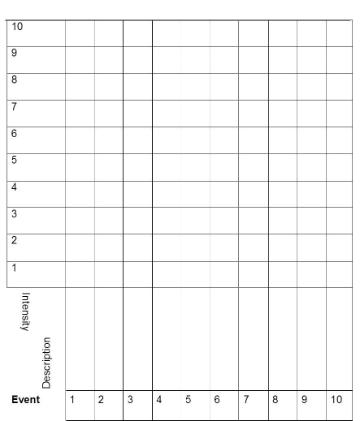
Discussion
Ask discussion questions of all 9 types.
Key Questions
- How does Mr. Aaron choose to approach Jess with the news of Leslie? Do you think this is beneficial to Jess? How would you want someone to tell you bad news?
- Jess falls into denial about Leslie’s death. Is denial healthy? What is happening when you deny bad news around you?
- What would it be like to lose your best friend?
- Jess’ father chooses not to speak. Is there anything he can do or say to take his son’s pain away? Why is silence better than mindless words in this type of situation? When Mr. Aaron’s follows Jess in his truck what does that action say to his son?
- Is it natural to have disbelief about something that severe that happens so quickly?
- Jess didn’t know what he should do next. Is it typical to be lost during a crisis? How can friends and family help you?
Analyze
Analyze the key paragraph.
Key Paragraph, p. 165
“‘Your friend Leslie is dead, Jesse. You need to understand that…’
His father leaned down the table and put his big hand on top of Jess’s hand. He gave his wife a quick, troubled look. But she just stood there, her eyes full of pain, saying nothing” (p. 165).
Extend
Write
Have each student write a short product based on today’s prompt to connect to the unit theme.
Jess and his family are in un-charted territory. It is not natural for a young person to die so suddenly. Unlike his sister’s his mother choses to say nothing. Silence is golden. Think of the situation Jess and his parents are in. They don’t communicate well on a good day. Now that their son is hurting they are at a loss.
Write a one-paragraph narrative in which you re-write this situation for Jess and his parents. In your situation, Leslie has died. As you write introduce the situation and the characters. Use dialog to re-write the conversation between Jess and his parents to better deliver the horrible news. Keep the facts of the situation based on the reading. Use dialog, pacing, and a variety of transitions to keep your reader engaged. Conclude by reflecting on the events.
Close
Close by extending today’s lesson to life and the world.
Day 15
Outcomes for Today
W3. Write narratives to develop real or imagined experiences or events using effective technique, relevant descriptive details, and well-structured event sequences.
- Engage and orient the reader by establishing a context and point of view and introducing a narrator and/or characters; organize an event sequence that unfolds naturally and logically.
- Use narrative techniques, such as dialogue, pacing, and description, to develop experiences, events, and/or characters.
- Provide a conclusion that follows from and reflects on the narrated experiences or events.
Prepare
Background
Gather background knowledge about a place, time, event, person, or thing.
What are the stages of grief?
There are five basic stages of grief. In most cases the stages are very fluid and there is no right or wrong way to grieve a loss. This process is individual and it is a process. Just because you were in a stage once doesn’t mean you can’t revisit it. The pain gets more manageable over -time but the loss will always be permanent.
http://grief.com/the-five-stages/
The five stages are:
- Denial—Denial and shock help us to cope and make survival possible. Denial helps us to pace our feelings of grief. There is a grace in denial. It is nature’s way of letting in only as much as we can handle.
- Anger—Anger is strength and it can be an anchor, giving temporary structure to the nothingness of loss. At first grief feels like being lost at sea: no connection to anything. Then you get angry at someone, maybe a person who didn’t attend the funeral, maybe a person who isn’t around, maybe a person who is different now that your loved one has died. Suddenly you have a structure—your anger toward them. The anger becomes a bridge over the open sea, a connection from you to them. It is something to hold onto; and a connection made from the strength of anger feels better than nothing. We usually know more about suppressing anger than feeling it. The anger is just another indication of the intensity of your love.
- Bargaining—After a loss, bargaining may take the form of a temporary truce. “What if I devote the rest of my life to helping others. Then can I wake up and realize this has all been a bad dream?” We become lost in a maze of “If only…” or “What if…” statements. We want life returned to what is was; we wa
- Depression—depression is not a sign of mental illness. It is the appropriate response to a great loss. We withdraw from life, left in a fog of intense sadness, wondering, perhaps, if there is any point in going on alone? Why go on at all? Depression after a loss is too often seen as unnatural: a state to be fixed, something to snap out of.
- Acceptance is often confused with the notion of being “all right” or “OK” with what has happened. This is not the case. Most people don’t ever feel OK or all right about the loss of a loved one. This stage is about accepting the reality that our loved one is physically gone and recognizing that this new reality is the permanent reality. We will never like this reality or make it OK, but eventually we accept it. We learn to live with it. It is the new norm with which we must learn to live.
In today’s reading, Jess, his mother, and father decide they need to go and pay respects to the Burke family. While there Jess realizes that Leslie is really gone. He has left denial and is able to start his own grieving process.
Word Wall
Here are five vocabulary words to teach and add to the Word Wall.
|
awkwardly (167) |
snicker (169) |
smothering (169) |
imitate (170) |
frayed (172) |
Read
Review
Review the timeline from the beginning every day.
Read
Read the selection, usually in a Shared Reading Read React Predict Cycle of 2-3 pages.
Read p. 166-175
|
Setting |
Characters |
Pages |
|
Burkes’ house |
Burkes’ family |
166-171 |
|
Home |
Jess and his sisters |
171-172 |
|
Creek |
Jess and his father |
172-175 |
Respond
Timeline
Agree on the facts in today’s reading and list the 3-5 most important on the timeline.
Students might mention:
- Jess and his parents pay the Burkes a visit.
- Jess is angry that her family is sad. He doesn’t think they deserve to be.
- Bill hugs Jess and tells him that Leslie loved him.
- Jess is not used to seeing so many adults crying, it makes him very uncomfortable.
- Leslie’s death becomes “real” when her dad talks about her ashes.
- Jess is angry and runs to the stream and throws his watercolors and paints into the water.
- His dad tries to comfort him, he talks to him like a man and that brings comfort to him.
- The Burkes ask Jess to take care of P.T. while they go out of town.
Map
Add to ongoing class activities like a KWL chart or map: where did the characters go?
Heroic Journey Chart
Add to the Heroic Journey chart class. Where is Jesse now?
Character Chart
Who are the characters so far in the book? List one trait for each of them.
Explore
Activity
Explore the reading more deeply with a visual or oral language activity.
Open Mind Portrait
What is Jess thinking and feeling as they go to the Burke house? As he sees many adults crying? Once he goes back to the creak? And when he connects with his dad? Add 3-5 more thoughts to your OMP.
Discussion
Ask discussion questions of all 9 types.
Key Questions
- When Jess goes to the Burke house he sees Leslie’s family crying and upset. He compares himself to them and doesn’t think they should be upset. Is there a right way to grieve?
- What does Bill tell Jess? How did Jess help Leslie? Do you think he was prepared to know he helped her as much as she helped him?
- How does hearing about the final arrangements affect Jess? What is his reaction to this information? Could he deny her death anymore? What does he have to do?
- What does Jess do out of anger at the creek? What is his father’s response? How does this response help him?
- How did Jess’ family react to him when he returned home? What does he vow to do for May Belle?
Analyze
Analyze the key paragraph.
Key Paragraph, p. 175
“That afternoon Bill came up to the house. They were about to leave for Pennsylvania, and he wondered if Jess would take care of the dog until they got back.
He was glad Bill wanted him to help. He was afraid he hurt Bill by running away this morning. He wanted, too, to know that Bill didn’t blame him for anything” (p. 175).
Extend
Write
Have each student write a short product based on today’s prompt to connect to the unit theme.
It was important for Jess to feel helpful. Taking care of the dog was something he could do to help Leslie’s family and indirectly help Leslie.
Think of a time you were able to help someone during a tough time.
Write a narrative describing the situation. Establish the point of view. Introduce the characters, situation, and narrator. Use good descriptions and dialog where appropriate. Organize your even in a sequence that flows naturally. Use relevant details and language to describe the situation to your reader. Conclude by relating the topic on a personal level.
|
Final Product Obituary—write an obituary on Leslie in narrative form. Use the following format to help you gather your thoughts and put information together on Leslie and her life. Template how to write an obit: |
Close
Close by extending today’s lesson to life and the world.
Day 16
Outcomes for Today
W3. Write narratives to develop real or imagined experiences or events using effective technique, relevant descriptive details, and well-structured event sequences.
- Engage and orient the reader by establishing a context and point of view and introducing a narrator and/or characters; organize an event sequence that unfolds naturally and logically.
- Use narrative techniques, such as dialogue, pacing, and description, to develop experiences, events, and/or characters.
- Provide a conclusion that follows from and reflects on the narrated experiences or events.
Prepare
Background
Gather background knowledge about a place, time, event, person, or thing.
What do bridges symbolize (for class discussion)?
Share THE BRIDGE BUILDER with your class.
An old man, going a lone highway,
Came at the evening cold and gray,
To a chasm, vast and deep and wide,
Through which was flowing a sullen tide.
The old man crossed in the twilight dim-
That sullen stream had no fears for him;
But he turned, when he reached the other side,
And built a bridge to span the tide.
"Old man," said a fellow pilgrim near,
"You are wasting strength in building here.
Your journey will end with the ending day;
You never again must pass this way.
You have crossed the chasm, deep and wide,
Why build you the bridge at the eventide?"
The builder lifted his old gray head.
"Good friend, in the path I have come," he said,
"There followeth after me today
A youth whose feet must pass this way.
This chasm that has been naught to me
To that fair-haired youth may a pitfall be.
He, too, must cross in the twilight dim;
Good friend, I am building the bridge for him."
WILL ALLEN DROMGOOLE
In today’s reading, Jess goes to Terabithia and realizes he needs to do something symbolic to say good-bye to Leslie. He makes her a wreath as an offering. May Belle followed and got stuck trying to cross. Jess asks Bill for lumber and he constructs a bridge for May Belle and others to cross the river into Terabithia.
Word Wall
Here are five vocabulary words to teach and add to the Word Wall.
|
whimpering (176) |
narrowest (177) |
piteously (177) |
constricting (178) |
bough (178) |
Read
Review
Review the timeline from the beginning every day.
Read
Read the selection, usually in a Shared Reading Read React Predict Cycle of 2-3 pages.
Read p. 176-191
|
Setting |
Characters |
Pages |
|
Home |
Jess, PT, Miss Bessie |
176-177 |
|
Terabithia |
Jess and PT |
177-179 |
|
Creek |
Jess and May Belle |
179-183 |
|
School |
Jess and Mrs. Myers |
184-188 |
|
Home |
Bill and Judy |
188-189 |
|
Terabithia |
Jess and May Belle |
189-191 |
Respond
Timeline
Agree on the facts in today’s reading and list the 3-5 most important on the timeline.
Students might mention:
- Jess goes to Terabithia with P.T. and makes Leslie a funeral wreath.
- He held a procession though the sacred grove.
- May Belle got stuck on the log trying to get to Terabithia, Jess fearlessly saves her.
- May Belle didn’t want Jess to be lonesome she came to be with him.
- Jess’ teacher tries to comfort him as well by sharing her loss and experience.
- Jess realizes he has to have courage and move on and realizes he will always have Leslie and her memory with him.
- The Burkes decide to move away.
- Jess builds a bridge to Terabithia using lumber and invites May Belle to be the new queen.
Map
Add to ongoing class activities like a KWL chart or map: where did the characters go?
Heroic Journey Chart
Add to the Heroic Journey chart class. Where is Jesse now?
Character Chart
Who are the characters so far in the book? List one trait for each of them.
Explore
Activity
Explore the reading more deeply with a visual or oral language activity.
Open Mind Portrait
Complete your OMP for Jess. What did he learn from Leslie? From Mrs. Myers? How can he pay his friendship forward? Add 3-5 new thoughts.
Discussion
Ask discussion questions of all 9 types.
Key Questions
- Why did Jess return to Terabithia? What was it like? What did he do to make an offering for Leslie? What realizations did he make when he was there?
- In what way do Jess and May Belle make amends? How was May Belle reaching out to him? What does that show you about her character and their relationship?
- How does Jess honor Leslie?
- What adult gave him the most support? Was he expecting support for this person? Why is it important to give people a chance? Is it true that our true nature comes out during a crisis? Explain.
- What is the significance of building a bridge to Terabithia and inviting May Belle to participate?
- The narrator refers to the Mr. and Mrs. Burke by their first name (Bill and Judy) but does not do the same thing for Jess’ parents. What point was the author trying to make?
- What lessons did Jess learn from Leslie and Terabethia?
- How is Jess similar to the Bridge Builder in the poem above?
Analyze
Analyze the key paragraph.
Key Paragraph, p. 188
“Now it occurred to him that perhaps Terabithia was like a castle where you came to be knighted. After you stayed awhile and grew strong you had to move on. For hadn’t Leslie, even in Terabithia, tried to push back the walls of his mind and make him see beyond the shining world—huge and terrible and beautiful and very fragile? (handle with care—everything—even the predators).
Now it was time for him to move out. She wasn’t there so he had to go for both of them. It was up to him to pay back the world in beauty and in caring what Leslie had loaned him in vision and in strength” (p. 188).
Extend
Write
Have each student write a short product based on today’s prompt to connect to the unit theme.
In what way does it take courage for Jess to continue the legacy of Terabithia? Wouldn’t it have been easier to put it all behind him and not go there ever again? What do you Leslie would have wanted him to do? In what way is he “going forth” and paying back the world with beauty and caring?
Think of a time that you had the opportunity to pay-it-forward. Write a one-paragraph narrative in which you share your pay-it-forward moment. Who did it involved? What happened? What was the end result? Introduce your characters. Use dialog and pacing where appropriate. Organize your even so it flows logically. Conclude with a statement that reflects on your experiences and how they changed you.
|
Final Writing Product Write a feature story about Terabithia and the impact it made of Jess and his life. What changes occurred for him and how did he want to “pay-those changes-forward”. |
Close
Close by extending today’s lesson to life and the world.
Final Writing Product
The final writing product for Bridge of Terabithia is a Newspaper layout. All articles and stories must be written in narrative format following the standards and instructions listed above. This project will be interjected into the lesson plan on days 2, 3, 13, 15, 16, or you can choose to move it to work within your plan.
Materials:
- Stiff paper 9x12 to 11x17 or butcher paper
- Pencils, pens, crayons, markers
- Construction paper, scissors, glue sticks if desired
- Newspapers or magazines to discuss the needed elements of a magazine or paper.
Imagine you are on the editorial team for a national magazine. Throughout the lesson you have written narrative stories. Create a magazine/paper with a compilation of your stories to form a mini-magazine or mini-paper.
- You have been assigned to write front page article, feature story, obituary, sports story, op-ed and cartoon, arts, weather and entertainment.
- You will have the cover and any additional pages you need to create your paper.
- Story format. Your stories need to be written in narrative format. Following all narrative writing standards.
- Once your stories have been written compile them together and format them to form a paper or magazine.
Some suggestions have been given for certain articles and others are embedded in the lesson plans on certain days. See below.
Front Page Article
Highlight Terabithia. Answer the five questions: Who? Where? What? Why? When? How? This main story can tie into your other stories.
Sports Story (Lesson Plan Day 32, 3)
Write a sports article that highlights the 5th grade race.
Be sure to answer the 5 questions.
- Who was involved?
- Where did it take place?
- What happened?
- When did the race take place?
- How the race was won, be descriptive (write in narrative form)
Obituary (Lesson Plan Day 15)
Write an obituary for Leslie. Use the following format to help you gather your thoughts and put information together on Leslie and her life.
Template how to write an obituary:
http://obituaryguide.com/template.php
Feature Story (Lesson Plan Day 16)
Write a feature story about Terabithia and the impact it made of Jess and his life. What changes occurred for him and how did he want to “pay-those changes-forward”.
Arts and Leisure (Lesson Plan Day 2 or Day 13)
Write a narrative that highlights the music from the novel and the 1970’s.
Have students listen to the songs in the background knowledge section of today’s lesson.
Have student interpret the song lyrics and meaning behind the words.
Students can state their opinion of the song and the group.
Writing should be in narrative format.
Narrative (Lesson Plan Day 10)
Have students research the National Museum or the Smithsonian.
Students can write a narrative about Jess’ experience and highlight the exhibits he may have seen. Students can write a recommendation to their audience about the museum.
Optional Articles
- Cartoon
- Weather (use the weather in the novel to create a weather map)
- Opinion or editorial article. Choose one of the social issues from the novel—gender equity, economics, friendship, family structure and write an opinion article to give your opinion of the issue.