Lesson Plans
East Side Dreams
40
60
90
Day 1
Outcomes for Today
Prepare
Background
Gather background knowledge about a place, time, event, person, or thing.
What is change?
Change is the process of altering something: an object, a social issue, or yourself. Change means to make something radically different. Change means to transform, to shift from one side to another, or to switch directions.
The theme for this unit is Change Requires Effort. We will be investigating Arthur Rodriquez as he changes. Today we will look at Art in the beginning. As you read, consider the things that Arthur does that you might choose to do differently. Can you think of choices you made that you might change if you could go back in time?
Word Wall
Here are five vocabulary words to teach and add to the Word Wall.
Introduce 5 important, useful words from today’s reading.
|
janitor (2) |
smart alecks (5) |
stocky (8) |
noble (10) |
antennas (10) |
Read
Review
Start at the beginning and review the story so far.
Read
Read the selection, usually in a Shared Reading Read React Predict Cycle of 2-3 pages.
Read p. 1-14
|
Setting |
Characters |
Pages |
|
Redhead’s Car |
Arthur, Mother, Tita, Eddie |
1-3 |
|
Mt. Hamilton |
Arthur, policemen, Arthur’s friends |
4-6 |
|
Richard’s house |
Eddie, Robert, Roy, Arthur, Tino, Caesar, Isaac, Steve |
6 |
|
House on Virginia Pl |
Art, Indio, Noah, Caesar, Eddie, Rudy, Joe, Tita |
7-8 |
|
En route to party near Happy Hollow Park |
Caesar, Isaac, Steve, Phillip, Arthur, Eddie, Redhead |
8-10 |
|
House at Keyes and Senter St. |
Arthur, Redhead, Eddie, Steve, partygoers, the guy that got run over |
10-14 |
Respond
Timeline
Agree on the facts in today’s reading, and list the 3-5 most important on the Timeline.
Students might mention:
- Caesar and his friends pull up when Art is with Redhead, asking for help with a fight at Virginia Place over where they are from.
- Flashback: Art fought Caesar’s friends, Indio and Noah. He did not like any of them that much.
- No one wants to help Caesar in the fight, but Art continues to talk-up the fight because he’s the youngest.
- Not according to the plan, they get to the party and Caesar has a weapon. Caesar isn’t going to wait for the others.
- A fight occurs, so Art and his friends try to leave. As they get in the car to leave, they hit someone three times.
- They drive away from the party, hurt and bloody.
Map
Add to ongoing class activities like a KWL chart or map: where did the characters go?
Choice Chart (Good and Bad Decisions)
- An ongoing classroom product for this novel is a choice chart.
- Using a large piece of butcher paper, make a “T” Chart.
- As you read, look for the situations in which Arthur finds himself where he either makes really good or really bad decisions.
- On the other side of the “T” Chart, list what you would have done if you were faced with the same decision.
- You should be able to find 2-3 situations for each day of reading. You can maintain a class chart or have your students keep a list as they read.
Map
Obtain a map of San Jose, California. As you read the novel, chart the locations that you read about. Today you should map: Mt. Hamilton, Happy hallow Park, Corner of Keyes St., and Senter St.
Lessons Learned Poster
In each day’s lesson there is a positive lesson that can be learned from Arthur. Some are very obvious, while others need to be interpreted. As a class, or independently, find each lesson and keep an ongoing list on poster paper or in your folder.
Explore
Activity
Explore the reading more deeply with a visual or oral language activity.
Book Cover Prediction
Have students review the cover of the book. As a class, predict what they think the book will be about.
Author Cube
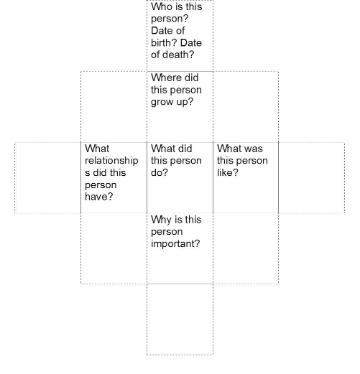
Since today is Day 1 of the reading, have students create a cube on Art Rodriguez. Visit and explore http://www.eastsidedreams.com for facts on the author. There is also a link showing Art Rodriguez speaking to students. You can use the cubes to make a class mobile or string them up in class.
10c12 Cubing Biography
Character Profile Chart
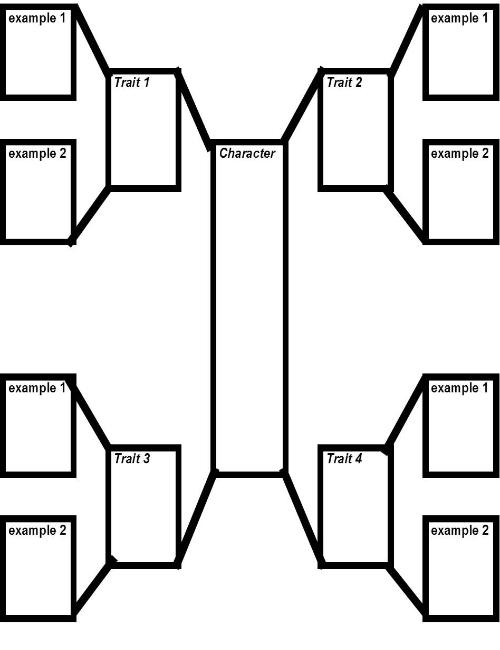
Create a Character Profile Chart for Art. Find 4 character traits that you think apply to him. List two examples to support your trait from today’s reading.
4g6 Character Profile Chart
Discussion
Ask discussion questions of all 9 types.
Key Questions
- Who is the author of the book? Who is the main character? What type of genre is this novel? Why?
- Where does this novel take place? What do we know about the setting?
- What are human principles? What principles are important to you?
- Do you think the divorce affected Arthur or do you think he would have made the same decisions?
- Art said that he and Tita were getting close. What are signs of positive sibling relationships?
- Based on what you know of Arthur so far, who or what is going to be his biggest conflict? Why?
- Why does Art want to fight when the rest of his friends do not? What do you think Arthur is trying to prove?
- If you didn’t know Caesar well and didn’t like him, would you fight for him? Why?
Analyze
Analyze the key paragraph.
Key Paragraph, p. 10
“When you are young and dumb as I was, you don’t think of the consequences of your actions. When I think back to this night, I think, ‘I didn’t even know Caesar well enough to give my life for him, and what if we did kill someone? For what? For someone I didn’t even know? For a cause that wasn’t even noble?’” (p. 10).
Extend
Write
Have each student write a short product based on today’s prompt to connect to the unit theme.
People often make exceptions to their rules or principles for a cause that is noble. In today’s reading, young Art convinces himself that fighting for the east side and Caesar is a noble cause. As he reflects back on his decisions, however, he realizes how that one choice permanently altered his life and impacted the lives of people he loved for many years to come.
Write an argumentative paragraph about a time when you had to set aside a rule or principle that you believed in for a cause you believed to be noble. Describe the setting, the people involved, and the situation. Explain logically why it made sense for you to set aside your beliefs and provide reasoning to your decision. As you look back at the situation, would you do the same thing again? Would you adhere to what you believe in? Why or why not?
Close
Close by extending today’s lesson to life and the world.
Day 2
Outcomes for Today
Prepare
Background
Gather background knowledge about a place, time, event, person, or thing.
Do you think that juveniles should face the same sentences as adults for certain crimes?
This question has no real “right” or “wrong” answer and has been debated throughout history; however, there are things we must consider when discussing justice and juvenile justice: the seriousness of the crime, age, motive, history, upbringing, etc.
As we read today’s selection, Arthur is being questioned for his involvement in the fight at the party. Arthur tries to stay consistent with his alibi, but it is determined that he is lying and that one kid has died because of his actions.
Word Wall
Here are five vocabulary words to teach and add to the Word Wall.
|
flagging (16) |
surrounded (17) |
harshly (18) |
circulation (18) |
juvenile (20) |
Read
Review
Start at the beginning and review the story so far.
Read
Read the selection, usually in a Shared Reading Read React Predict Cycle of 2-3 pages.
Read p. 15-28
|
Setting |
Characters |
Pages |
|
Railroad tracks back to Robert’s House |
Caesar, Arthur, Redhead |
15-17 |
|
En route to the hospital via Jackson Ave. |
Redhead, Arthur, the police |
17-19 |
|
The San Jose Movie Theatre |
Paul, Bobby, Arthur |
20-23 |
|
Virginia Place |
Paul, Bobby, The Lopez Girls, Arthur, the police |
23-25 |
|
The Hospital |
Arthur, mother, the police |
25 |
|
San Fernando St. |
Mother, Eddie, Tita, Victor, Father, and Arthur |
25-28 |
Respond
Timeline
Agree on the facts in today’s reading, and list the 3-5 most important on the Timeline.
Students might mention:
- Redhead and Arthur get away from the party and the police, but are stopped by the police and then released.
- Upon arrival at Robert’s house, they all regroup. It is suggested that Redhead take Arthur to the Emergency Room. The police intercept them again.
- They are questioned by the police and deny their involvement at the party. The police know about Caesar and arrest Redhead and Arthur. They take Arthur to the Emergency Room.
- Flashback: Arthur remembers the first time he went to juvenile hall: two friends and he stole a car together.
- At the hospital, Arthur sees his mother. He reflects on how his actions have affected his mother for years.
- Flashback: Arthur thinks about growing up in San Jose on San Fernando Street. He remembers everything his parents had done for him. He recalls the stories his father told him of living in Mexico. He recalls his childhood on San Fernando St. as being pleasant and happy.
Map
Add to ongoing class activities like a KWL chart or map: where did the characters go?
Choice Chart
- An ongoing classroom product for this novel is a choice chart.
- Using a large piece of butcher paper, make a “T” Chart.
- As you read, look for the situations in which Arthur finds himself where he either makes really good or really bad decisions.
- On the other side of the “T” Chart, list what you would have done if you were faced with the same decision.
- You should be able to find 2-3 situations for each day of reading. You can maintain a class chart or have your students keep a list as they read.
Map
Obtain a map of San Jose, California. As you read the novel, add the locations that you read about. Today you should map: Mt. Hamilton, Happy hallow Park, Corner of Keyes St. and Senter St.
Lessons Learned Poster
In each day’s lesson there is a positive lesson that can be learned from Arthur. Some are very obvious, while others need to be interpreted. As a class, or independently, find each lesson and keep an ongoing list on poster paper or in your folder.
Explore
Activity
Explore the reading more deeply with a visual or oral language activity.
Open Mind Portrait
Create an OMP for Arthur. What do you think he is thinking as he waits for his sentence? Give him 5-7 thought bubbles that reflect his thoughts, feelings, and perspectives.
Change Bookmark
Create a bookmark that reflects change. Bookmark directions are located at the end of today’s lesson.
Step One: Create a vision of your life 10 years from now.
- Imagine what you would like your life to be like 10 years from today.
- Where [or in what kind of housing] will you be living?
- Where will you be working?
- What will you be doing?
- How will you be getting around?
- What relationships will you be in?
- What will you be doing in your non-work hours?
- On the top 1/3 of one side of the bookmark, fill in pictures, words, or symbols that represent your vision.
Comment: This is a successful vision. This should be a vision that you, your parents, grandparents, teachers and the people who know you [as well as your friends] would be proud to see you have accomplished.
Warning: If people you know think they will be wealthy as a result of major drug sales, prostitution, gun running or some other major crime, they need to know they could be dead, disabled or imprisoned within 2 years. This is 10-year plan, with a vision of people who aren’t dead, imprisoned, or disabled from injuries received as a result of criminal behavior.
Step Two: Create a plan to achieve your vision in 10 years: what has to happen?
- Brainstorm a list of what has to happen between now and 10 years from now to achieve this vision. Compare lists with someone else and select the 10 most important things that have to happen.
- On the bottom 2/3 of the bookmark, underneath your vision, write 10 important things that have to happen in the next 10 years.
Step Three: Keep track of efforts to achieve your vision by following your plan.
- Every day, or as often as you like during this unit, consider:
- What have you done in the last 24 hours to get closer to your vision by following something on your plan?
- On the back of the bookmark, starting at the top, write the date and what you did in a couple of words.
- Write in small letters, keeping all of one day’s information in the same row. You want to have room for many entries during this unit.
Postcard
Pretend you are Arthur and you are in jail waiting for your sentence. In your mind, all you did was fight at a party and you think that you should be out of jail in a day or so.
- Write a letter to your mother and let her know how you are. Be honest with her.
- On the opposite side of the postcard, draw something that reflects what you read today—it must be school appropriate.
- Make sure you address the postcard appropriately and use the proper heading and closing.
Discussion
Ask discussion questions of all 9 types.
Key Questions
- Do you think that there are basic human rules that all people should follow? What are they?
- Who is driving Arthur? Where are they going?
- Would you have fought for Caesar?
- If you were in this situation, what would you do? How would you do it?
- What do you think is going to happen to Arthur?
- Why do you think the author uses flashbacks in his writing? Do you think that Arthur’s childhood has any affect on his present choices?
- At this point in the novel, what is Arthur’s biggest obstacle? How do you suggest he overcome it?
Analyze
Analyze the key paragraph.
Key Paragraph, p. 25
“My mother didn’t know what was in store for her, all the worrying she was going to experience for the next few years” (p. 25).
Extend
Write
Have each student write a short product based on today’s prompt to connect to the unit theme.
Sometimes when we make decisions, especially when it is in the heat of the moment, we don’t consider all of the possible people who our actions might affect. This is why it is important to pause before reacting to an emotional situation.
Write 1-2 analytical paragraphs explaining the different perspectives on this situation. How does Arthur view it? How does his mother view it? How do his siblings view it? Use descriptive language and details offered in the reading to support your writing.
Close
Close by extending today’s lesson to life and the world.
Day 3
Outcomes for Today
Prepare
Background
Gather background knowledge about a place, time, event, person, or thing.
What are possible alternatives to violence? How can using alternatives help you change?
There are many alternatives to violence. The first alternative is to take the necessary steps to avoid a violent situation. If that can’t be done, there are many ways to resolve conflict. Think of strategies you have used to help yourself in a violent situation. Did you need help from others?
In many situations, one needs to stop and think before acting. Taking a deep breath and breathing can help people see alternative options in their situation. Many people participate in sports, work out, take a walk, or talk to their friends to help alleviate a tense situation. Since people and situations are unique, it is important to find something that works for you. If you can learn to process information prior to reacting, you will be able to face decisions logically.
In today’s reading, we look at Arthur’s childhood. Arthur learns to fight at a young age and uses this ability to solve all of his problems. As you read, think of alternatives that Arthur could use each time he is faced with a fight.
Word Wall
Here are five vocabulary words to teach and add to the Word Wall.
|
interrogation (29) |
insisted (33) |
confront (34) |
praise (36) |
cautiously (40) |
Read
Review
Start at the beginning and review the story so far.
Read
Read the selection, usually in a Shared Reading Read React Predict Cycle of 2-3 pages.
Read p. 29-42
|
Setting |
Characters |
Pages |
|
The Interrogation Room |
Arthur, three detectives |
29-32 |
|
Lee Matson Middle School |
Arthur, father, bully 8th grader, other students |
33-36 |
|
Police Station |
Arthur, Redhead, police officers |
36-38 |
|
Alum Rock Market |
Arthur, Art, Bobby, Henry, the police |
39-42 |
Respond
Timeline
Agree on the facts in today’s reading, and list the 3-5 most important on the Timeline.
Students might mention:
- The police take Arthur to the police station for questioning. He learns that one of the boys at the party was killed. He continues to deny everything, which makes the officers angrier.
- Flashback: Arthur reflects on how he first started fighting. He realizes that after he received positive feedback for attacking an older, bigger kid, he came to like fighting. Arthur fought to gain acceptance from his father.
- The police return to Arthur and give him one last chance to confess to the crime. He continues to deny and they are released from questioning.
- Redhead asks the officers about his car. The officer goes to find out and they notice the license plate was identified at the scene. The boys are arrested for murder.
- Flashback: Arthur thinks back to the second time that he went to juvenile hall. He had robbed a market.
- Arthur explains why he never told the truth about who was involved in the fight.
Map
Add to ongoing class activities like a KWL chart or map: where did the characters go?
Choice Chart (Good and Bad Decisions)
- An ongoing classroom product for this novel is a choice chart.
- Using a large piece of butcher paper, make a “T” Chart.
- As you read, look for the situations in which Arthur finds himself where he either makes really good or really bad decisions.
- On the other side of the “T” Chart, list what you would have done if you were faced with the same decision.
- You should be able to find 2-3 situations for each day of reading. You can maintain a class chart or have your students keep a list as they read.
Map
Obtain a map of San Jose, California. As you read the novel, add the locations that you read about. Today you should map: Mt. Hamilton, Happy hallow Park, Corner of Keyes St., and Senter St.
Lessons Learned Poster
In each day’s lesson there is a positive lesson that can be learned from Arthur. Some are very obvious, while others need to be interpreted. As a class, or independently, find each lesson and keep an ongoing list on poster paper or in your folder.
Explore
Activity
Explore the reading more deeply with a visual or oral language activity.
Advertisement
Create an advertisement for a positive activity in which you would like to participate. It might be something individual, like music lessons, or a group activity, like a team sport. Provide the following on your poster:
- Title
- A slogan
- Illustration
- One-to-two sentence persuasive statement explaining the inherent good in participating.
Open Mind Portrait
Add to your OMP of Arthur. What do you think he is thinking and feeling as his father is trying to teach him lessons and as he waits for his sentence?
Character Profile Chart
Start a CPC on Arthur’s father. Based on today’s reading and the flashbacks, what do we know about his father and their relationship? Find one or two traits of his father from the reading. Provide examples of the traits and the page numbers from the reading. You will be adding to the chart as we read.
4g6 Character Profile Chart
Discussion
Ask discussion questions of all 9 types.
Key Questions
- What is different for Arthur when he is arrested this time? Based on the differences, why do you think he does not understand the seriousness of his crime?
- Why is Arthur remaining loyal to his friends? If you were in the same position, what would you do? Why?
- What lesson is Arthur’s father trying to teach him? Would you consider that justice? Why or why not?
- What would be a better lesson to teach Arthur? How would you teach it?
- Why do you think Arthur never “rats” on any of his friends?
- Why do you think the driver of Arthur’s car is referred to as Redhead?
- Based on what we have read so far, have any of the plans Arthur and his friends have come up with been good ones? If you keep getting caught with the same people, for the same things, what do you think should change? How?
- What are you good at that has a positive influence on the world or your community?
Analyze
Analyze the key paragraph.
Key Paragraph, p. 36
“Now, here I was, such a good fighter and loving it. Look where it got me—at the police station being questioned for murder!” (p. 36).
Extend
Write
Sometime we receive affirmations from our peers for being good at something that does not have a positive influence on the world, like fighting. Think about something you are good at or that you like to do that IS positive.
Using concrete details describe what you are good at in 1-2 paragraphs. Use detailed descriptive language. Explain how that activity has helped you make positive decisions. Does that activity have a good coach or mentor? Are you able to help others and make your community better? Relate how you impact others or how others help you in that activity to make you better.
Close
Close by extending today’s lesson to life and the world.
Day 4
Outcomes for Today
Prepare
Background
Gather background knowledge about a place, time, event, person, or thing.
How do you ask for help? Is it easy to ask for help? Why do some people find it challenging? Is it possible to change without accepting you need help?
It takes a strong person to know they need help and an even stronger person to ask for it. It is important to understand and learn the skill of asking for help. As you learn this skill, you realize you are not weak for needing help; in fact, you are empowered by knowing that you have the strength to rely on others to help you when needed.
In this chapter, Arthur struggles in school. Some teachers along the way have helped him, while others have not. Arthur needed help and should have asked his parents, teacher, or siblings. He may be justified by saying, “they should have known to help me,” but people are not mind readers, and unless you ask for help, you are not giving people the chance to meet your needs.
Word Wall
Here are five vocabulary words to teach and add to the Word Wall.
|
agitated (45) |
pretrial (49) |
pleaded (49) |
compassion (55) |
tone (55) |
Read
Review
Start at the beginning and review the story so far.
Read
Read the selection, usually in a Shared Reading Read React Predict Cycle of 2-3 pages.
Read p. 43-57
|
Setting |
Characters |
Pages |
|
Juvenile Hall |
Arthur and “The Fighter” |
43-45 |
|
Juvenile Hall |
Arthur, detectives, Mr. Anderson, Steve, Isaac, Phil, and mother |
45-49 |
|
Elementary School |
Arthur, Mrs. Heagan, mother, father |
49-53 |
|
Arthur’s House, near Virginia Pl. |
Arthur, mother, father |
53-55 |
|
Jail Cell |
Arthur, compassionate guard, dentist |
55-57 |
Respond
Timeline
Agree on the facts in today’s reading, and list the 3-5 most important on the Timeline.
Students might mention:
- Arthur's lawyer visits. He is reassured that he probably won’t get the electric chair.
- Flashback: Arthur recalls elementary school and his teacher Mrs. Heagan, the meanest teacher he ever had. Arthur’s father told him to convince his teacher to give his mother a good report. When Arthur’s father returned home, he beat him for doing poorly, for trying to hide it, and for crying as he was being beaten.
- Detectives question Arthur again. He does not change his story and insists that he doesn’t know anything.
- The lawyer tells him a little about his brother, the other boys, and the news media. Arthur is finally realizing that they have done something bad.
- Arthur is in a lot of pain, so a compassionate guard tries to help him see a dentist. The dental visit takes two days to get approved. Arthur’s tooth dies and he is in pain waiting to see the dentist.
Map
Add to ongoing class activities like a KWL chart or map: where did the characters go?
Choice Chart
- An ongoing classroom product for this novel is a choice chart.
- Using a large piece of butcher paper, make a “T” Chart.
- As you read, look for the situations in which Arthur finds himself where he either makes really good or really bad decisions.
- On the other side of the “T” Chart, list what you would have done if you were faced with the same decision.
- You should be able to find 2-3 situations for each day of reading. You can maintain a class chart or have your students keep a list as they read.
Map
Obtain a map of San Jose, California. As you read the novel, chart/map the locations that you read about. Today you should map: Mt. Hamilton, Happy hallow Park, Corner of Keyes St., and Senter St.
Lessons Learned Poster
In each day’s lesson there is a positive lesson that can be learned from Arthur. Some are very obvious, while others need to be interpreted. As a class, or independently, find each lesson and keep an ongoing list on poster paper or in your folder.
Explore
Activity
Explore the reading more deeply with a visual or oral language activity.
Open Mind Portrait
Add to your OMP of Arthur. What do you think he is thinking and feeling as he waits for his sentencing and to see the dentist? Don’t forget about his encounter with the guard and his teacher.
Open Mind Portrait
Create an OMP for the Chicano Guard who is compassionate to Arthur. Include what he says as well as what he is thinking about Arthur.
Character Profile Chart
Add to your Character Profile Chart on Arthur’s father. Based on today’s reading and the flashbacks, what do we know about his father and their relationship? Find one or two traits of his father from the reading. Provide examples of those traits and the page numbers from the reading. You will be adding to the chart as we read.
4g6 Character Profile Chart
Venn Diagram
Using a Venn Diagram, compare and contrast Arthur’s father and the Chicano Guard. Based on what you have learned, list their similarities and differences. You can use the diagram to help with today’s writing assignment.
6g6 Venn Diagram Chart

Bookmark
Create a change bookmark (instructions located at the end of today’s lesson) or add to the change bookmark you’ve already started.
Conflict Chart/Poster
List the conflicts that Arthur is having in today’s reading. Who/what are they between? Write 1-2 sentences giving Arthur a positive solution to that conflict.
Discussion
Ask discussion questions of all 9 types.
Key Questions
- While Arthur recalls his second time in juvenile hall, he thinks about his cellmate, who tells him how to get by in YA. The cellmate had not been to YA and continues to get caught for his crimes. Do you think he is a reliable source of information? Why do you think Arthur relies on him for guidance? If you were in Arthur’s position and you also continued to get caught, what would you change to get more positive information and support?
- Why is it important to seek a positive support group?
- When Arthur’s cellmate leaves, he says, “See you in YA.” Do you think those are the aspirations Arthur has? When your peer group has low expectations for you, how do you get support and do well?
- Arthur’s mother comes to see him and he lies, telling her that everything is fine. Why do you think he doesn’t tell her the truth? What does he have to gain by lying to her? Why do you think he is “sad for her”?
- Do you think your ability to succeed in school affects your success in life? How?
- What could the teacher have done to help Arthur, while keeping her integrity and morals?
Analyze
Analyze the key paragraph.
Key Paragraph, p. 55
“Around noon one guard came to my cell to see how I was doing. I told him I was not doing very well; my tooth was getting worse. He opened the door and entered. He was a young Chicano. I like this man because I could see compassion in his eyes. He talked to me in a mild tone; it showed his feelings for me. He seemed to be the nicest guard of all” (p. 55).
Extend
Write
Have each student write a short product based on today’s prompt to connect to the unit theme.
Today we meet two different paternal figures: Arthur’s dad and the Chicano guard. What do you think Arthur wants you to understand by comparing these two characters?
In a 1-2 comparative paragraphs, compare and contrast Arthur’s dad and the Chicano Guard. Use a clear, concise thesis statement to introduce your comparison. Give two examples for each character from the reading that support your thesis.
Close
Close by extending today’s lesson to life and the world.
Day 5
Outcomes for Today
Prepare
Background
Gather background knowledge about a place, time, event, person, or thing.
What does it mean to make amends?
Making amends means compensating for a loss, damage, or injury of any kind.
In this reading, Arthur is going through the court process and is sent to jail to wait for his final sentence. He recalls a time when he was young and got caught stealing from his family. He was given an opportunity to tell the truth and make amends with his father. As many children do, he chose to continue lying, which made things much worse.
Can you recall a time when you had an opportunity to make amends? Did you? Why or why not?
Word Wall
Here are five vocabulary words to teach and add to the Word Wall.
|
escorting (63) |
dormitory (63) |
boastfully (68) |
prejudiced (70) |
tract (70) |
Read
Review
Start at the beginning and review the story so far.
Read
Read the selection, usually in a Shared Reading Read React Predict Cycle of 2-3 pages.
Read p. 58-79
Page 68 contains sensitive content.
Please pre-read the selection and use judgment prior to reading with your class.
|
Setting |
Characters |
Pages |
|
Arthur’s House on Spencer St. |
Arthur and his dad |
58-60 |
|
Juvenile Hall, Arthur’s cell |
Arthur, Isaac, Phillip, and the Chicano Guard |
61-62 |
|
Jail |
Arthur, Isaac, Phillip |
62-64 |
|
Outside Arthur’s House |
Arthur, dad, and mom |
65-66 |
|
Jail |
Arthur |
66-69 |
|
Park near Meadow Faire |
Arthur, Art, Ray, Bobby, Dennis, Las Manos Negras, and the Meadow Faire Gang |
70-75 |
|
Jail |
Arthur, Isaac, and Phillip |
75-79 |
Respond
Timeline
Agree on the facts in today’s reading, and list the 3-5 most important on the Timeline.
Students might mention:
- Flashback: Arthur recalls stealing change from his parents to buy candy. When he was caught, Arthur lied to his father and said he found the money, but his father knew otherwise. Arthur realized that even though his father was VERY strict, he loved him and he was loved.
- Arthur, Isaac, and Phillip are moved to the county jail so they can be tried as adults. It is the first time they are able to talk about what has happened.
- Flashback: Arthur was helping his father. His father took out his frustrations on Arthur because he could not speak English very well.
- Flashback: Arthur’s “crew” fought people from Meadow Faire. Later, both of these groups became friends and would support each other.
- He spends his time listening to the radio, writing letters, and waiting for his one visit per week.
- On Sunday, his girlfriend’s mother who is angry because she found suggestive letters he had written visits him, and she tells Arthur he cannot write anymore letters to her. Arthur is angry because he is not able to see his mother for another week.
Map
Add to ongoing class activities like a KWL chart or map: where did the characters go?
Choice Chart
- An ongoing classroom product for this novel is a choice chart.
- Using a large piece of butcher paper, make a “T” Chart.
- As you read, look for the situations in which Arthur finds himself where he either makes really good or really bad decisions.
- On the other side of the “T” Chart, list what you would have done if you were faced with the same decision.
- You should be able to find 2-3 situations for each day of reading. You can maintain a class chart or have your students keep a list as they read.
Map
Obtain a map of San Jose, California. As you read the novel, chart/map the locations that you read about. Today you should map: Mt. Hamilton, Happy hallow Park, Corner of Keyes St., and Senter St.
Lessons Learned Poster
In each day’s lesson there is a positive lesson that can be learned from Arthur. Some are very obvious, while others need to be interpreted. As a class, or independently, find each lesson and keep an ongoing list on poster paper or in your folder.
Explore
Activity
Explore the reading more deeply with a visual or oral language activity.
Open Mind Portrait
Based on today’s reading, add 5-7 thoughts to Arthur’s OMP. Consider that he has been sent to the county jail, has missed his mother’s visit, and realized that he respected his father.
Postcard
Pretend you are Arthur and you have missed your one visit with your mother/family. Write a letter to her telling her what has happened to you this week and what her visits mean to you.
- Use details and be honest.
- On the other side, sketch something you think your mother would like.
- Be sure to properly address your letter.
Discussion
Ask discussion questions of all 9 types.
Key Questions
- Where is Arthur in todays reading? Where do his flashbacks take you?
- How does the author use flashbacks to help tell his story?
- What can you learn by reflecting/flashing back to previous mistakes and situations?
- What mistakes have you made that you would like to be able to correct? Why?
- Arthur reflects on his relationship with his father (page 61). His father was very hard on him. What could his father have done to raise him without being abusive?
- When the boys arrive in jail, many of the older guys help them. Why would the more seasoned inmates be willing to help three kids? What do you think they are trying to do?
- How can having “hope” help you change?
Analyze
Analyze the key paragraph.
Key Paragraph, p. 78
“I looked forward to visiting with my mother and family on Sunday’s. We were only allowed one, one-hour visit a week. The visiting room had a small stool to sit on, with a plate glass in front, and a phone to talk through. This was no fun. My mother always looked tired and sad” (p. 78).
Extend
Write
Have each student write a short product based on today’s prompt to connect to the unit theme.
Arthur realizes that his actions have affected others, especially his mother. Although he likes getting visits, he would like to think that this is not how his life was supposed to turn out. He wishes he could have done something different.
Think about a time in your life for which you would like to have a “do-over”. This would be a time that you wish you could do something different to produce a different outcome.
You will have one opportunity in life for your “Do Over”. Write 1-2 argumentative paragraphs in a letter format persuading your reader to let you have a “Do Over”. Introduce your argument, explain the significance of it, and address how others may argue against you Structure your arguments in a logical fashion supported by reasons and evidence.
Close
Close by extending today’s lesson to life and the world.
Day 6
Outcomes for Today
Prepare
Background
Gather background knowledge about a place, time, event, person, or thing.
What is a plea bargain?
A "plea bargain" is a deal offered by a prosecutor as an incentive for a defendant to plead guilty. If every case in the justice system went to trial, the courts would be so overloaded that they would effectively be shut down. Plea-bargaining allows the prosecutor to obtain guilty pleas in cases that might otherwise go to trial.
http://www.expertlaw.com/library/criminal/plea_bargains.html#Q1
There are two types of bargains: a charge bargain and a sentence bargain. In the first, the defendant is pleading guilty to a lesser charge. In the second, they are pleading guilty to get a lesser sentence.
In this chapter, the boys are going through the legal system. Due to their age, their attorney is trying to get them to plea for a lesser sentence. Do you believe a plea bargain takes in account people changing to better themselves? How do you think a plea bargain promotes or hinders change?
Word Wall
Here are five vocabulary words to teach and add to the Word Wall.
|
crane (81) |
tantrum (83) |
furious (83) |
condemned (86) |
plea bargain (91) |
Read
Review
Start at the beginning and review the story so far.
Read
Read the selection, usually in a Shared Reading Read React Predict Cycle of 2-3 pages.
Read p. 80-96
|
Setting |
Characters |
Pages |
|
Field between san Antonio and Virginia Pl. |
An old man, Arthur, Victor, kids, adults, and the police |
80-84 |
|
Jail, Mini Row, group cell |
Isaac, Phil, Arthur & Jerry, Tommy, and Gene |
84-88 |
|
The Lopez Girls’ House |
Sandy, Stella, Margie, Sylvia, Sarah, Fred, Art, and Dennis |
89-91 |
|
Mini Row |
Arthur, Isaac, Phil, Arthur’s Lawyer, The Sheriffs |
91-96 |
Respond
Timeline
Agree on the facts in today’s reading, and list the 3-5 most important on the Timeline.
Students might mention:
- Flashback: Arthur recalls having a rock fight between neighborhood kids. Arthur’s little brother, Victor, was hit in the head. The neighbors were mad and called the cops and chased the kids away.
- Arthur, Phil, and Isaac are moved together in a group cell.
- Some boys are arrested for killing a priest. The boys get to know each other in jail. They realize they are not killers and just made a stupid mistake.
- One of the boys, Jerry, is receiving “hate” mail from people and members of the clergy nationwide.
- Flashback: Arthur remembers hanging out at the Lopez girls’ house, where he met his lifelong friends, Art and Dennis.
- Arthur’s lawyer comes to see him. He is offered a plea bargain and sentenced to YA. The boys are sent to different facilities.
Map
Add to ongoing class activities like a KWL chart or map: where did the characters go?
Choice Chart
- An ongoing classroom product for this novel is a choice chart.
- Using a large piece of butcher paper, make a “T” Chart.
- As you read, look for the situations in which Arthur finds himself where he either makes really good or really bad decisions.
- On the other side of the “T” Chart, list what you would have done if you were faced with the same decision.
- You should be able to find 2-3 situations for each day of reading. You can maintain a class chart or have your students keep a list as they read.
Map
Obtain a map of San Jose, California. As you read the novel, chart/map the locations that you read about.
Lessons Learned Poster
In each day’s lesson, there is a positive lesson that can be learned from Arthur. Some are very obvious, while others need to be interpreted. As a class, or independently, find each lesson and keep an ongoing list on poster paper or in your folder.
Explore
Activity
Explore the reading more deeply with a visual or oral language activity.
Open Mind Portrait
Add to your OMP of Arthur. He is being sentenced. What do you think he is thinking and feeling as he gets his time and is transferred to the new facility? Add 5-7 new thoughts to your OMP.
Setting Chart
Create a setting chart for this section of reading. How does the weather (sunshine) play an important part of this selection?
1g6 Setting Chart

Bookmark
Add to your bookmark. Describe ways that you are making changes in your life to reach your goal.
Discussion
Ask discussion questions of all 9 types.
Key Questions
- The boys that joined Arthur on mini-row did not know the man they killed was a priest. If they did, would that justify what they did?
- Based on what Arthur says and knows of the new boys, do you think they are guilty?
- To what extent do you think Arthur is guilty? What do you think his punishment should be?
- The new boys talk about their crime (p. 85). Arthur realizes they were normal “good guys” that got caught up in bad company. How can peers affect you negatively and positively?
- What is waiting for Arthur at Perkins? What different or additional advice would you give to Arthur that he has not yet received about surviving YA?
- Is it possible to have respect from all groups inside YA? How?
- Based on what you read today, how would you describe the mood inside YA?
Analyze
Analyze the key paragraph.
Key Paragraph, p. 96
“I wondered what was waiting for me at Perkins. Was I going to have to fight a lot there? With whom? How much would I have to do? Where would I go after Perkins? All these questions were racing through my mind. Thinking about these things was kind of spooky—going somewhere I have never been before and not knowing what I was going to encounter in the unknown” (p. 96).
Extend
Write
Have each student write a short product based on today’s prompt to connect to the unit theme.
Arthur committed his crime as a teenager. However, he is being tried as an adult. He has been transferred from “Juvi” to the county jail next door. Do you think it is right for teenagers to be tried as an adult?
In 2 argumentative paragraphs make a claim about whether or not Arthur should be tried as an adult. Is he a teenager who made a mistake and should have a second chance or a teenager acting as an adult who should be severely punished? Be sure to make an argument supporting your claim with reasoning and evidence.
Close
Close by extending today’s lesson to life and the world.
Day 7
Outcomes for Today
Prepare
Background
Gather background knowledge about a place, time, event, person, or thing.
What is rehabilitation? Do you think people can be rehabilitated?
Rehabilitation is a treatment or treatments designed to facilitate the process of recovery from injury, illness, or disease.
In this selection, the boys are tested to see their leadership qualities. This is done to determine their leadership styles in order to better serve and rehabilitate individuals. Arthur was identified as a follower.
Word Wall
Here are five vocabulary words to teach and add to the Word Wall.
|
personnel (101) |
prolonged (103) |
classified (110) |
gruesome (113) |
reception (114) |
Read
Review
Start at the beginning and review the story so far.
Read
Read the selection, usually in a Shared Reading Read React Predict Cycle of 2-3 pages.
Read p. 97-116
|
Setting |
Characters |
Pages |
|
Spencer St. house |
Arthur, father, “monsters” |
97-100 |
|
Perkins |
Arthur, Locos, Straights, Bloods, and Stone Outs |
101-105 |
|
Arthur’s House |
Eddie, Arthur |
106-108 |
|
Perkins |
Arthur, the Locos |
108-109 |
|
Preston, solitary |
Arthur, a “Blood”, a guard |
110-116 |
Respond
Timeline
Agree on the facts in today’s reading, and list the 3-5 most important on the Timeline.
Students might mention:
- Flashback: Arthur’s father sent him to the store alone at night when he was four. Arthur was scared, but overcame his fear of the unknown.
- Arthur arrives at Perkins. He makes friends, gets his teeth fixed, and breaks fingers on both of his hands while trying to catch a ball.
- Flashback: Arthur recalls shooting his brother with a BB gun. He thought he outsmarted him, but still got hit.
- Arthur arrives at Preston. He is evaluated for placement in a rehabilitation group.
- Arthur gets in a fight. He is sent to “lock-up” for three days. He has nothing to do and learns the value of having an imagination in order to pass time.
Map
Add to ongoing class activities like a KWL chart or map: where did the characters go?
Choice Chart (Good and Bad Decisions)
Add 2-3 situations for today’s reading. You can maintain a class chart or have your students keep a list as they read.
Map
Obtain a map of San Jose, California. As you read the novel, add the locations that you read about.
Lessons Learned Poster
In each day’s lesson there is a positive lesson that can be learned from Arthur. Some are very obvious, while others need to be interpreted. As a class, or independently, find each lesson and keep an ongoing list on poster paper or in your folder.
Explore
Activity
Explore the reading more deeply with a visual or oral language activity.
Open Mind Portrait
Add to your OMP of Arthur. He has been moved two times. What do you think he is thinking and feeling as he is relocated? Add 5-7 thoughts to your OMP.
Postcard
Create a postcard. On one side, draw Arthur in his solitary cell at Preston. Pretend you are Arthur. On the other side, make a list of the positive things you are going to do and the changes you are going to make when you get out.
Personality Test/Skills Inventory
If you have access to a skills inventory (COIN test), have students take it. This is a great opportunity to expose students to new careers, their likes/dislikes, assets, and leadership styles.
Discussion
Ask discussion questions of all 9 types.
Key Questions
- Arthur’s father sends him to the store when he is four years old. What lesson about life do you think Arthur learned from that experience? What are other ways he could have been taught the same lesson?
- What lesson could Arthur apply from that night when he was four to his present situation as he travels to Preston?
- What is bravery? What makes you brave?
- What is your “monster”? List three ways that you can conquer it.
- Page 109, “There’s a saying about the castle…The day I was released from Preston and the car rolled out of the gate and down the street, I didn’t look back.” Why is it important to look and move forward? Can you learn from the past? Why shouldn’t you dwell on the past?
- What personality type are you: a leader, follower, or a combination of both? Why? What can you do to adapt other traits? Should you be all one type or a combination?
- Why do people return to jail every 4-6 months? How does jail meet their basic needs?
Analyze
Analyze the key paragraph.
Key Paragraph, p. 116
“Once in my room, I was reminded of Juvenile. There was nothing to do. At least in Juvenile, if I was a good reader, I could read. In lockup there was nothing to read. Not even a magazine. I had a small window with nothing to see but a wall of a building. What I learned to do really well was use my imagination. I could go anywhere I wanted and be anyone I wanted to be. Of course, I thought of things I did when I was home and things I was going to do when I returned” (p. 116).
Extend
Write
Have each student write a short product based on today’s prompt to connect to the unit theme.
Imagine you are Arthur, lying in his cell thinking about what you are going to be on the outside. How are you going to change your life? What will you do differently?
Write 1-2 argumentative paragraphs about how you will change your life around life for the better. What is going to be different when you get out? Be as specific as you can be by making a claim, addressing the problems you will fix, solutions to those problems, how others will support you, and what others may think of your change. While being specific, make sure it serves as evidence as to why you will change for the better.
Close
Close by extending today’s lesson to life and the world.
Day 8
Outcomes for Today
Prepare
Background
Gather background knowledge about a place, time, event, person, or thing.
How do you battle boredom?
Boredom is a condition characterized by wandering attention, impaired efficiency, and low levels of arousal. It is sometimes confused with fatigue; however, boredom usually results from too little stimulation, motivation, and interest. It commonly occurs in those who regularly perform monotonous exercise routines.
In today’s reading, Arthur is getting bored with his confinement. His roommate is leaving and he realizes that he has much more time to serve. Think about ways that you battle boredom and stay stimulated. Why is it important to your mental and emotional wellbeing to stay active and interested? In what ways could boredom lead you into trouble?
Word Wall
Here are five vocabulary words to teach and add to the Word Wall.
|
unconscious (118) |
committee (119) |
country club (121) |
confined (121) |
trades (130) |
Read
Review
Start at the beginning and review the story so far.
Read
Read the selection, usually in a Shared Reading Read React Predict Cycle of 2-3 pages.
Read p. 117-130
|
Setting |
Characters |
Pages |
|
Spencer St. |
Eddie, Arthur, Mother |
117-119 |
|
Preston, Company I |
Arthur, Locos, Ernie, Mr. Campbell, and Richard |
119-125 |
|
Near Lee Matson School |
Arthur and Billy |
126-128 |
|
Preston |
Arthur, Chuco from San Jo, Richard, and Ernie |
128-130 |
Respond
Timeline
Agree on the facts in today’s reading, and list the 3-5 most important on the Timeline.
Students might mention:
- Flashback: Arthur was hit by a car and spent time in the hospital for not listening to his brother.
- Arthur is released from “lock-up” and returns to his company. He wonders if he can survive his time in Preston. The Locos accept him.
- Arthur isn’t getting along with one of the Locos, so he stages a fight with him.
- Flashback: Arthur remembers starting a fire in a field near his house when he was a kid. Arthur was scared of getting caught. He hid in his room for several days.
- Arthur’s cellmate, Richard, tells Arthur how much he likes to start fires. Arthur knows that this is a horrible thing to do.
- Arthur continues to serve time: surviving, plotting, taking trade school classes, making purses, and waiting for visitors.
Map
Add to ongoing class activities like a KWL chart or map: where did the characters go?
Choice Chart (Good and Bad Decisions)
Add 2-3 situations for today’s reading. You can maintain a class chart or have your students keep a list as they read.
Map
Obtain a map of San Jose, California. As you read the novel, add the locations that you read about.
Lessons Learned Poster
In each day’s lesson there is a positive lesson that can be learned from Arthur. Some are very obvious, while others need to be interpreted. As a class, or independently, find each lesson and keep an ongoing list on poster paper or in your folder.
Explore
Activity
Explore the reading more deeply with a visual or oral language activity.
Sketch/Cartoon
Use the details from today’s reading to create a cartoon summarizing the reading.
Draw 5-7 panels and insert thought bubbles to depict the reading.
Open Mind Portrait
Add thought bubbles to your OMP of Arthur. What do you think he is thinking and feeling as he sits in “lock-up”? Add 5-7 more thought bubbles to your OMP.
Advertisement
Pretend you are the State of California and you have two schools to run at Preston. Create a poster advertising the classes you can take (from either school) and the benefits of each.
- Name your school
- What are they known for—what skills can you learn
- Is there a cost?
- What is the motto?
- Include contact information
- Include quotes from former students about the program
Bookmark
Add to your change bookmark (directions are on Days 2 and 4 of your lesson plan). List another step you have taken toward your goal.
Discussion
Ask discussion questions of all 9 types.
Key Questions
- A car hit Arthur because he was not listening to his brother and did not hold hands while crossing the street. Why is it an important life lesson to “hold hands and stick together”?
- What is the difference between trade school and “regular school”? What are the benefits of each?
- Arthur talks about “doing his time”. How does “doing time” equate to taking responsibility?
- What does Art Rodriquez, the author, want you to understand about life in CYA?
Analyze
Analyze the key paragraph.
Key Paragraph, p. 129
“Time went by slowly. Everybody told me it should be going by fast, but it wasn’t. I received letters from home all the time. My mother would be coming to see me soon. My poor mother wanted to see me every week, but money was a problem. Later on I learned my mother paid half of the lawyer’s fee; my father the other half. She came to visit every few months, not too often. I didn’t realize it then, but it was better that way. Guys who had a lot of visits had a harder time. They saw their families often and missed home even more. Some guys received packages every week, full of cartons of cigarettes and canned foods” (p. 129).
Extend
Write
Have each student write a short product based on today’s prompt to connect to the unit theme.
Jail life is often glamorized in the movies. What elements of jail do you think people are fascinated by? Based on what you have read so far, think of all of the ways “jail life” is unglamorous. Think of the things you have that you would not want to lose in your daily life. You have many freedoms that jail takes away. Use these examples to support your writing.
In 1-2 argumentative paragraphs support your claim that jail life is unglamorous with reasoning and evidence from the book. Use at least one direct quote from today’s reading to back up your argument.
Close
Close by extending today’s lesson to life and the world.
Day 9
Outcomes for Today
Prepare
Background
Gather background knowledge about a place, time, event, person, or thing.
How can sentimentality be dangerous for you?
To be sentimental is to allow your emotions to guide your thoughts and actions. Allowing your sentiments to guide your actions is dangerous. When you follow your emotions, you tend to not think of the consequences (positive or negative) to your action(s).
In today’s reading, Arthur is governed by sentiment when he recalls his childhood, manipulates his teacher, and is visited by both his parents.
Word Wall
Here are five vocabulary words to teach and add to the Word Wall.
|
innocently (132) |
deaf (133) |
barbed (140) |
gushed (142) |
wailed (145) |
Read
Review
Start at the beginning and review the story so far.
Read
Read the selection, usually in a Shared Reading Read React Predict Cycle of 2-3 pages.
Read p. 131-145
|
Setting |
Characters |
Pages |
|
Lee Matson, Outside the shower room |
Arthur, Billy Coach |
131-132 |
|
Preston School |
Arthur, Mr. Williams |
132-138 |
|
Preston Company I |
Arthur, Locos, Chuco de San Jo |
138-139 |
|
“Blow Your Horn” |
Arthur, Eddie, Victor, Tita, mother |
139-144 |
|
Preston, Visitor’s Center |
Arthur, Tita, Victor, mother, father |
144-145 |
Respond
Timeline
Agree on the facts in today’s reading, and list the 3-5 most important on the Timeline.
Students might mention:
- Flashback: Arthur and his friend Billy were caught looking in the girls’ shower room at Lee Matson School. Arthur manipulated the situation to stay out of trouble.
- He manipulates Mr. Williams, his teacher, into giving him one and one-half years of credit for work he did not do.
- “Important People” came into Arthur’s unit to present Arthur with a high school diploma that he did not earn.
- Chuco de San Jose arrives and provides Arthur with a “homeboy”.
- Flashback: Arthur recalls a time when his mother took his family and friends to “Blow Your Horn”, a place where they would swim and play. Eddie was left behind and had to walk home.
- Arthur’s mother, brother, and sister come to visit. Victor tells Arthur how his mother cries for him every night. A few months later, Arthur’s father comes to visit.
Map
Add to ongoing class activities like a KWL chart or map: where did the characters go?
Choice Chart (Good and Bad Decisions)
Add 2-3 situations for today’s reading. You can maintain a class chart or have your students keep a list as they read.
Map
Obtain a map of San Jose, California. As you read the novel, add the locations that you read about.
Lessons Learned Poster
In each day’s lesson there is a positive lesson that can be learned from Arthur. Some are very obvious, while others need to be interpreted. As a class, or independently, find each lesson and keep an ongoing list on poster paper or in your folder.
Explore
Activity
Explore the reading more deeply with a visual or oral language activity.
Open Mind Portrait
Add to your OMP of Arthur when he is recalling his experience at Coyote Creek. What do you think he was thinking and feeling as he had fun with his family and friends? Add 5-7 thought bubbles.
Create an OMP for Arthur’s mother. What do you think she was thinking and feeling as she watched the kids at Coyote Creek? What do you think she is feeling as she visits Arthur in jail? Add 5-7 thought bubbles to your OMP.
Setting Chart
Create a setting chart using pages 140-144. Cite examples from the reading on the chart.
1g6 Setting Chart
Bookmark
Add to the bookmark you created. (Directions are located on Days 2 and 4 of the lesson plan). Add one more change you have made to come closer to your goal. What is one positive thing you did today?
Discussion
Ask discussion questions of all 9 types.
Key Questions
- What do Arthur and Billy do to get in trouble? Why does Billy get in more trouble than Arthur? Is it just? What should their punishment have been?
- Why isn’t education a priority for Arthur? Why do you think the jail system doesn’t promote education better? Is education a priority for you?
- What does Mr. William’s attitude say to the boys? What is the author trying to convey with his description of the teacher?
- Whose responsibility is it for you to be educated? Why?
- “When I was going to school, I was a ‘F’ student. Even if I went to school the rest of the time at Preston, I couldn’t have graduated; I was so far behind in credits” (p. 135). What options does Arthur have? If you were giving him educational advice, what would you tell him?
- Arthur gets his diploma even though he does none of the work. Do you think that diploma is meaningful? What does his acceptance of the diploma say of his character? What does it say to those inmates that are really working on their diploma at Preston?
- Victor comes to visit Arthur. What can Arthur do to help Victor not make the same mistakes?
- Arthur’s father comes to visit him. What do you think this visit will do to their relationship?
Analyze
Analyze the key paragraph.
Key Paragraph, p. 145
“Walking into the visitor center, I looked around for my mother. She was nowhere to be found. At first, I thought it had to be a mistake; no one was there to visit me. The visiting center was a very large room, like a big hall with a lot of people. As I stood there trying to see if I would recognize anyone before turning around and walking back, I saw my father stand up. I couldn’t believe it. My father was there! I didn’t think he would come all the way to California, to see little old me. I didn’t think I was that important since I didn’t think that much for me. He and I had experienced a lot of problems before he left for Mexico” (p. 145).
Extend
Write
Have each student write a short product based on today’s prompt to connect to the unit theme.
This is Arthur’s father’s first attempt at making things up to Arthur for the way he used to treat him. From Arthur’s tone, one can tell that it means a lot to him. For Arthur, there are a few people he needs to fix his relationship with.
In an argumentative paragraph, choose one relationship that Arthur needs to fix. Have Arthur make a claim as to why he needs to fix this relationship. Explain the situation and reasons why Arthur needs to fix it. Describe his point of view about the situation and how the other person may argue against Arthur’s view. Convey your ideas logically and correctly.
Close
Close by extending today’s lesson to life and the world.
Day 10
Outcomes for Today
Prepare
Background
Gather background knowledge about a place, time, event, person, or thing.
What is restorative justice? What kind of rights do victims have? Are victims’ rights important?
Restorative justice requires offenders to participate in some sort of community restoration, victim restoration, and offender training and treatment to substitute for retributive punishment. This is directed toward correcting and rehabilitating youth who have committed public offenses.
Crime victims have the right to present victim impact statements in all juvenile court hearings and they must be notified of all proceedings. Your class can visit the following website for more information: http://ag.ca.gov/victimservices/
In today’s reading, Arthur spends time with Mr. Gorman studying religion in hope of getting his time cut. He went to hearings three times—and his time was not cut. On his third attempt, the board reminded him that “murder is a serious crime.” Arthur negotiated the system and never had to fully participate in restorative justice.
In the State of California, however, victims have been given a Victims Bill of Rights. They are protected on many levels of the law and trial proceedings.
Word Wall
Here are five vocabulary words to teach and add to the Word Wall.
|
despise (148) |
correctional (151) |
literature (152) |
outnumbered (155) |
coincidence (158) |
Read
Review
Start at the beginning and review the story so far.
Read
Read the selection, usually in a Shared Reading Read React Predict Cycle of 2-3 pages.
Read p. 146-160
|
Setting |
Characters |
Pages |
|
San Jose |
Arthur and father |
146-148 |
|
Visiting Area at Preston |
Arthur and father |
148-149 |
|
Preston, Company I |
Arthur, and Mr. Gorman |
149-152 |
|
Preston, Parole Board |
Arthur, Parole Board |
152-157 |
|
Leather Shop |
Arthur, Locos |
158-160 |
Respond
Timeline
Agree on the facts in today’s reading, and list the 3-5 most important on the Timeline.
Students might mention:
- Flashback: Arthur recalls the big fight he had with his father when he was 15. They both said, “They hated each other.” Arthur ran away.
- Arthur’s father comes all the way from Mexico to visit him at Preston. Arthur is shocked, but pleased.
- Arthur tries to manipulate the guard, Mr. Gorman, into recommending that he be released early for good behavior. He uses Mr. Gorman’s interest in religion for his recommendation.
- Flashback: Arthur recalls a time when Inestia, the maid, lived with them. She tried to get them in trouble and unjustly punish the kids. Inestia moved because she was in love with Arthur’s father.
- Arthur goes before the parole board. They give him another year and dismiss him with a reminder that “murder is a serious crime.”
- Arthur is allowed to work in the storage room in leather shop. He does well, until one of the Locos asks him to fill a jar with glue. Arthur fills the jar with industrial strength glue, gives it to the Locos, and joins them as they sniff. He does not realize how strong the glue is and ends up returning to his company feeling really sick and high.
Map
Add to ongoing class activities like a KWL chart or map: where did the characters go?
Choice Chart (Good and Bad Decisions)
Add 2-3 situations for today’s reading. You can maintain a class chart or have your students keep a list as they read.
Map
Obtain a map of San Jose, California. As you read the novel, add the locations that you read about.
Lessons Learned Poster
In each day’s lesson there is a positive lesson that can be learned from Arthur. Some are very obvious, while others need to be interpreted.
As a class, or independently, find each lesson and keep an ongoing list on poster paper or in your folder.
Explore
Activity
Explore the reading more deeply with a visual or oral language activity.
Cube
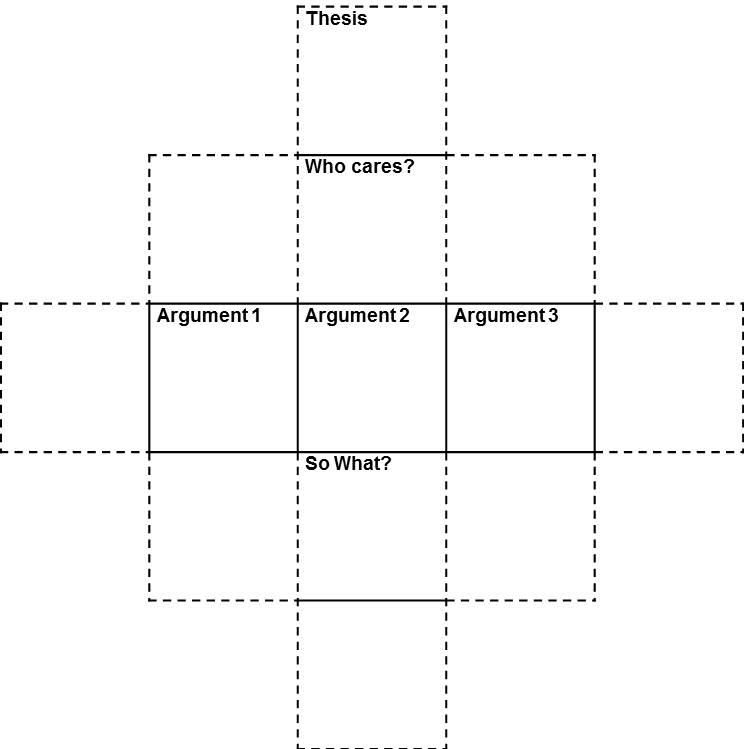
Use the 6c12 cube to plan a persuasive essay that begins with the thesis, “Murder is a serious crime.” You can use the cubes in your cube mobile or string them on a cube garland.
6c12 Cubing a Persuasive Essay
Open Mind Portrait
Add to your OMP of Arthur. What do you think he is thinking and feeling today as he does not get a shorter sentence, is visited by his dad, and fills the jar with glue for the Locos?
Discussion
Ask discussion questions of all 9 types.
Key Questions
- Why do you think the author has neglected to mention the victims of the crime for which he is serving time?
- How do you think the victims’ families feel about Arthur? How do you think they feel about his sentence being reduced?
- What do you think Arthur can do to “make things right” with the victims’ families?
- Do you think that victims should have rights? What should be done for them? http://ag.ca.gov/victimservices/
- What do you think will happen to Arthur once he is released?
- What changes will Arthur need to make to be successful on the outside?
- Arthur is given another year. What do you think the board wants to see from him before he is released? Do you feel that he is ready to go? What advice would you give him?
Analyze
Analyze the key paragraph.
Key Paragraph, p. 157
“After ninety days I went to the board on the date I was originally supposed to go. I thought for sure I was going to be released. I entered the room and sat down. One of the board members looked up at me and said, ‘Murder is a very serious crime. We’re going to give you another year.’ I almost fell off my chair. I didn’t know if I could take another year at Preston. I wanted to go home right then” (p. 157).
Extend
Write
Have each student write a short product based on today’s prompt to connect to the unit theme.
So far, this is the most that has been said about the kid(s) that died at the party. Pretend you are on the parole board. Think about what you want Arthur to learn about justice, restraint, and change while he is incarcerated. How can he show he has made the effort to change? Do not forget to mention the victims’ families. What would you like to see Arthur do to ask forgiveness from the families? Keep in mind that he killed two people.
Write two opposing arguments. The first will be from Arthur to the parole board arguing why he should be let out of Preston early. The second will be from the parole board to Arthur saying why he should stay. The parole board’s argument should start with, “Murder is a serious crime...” Both arguments should make a claim supported by reasons and evidence.
Close
Close by extending today’s lesson to life and the world.
Day 11
Outcomes for Today
Prepare
Background
Gather background knowledge about a place, time, event, person, or thing.
What are some long-term effects of sniffing and huffing? How do drugs get in the way of someone making positive changes?
Effects from abusing inhalants can be both short term and long term. These effects vary based on the substance abused and in what concentrations they are abused. Using inhalants can be deadly, even the first time they are used.
Short-term effects include:
- Dizziness
- Nausea/vomiting
- Delusions
- Hallucinations
- Loss of inhibitions
- Impaired judgment - leads to accidents such as car accidents and falls
Long-term effects of huffing are quite damaging to the major organs, including the brain, heart, lungs, kidneys and liver. Huffing can also lead to:
- Cardiac arrest
- Suffocation—due to decreased levels of oxygen
- Choking—can choke on vomit
- Brain damage—includes memory loss and effects on concentration caused by lack of oxygen to the brain
- Muscle damage
- Bone marrow damage - reduces formation of blood cells
- Cancer—some toxins are carcinogens
- Other forms of drug abuse
Do you think the author was affected by his drug use? How?
(Note) Upon hearing the author speak in August 2009, we know that he suffers from emphysema. He huffed for 10 minutes while in jail. The other two men, who had huffed for 20 minutes, died. The author strongly believes that his health today has been directly affected by this time in his life.
Word Wall
Here are five vocabulary words to teach and add to the Word Wall.
|
commotion (161) |
nauseated (161) |
plague (162) |
derby (163) |
exploratory (163) |
Read
Review
Start at the beginning and review the story so far.
Read
Read the selection, usually in a Shared Reading Read React Predict Cycle of 2-3 pages.
Read p. 164-176
|
Setting |
Characters |
Pages |
|
Preston |
Arthur, Freddie, Nacho, the old man in black |
161-164 |
|
Perkins |
Arthur, nurse, doctors |
165 |
|
Preston |
Arthur, the board |
165 |
|
Home on Emory St. |
Arthur, Denis, Eddie, mom, and Art |
165-176 |
Respond
Timeline
Agree on the facts in today’s reading, and list the 3-5 most important on the Timeline.
Students might mention:
- One friend, Nacho, died from sniffing glue; the other, Freddie, was never heard from again. Arthur gets sick, ends up in the hospital, but survives the incident.
- Arthur goes before the board again. This time he was granted his release and a 90-day time cut.
- He returns home. Eddie had been released 30 days earlier. Mother had moved to Emory St.
- Eddie has a job. Arthur and he move into the garage. Arthur starts looking for a job. He goes to work for the company across the street from his house.
- Their mother has started dating an abusive boyfriend. Eddie and Arthur beat him up in order to defend their mother’s honor.
- Art and Dennis want Arthur to go party with them. They drive around town, collecting change from phone booths. The police catch the boys. Art is arrested and taken to the same cell on mini-row. He has only been out for a week.
Map
Add to ongoing class activities like a KWL chart or map: where did the characters go?
Choice Chart (Good and Bad Decisions)
Add 2-3 situations for today’s reading. You can maintain a class chart or have your students keep a list as they read.
Map
As you read the novel, add the locations that you read about.
Lessons Learned Poster
In each day’s lesson there is a positive lesson that can be learned from Arthur. Some are very obvious, while others need to be interpreted. As a class, or independently, find each lesson and keep an ongoing list on poster paper or in your folder.
Explore
Activity
Explore the reading more deeply with a visual or oral language activity.
Open Mind Portrait
Continue to add to your OMP for Arthur. Add 5 things he can do to stay out of trouble once he is released. You can also add 5-7 thoughts based on what he is thinking and feeling while he is in the hospital and as he gets released.
Postcard
Pretend you are Arthur and the parole board just granted your release. Write a post card to your mother letting her know that you are coming home.
On the front, draw a picture.
On the back, write 1-2 paragraphs giving her details for your trip, what you are going to do to stay out of trouble, and tell her that you are sorry for causing her so much grief.
Add a proper address block and stamp to the back.
Resume
Pretend you are in Art’s position and you need to look for a job.
- Fill out the attached job application.
- Make sure you follow all of the directions.
- Print clearly and neatly using Blue or Black ink.
You can use this application to help you fill out applications in the future. If you are of working age, use this as an opportunity to get applications and fill them out.
Bookmark
Add to your bookmark. What have you done to make positive change in your life?
(Directions to the bookmark are located on day two and four of the lesson plans).
Discussion
Ask discussion questions of all 9 types.
Key Questions
- Why didn’t Arthur tell the doctors or nurses what happened to him? If he did, do you think they could have treated him more effectively?
- Who was the old man in the black coat and derby hat? Why didn’t he take Arthur? What do you think he wanted Arthur to do?
- Although Arthur was released from prison, do you think that he has really improved?
- What alternatives did Arthur and Eddie have instead of beating up their mother’s boyfriend?
- How did Arthur find himself back in jail?
- Gorman tells Arthur to behave himself. What do you think he means? Arthur says that he will and hoped he would never return. What else besides hope will Arthur need in order to really change?
- Why did Arthur’s mother move? Who was she trying to protect?
- Arthur is with Dennis and Art while they are breaking into the phone booths. Does the fact that he does nothing to stop them make him guilty? What do you think he is guilty of?
Analyze
Analyze the key paragraph.
Key Paragraph, p. 176
“As I stepped in, I just couldn’t believe it. Again! I looked up at the ceiling and what did I see up there etched in the wall? ‘ART WAS HERE’. It sent a chill up my back! Bringing my hands up to my face once again rubbing them against it and feeling frustrated, I sat on the bottom bunk. I couldn’t believe I was back for some dumb crime. I stood up and looked at the top bunk to see if anyone else was there. I thought I heard somebody breathing. Someone was sleeping all wrapped up in a blanket” (p. 176).
Extend
Write
Have each student write a short product based on today’s prompt to connect to the unit theme.
Arthur’s life has come full circle. Some would say that he is just a victim of circumstance—in the wrong place at the wrong time. While this might be true to a certain extent, Arthur cannot afford to find himself in this position anymore.
Write an argumentative paragraph about why being an accessory to a crime is still a criminal act. Make a clear claim, supported strongly with reasons, and have a strong conclusion.
Close
Close by extending today’s lesson to life and the world.
Employment Application
K, J, N, & B Enterprises
1234 Noname St., Zero Degrees, AK 93870
Employment Application
An Equal Opportunity Employer
Company is an equal opportunity employer. This application will not be used for limiting or excluding any applicant from consideration for employment on a basis prohibited by local, state, or federal law. Applicants requiring reasonable accommodation in the application and/or interview process should notify a representative of the organization.
Please print and fill out all sections (use blue or black ink)
Applicant Information
Applicant Name _____________________
Home Phone _______________________
Other ____________________________
Email Address _____________________
Current Address:
Number and street ____________________
City ________________________________
State & Zip ____________________________
How were you referred to Company?:___________________________
Employment Positions
Position(s) applying for:________________________________
Are you applying for:
- Temporary work – such as summer or holiday work? [ ] Y or [ ] N
- Regular part-time work? [ ] Y or [ ] N
- Regular full-time work? [ ] Y or [ ] N
What days and hours are you available for work?______________________________
If applying for temporary work, when will you be available? ___________________________________________
If hired, on what date can you start working? ___ / ___ / ___
Can you work on the weekends? [ ] Y or [ ] N
Can you work evenings? [ ] Y or [ ] N
Are you available to work overtime? [ ] Y or [ ] N
Salary desired: $________________________________
Personal Information:
Have you ever applied to / worked for Company before? [ ] Y or [ ] N
If yes, please explain (include date): ________________________
Do you have any friends, relatives, or acquaintances working for Company? [ ] Y or [ ] N
If yes, state name & relationship: ________________________________
If hired, would you have transportation to/from work? [ ] Y or [ ] N
Are you over the age of 18? (If under 18, hire is subject to verification of minimum legal age.) [ ] Y or [ ] N
If hired, would you be able to present evidence of your U.S. citizenship or proof of your legal right to work in the United States? [ ] Y or [ ] N
If hired, are you willing to submit to and pass a controlled substance test? [ ] Y or [ ] N
Are you able to perform the essential functions of the job for which you are applying, either with / without reasonable accommodation? [ ] Y or [ ] N
If no, describe the functions that cannot be performed
_____________________________________________________________
(Note: Company complies with the ADA and considers reasonable accommodation measures that may be necessary for eligible applicants/employees to perform essential functions. It is possible that a hire may be tested on skill/agility and may be subject to a medical examination conducted by a medical professional.)
Have you ever been convicted of a criminal offense (felony or misdemeanor)? [ ] Y or [ ] N
If yes, please describe the crime - state nature of the crime(s), when and where convicted and disposition of the case.________________________________________________________________
(Note: No applicant will be denied employment solely on the grounds of conviction of a criminal offense. The date of the offense, the nature of the offense, including any significant details that affect the description of the event, and the surrounding circumstances and the relevance of the offense to the position(s) applied for may, however, be considered.)
Education, Training and Experience
High School:
School name: ________________________
School address:________________________
School city, state, zip:________________________________
Number of years completed: _______________
Did you graduate? [ ] Y or [ ] N
Degree / diploma earned: _______________
College / University:
School name: __________________________
School address:________________________
School city, state, zip:________________________________
Number of years completed: ________
Did you graduate? [ ] Y or [ ] N
Degree / diploma earned: __________________
Vocational School:
Name: ________________________
Address:______________________
City, state, zip:________________________________
Number of years completed: ________
Did you graduate? [ ] Y or [ ] N
Degree / diploma? : __________________
Military:
Branch: ________________________
Rank in Military:________________________
Total Years of Service: ________
Skills/duties: ________
Related details:________________________________
Do you speak, write or understand any foreign languages? [ ] Y or [ ] N
If yes, describe which languages(s) and how fluent of a speaker you consider yourself to be. ____________________
Do you have any other experience, training, qualifications, or skills which you feel should be brought to our attention, in the case that they make you especially suited for working with us?
[ ] Y or [ ] N
If yes, please explain
Day 12
Outcomes for Today
Prepare
Background
Gather background knowledge about a place, time, event, person, or thing.
What does it mean to “grow up”? How does growing up show change?
Growing up not only means that you are getting older, but also that you are maturing. When you truly grow up, you should have the ability to handle life's challenges while finding fulfillment and enjoyment.
Some milestones that grown-ups meet are to:
- Know the appropriate time and place. It is OK to have fun, but it is also important to know when to act serious. There is a time and place for everything. Grown-ups make sure their behavior matches the situation.
- Control your emotions and your words. Use the appropriate tone, words, and respect whenever you need to convey your emotions.
- Hard work will get you somewhere. It is important to know and appreciate hard work. If you have a strong work ethic, you are valuable. Anyone can learn a new skill, but being able to work with integrity is an invaluable skill. If it seems too good to be true . . .it probably is.
- Learn about yourself. Who are you as a person? What is your character and your flaws? Be willing to accept criticism and be willing to adapt as needed. Don’t compare yourself to others, compare yourself to you.
- Set goals and work to reach them.
- Stay positive. Have fun with friends and family. Build a support network of positive people who will be there when you need them.
Word Wall
Here are five vocabulary words to teach and add to the Word Wall.
|
spoiled (177) |
clang (179) |
overextended (179) |
motioned (184) |
unanimous (184) |
Read
Review
Start at the beginning and review the story so far.
Read
Read the selection, usually in a Shared Reading Read React Predict Cycle of 2-3 pages.
Read p. 177-185
|
Setting |
Characters |
Pages |
|
San Jose, Arthur’s Childhood |
Tita, Arthur, father |
177-178 |
|
County Jail |
Arthur, Detective |
179 |
|
Master Metal Products |
Arthur, workers |
180-181 |
|
Los Angeles |
Arthur, Tita, Eddie, Victor, Dad |
181-182 |
|
Mom’s House |
Arthur, Eddie, Richard |
182-185 |
Respond
Timeline
Agree on the facts in today’s reading, and list the 3-5 most important on the Timeline.
Students might mention:
- Flashback: Tita was a spoiled brat. She was treated differently because she was a girl. Tita would do whatever she could to get Arthur in trouble. He received many whippings because of her. Over time, Tita and Arthur grew close.
- Arthur is released from jail and the detective tells him to stay out of trouble.
- Arthur buys a car and gets a job at Master Metal Products, across the street from his house.
- His father calls and wants to see the kids. They visit their father in Los Angeles, which is a positive step for their relationships.
- Upon returning home from work, Arthur encounters an old enemy at his house. Flashback: Arthur recalls the time when he fought Richard.
- Eddie tells Arthur to “let it go” and that Richard was “cool”. Arthur and Richard become friends.
Map
Add to ongoing class activities like a KWL chart or map: where did the characters go?
Choice Chart (Good and Bad Decisions)
Add 2-3 situations for today’s reading. You can maintain a class chart or have your students keep a list as they read.
Map
Obtain a map of San Jose, California. As you read the novel, add the locations that you read about.
Lessons Learned Poster
In each day’s lesson there is a positive lesson that can be learned from Arthur. Some are very obvious, while others need to be interpreted. As a class, or independently, find each lesson and keep an ongoing list on poster paper or in your folder.
Explore
Activity
Explore the reading more deeply with a visual or oral language activity.
Open Mind Portrait
Add to your OMP of Arthur. What do you think he is thinking and feeling while he in jail and as he meets his father again?
Create an OMP for Arthur’s father. What do you think he is thinking and feeling as he sees his children again? How has he changed?
Cartoon
Draw a cartoon strip that summarizes today’s reading. Create 7-10 cartoon panels and include thought bubbles to show the dialog.
Discussion
Ask discussion questions of all 9 types.
Key Questions
- Why did Arthur’s father treat Tita different? Do you think that boys and girls should have any different treatment while growing up?
- What do you think Arthur’s friends told the police that lead to his release?
- What attitude does the writer use to depict Arthur? Do you think that attitude has anything to do with the situation he finds himself in now?
- The detective tells Arthur to stay out of trouble (page 179). “That is hard for me to do,” is Arthur’s response. Why do you think staying out of trouble is so hard for Arthur? What is one thing he could do to help himself stay “clean”? What advice would you give to Arthur to help him stay out of trouble?
- Why do you think the writer chose to highlight this positive reunion with his father? What factors played into this reunion being positive?
- Arthur has had many opportunities to change. Today he has made one or two small steps at changing his attitude, choices, and behavior. What is happening that helps him make these small steps?
Analyze
Analyze the key paragraph.
Key Paragraph, p. 179
“The detective continued, ‘And as far as your parole officer is concerned, you don’t have to tell him anything, because we are not going to notify him. Your buddies told us what went down.’ He stood up from his chair. I also stood up and shook his hand, thank you for the break. I also asked him to thank the other cops for releasing me. Before I walked out, he told me to keep out of trouble. ‘That is a hard thing for me to do,’ I said to myself” (p. 179).
Extend
Write
Have each student write a short product based on today’s prompt to connect to the unit theme.
Arthur is starting to make some good decisions; however, he continues to associate with people that bring him down. Fortunately, his friends told the truth. What do you think Arthur should do to make some changes and stay out of trouble? As you write, think about obtainable goals that Arthur could start with.
In an argumentative paragraph, describe at least three things Arthur needs to stop or start doing to change his life. Use a clear thesis statement, explain your reasoning, and make clear, concise details to support your claims.
Close
Close by extending today’s lesson to life and the world.
Day 13
Outcomes for Today
Prepare
Background
Gather background knowledge about a place, time, event, person, or thing.
What do you think the economic impact of substance abuse has on the family and the community? Then provide them with the factual evidence below.
According to the new book “High Society - How Substance Abuse Ravages America and What to Do About It” by Joseph Califano (Public Affairs, April 2007),
The cost of drug abuse has grown to approximately $1 trillion dollars per year in America. Substance abuse is related to poverty, violent crime, academic underachievement, soaring health care costs, family breakup, child abuse, homelessness, teen pregnancy, work problems, and AIDS. There is an increased level of drug abuse in the nation’s criminal justice, health care, and social service systems. This one epidemic is responsible for the death of more Americans than all of America’s wars, natural catastrophes, and traffic accidents combined.
Some of the Costs include:
- Fetal Alcohol Syndrome: Mothers who drink alcohol or use drugs during pregnancy to an extent that causes their baby to have FAS or FADE could cost up to $4 million in health care and specialized services over the course of a lifetime. The total cost to American taxpayers is estimated to be $1.9 billion/year.
- Underage Drinking: According to the Office of Juvenile Justice and Delinquency Control, the cost of underage drinking to society from accidents, crime, academic underachievement, etc., is $64 billion per year.
- Emergency Room Visits: According to the Drug Abuse Warning Network, in 2006 there were 1,742,887 emergency room visits that were alcohol or drug related. While costs vary, drug related E.R. visits alone may cost society $4 billion.
- College Drinking: According to “Binge Drinking on College Campuses” (Center for Science in the Public Interest, December 2008), in 2005 there were approximately 7.2 million college binge drinkers, and 2.3 million heavy drinkers. This leads to 1,700 alcohol/drug related college deaths each year, 599,000 student injuries, 696,000 student assaults, 400,000 student incidents of engaging in unprotected sex, and some 70,000 instances of sexual assault. One estimate was placed at $80,000 per college just due to alcohol related vandalism.
- Criminal Justice System Costs: According to the Office of National Drug Control Policy (ONDCP), it was estimated that of the $38 billion spent on corrections in 1996, more than $30 billion was spent incarcerating individuals who had alcohol or drug problems or committed alcohol or drug related crimes.
- Impaired Employees: In “Employer Costs of Alcohol Related Injuries” (American Journal of Industrial Medicine, Zaloshnja, Miller, Hendrie, and Galvin, Wiley-Liss. Inc., December 22, 2006), the annual employer cost of alcohol-related injuries to employees and their dependents was reported at $28.6 billion.
- DWI Costs: Driving While Intoxicated continues as a horrendous problem throughout the country. According to “The High Cost of Drunk Driving” (Russell Weisman, Article Alley, January 5, 2006), the cost to society from D.W.I. in 2001 was estimated at $230 billion tax dollars due to highway DWI collisions.
The Total Costs
Every day, 1,500 people die from alcohol, tobacco and other drugs, while thousands more are admitted into hospitals, psychiatric facilities, jails, prisons, or divorce court. The magnitude is staggering, and according to California, drug abuse costs approximate $1 trillion per year. This does not even begin to measure the human costs in pain and suffering and lost lives.
Alcohol and drug abuse have reached epidemic proportions in America. Crime, violence, divorce, cancers, cardiovascular diseases, organic brain syndrome, school problems, job problems, mental health problems, family problems, financial problems, etc., are all consequences of alcohol and drug abuse as it ripples throughout society. All of these consequences have financial costs. This means that all businesses, consumers, and taxpayers are affected, and all must pay more due to the negative consequences of abuse.
Word Wall
Here are five vocabulary words to teach and add to the Word Wall.
|
consisted (186) |
alternative (187) |
trance (189) |
persuasion (190) |
sarcastically (193) |
Read
Review
Start at the beginning and review the story so far.
Read
Read the selection, usually in a Shared Reading Read React Predict Cycle of 2-3 pages.
Read p. 186-193
|
Setting |
Characters |
Pages |
|
King Rd., Tropicana Foods, Burger Bar |
Arthur, Art, mom |
186-189 |
|
Los Angeles |
Arthur, Aunt Connie, Uncle Ray, Aunt Maryann, Uncle Alfred, Uncle Joe |
190-193 |
Respond
Timeline
Agree on the facts in today’s reading, and list the 3-5 most important on the Timeline.
Students might mention:
- Flashback: Arthur recalls hanging out with Art on King Rd. One night, after stealing whiskey from the Tropicana Foods, Arthur’s mom caught him drunk in front of the Burger Bar.
- Flashback: Arthur believes he learned to like drinking so much from hanging out with his uncles in Los Angeles.
- Flashback: Arthur recalls visiting the family at the age of 13. He was allowed to drink and smoke. His uncle took him to look for fights in the neighborhood.
- Many years later, Uncle Joe committed suicide, Aunt Maryann divorced Uncle Alfred, Uncle Alfred died of liver complications, and Uncle Ray died from liver complications. They all died young.
Map
Add to ongoing class activities like a KWL chart or map: where did the characters go?
Choice Chart (Good and Bad Decisions)
Add 2-3 situations for today’s reading. You can maintain a class chart or have your students keep a list as they read.
Map
Obtain a map of San Jose, California. As you read the novel, add the locations that you read about.
Lessons Learned Poster
In each day’s lesson there is a positive lesson that can be learned from Arthur. Some are very obvious, while others need to be interpreted.
As a class, or independently, find each lesson and keep an ongoing list on poster paper or in your folder.
Explore
Activity
Explore the reading more deeply with a visual or oral language activity.
Open Mind Portrait
Add to your OMP of Arthur. What do you think he is thinking and feeling as he reflects back on his earlier choices and decisions? Do you think his life would have been different if he made better decisions?
Setting Chart
Create a setting chart for today’s reading. Do you feel Arthur’s location and relationships affected his choices today?
1g6 Setting Chart
Bookmark
Add to your bookmark. What have you done to help you reach your goal today? There is no step that is too small.
Discussion
Ask discussion questions of all 9 types.
Key Questions
- How would you describe Arthur’s mother? How do you think Arthur feels about her?
- Do you think that family role models play an important part of shaping who you are?
- Who are your role models? Who looks up to you? What do you do to be a good role model? Is it important to have a role model or a mentor? Why?
- Do you think Arthur’s Uncles were good role models?
- What did you do today, that made you a good role model?
- What happened to Arthur’s uncles? Is there a direct connection between their early death and their lifestyle? What?
- Nearly every situation we read about today had to do with drinking alcohol, what do you think the author wants you to learn from today’s reading?
Analyze
Analyze the key paragraph.
Key Paragraph, p. 193
“Uncle Joe shot himself in the head a few years later, having become depressed with life. Later on Aunt Maryann divorced Uncle Alfred. A few years after that, Uncle Alfred died from a bad liver, the result of having a wild life. Uncle Ray died a few years later, also from the same illness, a bad liver” (p. 193).
Extend
Write
Have each student write a short product based on today’s prompt to connect to the unit theme.
Arthur lost three relatives at a young age due to the negative effects of drinking, and he has spent time in YA due to bad decision-making while drinking. His relationship with his parents has suffered and so has his job. Based on today’s reading, think about the direct effects that alcohol has had on every situation. Put yourself in each person’s shoes to gain their perspective. Also consider Arthur’s grandparents, who lost two sons at a young age because they “partied”.
Write 2-3 argumentative paragraphs against abusing alcohol. Make a clear claim, supported with anecdotal evidence from today’s reading and the background information provided at the beginning of the lesson. Include a quote from the text. Use a strong conclusion statement.
Close
Close by extending today’s lesson to life and the world.
Day 14
Outcomes for Today
Prepare
Background
Gather background knowledge about a place, time, event, person, or thing.
What would you sacrifice your freedom for? Then have students share out their responses.
Sacrifice means to offer something to a deity in a ritual. It is giving up something you value for the sake of another. Some people sacrifice their time and talents to give to others, while others sacrifice their lives to give us our freedom in the United States.
In this situation, Arthur realizes that if he continues to live the way he is, he will end up sacrificing everything. He could end up in jail or dead. He is getting to the point in his life when he will have to start changing.
Word Wall
Here are five vocabulary words to teach and add to the Word Wall.
|
anglos (194) |
khaki (194) |
anticipation (195) |
threshold (199) |
expression (200) |
Read
Review
Start at the beginning and review the story so far.
Read
Read the selection, usually in a Shared Reading Read React Predict Cycle of 2-3 pages.
Read p. 194-205
|
Setting |
Characters |
Pages |
|
Los Angeles, Grandpa’s Apartment |
Arthur, Grandfather, Uncle Ray, Uncle Alfred, Uncle Joe |
194-201 |
|
San Jose, guest house behind mother’s house |
Arthur, Eddie, Mom, Ventura |
202-203 |
|
Taylor St. San Jose |
Arthur, Police |
204-205 |
Respond
Timeline
Agree on the facts in today’s reading, and list the 3-5 most important on the Timeline.
Students might mention:
- Arthur visited his uncles after his release from Preston.
- He involved himself in a brawl with his uncles and grandfather against the police in his grandfather’s apartment.
- His uncles and grandfather were arrested and served time in jail. It cost them a lot of money to fight their charges.
- Arthur realizes what is happening to them and he wonders what will happen to him.
- Back in San Jose, Arthur and his friends are using drugs more heavily. Arthur is faced with choices: he doesn’t want to take the drugs with them, but he does anyway.
- Arthur gets pulled over with marijuana in the car. He tries to swallow it and nearly chokes to death.
Map
Add to ongoing class activities like a KWL chart or map: where did the characters go?
Choice Chart (Good and Bad Decisions)
Add 2-3 situations for today’s reading. You can maintain a class chart or have your students keep a list as they read.
Map
Obtain a map of San Jose, California. As you read the novel, add the locations that you read about.
Lessons Learned Poster
In each day’s lesson there is a positive lesson that can be learned from Arthur. Some are very obvious, while others need to be interpreted.
As a class, or independently, find each lesson and keep an ongoing list on poster paper or in your folder.
Explore
Activity
Explore the reading more deeply with a visual or oral language activity.
Open Mind Portrait
Add to your OMP of Arthur. What do you think he is thinking and feeling as he almost gets arrested…again?
Postcard
Pretend you are Arthur and stuck in the same cycle: do well for a while, get in trouble, do well, get in trouble, and so on. You know that you need to make some changes, but don’t know where to start.
Write a postcard to Mr. Gorman.
Let him know that you want to change and ask for his advice.
On the opposite side, draw a picture that represents change to you.
Make sure you address your postcard appropriately.
Discussion
Ask discussion questions of all 9 types.
Key Questions
- What happened when Arthur went to visit his grandfather?
- How did Arthur escape arrest?
- How could the family have avoided this situation?
- Besides the financial cost to the family, what did the radio incident cost the family? Do you think it was worth it?
- What options did Arthur have besides fighting alongside his uncles?
- At the end of the chapter, Arthur is wondering how his life will end up. Predict what you think will happen to him.
- How do you think your life will end up? Who do you have for support? What and where do you want to be in one year, five years, and ten years?
Analyze
Analyze the key paragraph.
Key Paragraph, p. 200-201
“They didn’t take me in, but they did take all my uncles. It was no light matter. My uncles had to go to court many times, for months. They had to hire lawyers, and it cost them a lot of money. Finally the court process was over. They all had to pay fines and go to jail for awhile. It sure wasn’t worth it, beating up the cops and having to pay so much. I was having a difficult time staying out of trouble. Would I straighten out my life? If I did, when? Would I get caught for some of the things I was doing and be sent back to jail? Would I end up dead like some of my old friends? Some of my friends were living on the streets. Others overdosed on drugs. Still others were killed. How was I going to end up?” (p. 200-2001).
Extend
Write
Have each student write a short product based on today’s prompt to connect to the unit theme.
Arthur knows he has to stay out of trouble with the police. In today’s reading, Arthur decides that “backing up” his uncles and grandfather is a “noble cause”. Look at the paragraph above. Think about noble causes.
Using the above paragraph, write an argumentative paragraph about whether “backing up” his family was a noble cause or not. Use examples from today’s reading and your own experiences as evidence to support your claim. Explain what alternatives Arthur had based on the situation.
Close
Close by extending today’s lesson to life and the world.
Day 15
Outcomes for Today
Prepare
Background
Gather background knowledge about a place, time, event, person, or thing.
What does it mean to live your life with integrity? Do you need integrity to change?
In simple terms, “Integrity” is “doing the right thing when no one else is looking.” In order to live your life with integrity, you need to make good decisions all of the time and live your life responsibly. You must also treat others how you want to be treated.
In today’s reading, Arthur realizes how horrible his life has become. His mother kicks him out of his house. He is going to be facing many major decisions. He can either continue to live a life hurting others or decide to live his life with integrity?
Word Wall
Here are five vocabulary words to teach and add to the Word Wall.
|
productively (206) |
dormitory (207) |
discouragement (207) |
apprenticeship (208) |
devoted (208) |
Read
Review
Start at the beginning and review the story so far.
Read
Read the selection, usually in a Shared Reading Read React Predict Cycle of 2-3 pages.
Read p. 205-215
|
Setting |
Characters |
Pages |
|
Rainbow Dance Hall |
Arthur, Noah, and Art |
205-206 |
|
Master Metal Products |
Arthur, the manager, and mom |
206-207 |
|
Owens-Illinois |
Arthur and Cathy |
206-209 |
|
Redondo Beach |
Arthur, Uncle Ray, Aunt Connie, several doctors |
210-214 |
|
American Can Co. |
Arthur and his coworkers |
214-215 |
Respond
Timeline
Agree on the facts in today’s reading, and list the 3-5 most important on the Timeline.
Students might mention:
- Arthur is at the dance hall, thinking that he looks great. He is so strung out on drugs that he doesn’t know how bad he actually looks. He runs into Noah, an old enemy, at the dance hall. He thinks that things are great, but doesn’t realize that Noah wants to stab him.
- Arthur gets fired from his job at Master Metal. His mother kicks him out of the house because he has no job and lives like a “bum”.
- Arthur gets married.
- Arthur gets a new job at Owens-Illinois. He and his friends “cat call” a co-worker. When he finds out that she is religious, he feels bad, stops his friends and apologizes.
- Cathy and her husband go to visit Arthur and discuss religion. He tries to make arrangements to talk to them again, but leaves before he could do it.
- Arthur gets into a fight with a Vietnam veteran. The police are looking for him again. He moves to Wilmington to stay out of trouble.
- He goes to the beach with his family and injures himself while diving into the ocean. None of the doctors knows what is wrong with him.
Map
Add to ongoing class activities like a KWL chart or map: where did the characters go?
Choice Chart (Good and Bad Decisions)
Add 2-3 situations from today’s reading. You can maintain a class chart or have your students keep a list as they read.
Map
Obtain a map of San Jose, California. As you read the novel, add the locations that you read about.
Lessons Learned Poster
In each day’s lesson there is a positive lesson that can be learned from Arthur. Some are very obvious, while others need to be interpreted. As a class, or independently, find each lesson and keep an ongoing list on poster paper or in your folder.
Explore
Activity
Explore the reading more deeply with a visual or oral language activity.
Postcard
Pretend you are Arthur. Write a letter to Cathy and apologize to her for “cat calling” her at work. In your letter, accept responsibility for your actions, state how you harmed her, and explain what you will do in the future to set things right.
Character Profile Chart
Create a CPC for Cathy and Arthur’s mother. Chose two traits for each of them and write them in the box. Cite examples from today’s reading to support your choice.
4g6 Character Profile Chart
Bookmark
Add to your “change” bookmark. What have you done today to take another step closer to making change and working on your “plan”?
Discussion
Ask discussion questions of all 9 types.
Key Questions
- What almost happened to Arthur due to his drug use?
- What change occurred in Arthur’s mother? Will this change help Arthur?
- Why do you think the author chooses to say so little about his wife?
- Do you think Cathy is a good source of support?
- What do you think Arthur is expecting from Cathy and Mr. Gorman?
- Have you ever had to repair a broken relationship? Who was it with and what did you do to fix it?
- Based on today’s reading, who else influences Arthur to change?
- Arthur did not feel that the doctor’s at any of the hospitals were listening to him. What can you do to make sure a person of authority hears you?
Analyze
Analyze the key paragraph.
Key Paragraph, p. 206
“The next morning, my friend Art told me Noah had a knife about eight inches long. He had been holding it under his shirt. Art told me he thought I was going to be stabbed. I became really upset. ‘Today I’m not loaded. I don’t like that guy anyway. I’m going to get him for pulling a knife on me!’ I went looking for Noah in the neighborhood and was planning to fight him. Later we met, but nothing happened. We both felt everything was over between us, and that’s where it stayed” (p. 206).
Extend
Write
Have each student write a short product based on today’s prompt to connect to the unit theme.
As Arthur grows older, he is beginning to realize that his actions affect others, positively and negatively. He is also learning that sometimes you can go back and right the wrongs you have committed. He is beginning to realize how it frees him to move on with his life. Think about your own life. Have you ever gone back to right a wrong? The situation does not have to be a crime it can be a relationship that needed repair or a situation you wanted to fix.
Write an argumentative paragraph about a time when you were wrong. Argue against yourself being wrong and why you were wrong. Support your arguments with reason and evidence.
Close
Close by extending today’s lesson to life and the world.
Day 16
Outcomes for Today
Prepare
Background
Gather background knowledge about a place, time, event, person, or thing.
Explain the following term to your class: Entrepreneurship
Entrepreneurship is actually defined as "the state of being an entrepreneur." An entrepreneur is an individual who owns, organizes, and manages a business and, in so doing, assumes the risk of either making a profit or losing the investment.
In today’s reading, Arthur realizes that he has skills and he can start making money by selling items on the side. He is learning the basic principles of business and is willing to make sacrifices and work hard to earn extra cash. He is starting to realize that his father, despite their differences, gave him a very strong work ethic. Discuss the following questions: What tough decisions do you think you have to make as an entrepreneur?
Word Wall
Here are five vocabulary words to teach and add to the Word Wall.
|
warehouse (216) |
scam (219) |
vented (220) |
merchandise (223) |
cologne (225) |
Read
Review
Start at the beginning and review the story so far.
Read
Read the selection, usually in a Shared Reading Read React Predict Cycle of 2-3 pages.
Read p. 216-227
|
Setting |
Characters |
Pages |
|
American Can Co. |
Arthur and Sal |
216-217 |
|
Long Beach |
Arthur and the con man |
218-220 |
|
San Gabriel |
Arthur and his father |
221-222 |
|
Downtown Los Angeles |
Arthur, his father, Max |
222-225 |
|
Hotel Alexandra |
Arthur, Pepe, and the business man |
225-227 |
Respond
Timeline
Agree on the facts in today’s reading, and list the 3-5 most important on the Timeline.
Students might mention:
- Arthur starts to make changes. He decides not to smoke dope anymore. He starts changing his thinking about what is right and what is wrong.
- While on his way to the gas station to charge his battery, he is conned by a man for two sweaters. He resells them for a profit, but they were bad quality and got him in trouble with his friends.
- Arthur goes to Los Angeles with his father. Max tells Arthur that his father is proud of him. He goes to Max’s warehouse and finds out the sweaters were worth $1.50.
- Arthur’s father makes a deal. Arthur decides to buy some cologne and tries to sell it for a profit. His father’s business deal nets a $10,000 profit.
- Arthur aspires to go into business for himself.
- Arthur’s mother calls to tell him that she wants him to return to San Jose and to take over the house on Emory St. Arthur decides to go back.
Map
Add to ongoing class activities like a KWL chart or map: where did the characters go?
Choice Chart (Good and Bad Decisions)
Add 2-3 situations for today’s reading. You can maintain a class chart or have your students keep a list as they read.
Map
Obtain a map of San Jose, California. As you read the novel, add the locations that you read about.
Lessons Learned Poster
Add to your ongoing list on poster paper or in your folder.
Explore
Activity
Explore the reading more deeply with a visual or oral language activity.
Advertisement
Pretend you are Arthur and you have perfume to sell. Create an advertisement for your product. Be sure to include:
Name of the product
Company name
Motto or slogan
Illustration
Uses and purpose
Cost
Locations where you can purchase it
Open Mind Portrait
Add to your OMP of Arthur. What do you think he is thinking and feeling as he learns his father loves him, decides to make a clean break, gets sober, starts making plans, and setting goals? Give him 5-7 new thought bubbles.
Discussion
Ask discussion questions of all 9 types.
Key Questions
- Knowing what you know now, would you allow your children to drink, smoke, or do any of the things that you do? Why or why not?
- Arthur decides to make major life changes. Is it okay to change one thing at a time? What strategy works best for you: a major change, a series of little changes, or a combination of both?
- Do you think that Arthur will succeed in making the changes he envisions? What do you think is different for him now?
- Arthur’s father does well in business most of the time; however, he has lost much because he trusted bad people. Why is it important to surround yourself with great people all of the time?
- Arthur talks about being angry in this chapter. How does carrying anger with you hurt you and hinder your ability to fully function? What are positive ways to cope with anger?
- Arthur’s father has told Max that he is proud of his son. Why do you think he hasn’t told Arthur himself?
- Arthur wants an easy job and wants to make a lot of money. Are there any easy jobs? What is a strong work ethic? What do you think it takes to be successful in business?
Analyze
Analyze the key paragraph.
Key Paragraph, p. 223
“My father was proud of me? I always had the impression he didn’t love me. Maybe I was always wrong. My father gave me a look of approval. A second later he turned his attention to Max” (p. 223).
Extend
Write
Have each student write a short product based on today’s prompt to connect to the unit theme.
Arthur realizes for the first time that his father was proud of him. Think about how astonished you would feel the first time you realized you were loved.
In a 2-paragraph letter, pretend you are Pepe, and apologize to your son for one of the times you unjustly punished him. Describe the situation, explain your point of view, admit that you did something wrong, and explain what you would like to do to make things right. Be prepared to clarify any misunderstandings, biases, and expectations.
Close
Close by extending today’s lesson to life and the world.
Day 17
Outcomes for Today
Prepare
Background
Gather background knowledge about a place, time, event, person, or thing.
What is the value of hard work?
Lee Iacocca:
“Apply yourself. Get all the education you can, but then, by God, do something. Don't just stand there, make it happen.”
Vince Lombardi
“Practice does not make perfect. Only perfect practice makes perfect.”
Discuss the two quotes above. What do you think the speakers are trying to convey? As we discuss change throughout this unit, can you make change in your life without effort? What is one thing you can put more effort into on a daily basis that will help you make positive changes? Commit yourself to putting forth a little more effort each day.
As we have read, Arthur continues to put forth effort to make changes. Even though his work schedule is not optimal, he sticks with it until he sees a new opportunity, and then he takes that opportunity to better himself and his family. Arthur is taking control of his life and taking action. He is starting to make things happen for himself.
Word Wall
Here are five vocabulary words to teach and add to the Word Wall.
|
engulfed (230) |
subside (230) |
foreman (233) |
recession (238) |
recycling (240) |
Read
Review
Start at the beginning and review the story so far.
Read
Read the selection, usually in a Shared Reading Read React Predict Cycle of 2-3 pages.
Read p. 228-240
|
Setting |
Characters |
Pages |
|
San Jose, Emory St. |
Arthur, Uncle Bob, son, Daniel |
228-229 |
|
Owens-Corning Fiberglass and Dump |
Arthur, Landfill worker |
230-231 |
|
Apricot Orchard |
Eddie, Arthur, the foreman, father |
232-235 |
|
Mack truck Co. |
Arthur, the boss, and junior |
235-237 |
|
A Garbage Dump |
Arthur and Leo |
238-240 |
Respond
Timeline
Agree on the facts in today’s reading, and list the 3-5 most important on the Timeline.
Students might mention:
- Arthur moves back to San Jose and begins fixing up his mother’s house.
- His uncle helps him during this time that his second son is born.
- He begins working at Owens-Corning Fiberglass. At first, he has a crazy schedule. As time passes, however, he receives a driver position.
- He works for that company for five years before finding another job driving a diesel Mack truck. He is able to go on a regular schedule and finally has his “dream job”.
- Flashback: Arthur recalls his first childhood job. His dad took Eddie and Arthur to pick apricots because he wanted them to learn the value of hard work.
- Arthur goes to work with his friend Leo at a garbage company. While at this company, he learns that he can make extra money by recycling.
Map
Add to ongoing class activities like a KWL chart or map: where did the characters go?
Choice Chart (Good and Bad Decisions)
Add 2-3 situations for today’s reading. You can maintain a class chart or have your students keep a list as they read.
Map
Obtain a map of San Jose, California. As you read the novel, add the locations that you read about.
Lessons Learned Poster
Add to your ongoing list on poster paper or in your folder.
Explore
Activity
Explore the reading more deeply with a visual or oral language activity.
Open Mind Portrait
Add to your OMP of Arthur. He is making good choices. What do you think he is thinking and feeling as he continues to find success?
Resume
Use the information you collected for your job application to create a resume. This can be used and updated as you continue through school.
You can find sample resumes and information at:
http://www.collegegrad.com/resumes/
Skill Poster
Create a poster of all of the skills Arthur has obtained since he has started working. Place an illustration by each one. One the back, make of the top ten skills that you have that make you feel proud.
Bookmark
Add to your bookmark. What effort have you put into your plan today?
Commit yourself to take another step in your plan. Remember your long terms goals.
Discussion
Ask discussion questions of all 9 types.
Key Questions
- Arthur’s uncle has helped him many times and is now helping him with his house. Arthur appreciates his help. What are ways that you show appreciation to others?
- The boys are taken to pick apricots in the orchard. Arthur’s father gives him a lecture on what it means to be a “good worker”. What do you think are qualities of a good worker? How do you obtain and present those skills when looking for a job?
- Arthur got a job because he lied; however, he figured out how to drive the truck and was ultimately successful. What could he have done besides lying to get the job? What would you have done in the same situation?
- Junior was very disrespectful towards Arthur; however, he does not get angry and goes to talk to him. What changes have occurred in Arthur to have him display this response?
- Based on today’s reading, what lessons does the author want to convey to you as a reader? What is one thing you learned from Arthur’s experience today?
Analyze
Analyze the key paragraph.
Key Paragraph, p. 235
“When we got in the car and drove off, we knew we did all right. My father was in a pleasant mood. From that year on we worked in the field every summer” (p. 235).
Extend
Write
Have each student write a short product based on today’s prompt to connect to the unit theme.
Art Rodriguez has included many flashbacks in this novel. In this situation you are able to see how the lessons he learned in the past could be used as he in working in the present.
In an argumentative paragraph, explain what message the author is trying to get across with the flashback about working in the field as Arthur describes working at Owens Corning and driving a Mack Truck. Use a thesis, construct an argument, and support it with evidence from today’s reading.
Close
Close by extending today’s lesson to life and the world.
Day 18
Outcomes for Today
Prepare
Background
Gather background knowledge about a place, time, event, person, or thing.
What was the intended role of labor unions? What ethical dilemmas do labor unions address?
The intended role of labor unions was to protect, represent, and bargain on behalf of the employees. In their most basic form, unions were organized to seek out better working conditions, higher pay, and equality in the work place.
In today’s reading, Arthur is unjustly fired. The union is supposed to represent him and help him get his job back. His union falsely represented him to get what they wanted from the employer, which cost Arthur his reputation and his job.
Word Wall
Here are five vocabulary words to teach and add to the Word Wall.
|
route (240) |
tarp (240) |
composure (241) |
circuit boards (241) |
persistent (245) |
Read
Review
Start at the beginning and review the story so far.
Read
Read the selection, usually in a Shared Reading Read React Predict Cycle of 2-3 pages.
Read p. 240-253
|
Setting |
Characters |
Pages |
|
The garbage co. |
Arthur and Pawnbroker |
240-242 |
|
House on Emory St. |
Arthur, his new wife Flora, Tito, Gina, Elise, Artie, and Daniel |
242-243 |
|
Santa Rosa |
Arthur, truck seller |
244 |
|
The Garbage Co. |
Arthur, Rick, Jane, and the union representative |
245-248 |
|
The Garbage Co. |
Arthur, Rick, and the Union Representative |
249-251 |
|
At Home |
Arthur, the union representative, and John |
252-253 |
Respond
Timeline
Agree on the facts in today’s reading, and list the 3-5 most important on the Timeline.
Students might mention:
- Arthur learns that he can salvage circuit boards and make extra money.
- The city is buying property, so Arthur has to move or they will take his house. He splits the money with his mother.
- He buys a new house and gets remarried. He now has his two kids of his own and his wife’s three children.
- The union and management are at war.
- Arthur has an opportunity to buy a truck. He doesn’t know exactly what he is going to do with it. Arthur is fired for “being in competition” with his company.
- Arthur uses this opportunity to build a business of his own.
- The union falsely represents Arthur. He decides to continue to move forward, since it would be too costly (in time and money) to fight the company and the union.
Map
Add to ongoing class activities like a KWL chart or map: where did the characters go?
Choice Chart (Good and Bad Decisions)
Add 2-3 situations for today’s reading. You can maintain a class chart or have your students keep a list as they read.
Map
Obtain a map of San Jose, California. As you read the novel, add the locations that you read about.
Lessons Learned Poster
Add to your ongoing list on poster paper or in your folder.
Explore
Activity
Explore the reading more deeply with a visual or oral language activity.
Open Mind Portrait
Add to your OMP of Arthur. Add his thoughts and feelings as he continues to strengthen his relationship with his family and as he focuses on the positives of his job situation.
Recycling Poster
Arthur is recycling to earn extra money. Create a poster that advocates recycling or “going green”. List the benefits of recycling and give people suggestions on “how to” recycle.
Picket Sign
Make a picket sign or poster that lists what you think are the five most important rights for workers.
Bookmark
Add to your bookmark. List another positive thing you did today to help you reach your goal. What effort have you made?
Discussion
Ask discussion questions of all 9 types.
Key Questions
- Arthur assumed custody of his two boys. What is the difference between being a dad and being a father? What does it take to be a father? What does Arthur need to continue to do to be a good father?
- Arthur has the opportunity to purchase a truck, but has no plan once he gets it. Why is buying the truck a big risk for Arthur? What do you think he should do with it?
- What do you think you need to have a successful business?
- Arthur realizes that he is being used by the employer and by the union. What are his choices? How would you choose to proceed?
- What changes have you seen in Arthur today? What factors have contributed to these changes?
Analyze
Analyze the key paragraph.
Key Paragraph, p. 249
“’What I want you to do right away, Art is paint them your color. I don’t want them to look like my dumpsters. I’ll sell them to you for $100.00 each, and you can pay me later when you have the money.’
What a generous man!” (p. 249).
Extend
Write
Have each student write a short product based on today’s prompt to connect to the unit theme.
Arthur’s father has taught him the value of hard work and respect. Read the key paragraph above. This is the second time that someone has helped Arthur in a very generous way. These people are assets to Arthur. Think back to the beginning two-thirds of the book. Did his friends want to see Arthur be successful? Why do you think that people want to see Arthur succeed and why are they willing to help him?
In an argumentative paragraph, explain the different people who wanted to support Arthur and those who did not. Use events and examples from the book to support your decisions. Be sure to support your claim with evidence.
Close
Close by extending today’s lesson to life and the world.
Day 19
Outcomes for Today
Prepare
Background
Gather background knowledge about a place, time, event, person, or thing.
How do you mend broken relationships and ask forgiveness? Why is it important to do so?
Forgiveness is the act of forgiving or asking for pardon.
In order to grow and move forward, we have to ask forgiveness from those we have hurt and also forgive ourselves for the pain that we have caused others. In many instances it is appropriate to go to that person directly and to ask for “forgiveness” (say sorry). In addition to asking for forgiveness, you have to make a commitment to not repeat the same mistake.
In other instances, you may not be able to communicate with that person directly. In this situation, asking for forgiveness is sometimes harder. One suggestion would be to write that person a letter; however, instead of sending it, shred it and let it go. This is a symbolic way for you to know you have taken action to ask for their forgiveness.
If we ask for forgiveness and commit to changing behavior, we are freed from negative thoughts and emotions; consequently, we are able to move forward and be successful, free from negativity. If we are forgiven and work towards being the best we can be, our lives will be fuller.
In today’s reading, Arthur accepts forgiveness from his family and also forgives his father. He is able to fully appreciate his father after he forgives him. This enables Arthur to enjoy the time he has with his father.
Word Wall
Here are five vocabulary words to teach and add to the Word Wall.
|
expressway (255) |
mumbled (256) |
attorney (257) |
anxiety (259) |
nostrils (261) |
Read
Review
Start at the beginning and review the story so far.
Read
Read the selection, usually in a Shared Reading Read React Predict Cycle of 2-3 pages.
Read p. 254-265
|
Setting |
Characters |
Pages |
|
Capitol Expressway |
Arthur, Highway Patrol, Manuel |
254-257 |
|
Attorney’s office |
Arthur, the attorney |
257-258 |
|
The Garbage Co. |
Union leaders, union members |
259 |
|
Home |
Arthur, Uncle Tommy |
259 |
|
Mexico |
Arthur, his father |
260 |
|
The dump (many years ago) |
Arthur, Phillip, Arthur’s father |
261-265 |
|
Mexico |
The doctor, Eddie, Arthur, Victor, Tita |
265-266 |
Respond
Timeline
Agree on the facts in today’s reading, and list the 3-5 most important on the Timeline.
Students might mention:
- Arthur crashes his only truck in order to avoid an accident with a car full of children. No one got hurt and Arthur was able to have his truck repaired.
- The union made him a deal to get his job back. He thinks about his options. He is not able to get in touch with his attorney or the union leaders. He finds out the union “sold him out” and did not represent him properly.
- He considers suing them and the company. He gets advice from his uncle, and he moves forward, working on all of the positive things that are happening in his life.
- Arthur’s father has a heart attack. Arthur recalls the last time he saw his father. His father was proud of him. He is contacted by the doctor in Mexico and informed that his father has died. He is able to understand and love his father
- Flashback: When he was young, he was forbidden to go to the dump with his friend Phillip. Arthur and Phillip went to the dump anyway and found wonderful things. On their way back home, Arthur’s dad found them. He told his dad the junk was Phillips. His father forbade him from going to the dump ever again.
- Arthur finds it ironic that his father is proud to have his son in the garbage business.
Map
Add to ongoing class activities like a KWL chart or map: where did the characters go?
Choice Chart (Good and Bad Decisions)
Add 2-3 situations for today’s reading. You can maintain a class chart or have your students keep a list as they read.
Map
Obtain a map of San Jose, California. As you read the novel, add the locations that you read about.
Lessons Learned Poster
Add to your ongoing list on poster paper or in your folder.
Explore
Activity
Explore the reading more deeply with a visual or oral language activity.
Open Mind Portrait
Add to your OMP of Arthur or his father. What do you think they were thinking and feeling based on today’s reading? Add 5-7 new thoughts.
Venn Diagram
Create a Venn Diagram for Arthur.
- On one side of the diagram, list what Arthur was like at the beginning of the novel
- On the other side, list how Arthur has changed
- In the middle, list how Arthur has stayed consistent
6g6 Venn Diagram Chart
Character Profile Chart
Fill out a CPC on Arthur and his father. Fill out two traits for Arthur and two for his father. Cite examples from today’s reading to support your choice.
4g6 Character Profile Chart
Drawing
Create a heart from construction paper or using your choice of medium.
In it, write down all of the fond memories you have of your father (or grandfather, or adult male role model). You could also sketch a collage of visual representation of those memories.
Discussion
Ask discussion questions of all 9 types.
Key Questions
- What happened that lead to Arthur’s crash? What was the biggest choice he had to make while the crash was happening?
- The union made Arthur an offer to get his job back. If you were Arthur, would you take their offer, or continue to work independently? What do you think his work environment would be like if he took his job back?
- Do you think it is a big risk for Arthur to move forward with his company? Why? What do you think the author is trying to convey to you by this decision?
- What did all of the Rodriguez children learn about their father and themselves?
- Do you agree or disagree with Arthur’s statement about his father? “He was a good man. He had a good heart. He just had his ways and was brought up in a hard way.” Explain your answer.
- What do you think was the biggest change that occurred in Arthur? To what can you attribute that change?
Analyze
Analyze the key paragraph.
Key Paragraph, p. 266
“I was shocked! I couldn’t believe it at that instant. It took a few seconds for it to sink in. Then I cried and cried and cried. So did my brothers and sister. We grew to love my father a lot. Even though he was abusive when we young, he was a good man. He had a good heart. He just had his ways and was brought up in a hard way” (p. 266).
Extend
Write
Have each student write a short product based on today’s prompt to connect to the unit theme.
Arthur has learned to love his father and to understand him. Because of that understanding, he was able to forgive him and forge a new relationship with him that he valued.
Do you feel like Arthur’s father “did the best he could”? Support your claim with evidence from the book and experiences from your own life. As you write, think about the changes that have occurred in your life as well to help you come to this conclusion.
Close
Close by extending today’s lesson to life and the world.